

Global Rare Earth Magnet Market Size and Forecast – 2026 To 2033
The Global Rare Earth Magnet Market is estimated to be valued at USD 23.28 Bn in 2026 and is expected to reach USD 35.93 Bn by 2033, growing at a compound annual growth rate (CAGR) of 6.40% from 2026 to 2033. The market growth is supported by increasing integration of rare earth magnets in electric vehicle traction motors, renewable energy generators, industrial automation systems, robotics, and advanced electronic components due to their high magnetic strength, energy efficiency, and compact design advantages.
Additionally, global efforts to establish resilient and localized magnet supply chains are creating new manufacturing opportunities across key regions. In December 2025, the Government of India approved the USD 75.95 Bn Scheme to Promote Manufacturing of Sintered Rare Earth Permanent Magnets (REPM) to develop domestic manufacturing capabilities across the rare earth magnet value chain, supporting applications in electric mobility, renewable energy, electronics, aerospace, and defense sectors.
Key Takeaways of the Global Rare Earth Magnet Market
- Neodymium Iron Boron (NdFeB) Magnets, with an estimated CAGR of 6.6%, are expected to account for 87.8% of the global rare earth magnet market in 2026 due to their superior magnetic strength, compact design, and suitability for electric motors, wind power systems, and advanced electronics. In January 2025, MP Materials commenced trial production of automotive-grade sintered NdFeB magnets at its Texas facility, supporting domestic magnet supply development.
- Sintered Manufacturing Process, with an estimated CAGR of 6.4%, is projected to hold 68.2% of the global rare earth magnet market in 2026 as it enables high-performance magnets required for demanding mobility, energy, and industrial applications. In January 2025, USA Rare Earth announced successful production of its first batch of sintered permanent rare earth magnets at its Stillwater, Oklahoma facility, advancing localized manufacturing capabilities.
- Automotive End Use Industry, with an estimated CAGR of 7.0%, is anticipated to represent 38.4% of the global rare earth magnet market in 2026 as electric vehicles, hybrid powertrains, and efficiency-focused motor designs increase permanent magnet adoption. In December 2025, the Ministry of Heavy Industries India highlighted rare earth magnets as an advanced automotive technology component under India’s automotive manufacturing initiatives and approved support for integrated magnet production.
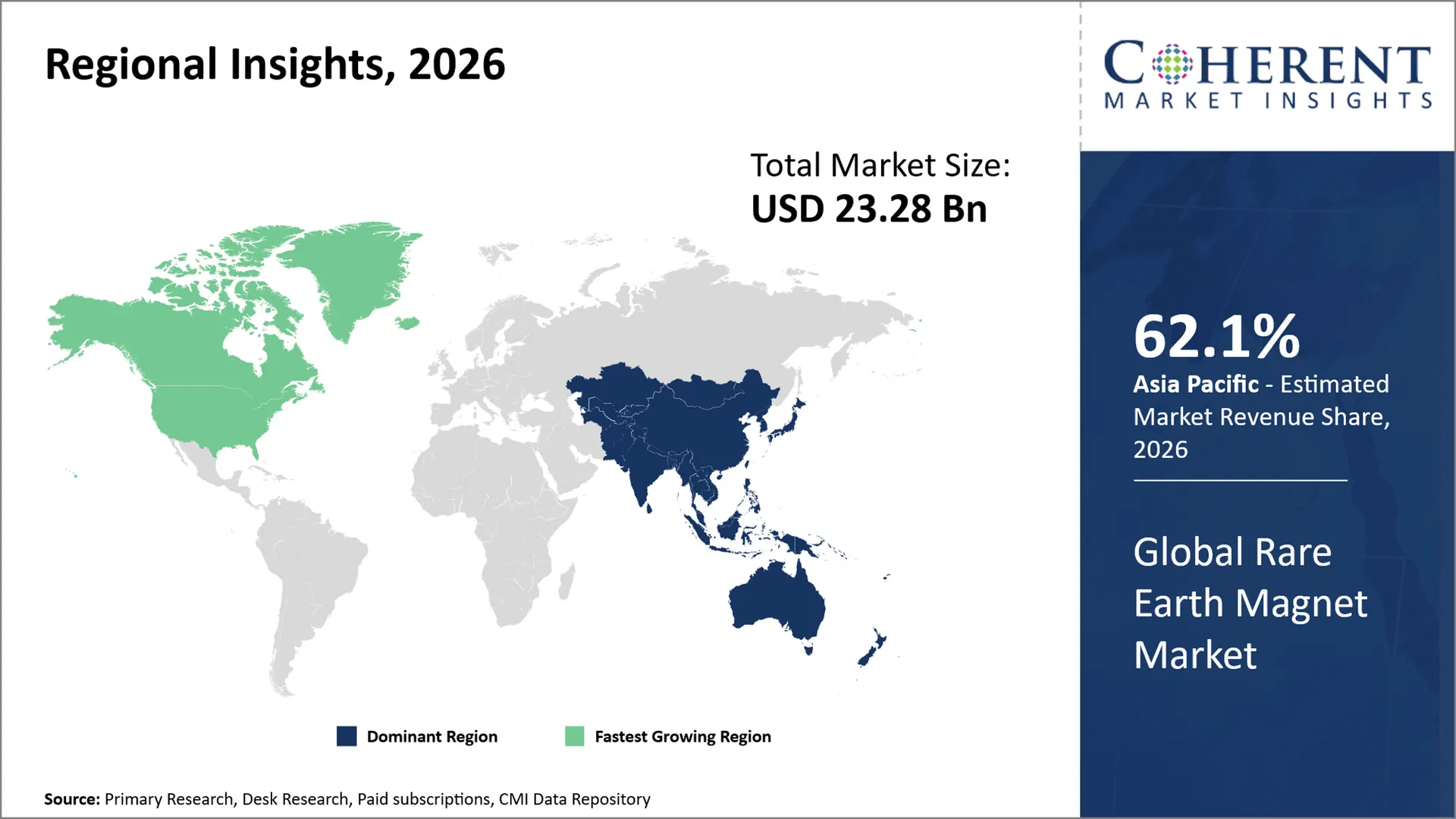
- Asia Pacific, with an estimated CAGR of 6.1%, is expected to contribute 62.1% of the global rare earth magnet market in 2026 owing to its established rare earth processing ecosystem, extensive magnet manufacturing base, and strong downstream demand from automotive and electronics sectors. In April 2025, Ministry of Commerce of the People's Republic of China implemented export controls covering several rare earth-related items, highlighting the region’s strategic role in global magnet supply chains.
- North America, with an estimated CAGR of 7.3%, is projected to account for 16.4% of the global rare earth magnet market in 2026 and record the fastest regional expansion due to investments aimed at strengthening domestic magnet production, supply security, and defense-related applications. In May 2025, USA Rare Earth signed an agreement with PolarStar Innovations for delivery of U.S.-made neodymium magnets, supporting regional manufacturing partnerships.
Segmental Insights
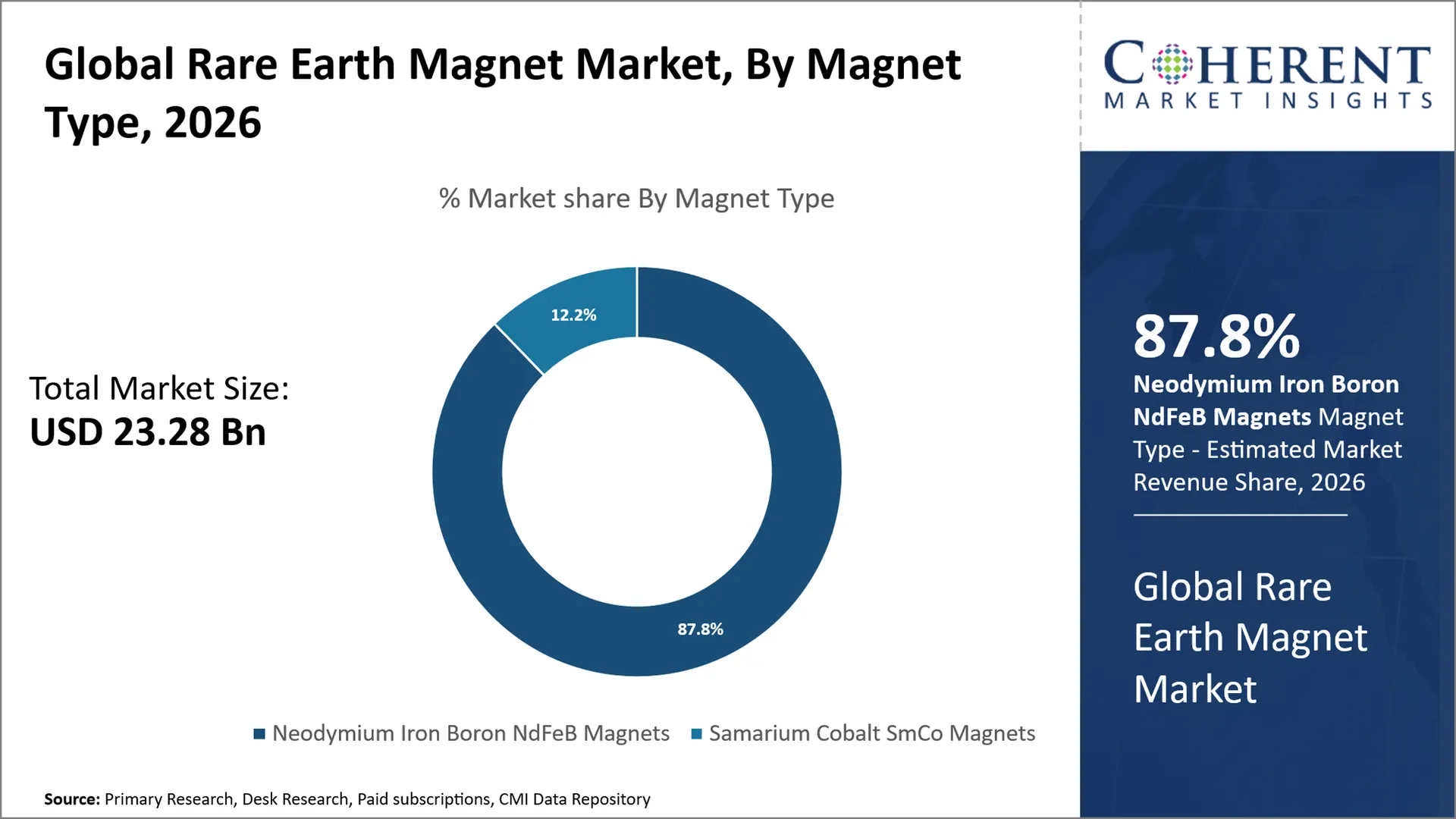
Why Do Neodymium Iron Boron (NdFeB) Magnets Dominate the Global Rare Earth Magnet Market?
Neodymium Iron Boron (NdFeB) Magnets are expected to account for 87.8% of the global rare earth magnet market in 2026 due to their exceptional magnetic strength, compact form factor, and suitability for applications requiring high power density. These magnets are preferred in electric motors, wind turbine generators, robotics, industrial automation systems, and advanced electronic devices where space efficiency and performance reliability are critical. Their commercial advantage comes from established manufacturing capabilities, availability of multiple grades, and compatibility with high-volume automotive and industrial production. Magnet producers benefit from strong demand for customized NdFeB solutions tailored to specific temperature, torque, and efficiency requirements. In February 2025, TDK Corporation announced expansion of its rare earth magnet production capabilities in Japan to strengthen supply for automotive and industrial applications, supporting continued availability of advanced NdFeB solutions.
- Current Industry Events of 2026
- Market Size Estimation
- Regional Breakdown
- Competitive Landscape
- Customer Intelligence
- Segmental Analysis
- Pricing Analysis
- Key Market Drivers, Challenges & Future Trends
- Customized Insights Section
Why Does Sintered Manufacturing Process Represent the Largest Manufacturing Category in the Global Rare Earth Magnet Market?
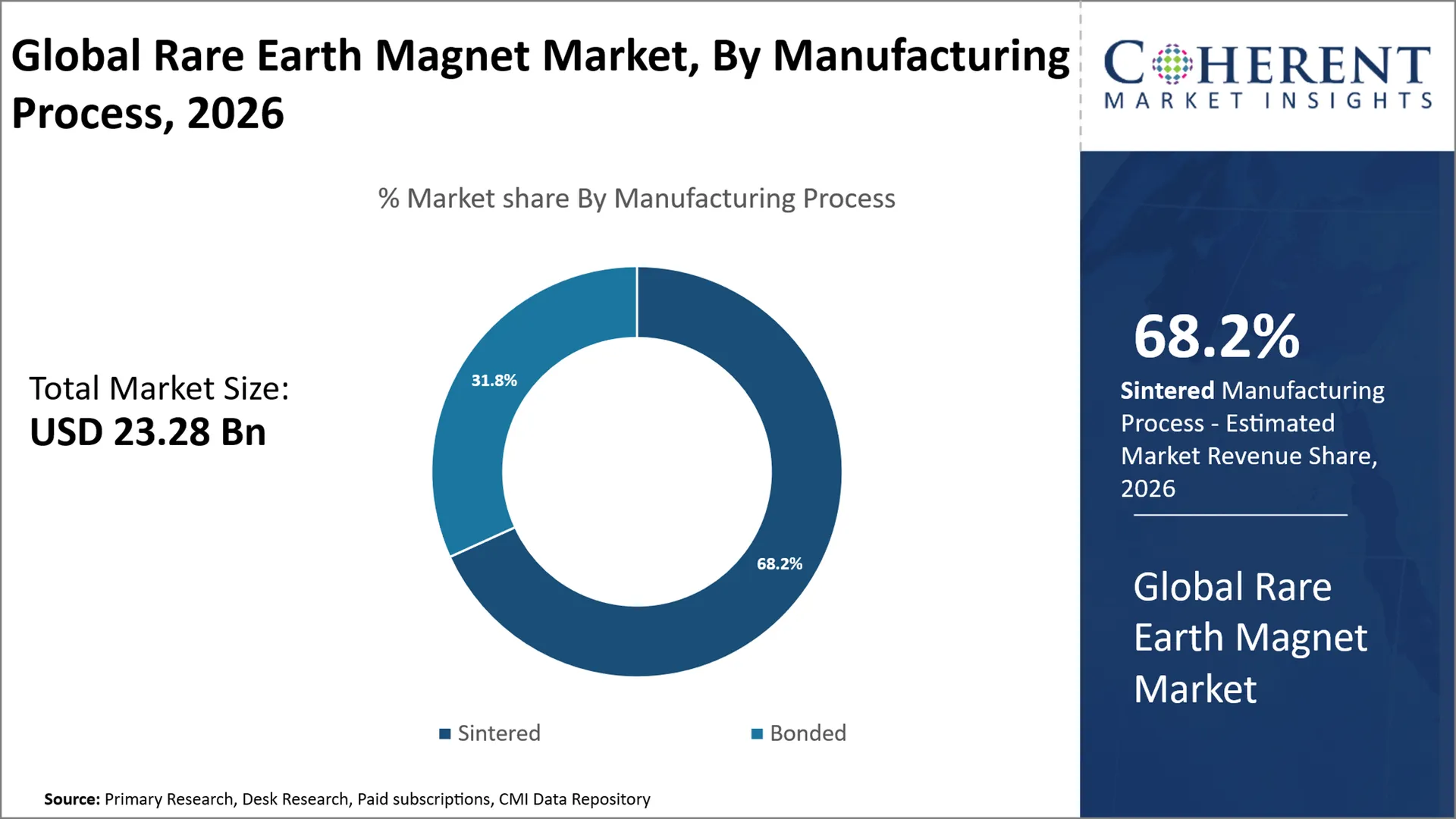
Sintered Manufacturing Process is expected to represent 68.2% of the global rare earth magnet market in 2026 because it enables production of high-performance magnets with superior magnetic energy density, structural stability, and durability for demanding applications. Unlike lower-density alternatives, sintered magnets are widely selected where maximum performance is required, particularly in traction motors, renewable energy generators, industrial drives, and precision equipment. The process allows manufacturers to produce customized magnet grades while maintaining consistency for large-scale industrial requirements. Automotive suppliers, energy equipment manufacturers, and industrial machinery companies increasingly prioritize reliable magnetic components that support efficiency improvements and compact system designs. In August 2024, the European Commission launched the European Raw Materials Alliance initiatives focused on strengthening critical raw material value chains, supporting technologies such as advanced permanent magnet manufacturing within Europe.
Why Does Automotive Dominate the End Use Industry Segment of the Global Rare Earth Magnet Market?
Automotive End Use Industry is expected to hold 38.4% of the global rare earth magnet market in 2026 as vehicle manufacturers increasingly integrate permanent magnets into electric motors, hybrid powertrains, steering systems, braking technologies, and auxiliary electrical components. The segment benefits from automotive manufacturers’ focus on improving vehicle efficiency, reducing motor weight, and increasing performance reliability. Rare earth magnets enable compact motor designs that support electrification strategies across passenger vehicles, commercial vehicles, and mobility platforms. Suppliers that can provide automotive-grade magnets with consistent quality, thermal resistance, and long-term reliability gain stronger relationships with OEMs and Tier-1 component manufacturers. In September 2025, BMW Group highlighted continued development of electric drivetrain technologies as part of its Neue Klasse vehicle platform, supporting demand for advanced motor components and magnetic materials.
Current Events and their Impact
Current Event | Description and Its Impact |
April 2025 – China Ministry of Commerce expanded export controls on selected rare earth-related materials |
|
February 2025 – European Commission Critical Raw Materials Act implementation activities |
|
May 2025 – U.S. Department of Defense initiatives for domestic critical mineral resilience |
|
Global Rare Earth Magnet Market Dynamics
Key Market Drivers
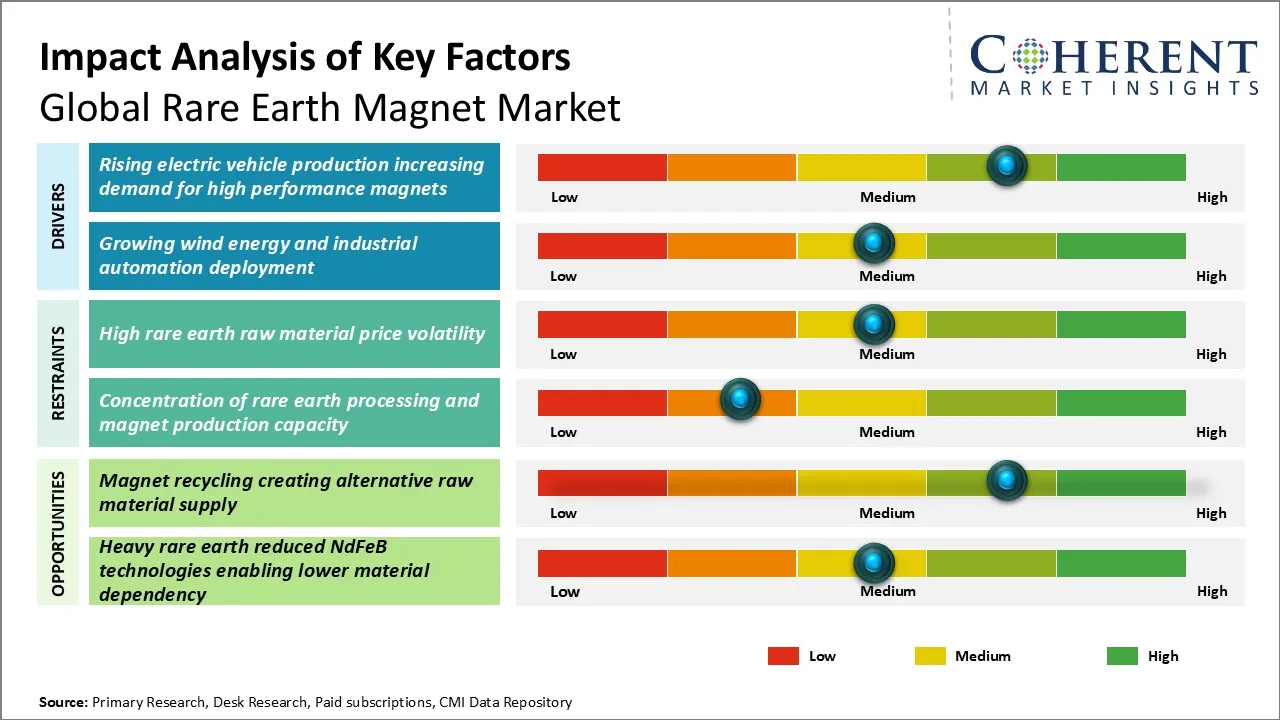
- Expansion of Electric Mobility Increasing Adoption of High-Performance Permanent Magnets: Electric vehicle manufacturing is strengthening the requirement for rare earth magnets because traction motors rely on high-energy-density NdFeB solutions to achieve compact designs, improved efficiency, and extended driving performance. Automotive OEMs, electric motor manufacturers, and magnet suppliers benefit from this transition as vehicle electrification increases demand for customized magnetic assemblies. In March 2025, the U.S. Department of Energy announced funding initiatives supporting domestic critical material supply chains, including materials required for electrification technologies, improving investment confidence among magnet ecosystem participants.
- Renewable Energy and Industrial Automation Creating Demand for Advanced Magnetic Systems: Wind turbine generators, robotics, factory automation equipment, and precision industrial machinery increasingly require reliable permanent magnets for efficient power conversion and motion control systems. This driver benefits magnet producers, equipment manufacturers, and industrial technology providers by creating demand for high-performance magnetic grades with improved thermal stability and operational durability. In February 2025, the International Energy Agency highlighted continued expansion of clean energy technologies requiring critical minerals, reinforcing the strategic importance of secure rare earth material availability for energy infrastructure.
Emerging Market Trends
- Development of Low-Rare-Earth and Rare-Earth-Free Magnet Alternatives: Manufacturers are increasingly exploring reduced-rare-earth formulations and alternative magnetic materials to address supply-chain concentration, material costs, and sustainability concerns. This trend is influencing research priorities among magnet producers, automotive suppliers, and industrial equipment companies seeking performance optimization with lower dependency on constrained elements. Over the forecast period, companies with advanced material development capabilities, recycling expertise, and scalable manufacturing processes are likely to gain strategic advantages, while suppliers dependent on conventional material pathways may face pressure from evolving procurement preferences.
- Increasing Integration of Recycling and Circular Supply Chains for Magnetic Materials: Circular economy practices are becoming more relevant as industries evaluate methods to recover rare earth elements from end-of-life electric motors, wind turbines, and electronic equipment. This trend is reshaping sourcing strategies by encouraging collaboration between recyclers, manufacturers, and downstream users to create secondary material streams. Companies capable of integrating recovery technologies, material separation processes, and traceable supply systems may strengthen supply resilience, while traditional linear supply chains could experience greater scrutiny regarding resource efficiency and environmental performance.
Regional Insights
Why Does Asia Pacific Dominate the Global Rare Earth Magnet Market?
Asia Pacific is expected to account for 62.1% of the global rare earth magnet market in 2026 due to its integrated rare earth mining, refining, alloy production, and permanent magnet manufacturing ecosystem. The region benefits from large-scale electric vehicle production, renewable energy installations, electronics manufacturing, and industrial automation deployment, creating strong downstream consumption for NdFeB and other high-performance magnets. China remains central to regional supply capabilities, while Japan and South Korea contribute advanced material technologies and precision manufacturing expertise. Automotive electrification, robotics expansion, and localized component sourcing strategies continue to strengthen regional demand. In March 2025, Japan’s Ministry of Economy, Trade and Industry announced additional measures to strengthen critical mineral supply-chain resilience through international cooperation and domestic capability development, supporting long-term rare earth material security across Asia Pacific.
Why Is North America Emerging as the Fastest-Growing Region in the Global Rare Earth Magnet Market?
North America is projected to represent 16.4% of the global rare earth magnet market in 2026 and is expected to record the fastest regional growth as governments and industries prioritize localized magnet supply chains. The region’s expansion is supported by increasing electric vehicle manufacturing, renewable energy deployment, defense-related applications, and investments aimed at reducing dependence on imported magnetic materials. The presence of automotive OEMs, clean energy equipment manufacturers, and advanced technology companies creates demand for domestically available high-performance magnets. In October 2025, the U.S. Department of Energy announced continued support for critical materials research and domestic supply-chain development through its Critical Materials Collaborative initiative, strengthening innovation capabilities across the rare earth ecosystem.
Global Rare Earth Magnet Market Outlook for Key Countries
Why Is the U.S. a Key Market for the Global Rare Earth Magnet Market?
The U.S. is becoming an important market for rare earth magnets due to expanding electric vehicle production, defense applications, renewable energy equipment manufacturing, and efforts to establish domestic critical mineral capabilities. Automotive manufacturers and technology companies require reliable access to high-performance magnets for electric motors, sensors, generators, and advanced electronic systems. The country’s strategic focus on supply-chain security is encouraging investments across mining, processing, recycling, and magnet manufacturing activities. Aerospace and defense applications further strengthen demand for specialized magnetic materials requiring strict quality standards. In June 2025, the U.S. Department of Defense announced initiatives supporting domestic critical mineral processing capabilities to strengthen national supply-chain resilience, reinforcing the importance of localized rare earth magnet production.
Why Is China Important in the Global Rare Earth Magnet Market?
China plays a central role in the global rare earth magnet market due to its extensive rare earth processing infrastructure, established magnet manufacturing capacity, and strong downstream industries. The country benefits from a complete supply chain covering raw material processing, alloy preparation, magnet fabrication, and component manufacturing. Large-scale electric vehicle production, wind power installations, consumer electronics manufacturing, and industrial automation equipment continue to support domestic magnet consumption. Chinese manufacturers also maintain strong export capabilities, supplying magnetic components to multiple global industries. In July 2025, China’s Ministry of Industry and Information Technology outlined initiatives supporting high-quality development of rare earth-related industries, emphasizing resource efficiency, technological improvement, and industrial upgrading.
Why Is Japan a Strategic Country in the Global Rare Earth Magnet Market?
Japan remains strategically important in the rare earth magnet market due to its advanced material science capabilities, precision manufacturing expertise, and strong presence in automotive, electronics, and industrial equipment supply chains. Japanese companies have historically contributed to high-performance magnet development, particularly for applications requiring reliability, miniaturization, and thermal stability. The country’s automotive transition toward electrified vehicles and continued investment in energy-efficient technologies create demand for specialized magnetic solutions. Japan also emphasizes supply diversification and recycling technologies to strengthen resource security. In April 2025, Japan’s New Energy and Industrial Technology Development Organization (NEDO) continued programs supporting research into efficient utilization of critical materials, contributing to innovation across rare earth-related technologies.
Global Rare Earth Magnet Market Outlook for Key Countries
Why Is South Korea Important in the Global Rare Earth Magnet Market?
South Korea is an important market for rare earth magnets due to its strong automotive manufacturing base, advanced electronics industry, battery ecosystem, and increasing focus on electric mobility technologies. The country’s major automotive and industrial equipment manufacturers require high-performance magnets for electric motors, power systems, automation equipment, and precision components. South Korea also has strong capabilities in semiconductor manufacturing and consumer electronics, where compact magnetic components support advanced devices and industrial applications. Government initiatives focused on critical mineral security and supply-chain diversification are encouraging domestic companies to strengthen access to rare earth materials. In February 2025, South Korea’s Ministry of Trade, Industry and Energy announced measures to expand critical mineral supply-chain cooperation and strengthen domestic resilience, supporting long-term development of rare earth-related industries.
Why Is Germany a Strategic Country in the Global Rare Earth Magnet Market?
Germany holds strategic importance in the rare earth magnet market due to its globally recognized automotive manufacturing sector, industrial automation expertise, and advanced engineering ecosystem. The country’s transition toward electric vehicles, efficient industrial machinery, and renewable energy technologies is increasing the importance of reliable permanent magnet solutions. German automotive suppliers and industrial equipment manufacturers require customized magnetic components that meet strict performance, quality, and sustainability requirements. The country’s strong emphasis on circular economy practices and responsible sourcing is also encouraging innovation in rare earth material management. In January 2025, the German Federal Ministry for Economic Affairs and Climate Action highlighted initiatives supporting resilient industrial supply chains for critical raw materials, reinforcing the need for secure access to materials essential for advanced manufacturing.
Why Is Brazil an Important Growth Market for the Global Rare Earth Magnet Market?
Brazil represents an emerging opportunity in the rare earth magnet market due to its growing industrial base, renewable energy potential, and strategic interest in developing critical mineral resources. The country possesses significant mineral resources and has increasing relevance in global discussions around diversification of rare earth supply chains. Expansion of wind energy projects, industrial equipment demand, and electrification initiatives may create future opportunities for magnetic material applications. Brazil’s role is particularly relevant for upstream resource development and regional supply-chain participation rather than large-scale magnet manufacturing currently. In May 2025, Brazil’s Ministry of Mines and Energy highlighted policies supporting strategic mineral development and value-chain advancement, strengthening attention toward critical minerals required for future industrial technologies.
Innovation, Production & Manufacturing Landscape
Technology | Description | Commercial Impact | Key Adoption Areas |
Advanced Sintered NdFeB Manufacturing | High-precision powder metallurgy processes enable production of NdFeB magnets with enhanced magnetic performance, improved grain control, and optimized heavy rare earth utilization. | Supports premium magnet production where compact size, high torque density, and thermal stability are critical. | Electric vehicle motors, wind generators, robotics, industrial drives |
Grain Boundary Diffusion Technology | A manufacturing approach that introduces elements such as dysprosium or terbium selectively into magnet structures to improve coercivity while reducing overall rare earth usage. | Helps manufacturers balance performance requirements with material cost management and supply availability. | High-temperature motors, aerospace systems, automotive applications |
Magnet Recycling and Rare Earth Recovery Technologies | Advanced separation, hydrogen processing, and chemical recovery methods are being developed to extract rare earth elements from end-of-life magnets. | Creates secondary raw material streams and reduces dependence on primary mining networks. | EV motors, electronic waste, industrial equipment recovery |
Bonded Magnet Production Technologies | Polymer-bonded magnetic materials combine magnetic powders with binders to enable flexible shapes, lightweight designs, and efficient manufacturing. | Enables customized components with lower machining requirements and supports miniaturized applications. | Consumer electronics, sensors, automotive components |
Rare-Earth Lean Magnet Development | Material engineering approaches aim to reduce dependence on critical rare earth elements while maintaining acceptable magnetic properties. | May reduce exposure to raw material volatility and support sustainable product strategies. | Industrial motors, energy-efficient equipment, emerging mobility systems |
Digital Manufacturing and Quality Control Systems | Data-driven manufacturing uses automation, process monitoring, and advanced inspection methods to improve consistency and reduce production losses. | Enhances yield, traceability, and scalability for magnet producers competing in specialized markets. | Large-scale magnet manufacturing facilities, automotive supply chains |
How Are Magnetic Recycling and Circular Supply Chains Creating New Growth Opportunities in the Global Rare Earth Magnet Market?
Magnetic recycling represents an emerging opportunity as industries seek alternative sources of rare earth materials while managing supply-chain risks. End-of-life electric motors, wind turbines, industrial equipment, and electronic devices contain recoverable magnetic materials that can support secondary production channels. Companies developing efficient collection networks, separation technologies, and recycled magnet manufacturing capabilities can create differentiated offerings for sustainability-focused customers. The opportunity is particularly relevant for automotive suppliers, recycling specialists, and integrated magnet manufacturers seeking greater control over raw material availability. Commercial success will require investment in dismantling infrastructure, processing expertise, quality certification, and partnerships across the value chain. Established producers with manufacturing knowledge may benefit from integration, while specialized recycling companies can capture value through advanced recovery technologies and localized supply models.
Market Players, Key Development, and Competitive Intelligence
Key Developments
- In June 2025, VACUUMSCHMELZE (VAC) announced developments related to advanced magnetic materials and solutions for electrification-focused applications. This is important for the global rare earth magnet market because specialized magnetic solutions support next-generation electrical systems, power electronics, and industrial applications requiring reliable performance under demanding operating conditions.
- In February 2025, Hitachi Metals (Proterial Ltd) highlighted continued advancement of high-performance magnetic materials and manufacturing technologies for mobility and industrial applications. This is important for the global rare earth magnet market because improved material engineering capabilities enable customers to achieve higher efficiency and durability in demanding applications, strengthening competition among specialized magnet suppliers.
- In January 2025, Shin-Etsu Chemical Co., Ltd announced expansion initiatives for its rare earth magnet production capabilities to strengthen supply reliability for automotive and industrial applications. This development is important for the global rare earth magnet market because Shin-Etsu’s integrated material capabilities support high-performance magnet availability for electric vehicle motors, industrial equipment, and energy-efficient technologies.
Competitive Landscape
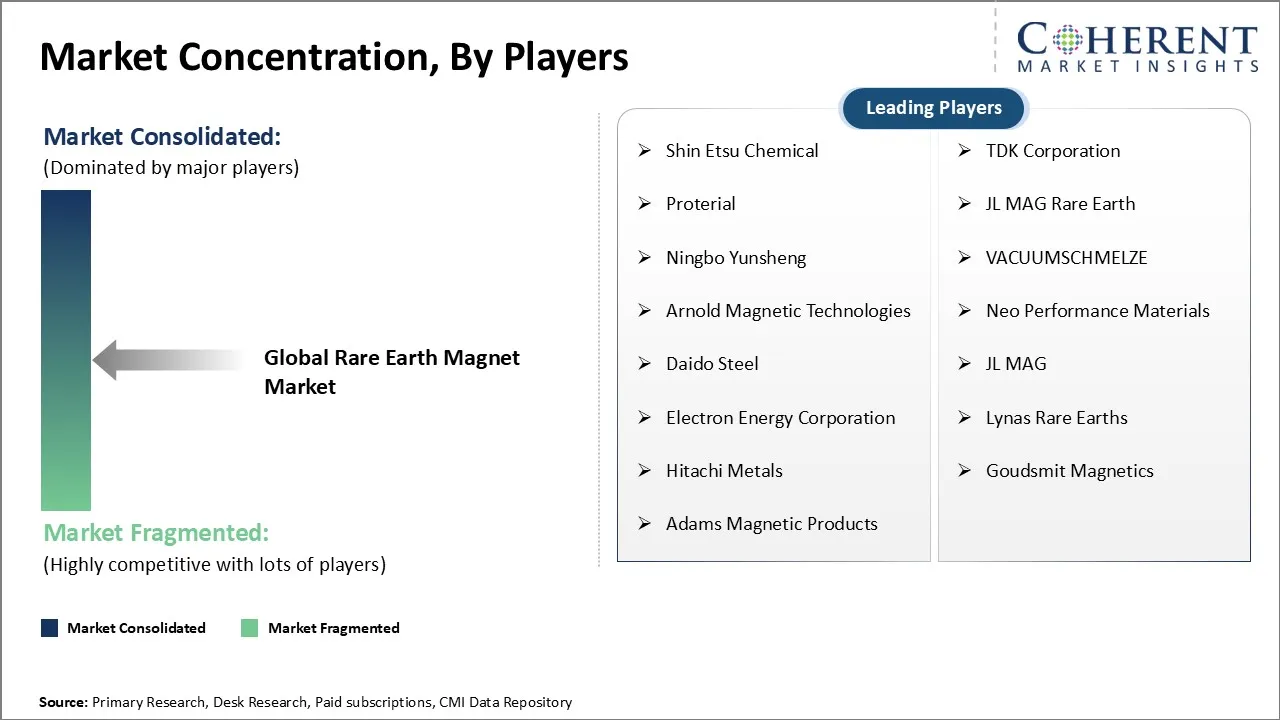
The global rare earth magnet market is moderately consolidated, with competition concentrated among integrated magnet manufacturers, rare earth processors, and specialized material technology companies. Market positioning depends on magnetic performance, manufacturing reliability, supply-chain control, customization capability, and long-term customer relationships. Regional suppliers are increasingly strengthening capabilities as automotive, energy, and industrial customers seek diversified sourcing options beyond traditional supply networks.
Key focus areas include
- Magnetic Performance and Product Customization: Manufacturers compete through higher energy density, improved temperature resistance, and application-specific magnet designs.
- Manufacturing Capacity and Supply Reliability: Consistent production capabilities and secure raw material availability remain essential for meeting large industrial customer requirements.
- Rare Earth Material Integration: Companies with integrated upstream processing and magnet manufacturing capabilities can improve supply-chain control and reduce material availability risks.
- Technology Efficiency and Process Optimization: Advanced manufacturing processes help improve production yield, minimize material waste, and enhance cost competitiveness.
- Quality Standards and Customer Qualification: Automotive, aerospace, and industrial buyers prioritize suppliers with strict validation processes and reliable long-term performance.
- Recycling and Circular Supply Chain Capabilities: Recovery and reuse of rare earth materials are becoming important competitive factors as customers focus on sustainable sourcing.
- Regional Manufacturing Presence: Localized production capabilities are gaining importance as industries seek supply security and reduced dependence on concentrated supply networks.
- Application-Specific Engineering Support: Technical collaboration with OEMs enables suppliers to develop customized magnetic solutions for complex industrial applications.
Market Report Scope
Global Rare Earth Magnet Market Report Coverage | |||
Report Coverage | Details | ||
Base Year | 2025 | Market Size in 2026: | USD 23.28 Bn |
Historical Data For: | 2020 To 2024 | Forecast Period: | 2026 To 2033 |
Forecast Period 2026 To 2033 CAGR: | 6.40% | 2033 Value Projection: | USD 35.93 Bn |
Geographies covered: |
| ||
Segments covered: |
| ||
Companies covered: | Shin Etsu Chemical, TDK Corporation, Proterial, JL MAG Rare Earth, Ningbo Yunsheng, VACUUMSCHMELZE, Arnold Magnetic Technologies, Neo Performance Materials, Daido Steel, JL MAG, Electron Energy Corporation, Lynas Rare Earths, Hitachi Metals, Goudsmit Magnetics, Adams Magnetic Products | ||
Growth Drivers: |
| ||
Restraints & Challenges: |
| ||
Analyst Opinion (Expert Opinion)
- The global rare earth magnet market is likely to move from a commodity-oriented supply model toward a capability-driven ecosystem where manufacturing expertise, material engineering, and supply-chain transparency determine competitive positioning. Future market leaders may not only sell magnets but also provide application-specific solutions, technical collaboration, and lifecycle support for OEM customers. Companies investing in integrated material capabilities, recycling pathways, and customer co-development models are likely to create stronger long-term differentiation.
- A major transformation in the rare earth magnet industry could emerge from the shift toward circular material systems. As industries become more concerned about raw material availability and supply-chain resilience, recycled rare earth inputs may gradually become a strategic resource rather than a secondary option. This shift could challenge traditional mining-dependent business models and create opportunities for companies combining recycling technology, material processing expertise, and magnet manufacturing capabilities within a single value chain.
- Market participants should prioritize improvements in material efficiency, manufacturing flexibility, and supply-chain diversification while avoiding dependence on limited sourcing channels. Automotive, renewable energy, robotics, and industrial automation customers will increasingly require reliable suppliers capable of meeting application-specific specifications. Companies should evaluate investments in recycling, regional production networks, and advanced processing capabilities while carefully managing cost pressures, technology development risks, and raw material uncertainty.
Speak to the analyst
Want personalized insights?
Take the findings above to one of our principal consultants, or have the report rebuilt around the segments, geographies and competitors you actually track.
Market Segmentation
- Magnet Type Insights (Revenue, USD Bn, 2021 - 2033)
- Neodymium Iron Boron NdFeB Magnets
- Samarium Cobalt SmCo Magnets
- Manufacturing Process Insights (Revenue, USD Bn, 2021 - 2033)
- Sintered
- Bonded
- End Use Industry Insights (Revenue, USD Bn, 2021 - 2033)
- Automotive
- Energy
- Industrial
- Consumer Electronics
- Aerospace and Defense
- Others
- Distribution Channel Insights (Revenue, USD Bn, 2021 - 2033)
- Direct Sales
- Distributors and Stockists
- Regional Insights (Revenue, USD Bn, 2021 - 2033)
- North America
- U.S.
- Canada
- Latin America
- Brazil
- Argentina
- Mexico
- Rest of Latin America
- Europe
- Germany
- U.K.
- Spain
- France
- Italy
- Russia
- Rest of Europe
- Asia Pacific
- China
- India
- Japan
- Australia
- South Korea
- ASEAN
- Rest of Asia Pacific
- Middle East
- GCC Countries
- Israel
- Rest of Middle East
- Africa
- South Africa
- North Africa
- Central Africa
- North America
Sources
Primary Research Interviews
- Rare earth magnet manufacturers, NdFeB and SmCo magnet producers, sintered and bonded magnet manufacturers
- Electric vehicle OEMs, automotive component suppliers, motor manufacturers, and industrial equipment companies
- Wind turbine manufacturers, renewable energy developers, robotics companies, and automation solution providers
- Magnet distributors, raw material suppliers, rare earth processors, and recycling technology providers
- Procurement managers, sourcing specialists, R&D engineers, and technical experts involved in magnetic material applications
Stakeholders
- Rare earth mining companies, refining companies, and permanent magnet manufacturers
- NdFeB and SmCo magnet suppliers, alloy producers, and magnetic component manufacturers
- Automotive OEMs, EV manufacturers, Tier-1 suppliers, and electric motor producers
- Renewable energy companies, wind turbine manufacturers, and power generation equipment suppliers
- Electronics manufacturers, industrial automation companies, robotics providers, and defense contractors
- Recycling companies, material recovery specialists, and circular economy solution providers
End-use Industries
- Automotive and electric vehicles
- Renewable energy and wind power generation
- Industrial automation and machinery
- Consumer electronics and electrical equipment
- Aerospace and defense systems
- Robotics and precision equipment
Regulatory and Industry Bodies
- International Energy Agency IEA
- U.S. Department of Energy DOE
- European Commission Critical Raw Materials initiatives
- International Renewable Energy Agency IRENA
- China Ministry of Industry and Information Technology MIIT
- Japan Ministry of Economy Trade and Industry METI
- National critical minerals and rare earth regulatory authorities
Databases
- Company annual reports and investor presentations
- Rare earth production and trade databases
- Mineral commodity and critical material databases
- Automotive production and electric vehicle adoption databases
- Renewable energy installation databases
- Import export trade flow datasets
- Magnet manufacturing capacity and supplier databases
Magazines and Journals
- IEEE Magnetics Society publications
- Journal of Magnetism and Magnetic Materials
- Materials Today
- Mining Journal
- Metal Bulletin
- Engineering and technology industry publications
Associations
- International Energy Agency IEA
- International Renewable Energy Agency IRENA
- Rare Earth Industry Association REIA
- Institute of Electrical and Electronics Engineers IEEE
- Critical Minerals Association
- Regional automotive, renewable energy, and advanced manufacturing associations
Public Domain Sources
- Rare earth element production and supply-chain updates
- Permanent magnet manufacturing developments
- Electric vehicle and renewable energy industry trends
- Critical mineral policy updates
- Magnet recycling and circular economy developments
- Industrial automation and robotics adoption trends
- Trade regulations and export control updates
Key Standards and Regulations
- Rare earth material classification and reporting standards
- Permanent magnet performance testing standards
- Automotive component quality and qualification requirements
- Critical mineral supply-chain compliance requirements
- Environmental and workplace safety regulations for magnet production
- Responsible sourcing and recycling guidelines
Proprietary Elements
- CMI Data Analytics Tool
- Proprietary CMI repository containing 10+ years of critical minerals, rare earth materials, permanent magnet manufacturing, automotive electrification, renewable energy, industrial automation, supply-chain intelligence, and advanced materials market insights.
Get access to 250+ pages report
Every segment, forecast, competitor profile and data table behind the analysis above — available for instant download.
- ESOMAR Member
- ISO 9001:2015 Certified
- D-U-N-S Registered
- GDPR & CCPA Compliant
Frequently Asked Questions
The CAGR of global rare earth magnet market is projected to be 6.40% from 2026 to 2033.
The global rare earth magnet market is estimated to be valued at USD 23.28 Bn in 2026 and is expected to reach USD 35.93 Bn by 2033.
The growth of the global rare earth magnet market is primarily driven by increasing electric vehicle production, which is accelerating demand for high-performance permanent magnets used in traction motors and advanced mobility systems.
High rare earth raw material price volatility and Concentration of rare earth processing and magnet production capacity are the major factors hampering the growth of global rare earth magnet market.
In terms of magnet type, neodymium iron boron NdFeB magnets is estimated to dominate the market revenue share in 2026.
Shin Etsu Chemical, TDK Corporation, Proterial, JL MAG Rare Earth, Ningbo Yunsheng, VACUUMSCHMELZE, Arnold Magnetic Technologies, Neo Performance Materials, Daido Steel, JL MAG, Electron Energy Corporation, Lynas Rare Earths, Hitachi Metals, Goudsmit Magnetics, Adams Magnetic Products are the major players.
Asia Pacific is expected to lead the global rare earth magnet market in 2026.