

Global Reactive PU Flame Retardants Market Size and Forecast – 2026 To 2033
The global reactive PU flame retardants market is expected to grow from USD 1.15 Bn in 2026 to USD 1.75 Bn by 2033, registering a compound annual growth rate (CAGR) of 4.1% from 2026 to 2033. The global reactive PU flame retardants market is driven by expansion of fire-resistant automotive interior materials. On May 28, 2025, Huntsman launched a new intumescent polyurethane coating system developed for automotive applications. POLYRESYST EV5005 polyurethane coating system has been developed to help protect structural integrity and improve fire protection in battery cells, a key challenge in the automotive industry.
Key Takeaways of the Global Reactive PU Flame Retardants Market
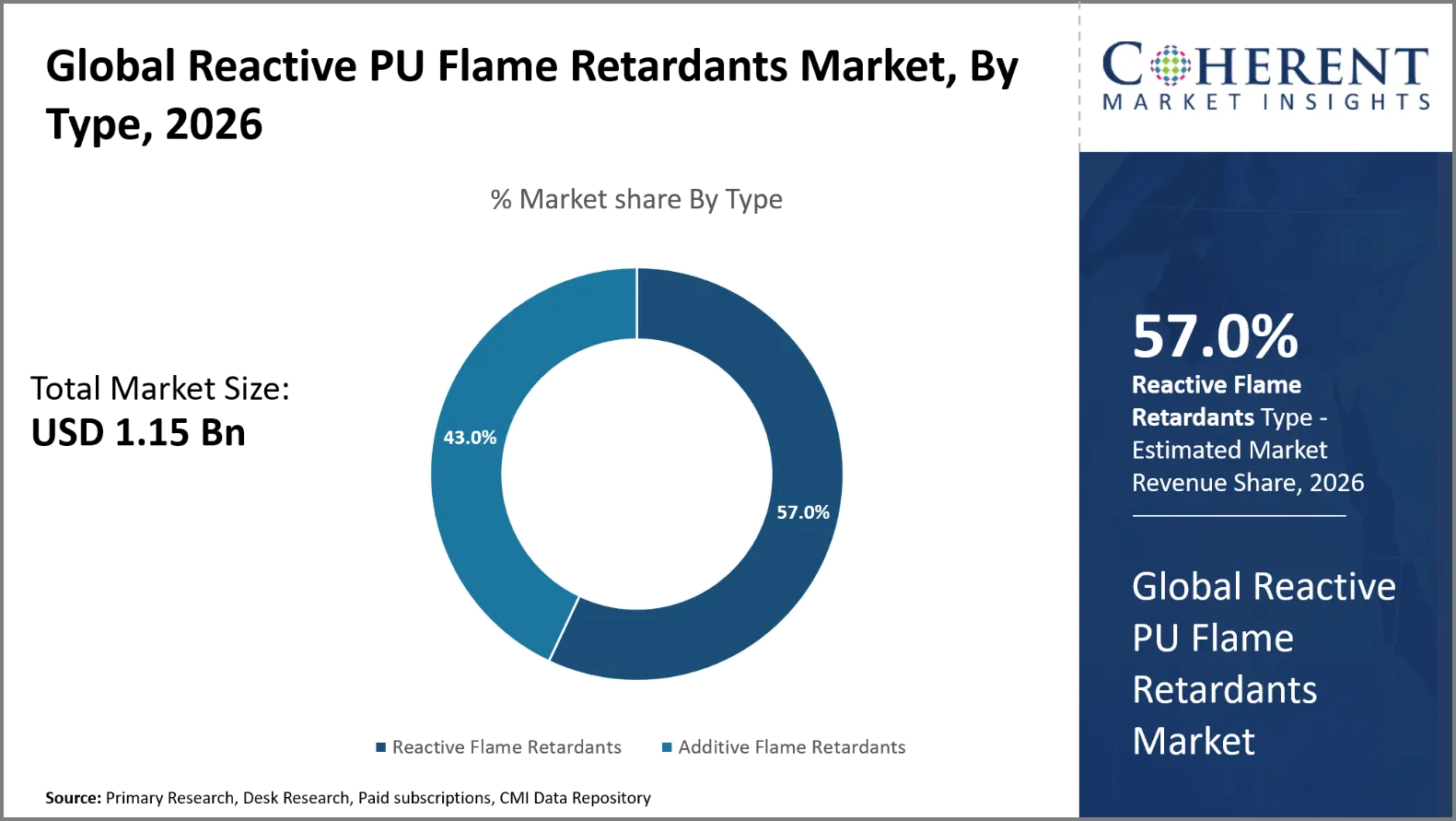
- The Reactive Flame Retardants segment is expected to account for 57.0% of the global reactive PU flame retardants market share in 2026. Increasing adoption of polyurethane in electrical equipment is driving the growth of the segment. On January 20, 2026, Henkel launched Loctite STYCAST US 8000 A/B. The two-component polyurethane potting compound targets industrial and power electronics assemblies.
- The Phosphorus-Based Reactive Flame Retardants segment is estimated to capture 44.0% of the market share in 2026. Growing demand for safer construction insulation materials is majorly driving the growth of the segment. On March 13, 2025, Knauf introduced Thane OpTTI roof insulation. The product incorporates a flame-retardant rigid polyurethane PIR foam core with aluminum-kraft composite facings.
- The Liquid segment is estimated to capture 52.0% of the market share in 2026. Increasing demand for flame-retardant electrical components is majorly driving the growth of the segment. On September 28, 2026, Avient Corporation launched Nymax FR REC. The recycled polyamide grades incorporate 42%-77% post-industrial recycled content.
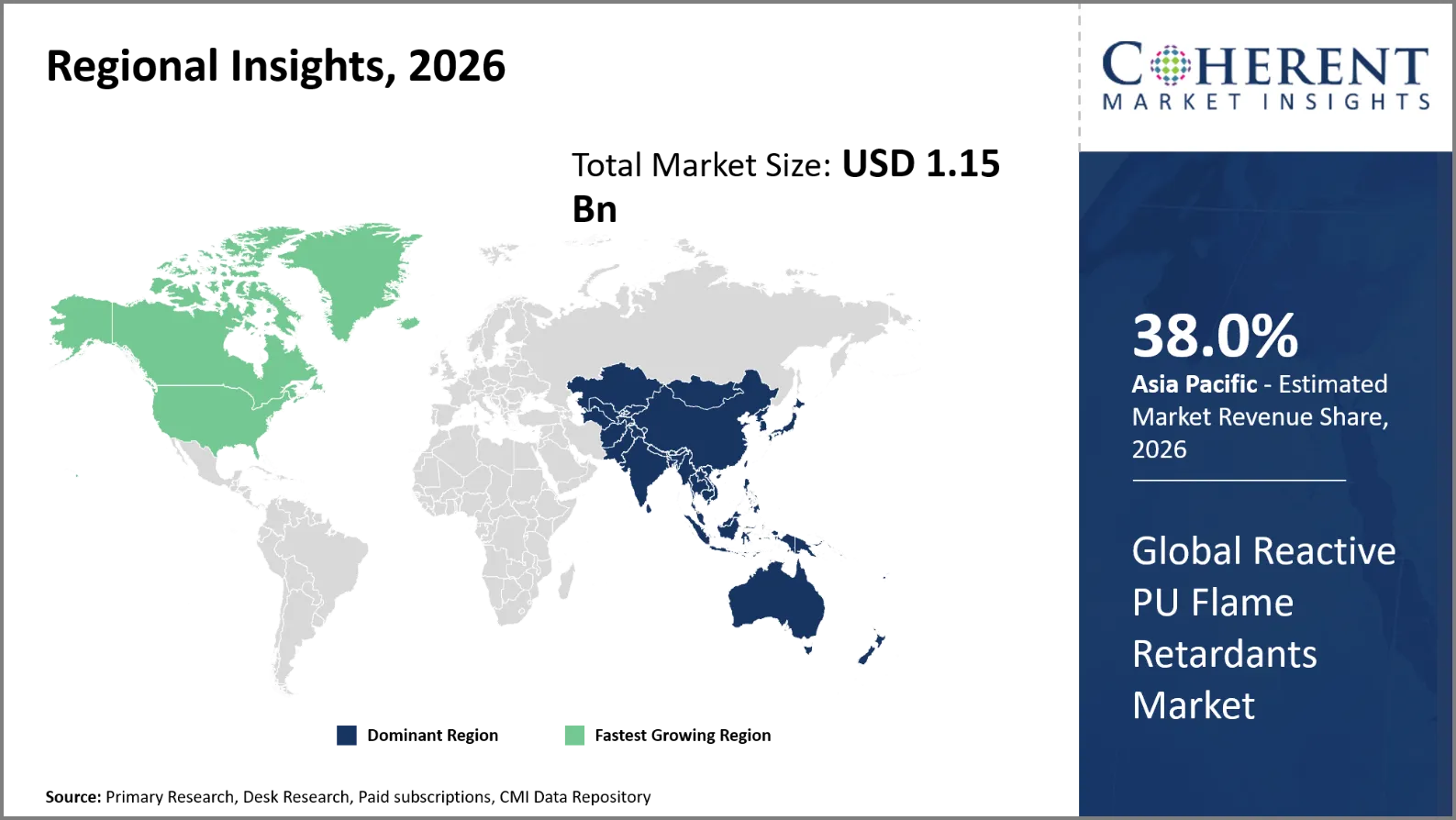
- Asia Pacific is expected to dominate the reactive PU flame retardants market in 2026 with a market share of 38.0%. Increasing demand for durable flame-retardant polyurethane formulations in Asia Pacific is driving the growth of the regional market.
- North America is expected to account for 24.0% share in 2026 and is projected to record the fastest growth over the forecast period. Growing emphasis on low-migration flame-retardant chemistry in North America is driving the growth of the regional market.
Segmental Insights
Why Does Reactive Flame Retardants Dominate the Global Reactive PU Flame Retardants Market?
The reactive flame retardants segment is expected to account for 57.0% of the global reactive PU flame retardants market share in 2026. Reactive flame retardants dominate because they become chemically integrated into polyurethane polymer structures during manufacturing. The covalent bonding decreases the migration, leaching and chemical loss during long-term product use. This incorporation enhances flame-retardant longevity while keeping material performance. Furthermore, reactive formulations are more compatible with polyurethane matrices than conventional additives. Incorporating them can reduce negative impacts on mechanical qualities. Rising need for robust, low emission and halogen-free polyurethane materials further boosts adoption. Such benefits enhance the advantages they offer for building, automotive, furniture and insulation applications.
On September 22, 2026, LANXESS announced the introduction of Purventis, a new platform for flame-retardant insulating material solutions. The first commercial product under the platform is Purventis Core, a reactive halogen-free phosphorus flame retardant for rigid polyurethane (PU) and polyisocyanurate (PIR) insulation foams.
- Current Industry Events of 2026
- Market Size Estimation
- Regional Breakdown
- Competitive Landscape
- Customer Intelligence
- Segmental Analysis
- Pricing Analysis
- Key Market Drivers, Challenges & Future Trends
- Customized Insights Section
Why is Phosphorus-Based Reactive Flame Retardants the Most Crucial Chemistry?
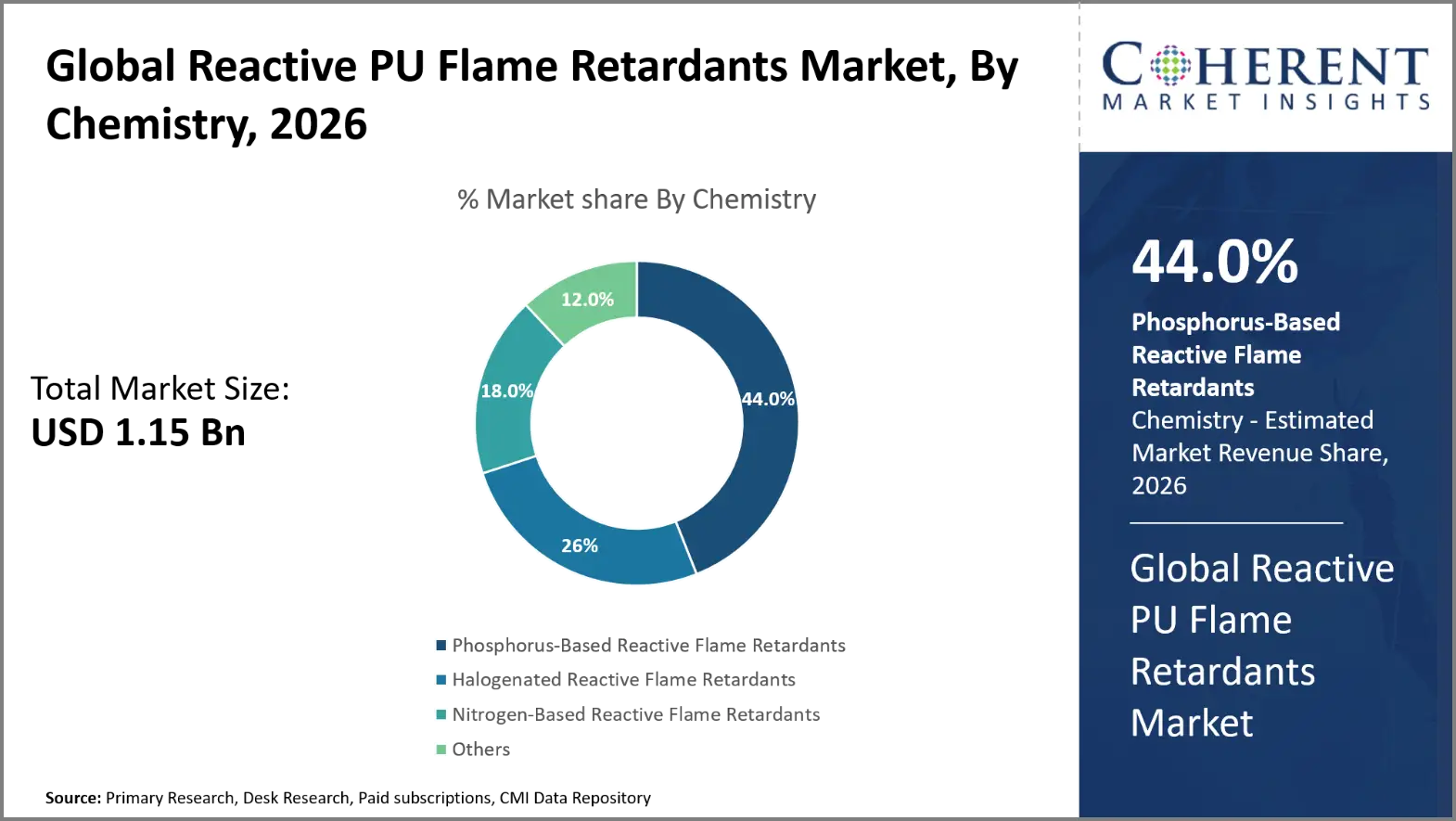
The phosphorus-based reactive flame retardants segment is expected to account for 44.0% of the global reactive PU flame retardants market share in 2026. Phosphorus-based reactive flame retardants are important because they provide efficient fire protection by several combustion-control methods. They encourage the development of a protective char that restricts heat transfer and the emission of flammable gasses. Some phosphorus compounds also form phosphorus containing radicals, which inhibit the combustion reactions. Their chemical incorporation enhances the retention of flame retardants in the structures of polyurethanes. The use of halogen-free formulations further aids their adoption in applications with high environmental criteria. The growing interest in sustainable polyurethane materials is driving the need for phosphorus-containing polyols. These qualities make phosphorus chemistry very relevant in rigid and flexible polyurethane foams.
On February 6, 2026, the product information for Clariant’s Exolit OP 552 was updated. The non-halogenated phosphorus polyol is for flexible polyurethane foams. Its reactive reactivity allows it to become incorporated in the polyurethane matrix, thus minimizing flame retardant migration. Clariant identifies automotive slabstock and molded foam as application areas.
Liquid Dominates the Global Reactive PU Flame Retardants Market
The liquid segment is expected to account for 52.0% of the global reactive PU flame retardants market share in 2026. Liquid reactive flame retardants dominate because polyurethane manufacturing relies heavily on liquid polyol and isocyanate formulations. Liquid products offer the convenience of blending, precision dosage and equal dispersion within polyurethane combinations. Compatibility with existing processing equipment means less need for formulation tweaks and less manufacturing complexity. Liquid phosphorus polyols can directly engage in polyurethane chemical processes. This incorporation enhances consistency in formulation and preservation of flame retardant. easy handling for manufacturers and flexible formulation creation. The growing need for high-performance polyurethane foams also favor the use of liquid reactive flame-retardants.
On January 6, 2025, ICL announced the launch of VeriQuel R100, a reactive phosphorus flame retardant for rigid polyurethane insulation. The formulation is chemically bonded into the polyurethane matrix to provide long-term flame-retardant retention and reduce migration. ICL said it was compatible with existing manufacturing techniques allowing insulation makers to avoid major modifications in formulation.
Current Events and their Impact
Current Events | Description and its Impact |
U.S. - Toxic Substances Control Act (TSCA) 15 U.S.C. § 2601 et seq. |
|
European Union – REACH Regulation (EC) No 1907/2006 Regulation (EC) No 1907/2006 |
|
Reactive PU Flame Retardants Market Dynamics
Market Drivers
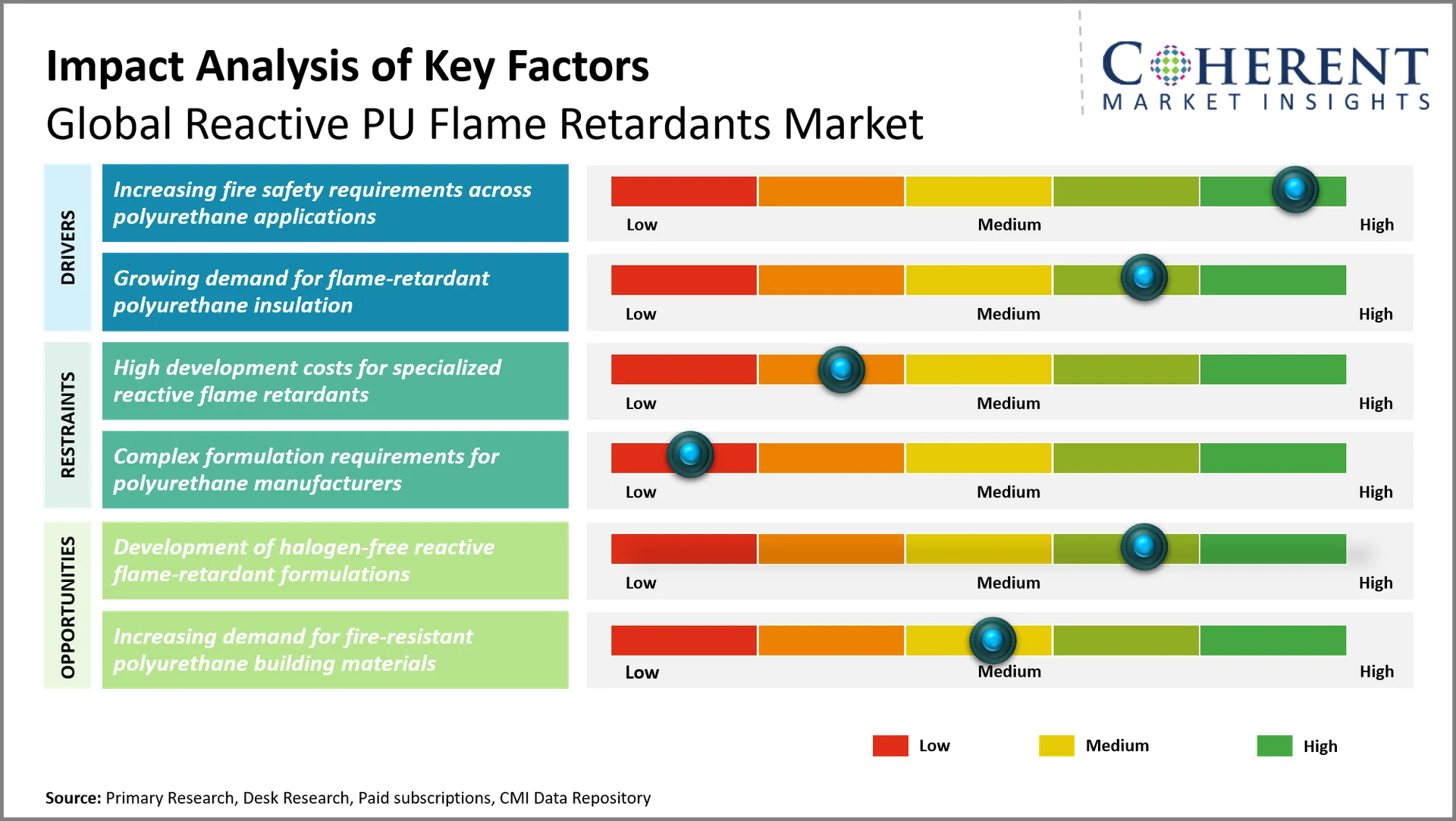
- Increasing fire safety requirements across polyurethane applications: Increasing fire safety requirements throughout the uses of polyurethane are reinforcing the demand for reactive flame retardants. Fire resistance is an ever more important component of building regulations and product safety standards for construction materials, furniture, car interiors, and electrical equipment. Some polyurethane foam formulations may lead to rapid fire spread, therefore flame protection must be effective. Manufacturers are looking at reactive flame-retardant technology to enhance combustion resistance and minimize chemical migration. These solutions provide permanent flame protection through chemical incorporation into polymer matrices. There’s also increased regulatory scrutiny pushing producers to develop safer, compliant polyurethane formulas.
- On April 2, 2025, ROCKWOOL launched its Smartrock interior insulation technology. The system combines stone wool insulation with a clever vapor retarder. ROCKWOOL emphasized its Class A surface-burning performance under ASTM E84. The insulation is also non-combustible per applicable building code regulations.
- Growing demand for flame-retardant polyurethane insulation: Increasing demand for flame-retardant polyurethane insulation is driving market growth in construction, industrial facilities, and transportation infrastructure. The advantages of polyurethane insulation are thermal efficiency, lightweight structure and space-saving installation. However, fire performance is still a crucial issue for building insulation applications. Manufacturers are adding reactive flame retardants to improve resistance to ignition and flame propagation. Increasing investment in energy efficient buildings and industrial insulation is creating application opportunities. The introduction of insulated panels, refrigeration systems and building envelopes further intensifies the need. These improvements urge the producers of polyurethanes to develop flame retardant formulations with good durability and better thermal and mechanical performance.
- On September 3, 2025, Rogers Corporation announced the launch of PORON 40V0 polyurethane foam. The material is rated UL 94 V-0 and is based on non-halogenated flame retardants. Its resilience to compression set promotes long-term performance in demanding applications.
Emerging Trends
- Development of Halogen-Free Reactive Phosphorus Flame Retardants: Manufacturers are creating halogen-free reactive phosphorus compounds that become chemically part of the polyurethane structure. These formulations also address challenges related to chemical migration, environmental persistence, and material compatibility in addition to improving flame resistance.
- Impact: This approach supports safer polyurethane formulations and lowers dependence on traditional addition fire retardants. It also boosts research into phosphorus-based polyols and reactive chemistries.
- Relevance to the market: Increasing demand for durable, low-emission flame retardants opens up market potential for phosphorus-based reactive formulations. Innovative product creation is one-way chemical suppliers may increase their market positions.
- Increasing Adoption of Reactive Flame Retardants in Building Insulation: Manufacturers of polyurethane insulation are increasingly considering reactive flame retardants for rigid foams, insulated panels and building applications. Better formulations are being driven by higher fire safety expectations without loss of any thermal insulating performance.
- Impact: This tendency will boost the need for appropriate reactive additives and specialty phosphorus-based polyols. Manufacturers are targeting fire resistance, formulation stability and mechanical performance.
- Relevance to the market: Growth in construction insulation applications opens the door for reactive flame-retardant suppliers. Product innovation in the polyurethane manufacturing process can lead to better fire performance and regulatory compliance.
Regional Insights
Why is Asia Pacific a Strong Market for Reactive PU Flame Retardants?
Asia Pacific is expected to account for a market share of 38.0% in 2026. The region is benefitting from wide range of polyurethane manufacturing in China, India, Japan and South Korea. The huge flexible foam, rigid foam and synthetic leather industries in China have different flame-retardant formulation needs. Demand for hard insulating panels and flexible seating foams is rising in India with industrial building. Japanese automotive electronics makers need flame retardant polyurethane parts for interior systems and electrical insulation. South Korea’s electronics and automotive supply chains also offer specific polymer applications. Regional manufacturers increasingly require reactive phosphorus chemistries offering chemical integration and reduced migration. These distinct industrial applications strengthen opportunities for specialized reactive flame-retardant suppliers.
Why Does North America Reactive PU Flame Retardants Market Exhibit High Growth?
North America is expected to register the fastest growth with a CAGR of 4.8% over the forecast period. It is projected to account for 24.0% of the global reactive PU flame retardants market in 2026. The region benefits from established polyurethane production and substantial demand for rigid foam insulation. The American Chemistry Council states regional production of polyurethanes will be 9.18 billion pounds on average from 2023 through 2025. Rigid foam made up 40% of manufacturing, with flexible foams making up 25%. Use in construction examples include spray polyurethane foam, continuous insulation and insulated building panels. Automakers also need flame retardant seating, interior components, and lightweight molded materials. Canada also requires the use of flame-retardant polyurethane in mattresses, upholstered furniture, construction foam boards and spray insulation. These applications support demand for specialized reactive formulations.
Global Reactive PU Flame Retardants Market Outlook for Key Countries
Why is China Emerging as a Major Hub in the Reactive PU Flame Retardants Market?
China represents a major growth center because of its extensive polyurethane manufacturing and building insulation industries. The International Organization of Motor Vehicle Manufacturers reported the country produced over 34.5 million motor cars in 2025. Flame-retarded polyurethane compositions for automotive seating, interior cushioning, acoustic insulation and electrical components. China also introduced national standard GB 46520-2025, which specifies the fire safety criteria for building insulation materials. The standard came into force on August 1, 2026. It covers rigid polyurethane foam insulation products. Such regulations increase the demand for better fire performance and compliance reactive flame-retardant formulations.
Is U.S. the Next Growth Engine for the Reactive PU Flame Retardants Market?
The U.S. has broad application of polyurethanes in home construction, commercial structures, automotive manufacturing, and furnishings. The American Chemistry Council said the U.S. accounted for 81% of North American polyurethane output in 2023-2025. Rigid foam comprised 40% of regional manufacturing, boosting demand for flame-retardant insulation products. There are more prospects in spray polyurethane foam applications in continuous insulation and air barrier systems. The Environmental Protection Agency’s chemical risk evaluation initiatives also bring attention to better flame-retardant formulations. Manufacturers are looking to alternatives to reactive phosphorus to alleviate the problems of chemical migration and exposure.
Germany Reactive PU Flame Retardants Market Analysis and Trends
Germany draws advantage from its automotive engineering industry, specialized chemical manufacturers, and advanced building material vendors. The country manufactured around 4.15 million passenger vehicles in 2025, the German Association of the Automotive Industry said. Key polyurethane applications include automotive seating, acoustic insulation, headliners and interior components. Germany’s automotive sector also invested USD 31.3 billion in research and development throughout the year 2024. Investment supports lightweight materials, electric vehicle components and modern interior technology. Reactive flame retardants offer opportunities in polyurethane components requiring improved fire performance. Construction insulation and industrial equipment provide additional application opportunities.
Japan Reactive PU Flame Retardants Market Analysis and Trends
Japan’s growth opportunities are closely connected to automotive electronics, electric mobility, and precision industrial manufacturing. The Japan Automobile Manufacturers Association reported automotive shipments worth approximately USD 462.11 billion during 2024. The country's automotive industry also invested approximately USD 31.70 billion in research and development during 2024. Vehicle seats, sound insulation, interior padding and protection of electrical components are made of polyurethane materials. The increasing electrification means new needs for flame-resistant materials for battery-related components and electrical systems. Japanese businesses are also developing low-emission coatings and innovative polymer compositions. Such demands offer possibilities for unique reactive phosphorus compounds and high-performance polyurethane materials.
India Reactive PU Flame Retardants Market Analysis and Trends
The growth of automotive production, commercial refrigeration and building insulation applications present great prospects in India. According to the International Organization of Motor Vehicle Manufacturers, almost 6.49 million motor cars were manufactured in India in 2025. The Indian Standards Bureau maintains IS 12436:1988 for preformed rigid polyurethane and polyisocyanurate thermal insulation foams. The standard references testing requirements for horizontal burning characteristics. IS 661:2019 also covers the thermal insulation criteria for cold storage facilities. Expansion of refrigerated warehouses, insulated panels and industrial cooling facilities are expected to boost the need for flame-retardant polyurethane products. Domestic chemical manufacturers can benefit from developing cost-effective reactive phosphorus formulations.
Global Reactive PU Flame Retardants Market - Polyurethane Consumption by Product Variants
Product Category | 2025 Estimated Consumption (Kilo Tons) | 2026 Estimated Consumption (Kilo Tons) |
Rigid polyurethane foam | 245 | 257 |
Flexible polyurethane foam | 163 | 171 |
Polyurethane coatings | 8 | 8.5 |
Polyurethane elastomers | 4 | 4.5 |
Total | 420 | 441 |
How is Development of Halogen-Free Reactive Flame-Retardant Formulations Creating New Growth Opportunities in the Reactive PU Flame Retardants Market?
Phosphorus-containing polyols and chemically integrated flame retardants are opening new possibilities for halogen-free reactive flame-retardant systems. These materials are chemically bound into polyurethane networks, unlike traditional additives, and thereby reduce migration, leaching and surface contamination. Manufacturers are developing reactive phosphorus chemistries for stiff insulating foams, automobile seating and upholstered furniture. For example, expandable phosphorus-containing polyols allow flame prevention to be integrated into the manufacture of polyurethane foam. These formulations also help manufacturers overcome challenges around limited halogenated chemicals and chemical exposure. The increased demand for low-emission insulation materials and safer furniture components is encouraging chemical producers to develop tailor-made reactive formulations with better fire performance and mechanical stability.
Market Players, Key Development, and Competitive Intelligence
Key Developments
- On June 5, 2026, Clariant finalized their investment at the Daya Bay facility in China. The second manufacturing line is planned to be completely operational by November 2026. The enhanced capacity will strengthen Clariant’s ability to serve the growing demand for more sustainable flame-retardant solutions in Asia and beyond.
- On March 2, 2026, BASF announced that its Thermoplastic Polyurethane (TPU) factory in Shanghai, China, is qualified to produce Elastollan Flame‐Retardant (FR) TPU grade, offering a comprehensive portfolio of flame-retardant solutions with both FHF and FR grades. This milestone comes after the plant localized the Halogen-free Flame-Retardant (FHF) TPU series in 2023 for customers in the Asia Pacific region.
- On July 16, 2025, Covestro announced it is introducing next-generation flame-retardant encapsulation polyurethane foam technology, to address battery safety as electric vehicle (EV) adoption continues worldwide. This breakthrough improves Covestro’s role as a trusted partner for materials in the expanding EV value chain. Covestro’s newly launched Baysafe BEF flame-retardant encapsulation foam series is designed to minimize thermal propagation between battery cells.
Competitive Landscape
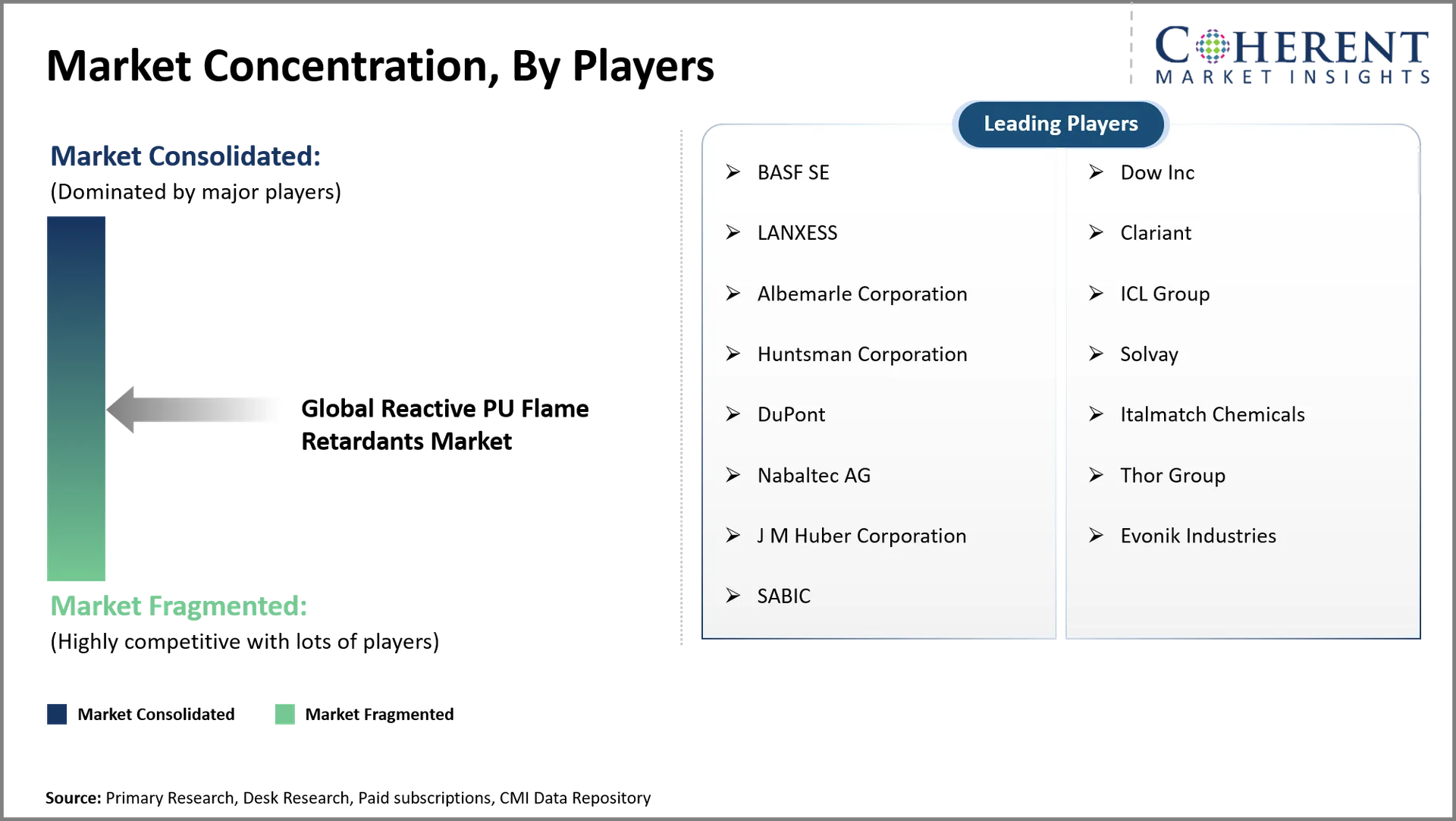
The competitive landscape is shaped by specialty chemical manufacturers developing phosphorus-based flame retardants and customized polyurethane additives. ICL Group’s strength comes from its portfolio in phosphorus chemistry and the creation of reactive flame retardants. Its goal is centered on halogen-free solutions for use in polyurethane foams and industrial applications. LANXESS is active in the area of phosphorus-based flame retardants and specialist additives for polymer applications. BASF applies its knowledge of raw materials for polyurethanes to deliver total formulation solutions. Huntsman Corporation focuses on polyurethane systems, foam technologies, and application-specific material performance. Clariant contributes through phosphorus-based flame-retardant technologies and sustainable chemical solutions. Competition increasingly centers on reactive chemical compatibility, halogen-free formulations, processing efficiency, and application-specific fire performance.
Top Manufacturers and Notable Products in the Reactive PU Flame Retardants Market
Manufacturer | Notable Product | Key features |
Clariant | Exolit OP 560 | Reactive non-halogenated phosphorus polyol, low-viscosity liquid, low migration, low VOC emissions, suitable for flexible PU foam |
LANXESS | Purventis Core | Reactive halogen-free phosphorus chemistry, chemically bonds into rigid PU/PIR foam, low emissions, improved foam stiffness |
ICL Group | VeriQuel R100 | Reactive phosphorus flame retardant, chemically integrates into rigid PU insulation, supports durable flame-retardant performance |
BASF | Irgastab PUR 70 | Anti-scorching additive for polyurethane foam processing, supports processing stability with reactive flame-retardant formulations |
Huntsman | POLYRESYST EV5005 | Intumescent polyurethane coating, passive fire protection, protects metal and composite substrates, supports electric vehicle battery safety |
Market Report Scope
Global Reactive PU Flame Retardants Market Report Coverage | |||
Report Coverage | Details | ||
Base Year | 2025 | Market Size in 2026: | USD 1.15 Bn |
Historical Data For: | 2020 To 2024 | Forecast Period: | 2026 To 2033 |
Forecast Period 2026 To 2033 CAGR: | 4.10% | 2033 Value Projection: | USD 1.75 Bn |
Geographies covered: |
| ||
Segments covered: |
| ||
Companies covered: | BASF SE, Dow Inc, LANXESS, Clariant, Albemarle Corporation, ICL Group, Huntsman Corporation, Solvay, DuPont, Italmatch Chemicals, Nabaltec AG, Thor Group, J M Huber Corporation, Evonik Industries, SABIC | ||
Growth Drivers: |
| ||
Restraints & Challenges: |
| ||
Analyst Opinion (Expert Opinion)
- The industry will increasingly favor reactive phosphorus chemistries over conventional additive-based flame retardants. Demand will shift toward formulations combining low emissions, durable fire protection, and minimal mechanical property deterioration. LANXESS Purventis Core and ICL VeriQuel R100 demonstrate this technological direction. Flexible polyurethane manufacturers will also seek reactive polyols meeting demanding automotive emission specifications. Product differentiation will increasingly depend on chemical integration, processing efficiency, and application-specific fire performance.
- The strongest opportunities will emerge in halogen-free phosphorus-based reactive flame retardants. Rigid polyurethane and polyisocyanurate insulating foams have great prospects in commercial buildings and industrial facilities. Flexible polyurethane foams offer extra alternatives for automotive seating and interior cushioning. Opportunities in growing insulation manufacturing & vehicle production in China & India. The U.S. and Germany have prospects in enhanced insulation technologies and automotive material development. Suppliers should focus on reactive formulations that are developed for these purposes.
- Market participants should invest in phosphorus-based reactive polyols with better compatibility in rigid and flexible polyurethane systems. In product development, the emphasis should be on: lower viscosity, less volatile organic compound emissions and constant mechanical qualities of the foam. Companies should work with polyurethane systems houses and insulation producers to test the applications. Suppliers should provide technical documents such as fire testing, chemical composition and regulatory compliance. Deepening regional technical assistance in China, India, Germany, and the U.S. will accelerate customer qualification. Manufacturers can strengthen long-term customer connections by developing unique formulations for insulating boards and car seating.
Speak to the analyst
Want personalized insights?
Take the findings above to one of our principal consultants, or have the report rebuilt around the segments, geographies and competitors you actually track.
Market Segmentation
- Type Insights (Revenue, USD Billion, 2021 - 2033)
- Reactive Flame Retardants
- Additive Flame Retardants
- Chemistry Insights (Revenue, USD Billion, 2021 - 2033)
- Phosphorus-Based Reactive Flame Retardants
- Halogenated Reactive Flame Retardants
- Nitrogen-Based Reactive Flame Retardants
- Others
- Form Insights (Revenue, USD Billion, 2021 - 2033)
- Liquid
- Powder
- Granules
- Application Insights (Revenue, USD Billion, 2021 - 2033)
- Polyurethane Foam
- Polyurethane Coatings
- Polyurethane Adhesives
- Polyurethane Elastomers
- Thermoplastic Polyurethane
- Others
- End User Insights (Revenue, USD Billion, 2021 - 2033)
- Building and Construction
- Automotive and Transportation
- Electrical and Electronics
- Furniture and Upholstery
- Others
- Regional Insights (Revenue, USD Billion, 2021 - 2033)
- North America
- U.S.
- Canada
- Latin America
- Brazil
- Argentina
- Mexico
- Rest of Latin America
- Europe
- Germany
- U.K.
- Spain
- France
- Italy
- Russia
- Rest of Europe
- Asia Pacific
- China
- India
- Japan
- Australia
- South Korea
- ASEAN
- Rest of Asia Pacific
- Middle East
- GCC Countries
- Israel
- Rest of Middle East
- Africa
- South Africa
- North Africa
- Central Africa
- North America
- Key Players Insights
- BASF SE
- Dow Inc
- LANXESS
- Clariant
- Albemarle Corporation
- ICL Group
- Huntsman Corporation
- Solvay
- DuPont
- Italmatch Chemicals
- Nabaltec AG
- Thor Group
- J M Huber Corporation
- Evonik Industries
- SABIC
Sources
Primary Research Interviews
- Reactive PU Flame Retardant Manufacturers & Producers
- Polyurethane Raw Material Suppliers & Distributors
- End-Use Industry Experts (Construction, Automotive & Electronics Sectors)
- Regulatory & Compliance Specialists in Chemical Safety
Magazines
- Plastics Technology Magazine
- European Coatings Journal
- Flame Retardants & Polymer Additives Magazine
- Chemical Week Magazine
Journals
- Journal of Applied Polymer Science
- Polymer Degradation and Stability Journal
- Journal of Fire Sciences
Associations
- American Chemistry Council (ACC)
- Polyurethane Foam Association (PFA)
- European Flame Retardants Association (EFRA)
- International Isocyanate Institute (III)
Public Domain Sources
- U.S. Environmental Protection Agency (EPA) - Chemical Safety Data
- European Chemicals Agency (ECHA) - REACH Regulatory Publications
- United Nations Environment Program (UNEP) - Chemical Safety Reports
- National Institute of Standards and Technology (NIST) - Material Safety Data
Proprietary Elements
- CMI Data Analytics Tool
- Proprietary CMI Existing Repository of Information for Last 10 Years
Get access to 250+ pages report
Every segment, forecast, competitor profile and data table behind the analysis above — available for instant download.
- ESOMAR Member
- ISO 9001:2015 Certified
- D-U-N-S Registered
- GDPR & CCPA Compliant
Frequently Asked Questions
The global reactive PU flame retardants market is expected to stand at USD 1.15 Bn in 2026 and is expected to reach USD 1.75 Bn by 2033.
The CAGR of the global reactive PU flame retardants market is projected to be 4.1% from 2026 to 2033.
Increasing fire safety requirements across polyurethane applications and Growing demand for flame-retardant polyurethane insulation are the major factors driving the growth of the global reactive PU flame retardants market.
High development costs for specialized reactive flame retardants and Complex formulation requirements for polyurethane manufacturers are the major factors hampering the growth of the global reactive PU flame retardants market.
In terms of type, reactive flame retardants segment is estimated to dominate the market revenue share in 2026.
Reactive PU flame retardants are chemicals that chemically bond with polyurethane structures to provide lasting fire protection.
They improve resistance to ignition and flame propagation in rigid polyurethane insulation materials.