

Global Renewable Energy Digitalization Market Size and Forecast – 2026-2033
Global Renewable Energy Digitalization Market is projected to reach USD 24.52 Bn by 2033, at a CAGR of 15.8% during the forecast period 2026-2033. It is anticipated to reach USD 8.78 Bn in 2026. The expansion is a broader commitment to invest in AI-enabled forecasting, automated asset monitoring and digital grid integration to improve the efficiency of renewable energy, operational reliability and generation management.
In November 2024, the U.S. Department of Energy announced plans to spend up to $30 million through its Artificial Intelligence for Interconnection (AI4IX) program to accelerate the interconnection of electricity generation using AI-based solutions. It highlights the growing role of digital technologies in helping reduce grid integration delays and supporting the development of renewable energy infrastructure.
Key Takeaways of the Global Renewable Energy Digitalization Market
- Software and analytics platforms are predicted to account for 48.7% of the global renewable energy digitalization market by 2026 and are projected to grow at a compound annual growth rate (CAGR) of 17.4% from 2026 to 2033. Their commercial advantage in taking fragmented generation and financial data and turning it into decisions that protect portfolio returns. Power Factors launched an intelligence engine called Unity REMI in April 2026 to help optimize renewable portfolios using operational data.
- The IoT and SCADA systems are projected to have a CAGR of 15.9% between 2026 and 2033 and will constitute 34.8% of the global renewable energy digitalization market in 2026. The importance of the latter is because real-time supervisory control of geographically dispersed renewable plants is a prerequisite, as delayed reporting cannot be relied upon for grid compliance. In February 2026 Siemens announced a cloud-based SCADA implementation connecting eight renewable generation and storage sites across Australia.
- Renewable Asset Monitoring and Optimization is expected to increase at a CAGR of 16.6% between 2026 and 2033, accounting for 33.8% share of the global renewable energy digitalization market in 2026. Operators are constantly comparing performance to identify poorly performing equipment, prioritize maintenance, and make sure that contracted output is achieved. In October 2025, DNV’s GreenPowerMonitor launched an upgraded GPM Horizon platform that provides a single platform for monitoring solar, wind and battery storage.
- North America is forecast to advance at an estimated CAGR of 14.3% during 2026–2033 while retaining the largest regional share of 32.7% in global renewable energy digitalization market. Established utility procurement channels and investment in digital grid reliability underpin its position. In July 2024, the U.S. Department of Energy selected projects for USD 7.5 million in funding for sensor technologies and grid analytics supporting renewable integration.
- Asia Pacific is expected to grow at the highest regional CAGR of 18.5% during the forecast period of 2026 to 2033. The region is expected to account for 30.1% of the global renewable energy digitalization market revenue in 2026. The coordination of new renewable capacity across power networks that need greater cross-border visibility is driving the potential for growth. The Asian Development Bank’s Pan-Asia Power Grid initiative announced in May 2026 explicitly includes renewable integration and grid digitalization.
Segmental Insights
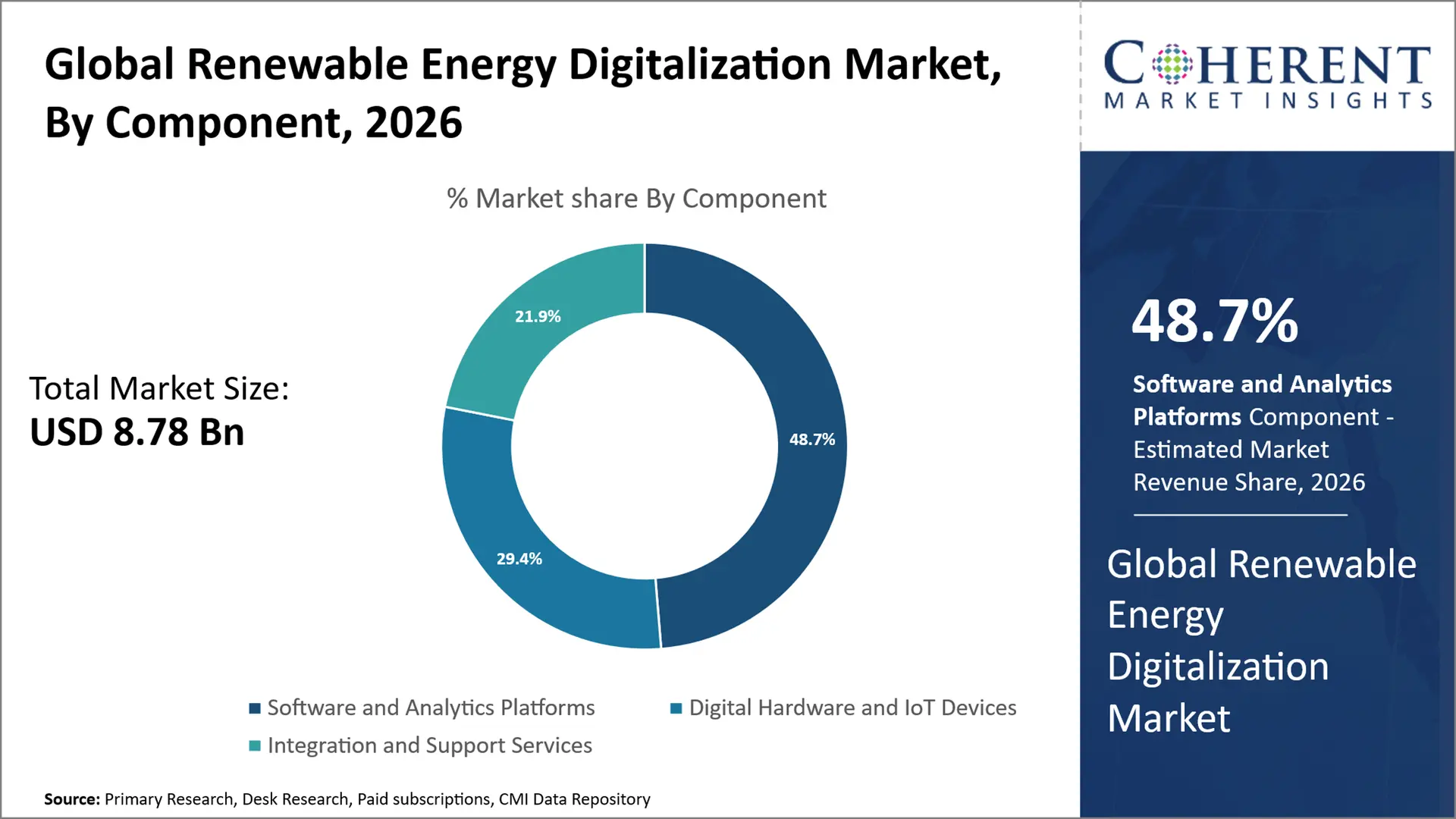
Why Do Software and Analytics Platforms Dominate the Global Renewable Energy Digitalization Market?
Software and Analytics Platforms, with an expected 2026 global renewable energy digitalization market share of 48.7%, lead the component category because asset owners need to reconcile technical operations with commercial obligations across solar, storage, and hybrid projects. Revenue verification, warranty tracking, and contract compliance create demand for software that joins equipment-level signals with financial workflows. Unlike plant hardware, configurable applications can be deployed across portfolios through existing data interfaces, creating scale advantages for software vendors. This capability is especially relevant to independent power producers managing multiple revenue streams and contractual counterparties. In May 2024, Stem announced PowerTrack APM, a configurable software suite combining technical and commercial performance views for clean energy portfolios. This announcement illustrates why integrated analytics can become a recurring procurement priority rather than a discretionary dashboard upgrade.
- Current Industry Events of 2026
- Market Size Estimation
- Regional Breakdown
- Competitive Landscape
- Customer Intelligence
- Segmental Analysis
- Pricing Analysis
- Key Market Drivers, Challenges & Future Trends
- Customized Insights Section
Why Do IoT and SCADA Systems Represent the Largest Technology Segment in the Global Renewable Energy Digitalization Market?
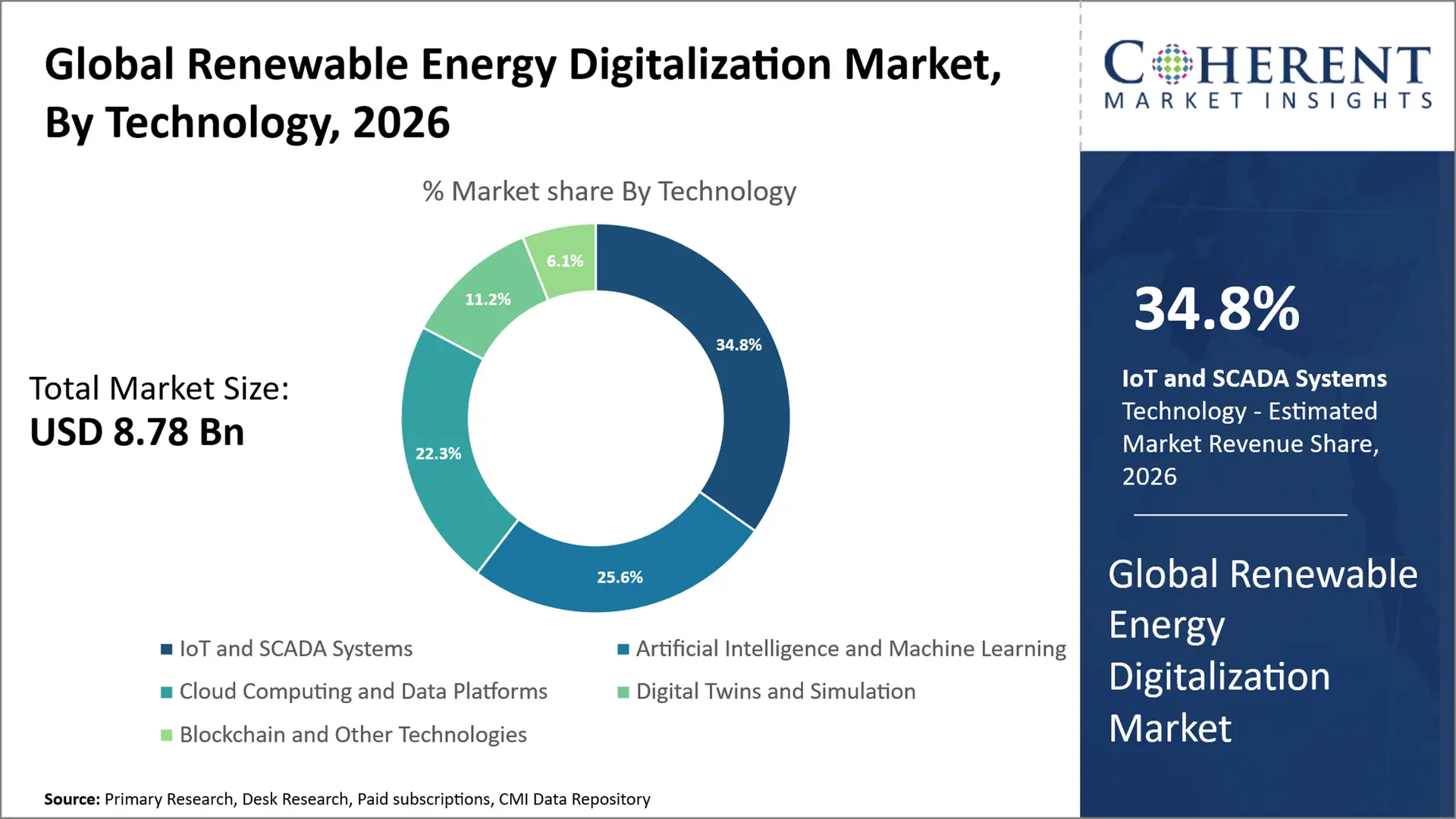
The technology category is being led by IoT and SCADA Systems, which are predicted to account for 34.8% in 2026 as utilities require telemetry that is always on and dispatch control that is verifiable, not just periodic performance reports. Control centers are responsible for executing grid instructions and managing day-ahead schedules, while a variety of solar inverters, wind plants, battery controllers and meters must exchange timely operating data. This requirement determines the positioning of SCADA at the operational interface between network operators and renewable generators, which allows for the allocation of resources to protocol integration, secure communication, and resilient control engineering. In June 2026, Emerson said Holy Cross Energy was using Ovation Green SCADA at four Colorado sites with solar, wind, and storage to provide centralized supervision and dispatch. The deployment highlights the repeated opportunities of automation suppliers to demonstrate cross-technology control reliability in utility operating environments.
Why Do Renewable Asset Monitoring and Optimization Dominate the Application Segment of the Global Renewable Energy Digitalization Market?
Renewable Asset Monitoring and Optimization, projected to hold 33.8% share for global renewable energy digitalization market in 2026, leads the application category because equipment availability alone does not reveal whether a plant is producing its achievable outputThis is because availability of equipment alone does not indicate if a plant is producing its achievable output. Investors and asset managers need to separate out weather effects, equipment derating and contractor performance to assess the amount of energy lost and prioritize corrective work. Software specialists provide independent benchmarks and root-cause diagnostics to help owners challenge maintenance assumptions, enforce service terms, and support defensible portfolio valuations. In May 2026 Captiva chose Clir Renewables’ AI platform for its wind, solar and battery portfolios in the Nordic and Baltic markets to help with performance deviation analysis, contract oversight and transparent reporting. The deal highlights a growing trend toward optimization tools that can translate technical exceptions into financially relevant actions within outsourced operating structures.
Current Events and their Impact
Current Event | Description and Its Impact |
European Commission: Strategic Roadmap for Energy digitalization and AI, June 2026 |
|
March 2025: Ofgem Decision on Registration of Assets in Flexibility Market |
|
Global Renewable Energy Digitalization Market Dynamics
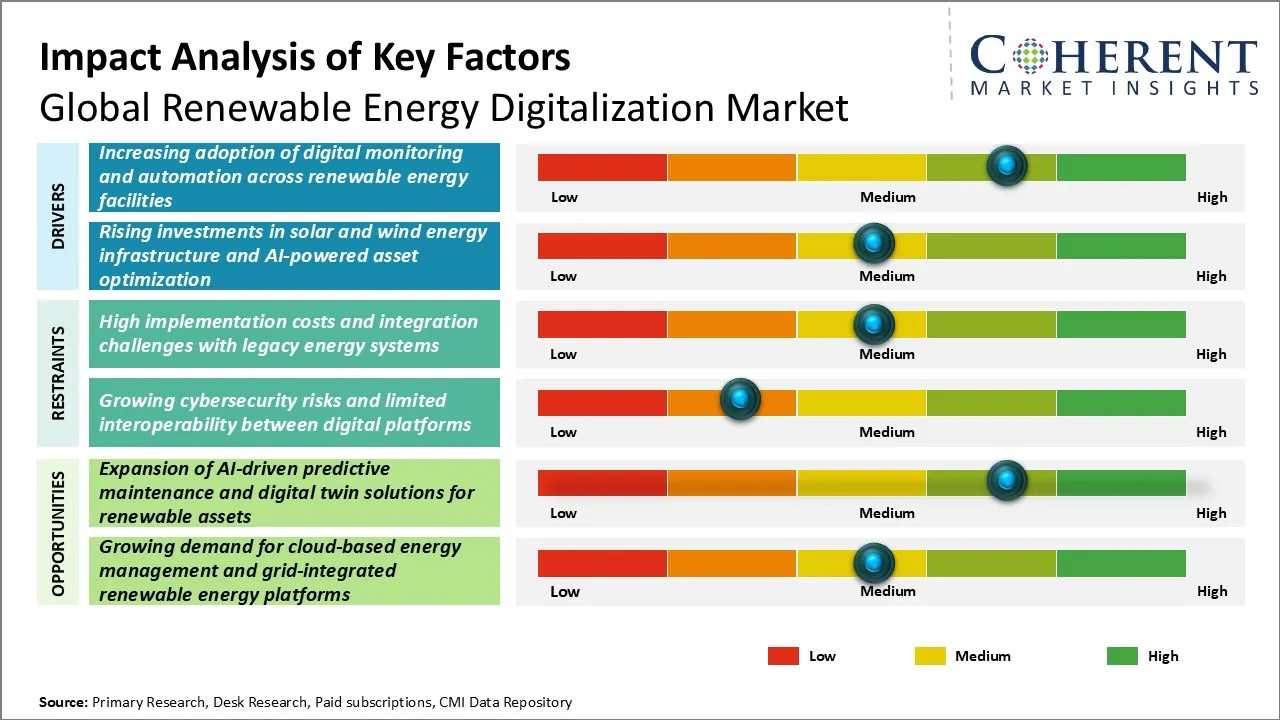
Key Market Drivers
- Increasing adoption of digital monitoring and automation across renewable energy facilities: Renewable energy operators are adopting automated inspection and monitoring systems to reduce turbine downtime, improve asset reliability, and control maintenance expenditure. Manual inspection may be required to identify faults and this will mean stopping electricity production. Automating data gathering will help to standardize equipment assessments and accelerate maintenance decisions, creating opportunities for operators of renewable assets and providers of digital solutions. In June 2026, RES launched Smart Pilot, a software application that leverages standard drone hardware to automate wind turbine blade inspections in a single turbine stop. This shows the commercial benefits of including automation into the renewable asset maintenance workflows.
- Rising investments in solar and wind energy infrastructure and AI-powered asset optimization: The growth of solar and wind portfolios necessitates the use of sophisticated forecasting and optimization tools to manage variable generation, power price exposure and grid constraints. Developers are becoming more aware of the importance of digital intelligence to protect project revenues and make better power trading decisions. This creates opportunities for renewable energy technology integrators, cloud infrastructure providers and AI developers. In June 2025 RWE and Amazon Web Services (AWS) announced a strategic partnership in cloud services, artificial intelligence (AI), renewable energy forecasting and commercial assets optimization, building upon previous agreements for wind and solar.
Emerging Market Trends
- Shift Toward Performance-Linked Digital Service Contracts: The purchase of renewable energy technology is shifting from software capabilities to measurable operating results. Asset owners are increasingly demanding digital solution providers to demonstrate improvements in operational efficiency, energy capture and availability. This allows for the possibility of performance-based service contracts, where the commercial value is linked to defined operational indicators. It would be very useful if specialized software providers could offer both continuous technical support and transparent performance measurement features. Suppliers that can validate improvements against agreed operating baselines may improve customer retention over the forecast period, while providers that rely mainly on standard licensing may experience increased pricing pressures.
- Convergence of Hybrid Renewable Plant Operating Systems: Coordinated operating architectures are emerging, rather than the separate, technology-specific control environments that have been used to operate solar, wind and battery storage facilities. Synchronized generation scheduling, storage management, inverter control, and grid communication are needed for hybrid renewable projects. This is pushing developers to create integrated energy management platforms that can handle various technologies without interfering with existing equipment. Vendors of technology that offer configurable control systems and compatible communication interfaces may have an advantage over application vendors who offer standalone products. Integrated operating capabilities are expected to influence equipment selection, software purchases and long-term service agreements during the forecast period.
Market Restraints
- Legacy Equipment Integration and Data Access Limitations: Renewable plants often have equipment from multiple vendors with different communications protocols, data formats, and access permissions. Further engineering, software customization and validation are needed to integrate these systems into centralized platforms. Older facilities will have higher retrofit costs that may reduce the commercial attractiveness of advanced analytics deployments.
- Cybersecurity Exposure and Operational Validation Requirements: The interconnection of renewable generation equipment to cloud platforms may create additional cybersecurity exposure across operational technology networks. Utilities need to evaluate the reliability of control systems, software updates, data security and remote access before deployment. These requirements can raise implementation costs , slow adoption of automated operating functions and extend procurement cycles for critical grid connected facilities.
Regional Insights
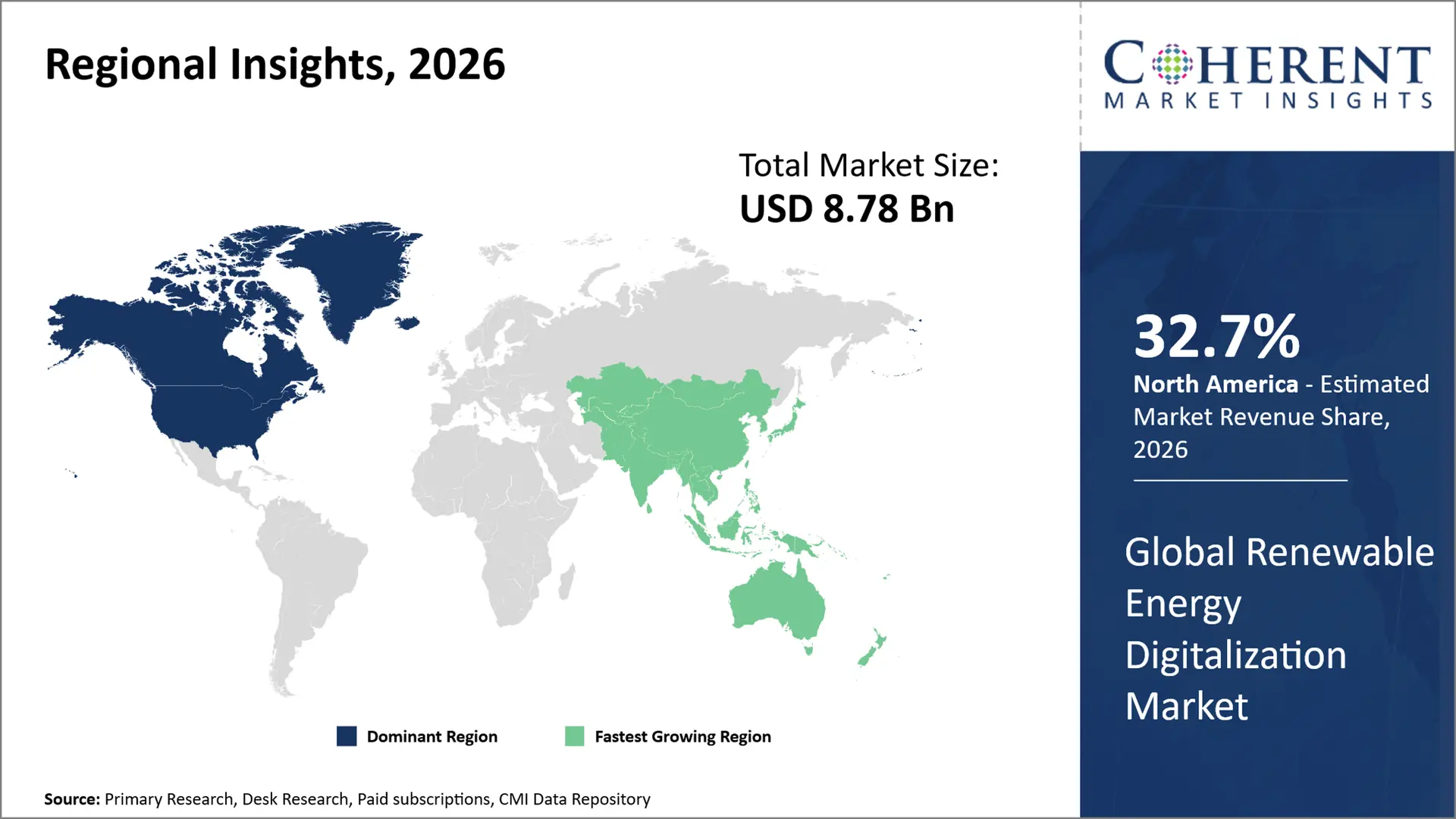
Why Does North America Dominate the Global Renewable Energy Digitalization Market?
North America is expected to represent 32.7% of the global renewable energy digitalization market in 2026, owing to the presence of well-established utility technology procurement, advanced electricity markets, and investment in distributed energy management. Utilities are embracing feeder-level analytics for assessing grid constraints, managing customer-owned energy assets and deferring costly network upgrades. The region’s established software engineering ecosystem also supports the commercialization of advanced grid applications. In December 2025, Natural Resources Canada announced USD 6 million in funding for Hydro Ottawa’s Distributed Energy Resource Accelerator, which uses AI-enhanced forecasting and responsive energy resources to improve the efficiency of distribution network operations. These investments also benefit grid software providers, technology integrators and utilities looking for measurable infrastructure efficiency improvements.
Why Is Asia Pacific Emerging as the Fastest-Growing Region in the Global Renewable Energy Digitalization Market?
Asia Pacific is anticipated to account for 30.1% of the global renewable energy digitalization market share in 2026 and will witness the fastest regional growth rate through 2033. The expansion of the region is consistent with the commercial need to orchestrate the increasing number of rooftop solar installations, distributed batteries and electricity networks with different levels of technical maturity. Utilities can use digital resource orchestration to accommodate decentralized generation instead of relying solely on physical grid build-out. In January 2025, the Australian Renewable Energy Agency committed USD 14.60 million to Western Power’s Project Jupiter to connect distributed energy resources to a coordinated electricity marketplace.
Global Renewable Energy Digitalization Market Outlook for Key Countries
Why Is the U.S. a Key Market for the Global Renewable Energy Digitalization Market?
The United States is a major global market for renewable energy digitalization, with growing demand for precise dispatch optimization, automated settlement and coordinated energy storage operations in competitive electricity markets. The ability of solar and wind developers to respond to volatile wholesale prices and the operational limitations of batteries also create opportunities for energy trading software and market optimization platforms. Texas provides a good example of this commercial transition. In December 2025, the Electric Reliability Council of Texas deployed Real-Time Co-optimization Plus Batteries, which involves coordinated procurement of electricity and ancillary services, and improved battery modeling. It also adds further weight to the business case for advanced bidding algorithms, storage dispatch analytics and market integration systems, especially for independent power producers and renewable project operators aiming to improve their revenue management.
Why Is India Important in the Global Renewable Energy Digitalization Market?
India offers substantial opportunities for renewable energy digitalization market as solar and wind installations expand across geographically dispersed generation zones. Variable generation requires accurate weather inputs, regional scheduling coordination, and compliance with grid operating requirements. Therefore, renewable developers and distribution utilities need forecasting applications and integrated operational control systems that fit cost-sensitive infrastructure budgets. According to the Indian Ministry of Power, the Renewable Energy Management Centers will be established in March 2026 to carry out real-time grid management and renewable forecasting, using advanced meteorological inputs from national forecasting institutions. These initiatives open avenues for domestic software developers, grid technology integrators and specialized forecasting providers that serve utility-scale renewable projects and electricity system operators.
Why Is Japan an Important Growth Market for the Global Renewable Energy Digitalization Market?
Japan is an important renewable energy digitalization market because solar generators increasingly need to optimize electricity sales as projects transition toward market-linked remuneration. Digital aggregation and battery scheduling allow project owners to respond to electricity prices, manage stored energy, and improve commercial returns from existing installations. This opens the door for battery technology suppliers and niche energy management businesses. In August 2025, PowerX signed its first operational management agreement with Senko Corporation and began providing power aggregation service for solar plants with battery energy storage systems. The development highlights the growing commercial need for integrated storage scheduling, electricity trading co-ordination and digital asset management in Japan, particularly for solar generators migrating to the Feed-in Premium framework.
Why Does China Support Growth in the Global Renewable Energy Digitalization Market?
The opportunity for digitalization of renewables in China is linked to integrating large clusters of renewable generation, coordinating electricity transmission and improving intelligent grid operations. Its domestic industries in automation, telecommunications and power equipment provides an established supply base for integrated digital energy infrastructure. Renewable developers are increasingly needing sophisticated control technologies to support complex electricity market operations and to manage generation from remote installations. In September 2025, China’s National Development and Reform Commission and National Energy Administration issued guidance to promote the integration of artificial intelligence applications into energy systems, such as renewable forecasting, intelligent dispatch and power market optimization. This policy direction presents opportunities for electricity network operators, AI developers and domestic industrial software suppliers who are deploying scalable digital control architectures.
Why Is Germany a Strategic Country in the Global Renewable Energy Digitalization Market?
Germany remains strategically important because its dense global renewable energy digitalization market network creates complex requirements for congestion management, operational transparency, and electricity balancing. Solar and wind operators must distinguish network-imposed generation restrictions from equipment-related losses, making accurate production records and curtailment analytics commercially valuable. This further increases the demand for grid data platforms, redispatch management software and renewable forecasting applications. In March 2026, the Federal Network Agency of Germany stated that volumes of solar photovoltaic redispatches through SMARD were 2,704 GWh in 2025, or about 94% higher than in 2024. These figures emphasize the necessity of digital solutions that could improve visibility on congestion, enable energy scheduling and help renewable asset operators in reconciling generation constraints and financial settlements.
Renewable Energy Digitalization – Customer Demand and Procurement Landscape
Customer Category | Primary Business Requirement | Procurement and Investment Priorities | Commercial Significance |
Utilities and Independent Power Producers | Improving generation grid compliance, operational efficiency and profitability | Performance accountability, enterprise contracts and long term service agreements | It is a large customer base for recurring service revenue and large-scale digitalization investments. |
Renewable Energy Operators and Developers | Managing profitability of assets and operating costs and project performance | Operational cost savings, deployment across the portfolio and lifecycle service support. | Creates opportunities for recurring contracts within the renewable portfolios (solar, wind and hybrid). |
Commercial and Industrial Energy Consumers | Reducing electricity expenditure and improving renewable energy utilization | Cost-effective subscriptions, measurable energy savings, and flexible contract terms | Encourages broader adoption for captive renewable energy projects, commercial buildings and industrial facilities. |
Energy Trading Firms & Aggregators | Enhancing the effectiveness of energy deals, income realization and market engagement | Support for market participation, accuracy of settlements and pricing on trades | Revenue opportunities from energy trading services, performance-linked fees and aggregation contracts. |
Renewable EPC and O&M Service Providers | Increased efficiency of project delivery, maintenance coordination and quality of contractual services | Long-term customer support, service level agreements, and implementation costs | Increases demands for specialized operational support, maintenance contracts and implementation services. |
Institutional Investors and Owners of Renewable Assets | Portfolio transparency, operating risk evaluation and protection of investment returns | Standardized reporting Help with asset valuation Performance verification | Offers for investment-focused advisory services, portfolio reporting, and independent performance assessment. |
How Are Vendor-Neutral Aggregator Platforms Creating New Growth Opportunities in the Global Renewable Energy Digitalization Market?
One promising opportunity is digital aggregation platforms that serve distributed battery operators, commercial solar projects, and smaller renewable generators.
These assets often lack the technical infrastructure to participate in the electricity market in a coordinated fashion. Vendor-neutral platforms could enable the integration of generation forecasting, asset registration, dispatch instructions, and settlement management within a common operating environment.
Potential customers include independent aggregators, renewable energy developers and commercial / industrial energy users. This presents an opportunity for technology suppliers to leverage transaction-based revenue models, modular subscriptions and integration services.
Successful market entry requires to be compatible to different inverter and storage manufacturers, have accurate metering, knowledge of the local electricity market and safe communication interfaces. Additionally, providers must have in place strong processes for customer authorization and settlement.
Technology integrators and specialist software houses may see value in servicing portfolios that are too small to justify conventional utility-scale software deployments. They’ll have a competitive advantage in their ability to reduce the cost of onboarding while keeping operational control reliable.
Market Players, Key Development, and Competitive Landscape
Key Developments
- In March 2026, Hitachi Energy launched HMAX Energy, an AI-powered service and solution portfolio focused on infrastructure reliability, operational efficiency, and predictive maintenance. Its relevance to renewable energy digitalization lies in extending digital asset intelligence across grid equipment and energy infrastructure, supporting condition-based servicing and more informed maintenance planning.
- In September 2025, GE Vernova launched PlanOS, a unified power-system planning platform integrating power-flow, resource adequacy, production-cost, and capacity-expansion modelling. The development supports renewable energy digitalization by helping utilities and project planners evaluate generation scenarios, transmission requirements, and investment decisions through a coordinated simulation environment.
- In July 2025, Fluence Energy announced its selection for AMPYR Australia's Wellington battery storage project, incorporating Mosaic bidding software and Nispera asset performance management software. The agreement demonstrates how digital optimization and automated market participation can become commercially integrated with energy storage infrastructure supporting renewable electricity systems.
Competitive Landscape
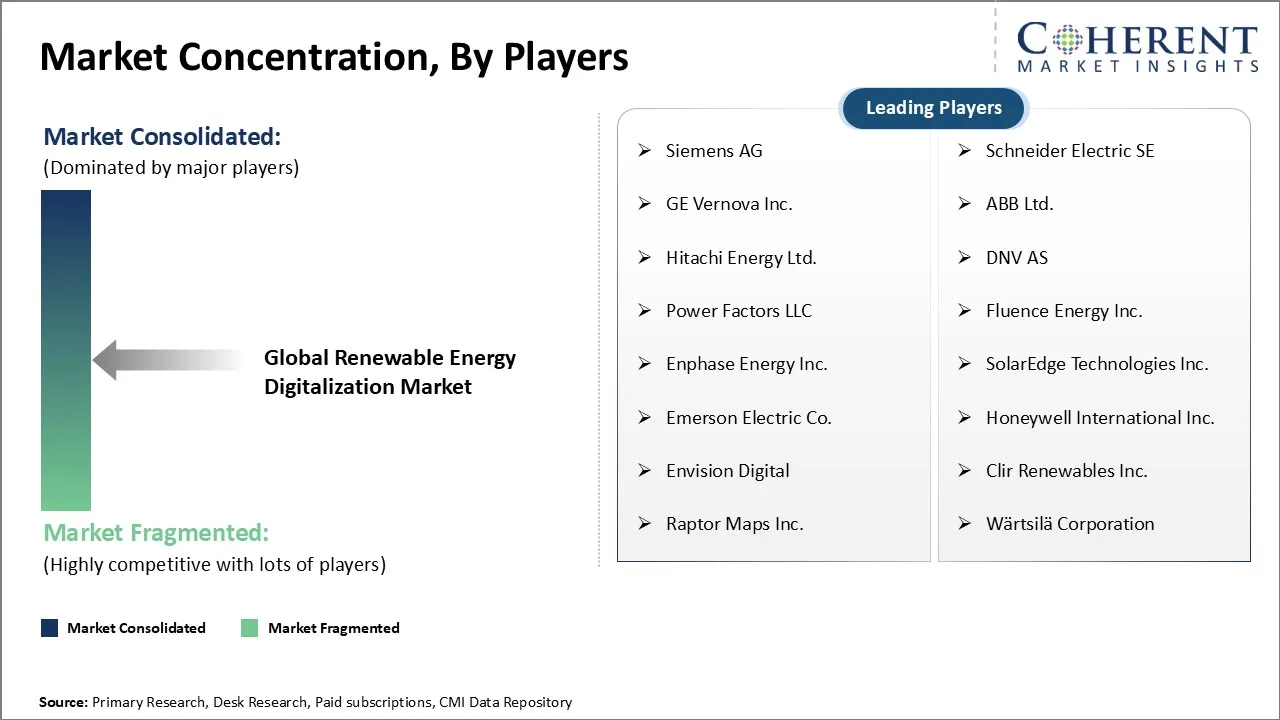
The global market for digitalization in renewable energy is fragmented and includes vendors of industrial automation, energy software, cloud technology, and specialized analytics. The main areas of competition are operational reliability, integration capabilities, cybersecurity, implementation costs and lifecycle support. Specialist providers compete through tailored solutions, application-specific expertise and faster deployment in renewable operating environments. Large technology companies benefit from established utility relationships.
Key focus areas include
- Software Reliability: The ability to reliably perform under varying grid and generation conditions.
- Economics of Implementation: Removal of ongoing support requirements, integration costs and commissioning expenditure.
- System Compatibility: Compatible with a range of inverter, turbine, controller and communication configurations.
- Cybersecurity Assurance: Documentation of protection mechanism, secure access control, and software maintenance is given.
- Application Specialization: Creation of solutions pertinent to particular renewable technologies and operational conditions.
- Regional Market Knowledge: Adapting the software to grid requirements and rules of the local electricity market.
- Customer Retention: Improving long-term platform usability, service continuity and technical support.
Market Report Scope
Renewable Energy Digitalization Market Report Coverage | |||
Report Coverage | Details | ||
Base Year | 2025 | Market Size in 2026: | USD 8.78 Bn |
Historical Data For: | 2020 To 2024 | Forecast Period: | 2026 To 2033 |
Forecast Period 2026 To 2033 CAGR: | 15.8% | 2033 Value Projection: | USD 24.52 Bn |
Geographies covered: |
| ||
Segments covered: |
| ||
Companies covered: | Siemens AG, Schneider Electric SE, GE Vernova Inc., ABB Ltd., Hitachi Energy Ltd., DNV AS, Power Factors LLC, Fluence Energy Inc., Enphase Energy Inc., SolarEdge Technologies Inc., Emerson Electric Co., Honeywell International Inc., Envision Digital, Clir Renewables Inc., Raptor Maps Inc., Wärtsilä Corporation | ||
Growth Drivers: |
| ||
Restraints & Challenges: |
| ||
Analyst Opinion (Expert Opinion)
- The global renewable energy digitalization market leadership is likely to depend increasingly on the ability to provide credible operational evidence to asset owners, investors, insurers, and electricity offtakes. Digital platforms that connect technical performance records with commercial obligations could gain strategic importance. Suppliers offering auditable asset histories and transparent performance attribution may become more valuable than vendors providing visualization tools without decision-grade supporting evidence.
- Ownership and permitted use of renewable operating data could reshape competition among software providers, equipment manufacturers, and asset owners. As machine learning systems become more dependent on proprietary asset histories, contractual control over data access, model training, and derived insights may become a commercial differentiator. Suppliers lacking transparent data governance arrangements could face challenges when pursuing large portfolio customers.
- Technology providers should prioritize accurate loss attribution, dependable forecasting, grid-code validation, and market-specific optimization capabilities. Commercial agreements should define data ownership, performance responsibilities, and service continuity. Companies must control integration costs and avoid excessive investment in features without demonstrated customer willingness to pay. Partnerships with local engineering specialists and utilities can strengthen deployment quality, while disciplined product customization will help protect margins.
Speak to the analyst
Want personalized insights?
Take the findings above to one of our principal consultants, or have the report rebuilt around the segments, geographies and competitors you actually track.
Market Segmentation
- Component Insights (Revenue, USD Bn, 2021 - 2033)
- Software and Analytics Platforms
- Digital Hardware and IoT Devices
- Integration and Support Services
- Technology Insights (Revenue, USD Bn, 2021 - 2033)
- IoT and SCADA Systems
- Artificial Intelligence and Machine Learning
- Cloud Computing and Data Platforms
- Digital Twins and Simulation
- Blockchain and Other Technologies
- Application Insights (Revenue, USD Bn, 2021 - 2033)
- Renewable Asset Monitoring and Optimization
- Predictive Maintenance
- Energy Generation Forecasting
- Grid Integration and Energy Dispatch
- Energy Trading and Portfolio Analytics
- Energy Source Insights (Revenue, USD Bn, 2021 - 2033)
- Solar Energy
- Wind Energy
- Hydropower
- Bioenergy
- Geothermal and Other Renewables
- Deployment Insights (Revenue, USD Bn, 2021 - 2033)
- Cloud-Based
- On-Premises
- Hybrid
- End User Insights (Revenue, USD Bn, 2021 - 2033)
- Utilities and Independent Power Producers
- Renewable Energy Developers and Asset Operators
- Commercial and Industrial Energy Users
- Aggregators and Other End Users
- Sales Channel Insights (Revenue, USD Bn, 2021 - 2033)
- Direct Vendor Sales
- System Integrators and Technology Partners
- Cloud Marketplaces and Other Channels
- Regional Insights (Revenue, USD Bn, 2021 - 2033)
- North America
- U.S.
- Canada
- Latin America
- Brazil
- Argentina
- Mexico
- Rest of Latin America
- Europe
- Germany
- U.K.
- Spain
- France
- Italy
- Russia
- Rest of Europe
- Asia Pacific
- China
- India
- Japan
- Australia
- South Korea
- ASEAN
- Rest of Asia Pacific
- Middle East
- GCC Countries
- Israel
- Rest of Middle East
- Africa
- South Africa
- North Africa
- Central Africa
- North America
- Key Players Insights
- Siemens AG
- Schneider Electric SE
- GE Vernova Inc.
- ABB Ltd.
- Hitachi Energy Ltd.
- DNV AS
- Power Factors LLC
- Fluence Energy Inc.
- Enphase Energy Inc.
- SolarEdge Technologies Inc.
- Emerson Electric Co.
- Honeywell International Inc.
- Envision Digital
- Clir Renewables Inc.
- Raptor Maps Inc.
- Wärtsilä Corporation
Sources
Primary Research Interviews
- Renewable energy developers, utilities, independent power producers (IPPs), and asset operators
- Digital energy platform providers, SCADA vendors, IoT suppliers, and grid integration experts
Stakeholders
- Solar and wind farm operators, utilities, and renewable energy developers
- Digital solution providers, system integrators, energy aggregators, and grid operatorsEnd-use Sectors
- Solar, wind, hydropower, bioenergy, and geothermal energy
- Utilities, IPPs, and commercial and industrial energy users
Regulatory and Industry Bodies
- International Energy Agency (IEA)
- International Renewable Energy Agency (IRENA)
- U.S. Department of Energy (DOE)
- European Commission and Federal Energy Regulatory Commission (FERC)
Databases
- IEA energy statistics and IRENA renewable capacity datasets
- U.S. EIA, Eurostat, and World Bank energy indicators
- National grid operator data and renewable generation statistics
- Renewable asset performance, digital infrastructure, and energy investment databases
Magazines and Journals
- Renewable Energy World
- IEEE Power & Energy Magazine
- Applied Energy
- Renewable and Sustainable Energy Reviews
Associations
- Global Wind Energy Council (GWEC)
- SolarPower Europe
- Smart Electric Power Alliance (SEPA)
- Global Solar Council (GSC)
Public Domain Sources
- Renewable energy capacity, generation, and digital grid investment data
- Smart grid adoption, SCADA deployment, and energy forecasting statistics
- Renewable asset optimization, grid modernization, and government initiatives
Key Standards and Regulations
- IEC 61850 – Power Utility Communication Standards
- IEC 62351 – Power System Cybersecurity
- IEEE 1547 – Distributed Energy Resource Interconnection
- NERC CIP Standards and EU NIS2 Directive
Proprietary Elements
- CMI Data Analytics Tool and proprietary research repository, supplemented by primary interviews, renewable energy capacity analysis, digital technology adoption assessments, asset performance benchmarking, and competitive intelligence.Top of Form
Get access to 250+ pages report
Every segment, forecast, competitor profile and data table behind the analysis above — available for instant download.
- ESOMAR Member
- ISO 9001:2015 Certified
- D-U-N-S Registered
- GDPR & CCPA Compliant
Frequently Asked Questions
The CAGR of global renewable energy digitalization market is projected to be 15.8% from 2026 to 2033.
The global renewable energy digitalization market is estimated to be valued at USD 8.78 billion in 2026 and is expected to reach USD 24.52 billion by 2033.
High implementation costs and integration challenges with legacy energy systems and Growing cybersecurity risks and limited interoperability between digital platforms are the key factors hampering the growth of global renewable energy digitalization market.
In terms of component, software and analytics platforms are estimated to dominate the market revenue share in 2026.
Siemens AG, Schneider Electric SE, GE Vernova Inc., ABB Ltd., Hitachi Energy Ltd., DNV AS, Power Factors LLC, Fluence Energy Inc., Enphase Energy Inc., SolarEdge Technologies Inc., Emerson Electric Co., Honeywell International Inc., Envision Digital, Clir Renewables Inc., Raptor Maps Inc., Wärtsilä Corporation are the major players.
North America is expected to lead the global renewable energy digitalization market in 2026.