

Global Rolling Dies Market Size and Forecast – 2026 To 2033
The global rolling dies market is expected to grow from USD 519.7 Mn in 2026 to USD 829.1 Mn by 2033, registering a compound annual growth rate (CAGR) of 7% from 2026 to 2033. The global rolling dies market is driven by growing aerospace demand for lightweight and high-performance fasteners. On December 22, 2025, Howmet Aerospace Inc. announced it has entered into a definitive agreement to acquire Consolidated Aerospace Manufacturing, LLC, a leading global designer and manufacturer of precision fasteners, fluid fittings, and other complex, highly engineered products for demanding aerospace and defense applications.
Key Takeaways of the Global Rolling Dies Market
- The Cold Rolling segment is expected to account for 45.0 % of the global rolling dies market share in 2026. Expansion of electric vehicle manufacturing is driving the growth of the segment. In August 2025, Suzuki Motor began production of its first electric vehicle in Gujarat, India.
- The Rolling Flat Dies segment is estimated to capture 36.0 % of the market share in 2026. Increasing demand for high dimensional accuracy is majorly driving the growth of the segment. On May 7, 2025, Hexagon partnered with ZeroTouch to provide high-accuracy inline inspection cells.
- The High-Speed Steel segment is estimated to capture 34.0 % of the market share in 2026. Increasing automation in precision metal forming is majorly driving the growth of the segment. In 2025, ANDRITZ Schuler expanded its automation portfolio for cold, warm, and hot forging applications.
- Asia Pacific is expected to dominate the rolling dies market in 2026 with a market share of 42.0 %. Increasing production of miniature precision fasteners in Asia Pacific is driving the growth of the regional market. In February 2026, Bulten announced a USD 55.1 million fastener facility at Oragadam, Tamil Nadu, India.
- North America is expected to account for 22.0% share in 2026 and is projected to record the fastest growth over the forecast period. Expansion of automated thread rolling systems in North America is driving the growth of the regional market. In 2025, Reed Machinery demonstrated its Model A22HDC computer-controlled three-die thread rolling machine.
Segmental Insights
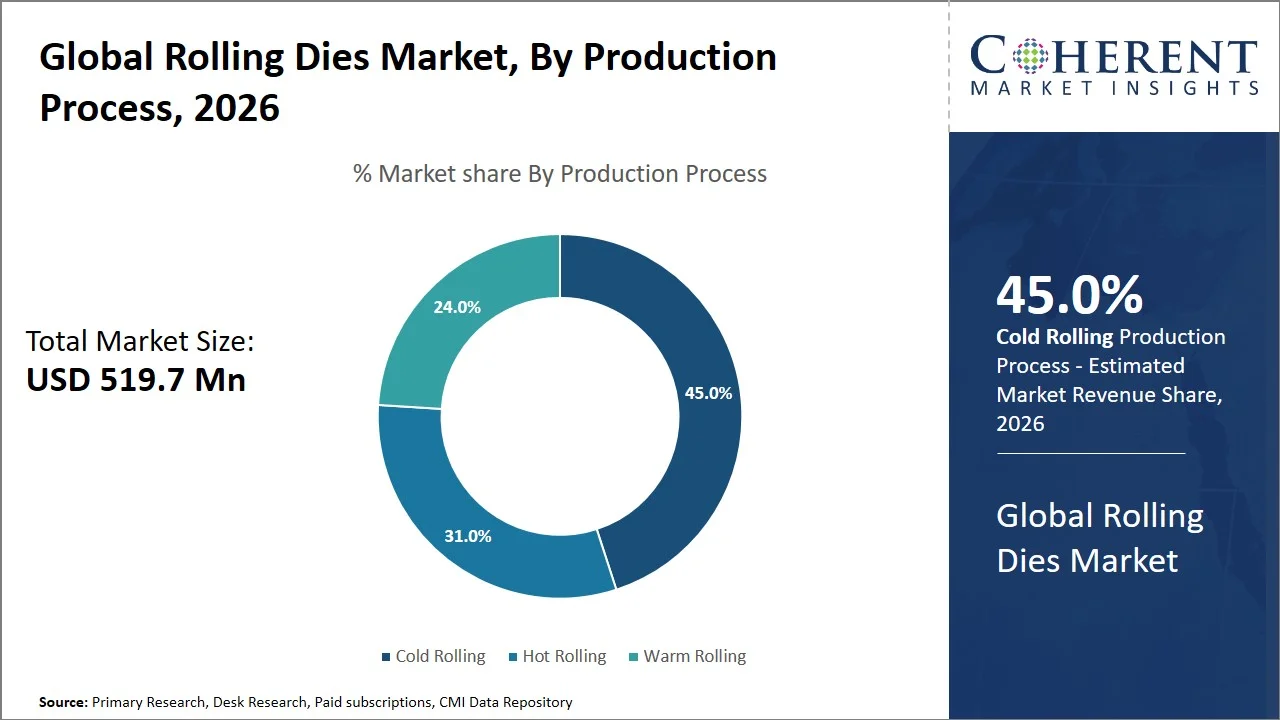
Why Does Cold Rolling Dominate the Global Rolling Dies Market?
The cold rolling segment is expected to account for 45.0% of the global rolling dies market share in 2026. Cold rolling gives close dimensional control for forming threads and components, while keeping consistent geometry in high volume production. The procedure raises the surface finish and also increases the strength of components by work hardening. It also reduces material waste because the material is shifted, not removed, during shaping. These features make it possible to produce automotive and industrial fasteners efficiently, which is important for quality consistency. Therefore, for applications requiring precision, durability and manufacturing efficiency, manufacturers chose cold rolling. On January 26, 2026, Kinefac launched its Core range of all-electric PowerBox thread rolling machines at the International Fastener Expo 2025. The machines are designed for precision rolling with numerical control and integrated automatic handling. This provides cold rolling strength for efficient, reproducible fastener production.
- Current Industry Events of 2026
- Market Size Estimation
- Regional Breakdown
- Competitive Landscape
- Customer Intelligence
- Segmental Analysis
- Pricing Analysis
- Key Market Drivers, Challenges & Future Trends
- Customized Insights Section
Why is Rolling Flat Dies the Most Crucial Type?
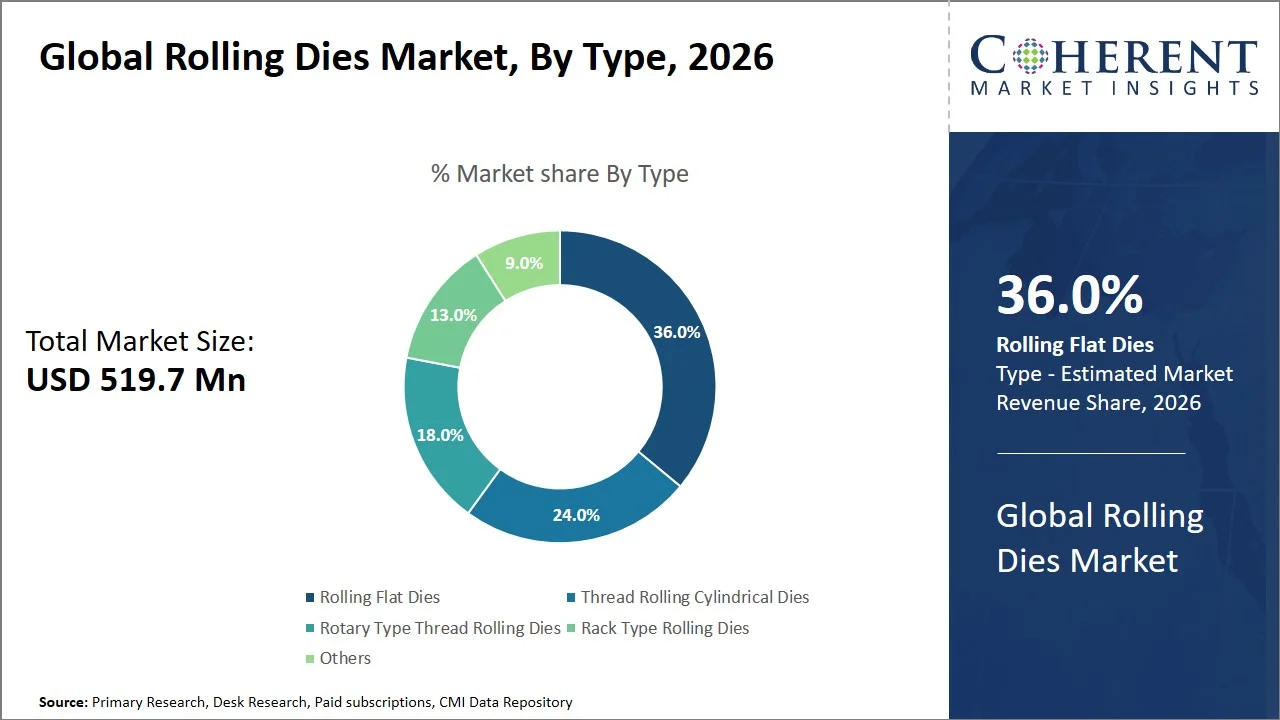
The rolling flat dies segment is expected to account for 36.0% of the global rolling dies market share in 2026. Rolling flat dies provide consistent thread formation across large production volumes. Flat rolling dies give a uniform thread formation in big manufacturing runs. They are designed to be able to move material out of the way efficiently. They also keep the threads the right size. They are ideal for the production of repeatable profiles and homogeneous surface finishes on fasteners. Their very simple set-up is also compatible with high-speed automated manufacturing operations. These features make the rolling flat dies useful in the automotive, industrial and general engineering fields. For instance, Kadimi presented flat milled and flat ground thread rolling dies at the wire trade fair 2026 in August 2026. The company also provides custom flat dies to meet unique production needs. Its tooling portfolio targets high-volume fastener manufacturing and precision thread formation.
High-Speed Steel Dominates the Global Rolling Dies Market
The high-speed steel segment is expected to account for 34.0% of the global rolling dies market share in 2026. High-speed steel provides good wear resistance in continuous thread rolling operations. The material retains the developed hardness at high operational temperatures during manufacture. This feature contributes to longer die life and less frequent replacement. Manufacturers also prize it for its constant performance in tough manufacturing situations. Hence, this is the chosen material for manufacturing of sturdy and dependable rolling dies. On April 30, 2025, Erasteel demonstrated their high-speed steel solutions at CIMT 2025, in Beijing, China. During the exhibition, the company introduced ASP grades for demanding tooling applications. Its array of thread rolling products includes ASP 2030, ASP 2042 and ASP 2053.
Current Events and their Impact
Current Events | Description and its Impact |
India - Bolts, Nuts and Fasteners Quality Control Order |
|
China - Specifications for the Steel Industry |
|
Rolling Dies Market Dynamics
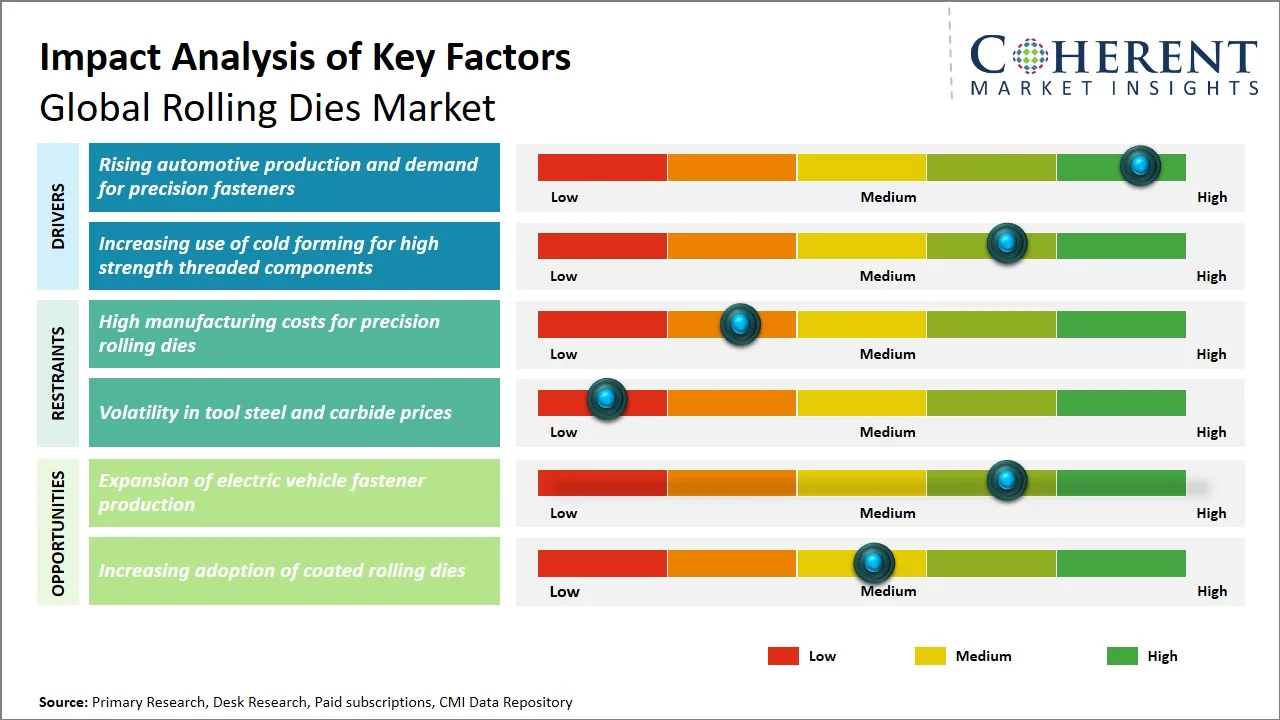
Market Drivers
Rising automotive production and demand for precision fasteners
The rise in automotive production raises the demand for precision fasteners used in all vehicle assemblies and structural components. Automotive manufacturers need standard thread size to enable dependable connections and automated assembly procedures. Rolling dies allow for high volume manufacturing of threads with consistent profiles and control of dimensional precision. Higher electric vehicle manufacturing also boosts demand for specialty fasteners used in batteries, motors and lightweight frames. This expanding requirement supports greater adoption of precision rolling dies among automotive fastener manufacturers.
On October 14, 2025, Stellantis announced plans to invest USD 13 billion over the next four years to grow its business in the critical United States market and to increase its domestic manufacturing footprint. The investment is the largest in the Company’s 100-year U.S. history and will support the introduction of five new vehicles across the brand portfolio in key segments
Increasing use of cold forming for high strength threaded components
Cold forming is increasingly used because it produces strong threaded components with efficient material utilization. The method work-hardens fasteners without breaking the continuity of the material around the threads. Rolling dies are capable of producing correct thread profiles without large amount of material removal. This technique allows durable fasteners to be produced for automotive, aerospace and industrial applications. Therefore, the demand for sophisticated rolling die systems is being supported by the growing demand for lightweight and high strength components. Kinefac presented their thread-rolling equipment and KineForm cylindrical dies at Fastener Fair USA 2025. Its equipment is capable of infeed, through feed and incremental cold rolling of threads, knurls, serrations and grooves. The company explicitly cited potential in automotive, aerospace, medical and electronics industries.
Emerging Trends
- Advanced Die Materials and Coatings: Manufacturers are increasingly using carbide materials and specialized coatings to improve wear resistance. These solutions improve die life, preserve thread accuracy and enable faster production rates during demanding automotive and industrial applications.
- Automation and Smart Manufacturing: The die manufacture of rolling dies is increasingly integrated with automated thread rolling equipment and digital monitoring systems. Process controls and sensors are being employed by manufacturers to identify dimensional deviations, adjust operational parameters, decrease downtime and increase production consistency.
- Electric Vehicle Fastener Applications: The electric vehicle manufacturing sector is driving demand for specialty fasteners with exact dimensional accuracy and dependable mechanical performance. Suppliers of rolling die are creating tooling solutions for battery systems, electric motors, lightweight constructions and specific drivetrain assembly.
- Sustainable Cold Forming Processes: As manufacturers place more emphasis on material efficiency and waste reduction in fastener manufacturing. Cold forming and thread rolling help to achieve these goals by reducing material removal, cutting down on machining requirements and increasing production efficiency for high volume manufacture.
Regional Insights
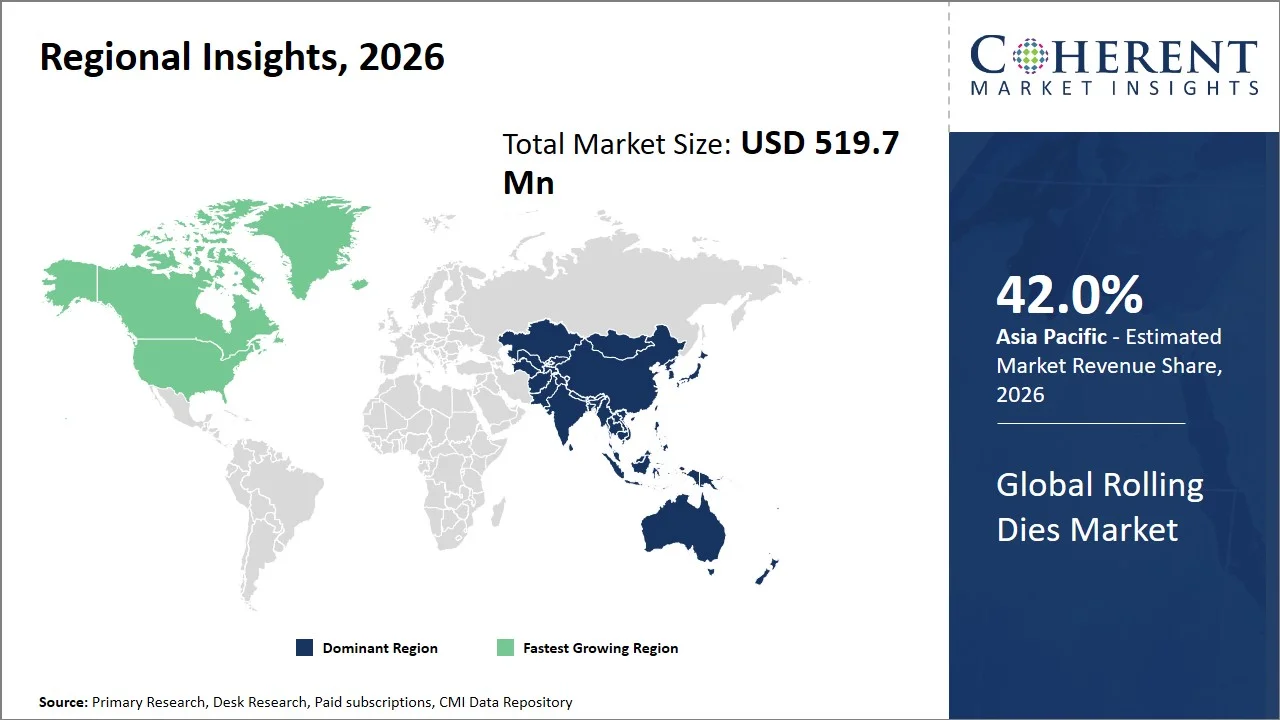
Why is Asia Pacific a Strong Market for Rolling Dies?
Asia Pacific is expected to account for a market share of 42.0% in 2026. The Asia Pacific region has dense clusters of fastener manufacturers in China, Japan, South Korea, India, and Taiwan. 34.531 million autos were built in China in 2025, producing huge demand for precision threaded components. The manufacturing of new energy vehicles reached 16.626 million units, which increased the demand for specialized automotive fasteners. Japan has superior machinery and fabricated metal manufacturing skills, and strong automotive supply chains. India manufactured 331.9 lakh vehicles in 2025, increasing the regional demand for forming tools. These complementary manufacturing bases support rolling die consumption across automotive, machinery, electronics, and industrial equipment applications.
Why Does North America Rolling Dies Market Exhibit High Growth?
North America is expected to register the fastest growth with a CAGR of 7.6% over the forecast period. It is projected to account for 22.0% of the global rolling dies market in 2026. North America benefits from strong aerospace, automotive, machinery, and industrial equipment manufacturing clusters. Orders to U.S. factories grew 0.9% in July 2026, driven by robust demand for aircraft and parts. Orders for civilian aircraft and parts rose 12.7% that month. Motor vehicle parts and trailers orders rose 0.4% too. Such production constraints have created a demand for precisely made threaded components for aircraft frames and engines, cars and industrial machines. Automotive manufacturers are demanding predictable fastener dimensions for automated assembly. Aerospace vendors also need threaded components that are strong in strength and exact in dimensions and quality. These applications support advanced rolling die adoption across regional precision manufacturing facilities.
Global Rolling Dies Market Outlook for Key Countries
Why is China Emerging as a Major Hub in the Rolling Dies Market?
China represents a major rolling dies market because of its enormous automotive and new energy vehicle manufacturing ecosystem. Automobile production achieved another high for the sector with 34.531 million vehicles produced in 2025. Production volume of new energy vehicles reached 16.626 million units, which leads to a greater demand for specialist vehicle fastening systems. In 2025, China also exported 8.32 million vehicles to over 200 markets worldwide. This broad export base requires consistent fastener quality across vehicle platforms and supplier networks. Therefore, the country’s enormous clusters of automotive component manufacturing generate continuous demands for high-volume thread formation. Manufacture of vehicles and local fabrication of components also aid domestic tooling providers.
Is U.S. the Next Growth Engine for the Rolling Dies Market?
The U.S. rolling dies market is especially well suited to aircraft manufacturing and the making of home industrial equipment. Demand for equipment remained solid as U.S. manufacturing orders grew 0.9% in July 2026. Civilian aircraft and parts orders jumped 12.7% in the same month. Motor vehicle parts and trailers also saw orders climb by 0.4 percent. The construction of aerospace demands high strength threaded components for airframes, engines, landing systems and equipment assemblies. Automotive manufacturers demand precision fasteners for automated assembly activities that must meet tight dimensional tolerances. Higher capital spending on sophisticated manufacturing also underpins demand for robust tooling. These factors create opportunities for rolling die suppliers serving aerospace, automotive, machinery, and defense-oriented component manufacturers.
Germany Rolling Dies Market Analysis and Trends
Germany benefits from its concentration of automotive engineering, machinery manufacturing, and fabricated metal production. Federal Statistical Office data showed automotive production increased 7.8% month-on-month during November 2025. Machinery and equipment production also increased 3.2% during that month. Fabricated metal production increased 3.2% during December 2025. The German automotive suppliers need precision threaded parts for powertrains, chassis systems, braking equipment and body structures. Similarly, the makers of machinery need huge volumes of ordinary and customized fasteners. This combination meets the demand for accurate rolling dies from automotive suppliers and precision engineering companies. The advanced German manufacturing also promotes investment in durable tooling that enables repetitive output.
Japan Rolling Dies Market Analysis and Trends
Japan’s superior automobile production and well-established precision engineering capabilities support its rolling dies market. Japanese automobile production recorded an industrial production index of 106.2 during 2025. Automobile production also increased 1.3% year-on-year on the corresponding index. Honda produced 689,802 vehicles in Japan during 2025. Japanese manufacturers stress dimensional uniformity in automobile components, precise machinery. Threaded fasteners are in great demand in automotive assemblies, industrial equipment, electronics machinery and specialized manufacturing systems. Japan’s Ministry of Economy, Trade and Industry separately tracks the output of fabricated metals, machinery and transport equipment. This complex manufacturing structure guaranties the constant demand for sophisticated shaping tools and high-precision rolling dies.
India Rolling Dies Market Analysis and Trends
India has very high vehicle output in terms of passenger vehicles, commercial vehicles, three-wheelers and two-wheelers. India produced 53.8 lakh passenger vehicles and 255 lakh two-wheelers during 2025. Commercial vehicle production reached 11.1 lakh units, while three-wheeler production reached 12.2 lakh units. India also recorded 49.4 lakh two-wheeler exports during the year. This extensive industrial base generates a large demand for threaded fasteners for engines, chassis, suspension systems and vehicle assemblies. India’s dies, molds and press tools business also saw production of USD 1.84 billion during financial year 2024-25. Local tooling capacity expansion can boost local rolling die production and replacement demand.
Global Rolling Dies Market - Die Geometry Adoption by Country (2025)
Country | Rolling Flat Dies | Cylindrical Dies | Planetary Dies | Rack Dies |
China | 42% | 38% | 12% | 8% |
Japan | 35% | 42% | 15% | 8% |
U.S. | 28% | 48% | 16% | 8% |
Germany | 30% | 45% | 16% | 9% |
India | 48% | 35% | 10% | 7% |
South Korea | 40% | 42% | 11% | 7% |
Taiwan | 45% | 38% | 10% | 7% |
How is Expansion of Electric Vehicle Fastener Production Creating New Growth Opportunities in the Rolling Dies Market?
The increase in electric vehicle fastener production is a unique opportunity for rolling die producers, since EV platforms require specific fastening throughout battery packs, traction motors, inverters, and lightweight structures. Global EV battery adoption reached 1.2 TWh in 2025, which drove demand for battery-related hardware and assembly components. China generated 12.4 million electric cars in 2024, which accounted for almost 70% of global electric car production. India is also developing indigenous EV component manufacturing through its Production Linked Incentive plan. The plan covers 103 innovative automotive technology components and it mandates that the qualifying applicants should have 50% domestic value addition. This localization provides chances for rolling dies to be used for repeatable, high strength fastener production inside the growing EV supply chains. On July 17, 2025, SFS Group reorganized its Engineered Components segment around dedicated automotive fastener and formed-parts business units. The company serves automotive customers with customer-specific precision components and fastening solutions.
Market Players, Key Development, and Competitive Landscape
Key Developments
- On July 10, 2025, OSG Corporation reported continued rolling-die sales during its fiscal 2025 period. Its rolling-die segment recorded USD 35 million during the first half. The company also continued investments supporting advanced tooling production.
- On September 2, 2024, LMT Tools introduced the EASYReam series at the 2024 AMB exhibition. The product combines solid-carbide and modular reaming solutions with internal cooling. The launch demonstrates the company's broader focus on longer tool life and process reliability.
Competitive Landscape
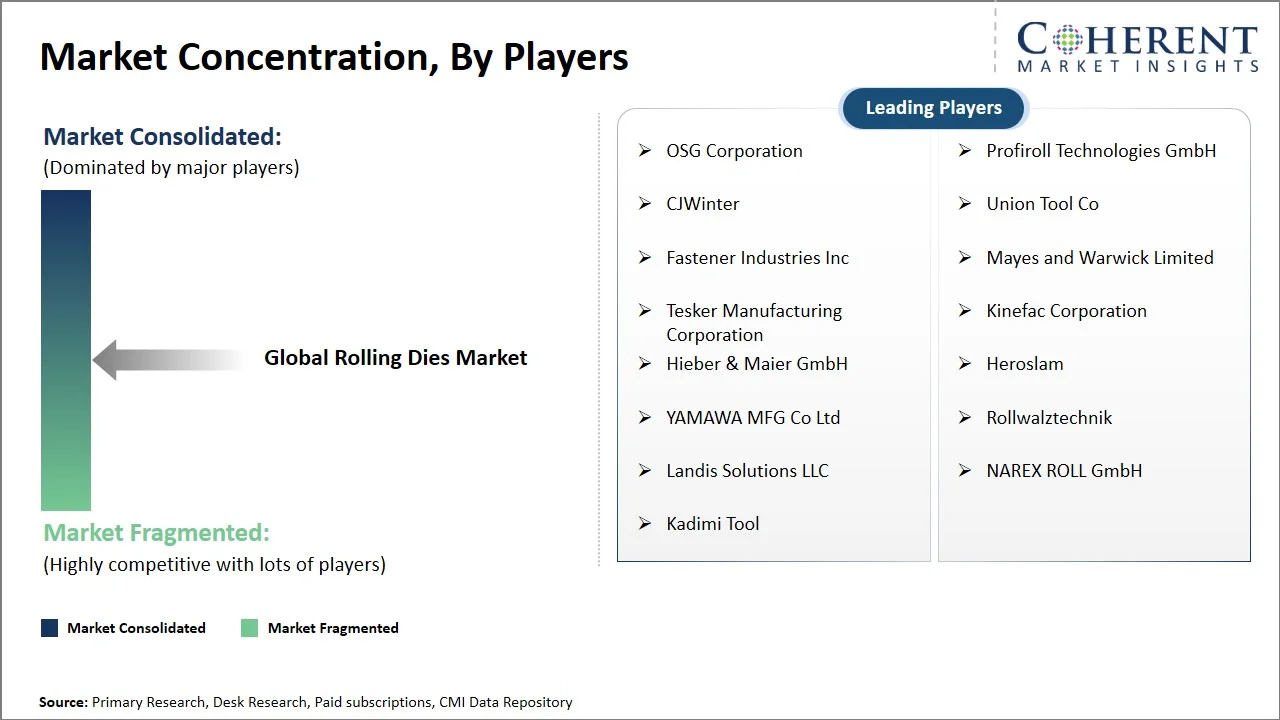
The rolling dies industry is headed by specialized tooling businesses supplying automotive and high-strength fastener makers. OSG Corporation specializes in bespoke rolling dies, precision grinding and long tool life. Kadimi International specializes in flat and round dies, automotive toolmaking and high-speed thread rolling solutions. Daido Machinery stands out with sophisticated die steels such as high-speed and powdered high-speed steel grades. Jyoti Tools Corporation targets special flat dies for automotive, industrial, structural and general-purpose fasteners. S.J.V. Tools has expanded from carbide dies into thread-rolling tooling for advanced cold-forging applications. Competition is therefore shifting toward precision profiles, longer die life, customized geometries, and application-specific materials.
Market Report Scope
Rolling Dies Market Report Coverage
| Report Coverage | Details | ||
|---|---|---|---|
| Base Year: | 2025 | Market Size in 2026: | USD 519.7 Mn |
| Historical Data for: | 2020 To 2024 | Forecast Period: | 2026 To 2033 |
| Forecast Period 2026 to 2033 CAGR: | 7% | 2033 Value Projection: | USD 829.1 Mn |
| Geographies covered: |
| ||
| Segments covered: |
| ||
| Companies covered: | OSG Corporation, Profiroll Technologies GmbH, CJWinter, Union Tool Co, Fastener Industries Inc, Mayes and Warwick Limited, Tesker Manufacturing Corporation, Kinefac Corporation, Hieber & Maier GmbH, Heroslam, YAMAWA MFG Co Ltd, Rollwalztechnik, Landis Solutions LLC, NAREX ROLL GmbH, Kadimi Tool | ||
| Growth Drivers: |
| ||
| Restraints & Challenges: |
| ||
Analyst Opinion (Expert Opinion)
- The future of rolling dies will be closely tied to higher-strength fasteners and increasingly complex automotive components. Electric vehicles will create demand for specialized fastening systems in battery structures, motors, and lightweight assemblies. High-speed steel and powdered high-speed steel should gain attention where manufacturers prioritize wear resistance and longer production runs.
- The best prospects are likely to be in automotive and aerospace fasteners that require strict tolerances on threads. Opportunities are particularly good in the Asia Pacific, where India is likely to see localized tooling and fastener production. The use of flat dies should be preferred for high volume automobile fasteners whereas customized cylindrical dies should be used for unique components.
- Market players looking for an edge should combine die manufacturing with application engineering and rapid customization. OSG already allows the specification-based development of dies and technical evaluation. Indian manufacturers can strengthen competitiveness by combining die design, heat treatment, precision grinding, and fast delivery. Longer die life, repeatable thread profiles, and shorter tooling replacement cycles should become major competitive differentiators.
Speak to the analyst
Want personalized insights?
Take the findings above to one of our principal consultants, or have the report rebuilt around the segments, geographies and competitors you actually track.
Market Segmentation
- Production Process Insights (Revenue, USD Million, 2021 - 2033)
- Cold Rolling
- Hot Rolling
- Warm Rolling
- Type Insights (Revenue, USD Million, 2021 - 2033)
- Rolling Flat Dies
- Thread Rolling Cylindrical Dies
- Rotary Type Thread Rolling Dies
- Rack Type Rolling Dies
- Others
- Material Insights (Revenue, USD Million, 2021 - 2033)
- High-Speed Steel
- Tungsten Carbide
- Carbon Steel
- Tool Steel
- Alloy Steel
- Application Insights (Revenue, USD Million, 2021 - 2033)
- Automotive
- Aerospace
- White Goods
- Medical
- Cutlery
- Consumer Electronics
- Regional Insights (Revenue, USD Million, 2021 - 2033)
- North America
- U.S.
- Canada
- Latin America
- Brazil
- Argentina
- Mexico
- Rest of Latin America
- Europe
- Germany
- U.K.
- Spain
- France
- Italy
- Russia
- Rest of Europe
- Asia Pacific
- China
- India
- Japan
- Australia
- South Korea
- ASEAN
- Rest of Asia Pacific
- Middle East
- GCC Countries
- Israel
- Rest of Middle East
- Africa
- South Africa
- North Africa
- Central Africa
- North America
- Key Players Insights
- OSG Corporation
- Profiroll Technologies GmbH
- CJWinter
- Union Tool Co
- Fastener Industries Inc
- Mayes and Warwick Limited
- Tesker Manufacturing Corporation
- Kinefac Corporation
- Hieber & Maier GmbH
- Heroslam
- YAMAWA MFG Co Ltd
- Rollwalztechnik
- Landis Solutions LLC
- NAREX ROLL GmbH
- Kadimi Tool
Sources
Primary Research Interviews
- Rolling Dies Manufacturers
- Automotive Component Suppliers
- Aerospace & Defense Industry Experts
- Industrial Machinery & Equipment Distributors
Magazines
- Manufacturing Engineering Magazine
- Modern Machine Shop Magazine
- Tooling & Production Magazine
Journals
- Journal of Manufacturing Science and Engineering
- International Journal of Machine Tools and Manufacture
- Journal of Materials Processing Technology
Associations
- Precision Metalforming Association (PMA)
- American Gear Manufacturers Association (AGMA)
- National Tooling and Machining Association (NTMA)
- Industrial Fasteners Institute (IFI)
Public Domain Sources
- U.S. International Trade Commission (USITC)
- U.S. Census Bureau – Manufacturing & Industrial Statistics
- European Commission – Industrial Policy Reports
- World Trade Organization (WTO) – Trade Statistics
Proprietary Elements
- CMI Data Analytics Tool
- Proprietary CMI Existing Repository of information for last 10 years
Get access to 250+ pages report
Every segment, forecast, competitor profile and data table behind the analysis above — available for instant download.
- ESOMAR Member
- ISO 9001:2015 Certified
- D-U-N-S Registered
- GDPR & CCPA Compliant
Missing comfort of reading report in your local language? Find your preferred language:
Frequently Asked Questions
The global rolling dies market is expected to stand at USD 519.7 Mn in 2026 and is expected to reach USD 829.1 Mn by 2033.
The CAGR of the global rolling dies market is projected to be 7% from 2026 to 2033.
They enable high-volume thread production with consistent dimensions and strong surface properties.
They produce precision threads and profiles for bolts, studs, shafts, and specialized automotive components.
Electric vehicles require specialized fasteners for battery systems, motors, inverters, and lightweight structures.
Longer die life reduces tooling changes, production interruptions, and replacement requirements.
Suitable coatings can reduce friction, wear, and material adhesion during forming.