

Global Rotating Car Seat Market Size and Forecast – 2026 To 2033
The Global Rotating Car Seat Market is estimated to be valued at USD 3.28 Bn and is expected to reach USD 4.35 Bn by 2033, growing at a compound annual growth rate (CAGR) of 4.10% from 2026 to 2033. This steady growth is driven by more parental focus on child passenger safety and product innovations that make every day travel easier. Manufacturers are introducing better swivel mechanism, ergonomic loading features and installation technologies to improve convenience while keeping safety performance.
In November 2026, Graco announced the commercial availability of its SnugRide Turn & Slide Rotating Infant Car Seat, featuring a combined rotation and sliding mechanism that brings the child closer to the caregiver during loading and unloading. The development is a practical product upgrade that underlines the growing commercial attractiveness of rotating child restraints.
Key Takeaways of the Global Rotating Car Seat Market
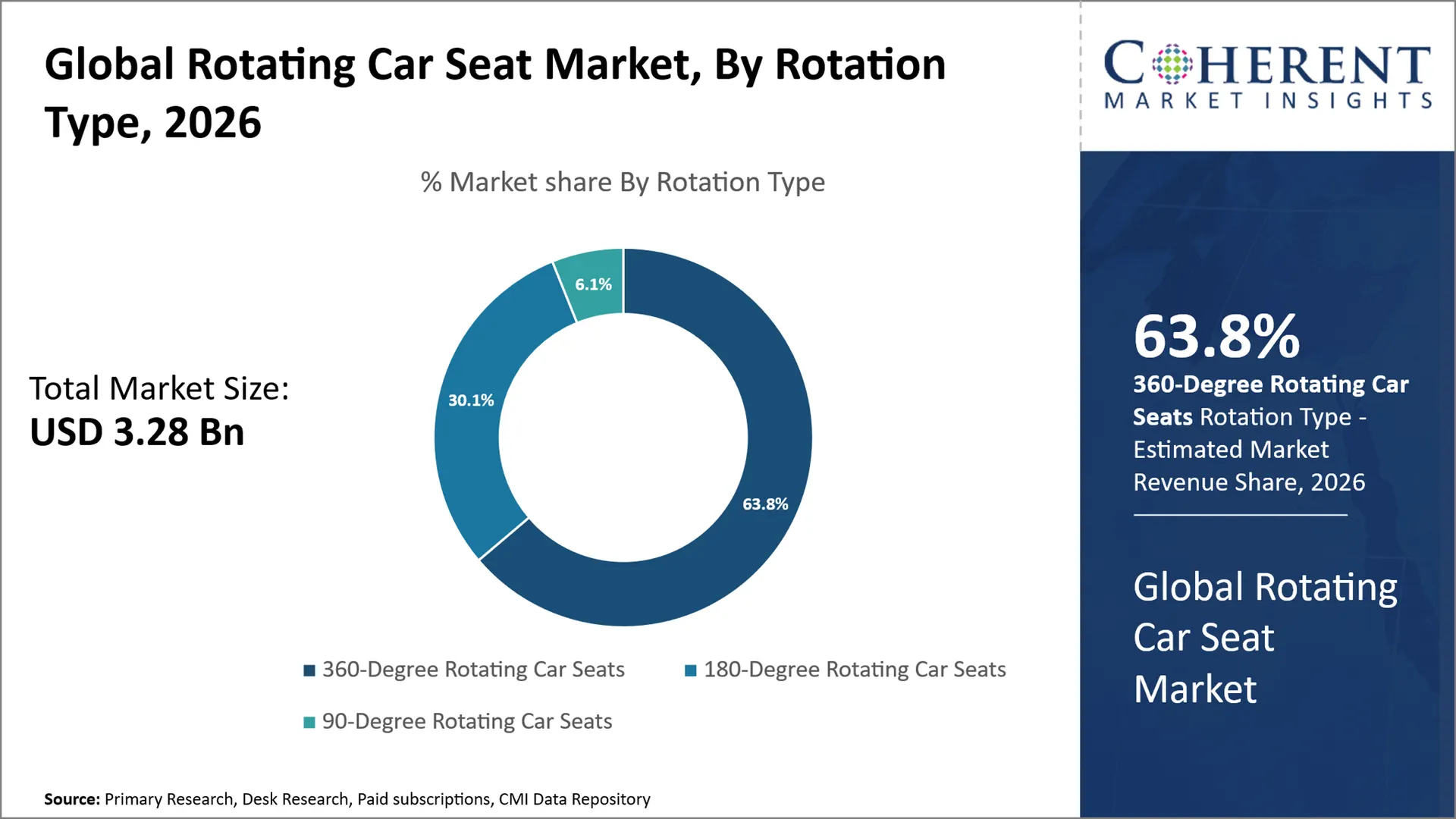
- 360-Degree Rotating Car Seats are expected to grow at a CAGR of 4.5% through 2033 and will account for 63.8% of the global rotating car seat market revenue by 2026. Dedicated anchors and installation indicators make secure fitment easier to assess, particularly with rotating bases. Graco's EasyTurn 360 two-in-one model, released in February 2025, makes it easy to access in both rear-facing and forward-facing positions.
- Convertible Rotating Car Seats are projected to record an estimated 4.3% CAGR through 2033 and secure a 59.6% share of the global rotating car seat market in 2026. The multiple stages of design mean they’re useful from infancy to toddlerhood, so they add value per purchase for families. Britax unveiled the Galaxy360 in February 2026, available in rear- and forward-facing modes in a slim package for tighter vehicle interiors.
- ISOFIX & LATCH-Based Installation is anticipated to witness an estimated CAGR of 4.6% during the forecast period, holding 69.4% of the global rotating car seat market in 2026. The rotating bases with dedicated anchors and installation indicators allow easy assessment of the secure fitment. Silver Cross launched its Plus 360 collection in May 2025, which includes an ISOFIX base with 360-degree rotation, a support leg and a visual installation indicator.
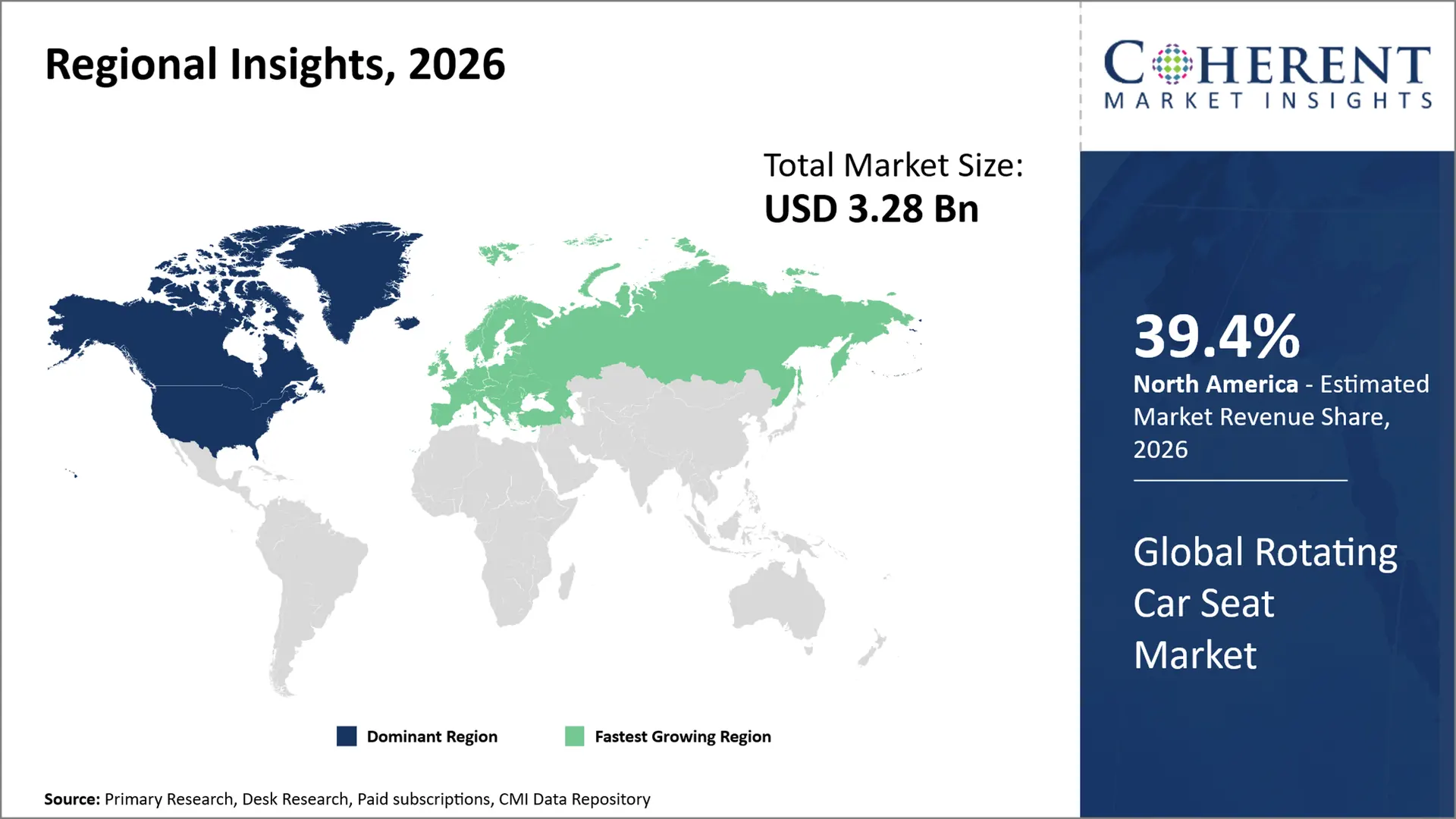
- North America is projected to grow at an estimated 3.5% CAGR through 2033 while accounting for 39.4% of global rotating car seat market revenue in 2026. Higher value purchases supported by established specialist retail channels and safety-focused product differentiation. The U.S.-based Baby Safety Alliance in October 2025 declared Chicco’s Fit360 Zip ClearTex the winner in its Child Restraint Systems category.
- Europe is expected to register an estimated 5.2% CAGR through 2033, alongside a 31.6% share of the global rotating car seat market in 2026, making it the fastest-growing region. The need for more rearward travel allows for the possibility of safety-minded swivel designs. In February 2025, Swedish maker Axkid introduced the Spinkid 2, a 180 degree rear facing model that passed the Swedish Plus Test.
Segmental Insights
Why Do 360-Degree Rotating Car Seats Dominate the Global Rotating Car Seat Market?
360-Degree Rotating Car Seats are expected to account for 63.8% of the global rotating car seat market in 2026. The common rotational platform allows them to be leaders in accommodating rear-facing and forward-facing configurations as well as flexibility across vehicle layouts. For households, full swivel functionality supports adjustments when seating arrangements change, particularly in shared family vehicles. Manufacturers can differentiate themselves with durable pivot mechanisms, reliable travel-position locking systems, and materials that can take the abuse of frequent adjustments. These engineering requirements also provide opportunities for specialized component suppliers. In July 2025, South Korean manufacturer Daiichi launched the One-Fix 360 Season 3 Air, a rotating car seat offering that incorporates premium breathable materials. This introduction shows how manufacturers can add comfort-oriented improvements to existing rotational platforms without losing their basic functionality.
- Current Industry Events of 2026
- Market Size Estimation
- Regional Breakdown
- Competitive Landscape
- Customer Intelligence
- Segmental Analysis
- Pricing Analysis
- Key Market Drivers, Challenges & Future Trends
- Customized Insights Section
Why Do Convertible Rotating Car Seats Represent the Largest Product Type in the Global Rotating Car Seat Market?
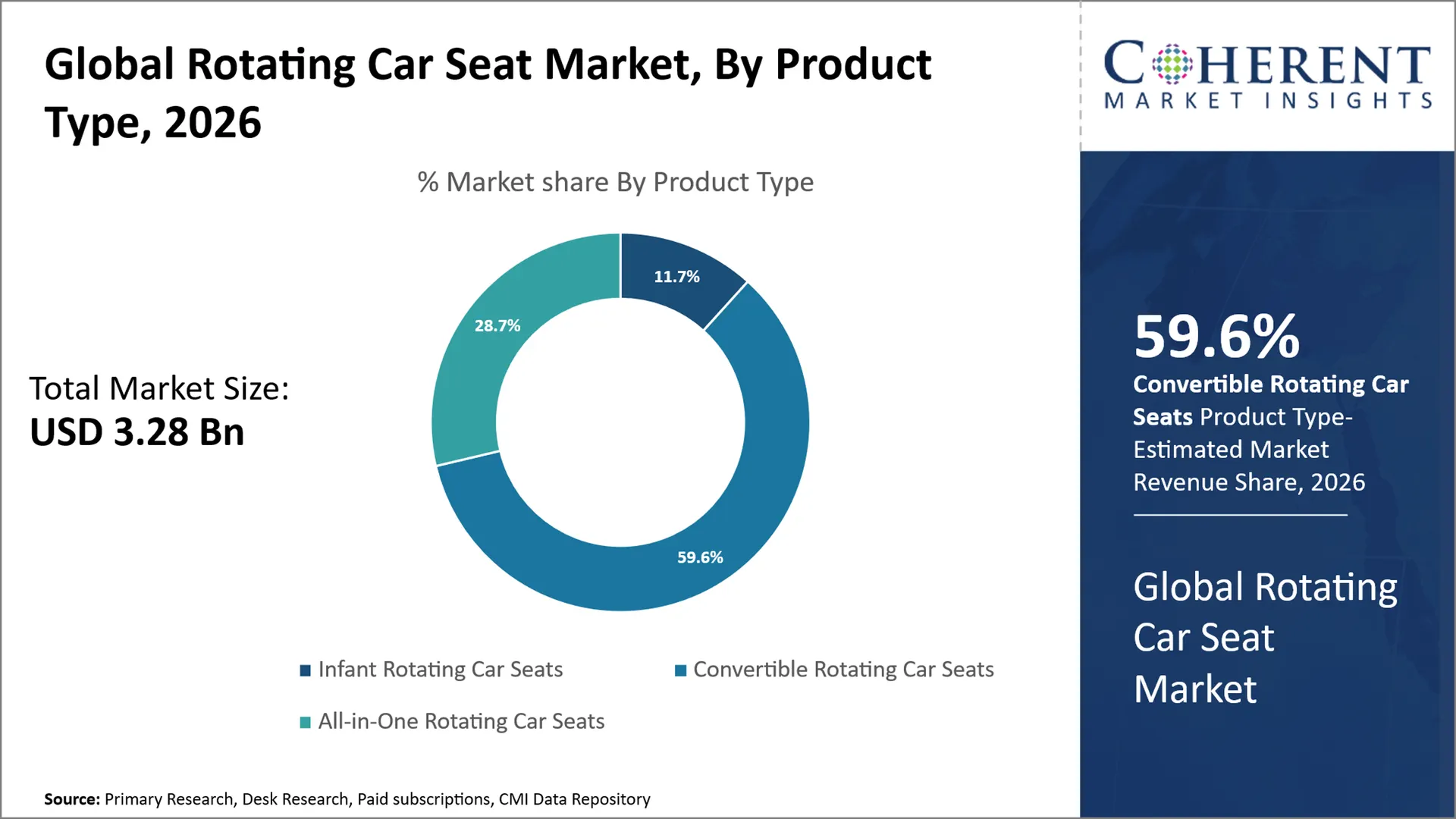
Convertible Rotating Car Seats are projected to represent 59.6% of the global rotating car seat market in 2026. They lead with the ability to keep the harness in the correct position, the recline angles and the head support in all stages of the child's development. Adjustable parts allow parents to modify approved seating configurations without having to learn an entire new restraint system. The convertible designs concentrate engineering investment on adaptable seat structures for manufacturers, but require extensive testing across child sizes and travel orientations. Specialty retailers prefer to sell products with well-defined adjustment capabilities. In June 2026, iCandy introduced the Cocoon 360 Baby & Beyond car seat, designed for children measuring 40–105 cm, featuring adjustable head support, multiple recline positions, and rearward- and forward-facing configurations. It’s design points to the need for child-specific fit adjustments in convertible restraint systems.
Why Does ISOFIX & LATCH-Based Installation Dominate the Installation Type Segment of the Global Rotating Car Seat Market?
ISOFIX & LATCH-Based Installation is expected to hold 69.4% of the global rotating car seat market in 2026. The upside is it has standard vehicle anchor points so manufacturers can come up with secure attachments without having to only use seat belt routing. This is particularly crucial for rotating models where the base must remain firmly in position as the seat is moved. Suppliers of components benefit from the demand for durable connectors, support legs and installation feedback systems. Manufacturers also need to give reliable information about vehicle compatibility so that fitting errors can be reduced. In October 2024, Thule announced that its Maple infant seat with the Alfi ISOFIX base received a 1.6 score in ADAC child car seat testing. This result supports the commercial significance of reliable anchorage systems, installation engineering and independent product appraisal.
Current Events and their Impact
Current Event | Description and Its Impact |
November 2026 – Australia Opens Consultation on Updated Child Restraint Safety Requirements |
|
September 2026 – U.S. Revises Child Restraint Side-Impact Compliance Timeline |
|
April 2026 – European Commission Identifies Child Car Seat Safety Compliance Failures |
|
Global Rotating Car Seat Market Dynamics
Key Market Drivers
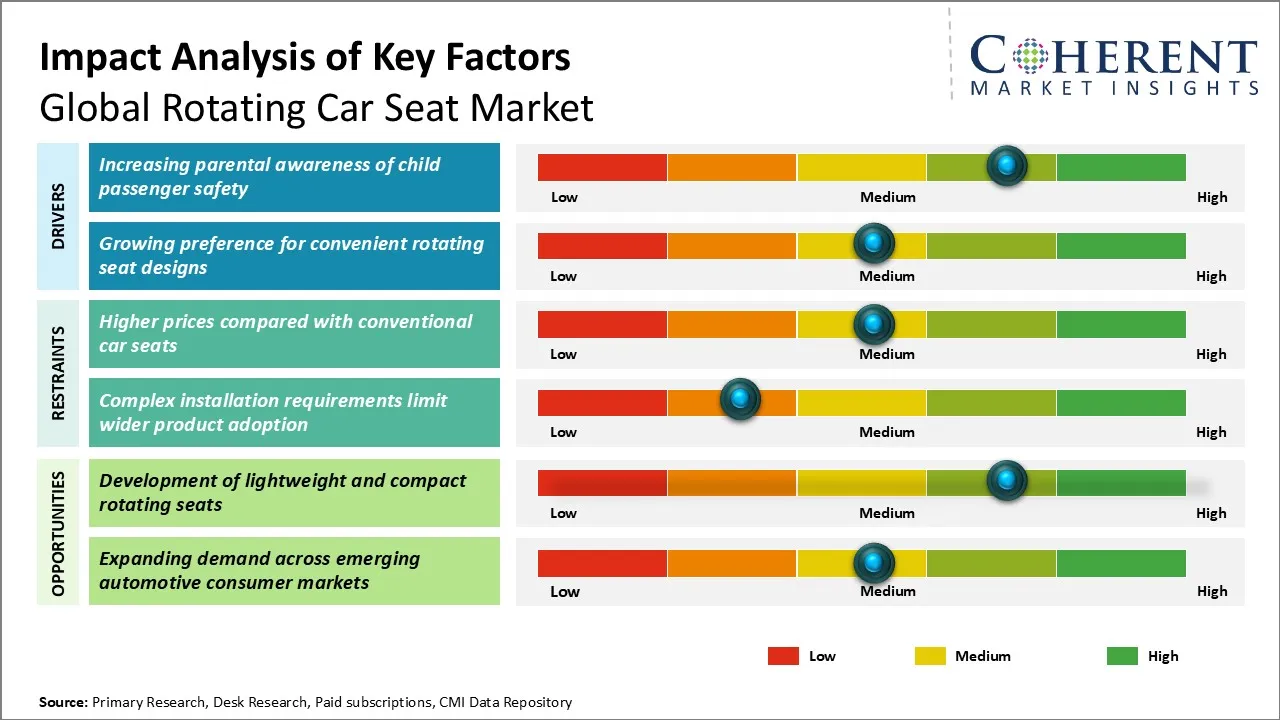
- Increasing parental awareness of child passenger safety: Parents are getting more concerned with the quality of installation, selection of appropriate restraints, and placement of the seats that are appropriate to the child’s age. A better understanding of installation errors encourages purchases that provide clearer fitting instructions, adjustable harnesses, and reliable restraint mechanisms. This is advantageous for certified manufacturers, specialist retailers and child passenger safety educators by emphasizing the significance of product suitability as a purchasing criterion. In September 2025, AAA and the National Safety Council highlighted research indicating that 67% of car seats inspected in 2024 were improperly installed or used, reinforcing the commercial importance of user-friendly safety features.
- Growing preference for convenient rotating seat designs: Frequent child loading and unloading makes accessibility an important consideration for families purchasing car seats. The swivel mechanisms allow the caregivers to move the seat very close to the vehicle’s door, thus reducing the need for awkward reaching when securing children. Manufacturers can use this advantage to set their products apart, while retailers can demonstrate practical convenience when customers are shopping. In August 2025, Evenflo featured its REO by Revolve360 convertible car seat, designed for everyday family use and secondary vehicles, featuring a compact footprint and one-handed rotation. This increases the commercial appeal of rotating restraints beyond premium buyers.
Emerging Market Trends
- Increasing Importance of Material Transparency in Child Car Seats: Parents are becoming more attentive to upholstery composition, chemical treatments, and prolonged skin contact with car seat materials. Manufacturers are consequently exploring fabrics with clearer material disclosures and fewer unnecessary chemical additives.
- Impact: Supplier qualification requirements may be increased and investment in documented material safety may be encouraged through more transparency. Lesser manufacturers may face higher sourcing and testing costs, while premium brands may gain product differentiation.
- Relevance to Market: Beyond crash protection, material specifications are likely to play a bigger role in the purchase decision. Clear documentation can help increase the confidence of retailers and increase the premium positioning.
- Shift Toward Active Usage Feedback and Smart Safety Monitoring: Rotating car seat designs are enabling the integration of electronic indicators to monitor certain installation and restraint conditions. Connected alerts might be a supplement to mechanical locking systems helping caregivers to detect particular use errors.
- Impact: The integration of sensors can create new opportunities for premium restraint manufacturers and electronics suppliers. However, the additional costs of components, the need for battery management and the need for reliability may limit the potential for broader adoption.
- Relevance to Market: Smart monitoring is likely to remain a premium feature, a choice rather than a must-have. Manufacturers that can provide reliable alerts without complicating daily operations could establish a more robust product differentiation.
Regional Insights
Why Does North America Dominate the Global Rotating Car Seat Market?
North America is expected to account for 39.4% of the global rotating car seat market in 2026, supported by established child restraint purchasing practices and extensive specialty retail networks. U.S. and Canadian consumers have access to multiple rotating car seat configurations through childcare retailers and online platforms, encouraging product comparisons based on functionality, safety, and vehicle suitability. Manufacturers are increasingly addressing installation challenges through integrated feedback mechanisms that improve the ownership experience. In January 2026, Maxi-Cosi USA showcased its Andi 360 all-in-one convertible car seat, featuring a color-changing belt-tension indicator alongside rotating functionality. This development demonstrates how manufacturers can differentiate their products by integrating installation assistance with everyday convenience, strengthening premium positioning within the North American market.
Why Is Europe Emerging as the Fastest-Growing Region in the Global Rotating Car Seat Market?
Europe is projected to capture 31.6% of the global rotating car seat market in 2026, while recording the fastest regional growth. Stricter child restraint requirements encourage manufacturers to redesign products around height-based suitability, side-impact protection, and standardized installation systems. European suppliers are consequently positioned to expand their portfolios of compliant rotating restraints while strengthening technical differentiation. In September 2024, the European Union completed its transition away from new sales of R44-approved child restraints, requiring products newly sold through retail channels to comply with UN Regulation No. 129. This transition supports ongoing product portfolio modernization and creates opportunities for manufacturers offering certified rotational systems that meet current European safety requirements.
Global Rotating Car Seat Market Outlook for Key Countries
Why Is the U.S. a Key Market for the Global Rotating Car Seat Market?
The U.S. continues to be a leading country market for rotating car seats, with purchases of child restraints shaped by particular safety guidance and a broad ecosystem of pediatric advisers, certified fitting technicians, retailers and vehicle manufacturers. Buyers can assess whether a seat fit based on the size of the child, the configuration of the vehicle, and the way the seat is installed not on rotation as a benefit in and of itself. This creates opportunities for suppliers that offer clear fit lists, practical demonstrations and accessible installation support. In April 2026, the American Academy of Pediatrics updated its car seat guidance to emphasize proper fit to the child, correct installation and consistent use. The guidance underlines the need for clear product instructions and trained retail help as manufacturers provide more mechanically complex rotating seats.
Why Does China Support Growth in the Global Rotating Car Seat Market?
China is a key contributor to the rotating car seat market, both as a manufacturing hub and a source of product engineering capabilities. Domestic suppliers may utilize automotive plastics, metal hardware, electronics and assembly operations to produce swivel mechanisms and finished child restraints. They are also able to service different price points, enabling domestic distribution and export-oriented product portfolios, although compliance requirements increase engineering costs. In April 2026, China’s State Administration for Market Regulation unveiled its new technical standard for electronically equipped child restraints, which includes reliability tests for rotating parts and electrical safety and installation reminders. The framework might encourage suppliers to put money into validated electronic features rather than competing only on the basis of production cost.
Why Is Germany a Strategic Country in the Global Rotating Car Seat Market?
Germany is strategically important as manufacturers focuses on engineering detail, compliance expertise and specialized product development. Domestic manufacturers may optimize structural features such as anchorage geometry, swivel locking and base construction to accommodate packaging limitations within the passenger vehicle. The technological emphasis allows German suppliers to cater to demanding European retail channels and overseas distributors who appreciate product differentiation. In June 2026, Germany-based Osann launched new versions of its Taos360 midi that secures Top Tether anchorage to the base to maintain rotation through supported child-size categories without the need for a support leg. The design shows the possibility for mechanical architecture to extend usability and to create unique competitive advantages.
Why Is Japan an Important Growth Market for the Global Rotating Car Seat Market?
Japan plays a distinctive role in the global rotating car seat market because manufacturers must address compact passenger cabins and frequent caregiver access to rear seats. In addition to certified protection, buyers will probably appreciate manageable seat dimensions, intuitive harness handling and well-organized retail demonstrations. Therefore, the development of domestic products is related to the interaction between restraint ergonomics and daily family life. Aprica announced the Cururila Fit AB rotating child seat for release in early October 2026, with magnetic harness tongues and a buckle designed to stay out of the way when putting the child into the seat. Retailer-specific variants also demonstrate how manufacturers can customize product assortments to established Japanese baby-goods channels.
Consumer Safety Features and Product Evolution Landscape in the Global Rotating Car Seat Market
Product Technology | Core Function | Adoption Landscape | Commercial Relevance |
Mechanical Swivel-Lock Systems | Enable controlled rotation and secure the seat in its approved travel orientation. | Established across rotating designs, with differences in locking mechanisms. | Positive lock indication and secure engagement can reduce warranty claims and concerns about misuse. |
ISOFIX & LATCH Anchorage Systems | Use compatible vehicle anchorages to secure child restraint. | Commonly used in compatible rotating seats | Enhance ease of installation and increase attraction to safety-aware purchasers. |
Side-Impact Energy Absorption | Uses protective structures and energy absorbing materials to manage the forces of a side-impact crash. | Embedded in several product lines, each with different designs. | Supports product differentiation and compliance with applicable crash-test standards. |
Support Legs and Anti-Rebound Systems | Helps manage movement of restraint during certain crash conditions. | Product specific, depending on the installation architecture and applicable standards. | Engineer in more differentiation where testing and vehicle compatibility allow. |
No-Rethread Harness Adjustment | Allows harness height adjustment without manually rerouting straps. | Available with different convertible and multi-stage rotating seats. | Improves adjustment convenience and supports continued use as children grow. |
Multi-Position Recline and Angle Controls | Allow approved seating-angle adjustments based on child size and travel direction. | Often found in many convertible and premium spin models. | Helps manufacturers meet comfort and positioning requirements during various stages of development. |
How Are Family-Oriented Mobility Services Creating New Growth Opportunities in the Global Rotating Car Seat Market?
Family-focused car rental and mobility services have an underdeveloped opportunity for rotating car seat manufacturers. Unlike individual households, commercial operators need restraints that can deal with different passengers, can be frequently handled and allow for efficient vehicle preparation between bookings. These requirements provide opportunities for manufacturers to develop commercial-use solutions including durable swivel mechanisms, easy-clean upholstery, standardized installation guidance and documented maintenance procedures.
Car rental operators, airport mobility providers and family transportation services could be interesting institutional customers. Manufacturers get access to these buyers through fleet supply agreements, vehicle compatibility assessments and operator training programs.
Success depends on commitment to product durability, liability management, availability of replacement parts, and reliable distribution. Specialist manufacturers with the established safety testing capabilities and strong after-sales support are likely to be better positioned. Commercial adoption will hinge on operators’ ability to justify the cost of the equipment through service differentiation, operational efficiency and customer satisfaction.
Market Players, Key Developments, and Competitive Intelligence
Key Developments
- In August 2026, Joie announced its expansion into Canada, including the chili spin SI rotating car seat within its product offering. This entry creates additional opportunities to reach Canadian consumers through established retail and online distribution channels while increasing competition among manufacturers offering accessible rotating child restraints.
- In May 2026, CYBEX's Sirona Ti rotating car seat received Best in Class recognition in its category during ADAC testing. The result highlights the commercial importance of independent safety assessments, enabling premium manufacturers to support product positioning through externally assessed performance rather than relying exclusively on design features.
- In March 2026, Nuna introduced the REVV maxx rotating convertible car seat, extending the product's forward-facing suitability to 65 pounds. The development strengthens the company's premium product offering by increasing the potential usable period of its rotating restraint, making product longevity an additional consideration in purchasing decisions.
Competitive Landscape
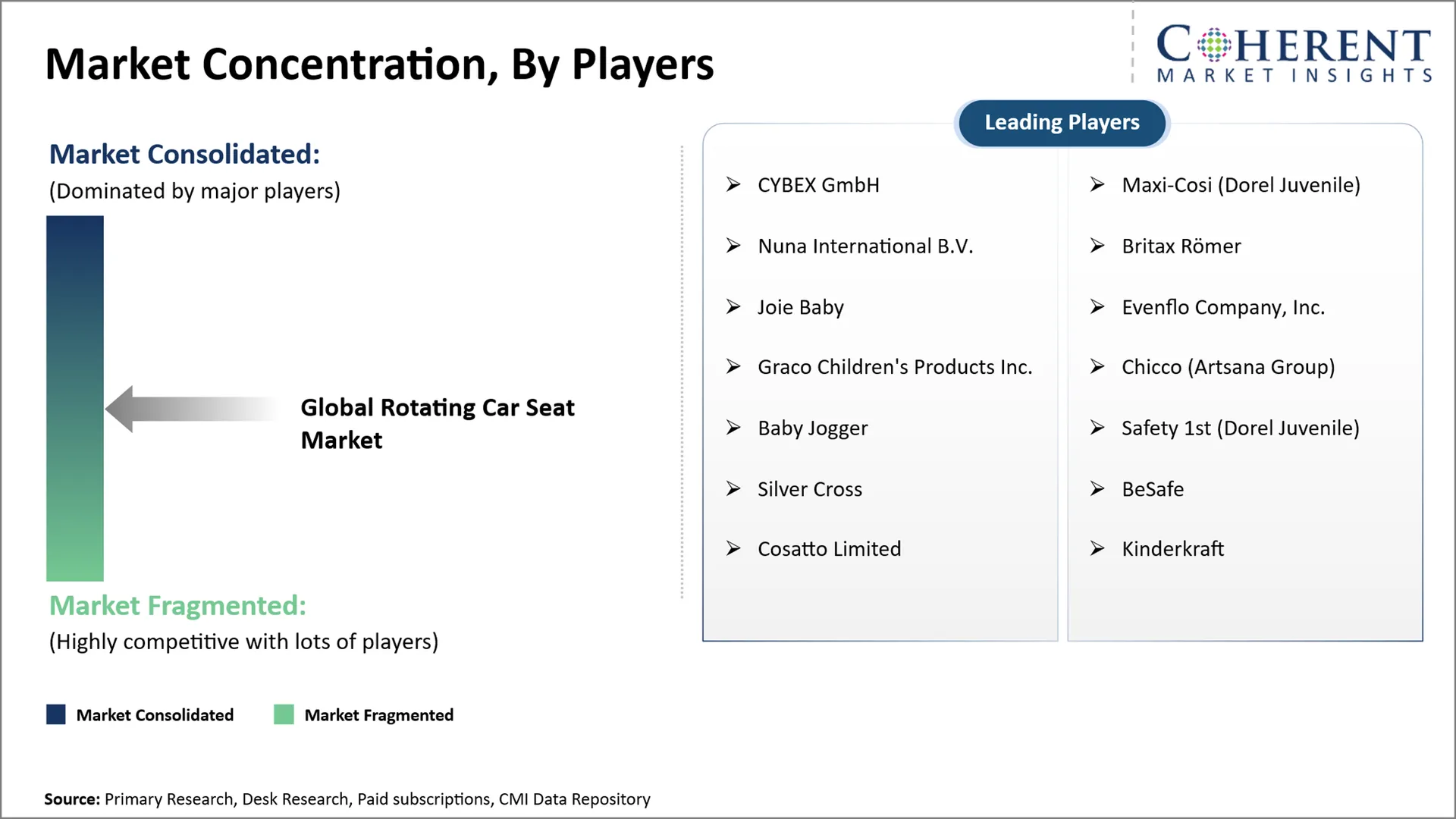
The global rotating car seat market is moderately fragmented comprising premium restraint specialists, established international childcare brands and regional manufacturers. Competition is not only about the price of the product, it is about engineering reliability, vehicle compatibility, independent safety assessments and distribution capabilities. Specialist manufacturers have a competitive advantage because they specialize in product portfolios. International companies have established retail relationships. From a commercial standpoint, it is important to have a stable manufacturing quality and reliable customer support.
Key focus areas include
- Mechanical Durability: Swivel mechanisms should be able to withstand repeated use without affecting the security of the locking mechanism.
- Vehicle Compatibility: Increasing the fitment coverage of the product to provide accessibility for a wider range of vehicles.
- Certification Capabilities: The testing infrastructure and compliance expertise are the factors that impact the development costs and market entry readiness.
- Pricing Strategy: Efficient manufacturing and controlled feature costs help preserve competitive margins.
- Supply Reliability: Reliable components availability is fundamental for planning of retailer inventory and production continuity.
- Distribution Network: Childcare retailers, automotive channels and online platforms help to grow the customer base.
- Warranty and Support: Providing replacement parts, responsive service, and clear user instructions helps to build long-term customer relationships.
Market Report Scope
Global Rotating Car Seat Market Report Coverage | |||
Report Coverage | Details | ||
Base Year | 2025 | Market Size in 2026: | USD 3.28 Bn |
Historical Data For: | 2020 to 2024 | Forecast Period: | 2026 to 2033 |
Forecast Period 2026 To 2033 CAGR: | 4.10% | 2033 Value Projection: | USD 4.35 Bn |
Geographies covered: |
| ||
Segments covered: |
| ||
Companies covered: | CYBEX GmbH, Maxi-Cosi (Dorel Juvenile), Nuna International B.V., Britax Römer, Joie Baby, Evenflo Company, Inc., Graco Children's Products Inc., Chicco (Artsana Group), Baby Jogger, Safety 1st (Dorel Juvenile), Silver Cross, BeSafe, Cosatto Limited, Kinderkraft | ||
Growth Drivers: |
| ||
Restraints & Challenges: |
| ||
Analyst Opinion (Expert Opinion)
- Future Market Direction: The global rotating car seat market is expected to lean toward a more robust differentiation based on the ownership experience rather than just the product features. Manufacturers offering structured warranty support, accessible replacement parts and dependable service can improve customer loyalty. This transition may work well for organizations that can manage customer relationships and product performance during the useful life of the restraint.
- Transformative Trend or Disruption: Direct-to-consumer childcare brands can be disruptive to traditional distribution models by combining digital product education with more transparent pricing and direct relationships with customers. It may force established manufacturers to re-evaluate their channel strategies and put pressure on traditional retail margins. This shift can be a positive for brands with robust customer support and efficient fulfillment processes.
- Strategic priorities, risks and recommendations: Manufacturers should prioritize rotation-mechanism durability, rigorous safety testing, and cost-efficient product engineering. Investment in diversified component sourcing can reduce supply disruptions, while regional compliance expertise can support international expansion. Companies should avoid excessive spending on complex features with limited customer value and instead focus on dependable performance, manageable production costs, and sustainable pricing.
Speak to the analyst
Want personalized insights?
Take the findings above to one of our principal consultants, or have the report rebuilt around the segments, geographies and competitors you actually track.
Market Segmentation
- Rotation Type Insights (Revenue, USD Bn, 2021 - 2033)
- 360-Degree Rotating Car Seats
- 180-Degree Rotating Car Seats
- 90-Degree Rotating Car Seats
- Product Type Insights (Revenue, USD Bn, 2021 - 2033)
- Infant Rotating Car Seats
- Convertible Rotating Car Seats
- All-in-One Rotating Car Seats
- Installation Type Insights (Revenue, USD Bn, 2021 - 2033)
- ISOFIX & LATCH-Based Installation
- Seat Belt-Based Installation
- Price Range Insights (Revenue, USD Bn, 2021 - 2033)
- Below USD 200
- USD 200–400
- Above USD 400
- End User Insights (Revenue, USD Bn, 2021 - 2033)
- Individual Consumers
- Commercial Transport Operators
- Car Rental & Mobility Services
- Distribution Channel Insights (Revenue, USD Bn, 2021 - 2033)
- Specialty Baby & Childcare Stores
- Online Retail
- Supermarkets & Hypermarkets
- Other Distribution Channels
- Regional Insights (Revenue, USD Bn, 2021 - 2033)
- North America
- U.S.
- Canada
- Latin America
- Brazil
- Argentina
- Mexico
- Rest of Latin America
- Europe
- Germany
- U.K.
- Spain
- France
- Italy
- Russia
- Rest of Europe
- Asia Pacific
- China
- India
- Japan
- Australia
- South Korea
- ASEAN
- Rest of Asia Pacific
- Middle East
- GCC Countries
- Israel
- Rest of Middle East
- Africa
- South Africa
- North Africa
- Central Africa
- North America
- Key Players Insights
- CYBEX GmbH
- Maxi-Cosi (Dorel Juvenile)
- Nuna International B.V.
- Britax Römer
- Joie Baby
- Evenflo Company, Inc.
- Graco Children's Products Inc.
- Chicco (Artsana Group)
- Baby Jogger
- Safety 1st (Dorel Juvenile)
- Silver Cross
- BeSafe
- Cosatto Limited
- Kinderkraft
Sources
Primary Research Interviews
- Rotating car seat manufacturers, child restraint system developers, and product engineers
- Automotive safety specialists, crash-testing experts, and certification professionals
- Childcare product distributors, specialty retailers, and e-commerce suppliers
- Pediatric safety experts, child passenger safety technicians, and installation consultants
- Parents, caregivers, commercial transport operators, and car rental companies
Stakeholders
- Rotating car seat and child restraint system manufacturers
- Swivel mechanism, locking system, and rotating base suppliers
- Harness, buckle, ISOFIX, LATCH, and seat belt component suppliers
- Automotive OEMs and vehicle seating system manufacturers
- Crash-testing laboratories and product certification agencies
- Specialty baby stores, wholesalers, and online retailers
- Commercial transport operators and mobility service providers
End-use Sectors
- Individual Consumers: Infant transportation, child safety, and everyday family travel
- Commercial Transport Operators: Child passenger transportation and fleet-installed restraints
- Car Rental & Mobility Services: Rental vehicles, family mobility, and temporary child seating solutions
Product Applications
- Infant and newborn transportation
- Rear-facing and forward-facing child restraint applications
- Convertible and all-in-one child seating
- 90-degree, 180-degree, and 360-degree rotation
- ISOFIX and LATCH-based vehicle installation
- Seat belt-based child restraint installation
- Everyday child loading, positioning, and secure fastening
Regulatory and Industry Bodies
- National Highway Traffic Safety Administration (NHTSA), U.S.
- United Nations Economic Commission for Europe (UNECE)
- European Commission – Vehicle Safety Regulations
- Transport Canada – Motor Vehicle Safety Directorate
- Ministry of Road Transport and Highways (MoRTH), India
- Automotive Research Association of India (ARAI)
- State Administration for Market Regulation (SAMR), China
- Ministry of Land, Infrastructure, Transport and Tourism (MLIT), Japan
- Australian Department of Infrastructure, Transport, Regional Development, Communications and the Arts
Databases
- UN Comtrade and ITC Trade Map
- Eurostat – Automotive and Trade Statistics
- U.S. Census Bureau – Automotive and Retail Trade Data
- NHTSA – Vehicle Safety Standards, Recalls and Compliance Testing Database
- Transport Canada – Motor Vehicle Safety Recalls Database
- European Commission – Safety Gate Product Recall Database
- China National Standards Information Public Service Platform
- Company Annual Reports, Product Catalogues, and Investor Presentations
- Google Trends – Child Car Seat and Rotating Car Seat Search Interest
- E-commerce Product Listings, Pricing, and Consumer Review Databases
- WIPO Patentscope and Google Patents
Magazines and Journals
- Traffic Injury Prevention
- Accident Analysis & Prevention
- Injury Prevention
- Journal of Safety Research
- SAE International Journal of Transportation Safety
- Automotive News
- Consumer Reports
- Automotive Testing Technology International
Associations
- Baby Safety Alliance (Formerly Juvenile Products Manufacturers Association – JPMA)
- National Child Passenger Safety Board (NCPSB)
- Safe Kids Worldwide
- Child Passenger Safety Association of Canada (CPSAC)
- Global New Car Assessment Programme (Global NCAP)
- European New Car Assessment Programme (Euro NCAP)
- International Consumer Research & Testing (ICRT)
Public Domain Sources
- Child restraint system product catalogues and manufacturer technical specifications
- Rotating mechanism, ISOFIX anchorage, and LATCH installation documentation
- Child restraint crash-testing reports and safety performance assessments
- Vehicle compatibility guides and child seat installation manuals
- Child passenger injury statistics and road safety research
- Product recalls, safety alerts, and regulatory compliance disclosures
- Automotive production, vehicle ownership, and passenger vehicle registration data
- Product launches, manufacturing investments, and distribution agreements
- Patent filings covering swivel mechanisms, locking systems, and restraint designs
- Consumer purchasing preferences, product pricing, and retail distribution trends
Key Standards and Regulations
- UN Regulation No. 129 – Enhanced Child Restraint Systems (i-Size)
- U.S. FMVSS No. 213 – Child Restraint Systems
- U.S. FMVSS No. 213a – Child Restraint Systems, Side-Impact Protection
- U.S. FMVSS No. 225 – Child Restraint Anchorage Systems (LATCH)
- Canada CMVSS 213 and 213.1 – Child and Infant Restraint Systems
- India AIS-072-2009 – Child Restraint Systems
- China GB 27887-2024 – Child Restraint Systems for Power-Driven Vehicles
- Australia ADR 34 – Child Restraint Requirements
- AS/NZS 1754 – Child Restraints for Use in Motor Vehicles
- ISO 13216 – ISOFIX Anchorage Systems for Child Restraints
- ISO 29061-1:2026 – Usability Evaluation of Child Restraint Systems and ISOFIX Interfaces
Proprietary Elements
- CMI Data Analytics Tool
- Proprietary research repository, supported by primary interviews, rotating car seat product and manufacturer analysis, rotation mechanism benchmarking, installation system assessment, product pricing and ASP benchmarking, child safety and consumer purchasing behavior analysis, vehicle compatibility assessment, competitive benchmarking, product launch tracking, and global market intelligence.
Get access to 250+ pages report
Every segment, forecast, competitor profile and data table behind the analysis above — available for instant download.
- ESOMAR Member
- ISO 9001:2015 Certified
- D-U-N-S Registered
- GDPR & CCPA Compliant
Frequently Asked Questions
The global rotating car seat market is projected to register a CAGR of 4.10% from 2026 to 2033.
The global rotating car seat market is valued at USD 3.28 Bn in 2026 and is expected to reach USD 4.35 Bn by 2033.
Consumers should evaluate side-impact protection, secure harness systems, reliable rotation locks, installation indicators, and compliance with applicable child restraint safety standards.
No. Compatibility depends on vehicle anchorage systems, available cabin space, seat dimensions, support-leg requirements, and manufacturer-approved vehicle fitment.
Rotating car seats feature a swivel mechanism that allows the restraint to turn toward the vehicle door, making child placement and harness fastening more convenient than with conventional fixed-position seats.
Manufacturers are focusing on improved swivel-lock mechanisms, one-hand rotation, adjustable recline systems, magnetic harness components, installation feedback indicators, and lightweight structural designs to improve product functionality and user experience.
Increasing parental awareness of child passenger safety and a growing preference for convenient rotating seat designs are the major factors driving growth in the global rotating car seat market.