

Global Satellite Direct-to-Device Network Software Market Size and Forecast – 2026 To 2033
The global satellite direct-to-device network software market is expected to grow from USD 0.45 Bn in 2026 to USD 2.55 Bn by 2033, registering a compound annual growth rate (CAGR) of 29.3% from 2026 to 2033. The global satellite direct-to-device network software market is rising adoption of non-terrestrial network technologies. On august 13, 2025, OQ Technology announced the official launch of its flagship 5NETSAT mission, supported by a USD 2.7 million grant from the European Innovation Council (EIC) under the prestigious EIC Accelerator program.
Key Takeaways of the Global Satellite Direct-to-Device Network Software Market
- The Network Management Software segment is expected to account for 43.0% of the global satellite direct-to-device network software market share in 2026. Increasing demand for uninterrupted emergency communication services is driving the growth of the segment. On March 3, 2026, MediaTek announced collaboration with Starlink to support emergency alerts through satellite connectivity. The demonstration used the MediaTek M90 modem with integrated satellite technology.
- The Low Earth Orbit Satellite Networks segment is estimated to capture 46.0% of the market share in 2026. Growing integration of satellite connectivity into standard smartphones is majorly driving the growth of the segment. On November 18, 2025, Orange introduced satellite-based SMS connectivity for customers in mainland France. The service uses Skylo's Non-Terrestrial Network infrastructure and supports compatible Google Pixel 9 and Pixel 10 smartphones.
- The 3GPP Non-Terrestrial Network segment is estimated to capture 39.0% of the market share in 2026. Expansion of satellite-based Internet of Things applications is driving the growth of the segment. On October 8, 2025, Sateliot completed its first commercial 5G Internet of Things transmission from Low Earth Orbit satellites to a standard cellular IoT device. Nordic Semiconductor and Gatehouse Satcom participated in the demonstration.
- North America is expected to dominate the satellite direct-to-device network software market in 2026 with a market share of 42.0%. Integration of AI into satellite network management in North America is driving the growth of the regional market. On March 3, 2025, G&S SatCom announced a strategic technology partnership with Intelsat to deploy its SatConnect artificial intelligence platform. The platform manages Intelsat's geostationary satellites and partner Low Earth Orbit networks.
- Asia Pacific is expected to account for 31.0% share in 2026. Development of automated satellite resource allocation platforms in Asia Pacific is driving the growth of the regional market. On March 18, 2025, Orion Satellite Systems enhanced its Horizon platform with artificial intelligence capabilities. The platform forecasts satellite data consumption across LEO, GEO, and MEO constellations.
Segmental Insights
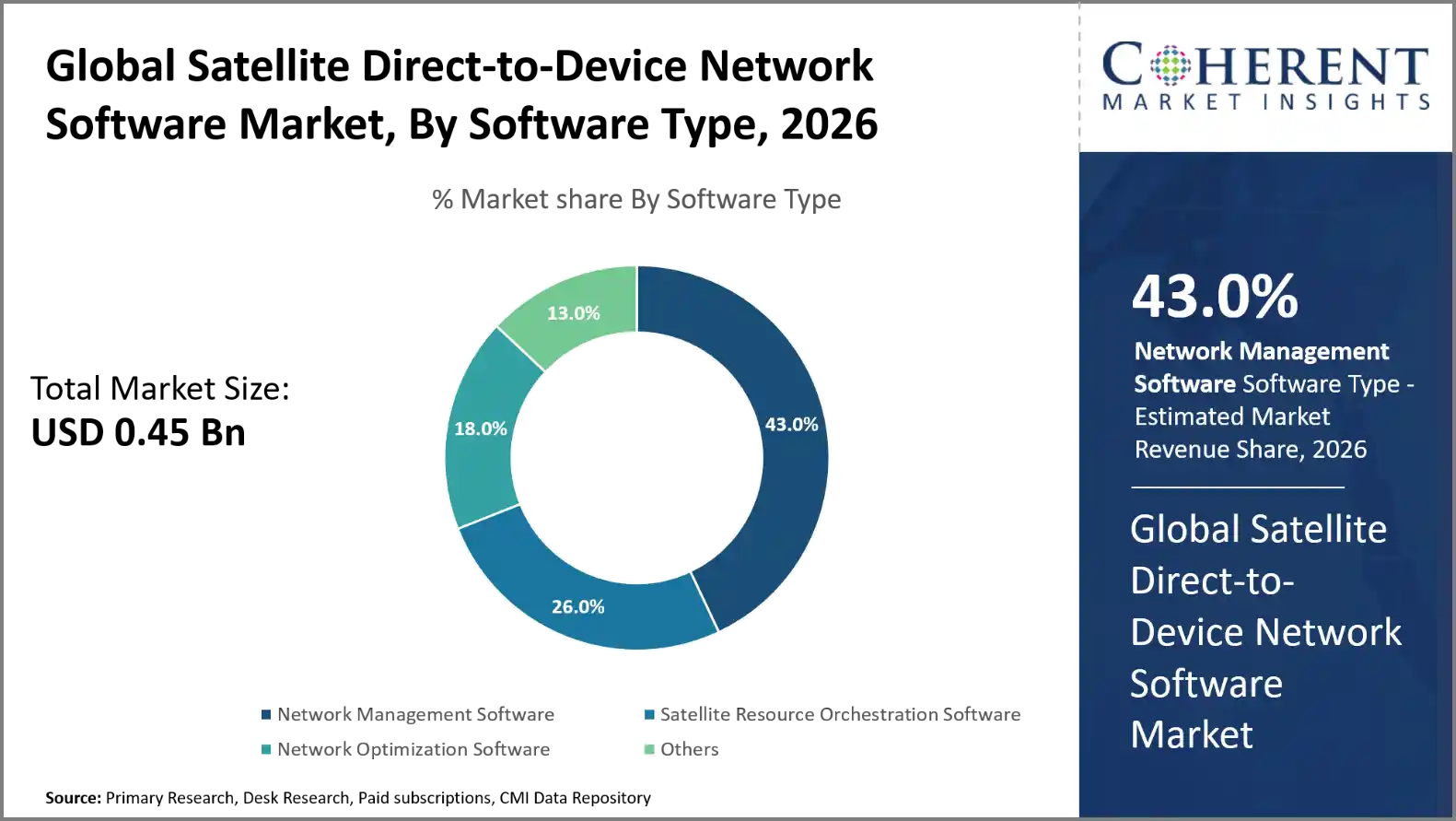
Why Does Network Management Software Dominate the Global Satellite Direct-to-Device Network Software Market?
The network management software segment is expected to account for 43.0% of the global satellite direct-to-device network software market share in 2026. Network management software is dominant as satellite direct-to-device services require constant coordination between space and terrestrial infrastructure. These solutions address satellite connectivity, network performance, spectrum usage, traffic routing and service availability. Operators want centralized monitoring to provide dependable connectivity over fast-moving satellite constellations. The software also handles satellite handovers, beam allocation, interference management and interfacing with terrestrial networks. Such capabilities are especially relevant when satellite infrastructure is shared across numerous mobile network carriers. Network management platforms also enable fault detection, configuration management, service provisioning and quality-of-service monitoring.
On February 24, 2025, Mavenir and Terrestar Solutions Inc. achieved a groundbreaking milestone by successfully completing an industry first Voice over NB-IoT (Narrowband Internet of Things) call in NTN (Non-Terrestrial Networks) mode. The achievement was conducted over a 3GPP-standardized NTN S-band spectrum, avoiding interference common in terrestrial networks.
- Current Industry Events of 2026
- Market Size Estimation
- Regional Breakdown
- Competitive Landscape
- Customer Intelligence
- Segmental Analysis
- Pricing Analysis
- Key Market Drivers, Challenges & Future Trends
- Customized Insights Section
Why is Low Earth Orbit Satellite Networks the Most Preferred Network Architecture?
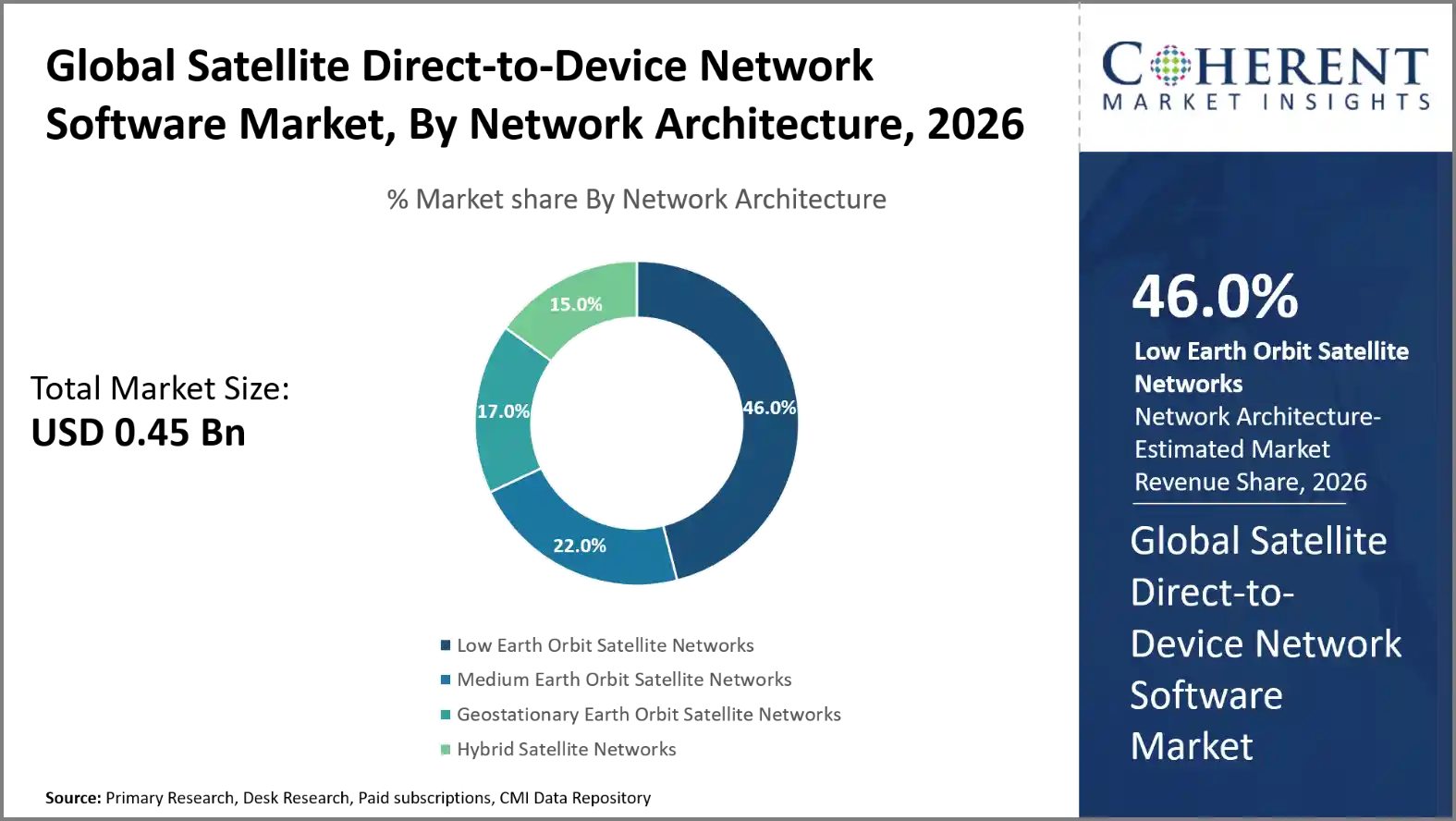
The low earth orbit satellite networks segment is expected to account for 46.0% of the global satellite direct-to-device network software market share in 2026. The low Earth orbit satellites are at a lower altitude, which makes these networks more attractive, as it minimizes the transmission latency. Satellites usually fly at altitudes of between 300 to 1,500 kilometers above Earth. Their closeness enables more responsive messaging to traditional cellphones and other IoT devices. Lower propagation delays are good for message, emergency communications, and interactive connectivity. LEO constellations also enable smaller communication footprints and more frequent geographic coverage opportunities. Multiple satellites can offer overlapping coverage over rural regions and marine areas. Their new orbital design requires sophisticated software to keep track of satellites, switch beams and control motion.
On April 28, 2025, Amazon launched its first 27 manufacturing satellites, on a United Launch Alliance Atlas V rocket. This mission marked the start of its active constellation deployment in Low Earth Orbit. The satellites provide broadband access to consumer, commercial and government customers.
3GPP Non-Terrestrial Network Dominates the Global Satellite Direct-to-Device Network Software Market
The 3GPP non-terrestrial network segment is expected to account for 39.0% of the global satellite direct-to-device network software market share in 2026. The 3GPP Non-Terrestrial Network technology is a dominant technology because it enables the standardized integration of satellite systems with terrestrial mobile networks. Its specifications extend established 5G New Radio and Internet of Things communication frameworks into satellite environments. Release 17 introduced foundational support for New Radio Non-Terrestrial Networks and Narrowband Internet of Things satellite connectivity. Release 18 introduced additional improvements supporting device capabilities, mobility, and network performance. The convergence of satellite with terrestrial 5G infrastructure is further strengthened by recent innovations. This standardization allows equipment makers, satellite operators and mobile network providers to design compatible solutions.
On March 14, 2025, Taiwan’s Industrial Technology Research Institute and Chunghwa Telecom collaborated for a geostationary satellite demonstration. The firms created a two-way video link utilizing Chunghwa Telecom’s ST-2 satellite. Their setup consisted of an NTN base station and a 5G user terminal.
Current Events and their Impact
Current Events | Description and its Impact |
U.S. Federal Communications Commission - Supplemental Coverage from Space Framework, FCC 24-28 (2024) |
|
U.K. - Wireless Telegraphy (Direct to Device Satellite Communications) (Exemption) Regulations 2026, SI 2026/139 |
|
Satellite Direct-to-Device Network Software Market Dynamics
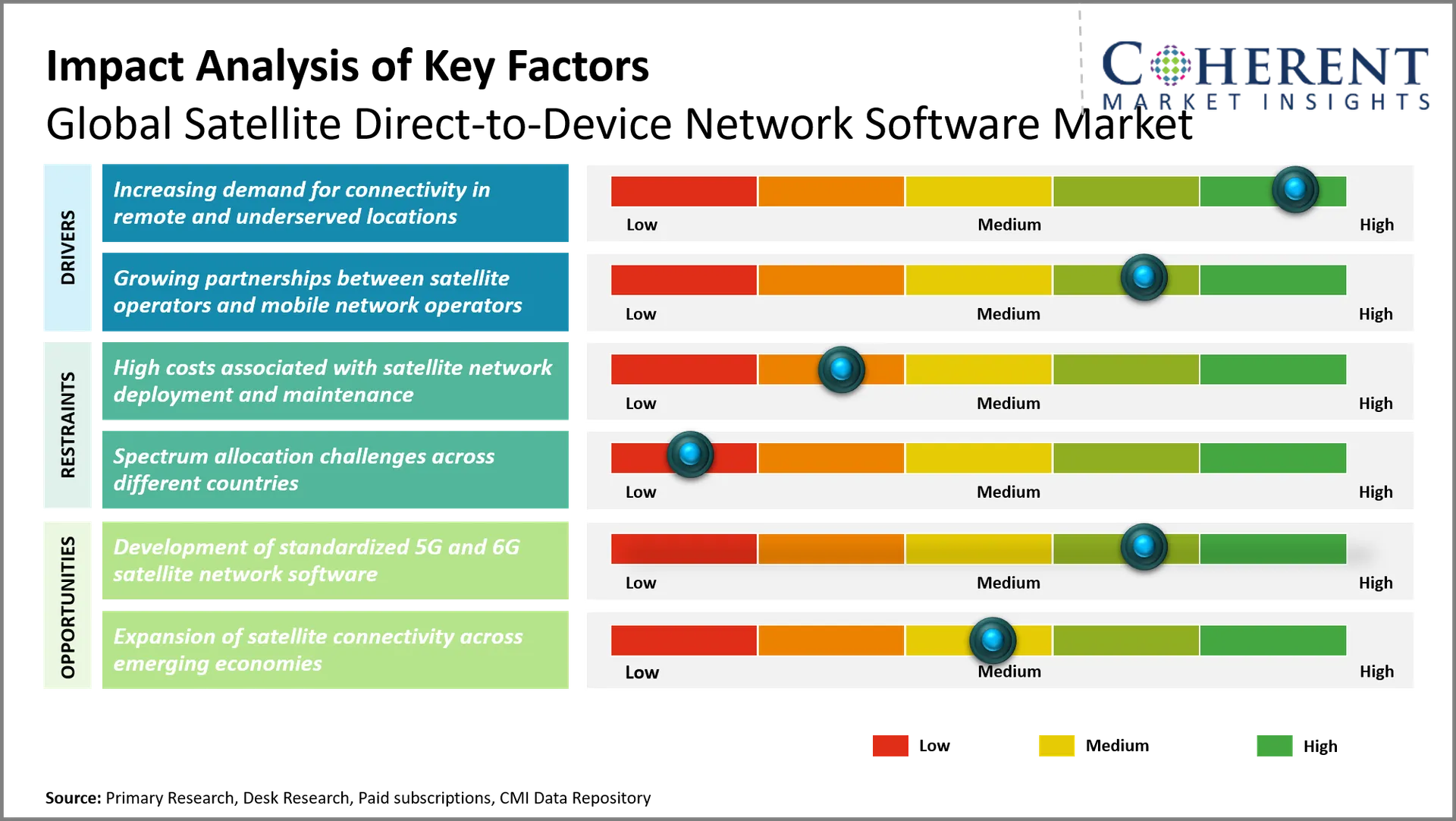
Market Drivers
- Increasing demand for connectivity in remote and underserved locations: Growing demand for connectivity in remote and underserved locations pushes adoption of satellite direct-to-device network software. Mountainous areas, deserts, oceans and sparsely inhabited settlements continue to pose economic challenges for conventional terrestrial networks. Satellite direct-to-device capability means compatible smartphones can connect without separate satellite terminals. Companies are creating software to manage communications, emergency alerts, location sharing and to improve cellular connectivity. On May 30, 2025, DOCOMO PACIFIC and Lynk Global, LLC announced they have successfully completed the latest step of their strategic relationship, the first ever recorded SMS from space, delivered from the Marianas. This milestone is a historic moment for the Marianas and a big step forward in the partners’ joint ambition to offer satellite direct-to-device (D2D) connection to underserved and remote locations in the region.
- Growing partnerships between satellite operators and mobile network operators: Growing partnerships between satellite operators and mobile network operators accelerate the commercial deployment of direct-to-device network software. Such partnerships combine satellite infrastructure with existing mobile airwaves, customer bases and telecommunications distribution networks. Satellite operators provide orbital capacity, satellite radio access infrastructure and dedicated connection platforms. Mobile network operators provide access to spectrum, subscriber authentication, billing integration and existing cellular infrastructure. On March 11, 2025, Space42 and Viasat signed a memorandum of understanding on the development of a common multi-orbit Non-Terrestrial Network infrastructure. The suggested architecture enables direct-to-device communication and Narrowband Internet of Things services.
Emerging Trends
- Integration of Artificial Intelligence in Satellite Network Management: Satellite operators are progressively adopting artificial intelligence for predictive network management, automated satellite handovers, traffic optimization, interference detection, and dynamic resource allocation. Such features improve connectivity reliability under fast-moving satellite constellations and varying terrestrial coverage situations.
- Impact: AI decreases complexity of network operations with automated problem identification and predictive maintenance. It enhances spectrum use, traffic allocation, satellite availability, and connectivity continuity for geographically dispersed mobile subscribers.
- Relevance to the market: SpaceX’s Starlink Direct to Cell rollout presents opportunity for sophisticated traffic orchestration. Software suppliers can build predictive handover algorithms and automated capacity management solutions for growing satellite constellations.
- Development of 5G Non-Terrestrial Network Interoperability Platforms: Software developers are rapidly developing standardized 5G Non-Terrestrial Network platforms that support satellite-terrestrial compatibility. The platforms incorporate satellite radio access networks, mobile core networks, device authentication, mobility management, and terrestrial cellular infrastructure.
- Impact: Standardized interoperability minimizes proprietary integration needs and enhances compatibility between satellite operators and mobile network operators. It also facilitates scalable installations, simplified device connectivity and uniform network management.
- Relevance to the market: 3GPP-compliant modem technology from Qualcomm enable standardized satellite connectivity. Software providers can develop interoperable network management platforms that support satellite handovers, mobile core integration and multi-operator connectivity.
Regional Insights
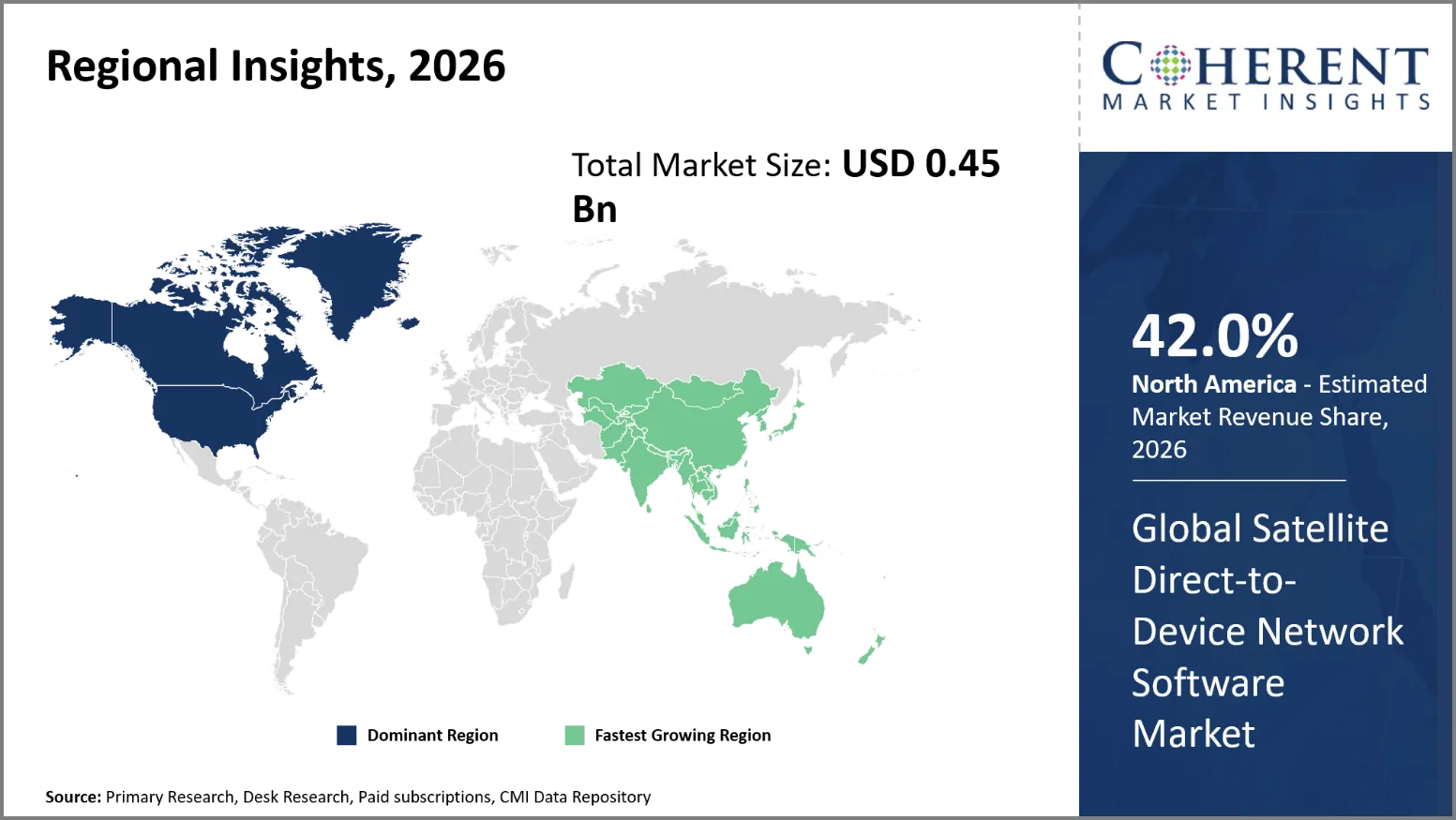
Why is North America a Strong Market for Satellite Direct-to-Device Network Software?
North America is expected to account for a market share of 42.0% in 2026. North America has commercial satellite deployment, modern telecommunications infrastructure and considerable private sector investment. The region is creating advanced software for integrating satellite and terrestrial networks. AST SpaceMobile stated that it has connections with approximately 60 mobile network carriers with more than three billion subscribers worldwide. Its strategy of development consists in integrating satellite services in the existing infrastructure of mobile operators. Bell Canada’s deployment of a sovereign satellite ground station further improves regional capabilities in the ground segment. Such advances drive need for satellite gateway orchestration, network authentication, spectrum coordination and service provisioning software. Regulatory developments surrounding supplemental satellite coverage further encourage software investments supporting multi-operator connectivity and network interoperability.
Why Does Asia Pacific Satellite Direct-to-Device Network Software Market Exhibit High Growth?
Asia Pacific is expected to register the fastest growth with a CAGR of 33.1% over the forecast period. It is projected to account for 31.0% of the global satellite direct-to-device network software market in 2026. Asia Pacific has a strong direct to device commercialization with collaborations with mobile operators and increasing satellite connectivity services. Six Starlink-based commercial services were functioning across four regional marketplaces by July 2026. These projects include commercial deployments in the Philippines, Japan, Australia and New Zealand. Globe launched commercial satellite-to-mobile services in the Philippines in June 2026. Telstra added satellite messaging to its mobile offering in Australia. One NZ has launched its satellite messaging service for specific apps and voice-enabled services. These deployments increase demand for regional network orchestration, application traffic management, roaming coordination, and satellite capacity allocation software.
Global Satellite Direct-to-Device Network Software Market Outlook for Key Countries
Why is U.S. Emerging as a Major Hub in the Satellite Direct-to-Device Network Software Market?
The U.S. remains a major development center for satellite direct-to-device network software. Its ecosystem includes commercial satellite operators, mobile carriers, chipset makers and cloud infrastructure providers. T-Mobile’s satellite connectivity expansion with SpaceX allows messaging and certain apps outside terrestrial coverage. AT&T and Verizon are moving ahead with AST SpaceMobile on other satellite connection plans. The Federal Communications Commission’s Supplemental Coverage from Space framework allows satellite operators to tap into participating terrestrial spectrum. According to the National Broadband Map, 4G cellular services had 70.3% land coverage as of June 2026. These advances are driving investment in software for automatic handovers, emergency messages, spectrum management and cellular core integration.
Is China the Next Growth Engine for the Satellite Direct-to-Device Network Software Market?
China has the advantage of a pre-existing satellite communication infrastructure and growing integration with popular smartphone ecosystems. China Telecom launched Tiantong direct-to-device connection for consumer smartphones in September 2023. According to the China Telecom 2026 sustainability report, there were 8.2 million D2D users and over 26 million linked devices in 2025. China Mobile and China Unicom were also allowed to offer satellite mobile services from September 2025. Such advances fuel the demand for subscriber provisioning, satellite messaging management, device authentication, and network traffic optimization. The domestic satellite ecosystem in China also fosters the development of software that enables BeiDou messaging, emergency communications and linked vehicle applications.
Japan Satellite Direct-to-Device Network Software Market Analysis and Trends
Japan’s market expansion is an indication of the need for disaster-resistant communications and the integration of advanced mobile networks. On March 4, 2026, KDDI began offering international roaming for au Starlink Direct. The service allows users to connect across borders and use certain communication programs. Rakuten Mobile and AST SpaceMobile set up Rakuten AST in November 2026. The joint venture targets a Japanese-flagged Low Earth Orbit satellite constellation. Japan's Ministry of Internal Affairs and Communications awarded approximately USD 1 billion supporting the deployment initiative. These improvements provide prospects for sovereign satellite network orchestration, cross-border roaming management, disaster communication prioritizing and localized satellite infrastructure monitoring software.
Canada Satellite Direct-to-Device Network Software Market Analysis and Trends
The Canadian market development is highly dependent on the broad coverage requirements of the wilderness and the durability of the telecommunications infrastructure. Rogers started its satellite-to-mobile service on July 15, 2025. Initially, the service provided satellite messaging and spanned an area of more than 5.4 million square kilometers. In July, 2025, Bell reported that it had finished construction of its first sovereign direct-to-device satellite ground station in Quebec. The station interacts with AST SpaceMobile’s growing satellite constellation. These investments stimulate demand for sovereign gateway management, remote network monitoring, satellite-to-terrestrial traffic routing and regionally distributed network operations software. Canada’s regulatory regime also encourages coordination of spectrum between satellite and terrestrial telecommunications carriers.
India Satellite Direct-to-Device Network Software Market Analysis and Trends
India presents significant prospects since satellite connection can connect challenging terrain and geographically dispersed populations. The Department of Telecommunications has given Global Mobile Personal Communications using Satellite authorizations to OneWeb India Communications, Jio Satellite Communications and Starlink Satellite Communications. The Telecom Regulatory Authority of India on 5 November 2026 issued recommendations for authorization of satellite network providers. Recommendations include D2D services based on Mobile Satellite Service and International Mobile Telecommunications. They also propose wholesale satellite network services for eligible telecommunications operators. These developments create demand for spectrum administration, wholesale network provisioning, subscriber authentication, and satellite-terrestrial integration software.
Average Message Delivery Latency across LEO, MEO, and GEO Satellites
Global Satellite Direct-to-Device Network Software Market - Average Message Delivery Latency across LEO, MEO, and GEO Satellites
Metric | LEO | MEO | GEO |
Typical orbital altitude | 400-2,000 km | 8,000-20,000 km | 35,786 km |
One-way propagation latency | 3-30 ms | 27-90 ms | 120-280 ms |
Average one-way propagation latency | 16.5 ms | 58.5 ms | 200 ms |
Round-trip propagation latency | 6-60 ms | 54-180 ms | 240-560 ms |
Average round-trip propagation latency | 33 ms | 117 ms | 400 ms |
How is Development of Standardized 5G and 6G Satellite Network Software Creating New Growth Opportunities in the Satellite Direct-to-Device Network Software Market?
Standardized 5G and upcoming 6G satellite network software development offers prospects for compatible satellite-terrestrial infrastructure. The 3rd Generation Partnership Project Release 17 defined the initial Non-Terrestrial Network standards for 5G New Radio and Narrowband Internet of Things connectivity through satellites. Later Release 18 and Release 19 improvements include regenerative satellite payloads, feeder-link switching, reduced-capability devices, and better mobility procedures. These improvements allow software vendors to construct standardized network orchestration, satellite radio resource management and mobility control solutions.
On March 2, 2026, Qualcomm introduced the X105 modem with integrated satellite connection. Its platform offers voice, video and data capabilities through satellite. In February 2026, the International Telecommunication Union published Recommendation ITU-R M.2177-0, which defines the 5G satellite radio interfaces. The emerging 6G standardization also opens up prospects for software to allow AI native network orchestration, satellite edge computing, prediction handovers and integrated terrestrial-space network control. These discoveries establish the groundwork for standards-based software as a key element of multi-vendor interoperability and future satellite connectivity services.
Market Players, Key Development, and Competitive Landscape
Key Developments
- On June 21, 2026, Iridium Communications Inc. announced that Mlink Technology Inc. has begun live, on-air testing of its MS150-IR IoT-NTN chipset using Iridium NTN Direct. MS150-IR is a specialized version of the MS150 chipset family, developed specifically for Iridium NTN Direct as part of Mlink's global IoT-NTN product portfolio.
- On May 18, 2026, Anterix and Lynk Global announced that the U.S. Federal Communications Commission (FCC) has approved an experimental license to explore the use of Lynk’s satellite direct-to-device communications network in Anterix’s licensed 900 MHz broadband spectrum.
- On January 7, 2026, Lacuna Space announced it is opening its LoneWhisper Direct-to-Device (D2D) satellite IoT technology for collaboration through the Lacuna Network, inviting other operators, agencies, and nations to join a shared global system that already spans every continent.
Competitive Landscape
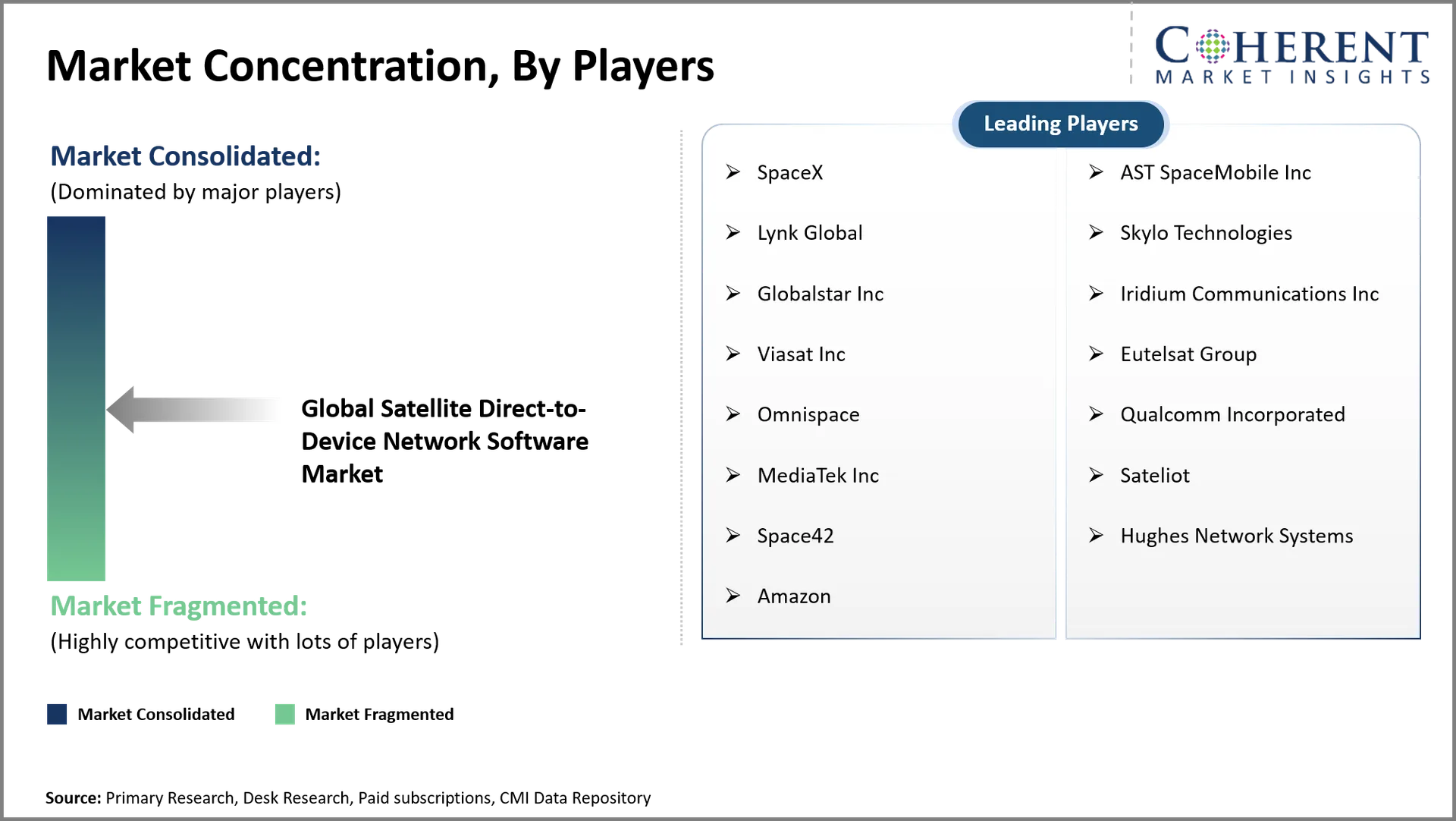
The competitive landscape features satellite operators, telecommunications technology providers, and specialized Non-Terrestrial Network software developers. SpaceX focuses on constellation scale and mobile operator partnerships through Starlink Mobile. Its strategy combines satellite infrastructure, launch capabilities, and terrestrial spectrum integration. AST SpaceMobile differentiates through broadband connectivity directly to conventional smartphones. Its BlueBird constellation targets voice, video, and mobile broadband applications. Skylo Technologies follows an asset-light strategy using existing satellite infrastructure and cloud-native connectivity software. Lynk Global focuses on cellular-compatible satellite services and mobile operator integration. Globalstar emphasizes dedicated satellite spectrum and device ecosystem partnerships. Meanwhile, Qualcomm develops modem technologies supporting standardized satellite connectivity.
Top Companies/Manufacturers and Notable Products/Solutions in the Satellite Direct-to-Device Network Software Market
Company/Manufacturer | Notable Product/Solution | Key features |
SpaceX | Starlink Mobile (Direct to Cell) | Cellular connectivity through existing LTE smartphones; satellite-to-terrestrial network integration; phased-array antennas; messaging, data and emergency alerts; seamless roaming with mobile network partners |
AST SpaceMobile | BlueBird Satellites with AST5000 ASIC | Broadband connectivity for standard smartphones; software-defined satellite processing; large phased-array antennas; more than 2,000 active cells per satellite; peak speeds exceeding 150 Mbps per coverage cell |
Skylo Technologies | Skylo Non-Terrestrial Network Platform | Cloud-native virtualized radio access network and core; 3GPP Release 17 support; satellite-terrestrial mobility; SIM provisioning; network operations support systems; billing and secure application programming interfaces |
Lynk Global | Lynk Direct-to-Device System | Direct connectivity for standard mobile phones; mobile network operator integration; satellite-to-cell handovers; emergency broadcast messaging; support for cellular IoT devices; roaming-based service delivery |
Iridium Communications | Iridium NTN Direct | 3GPP standards-based NB-IoT connectivity; global Low Earth Orbit coverage; L-band spectrum; software-defined satellite waveforms; low-power device connectivity; integration with compatible chipsets |
Satellite Direct-to-Device Network Software Market | |||
Report Coverage | Details | ||
Base Year | 2025 | Market Size in 2026: | USD 0.45 Bn |
Historical Data For: | 2020 To 2024 | Forecast Period: | 2026 To 2033 |
Forecast Period 2026 To 2033 CAGR: | 29.3% | 2033 Value Projection: | USD 2.55 Bn |
Geographies covered: |
| ||
Segments covered: |
| ||
Companies covered: | SpaceX, AST SpaceMobile Inc, Lynk Global, Skylo Technologies, Globalstar Inc, Iridium Communications Inc, Viasat Inc, Eutelsat Group, Omnispace, Qualcomm Incorporated, MediaTek Inc, Sateliot, Space42, Hughes Network Systems, Amazon | ||
Growth Drivers: |
| ||
Restraints & Challenges: |
| ||
Analyst Opinion (Expert Opinion)
- The industry will transition from satellite emergency messaging toward integrated cellular broadband connectivity. Software will increasingly determine interoperability between satellite constellations and terrestrial mobile networks. Multi-orbit connectivity will create additional requirements for network selection and traffic orchestration. Regenerative satellite payloads will increase demand for onboard processing and distributed network control. Artificial intelligence will support predictive beam allocation, interference management, and autonomous network optimization. The emergence of 6G Non-Terrestrial Networks will further expand software requirements for integrated space-air-ground connectivity. Companies developing programmable network management platforms will occupy important positions in this evolving ecosystem.
- The largest potential will be in Network Management Software, specifically satellite handover orchestration and multi-network connectivity management. Broadband connectivity, enterprise Internet of Things applications and emergency communications will produce different software requirements. The U.S. can make use of existing cell operator relationships and commercial satellite deployment. There are opportunities in India, such as new satellite authorization frameworks and wholesale network provisioning. Japan holds promise for sovereign satellite infrastructure and disaster-resilient connectivity. Canada has prospects for remote network management and geographically dispersed gateway operations. Software providers should focus on 3GPP-compliant solutions that can serve different satellite operators and terrestrial network settings.
- Focus on software interoperability as opposed to building stand-alone proprietary network management tools. Investment should focus on automated satellite handovers, dynamic spectrum coordination and intelligent traffic prioritization. Vendors should build technical agreements with chipset manufacturers, mobile network operators and satellite constellation builders. And they should build modular software that accommodates various orbital topologies and national spectrum needs. Enterprise-grade solutions will have strong cybersecurity, subscriber authentication and emergency communication capabilities. Companies should also provide flexible license models to facilitate wholesale satellite connection and multi-operator network deployments.
Speak to the analyst
Want personalized insights?
Take the findings above to one of our principal consultants, or have the report rebuilt around the segments, geographies and competitors you actually track.
Market Segmentation
- Software Type Insights (Revenue, USD Billion, 2021 - 2033)
- Network Management Software
- Satellite Resource Orchestration Software
- Network Optimization Software
- Others
- Network Architecture Insights (Revenue, USD Billion, 2021 - 2033)
- Low Earth Orbit Satellite Networks
- Medium Earth Orbit Satellite Networks
- Geostationary Earth Orbit Satellite Networks
- Hybrid Satellite Networks
- Connectivity Technology Insights (Revenue, USD Billion, 2021 - 2033)
- 3GPP Non-Terrestrial Network
- Proprietary Satellite Connectivity
- Narrowband Internet of Things
- LTE-Based Direct-to-Device Connectivity
- 5G-Based Direct-to-Device Connectivity
- Application Insights (Revenue, USD Billion, 2021 - 2033)
- Mobile Broadband Connectivity
- Emergency Communication
- Messaging Services
- Voice Communication
- Internet of Things Connectivity
- Enterprise Connectivity
- Maritime and Aviation Connectivity
- End User Insights (Revenue, USD Billion, 2021 - 2033)
- Telecommunications
- Government and Defense
- Transportation and Logistics
- Maritime
- Aviation
- Agriculture
- Energy and Utilities
- Consumer Electronics
- Regional Insights (Revenue, USD Billion, 2021 - 2033)
- North America
- U.S.
- Canada
- Latin America
- Brazil
- Argentina
- Mexico
- Rest of Latin America
- Europe
- Germany
- U.K.
- Spain
- France
- Italy
- Russia
- Rest of Europe
- Asia Pacific
- China
- India
- Japan
- Australia
- South Korea
- ASEAN
- Rest of Asia Pacific
- Middle East
- GCC Countries
- Israel
- Rest of Middle East
- Africa
- South Africa
- North Africa
- Central Africa
- North America
- Key Players Insights
- SpaceX
- AST SpaceMobile Inc
- Lynk Global
- Skylo Technologies
- Globalstar Inc
- Iridium Communications Inc
- Viasat Inc
- Eutelsat Group
- Omnispace
- Qualcomm Incorporated
- MediaTek Inc
- Sateliot
- Space42
- Hughes Network Systems
- Amazon
Sources
Primary Research Interviews
- Satellite Network Software Developers & Architects
- Telecommunications Equipment Manufacturers
- Mobile Network Operators (MNOs) & Satellite Service Providers
- IoT Solution Providers & Enterprise End-Users
Magazines
- Via Satellite Magazine
- Space News Magazine
- IEEE Spectrum (Satellite & Wireless Communications)
- Mobile Communications International Magazine
Journals
- IEEE Transactions on Aerospace and Electronic Systems
- International Journal of Satellite Communications and Networking
- Journal of Spacecraft and Rockets (AIAA)
Associations
- Satellite Industry Association (SIA)
- Global VSAT Forum (GVF)
- Space Foundation
- GSM Association (GSMA) – Non-Terrestrial Networks Division
Public Domain Sources
- U.S. Federal Communications Commission (FCC) – Satellite Licensing & Regulatory Filings
- European Space Agency (ESA) – Open Access Research & Reports
- NASA Technical Reports Server (NTRS)
- 3GPP (3rd Generation Partnership Project) – NTN & D2D Specification Documents
Proprietary Elements
- CMI Data Analytics Tool
- Proprietary CMI Existing Repository of Information for the Last 10 Years
Get access to 250+ pages report
Every segment, forecast, competitor profile and data table behind the analysis above — available for instant download.
- ESOMAR Member
- ISO 9001:2015 Certified
- D-U-N-S Registered
- GDPR & CCPA Compliant
Frequently Asked Questions
The global satellite direct-to-device network software market is expected to stand at USD 0.45 Bn in 2026 and is expected to reach USD 2.55 Bn by 2033.
The CAGR of the global satellite direct-to-device network software market is projected to be 29.3% from 2026 to 2033.
Increasing demand for connectivity in remote and underserved locations and Growing partnerships between satellite operators and mobile network operators are the major factors driving the growth of the global satellite direct-to-device network software market.
High costs associated with satellite network deployment and maintenance and Spectrum allocation challenges across different countries are the major factors hampering the growth of the global satellite direct-to-device network software market.
In terms of software type, network management software segment is estimated to dominate the market revenue share in 2026.
Satellite direct-to-device network software manages connectivity between satellites and standard mobile devices without dedicated satellite terminals.
Satellites communicate with compatible smartphones using allocated mobile frequencies and specialized satellite network infrastructure.