

Global Silicon-Anode Prelithiation Additives Market Size and Forecast – 2026 To 2033
The Global Silicon-Anode Prelithiation Additives Market is estimated to be valued at USD 45.2 Mn in 2026 and is expected to reach USD 291.3 Mn by 2033, registering a compound annual growth rate (CAGR) of 30.50% from 2026 to 2033. The market is growing as lithium-ion batteries for electric vehicles, consumer electronics and energy storage systems increasingly use silicon-rich anodes.
Prelithiation additives compensate the irreversible lithium loss during the first charge to improve the first cycle efficiency, available capacity and energy density of the battery. Researchers at Zhejiang University published a study in July 2026 entitled, Mild and Sustainable Synthesis of Li₁₅Si₄ as Lithium-Compensation Additive for High-Energy Lithium-Ion Batteries. The study demonstrated the lithium-silicon (Li₁₅) additive is a viable option for high-energy lithium-ion batteries. The Si₄ addition improved the initial Coulombic efficiency of silicon-graphite anodes from 76.04% to 98.40%. The results show the potential of prelithiation additives to improve the performance and lithium utilization of the batteries.
Key Takeaways of the Global Silicon-Anode Prelithiation Additives Market
- The Stabilized Lithium Metal Powder (SLMP) segment is estimated to account for 38.4% share of the global silicon-anode prelithiation additives market in 2026, growing at a CAGR of 31.5% during 2033. The dense supply of lithium is able to compensate for first cycle losses in silicon-rich anodes and allows for controlled electrode treatments. In January 2025, researchers from Shanghai Jiao Tong University identified SLMP as a typical anode prelithiation additive with high lithium capacity.
- Dry Powder is projected to record a 30.8% CAGR through 2033 and account for 70.2% of the global silicon-anode prelithiation additives market in 2026. Solvent-free dosing offers a processing option for lithium-sensitive formulations and avoids additional liquid carriers. In June 2026, researchers published a roll-to-roll-compatible approach combining dry-coated silicon-carbon electrodes with encapsulated lithium-silicon replenishment agents.
- Silicon-Graphite Composite Anodes is expected to grow at a CAGR of 30.1% from 2033, and hold 39.8% of the global silicon-anode prelithiation additives market. These mixtures serve as realistic qualification targets with graphite moderating the mechanical expansion of silicon and prelithiation compensates for the initial loss in capacity. NEO Battery Materials said it was producing silicon-graphite composite anodes with its P-300 material in January 2025 and was advancing toward pilot validation.
- Asia Pacific is projected to witness a 29.0% compound annual growth rate (CAGR) till 2033 and is expected to hold 44.9% of the global silicon-anode prelithiation additives market revenue share in 2026. It promotes collaboration between silicon-anode makers and additive developers with its integrated battery material supply chains. In August 2026, Japan’s Asahi Kasei revealed a lithium-carbonate based pre-doping approach for silicon-rich cells that is designed to address first-cycle lithium loss and is compatible with existing production lines.
- North America is projected to achieve a 33.5% CAGR through 2033, alongside a 30.9% market share in global silicon-anode prelithiation additives market, making it the fastest-growing region. Local silicon-anode investment creates opportunities for additive suppliers offering technical support and automotive-grade qualification. In September 2025, Sila began operations at its Moses Lake, Washington, automotive-scale silicon-anode facility, expanding the region's potential customer base.
Segmental Insights
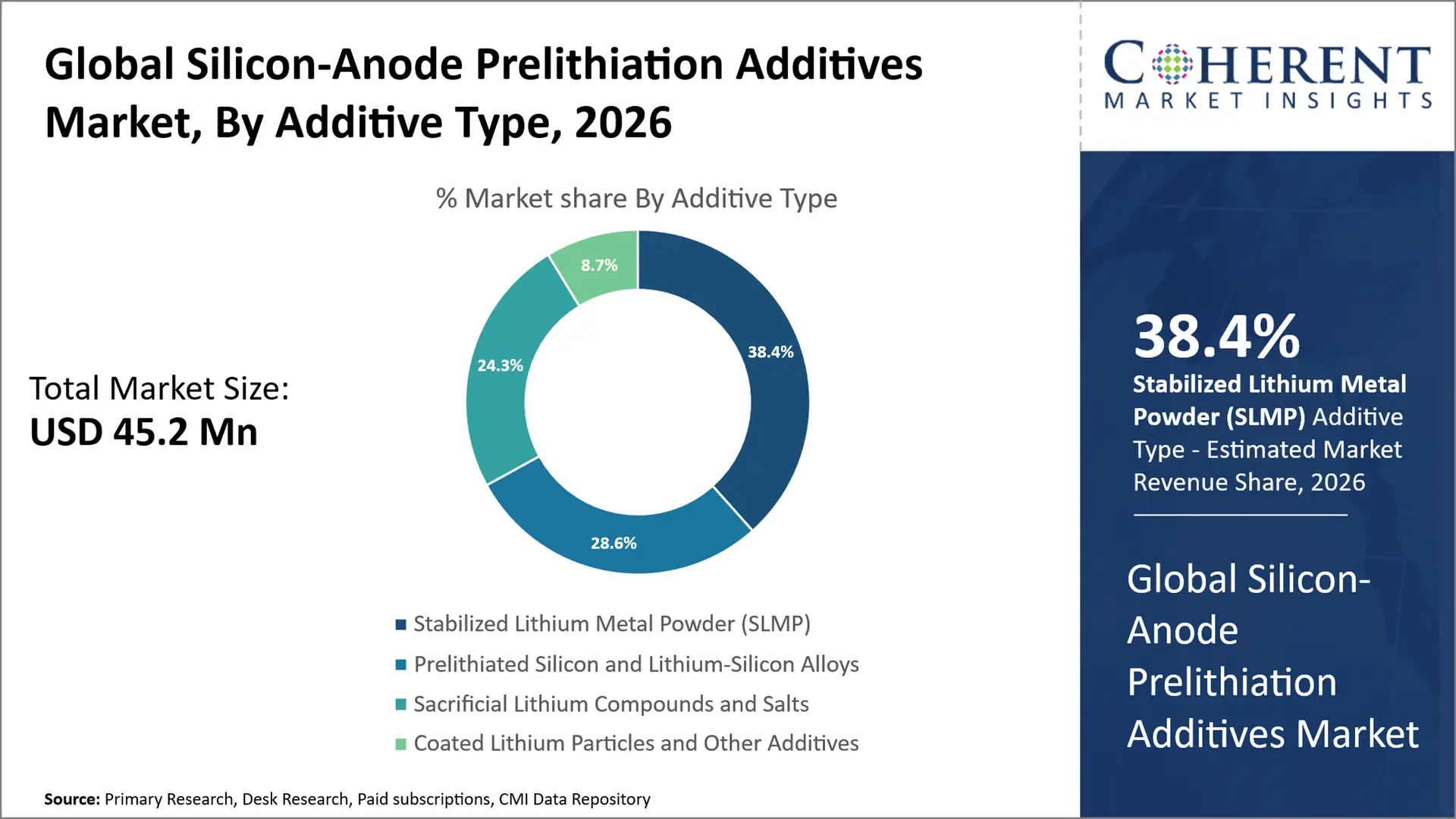
Why Does Stabilized Lithium Metal Powder (SLMP) Dominate the Global Silicon-Anode Prelithiation Additives Market?
Stabilized Lithium Metal Powder (SLMP) is projected to hold 38.4% of the additive-type global silicon-anode prelithiation additives market in 2026. This projection is a reflection of SLMP's capacity to inject metallic lithium directly into silicon-containing electrodes without altering the cathode chemistry. The commercial value of the device stems from the versatility in mechanical electrode-treatment concepts and tunable lithium loading (not from a fixed cell design). Developers of batteries can relate the amount of powder to the silicon loading, although particle distribution, contact pressure and moisture protection make scale-up difficult. In April 2024, researchers from the University of California San Diego and collaborators have demonstrated pressure-induced prelithiation in Nature Communications by coupling SLMP with micron-sized silicon for solid-state battery anodes. Their results provide a technically plausible route to the formation of lithium-silicon alloys, but not evidence of existing mass production. Suppliers will need standardized particle specifications and help in applying them to win industrial qualification orders.
- Current Industry Events of 2026
- Market Size Estimation
- Regional Breakdown
- Competitive Landscape
- Customer Intelligence
- Segmental Analysis
- Pricing Analysis
- Key Market Drivers, Challenges & Future Trends
- Customized Insights Section
Why Does Dry Powder Represent the Largest Product Form in the Global Silicon-Anode Prelithiation Additives Market?
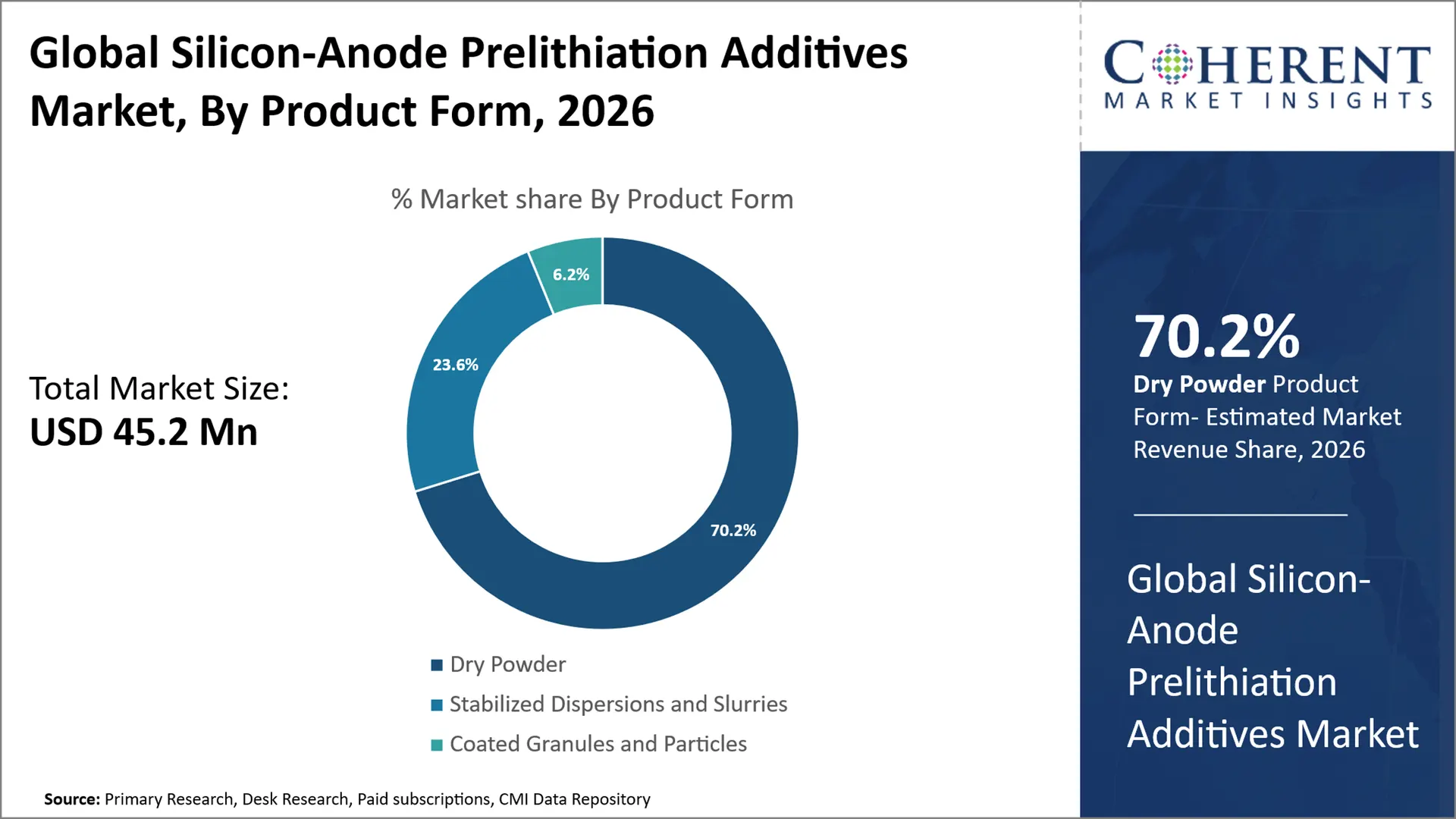
Dry Powder is expected to command 70.2% of the global silicon-anode prelithiation additives market in 2026, supported by its suitability for measured batch preparation and flexible incorporation into silicon-anode material formulations. Relative to ready-made dispersions, powdered materials allow electrode developers to choose compatible binders and processing media at the point of use, although protective packaging and inert handling remain essential. This versatility can simplify inventory across battery research laboratories and specialist anode-material producers serving different cell designs. In July 2025, Wiley Online Library researchers at Fraunhofer ISE and the University of Freiburg reported preparing prelithiated silicon powder through lithium-arene chemistry, recovering processing agents before incorporating the material into solid-state battery electrodes. The study demonstrated the feasibility of producing a powder-form lithium-bearing intermediate, but also identified reactivity and scale-up limitations. Commercial differentiation will depend on powder stability and verified lithium content.
Why Do Silicon-Graphite Composite Anodes Dominate the Anode Type Segment of the Global Silicon-Anode Prelithiation Additives Market?
The silicon-graphite composite anodes segment is expected to account for 39.8% share of the global silicon-anode prelithiation additives market by 2026. This opportunity is attributed to the ability of the silicon to be incorporated into existing graphite-electrode manufacturing processes without the need of a complete overhaul of each battery component. Familiar graphite sourcing, electrode coating practices and quality-control methods provide a more accessible qualification route than entirely new anode architectures for cell manufacturers. Prelithiation suppliers might expand addressable demand outside of specialist battery programs by developing blend-specific treatments based on silicon fraction and operating conditions. The Indian Space Research Organisation successfully demonstrated silicon-graphite lithium-ion cells in orbit on its PSLV-C58 mission in January 2024, validating the composite architecture for a demanding application. In the demonstration, no prelithiation additives were used. Therefore, the commercial viability depends on independent verification of performance improvements of electrode systems of this kind with lithium-compensation additives.
Global Silicon-Anode Prelithiation Additives Market Dynamics
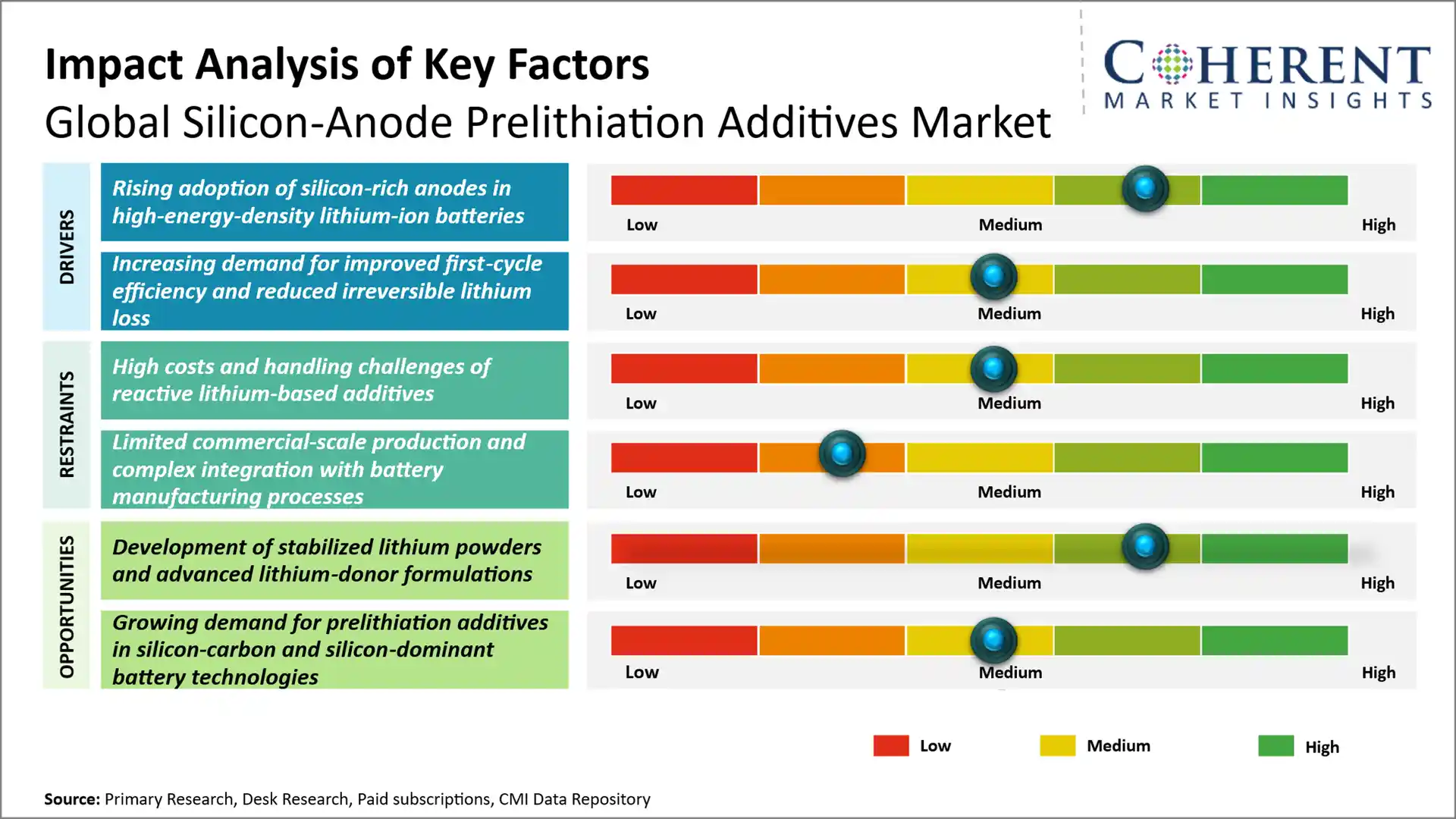
Key Market Drivers
- Rising Adoption of Silicon-Rich Anodes in High-Energy-Density Lithium-Ion Batteries: The integration of silicon-rich anodes into lithium-ion batteries is creating new requirements for controlled lithium compensation during electrode manufacturing. Silicon offers a high lithium-storage capacity, which potentially enables compact batteries, but its large initial lithium consumption can degrade usable energy density. To overcome this limitation, suppliers of prelithiation additives can offer formulations that are compatible with advanced anode architectures, thus supporting battery manufacturers and electric mobility developers. Amprius Technologies announced its 450 Wh/kg SiCore battery in April 2025, showcasing commercial progress in silicon-anode cell technology and broadening the scope of potential applications for lithium-compensation solutions.
- Increasing Demand for Improved First-Cycle Efficiency and Reduced Irreversible Lithium Loss: Irreversible lithium consumption during the initial formation of the solid-electrolyte interphase reduces the available lithium inventory of silicon-based batteries, limiting the practical cell capacity. Prelithiation additives can be used to compensate for these losses before or during the first charge, thereby improving lithium utilization without necessarily increasing the loading of the cathode. That creates an opportunity for specialized additive developers and suppliers of electrode formulations. In July 2025, Graphenix Development received an NSF Energy Storage Engine grant to work on its silicon-anode battery program, specifically to study in situ prelithiation of lithium iron oxide to improve cycling durability.
Emerging Market Trends
- Transition Toward Precision-Controlled Lithium Replenishment Formulations: Prelithiation additive development is shifting toward formulations that deliver precise lithium quantities with controlled release kinetics and uniform particle distribution. Manufacturers are increasingly prioritizing compatibility with silicon-anode materials, electrode binders, and battery processing conditions.
Impact: This transition will strengthen demand for customized lithium-silicon alloys, stabilized lithium particles, and sacrificial lithium compounds. Suppliers offering consistent material performance and batch-to-batch reproducibility could secure higher-value contracts.
Relevance to the Market: Precision-controlled formulations can improve first-cycle efficiency and reduce lithium wastage in silicon-rich batteries. This creates opportunities for specialized additive manufacturers serving advanced lithium-ion battery producers.
- Integration of Additive Qualification into Battery Manufacturing Workflows: Battery manufacturers are increasingly evaluating prelithiation additives alongside electrode coating, calendaring, electrolyte selection, and cell formation. This approach is expected to shift qualification from isolated laboratory testing toward integrated manufacturing process validation.
Impact: Suppliers providing application engineering, process compatibility testing, and production support could establish stronger relationships with battery manufacturers. Laboratory-focused suppliers may face longer qualification cycles and greater commercialization barriers.
Relevance to the Market: Integrated qualification can facilitate the transition of prelithiation additives from pilot testing to commercial battery manufacturing. It also strengthens opportunities for suppliers capable of delivering production-ready formulations and reliable technical documentation.
Current Events and their Impact
Current Event | Description and Its Impact |
EU Battery Due Diligence Postponement – July 2025 |
|
China Revises Lithium-Ion Battery Industry Guidelines – June 2024 |
|
EU Digital Battery Passport Guidance- August 2026 |
|
Regional Insights
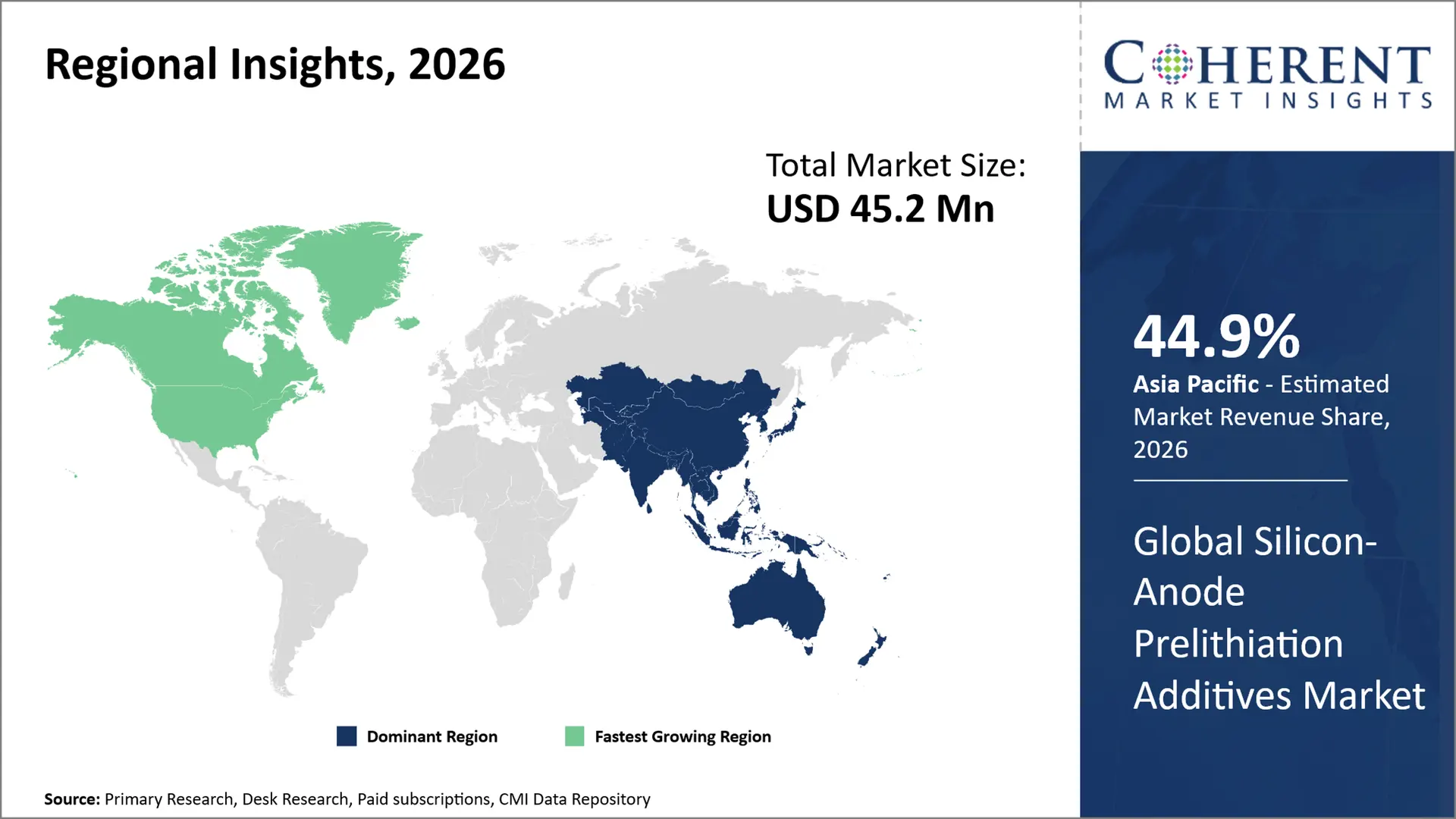
Why Does Asia Pacific Dominate the Global Silicon-Anode Prelithiation Additives Market?
Asia Pacific is projected to command 44.9% share of the global silicon-anode prelithiation additives market in 2026, riding on the back of its dense population of lithium-ion battery manufacturers, sophisticated anode-material processors, and niche chemical suppliers. The region’s integrated manufacturing ecosystem enables coordination between silicon material developers and cell producers to speed up formulation testing and supplier qualification. Local access to infrastructure for processing electrodes also allows the evaluation of lithium-compensation materials under commercial production conditions. South Korea’s POSCO Future M said in May 2026 it had secured technology for mass production of silicon anodes and completed customer tests, aiming to commercialize them in 2028. This strengthens the regional pipeline of advanced anode technologies that will likely need prelithiation solutions.
Why Is North America Emerging as the Fastest-Growing Region in the Global Silicon-Anode Prelithiation Additives Market?
North America is projected to account for 30.9% of the global silicon-anode prelithiation additives market in 2026, and the fastest growth is predicted to occur during the period up to 2033. Investing in local battery-material manufacturing, cutting-edge electrode research and technologies that reduce reliance on imported battery parts all contribute to regional growth. Collaboration between battery manufacturers needing to validate high-capacity silicon electrodes and specialized prelithiation suppliers could be beneficial. In August 2024, the U.S. Department of Energy announced a battery research funding opportunity that earmarked $12.5 million specifically for silicon-based anode development for better cell energy density and manufacturing economics. These programs provide the technical basis for commercialization of future lithium-compensation materials.
Global Silicon-Anode Prelithiation Additives Market Outlook for Key Countries
Why Is China a Key Market for the Global Silicon-Anode Prelithiation Additives Market?
China continues to be a key global silicon-anode prelithiation additives market, with its battery-material value chain integrating silicon processing, anode formulation, electrode manufacturing and cell assembly in well-established industrial clusters. This structure can reduce the number of sampling cycles and encourage additive suppliers to compete on lithium utilization and processing cost per electrode rather than solely on material price. The China International Battery Fair in May 2025 featured BTR New Material Group's silicon-based anode materials for semi-solid batteries with specific capacities of up to 2,300 mAh/g. These higher capacity designs make the technical challenge of managing first cycle lithium loss increasingly important. If a supplier wants Chinese customers, he will need strong cost control, application engineering and consistent chemical purity before wide commercial qualification becomes feasible.
Why Is Japan Important in the Global Silicon-Anode Prelithiation Additives Market?
Japan holds a strategic position in the global silicon-anode prelithiation additives market, thanks to its proven capabilities in battery engineering and emphasis on long-life, high-reliability cells. The silicon integration is balanced by local manufacturers against the tight energy-density, cycle-life and manufacturing-consistency demands, creating openings for precise lithium compensation metering and not wide additive formulations. Panasonic Energy’s development work towards silicon negative electrodes for battery energy density of the 900 Wh/L class was described in February 2026. This is still a development goal, not a confirmation of additive procurement. Japan can offer technically demanding customers to potential suppliers, and may reward documented electrolyte compatibility, controlled initial efficiency and dependable quality systems over lowest-price sourcing.
Why Does South Korea Support Growth in the Global Silicon-Anode Prelithiation Additives Market?
South Korea is a major growth market for silicon-anode prelithiation additives as its battery manufacturers offers high-performance cylindrical and automotive cells, where the silicon-containing anodes should satisfy demanding charging and durability requirements. This potentially opens a market for lithium-compensation materials designed for specific cell formats and operating profiles. In February 2025, Samsung SDI introduced its 50 Amp high-power cylindrical cell, featuring a silicon-carbon nanocomposite anode, tabless design and fast charging capability. The development shows end-user integration of silicon-carbon chemistry but it does not establish the use of prelithiation additives. Joint testing, which isolates first-cycle efficiency improvements without compromising high-current performance, safety or long-term electrode integrity, could also provide traction for suppliers.
Why Is Germany a Strategic Country in the Global Silicon-Anode Prelithiation Additives Market?
Germany's position in the global silicon-anode prelithiation additives market is built on applied materials engineering and close ties between electrode developers, specialized chemical companies and battery cell makers. Its commercial opportunity is to convert lab formulations into qualified electrode inputs under stringent quality and traceability requirements. In May 2026, PCC Thorion of Duisburg and UniverCell signed a letter of intent to assess Sithorit AX silicon-carbon composite material in commercial format lithium-ion cells following initial sample validation. The agreement is still a path to qualification, not a solid long-term supply agreement or proof of additive use. Prelithiation suppliers can look for similar development partnerships if they can show stable lithium loading, reproducible coating behavior and solid handling documentation.
Why Is the U.S. a Key Growth Market for the Global Silicon-Anode Prelithiation Additives Market?
The U.S. is a key global silicon-anode prelithiation additives market because domestic companies are commercializing advanced anode materials for applications with demanding performance specifications, including electric mobility, defense equipment, and portable medical systems. Cell level performance is important but buyers may also appreciate qualification support, and reliable domestic supply. Chicago-based NanoGraf launched its Onyx silicon-oxide anode material for electric vehicles and other high-performance batteries in December 2024 and produces the material in the U.S. The announcement confirms domestic silicon-anode activity, not use of a specific prelithiation product. By showing better usable capacity at a good process price, without compromising on cycle durability or manufacturing safety, additive makers can differentiate themselves.
Innovation, Production & Manufacturing Landscape for Global Silicon-Anode Prelithiation Additives Market
Technology | Technical Role | Adoption Landscape | Commercial Implications |
Stabilized Lithium Metal Powder Application | Introduces supplementary lithium through controlled powder deposition or electrode blending | Research, pilot evaluation, and process-specific industrial qualification | Requires controlled dosing, protective handling, and uniform electrode distribution |
Prelithiated Lithium-Silicon Alloy Integration | Uses lithium-bearing silicon compounds to introduce lithium before initial cell operation | Materials development and application-specific qualification | Offers formulation flexibility but requires careful control of alloy stability and reactivity |
Sacrificial Lithium Compound Activation | Releases supplementary lithium through electrochemical reactions during initial cell charging | Research and qualification across compatible cathode formulations | Provides a route to lithium compensation without directly incorporating reactive lithium metal into the anode |
Passivated Lithium Particle Engineering | Uses protective coatings to limit premature lithium reactions during storage and processing | Advanced formulation development and pilot validation | Creates differentiation through storage stability, particle consistency, and activation behavior |
Stabilized Lithium Dispersion Processing | Distributes lithium-containing additives through compatible liquid carriers for controlled electrode application | Pilot-scale processing and formulation optimization | May improve dosing flexibility but introduces solvent compatibility, dispersion stability, and drying considerations |
Inline Electrochemical Prelithiation | Supplies lithium through controlled electrochemical treatment before final cell assembly | Laboratory demonstration and industrial process development | Represents a potential alternative to standalone additive dosing, creating opportunities for equipment and technology-licensing providers |
How Are Contract Electrode Manufacturing Partnerships Creating New Growth Opportunities in the Global Silicon-Anode Prelithiation Additives Market?
Contract electrode making is an emerging opportunity for prelithiation additive suppliers who want to serve battery developers without dedicated lithium treatment infrastructure. Smaller cell manufacturers and specialty battery developers may want prelithiated silicon electrodes, but they lack the equipment, handling facilities and technical expertise to process reactive lithium.
Suppliers can close the gap by partnering with electrode toll mills to supply pre-treated electrode rolls, customized lithium-loading specifications, and validated material processing packages. Potential customers include developers of silicon oxide and silicon dominant electrodes for niche mobility, aerospace and compact electronics applications.
To be commercially viable, it will require investment in controlled-atmosphere processing capabilities, electrode uniformity measurement, safe packaging, and technical qualification. Suppliers could compete on repeatable treatment specification and manufacturing documentation rather than additive pricing.
This opportunity is likely to favor specialist material developers working with established electrode processors, enabling customers to access prelithiation technology without immediately investing in proprietary production infrastructure.
Market Players, Key Development, and Competitive Intelligence
Key Developments
- In March 2026, Group14 Technologies announced that its Sangju, South Korea, facility had begun EV-scale production of SCC55 silicon battery material, with designed annual capacity of 2,000 metric tons. This expansion increases the industrial scale of silicon-anode production, creating potential downstream qualification opportunities for compatible prelithiation additives.
- In February 2026, Elevated Materials announced plans to triple its production capacity for ultra-thin lithium metal films following shipments to battery customers. This expansion strengthens the supply infrastructure for advanced lithium-based electrode technologies and could support certain film-based prelithiation approaches, subject to compatibility validation with silicon-anode manufacturing processes.
- In August 2025, LeydenJar introduced Silyte, a pure-silicon anode designed for compact consumer electronics and wearable devices. The company reported pilot production and compatibility with existing battery manufacturing equipment. Its development broadens the silicon-electrode ecosystem, although the announcement does not confirm commercial adoption of external prelithiation additives.
Competitive Landscape
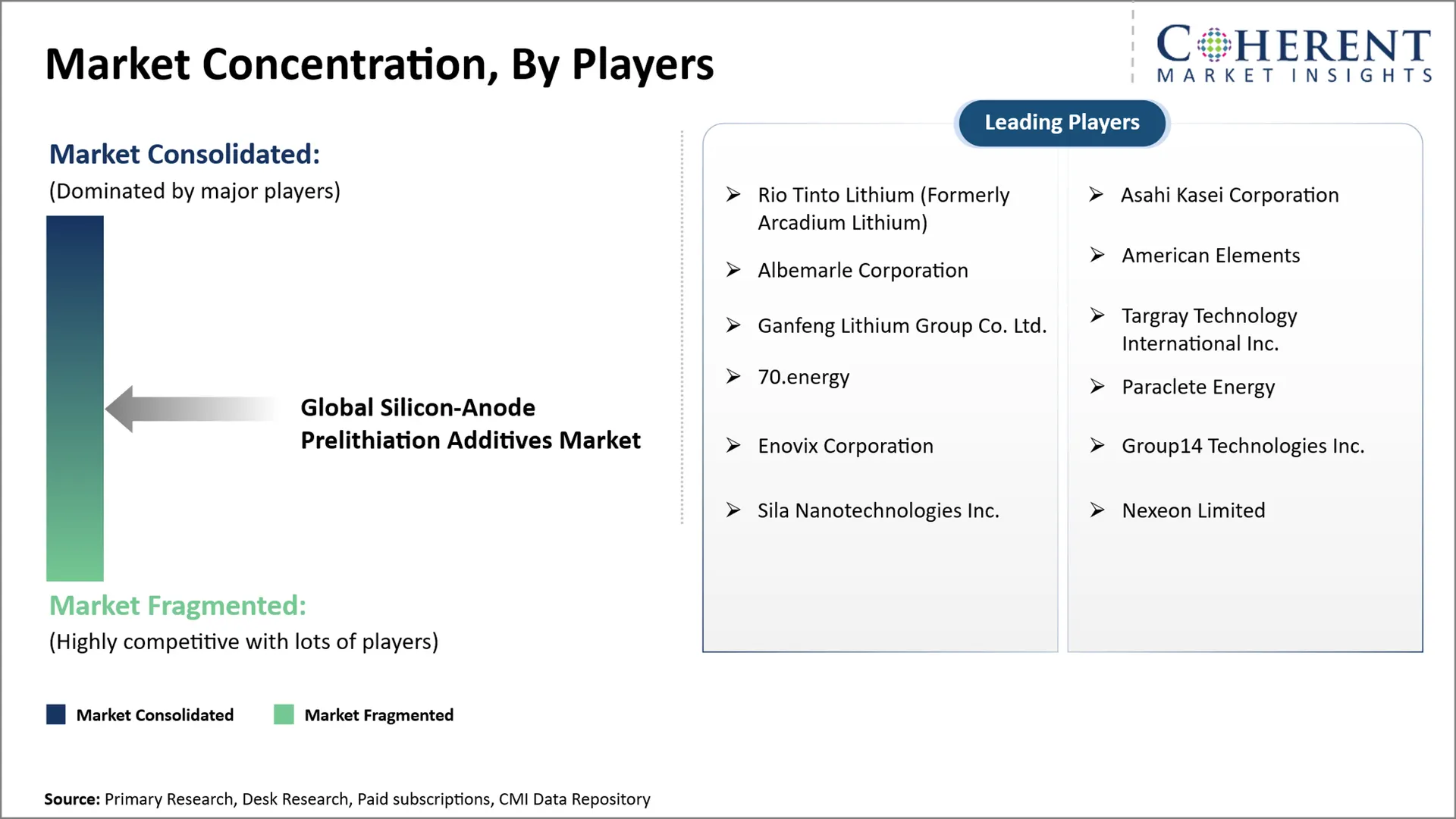
The global silicon-anode prelithiation additives market is characterized by a fragmented development-stage supplier ecosystem, comprising lithium-material specialists, advanced chemical producers, silicon-anode technology developers, and electrode-processing companies. Competition centers on proprietary lithium-delivery methods, manufacturing reproducibility, material stability, and qualification capabilities. Regional suppliers may compete through customized formulations and technical support, while established producers benefit from chemical-processing expertise, supply reliability, and established industrial customer relationships.
Key focus areas include
- Lithium delivery efficiency: Controlled lithium availability and reduced unwanted side reactions.
- Material stability: Consistent performance during storage, transportation, and electrode processing.
- Application-specific grades: Tailored formulations for SiOx, silicon-carbon, and silicon-dominant electrodes.
- Manufacturing economics: Lower processing waste, material losses, and cost per usable battery capacity.
- Intellectual property: Protection of lithium stabilization, activation, and processing technologies.
- Quality assurance: reliable batch specifications, impurity control, and technical documentation.
- Commercial partnerships: Long-term supply agreements supported by joint product-development programs.
- Supply resilience: Secure access to lithium precursors and specialized chemical-processing capacity.
Market Report Scope
Global Silicon-Anode Prelithiation Additives Market Report Coverage | |||
Report Coverage | Details | ||
Base Year | 2025 | Market Size in 2026: | USD 45.2 Mn |
Historical Data For: | 2020 To 2024 | Forecast Period: | 2026 To 2033 |
Forecast Period 2026 To 2033 CAGR: | 30.50% | 2033 Value Projection: | USD 291.3 Mn |
Geographies covered: |
| ||
Segments covered: |
| ||
Companies covered: | Rio Tinto Lithium (Formerly Arcadium Lithium), Asahi Kasei Corporation, Albemarle Corporation, American Elements, Ganfeng Lithium Group Co. Ltd., Targray Technology International Inc., 70.energy, Paraclete Energy, Enovix Corporation, Group14 Technologies Inc., Sila Nanotechnologies Inc., Nexeon Limited | ||
Growth Drivers: |
| ||
Restraints & Challenges: |
| ||
Analyst Opinion (Expert Opinion)
- The global silicon-anode prelithiation additives market leadership is likely to shift toward suppliers that can establish performance-linked commercial agreements rather than compete solely on the price of lithium-containing materials. Business models incorporating verified electrode performance, technical licensing, and customer-specific production specifications could generate more predictable revenue while reducing exposure to commodity pricing.
- Integration of electrode design into new battery architectures to control lithium inventory may reduce the need for separately applied prelitigation agents. This shift could be challenging for traditional additive suppliers but advantageous for firms controlling proprietary lithium-release chemistry, electrode architecture and process IP. Being able to follow several lithium-compensation strategies may become a strategic asset.
- Suppliers must concentrate on proprietary lithium formulations that can offer defensible performance, flexible manufacturing and robust supply-chain safeguards. Investment possibilities. Investment decisions must account for reactive-material handling costs, uncertain commercialization schedules, and potential substitution by competing lithium-compensation techniques. Companies should pursue selective technology partnerships and avoid committing to large-scale production before customers establish commercially viable qualification pathways.
Speak to the analyst
Want personalized insights?
Take the findings above to one of our principal consultants, or have the report rebuilt around the segments, geographies and competitors you actually track.
Market Segmentation
- Additive Type Insights (Revenue, USD Mn, 2021 - 2033)
- Stabilized Lithium Metal Powder (SLMP)
- Prelithiated Silicon and Lithium-Silicon Alloys
- Sacrificial Lithium Compounds and Salts
- Coated Lithium Particles and Other Additives
- Product Form Insights (Revenue, USD Mn, 2021 - 2033)
- Dry Powder
- Stabilized Dispersions and Slurries
- Coated Granules and Particles
- Anode Type Insights (Revenue, USD Mn, 2021 - 2033)
- Silicon-Graphite Composite Anodes
- Silicon-Carbon Composite Anodes
- Silicon Oxide (SiOx) Anodes
- Silicon-Dominant Anodes
- Application Insights (Revenue, USD Mn, 2021 - 2033)
- Electric Vehicle Batteries
- Consumer Electronics Batteries
- Energy Storage Batteries
- Industrial and Other Batteries
- Development Stage Insights (Revenue, USD Mn, 2021 - 2033)
- Research and Laboratory Testing
- Pilot Production and Qualification
- Commercial Battery Manufacturing
- End User Insights (Revenue, USD Mn, 2021 - 2033)
- Anode Material Manufacturers
- Anode Material Manufacturers
- Research and Development Institutions
- Sales Channel Insights (Revenue, USD Mn, 2021 - 2033)
- Direct Manufacturer Sales
- Specialty Material Distributors
- Research Material Suppliers
- Regional Insights (Revenue, USD Mn, 2021 - 2033)
- North America
- U.S.
- Canada
- Latin America
- Brazil
- Argentina
- Mexico
- Rest of Latin America
- Europe
- Germany
- U.K.
- Spain
- France
- Italy
- Russia
- Rest of Europe
- Asia Pacific
- China
- India
- Japan
- Australia
- South Korea
- ASEAN
- Rest of Asia Pacific
- Middle East
- GCC Countries
- Israel
- Rest of Middle East
- Africa
- South Africa
- North Africa
- Central Africa
- North America
- Key Players Insights
- Rio Tinto Lithium (Formerly Arcadium Lithium)
- Asahi Kasei Corporation
- Albemarle Corporation
- American Elements
- Ganfeng Lithium Group Co. Ltd.
- Targray Technology International Inc.
- 70.energy
- Paraclete Energy
- Enovix Corporation
- Group14 Technologies Inc.
- Sila Nanotechnologies Inc.
- Nexeon Limited
Sources
Primary Research Interviews
- Prelithiation additive manufacturers, lithium chemical producers, and silicon-anode material developers
- Lithium-ion battery manufacturers, electrode processors, and battery technology specialists
Stakeholders
- Stabilized lithium metal powder, lithium-silicon alloy, and specialty additive suppliers
- Battery cell manufacturers, anode producers, research institutions, and industrial buyers
End-use Sectors
- Electric vehicles, consumer electronics, and stationary energy storage
- Industrial batteries, advanced mobility, and specialty battery applications
Regulatory and Industry Bodies
- U.S. Department of Energy (DOE)
- European Chemicals Agency (ECHA)
- European Commission
- Occupational Safety and Health Administration (OSHA)
Databases
- UN Comtrade and ITC Trade Map
- USGS Mineral Commodity Summaries and IEA battery industry datasets
- Eurostat industrial statistics and national battery manufacturing datasets
Magazines and Journals
- Journal of Power Sources
- Energy Storage Materials
- Advanced Energy Materials
- Journal of Energy Chemistry
Associations
- NAATBatt International
- RECHARGE – European Advanced Rechargeable Batteries Association
- EUROBAT – Association of European Automotive and Industrial Battery Manufacturers
- China Industrial Association of Power Sources (CIAPS)
Public Domain Sources
- Prelithiation additive specifications, technical data sheets, and safety data sheets
- Silicon-anode performance studies, battery production statistics, and patent publications
- Lithium feedstock pricing, battery manufacturing investments, and capacity announcements
Key Standards and Regulations
- EU Batteries Regulation (EU) 2023/1542
- EU REACH Regulation (EC) No 1907/2006
- EU CLP Regulation (EC) No 1272/2008
- OSHA 29 CFR 1910.1200 – Hazard Communication Standard
- UN Recommendations on the Transport of Dangerous Goods – applicable lithium-material handling and transport requirements
Proprietary Elements
- CMI Data Analytics Tool
- Proprietary research repository, supplemented by primary interviews, additive-level demand estimates, battery production analysis, pricing assessments, technology benchmarking, and competitive intelligence.
Get access to 250+ pages report
Every segment, forecast, competitor profile and data table behind the analysis above — available for instant download.
- ESOMAR Member
- ISO 9001:2015 Certified
- D-U-N-S Registered
- GDPR & CCPA Compliant
Frequently Asked Questions
The CAGR of global silicon-anode prelithiation additives market is projected to be 30.50% from 2026 to 2033.
The global silicon-anode prelithiation additives market is estimated to be valued at USD 45.2 Mn in 2026 and is expected to reach USD 291.3 Mn by 2033.
High-energy-density electric vehicle batteries, compact consumer electronics, advanced energy storage systems, and next-generation lithium-ion battery technologies are creating new opportunities for silicon-anode prelithiation additives.
Achieving uniform lithium distribution, maintaining additive stability, controlling lithium reactivity, and ensuring compatibility with existing electrode manufacturing processes are the primary technical challenges.
Lithium raw material costs, additive purity, particle size, stabilization technology, production scale, specialized packaging, and customer-specific formulation requirements are the major pricing factors.
Battery manufacturers should evaluate lithium-compensation efficiency, product consistency, material safety, manufacturing compatibility, technical support, supply reliability, and the supplier's ability to meet commercial-scale qualification requirements
The major factors driving growth in the global silicon-anode prelithiation additives market are the increasing adoption of silicon-rich anodes in high-energy-density lithium-ion batteries and the growing need to improve first-cycle efficiency by reducing irreversible lithium loss.