

Global Silicon Temperature Sensor Market Size and Forecast – 2026 To 2033
The global silicon temperature sensor market is expected to grow from USD 1.19 Bn in 2026 to USD 1.49 Bn by 2033, at a compound annual growth rate (CAGR) of 3.3% over 2026–2033. A silicon temperature sensor is an integrated circuit that measures temperature from the predictable voltage change of a transistor junction, a method known as the bandgap principle, and reports it as a voltage, a current or a digital word. This report covers standalone sensor chips that sense their own surroundings (local sensing) or an external diode on a processor, power module or battery (remote diode sensing). Thermistors, resistance temperature detectors, thermocouples, infrared sensors, on-die sensors inside processors and sensors built into memory-module hub chips sit outside its scope. The market is a specialized slice of the wider Temperature Sensors Market and is closely linked to the Embedded Temperature Sensor Market.
Three forces support growth. First, vehicles are filling with power electronics, batteries and driver-assistance computers, and each of them needs thermal protection that works across wide temperature swings. Second, AI servers and their memory modules run hotter than earlier generations, so more sensing points are placed on boards, memory modules and power stages to keep the hardware inside its safe limits. Third, sensor chips keep getting smaller and more accurate, with published accuracies now reaching ±0.09 °C, which makes it cheaper and easier to add another sensing point wherever heat matters.
Key Takeaways of the Global Silicon Temperature Sensor Market
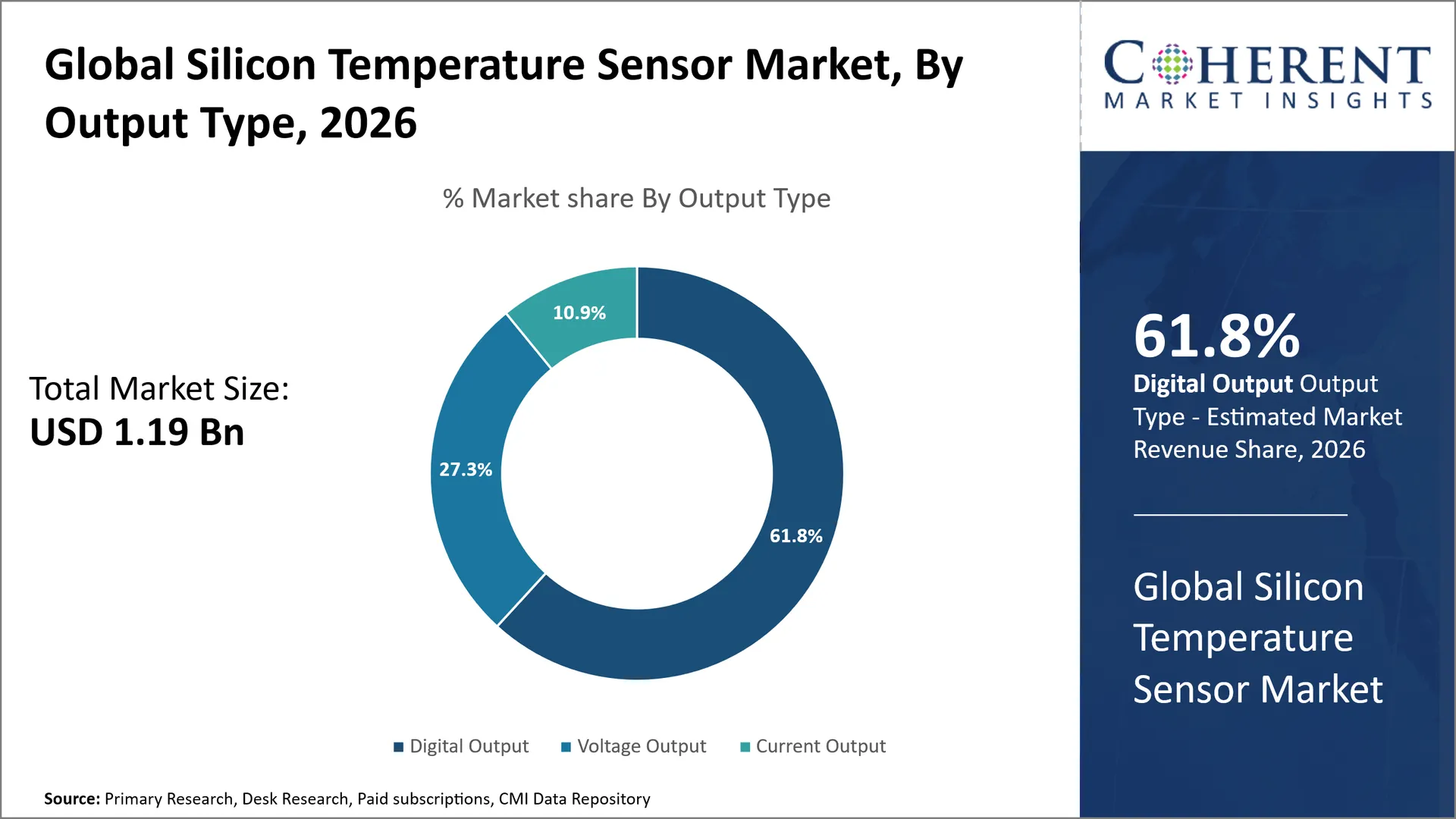
- Digital output is expected to account for 61.8% of the output type segment in 2026. Digital chips deliver a finished temperature reading over a two-wire bus, so designers avoid external converters. NXP’s P3T1755 supports I3C at up to 12.5 MHz and I²C at up to 3.4 MHz, with ±0.5 °C accuracy from –40 °C to +125 °C.
- Local sensing is expected to account for 82.2% of the sensing configuration segment in 2026. Most boards need a simple reading of the temperature at the chip’s own location, and that needs no external diode. Infineon’s AS6223 comes in a package of only 0.82 mm × 0.82 mm.
- Automotive is expected to account for 60.6% of the end-use industry segment in 2026. Each vehicle carries many protected electronic and power modules, and the chips must survive harsh heat. Texas Instruments’ TMP126-Q1 is specified for ambient temperatures from –55 °C to 175 °C.
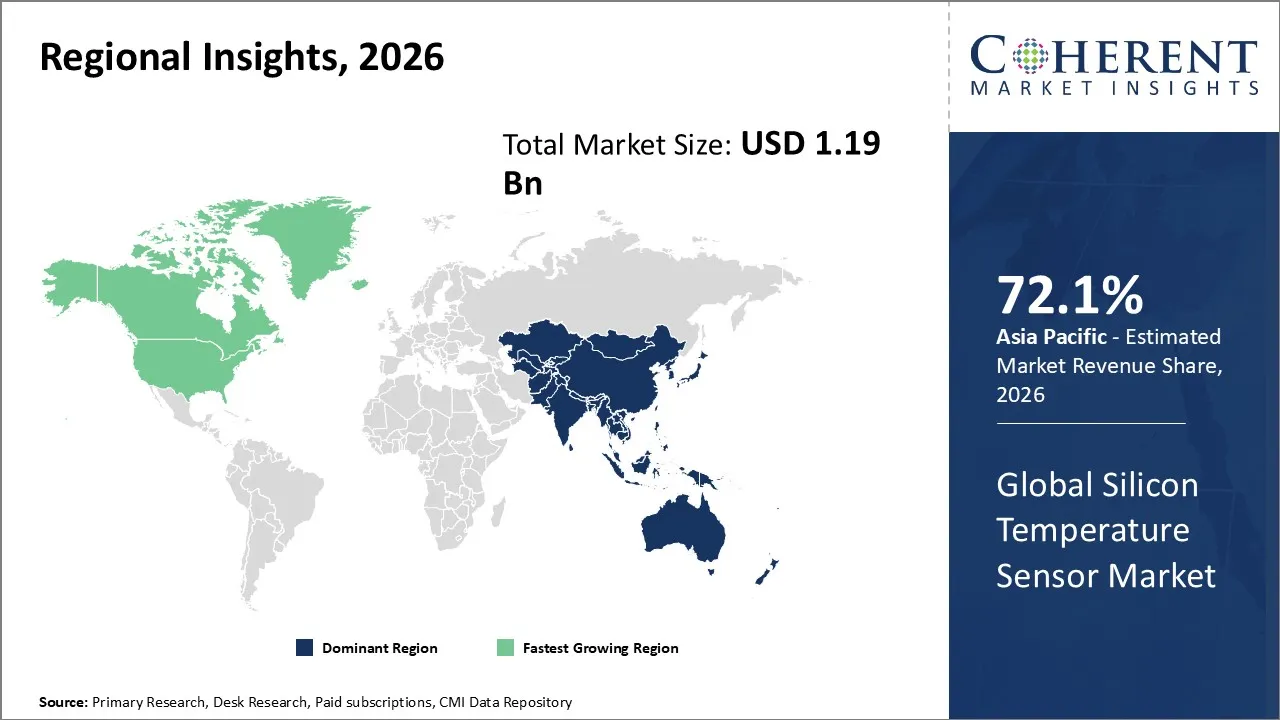
- Asia Pacific is expected to dominate the silicon temperature sensor market in 2026, with a share of 72.1%. The region assembles most of the world’s phones, computers, servers and vehicles, so sensor chips are designed in and bought close to the production lines.
- North America is expected to account for 11.1% of the market in 2026 and to be the fastest-growing region over 2026–2033. The region’s growth comes from data centres that are being built and fitted out for AI workloads, where every server needs many more sensing points than a conventional one.
Segmental Insights
Why Does Digital Output Lead the Output Type Segment?
In terms of output type, digital sensors are expected to account for 61.8% of the global silicon temperature sensor market share in 2026. A digital chip does its own measuring and conversion, then leaves a finished number in a register that the host processor reads over a two-wire bus. Engineers like this because nothing about the reading depends on how the board is routed. Several chips can share one bus through address pins, so a board with eight sensing points needs no more signal wires than a board with one. Software teams also like it: the same driver code works from one supplier’s part to the next.
A digital sensor chip is usually judged on four working blocks, and buyers compare parts on each of them:
- Sensing element: a bandgap junction measures the die temperature. Microchip’s MCP9808 is specified at ±0.25 °C typical and ±0.5 °C maximum from –20 °C to 100 °C.
- Converter and resolution: an on-chip converter turns the junction voltage into a number. The MCP9808 lets the user pick a resolution from 0.5 °C down to 0.0625 °C, trading speed against detail.
- Limit registers and alert pin: the designer stores a window and a critical limit, and the chip raises an alert on its own when the temperature leaves them, so the processor does not have to poll.
- Bus interface: I²C and SMBus are the common choices, with I³C now available on newer parts for faster reads and in-band interrupts.
- Current Industry Events of 2026
- Market Size Estimation
- Regional Breakdown
- Competitive Landscape
- Customer Intelligence
- Segmental Analysis
- Pricing Analysis
- Key Market Drivers, Challenges & Future Trends
- Customized Insights Section
Why Does Local Sensing Lead the Sensing Configuration Segment?
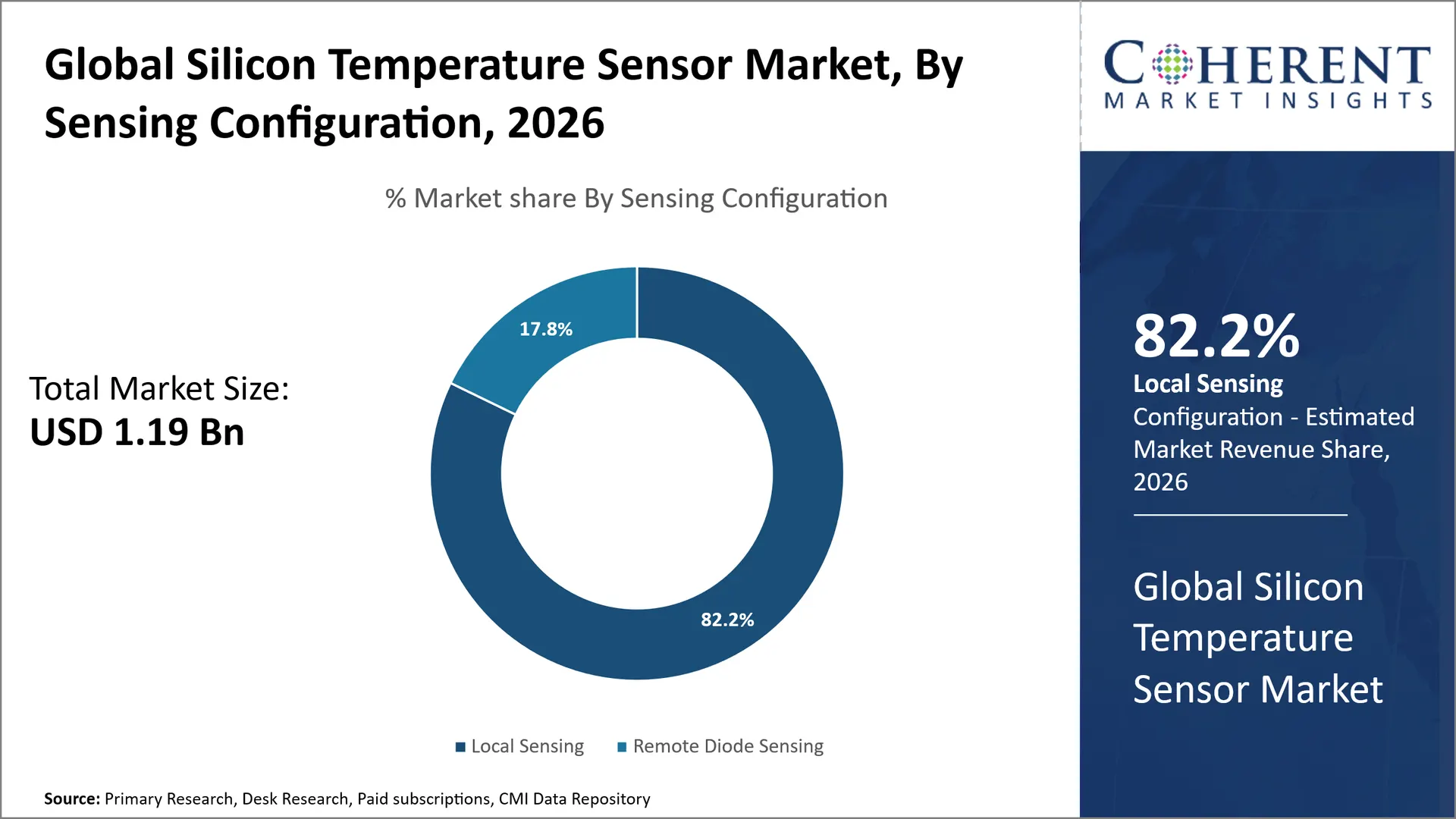
In terms of sensing configuration, local sensing is expected to account for 82.2% of the global silicon temperature sensor market share in 2026. A local sensor measures its own die. Since the chip sits on the board right next to the part being watched, its die temperature follows that part closely, and the design needs nothing else: no extra diode, no extra trace. This makes it the cheapest sensing point to add and the quickest to place in a layout. Typical spots are the corner of a board near a voltage regulator, the lid of a battery pack, the base of a laptop or the inside of an SSD.
Four things decide how well a local sensor does its job once it is placed:
- Thermal coupling: STMicroelectronics builds the STTS22H in a 2 mm × 2 mm × 0.5 mm six-lead UDFN package with the exposed pad facing down, so heat from the board reaches the die through the pad.
- Package size: smaller packages fit between components. Infineon’s AS6223 measures only 0.82 mm × 0.82 mm, which suits wearables and patches.
- Supply and power draw: the STTS22H runs from 1.5 V to 3.6 V and draws 1.75 µA in one-shot mode, which matters in battery products.
- Accuracy over the range that matters: the STTS22H is specified at ±0.5 °C maximum from –10 °C to +60 °C, the span in which most consumer and building devices operate.
Why Does Automotive Lead the End-Use Industry Segment?
In terms of end-use industry, automotive is expected to account for 60.6% of the global silicon temperature sensor market share in 2026. The base is large and growing. The International Organization of Motor Vehicle Manufacturers (OICA) reported that global vehicle production rose from 92.7 million units in 2024 to 96.4 million in 2025, an increase of 3.9%, and that new-energy vehicle production reached 16.626 million units, up 29%. Every one of those vehicles carries several protected electronic modules, and each module needs a sensor chip that is qualified to survive years of heat cycling.
Inside a vehicle, sensor chips are placed in four main areas, and the number of points per car keeps rising:
- Battery pack: sensors watch cell groups, busbars and coolant lines so the controller can limit current or call for cooling before a hot spot grows.
- Power electronics: inverters, on-board chargers and DC-DC converters switch large currents, and a sensor near the power devices protects them from overheating.
- Compute modules: driver-assistance and infotainment processors run warm in sealed housings, so their boards carry sensors for thermal throttling.
- Body and lighting: headlamp drivers, seat and mirror controllers and door modules use small sensors to prevent overheating in confined spaces.
Current Events and their Impact
Current Events | Description and its Impact |
GB 38031-2025: China’s “no fire, no explosion” EV battery standard takes effect on July 1, 2026 |
|
MIIT production data: China’s electronics output reported on January 30, 2026 |
|
Silicon Temperature Sensor Market Dynamics
Market Drivers
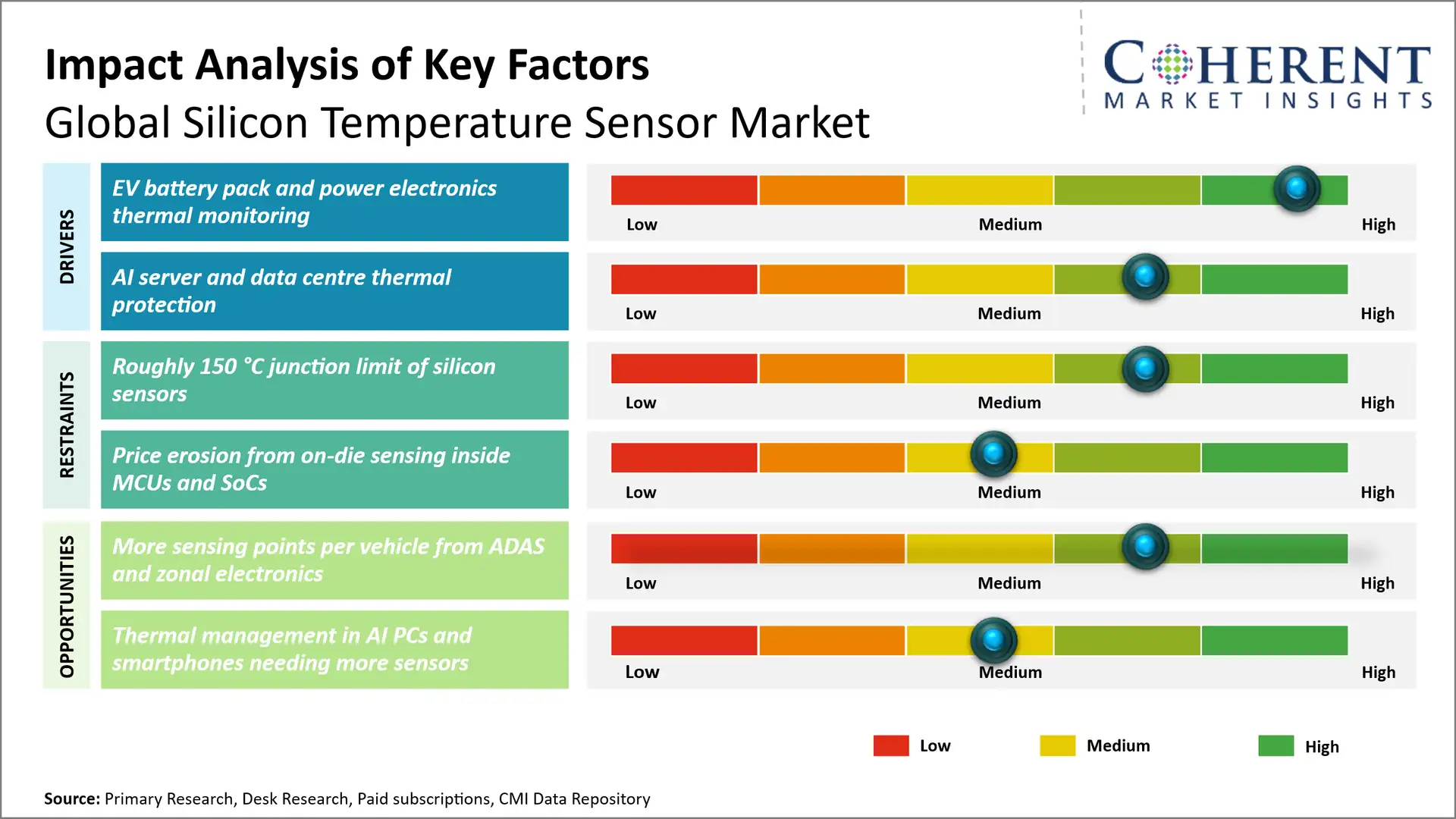
- EV battery pack and power electronics thermal monitoring: An electric vehicle stores a great deal of energy in one place, and the parts that move it in and out, the inverter, the charger and the DC-DC converter, all run hot. A sensor on the cells, the cooling plates and the power devices tells the control unit how fast each is heating, and the controller then cuts current, starts the coolant pump or shuts the system down. Safety rules now ask for early warning of battery failure, so another temperature point stops being an option and becomes a requirement. Remote diode chips are popular for the power stage because a cheap transistor can sit beside the hot device while the sensor chip stays on a cooler part of the board. In the Global EV Outlook 2026, the IEA reported that electric car sales grew by 20% to exceed 20 million in 2025, a quarter of all new cars sold, and that nearly 22 million electric cars were produced.
- AI server and data centre thermal protection: An AI server packs processors, memory and power stages into very little space, and the cooling system has to be adjusted all the time to keep up. Sensor chips on the motherboard, on each memory module and beside the power stages give the management controller the readings it needs to set fan speed and coolant flow. STMicroelectronics describes its STTS series as aimed at DRAM memory modules in servers, desktops and laptops, and every added memory channel adds another sensing point to the rack. In its Key Questions on Energy and AI report, the IEA reported that data centre electricity demand grew by 17% in 2025 and is expected to roughly double from 485 TWh in 2025 to 950 TWh in 2030.
Emerging Trends
- Memory-module thermal sensing is settling on a published standard: Server memory has moved to the I3C bus, and the sensor chips that sit on each module now follow a fixed standard instead of each supplier’s own design. In August 2023, JEDEC published JESD302-1A, which defines the TS511X and TS521X standalone thermal sensor devices for memory modules and covers both I²C and I3C operation.
- Impact: Memory-module makers can buy a compliant sensor from more than one supplier and swap between them without redesigning the board.
- Relevance to the market: A written standard makes sensor chips for DIMMs easier to qualify and quicker to buy in volume, which favours suppliers that can prove compliance and supply many parts at a steady price.
- Remote diode chips are correcting their own errors: A remote diode sensor reads a transistor placed near the hot part, and long traces or a different transistor make the reading drift. Newer chips correct for both. On December 4, 2025, Texas Instruments listed the data sheet for the TMP4719-Q1, an automotive chip with one local and two remote channels, series-resistance correction, a programmable η-factor and a published accuracy of 0.8 °C.
- Impact: Designers can place the monitored transistor farther from the chip, closer to the hottest spot, and still trust the reading.
- Relevance to the market: Better correction widens the use of remote sensing from processors to power modules and battery boards, where sensors have to sit in awkward places.
- Data centre cooling is being tuned with more temperature points: Cooling takes a very different share of a data centre’s power bill depending on how well it is controlled. The IEA noted in its Energy and AI report that the share of cooling in total data centre consumption runs from about 7% in efficient hyperscale sites to over 30% in less efficient ones.
- Impact: Operators with finer temperature data can lower fan and pump power without letting any chip run hot.
- Relevance to the market: Cooling control that depends on readings from many points rewards sensor chips that are cheap, small and easy to read over a shared bus.
Regional Insights
Why Does Asia Pacific Lead the Global Silicon Temperature Sensor Market?
Asia Pacific is expected to hold 72.1% of the silicon temperature sensor market in 2026. The reason is where the end products are built. China, Japan, South Korea, India and ASEAN countries assemble most of the world’s smartphones, computers, servers, home appliances and vehicles, and sensor chips are bought where boards are made. The region is also home to sensor and analog-chip designers such as ABLIC and ROHM in Japan. Because design teams, contract manufacturers and component distributors sit within the same supply chain, Asian buyers can qualify a new sensor quickly and place high-volume orders.
Why Is North America the Fastest-Growing Region in the Silicon Temperature Sensor Market?
North America is expected to account for 11.1% of the market in 2026 and to grow faster than any other region over 2026–2033. Its growth is tied to the build-out of data centres and AI server capacity, which brings more memory modules, power stages and cooling controls per rack, and each of them needs its own temperature sensor chip. The region also hosts major chip designers such as Texas Instruments, Microchip Technology and onsemi, which keeps design-in activity close to the customers building AI hardware.
Global Silicon Temperature Sensor Market Outlook for Key Countries
Is China the Largest Market for Silicon Temperature Sensors?
China is the largest country market, with a value of USD 0.55 Bn in 2026. It leads because it makes more of the end products that carry these chips than any other country. The National Bureau of Statistics reported in its February 28, 2026 statistical communiqué that China produced 5.970 million servers in 2025, and the country is also the centre of electric vehicle and consumer electronics assembly. Local and global suppliers compete on price here, which supports unit volumes.
Is the U.S. the Largest North American Market for Silicon Temperature Sensors?
The U.S. is the largest market in North America, valued at USD 0.10 Bn in 2026. Demand is led by data centres and by automotive and industrial electronics. The U.S. Energy Information Administration published analyses of data-centre electricity use on March 12 and May 19, 2026, which show how closely grid planners are following this build-out. The country also hosts the headquarters and design teams of Texas Instruments, Analog Devices, Microchip Technology and onsemi.
Is India the Second-Largest Asia Pacific Market for Silicon Temperature Sensors?
India is the second-largest Asia Pacific market, with a value of USD 0.08 Bn in 2026. The country has been building up local assembly of phones and electronics, and the Ministry of Electronics and Information Technology reported that electronics production grew 15.8% in fiscal year 2025-26, while electronics exports reached USD 47.96 Bn, making electronic goods India's third-largest export category.
Is Japan the Leading Home of Silicon Temperature Sensor Suppliers in Asia Pacific?
Japan is valued at USD 0.07 Bn in 2026. Its position rests on strong automotive and industrial electronics production and on domestic chip suppliers. ABLIC publishes a digital sensor line such as the S-5852A, with ±0.5 °C typical accuracy and a thermostat function, and ROHM sells analog-output parts such as the BD1020HFV with a quiescent current of only 4 µA. Local sourcing between Japanese carmakers and component makers keeps these suppliers close to demand.
Is Germany the Leading European Market for Silicon Temperature Sensors?
Germany is the largest European market, with a value of USD 0.03 Bn in 2026. It leads because it is Europe’s centre for car production and industrial equipment. The German Association of the Automotive Industry (VDA) reported on January 5, 2026 that German car production reached 4.15 million vehicles in 2025, up 2%. Infineon, Europe’s largest sensor and power chip supplier, is based in Munich.
Global Silicon Temperature Sensor Market - Key Countries at a Glance (2026)
Country | Value (USD Bn) | Position | Anchor Data Point |
China | 0.55 | Largest country market | 5.970 million servers produced in 2025 (National Bureau of Statistics) |
U.S. | 0.10 | Largest North American market | Data-centre electricity use under close federal review (EIA analyses, March 12 and May 19, 2026) |
India | 0.08 | Second-largest in Asia Pacific | Electronics production up 15.8% and exports of USD 47.96 Bn in FY 2025-26 (MeitY) |
Japan | 0.07 | Home of ABLIC and ROHM | Digital and analog-output sensor lines from two domestic suppliers |
Where Silicon Temperature Sensors Are Placed - Application Map
Application | What Is Being Watched | Sensor Style | Reference Part and Published Detail |
EV battery pack | Cell groups, busbars and coolant lines | Local, SPI or I²C | TI TMP126-Q1: –55 °C to 175 °C ambient range, 14-bit resolution, 1.62 V to 5.5 V supply |
Inverter and power module | Temperature of the switching devices | Remote diode | TI TMP4719-Q1: two remote channels plus one local, with series-resistance correction |
Server memory module | DRAM components on a DIMM | Local, I²C or I3C | TI TMP139: JEDEC DDR5 Grade B, 11-bit resolution of 0.25 °C, six-ball DSBGA package |
Low-voltage motherboard | Processor or power stage through an external transistor | Remote diode | onsemi NCT218: 1.4 V to 2.75 V supply, ±1 °C remote accuracy |
SSD, notebook PC and appliance | Storage drive, device base, refrigerator or air-conditioner temperature | Local, I²C | ABLIC S-5852A: thermostat function, 1.7 V to 3.6 V supply, I²C up to 1.0 MHz |
Wearable and health patch | Skin or body-contact temperature | Local, I²C | Infineon AS6223: ±0.09 °C from 20 °C to 42 °C; TI TMP117: ±0.1 °C maximum accuracy |
Battery-powered gadget | Casing or battery temperature at minimal drain | Local, voltage or digital | ROHM BD1020HFV: 4 µA typical supply current, 1.6 mm × 1.6 mm package |
How Are More Sensing Points per Vehicle and Thermal Management in AI PCs and Smartphones Creating New Growth Opportunities in the Silicon Temperature Sensor Market?
Heat is the common thread. Wherever electronics get denser and hotter, someone has to watch one more spot, and both of the openings below grow out of that.
The first is More sensing points per vehicle from ADAS and zonal electronics. Carmakers are moving from dozens of small control boxes to a handful of zonal computers, and driver-assistance systems add cameras, radar and processors that all run warm in sealed housings. On January 5, 2026, Texas Instruments introduced its TDA5 processor family, which supports up to SAE Level 3 autonomy, along with a single-chip 4D imaging radar transceiver. Each of these computers needs its own thermal watch, and the more safety-critical the function, the more spots engineers want to cover. A supplier with qualified multi-channel chips can sell several parts into a single module instead of one, so the sensor content of each car rises even when car volumes barely move.
The second is Thermal management in AI PCs and smartphones needing more sensors. An on-device AI engine works in bursts, and the heat from each burst lands in a very small space. If it is not managed, the device gets hot to hold or slows itself down. To prevent that, designers put extra sensors near the processor, the battery and the memory, so the system can spread the load before anything overheats. These sockets go to chips that are tiny and sip very little current. A maker that can offer both has a fair shot at winning them, and because the sensors are added rather than swapped in for older ones, each new design means extra units sold.
Market Players, Key Development, and Competitive Landscape
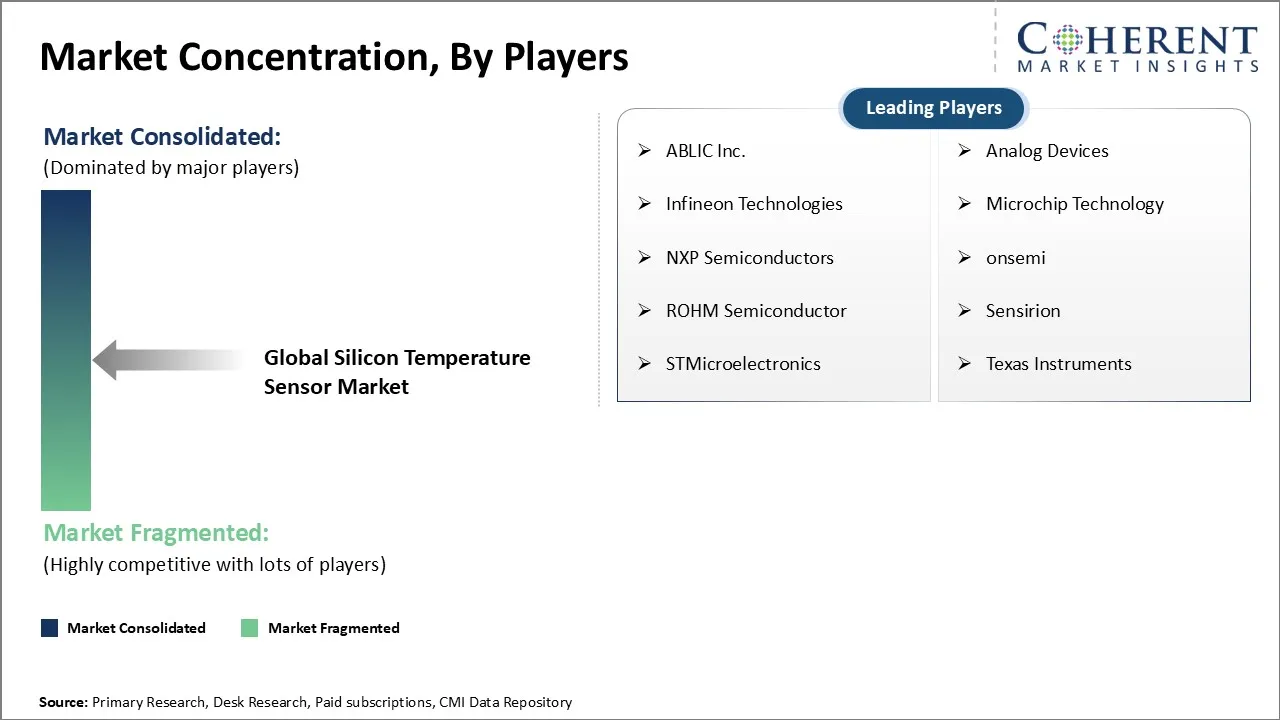
Key Developments
- On July 1, 2026, Infineon announced that it had completed the acquisition of the non-optical analog and mixed-signal sensor portfolio from ams OSRAM, a deal valued at about USD 653 Mn. Around 230 employees from ams OSRAM joined Infineon, and the business adds three locations in Valencia, Rapperswil and Hyderabad.
- On February 3, 2026, Infineon announced an agreement to acquire the portfolio, which includes a multi-year supply agreement with ams OSRAM. The deal aims to strengthen Infineon’s position in sensors for automotive and industrial markets and to widen its range in medical applications.
- On October 17, 2024, Sensirion announced the STS4L, a digital temperature sensor with ±0.4 °C accuracy in a 1.5 mm × 1.5 mm × 0.5 mm package, three I²C addresses and communication speeds up to 1 MHz, added to its STS4x series for cost-sensitive and space-limited designs.
- On January 18, 2024, Microchip Technology announced the MCP998x family of 10 automotive-qualified multi-channel remote temperature sensors, five of which include shutdown safety features, for uses such as driver assistance, infotainment and body electronics.
Competitive Landscape
The market is shared between three groups. Large analog and mixed-signal suppliers such as Analog Devices, Microchip Technology, onsemi, STMicroelectronics and Texas Instruments offer the broadest ranges, from low-cost local sensors to multi-channel remote diode chips qualified for cars. Infineon and NXP Semiconductors link sensor chips to their automotive, power and processing businesses, and Infineon has widened its sensor portfolio through its purchase of the ams OSRAM business. Specialists such as ABLIC, ROHM Semiconductor and Sensirion compete on tiny packages, very low current and cost. Buyers judge suppliers on accuracy, package size, power draw, automotive qualification and long-term supply, so the contest is mostly decided at the design-in stage.
Top Companies and Notable Products in the Silicon Temperature Sensor Market:
Company | Headquarters | Notable Product | Output and Sensing Style | Standout Published Feature |
ABLIC Inc. | Japan | S-5852A | Digital, local | Thermostat function; ±0.5 °C typical from 0 °C to 65 °C; I²C up to 1.0 MHz |
Analog Devices | U.S. | ADT7420 | Digital, local | 16-bit resolution of 0.0078 °C; ±0.25 °C from –20 °C to +105 °C |
Infineon Technologies | Germany | XENSIV AS6223 | Digital, local | ±0.09 °C from 20 °C to 42 °C; four selectable I²C addresses |
Microchip Technology | U.S. | MCP9808 | Digital, local | ±0.25 °C typical; resolution selectable from 0.5 °C to 0.0625 °C |
NXP Semiconductors | Netherlands | P3T1755 | Digital, local | I3C up to 12.5 MHz and I²C up to 3.4 MHz; ±0.5 °C |
onsemi | U.S. | NCT218 | Digital, remote diode and local | Cancels up to 500 Ω of series resistance on the remote diode |
ROHM Semiconductor | Japan | BD1020HFV | Voltage, local | 4 µA typical supply current; –8.2 mV/°C sensitivity |
Sensirion | Switzerland | STS4L | Digital, local | ±0.4 °C in a 1.5 mm × 1.5 mm × 0.5 mm package |
STMicroelectronics | Switzerland | STTS22H | Digital, local | 1.75 µA in one-shot mode; ±0.5 °C from –10 °C to +60 °C |
Texas Instruments | U.S. | TMP117 and TMP126-Q1 | Digital, local | TMP117 reaches ±0.1 °C; TMP126-Q1 operates up to 175 °C |
Market Report Scope
Silicon Temperature Sensor Market | |||
Report Coverage | Details | ||
Base Year | 2025 | Market Size in 2026: | USD 1.19 Bn |
Historical Data For: | 2020 To 2024 | Forecast Period: | 2026 To 2033 |
Forecast Period 2026 To 2033 CAGR: | 3.3% | 2033 Value Projection: | USD 1.49 Bn |
Geographies covered: |
| ||
Segments covered: |
| ||
Companies covered: | ABLIC Inc., Analog Devices, Infineon Technologies, Microchip Technology, NXP Semiconductors, onsemi, ROHM Semiconductor, Sensirion, STMicroelectronics, Texas Instruments | ||
Growth Drivers: |
| ||
Restraints & Challenges: |
| ||
Analyst Opinion (Expert Opinion)
- Digital, local and automotive lead, but thermal protection now follows the AI build-out. Digital output holds 61.8% of the output type segment in 2026, local sensing holds 82.2% of the sensing configuration segment, and automotive holds 60.6% of the end-use industry segment. Demand is anchored in vehicles, while EV battery pack and power electronics thermal monitoring and AI server and data centre thermal protection are the forces that add sensor chips to every board. Winners will be suppliers that combine accuracy, small packages and automotive qualification.
- Asia Pacific holds 72.1% of the market in 2026, while North America is the fastest-growing region at 11.1% of the 2026 market, and two risks remain. The first is the Roughly 150 °C junction limit of silicon sensors, which pushes hotter locations toward other sensing technologies, although a few parts such as the TMP126-Q1 are specified to 175 °C. The second is Price erosion from on-die sensing inside MCUs and SoCs, which removes the need for a separate chip in many low-end designs. The opportunities are More sensing points per vehicle from ADAS and zonal electronics and Thermal management in AI PCs and smartphones needing more sensors.
Speak to the analyst
Want personalized insights?
Take the findings above to one of our principal consultants, or have the report rebuilt around the segments, geographies and competitors you actually track.
Market Segmentation
- Output Type Insights (Revenue, USD Billion, 2021 - 2033)
- Digital Output
- Voltage Output
- Current Output
- Sensing Configuration Insights (Revenue, USD Billion, 2021 - 2033)
- Local Sensing
- Remote Diode Sensing
- End-use Industry Insights (Revenue, USD Billion, 2021 - 2033)
- Automotive
- Consumer Electronics
- IT/Data Centre
- Regional Insights (Revenue, USD Billion, 2021 - 2033)
- North America
- U.S.
- Canada
- Latin America
- Brazil
- Argentina
- Mexico
- Rest of Latin America
- Europe
- Germany
- U.K.
- Spain
- France
- Italy
- Russia
- Rest of Europe
- Asia Pacific
- China
- India
- Japan
- Australia
- South Korea
- ASEAN
- Rest of Asia Pacific
- Middle East
- GCC Countries
- Israel
- Rest of Middle East
- Africa
- South Africa
- North Africa
- Central Africa
- North America
- Key Players Insights
- ABLIC Inc.
- Analog Devices
- Infineon Technologies
- Microchip Technology
- NXP Semiconductors
- onsemi
- ROHM Semiconductor
- Sensirion
- STMicroelectronics
- Texas Instruments
Sources
- Primary Research Interviews
- Sensor IC Design and Product Marketing Managers
- Automotive Electronics and Battery Management Engineers
- Server, Memory Module and Data Centre Hardware Engineers
- Consumer Electronics Hardware Designers
- Distributors and Contract Electronics Manufacturers
- Magazines
- EE Times
- Electronic Design
- Electronics Weekly
- Semiconductor Engineering
- EDN
- Power Electronics News
- Journals
- IEEE Sensors Journal
- IEEE Journal of Solid-State Circuits
- Sensors and Actuators A: Physical
- Measurement
- Associations
- JEDEC Solid State Technology Association
- Semiconductor Industry Association (SIA)
- SEMI
- Society of Automotive Engineers (SAE)
- Organisation Internationale des Constructeurs d’Automobiles (OICA)
- Public Domain Sources
- China Ministry of Industry and Information Technology: 2025 electronics production data, January 30, 2026
- National Bureau of Statistics of China: Statistical Communiqué on 2025 National Economic and Social Development, February 28, 2026
- China national standard GB 38031-2025: Electric vehicles traction battery safety requirements, effective July 1, 2026
- German Association of the Automotive Industry (VDA): German car production 2025, January 5, 2026
- U.S. Energy Information Administration: Analyses of data-centre electricity use, March 12 and May 19, 2026
- India Ministry of Electronics and Information Technology: Electronics production data for fiscal year 2025-26
- International Energy Agency: Energy and AI, data centre electricity demand
- Company press releases, datasheets and newsrooms (ABLIC, Analog Devices, Infineon Technologies, Microchip Technology, NXP Semiconductors, onsemi, ROHM Semiconductor, Sensirion, STMicroelectronics, Texas Instruments)
- Proprietary Elements
- CMI Data Analytics Tool
- Proprietary CMI Existing Repository of information for last 10 years
Get access to 250+ pages report
Every segment, forecast, competitor profile and data table behind the analysis above — available for instant download.
- ESOMAR Member
- ISO 9001:2015 Certified
- D-U-N-S Registered
- GDPR & CCPA Compliant
Frequently Asked Questions
The global silicon temperature sensor market is valued at USD 1.19 Bn in 2026 and is expected to reach USD 1.49 Bn by 2033.
The CAGR of the global silicon temperature sensor market is projected to be 3.3% from 2026 to 2033.
EV battery pack and power electronics thermal monitoring, and AI server and data centre thermal protection, are the major factors driving market growth.
The roughly 150 °C junction limit of silicon sensors, and price erosion from on-die sensing inside MCUs and SoCs, are the major factors hampering market growth.
In terms of output type, digital is expected to dominate the market, with a revenue share of 61.8% in 2026.
It is an integrated circuit that measures temperature using the voltage of a silicon transistor junction, and reports it as a voltage, a current or a digital value.
A transistor’s base-emitter voltage falls in a steady, predictable way as temperature rises. The chip measures this voltage against a stable reference to find the temperature.