

Global Spend Analytics Market Size and Forecast – 2026 To 2033
The global spend analytics market is expected to grow from USD 4.00 Bn in 2026 to USD 8.85 Bn by 2033, registering a compound annual growth rate (CAGR) of 7.4% from 2026 to 2033. The global Spend Analytics market is driven by expansion of cloud-based procurement platforms. On March 12, 2026, SAP SE announced the availability of next‑gen SAP Ariba, marking the next phase in SAP’s journey to reimagine source‑to‑pay for the age of AI. With this announcement, SAP outlined a major shift in how procurement technology must evolve to meet modern realities.
Key Takeaways of the Global Spend Analytics Market
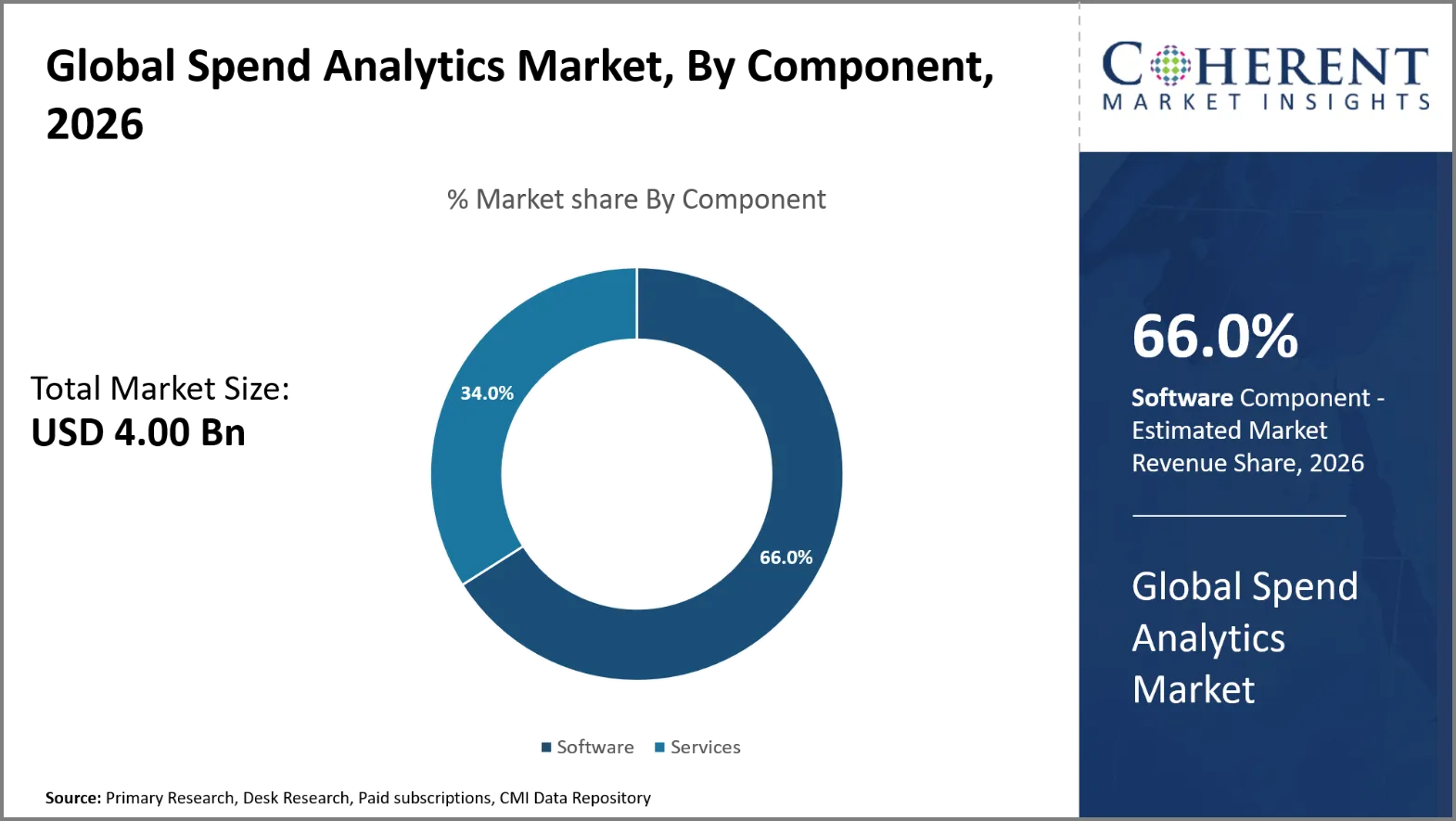
- The Software segment is expected to account for 66.0% of the global spend analytics market share in 2026. Increasing focus on maverick spend reduction is driving the growth of the segment. On May 5, 2026, JAGGAER launched JAI, an artificial intelligence assistant for procurement teams. JAI can answer questions about spending, suppliers, contracts, and purchasing rules.
- The Cloud segment is estimated to capture 57.0% of the market share in 2026. Growing demand for real time spending visibility is majorly driving the growth of the segment. In June 2026, Amazon Business rebuilt Spend Visibility with redesigned dashboards and faster purchasing-data access.
- The Procurement Analytics segment is estimated to capture 28.0% of the market share in 2026. Increasing procurement digitization among large enterprises is driving the growth of the segment. On March 18, 2025, BAE Systems chose Ivalua to combine its direct and indirect procurement systems. The implementation is focused on unified source-to-pay processes across the aerospace and defense organization.
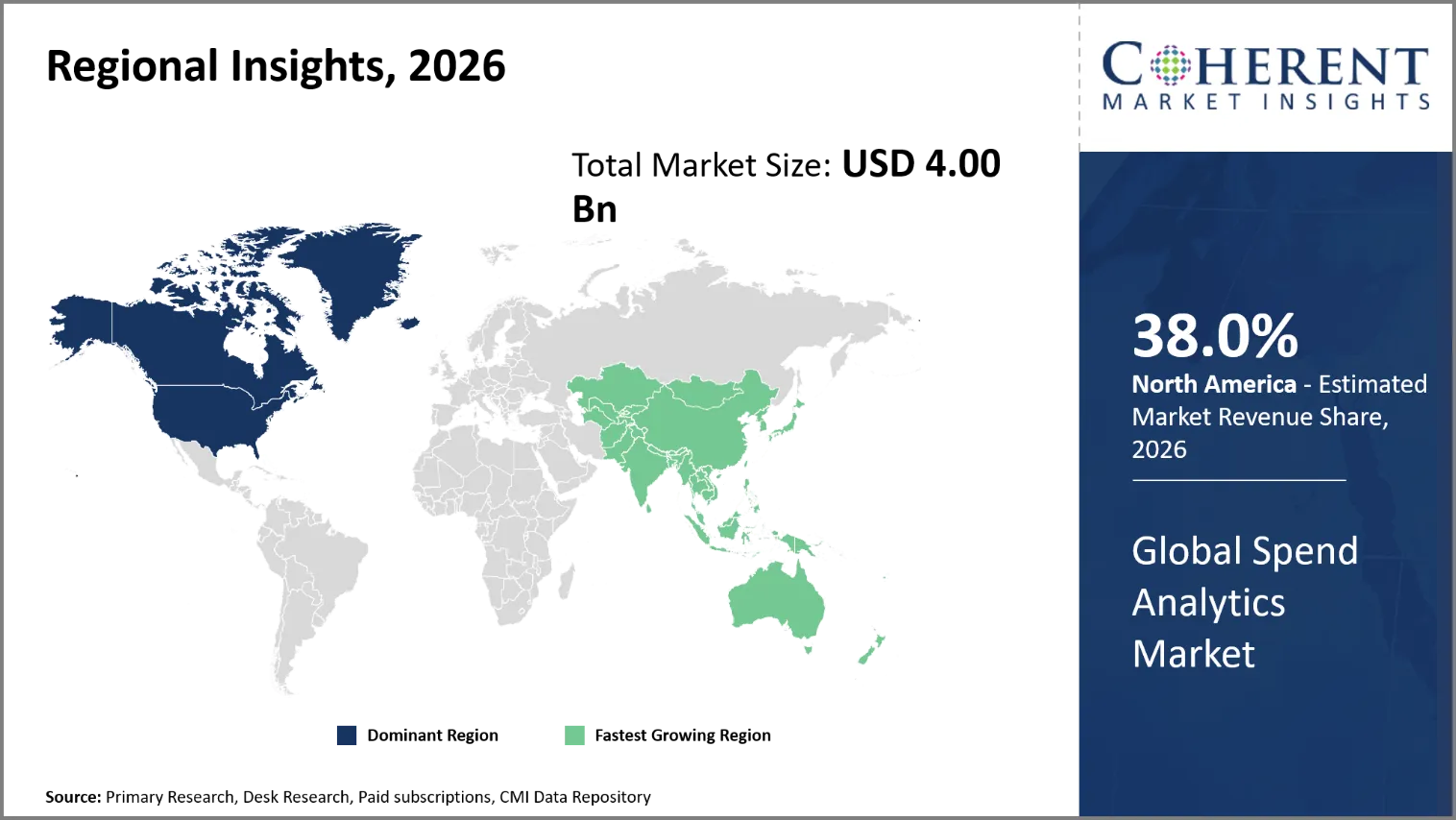
- North America is expected to dominate the spend analytics market in 2026 with a market share of 38.0%. Rising adoption of predictive and prescriptive analytics in North America is driving the growth of the regional market. On February 12, 2026, Ports America selected GEP’s artificial intelligence procurement software for enterprise-wide spend analysis. The platform will unify fragmented invoices, purchasing cards, and travel data.
- Asia Pacific is expected to account for 27.0% share in 2026. Growing need for automated spend classification in Asia Pacific is driving the growth of the regional market. On July 25, 2025, Digitate announced the successful deployment of its artificial intelligence spend intelligence solution at Tata Chemicals.
Segmental Insights
Why Does Software Dominate the Global Spend Analytics Market?
The software segment is expected to account for 66.0% of the global spend analytics market share in 2026. Software can automatically classify procurement data across huge, fragmented spending records. It ingests data from enterprise resource planning systems, procurement platforms, invoices, contracts and supplier databases. Artificial intelligence increases anomaly detection, supplier segmentation, category analysis and savings identification. With cloud deployment of software, procurement teams gain a uniform view of expenditures across several business units. These features provide constant purchase monitoring without the intensive human data processing.
On April 7, 2026, Coupa, a leading AI platform for total spend management, entered into a five-year strategic collaboration deal with Amazon Web Services. The partnership leverages Coupa’s own business intelligence network and AWS AI capabilities to enable autonomous direct and indirect expenditure across the complete spend lifecycle; from sourcing to payment to supply chain execution.
- Current Industry Events of 2026
- Market Size Estimation
- Regional Breakdown
- Competitive Landscape
- Customer Intelligence
- Segmental Analysis
- Pricing Analysis
- Key Market Drivers, Challenges & Future Trends
- Customized Insights Section
Why is Cloud the Most Preferred Deployment Type?
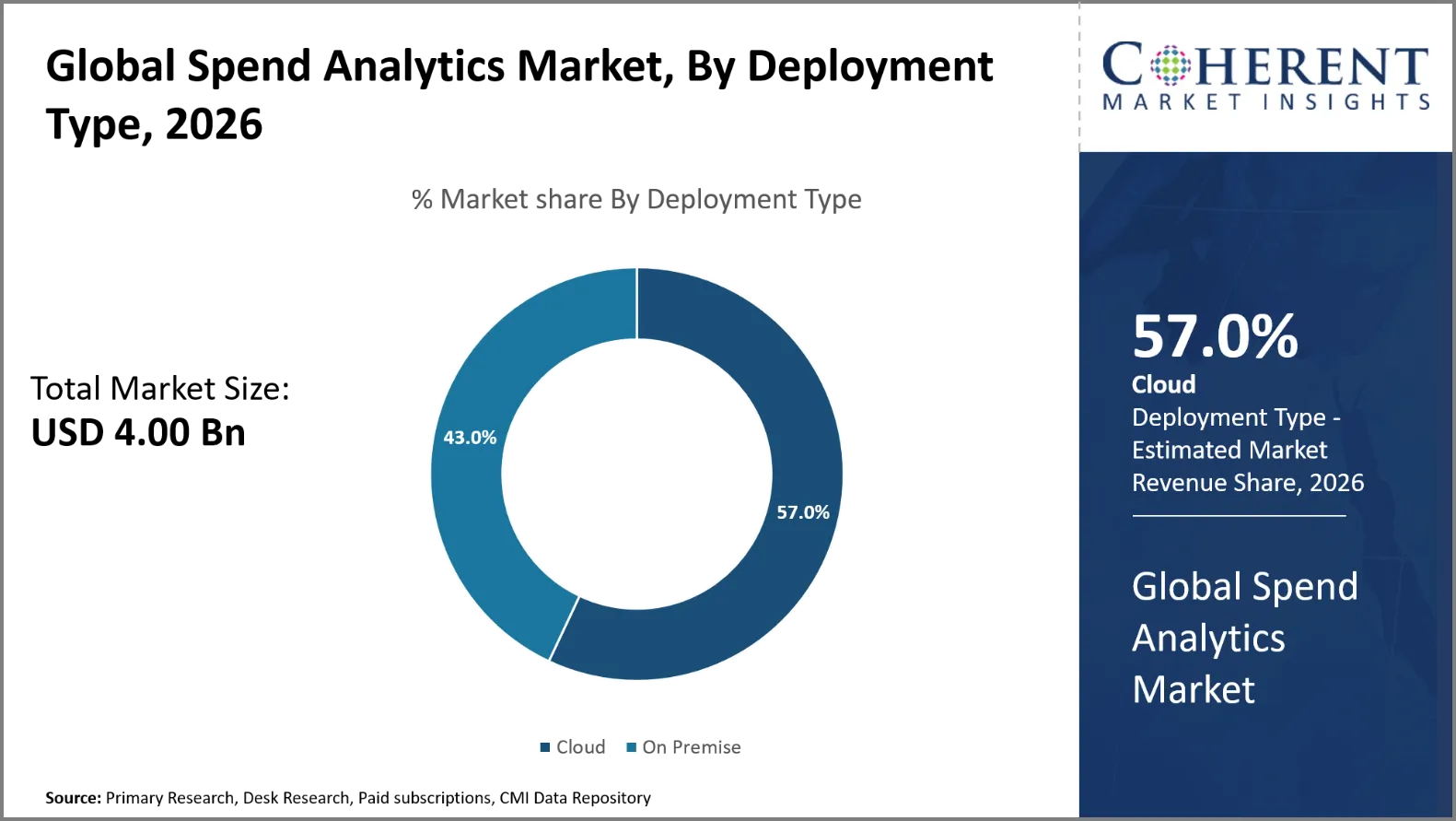
The cloud segment is expected to account for 57.0% of the global spend analytics market share in 2026. Cloud implementation minimizes the infrastructure requirements for organizations using spend analytics across numerous procurement activities. Provides a single place to view spending data across geographically spread business units. Organizations can stay current with their analytics capabilities without significant internal maintenance by allowing automatic software updates. Cloud solutions can provide flexibility in scaling up, when transaction volumes, suppliers or users expand. These advantages make cloud deployment useful for firms that want accessible and flexible procurement intelligence. In February 2026, Oracle included embedded artificial intelligence and analytics in Oracle Fusion Cloud Procurement. It enables automated procurement processes, supplier suggestions, sourcing intelligence and live supplier visibility. Oracle also integrates procurement with its broader Fusion Cloud Applications environment.
Procurement Analytics Dominates the Global Spend Analytics Market
The procurement analytics segment is expected to account for 28.0% of the global spend analytics market share in 2026. Procurement analytics allows firms to see the purchase patterns across categories, suppliers, departments and business units. It offers transparency into supplier consolidation opportunities and unregulated purchasing activity. Automated analysis enables procurement teams to identify savings potential based on price disparities and purchasing quantities. Integration with procurement systems also accelerates tracking of sourcing performance and purchasing compliance. These capabilities are driving increased demand for procurement-centric analytics across enterprises with complex buying processes. In August 2026, Tropic released new intelligence capabilities for tech procurement teams. It has a Redundancy Analysis that finds overlapping software products at the stock keeping unit level. The tool calculates possible savings from software consolidation. Its artificial intelligence consumption management also compares committed spending with actual usage.
Current Events and their Impact
Current Events | Description and its Impact |
European Union Data Act |
|
U.K. Procurement Act |
|
Spend Analytics Market Dynamics
Market Drivers
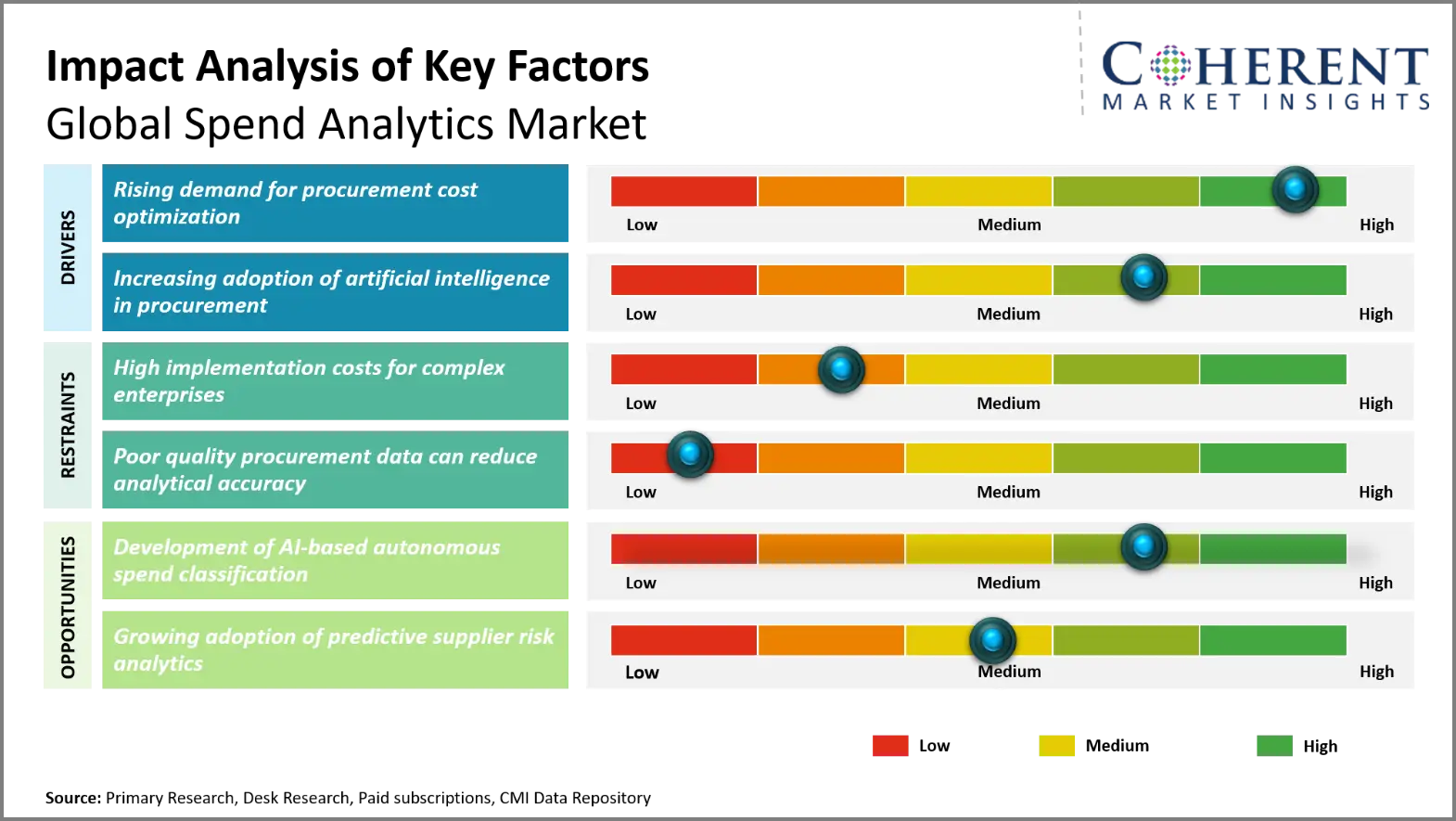
Rising demand for procurement cost optimization
Enterprises are looking for procurement cost optimization as they are under pressure to boost margins and minimize operational expenses. Organizations use spend analysis to find price variances, redundant vendors and needless purchases. It also allows procurement teams to study spend patterns by category and business unit. Automated insights show possibilities to save money and tighten purchase controls. These capabilities are driving spend analytics adoption across enterprises looking to realize measurable procurement savings.
On September 14, 2026, Jaggaer, a leader in AI-powered procurement solutions, announced it has finalized its acquisition of Ivoflow, a spend & pricing intelligence platform for direct materials based in Koblenz, Germany. The purchase fits well with Jaggaer’s aim of creating the most intelligent procurement platform in the business.
Increasing adoption of artificial intelligence in procurement
The integration of artificial intelligence in procurement process is on the rise to enhance the expenditure analysis and decision-making. Artificial intelligence can automate spend classification across complex procurement datasets. It can identify abnormalities, supplier risks, purchase trends, and even savings opportunities. Demand forecasting and supplier performance evaluations can also be assisted by predictive models. Such capabilities are extending the usage of artificial intelligence in expenditure analytics solutions.
On March 16, 2026, Pactum announced the debut of its Requisition Alignment Agent, a new feature for the company’s AI-native platform, integrated directly into business procure-to-pay (P2P) systems like SAP and Coupa. The new agent examines incoming procurement requests for completeness, policy compliance and commercial relevance to identify any important bargaining chances before triggering specialized AI agents that negotiate autonomously.
Emerging Trends
- Generative artificial intelligence for procurement insights: Generative AI is being used to enable complex spend datasets to deliver natural language queries, automated summaries, and contextual suggestions. Procurement teams can progressively drill down into supplier performance, category trends and savings potential without the need for specific analytical skills.
- Predictive supplier risk analytics: Spend analytics tools are progressively linking purchase information with supplier, financial and operational variables. Predictive analytics models enable procurement teams to identify probable disruptions, evaluate supplier exposure and rank risk mitigation measures across important sourcing categories.
- Real time spend monitoring: Enterprises are moving toward constantly updated procurement dashboards that deliver speedier visibility into transactions and purchasing activity. Real time monitoring allows firms to see policy infractions, strange spending trends, duplicate transactions and savings possibilities as they happen.
- Sustainability focused spend analytics: More procurement data is being integrated with environmental and supplier sustainability data. Analytics tools are able to assess supplier characteristics, product qualities and buying habits. This helps to drive sustainable sourcing decisions and increased visibility to sustainability performance across procurement operations.
Regional Insights
Why is North America a Strong Market for Spend Analytics?
North America is expected to account for a market share of 38.0% in 2026. North American adoption is backed by large scale federal procurement digitalization and advanced procurement automation programs. In January 2026, the U.S. General Services Administration completed full implementation of Transactional Data Reporting. The initiative generated USD 20.2 million in annual cost avoidance during initial mandatory implementation. The agency projects USD 50 million in annual cost avoidance after full implementation. The U.S. General Services Administration is also developing an artificial intelligence-enabled Procurement Automation Ecosystem. The platform centralizes federal procurement data and supports automated purchasing decisions. The National Institute of Standards and Technology is separately working with the agency on artificial intelligence evaluation for procurement.
Why Does Asia Pacific Spend Analytics Market Exhibit High Growth?
Asia Pacific is expected to register the fastest growth with a CAGR of 8.1% over the forecast period and projected to account for 27.0% of the global spend analytics market in 2026. Asia Pacific growth is increasingly linked to procurement digitalization, supplier relationship management, and sustainability requirements. PricewaterhouseCoopers surveyed about 250 Asia Pacific procurement responses and found greater focus on supplier sourcing and digital transformation. The survey established a target for digitized transactional procurement procedures at 63% by 2027. Japan is encouraging electronic procurement, using the shared Electronic Procurement System among ministries and agencies. Japan also introduced a Digital Marketplace to speed up cloud software buying. These programs yield organized purchasing data for spend classification, supplier comparisons and procurement performance analysis.
Global Spend Analytics Market Outlook for Key Countries
Why is U.S. Emerging as a Major Hub in the Spend Analytics Market?
The U.S. spend analytics market is being driven by federal projects to optimize buying decisions using transactional procurement data. By 2026, the U.S. General Services Administration fully embedded Transactional Data Reporting into its purchasing system. Mandatory implementation at start-up avoided $20.2 million in annual costs. The agency anticipates saving roughly USD 50 million annually after widespread deployment. Its Procurement Automation Ecosystem is built to connect siloed historical procurement systems and consolidate federal purchasing information. The General Services Administration is also developing artificial intelligence evaluation capabilities with the National Institute of Standards and Technology.
Is China the Next Growth Engine for the Spend Analytics Market?
China also has a great demand of procurement analytics as government purchasing creates a large amount of structured transactional data. Government purchases surged to USD 502.90 billion in 2024, according to Ministry of Finance figures. Open bidding accounted for 76.63% of procurement methods, and generated large amounts of digital transaction records. Government procurement contracts awarded to small and medium enterprises of USD 361.03 billion. Chinese procurement officials are likewise pushing for platform integration and consistent procurement data across the nation. The current focus is on data quality, interoperability, artificial intelligence, electronic certificates and the digital procurement of the entire process. These developments strengthen requirements for supplier analytics, transaction classification, compliance monitoring, and procurement intelligence.
U.K. Spend Analytics Market Analysis and Trends
U.K. Transparencies in public procurement and unified procurement data standards are boosting market. The Procurement Act 2023 and the Procurement Regulations 2024 came into force on February 24, 2025. The enhanced Find a Tender Service became the central digital platform for procurement information. More than 20,000 learners completed the related core procurement training program. U.K. public-sector procurement reached £461 billion during 2025–26, according to House of Commons Library analysis. The centralized dataset supports supplier analysis, contract monitoring, spending comparisons, and procurement transparency. These requirements create stronger demand for analytics tools capable of processing standardized procurement information.
Germany Spend Analytics Market Analysis and Trends
Germany is advancing spend analytics through centralized digital transformation of federal information technology procurement. The Federal Ministry for Digital Affairs and State Modernization has assumed strategic responsibility for federal information technology purchasing. A new Chief Procurement Office is being established to consolidate procurement strategy across federal authorities. The planned Marktplatz Deutschland will create a central digital portal connecting public buyers with suppliers. The drive is intended to cut purchase costs, eliminate duplication, increase transparency and provide speedier access to innovative technology vendors. These developments have created a requirement for centralized insight into federal institution expenditure, supplier comparison, category analysis and procurement performance monitoring.
Japan Spend Analytics Market Analysis and Trends
Japan is developing procurement analytics through nationwide electronic procurement and cloud modernization. Bidding and contracting procedures can be made online through the Electronic Procurement System adopted by ministries and agencies, the Digital Agency said. The Digital Marketplace is a platform that enables government organizations to buy cloud software more rapidly and transparently. The Government Cloud program is also building adaptable shared infrastructure for public sector information systems. Japan in 2025 issued rules for the use and acquisition of generative artificial intelligence by the government. These developments increase the volume of standardized procurement data and support automated supplier evaluation, spending analysis, cloud purchasing comparison, and artificial intelligence-assisted procurement decisions.
Global Spend Analytics Market - Spend Visibility Across Direct and Indirect Procurement by Region (2025)
Region | Direct Procurement Spend Visibility | Indirect Procurement Spend Visibility | Combined Spend Visibility |
North America | 86% | 78% | 82% |
Europe | 83% | 75% | 79% |
Asia Pacific | 72% | 64% | 68% |
Latin America | 63% | 56% | 60% |
Middle East & Africa | 59% | 52% | 56% |
How is Development of AI-Based Autonomous Spend Classification Creating New Growth Opportunities in the Spend Analytics Market?
AI-powered autonomous expenditure classification is offering development potential by lowering the manual work necessary to organize fragmented procurement transactions. Machine learning algorithms can classify invoices, purchase orders, supplier information and line-item descriptions into conventional categories. For example, procurement platforms can match identical purchases even when supplier names, descriptions or coding structures differ. Generative artificial intelligence can also analyze confusing descriptions and suggest category mappings based on previous purchase trends. This capacity allows organizations to process more transactions without growing categorization teams. It also enhances supplier consolidation analysis, tail spend identification, contract compliance monitoring, and category level savings analysis. As procurement datasets become more complex, autonomous classification creates opportunities for analytics providers to offer continuously learning spend intelligence.
On October 7, 2025, SpendHQ announced a strategic investment in Sligo AI, the pioneer of procurement-specific agentic AI. Together, the companies are launching the first Agentic Enterprise Procurement (AEP) platform, bringing together SpendHQ’s spend intelligence with Sligo AI’s agentic AI to give procurement leaders the fastest, safest way to put AI to work at enterprise scale.
Market Players, Key Development, and Competitive Landscape
Key Developments
- On August 16, 2025, Simfoni officially launched its Strategic Spend Hub on the Snowflake AI Data Cloud, giving procurement professionals a single platform to see, source, and manage spend. Unlike traditional spend analytics and procurement suites, Simfoni’s Strategic Spend Hub is built from the ground up on Snowflake, and is the first and only native procurement app available on Snowflake.
- On July 22, 2025, Tata Play adopted Zycus Autonomous Negotiation Agent (ANA) to convert tail spend from a persistent problem into a strategic advantage. With its extensive business presence and strong culture of operational innovation, Tata Play will now have Zycus’ AI-driven ANA handle its tail-end purchases.
Competitive Landscape
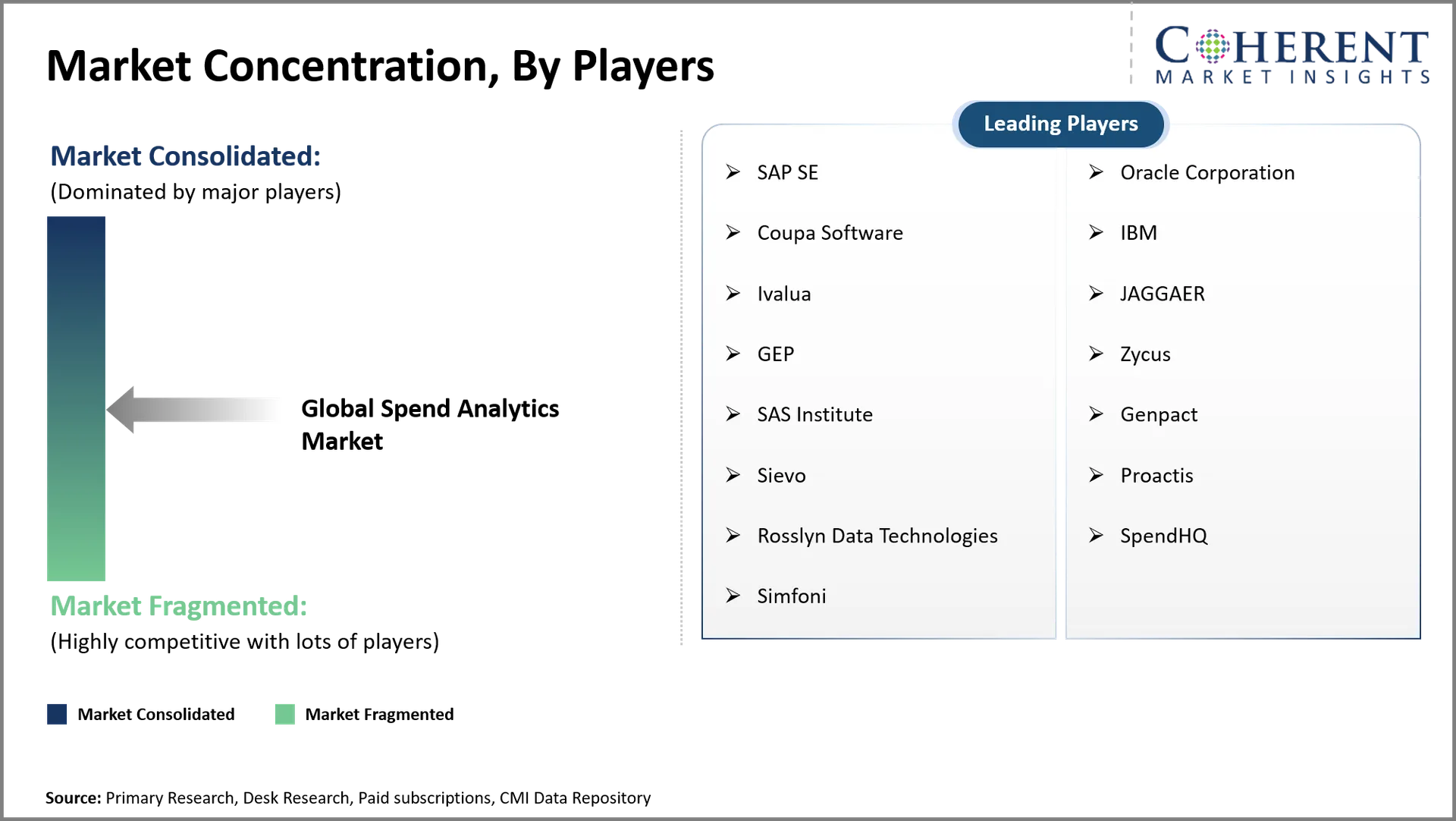
Leading players are expanding spend analytics by combining data unification, artificial intelligence, and source-to-pay workflows. In September 2026, SAP announced SAP Ariba Spend Analysis and Insights. The solution incorporates data from SAP Ariba, SAP Fieldglass, SAP Concur, SAP Cloud ERP and external sources. It also supports AI classification matched to UNSPSC v25 or custom taxonomy. JAGGAER focuses on artificial intelligence classification, supplier rationalization, pricing leakage detection, and real-time dashboards. Its IntelliClass uses nine natural language processing and machine learning algorithms. Ivalua emphasizes unified spend data, supplier management, compliance, and artificial intelligence across source-to-pay processes.
Market Report Scope
Report Coverage | Details | ||
Base Year | 2025 | Market Size in 2026: | USD 4.00 Bn |
Historical Data For: | 2020 To 2024 | Forecast Period: | 2026 To 2033 |
Forecast Period 2026 To 2033 CAGR: | 7.4% | 2033 Value Projection: | USD 8.85 Bn |
Geographies covered: |
| ||
Segments covered: |
| ||
Companies covered: | SAP SE, Oracle Corporation, Coupa Software, IBM, Ivalua, JAGGAER, GEP, Zycus, SAS Institute, Genpact, Sievo, Proactis, Rosslyn Data Technologies, SpendHQ, Simfoni | ||
Growth Drivers: |
| ||
Restraints & Challenges: |
| ||
Analyst Opinion (Expert Opinion)
- The future of spend analytics will shift from retrospective reporting toward continuously updated procurement decision systems. Artificial intelligence agents will increasingly connect spend data with supplier records, contracts, market information, and purchasing workflows. SAP is already positioning Joule Agents around recommendations and executable procurement actions. JAGGAER is similarly extending artificial intelligence into everyday purchasing through its JAI assistant.
- The largest opportunities should emerge in artificial intelligence-enabled software, autonomous classification, supplier intelligence, and real-time procurement analytics. Use cases around direct materials, supplier risk, contract compliance, pricing variance and tail spend have especially compelling use cases. Germany and Japan provide unique potential as digital public procurement is becoming more formalized. The U.S. also has big prospects in complex enterprise and government procurement environments.
- Advantage-seeking players should look to proprietary procurement data models, multilingual classification and integrations across fragmented business systems. They need to tie analytics directly to sourcing, contracts, purchasing and supplier management procedures. The continuous re-training of the model should improve classification in case of varying supplier names, product descriptions and purchasing categories. Vendors should also improve their artificial intelligence governance, explainability and human review for sensitive procurement choices. Examples of the trend toward integrated analytics rather than stand-alone reporting solutions include SAP, JAGGAER and Ivalua.
Speak to the analyst
Want personalized insights?
Take the findings above to one of our principal consultants, or have the report rebuilt around the segments, geographies and competitors you actually track.
Market Segmentation
- Component Insights (Revenue, USD Billion, 2021 - 2033)
- Software
- Services
- Deployment Type Insights (Revenue, USD Billion, 2021 - 2033)
- Cloud
- On Premise
- Application Insights (Revenue, USD Billion, 2021 - 2033)
- Procurement Analytics
- Supplier Analytics
- Category Analytics
- Contract Analytics
- Compliance Analytics
- Tail Spend Analytics
- Savings Analytics
- End User Insights (Revenue, USD Billion, 2021 - 2033)
- Manufacturing
- Retail
- BFSI
- Healthcare
- IT and Telecom
- Energy and Utilities
- Government
- Education
- Regional Insights (Revenue, USD Billion, 2021 - 2033)
- North America
- U.S.
- Canada
- Latin America
- Brazil
- Argentina
- Mexico
- Rest of Latin America
- Europe
- Germany
- U.K.
- Spain
- France
- Italy
- Russia
- Rest of Europe
- Asia Pacific
- China
- India
- Japan
- Australia
- South Korea
- ASEAN
- Rest of Asia Pacific
- Middle East
- GCC Countries
- Israel
- Rest of Middle East
- Africa
- South Africa
- North Africa
- Central Africa
- North America
- Key Players Insights
- SAP SE
- Oracle Corporation
- Coupa Software
- IBM
- Ivalua
- JAGGAER
- GEP
- Zycus
- SAS Institute
- Genpact
- Sievo
- Proactis
- Rosslyn Data Technologies
- SpendHQ
- Simfoni
Sources
Primary Research Interviews
- Chief Procurement Officers (CPOs)
- Spend Analytics Solution Providers & Vendors
- Enterprise IT & Digital Transformation Heads
- Finance & Supply Chain Management Executives
Magazines
- Spend Matters Magazine
- CFO Magazine
- Supply Chain Digital
- Procurement Leaders Magazine
Journals
- Journal of Purchasing and Supply Management
- International Journal of Production Economics
- Journal of Business Logistics
Associations
- Institute for Supply Management (ISM)
- Chartered Institute of Procurement & Supply (CIPS)
- Association for Financial Professionals (AFP)
- The Hackett Group Procurement Research
Public Domain Sources
- U.S. Securities and Exchange Commission (SEC) Filings
- World Bank Open Data
- European Commission – Digital Economy Reports
- U.S. Bureau of Economic Analysis (BEA)
Proprietary Elements
- CMI Data Analytics Tool
- Proprietary CMI Existing Repository of Information for the Last 10 Years
Get access to 250+ pages report
Every segment, forecast, competitor profile and data table behind the analysis above — available for instant download.
- ESOMAR Member
- ISO 9001:2015 Certified
- D-U-N-S Registered
- GDPR & CCPA Compliant
Frequently Asked Questions
The global spend analytics market is expected to stand at USD 4.00 Bn in 2026 and is expected to reach USD 8.85 Bn by 2033.
The CAGR of the global spend analytics market is projected to be 7.4% from 2026 to 2033.
Rising demand for procurement cost optimization and increasing adoption of artificial intelligence in procurement are the major factors driving the growth of the global spend analytics market.
High implementation costs for complex enterprises and poor quality procurement data can reduce analytical accuracy are the major factors hampering the growth of the global spend analytics market.
In terms of component, software segment is estimated to dominate the market revenue share in 2026.
Spend analytics is the process of analyzing procurement transactions to identify spending patterns, suppliers, categories, compliance issues, and savings opportunities.
Artificial intelligence can automate classification, detect anomalies, identify supplier relationships, and generate procurement insights from complex datasets.