
Global Stretchable Electronics Market Size and Forecast – 2026 To 2033
The global stretchable electronics market is expected to grow from USD 4.50 Bn in 2026 to USD 12.50 Bn by 2033, registering a compound annual growth rate (CAGR) of 11% from 2026 to 2033. The global stretchable electronics market is driven by growing healthcare monitoring applications. On December 19, 2025, CEA-Leti collaborated with STMicroelectronics to unveil a major step toward practical, continuous biochemical monitoring, a wearable patch prototype that analyzes sweat in real time.
Key Takeaways of the Global Stretchable Electronics Market
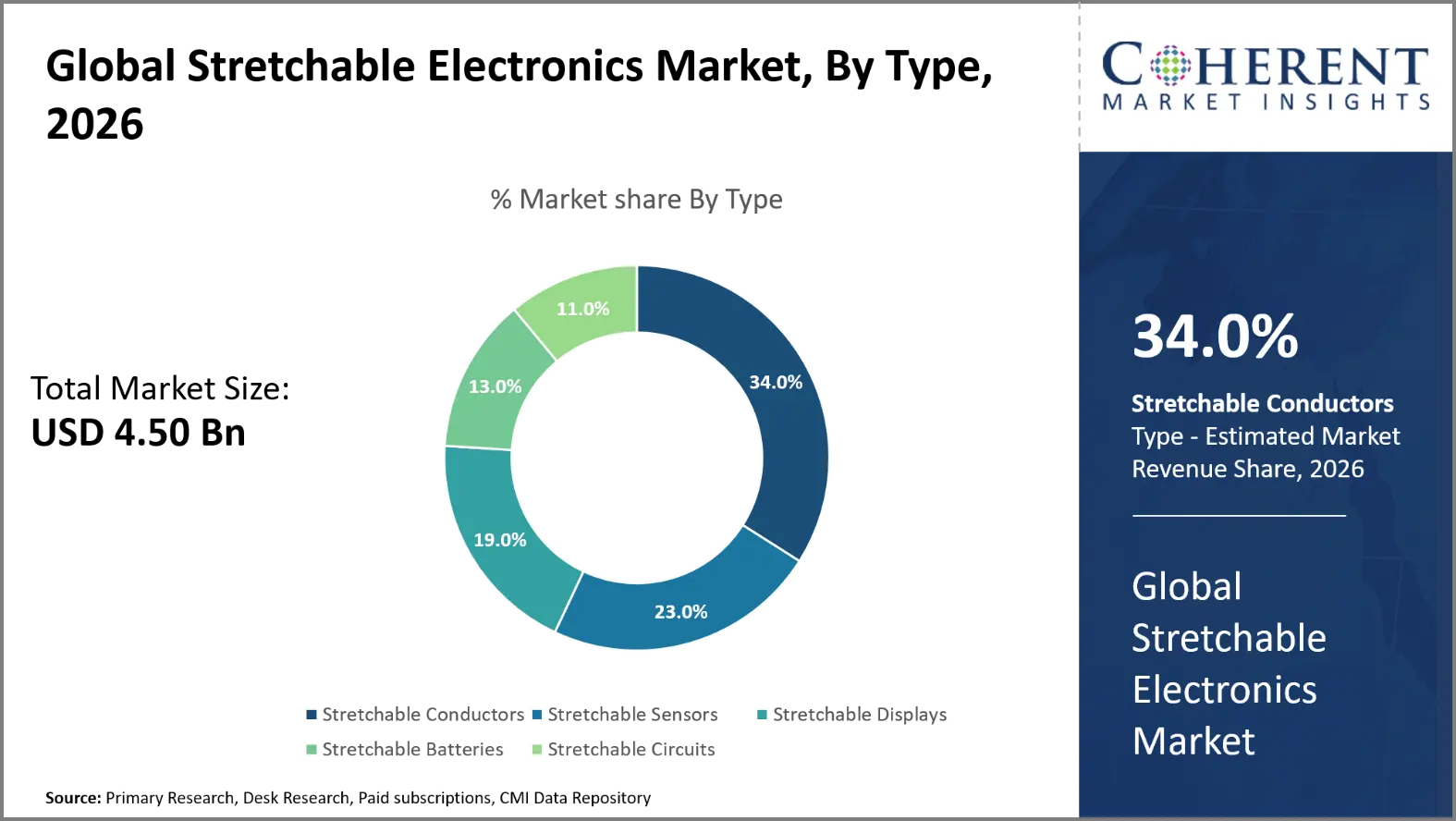
- The Stretchable Conductors segment is expected to account for 34.0% of the global stretchable electronics market share in 2026. Expansion of smart textile applications is driving the growth of the segment. In October 2025, Makalot Industrial expanded its smart-textile portfolio and regional supply-chain capabilities. Its WIIM platform supports ECG, EMG, and EEG sensing textiles.
- The Elastomers segment is estimated to capture 42.0% of the market share in 2026. Advancements in conductive elastomers is majorly driving the growth of the segment. On October 23, 2025, Elkem introduced SILBIONE LSR Select EC 70. The medical-grade liquid silicone rubber combines electrical conductivity, biocompatibility, and controlled processing.
- The Wearable Electronics segment is estimated to capture 36.0% of the market share in 2026. Increasing demand for conformable sensors is driving the growth of the segment. In February 2025, Covestro and Really Flex Electronics developed an ECG patch using Platilon TPU films. The soft material supports printed electronics while remaining durable and stretchable.
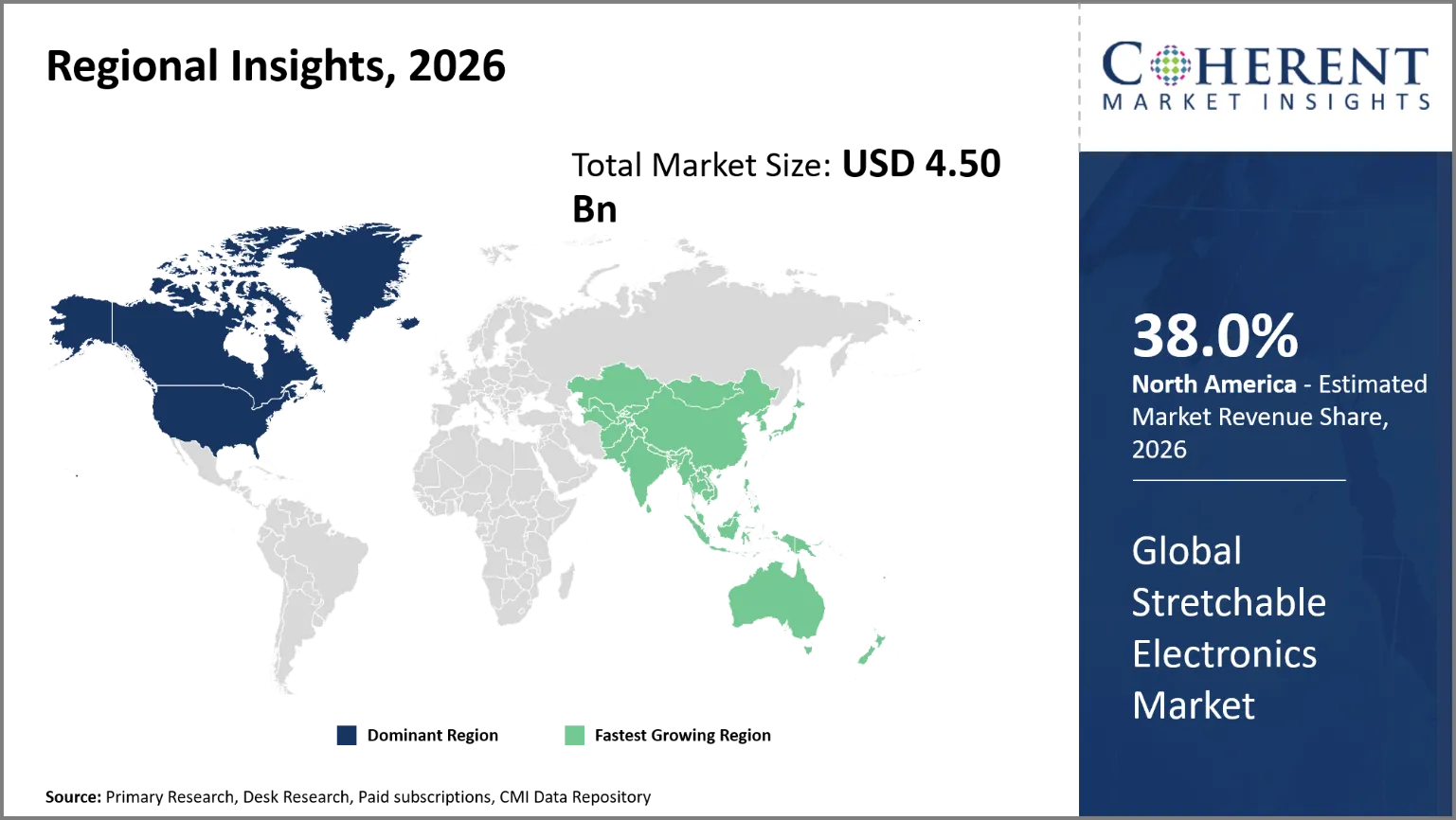
- North America is expected to dominate the stretchable electronics market in 2026 with a market share of 38.0%. Growing development of soft robotics in North America is driving the growth of the regional market. On February 27, 2025, Nexera Robotics secured USD 4.5 million. The investment supports commercialization of its NeuraGrasp robotic grasping technology.
- Asia Pacific is expected to account for 32.0% share in 2026. Growing emphasis on Stretchable Growing demand for defense and aerospace wearable systems in Asia Pacific is driving the growth of the regional market. On September 18, 2025, MEDIROM MOTHER Labs announced that it has started supplying its REMONY remote health monitoring technology to personnel of the Japan Ground Self-Defense Force.
Segmental Insights
Why Does Stretchable Conductors Dominate the Global Stretchable Electronics Market?
The stretchable conductors segment is expected to account for 34.0% of the global stretchable electronics market share in 2026. Deformable electronic systems rely largely on stretchable conductors, which provide the electrical backbone of such systems. They stay conductive during repeated stretching, bending, twisting and compression. Conductive elastomers, liquid metals and nanomaterial networks support a range of device topologies. They are flexible enough to integrate into skin, fabrics, soft substrates and curved surfaces. Stretchable conductors also support sensors, displays, batteries, and electronic interconnects. Healthcare wearables increasingly require reliable electrical connections under continuous body movement. Soft robotics similarly requires conductors that tolerate substantial mechanical deformation.
On October 23, 2025, Elkem ASA launched next generation medical grade liquid silicone rubber SILBIONE LSR Select EC 70. The material is meant for wearable and diagnostic devices and combines excellent electrical conductivity, proven biocompatibility and increased process control, setting a new standard for precision healthcare applications.
- Current Industry Events of 2026
- Market Size Estimation
- Regional Breakdown
- Competitive Landscape
- Customer Intelligence
- Segmental Analysis
- Pricing Analysis
- Key Market Drivers, Challenges & Future Trends
- Customized Insights Section
Why is Elastomers the Most Preferred Material Type?
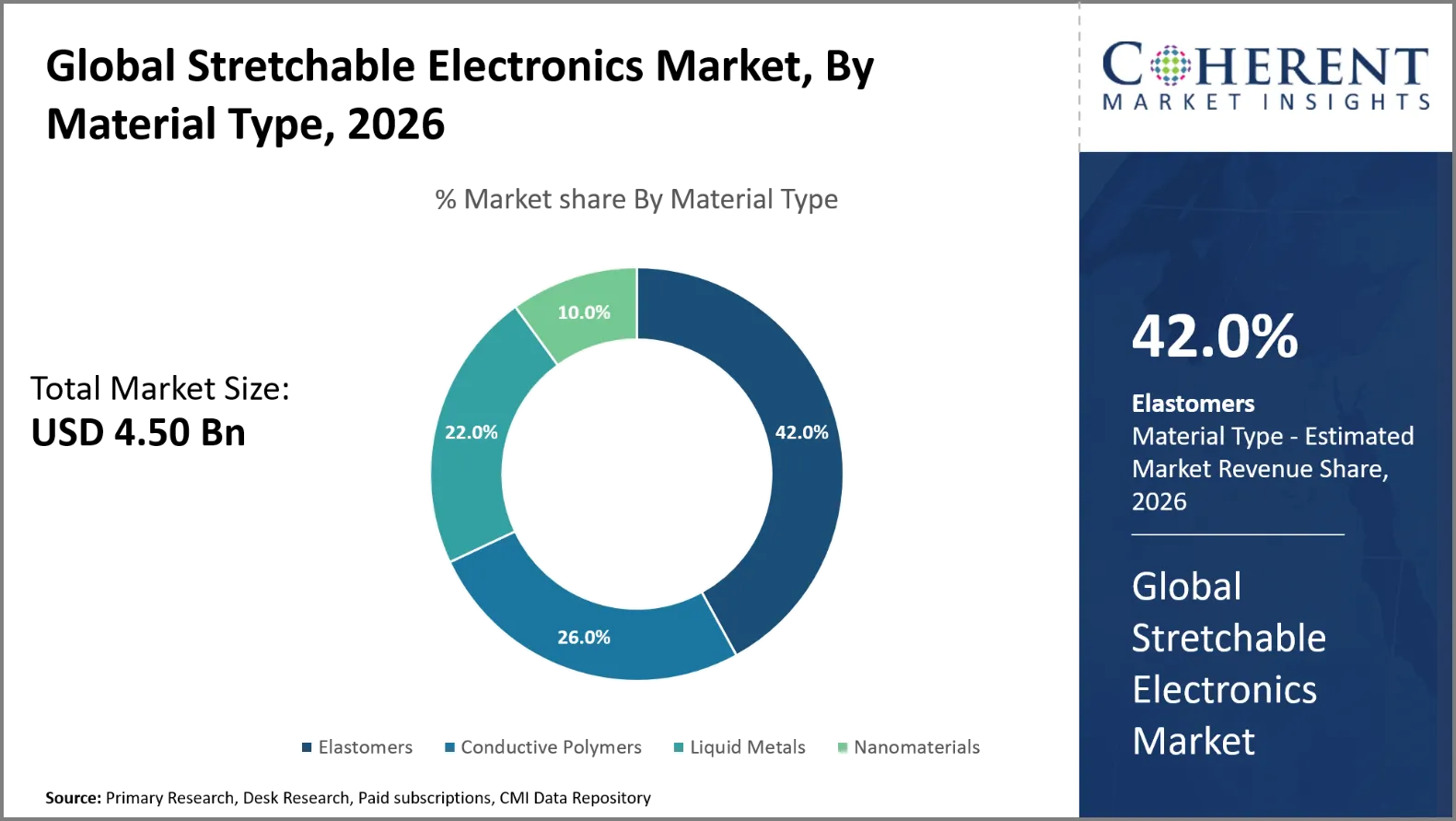
The elastomers segment is expected to account for 42.0% of the global stretchable electronics market share in 2026. The choice of elastomers is due to its elasticity, flexibility, durability and lightweight qualities. Their mechanical properties are quite close to the deformation behavior of human skin and soft materials. Silicone, polyurethane and thermoplastic elastomers can be repeatedly stretched without permanent damage to their structure. They can be used with conductive fillers to create electrically functioning composite materials. Additionally, elastomers serve as valuable insulation and mechanical protection for embedded electronic components. Manufacturers can engineer their stiffness, elasticity, transparency, and surface characteristics for specific applications.
On September 3, 2025, WACKER group announced that with the serial production of sensor laminates, it is taking the production of flexible printed electronics to the next level. The laminates which are offered under the brand name NEXIPAL Sense are produced using a specially developed and fully automated roll-to-roll manufacturing process.
Wearable Electronics Dominates the Global Stretchable Electronics Market
The wearable electronics segment is expected to account for 36.0% of the global stretchable electronics market share in 2026. Wearable electronics dominates because stretchable technologies closely match the mechanical requirements of body-worn devices. Smartwatches, fitness devices, electronic skin, and health monitors increasingly require flexible sensing surfaces. Stretchable electronics can conform to complex body contours while maintaining electrical functionality during movement. Monitoring of physiological signals is very helpful in healthcare applications. Stretchable sensors can detect temperature, pressure, strain, motion, and biological markers. Smart textiles can incorporate sensing and communication capabilities directly into garments.
On July 9, 2025, Samsung Electronics introduced Galaxy Watch8 and Galaxy Watch8 Classic, establishing an iconic design identity across the entire Galaxy Watch lineup. Building upon the foundation of the Galaxy Watch Ultra’s cushion design, this series boasts the thinnest, most comfortable Galaxy Watch ever for continuous health tracking.
Current Events and their Impact
Current Events | Description and its Impact |
European Union Restriction Of Hazardous Substances Directive |
|
European Union PFHxA Restriction Regulation |
|
Stretchable Electronics Market Dynamics
Market Drivers
Increasing demand for wearable electronics
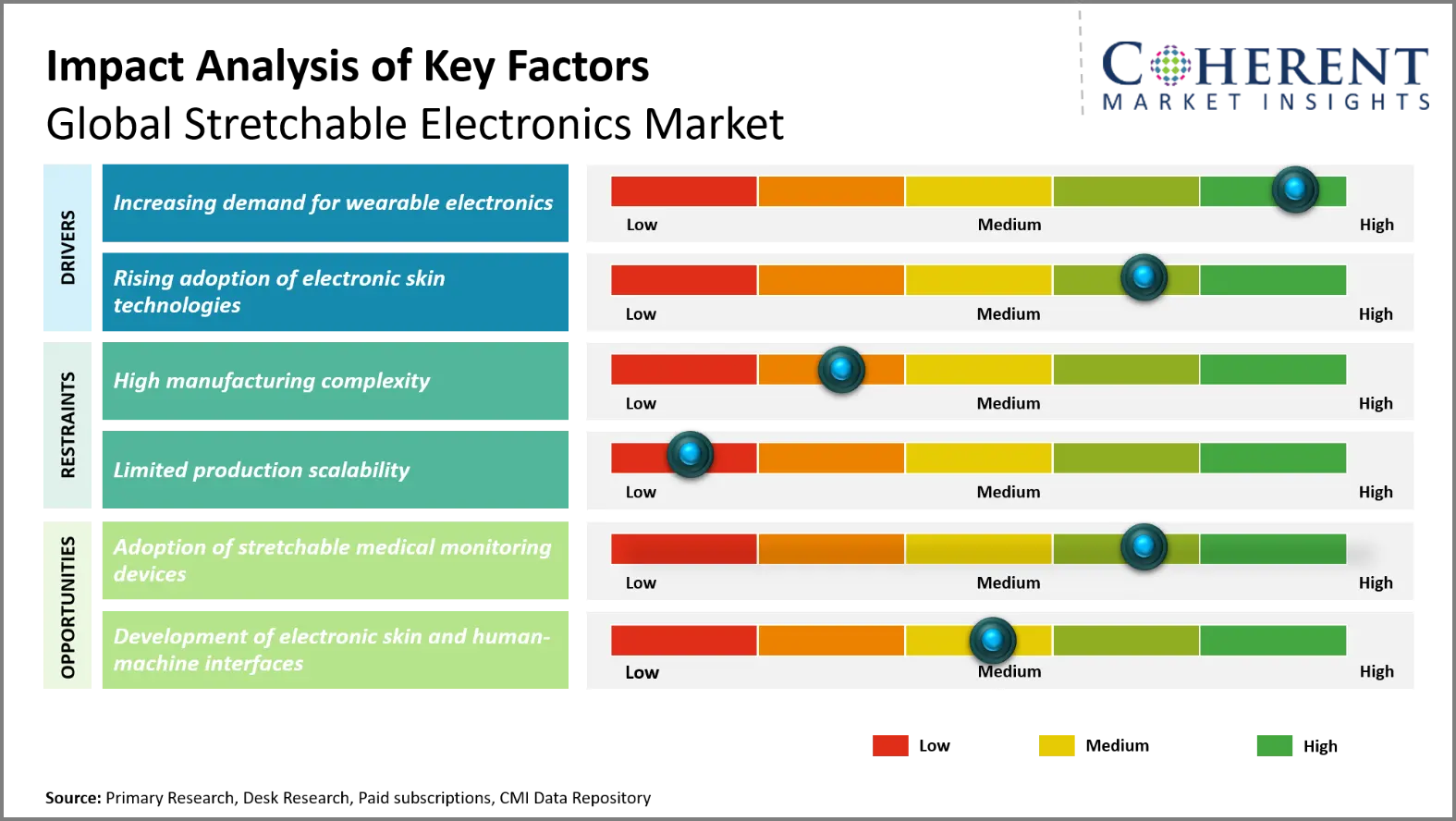
The growing demand for wearable devices is boosting the adoption of stretchy electronic technology. Consumers are more and more expecting devices to stay comfortable during long periods of movement on the body. Stretchable circuits can be molded to fit to curved body surfaces without impeding natural motion. In healthcare applications, wearable sensors are increasingly used to continuously monitor physiological data. In addition, fitness devices need flexible sensor components that can survive repeated motion and mechanical stress. Smart clothing is expanding opportunities for embedded sensing and communication capabilities. Manufacturers are therefore developing thinner, lighter, and more mechanically compliant wearable components. These developments are strengthening demand for stretchable conductors, sensors, batteries, and flexible circuits.
On May 8, 2025, WHOOP announced it is introducing two new revolutionary devices, offering all new health sensing capabilities, the WHOOP 5.0 and WHOOP MG. WHOOP 5.0 is the latest technology, offering advanced health and fitness sensing with unparalleled battery life. WHOOP MG is designed to deliver medical-grade insights like heart screening capabilities, and all-new wellness features in our most advanced technology to date.
Rising adoption of electronic skin technologies
Growing acceptance of electronic skin technologies is offering huge prospects for stretchy electronics. Electronic skin mimics some of the sensory functions of human skin. Stretchable sensors can sense pressure, temperature, strain, touch and other physical inputs. These systems are being integrated into soft robotics, prosthetics, healthcare gadgets and human-machine interfaces, researchers say. Advances in nanoparticles and conductive polymers are enhancing sensitivity while retaining mechanical flexibility. Electronic skin also enables constant surveillance on uneven and shifting surfaces. The ongoing commercialization of research is driving vendors to create scalable techniques for fabrication and integration. These innovations are extending the use of stretchable electronics beyond traditional wearable devices.
On September 28, 2026, National University of Singapore researchers developed an electronic skin with sensing and self-healing capabilities. The technology recognizes touch and physical damage and repairs itself under water.
Emerging Trends
- Development of Self-Healing Stretchable Electronics: Scientists are working on self-healing polymers that can recover electrical and mechanical properties following damage. These materials can improve the durability of devices that are stretched and deformed repeatedly. Their implementation could increase dependability in wearable sensors, electronic skin and soft robotic systems.
- Integration of Stretchable Electronics with Artificial Intelligence: Artificial intelligence is becoming a great complement to stretchy sensors to analyze the physiological and mechanical signals that are continuously created. Complex sensor data can be learned by sophisticated algorithms to find patterns. This combination allows individualized health care monitoring, predictive diagnostics, adaptive prosthetics and intelligent human machine interfaces.
- Expansion of Stretchable Energy Storage: Researchers are developing stretchy batteries, supercapacitors and energy-harvesting technologies for autonomous wearable devices. These technologies are functional by repeated deformation. Next-generation wearable electronics could rely less on traditional inflexible power sources due to higher energy density and mechanical robustness.
- Growth of Bio integrated and Implantable Electronics: Bio integrated electronics are designed to work pleasantly against the biological tissues. Stretchable substrates can support natural tissue motion and preserve electrical performance. New applications such as physiological monitoring, neural interfaces, therapeutic systems and implantable sensors that require long term mechanical compatibility are emerging.
Regional Insights
Why is North America a Strong Market for Stretchable Electronics?
North America is expected to account for a market share of 38.0% in 2026. The region benefits from sophisticated bioelectronics research & commercialization of skin-interfaced healthcare devices U.S. research has demonstrated high-density stretchy circuits, tactile arrays and conformal light-emitting systems. Stanford researchers built a 527-stage oscillator using 1,056 transistors and 528 logic gates. The technology ran at 1MHz while enabling dense tactile sensing. Commercialization of healthcare also fosters uptake through connected physiological monitoring and rehabilitation technology. StretchSense is one example of a company developing stretch sensors for human-machine interactions and motion capture. Skin-conformal electronics, a burgeoning field, is increasingly being applied to virtual reality, robotics, and remote healthcare. These achievements reinforce North America’s position in high-performance stretchable electronics.
Why Does Asia Pacific Stretchable Electronics Market Exhibit High Growth?
Asia Pacific is expected to register the fastest growth with a CAGR of 11.5% over the forecast period. It is projected to account for 32.0% of the global stretchable electronics market in 2026. The region benefits from concentrated semiconductor, display, textile, and consumer electronics manufacturing capabilities. South Korean researchers are developing stretchable displays using advanced organic and inorganic materials. Japanese researchers are advancing tissue-interfaced bioelectronics requiring precise mechanical matching with living organs. Chinese researchers are extending wireless stretchy bioelectronics for untethered body-mounted and implantable systems. Organic electrochemical transistors based on fibers can also be directly integrated into textiles. These technologies allow electronic skin, physiological monitoring, soft human-machine interactions and smart clothes. The region's manufacturing infrastructure enables rapid transfer of laboratory innovations into display, sensor, textile, and wearable product development.
Global Stretchable Electronics Market Outlook for Key Countries
Why is U.S. Emerging as a Major Hub in the Stretchable Electronics Market?
The U.S. is pushing the envelope of stretchy electronics with high-density circuits, bio integrated sensors and skin-like interfaces. Researchers at Stanford University have created stretchable integrated circuits that can function at 1 megahertz. Their system incorporated 1,056 transistors and 528 logic gates within a 527-stage oscillator. Research teams are also developing strain-tolerant radio-frequency components for wireless wearables. University of California, Los Angeles researchers developed an elastic dielectric substrate maintaining wireless performance during mechanical deformation. U.S. health care research is focusing more on cortisol, glucose, salt, ECG and EMG monitoring. Such innovations open the road for unique prospects in stretchy diagnostic patches and continuous physiological monitoring platforms.
Is China the Next Growth Engine for the Stretchable Electronics Market?
China is developing flexible electronics in the fields of wireless bioelectronics, electronic skin and textile-integrated sensing. Researchers at the University of Macau have studied wireless power transfer and communication for untethered stretchy bioelectronics. They can be used to power devices that are attached to the skin, implanted in the body or intended to be swallowed. Chinese research also increasingly combines stretchable sensors with artificial intelligence for signal interpretation. Textile-compatible organic electrochemical transistors represent another important development direction. Such fiber-based architectures can place active electronic functions directly within fabrics. These capabilities support smart clothing, physiological monitoring, soft robotics, and human-machine interfaces requiring wireless operation and mechanical compliance.
Germany Stretchable Electronics Market Analysis and Trends
Germany's growth is strongly connected with industrial electronics, printed manufacturing, smart textiles, and biomedical engineering. Fraunhofer research programs are developing stretchable electronic systems for three-dimensional surfaces and complex industrial structures. Fraunhofer Institute for Reliability and Micro-integration reports substrate processing reaching 60 × 40 centimeters. Copper structures can reach approximately 10 micrometer line and space dimensions. The HyPerStripes program targets flexible electronic stripes exceeding one meter. Sixteen partners across three European countries participate in this development program. These capabilities support automotive interiors, industrial sensing, smart textiles, medical devices, and distributed electronic systems requiring scalable manufacturing.
Japan Stretchable Electronics Market Analysis and Trends
Japan benefits from advanced materials science, precision electronics, and strong tissue-interfaced bioelectronics research. Researchers at the University of Tokyo are studying mechanically compliant platforms for integration with organs and biological tissues. Current research distinguishes mechanical requirements across the brain, nerves, skin, myocardium, and visceral organs. This work supports development of electronics that better match biological tissue mechanics. Japanese capabilities in miniaturized electronics also support compact sensing and signal-processing architectures. Research emphasis increasingly includes implantable monitoring, neural interfaces, and tissue-compatible devices. These applications provide a distinct growth pathway beyond consumer wearables and conventional flexible display technologies.
South Korea Stretchable Electronics Market Analysis and Trends
South Korea is particularly strong in stretchable displays, skin-conformal electronics, and wearable semiconductor technologies. Researchers at Korea Advanced Institute of Science and Technology are advancing materials and architectures for stretchable displays. Recent Korean research has also demonstrated breathable, transfer-printed electronics for conformal wearable applications. Nanomesh electrodes achieved approximately 5 micrometer pattern resolution with 20 nanometer thickness. The electrodes showed less than 0.53% resistance change at a 1 millimeter bending radius. Such performance supports electronic skin requiring fine patterns, breathability, and mechanical conformity. South Korea's display manufacturing expertise provides an additional pathway toward commercial stretchable displays and interactive wearable surfaces.
Global Stretchable Electronics Market - Stretchable Circuit Manufacturing Capacity by Region (2025)
Region | Estimated Manufacturing Capacity (Million Units) | Estimated Global Capacity Share |
Asia Pacific | 42 | 42% |
North America | 25 | 25% |
Europe | 18 | 18% |
Latin America | 7 | 7% |
Middle East & Africa | 5 | 5% |
South America | 3 | 3% |
Global | 100 | 100% |
How is Adoption of Stretchable Medical Monitoring Devices Creating New Growth Opportunities in the Stretchable Electronics Market?
Stretchable medical monitoring devices are opening avenues for continuous biochemical and electrophysiological monitoring. Researchers are developing skin-conformal patches that can simultaneously assess glucose, lactate, electrolytes, temperature, and heart signals. The stretchable electrodes retain contact even when the electrodes move, minimizing signal disruption from traditional stiff sensors. Emerging devices implement microfluidic channels and flexible sensors for direct sweat analysis on skin. Neural interfaces are also using soft electrode arrays that can better accommodate tissue movement. These discoveries extend applications from hospital monitoring to rehabilitation, sports medicine, chronic illness management and remote patient observation. Therefore, manufacturers are designing stretchable substrates, conductive elastomers, flexible batteries and small wireless circuits for medical monitoring.
On February 19, 2025, VitalConnect, Inc. reported that it has closed USD 100 million of financing through a mix of stock and borrowed capital. VitalConnect is a leader in biosensor technology and fast growing in the ambulatory cardiac monitoring sector. Built on deep experience in biomedical engineering, data analytics, chip design and mobile and cloud applications, Vital Connect creates technology that enables decision-making paradigms that generate improved health and economic outcomes.
Market Players, Key Development, and Competitive Landscape
Key Developments
- On May 14, 2026, Interlink Electronics announced plans for a new research and production facility in South Yorkshire, U.K. The facility supports its conductive-transfer technology for smart textiles and wearable devices. The company is developing a third-generation wearable product using this technology within an FDA-approved muscle-stimulation device.
- On February 4, 2025, Voltera announced the NOVA software update v1.16, which unlocks an exciting feature, multilayer printing and print job editing. This feature is in direct response to requests from NOVA users who are frequently printing multilayer or multi-material designs.
- On March 12, 2025, Forciot announced that Chimet SpA, a leader in precious metal recovery and refining, has joined Forciot as a new investor. The two companies will closely collaborate on advanced sensor and heater ink development, materials essential for Forciot’s sensor and heater solutions.
Competitive Landscape
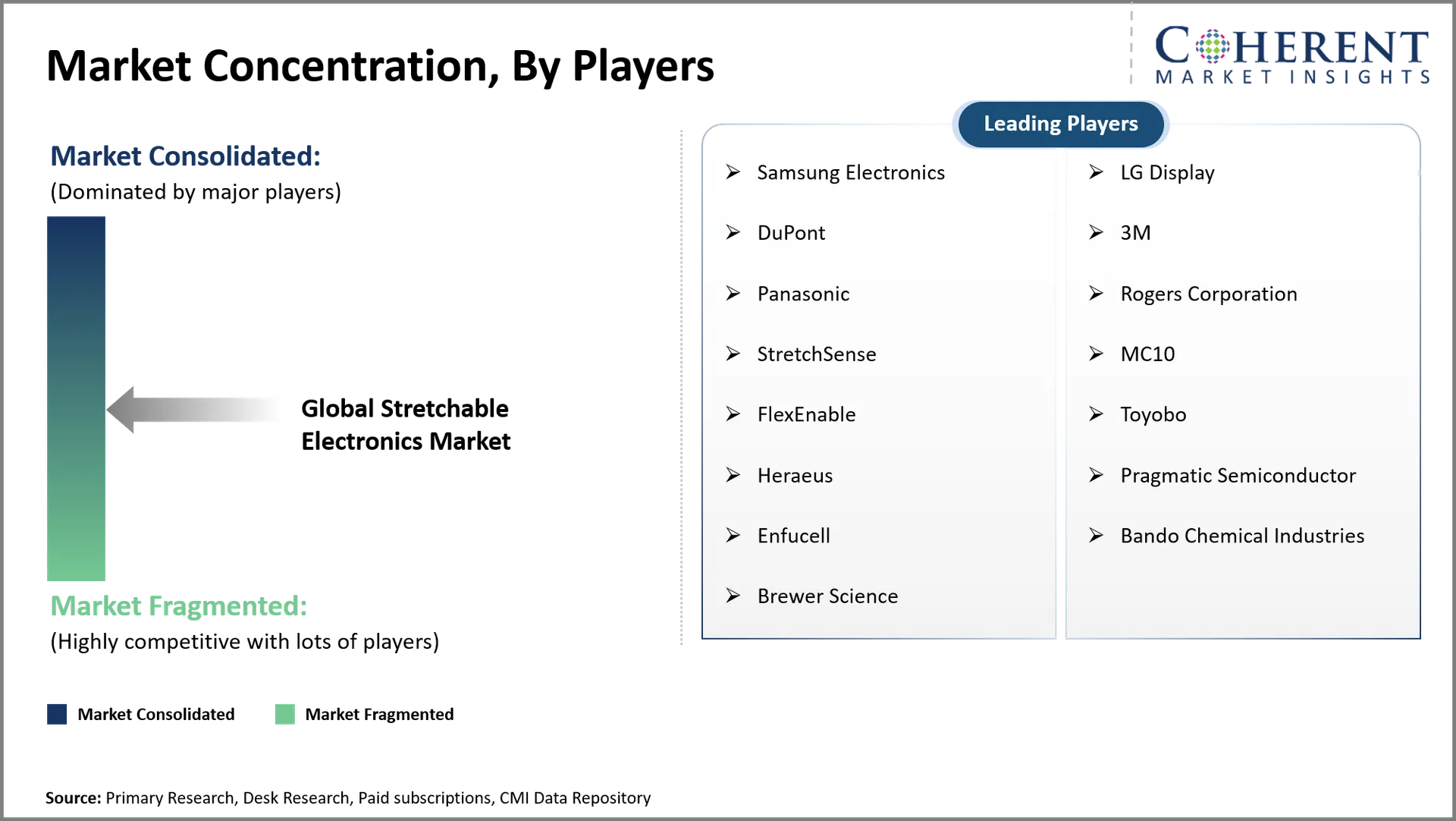
The competitive landscape is shifting toward integrated stretchable systems rather than standalone conductive materials. StretchSense focuses on high-fidelity motion sensing for robotics, healthcare, defense, and immersive technologies. Its strategy increasingly combines stretch sensors with artificial intelligence and motion datasets. Samsung Electronics is strengthening flexible-display expertise through material and structural engineering. Its 2026 Flex Titanium technology combines titanium-alloy components for thinner and more durable foldable displays. Stanford University researchers are pursuing intrinsically stretchable transistors for compact medical and human-machine applications. Their circuits integrate semiconducting carbon nanotubes within elastic materials. The competitive focus is therefore moving toward integrated sensing, processing, displays, and wireless connectivity.
Top Manufacturers and Notable Products in the Stretchable Electronics Market
Manufacturer | Notable Product | Key features |
Samsung Display | Stretchable Display 2.0 | Three-dimensional vehicle dashboard visuals, advanced stretchable display architecture, high-resolution visualization |
LG Display | 18-Inch Stretchable Micro-LED Display | 50% elongation, 100 pixels per inch, micro-LEDs up to 40 micrometers, over 10,000 stretching cycles |
DuPont | MULTIFLEX Elastomer Solutions | Flexible elastomer materials, durability, processing flexibility, suitability for consumer electronics |
WACKER | NEXIPAL Sense | Stretchable silicone laminate, conductive silicone layers, capacitive sensing, roll-to-roll production |
StretchSense | StretchSense Motion Sensors | High-resolution stretch sensing, continuous deformation measurement, wearable integration, motion tracking |
Market Report Scope
Report Coverage | Details | ||
Base Year | 2025 | Market Size in 2026: | USD 4.50 Bn |
Historical Data For: | 2020 To 2024 | Forecast Period: | 2026 To 2033 |
Forecast Period 2026 To 2033 CAGR: | 11% | 2033 Value Projection: | USD 12.50 Bn |
Geographies covered: |
| ||
Segments covered: |
| ||
Companies covered: | Samsung Electronics, LG Display, DuPont, 3M, Panasonic, Rogers Corporation, StretchSense, MC10, FlexEnable, Toyobo, Heraeus, Pragmatic Semiconductor, Enfucell, Bando Chemical Industries, Brewer Science | ||
Growth Drivers: |
| ||
Restraints & Challenges: |
| ||
Analyst Opinion (Expert Opinion)
- The industry's future will move toward multifunctional stretchable systems that combine sensing, processing, communication, and therapeutic capabilities. Intrinsically stretchable integrated circuits could reduce reliance on rigid electronic islands. This architecture can improve conformity across continuously moving biological surfaces. Healthcare, electronic skin, and soft robotics should become important commercialization pathways. Thermal management will also become increasingly important as device functionality rises beyond low-power sensing. Recent research demonstrates integrated stretchable thermoelectric systems for active temperature regulation.
- The strongest opportunity should concentrate on stretchable sensors and intrinsically stretchable integrated circuits for healthcare applications. Continuous monitoring platforms can combine electrophysiological, biochemical, temperature, and mechanical measurements within one conformal system. Asia Pacific offers particularly strong opportunities for display-integrated wearables and textile electronics. The U.S. has to be competitive in sophisticated bioelectronics and high-density stretchable circuits. Industrial and textile electronics in Germany and flexible display technologies in South Korea remain of crucial importance.
- Market players are advised to focus on the vertical integration of platforms rather than selling individual stretchy components. They need to develop proprietary conductive materials, encapsulating techniques, low-power circuitry and dependable wireless interfaces. Furthermore, companies need to develop production procedures that can sustain performance throughout repetitive deformation. Special attention must be paid to encapsulation, since the sensitive electronic layers might degrade quickly due to moisture and oxygen. Collaborations with medical-device developers may speed up clinical applications and enhance validation capabilities. Players should also combine sensor hardware with artificial intelligence software to create differentiated, application-specific solutions.
Speak to the analyst
Want personalized insights?
Take the findings above to one of our principal consultants, or have the report rebuilt around the segments, geographies and competitors you actually track.
Market Segmentation
- Type Insights (Revenue, USD Billion, 2021 - 2033)
- Stretchable Conductors
- Stretchable Sensors
- Stretchable Displays
- Stretchable Batteries
- Stretchable Circuits
- Material Type Insights (Revenue, USD Billion, 2021 - 2033)
- Elastomers
- Conductive Polymers
- Liquid Metals
- Nanomaterials
- Application Insights (Revenue, USD Billion, 2021 - 2033)
- Wearable Electronics
- Healthcare Monitoring
- Human-Machine Interfaces
- Soft Robotics
- Smart Textiles
- Flexible Displays
- End User Insights (Revenue, USD Billion, 2021 - 2033)
- Consumer Electronics
- Healthcare
- Automotive
- Aerospace And Defense
- Sports And Fitness
- Industrial Automation
- Regional Insights (Revenue, USD Billion, 2021 - 2033)
- North America
- U.S.
- Canada
- Latin America
- Brazil
- Argentina
- Mexico
- Rest of Latin America
- Europe
- Germany
- U.K.
- Spain
- France
- Italy
- Russia
- Rest of Europe
- Asia Pacific
- China
- India
- Japan
- Australia
- South Korea
- ASEAN
- Rest of Asia Pacific
- Middle East
- GCC Countries
- Israel
- Rest of Middle East
- Africa
- South Africa
- North Africa
- Central Africa
- North America
- Key Players Insights
- Samsung Electronics
- LG Display
- DuPont
- 3M
- Panasonic
- Rogers Corporation
- StretchSense
- MC10
- FlexEnable
- Toyobo
- Heraeus
- Pragmatic Semiconductor
- Enfucell
- Bando Chemical Industries
- Brewer Science
Sources
Primary Research Interviews
- Stretchable Electronics Manufacturers & Component Suppliers
- Wearable Technology Developers & OEMs
- Healthcare Device Integrators & Biomedical Engineers
- Consumer Electronics Industry Experts & R&D Professionals
Magazines
- IEEE Spectrum (Electronics & Technology Innovations)
- Wearable Technologies Magazine
- Electronic Design Magazine
Journals
- Nature Electronics (Flexible & Stretchable Electronics Research)
- Advanced Functional Materials Journal
- ACS Nano (Nanotechnology & Stretchable Devices)
Associations
- Consumer Technology Association (CTA)
- IPC – Association Connecting Electronics Industries
- Flexible Electronics & Display Center (FEDC)
- Semiconductor Industry Association (SIA)
Public Domain Sources
- U.S. Patent and Trademark Office (USPTO) – Patents on Stretchable Electronics
- National Institute of Standards and Technology (NIST)
- European Commission – Horizon Research & Innovation Programs
- World Intellectual Property Organization (WIPO) – Global Innovation Index
Proprietary Elements
- CMI Data Analytics Tool
- Proprietary CMI Existing Repository of Information for the Last 10 Years
Get access to 250+ pages report
Every segment, forecast, competitor profile and data table behind the analysis above — available for instant download.
- ESOMAR Member
- ISO 9001:2015 Certified
- D-U-N-S Registered
- GDPR & CCPA Compliant
Frequently Asked Questions
The global stretchable electronics market is expected to stand at USD 4.50 Bn in 2026 and is expected to reach USD 12.50 Bn by 2033.
The CAGR of the global stretchable electronics market is projected to be 11% from 2026 to 2033.
Increasing demand for wearable electronics and Rising adoption of electronic skin technologies are the major factors driving the growth of the global stretchable electronics market.
High manufacturing complexity and limited production scalability are the major factors hampering the growth of the global stretchable electronics market.
In terms of type, stretchable conductors segment is estimated to dominate the market revenue share in 2026.
Stretchable electronics are electronic systems designed to maintain functionality while stretching, bending, twisting, or compressing.
Stretchable sensors monitor physiological signals, biochemical markers, temperature, pressure, strain, and movement.