

Global Sustainable AI Data Center Infrastructure Market Size and Forecast – 2026 To 2033
The global sustainable AI data center infrastructure market is expected to grow from USD 42.00 Bn in 2026 to USD 175.00 Bn by 2033, registering a compound annual growth rate (CAGR) of 22.0% from 2026 to 2033. The global sustainable AI data center infrastructure market is driven by rising investments in renewable-powered data center facilities. On November 4, 2025, TotalEnergies and Data4 signed an agreement to supply renewable electricity with a stable consumption profile (Clean Firm Power) to Data4’s sites in Spain. This contract will begin in January 2026 for 10 years and will represent a total volume of 610 GWh.
Key Takeaways of the Global Sustainable AI Data Center Infrastructure Market
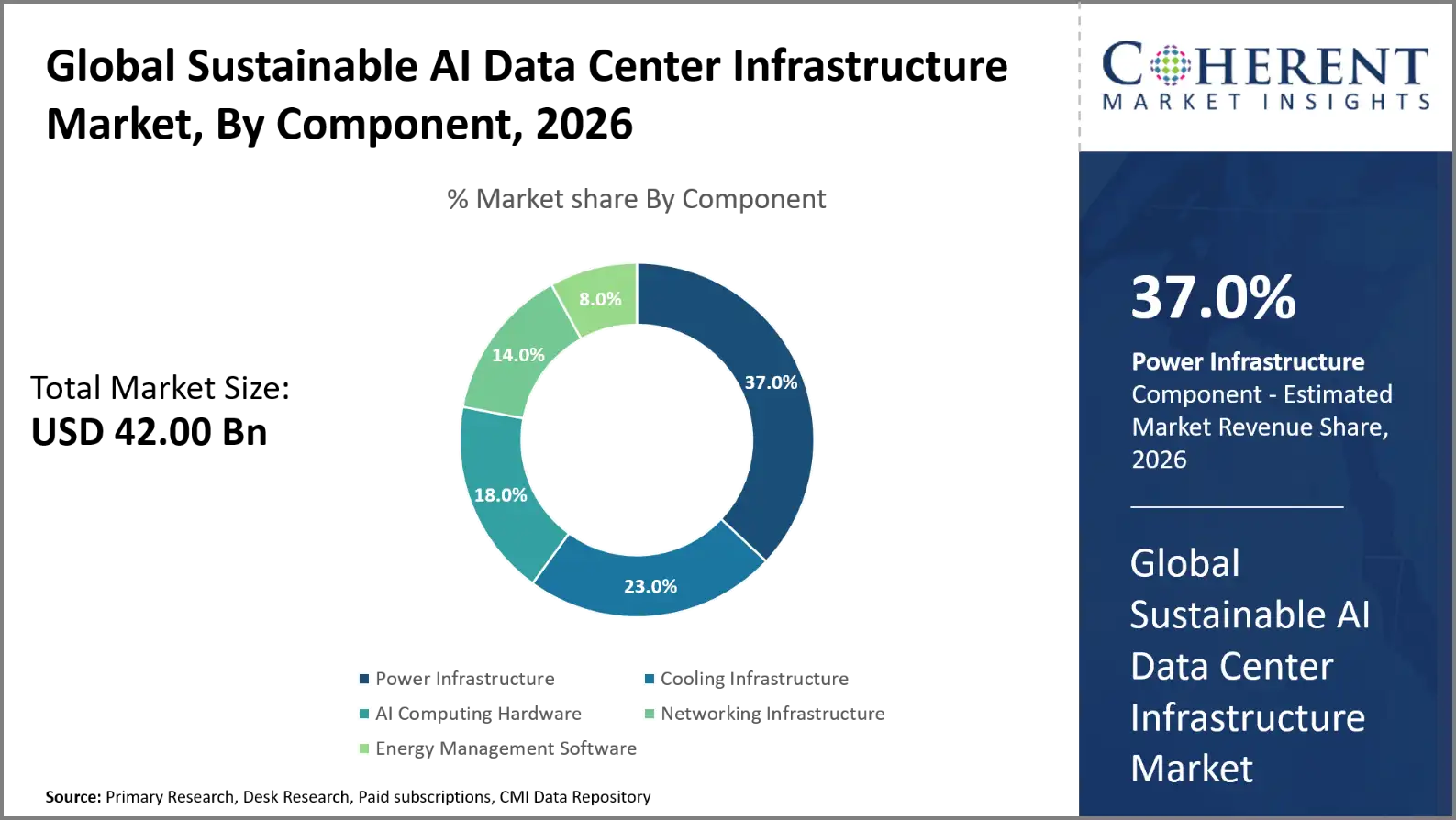
- The Power Infrastructure segment is expected to account for 37.0% of the global sustainable AI data center infrastructure market share in 2026. Increasing adoption of liquid cooling technologies is driving the growth of the segment. On June 2, 2025, Shell launched its DLC Fluid S3 direct liquid cooling fluid for data centers. The propylene glycol-based solution targets high-performance computing and artificial intelligence workloads.
- The Air-Based Cooling segment is estimated to capture 35.0% of the market share in 2026. Growing deployment of high-density AI server racks is majorly driving the growth of the segment. On August 11, 2025, NVIDIA announced the availability of its RTX PRO 6000 Blackwell Server Edition GPUs across enterprise server platforms.
- The Uninterruptible Power Supply Systems segment is estimated to capture 36.0% of the market share in 2026. Rising corporate commitments toward carbon-neutral data center operations is driving the growth of the segment. On May 6, 2026, Iron Mountain Data Centers entered a long-term renewable energy partnership with CleanMax in India. The agreement supplies solar and wind electricity to its Mumbai, Pune, and Bengaluru facilities.
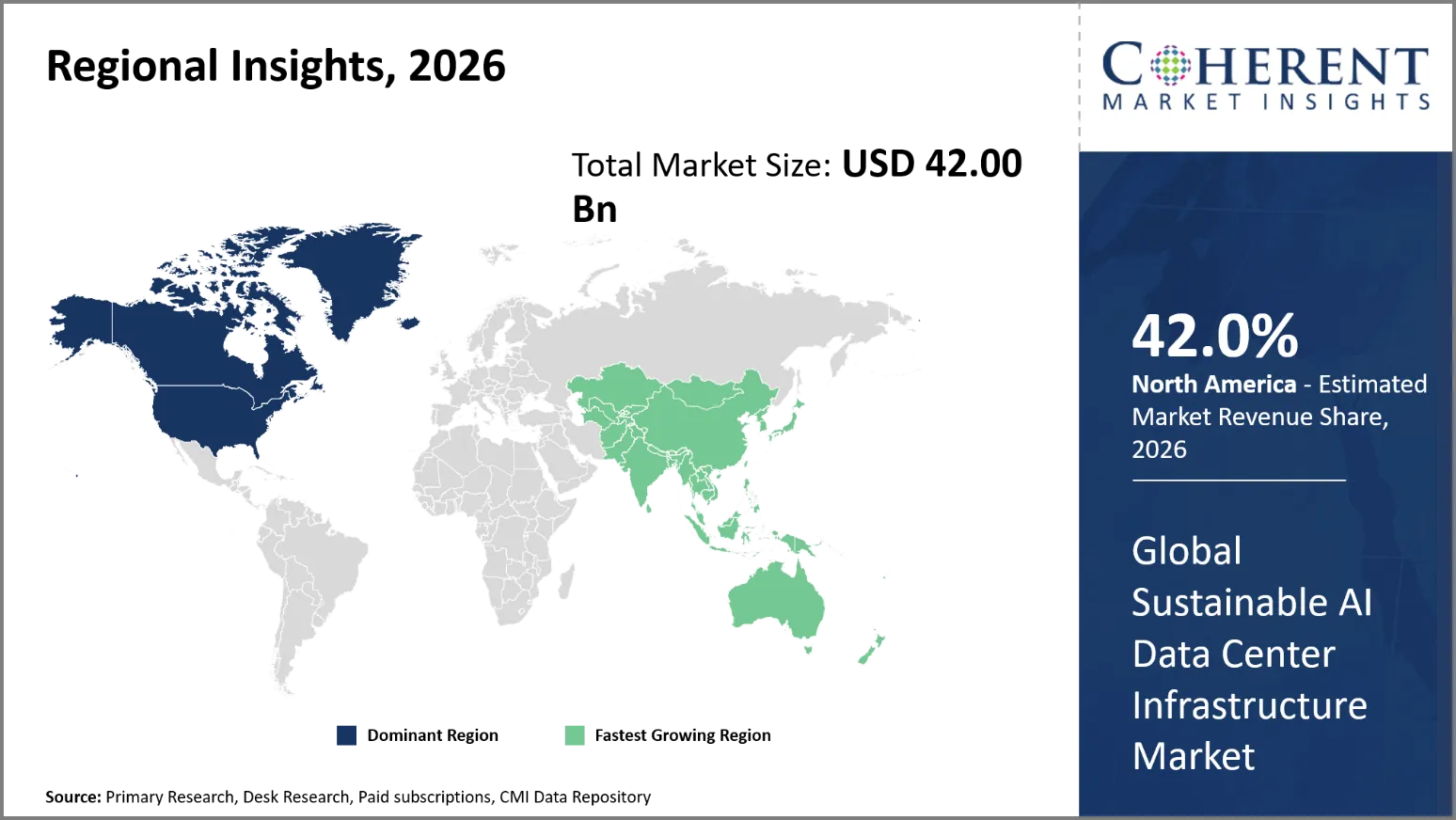
- North America is expected to dominate the sustainable AI data center infrastructure market in 2026 with a market share of 42.0%. Increasing demand for efficient power distribution systems in North America is driving the growth of the regional market. On February 12, 2025, Eaton announced a USD 340 million investment in a new three-phase transformer manufacturing facility in Jonesville, South Carolina. The facility will become Eaton’s third U.S. manufacturing site for three-phase transformers.
- Asia Pacific is expected to account for 29.0% share in 2026. Increasing adoption of immersion cooling technologies in Asia Pacific is driving the growth of the regional market. On June 26, 2025, Kixx began supplying its Immersion Fluid S 30 to LG U+’s Pyeongchon 2 hyperscale data center in South Korea. The businesses set up a demonstration setting to evaluate AI servers’ performance under immersion cooling circumstances.
Segmental Insights
Why Does Power Infrastructure Dominate the Global Sustainable AI Data Center Infrastructure Market?
The power infrastructure segment is expected to account for 37.0% of the global sustainable AI data center infrastructure market share in 2026. Power infrastructure is king for artificial intelligence workloads, which require a constant, high-capacity supply of electricity and dependable power delivery. High-performance graphics processing units draw a lot of electricity during intense training and inference procedures. So, data centers need upgraded transformers, switchgear, power distribution devices, backup generators and battery storage. A well-designed electrical infrastructure will reduce transmission losses and improve the energy performance of the facility as a whole. Redundant power topologies help protect computing equipment from grid disturbances and unexpected outages. Growing investments in renewable energy integration further increase demand for intelligent power management systems.
On January 28, 2026, American Intelligence & Power Corporation, Caterpillar Inc. and Boyd CAT announced a strategic alliance and the execution of a purchase agreement supporting the development of AIP Corp’s flagship site, the Monarch Compute Campus, a large-scale, multi-phase power generation and infrastructure platform designed to deliver long-term, high-reliability power solutions to hyperscale and enterprise data center customers.
- Current Industry Events of 2026
- Market Size Estimation
- Regional Breakdown
- Competitive Landscape
- Customer Intelligence
- Segmental Analysis
- Pricing Analysis
- Key Market Drivers, Challenges & Future Trends
- Customized Insights Section
Why is Air-Based Cooling the Most Preferred Cooling Technology?
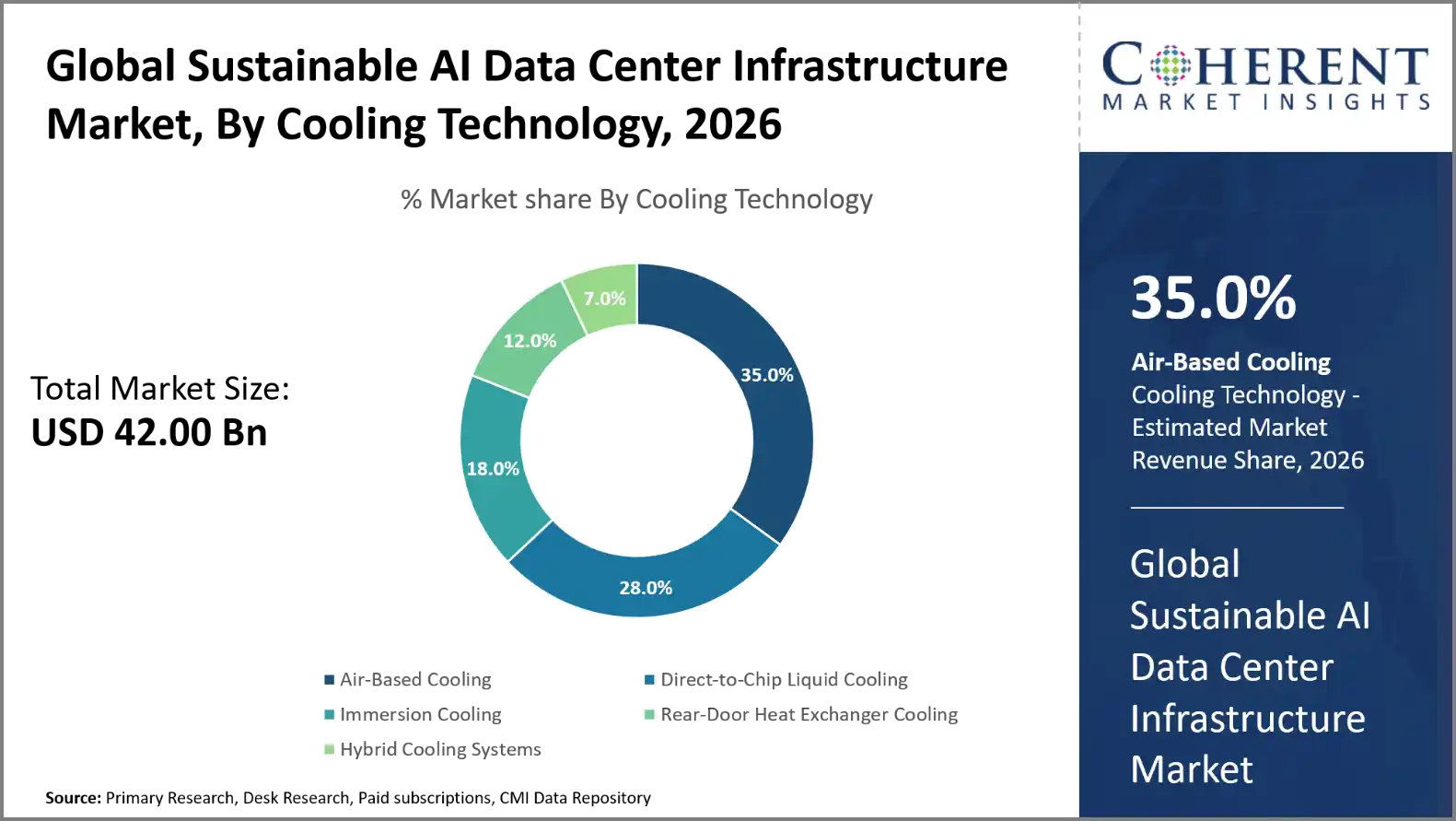
The air-based cooling segment is expected to account for 35.0% of the global sustainable AI data center infrastructure market share in 2026. Air-based cooling is frequently implemented, because of the established infrastructure, standard air-conditioning equipment and familiar maintenance techniques. Computer room air conditioners, computer room air handlers, ventilation systems, and precision cooling units provide reliable thermal management. These systems supply conditioned air to server racks and remove heat produced by computing operations. Air cooling also has very easy installation and compatibility with current data center capabilities. Optimized airflow control, hot-aisle containment, and variable-speed fans improve cooling efficiency. However, artificial intelligence workloads are increasing rack power densities and thermal needs. Direct-to-chip liquid cooling is consequently gaining importance for high-density AI infrastructure.
On February 19, 2025 Daikin released its Pro-C Computer Room Air Handler series for data center cooling applications. The units have cooling capacity from 30 kW to 210 kW. Their design incorporates optimized chilled-water heat exchangers, electronically commutated fans, and pressure-independent control valves.
Uninterruptible Power Supply Systems Dominates the Global Sustainable AI Data Center Infrastructure Market
The uninterruptible power supply systems segment is expected to account for 36.0% of the global sustainable AI data center infrastructure market share in 2026. Uninterruptible power supply systems dominate because they protect critical AI computing equipment against power interruptions and electrical disturbances. These systems give instant battery-backed power during utility outages and generator transfers. Double-conversion UPS topologies keep voltage and frequency steady for sensitive servers online. They also protect pricey graphics processing units, networking equipment and storage infrastructure from power quality variations. Modern modular UPS systems provide extended operational flexibility and meet increasing computer capacities. The higher the conversion efficiency, the less electricity is lost and the less cooling is required.
On June 6, 2025, ABB released the MegaFlex UL 415V three-phase UPS for large-scale data centers. It supports 415V, 60Hz electrical infrastructure across hyperscale, colocation and neocloud data centers. This expands ABB’s existing 480V portfolio, and increases compatibility with various data center electrical configurations.
Current Events and their Impact
Current Events | Description and its Impact |
European Union - Energy Efficiency Directive (EU) 2023/1791 |
|
European Union - Commission Delegated Regulation (EU) 2024/1364 |
|
Sustainable AI Data Center Infrastructure Market Dynamics
Market Drivers
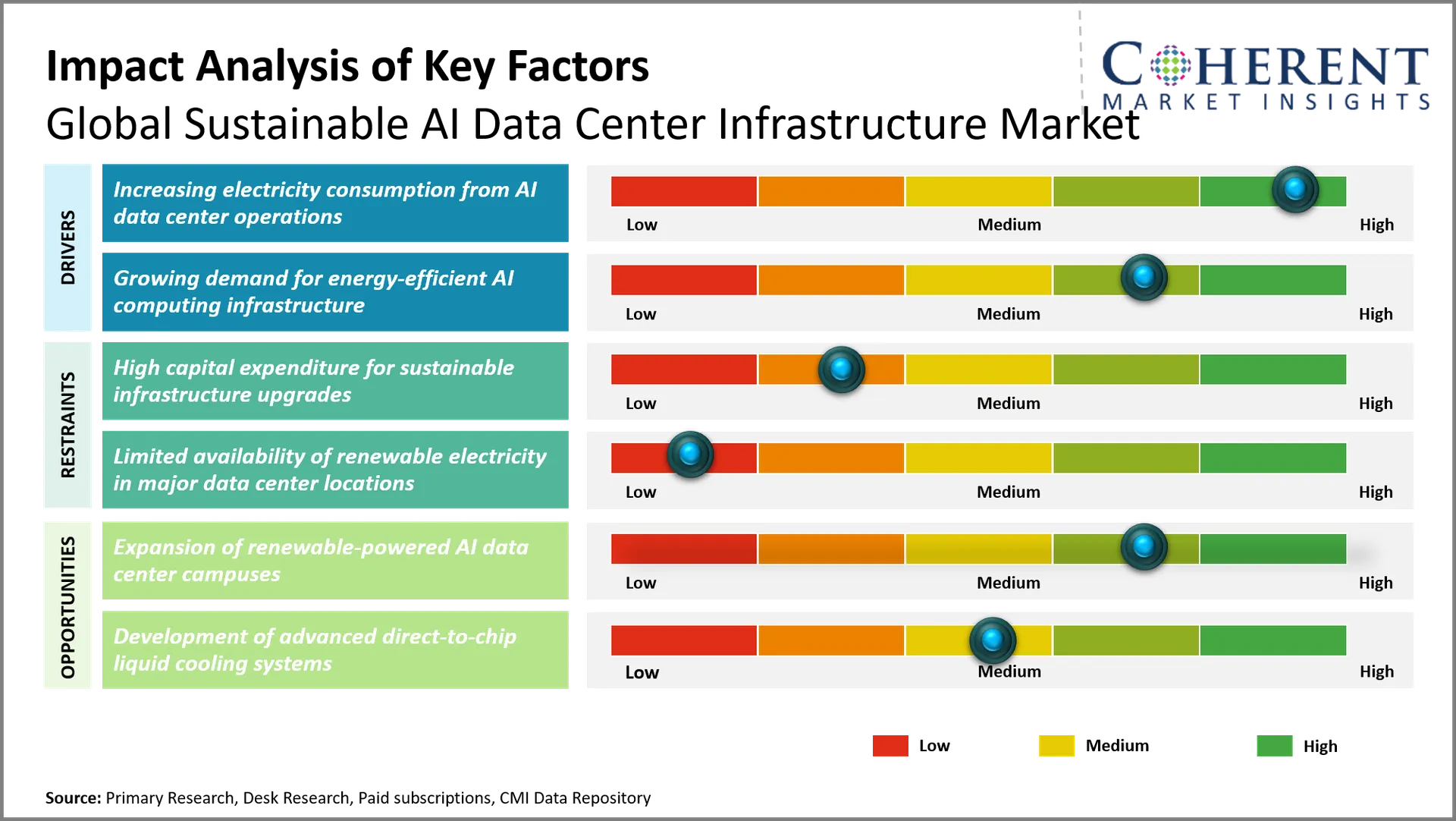
- Increasing electricity consumption from AI data center operations: The explosive growth in artificial intelligence workloads is pushing up electricity usage in data centers throughout the world. Training AI models requires energy-intensive graphics processing units running 24/7 across massive computing clusters. Generative AI inference also boosts power consumption for companies running AI apps at scale. Server racks with high density demand more power for the processors, networking, storage and cooling systems. Hyperscale operators are thus extending power procurement and updating electrical infrastructure. Rising electricity needs are also straining regional power infrastructures and renewable energy supply. These trends are encouraging investments in dedicated power generation, battery storage, sophisticated UPS systems and smart distribution of electricity.
- On July 30, 2025, Energy Capital Partners and KKR announced the construction of a new 190 MW hyperscale data center facility in Bosque County, Texas, U.S., the first investment within ECP and KKR’s USD 50 billion strategic collaboration to support expansion in AI infrastructure in United States.
- Growing demand for energy-efficient AI computing infrastructure: Growing power costs and sustainability commitments are driving the demand for energy-efficient AI computing infrastructure. Data center operators are looking at new CPUs that provide more computing performance per watt. High-efficiency power supplies, modular UPS systems and intelligent power distribution achieve reduced electrical conversion losses. Direct-to-chip liquid cooling and better airflow management handle the rising server temperatures. Procurement of renewable electricity and battery energy storage also contributes to lower-carbon computing activities. Big IT businesses are also creating dedicated AI accelerators to boost computing performance. These improvements push infrastructure suppliers to incorporate energy-efficient servers, improved cooling and intelligent building management systems
- On July 24, 2025, IBM announced the launch of its Power11 server platform in India for enterprise AI and data demanding workloads. The company reported twice the performance per watt compared with comparable x86 servers. Its Energy Efficient Mode also delivers up to 28% better server efficiency than Maximum Performance Mode.
Emerging Trends
- Increasing Adoption of Liquid Cooling Technologies: AI data centers are embracing direct-to-chip liquid cooling and immersion cooling at a faster rate to handle the heat generated by high-density graphics processing units and advanced computing servers.
Impact: Liquid cooling enhances thermal performance, reduces electricity needed for cooling, and enables higher rack densities. This allows operators to support more demanding AI workloads while enhancing the overall efficiency of the infrastructure.
Relevance to the market: Companies such as Vertiv, Schneider Electric, and CoolIT Systems are growing liquid cooling solutions. Their innovations allow for sustainable thermal infrastructure potential across hyperscale AI facilities.
- Integration of Renewable Energy and Battery Storage Systems: Data center operators are rapidly integrating renewable electricity, battery energy storage, and advanced power management technologies to decrease dependence on conventional grid electricity.
Impact: Integration of renewable energy reduces carbon emissions from operations and improves resilience of electricity supply. Battery storage smooths peak demand and increases electricity availability during grid outages.
Relevance to the market: Microsoft, Google and Amazon are stepping up their purchases of renewable energy and their clean electricity efforts. Their investments create a demand for sustainable power infrastructure and innovative energy storage systems.
Regional Insights
Why is North America a Strong Market for Sustainable AI Data Center Infrastructure?
North America is expected to account for a market share of 42.0% in 2026. In the North America region, the advantage comes from large expenditures in hyperscale computing and relatively clean electrical resources. Canada is particularly well positioned with hydroelectricity, nuclear energy and colder climes that lend themselves to sustainable data center operations. More than 83% of Canada’s electricity comes from renewable and low-emission sources. In September 2026, the Government of Canada issued Responsible Data Center Development Principles. These concepts talk about community benefits, water conservation and affordable power. Bell Canada is building an AI data center in Saskatchewan that will be 300 megawatts. Its infrastructure expansion demonstrates growing demand for sovereign computing and resource-efficient facility designs.
Why Does Asia Pacific Sustainable AI Data Center Infrastructure Market Exhibit High Growth?
Asia Pacific is expected to register the fastest growth with a CAGR of 22.6% over the forecast period. Asia Pacific is projected to account for 29.0% of the global sustainable AI data center infrastructure market in 2026. The proliferation of AI use is leading to a boom in infrastructure investments in growing digital economies in Asia Pacific. Power availability is increasingly becoming an issue in the site decisions of data centers. Malaysia and Australia are drawing developers looking for suitable power resources and space for expansion. Johor region of Malaysia has 897 MW operational capacity and 315 MW under construction. Its pipeline for planned development presents further potential for suppliers of AI infrastructure. Singapore is also stepping up regional connectivity and energy efficiency programs. These improvements fuel investments in modern electrical systems, renewable power acquisition and efficient thermal management technology.
Global Sustainable AI Data Center Infrastructure Market Outlook for Key Countries
Why is U.S. Emerging as a Major Hub in the Sustainable AI Data Center Infrastructure Market?
The U.S. market is reaping the benefits as technology firms build dedicated electricity infrastructure to complement their burgeoning AI computer facilities. Partnerships between hyperscale operators and utilities are being driven by grid congestion and worries about affordable electricity. Google announced a Michigan data center partnership with DTE Energy in March 2026. The agreement supports 2.7 GW of additional clean energy resources for the electricity grid. Google also established a USD 10 million Energy Impact Fund for community energy affordability initiatives. Moves like this show an increasing interest in coupling the rollout of AI technology with more renewable electricity generating. This opens new prospects for enhanced grid integration and power management technologies for sustainability.
Is China the Next Growth Engine for the Sustainable AI Data Center Infrastructure Market?
China is creating sustainable AI infrastructure with experimental facility designs and renewable energy integration. The Shanghai Lingang underwater data center is a showcase of the country’s interest in alternative cooling systems. The project, which began in June 2025, combines offshore wind generation with natural saltwater cooling. The designed capacity is 24 MW and the target power usage effectiveness is less than 1.15. The project is expected to source more than 90% of its electricity from offshore wind farms. It’s designed in such a way that it can reduce the need for electricity for cooling and the need for fresh water. These trends are fueling investment in renewably powered computing and creative thermal infrastructure.
Germany Sustainable AI Data Center Infrastructure Market Analysis and Trends
Germany benefits from strong industrial engineering capabilities and increasing integration between data centers and district heating networks. Waste heat utilization is becoming an important infrastructure investment consideration. In September 2026, Telehouse Germany and etalytics announced AI-powered cooling optimization at their Frankfurt site. The method cut electricity use by 10.4% on a cooling unit. Full implementation in five units is estimated to save around 497 MWh per year. This shows prospects for artificial intelligence-based facility optimization. The heat from servers can also be recovered by district heating networks in Germany and sent into surrounding residential projects.
Japan Sustainable AI Data Center Infrastructure Market Analysis and Trends
In Japan, the development of sustainable AI infrastructure is driven by the partnership among power generators, technology businesses and specialist infrastructure developers. JERA, Dell Technologies and RHAELM Holdings agreed in October 2026. The partnership intends to produce common development models of AI infrastructure at the national level. Their first proposed project is a 400 MW hyperscale facility in Chiba. JERA will share its power generation know-how and Dell Technologies will deliver standardized rack-scale artificial intelligence technologies. This integrated development technique solves the problems of project complexity and electricity coordination. It allows for flexible infrastructure and efficient power distribution and coordinated deployment of cooling systems.
India Sustainable AI Data Center Infrastructure Market Analysis and Trends
India’s market is gaining speed, driven by government-backed computing infrastructure and rising indigenous AI capabilities. The IndiaAI Mission is making high-end computing resources more accessible for startups, researchers and companies. In March 2026, the government revealed that 38,231 GPUs had been onboarded using 14 empaneled service providers. The subsidized computing architecture opens AI infrastructure to more than just big tech. India’s data center business is also turning to direct-to-chip liquid cooling, immersion cooling and closed-loop solutions. These solutions comply with the increasing needs of thermal management and the worries on groundwater conservation. Investments in domestic semiconductor manufacturing further support opportunities for energy-efficient AI server infrastructure.
Global Sustainable AI Data Center Infrastructure Market - Grid-Interactive Data Centers
Company / Project | Flexibility Mechanism | Reported Data | Grid Stabilization Benefit |
Google with Indiana Michigan Power and Tennessee Valley Authority | Shifting non-urgent machine learning workloads during grid stress | Two new utility agreements; previous Omaha Public Power District demonstration covered three grid events | Reduces peak electricity demand and supports utility resource management |
Emerald AI, Electric Power Research Institute, and Salt River Project | Software-based workload orchestration responding to real-time grid signals | 256-GPU cluster achieved 25% power reduction for three hours | Reduces peak demand while maintaining AI service quality |
Emerald AI, National Grid, Nebius, and NVIDIA | Real-time GPU power adjustment using Emerald Conductor software | 96 NVIDIA Blackwell Ultra GPUs; up to 40% demand reduction; 30% load reduction in approximately 30 seconds; responses sustained up to 10 hours | Supports peak shaving, emergency load reduction, and faster grid integration |
FlexSysAI, ResetData, Commonwealth Scientific and Industrial Research Organization, and University of Queensland | Shifting GPU-based AI workloads across locations and operating periods | Early modelling indicates 20-50% workload adjustment potential on NVIDIA H200 GPUs within seconds | Helps reduce grid congestion and improves utilization of existing grid capacity |
AI data center demand response research, ACM E-Energy 2026 | GPU power capping and workload scheduling for demand response participation | 18-55% flexibility relative to average power in regulation reserve scenarios; up to 20% reduction in emergency demand response | Provides controllable electricity demand for frequency regulation and emergency grid support |
How is Expansion of Renewable-Powered AI Data Center Campuses Creating New Growth Opportunities in the Sustainable AI Data Center Infrastructure Market?
Expansion of renewable-powered AI data center campuses creates opportunities for integrated electricity generation, storage, and computing infrastructure. Developers are increasingly building complexes near specific solar, wind and hydroelectric power sources. This minimizes dependence on the traditional grid power and enhances long-term predictability in energy purchase. Also co-located battery storage helps with renewable intermittency and abrupt AI load spikes. Renewable-powered campuses need customized substations, high voltage transformers, grid-forming inverters and advanced energy management systems. With these regulations, there are more economic potential for electrical equipment producers and microgrid developers.
A prime example is ENGIE North America’s announcement in September 2025 of its partnership with Prometheus Hyperscale. Their deal is a combination of liquid cooled AI facilities with renewable generating and battery storage assets in Texas. In November 2026, CleanMax revealed plans for a renewable energy complex to support a 2 GW AI computer facility in Andhra Pradesh. These projects are examples of emerging prospects for co-developed energy and computing infrastructure.
Market Players, Key Development, and Competitive Landscape
Key Developments
- On October 16, 2026, Vertiv and CapitaLand India Trust (CLINT), Asia’s first India-focused property trust under CapitaLand Investment (CLI), commissioned India’s first direct-to-chip high-density liquid cooling (HDLC) deployment at the CLDC Mumbai 01 Data Center in Airoli, Navi Mumbai.
- On February 18, 2026, Schneider Electric announced the launch of Motivair liquid cooling solutions facility in Bengaluru, the first production location for this technology for Schneider Electric in India and third in the world. The plant is designed to support the country's developing data center ecosystem through localizing the manufacturing of high-density cooling systems.
- On February 12, 2026, Infosys announced an expansion of its strategic collaboration with ExxonMobil to develop and implement its industry-leading range of ExxonMobil Data Center Immersion Fluids that improves energy efficiency and maximizes utilization of available electricity. This program is in alignment with Infosys’ commitment toward energy innovation, de-carbonization and cross-industry partnerships.
Competitive Landscape
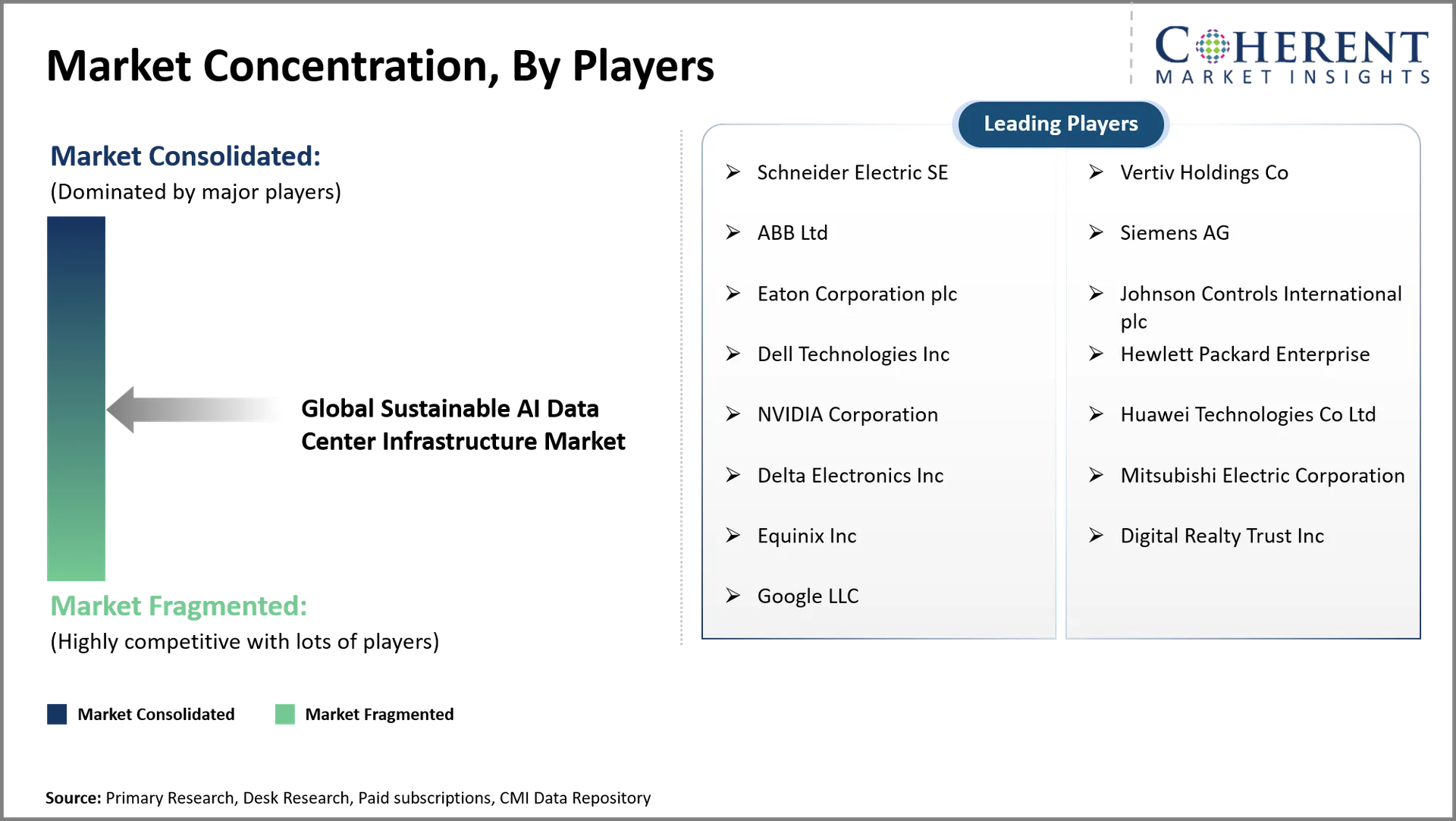
Vertiv and Schneider Electric are leading infrastructure providers in the global sustainable AI data center infrastructure industry. Vertiv is focused on integrated power management, high density cooling and modular AI data center architecture. Vertiv announced in September 2026 that it had acquired UtilityInnovation Group for about USD 1.45 billion. That adds to its ability in microgrid controls, on-site generation and behind-the-meter power design. Schneider Electric is a specialist in electrical distribution, energy management and liquid cooling technology. In June 2026, Schneider Electric teamed with Hon Hai Technologies Group (Foxconn) to build integrated AI data center solutions. Eaton, Siemens, and ABB also compete through power distribution, electrical protection, and energy management technologies.
Top Manufacturers and Notable Products in the Sustainable AI Data Center Infrastructure Market
Manufacturer | Notable Product | Key features |
Vertiv | Vertiv CoolChip CDU and Vertiv Trinergy UPS | Liquid cooling for high-density AI racks, efficient power conversion, modular power protection, integrated monitoring, and scalable infrastructure |
Schneider Electric | Galaxy VXL UPS and EcoStruxure IT | Up to 99% efficiency in eConversion mode, AI-load tolerance, modular architecture, lithium-ion battery compatibility, and infrastructure monitoring |
Eaton | Power Xpert 9395P UPS | Up to 97% double-conversion efficiency, lithium-ion battery options, scalable power capacity, and compact installation footprint |
ABB | HiPerGuard Medium Voltage UPS and ABB Busway | Medium-voltage power protection, reduced conversion complexity, modular power distribution, grid support, and scalable electrical infrastructure |
Delta Electronics | 3MW GoCool Liquid Cooling System and 800 VDC Power Solutions | Integrated liquid cooling, high-voltage DC distribution, modular coolant systems, hot-swappable pumps, and efficient power delivery |
Market Report Scope
Global Sustainable AI Data Center Infrastructure Market Report Coverage | |||
Report Coverage | Details | ||
Base Year | 2025 | Market Size in 2026: | USD 42.00 Bn |
Historical Data For: | 2020 To 2024 | Forecast Period: | 2026 To 2033 |
Forecast Period 2026 To 2033 CAGR: | 22.00% | 2033 Value Projection: | USD 175.00 Bn |
Geographies covered: |
| ||
Segments covered: |
| ||
Companies covered: | Schneider Electric SE, Vertiv Holdings Co, ABB Ltd, Siemens AG, Eaton Corporation plc, Johnson Controls International plc, Dell Technologies Inc, Hewlett Packard Enterprise, NVIDIA Corporation, Huawei Technologies Co Ltd, Delta Electronics Inc, Mitsubishi Electric Corporation, Equinix Inc, Digital Realty Trust Inc, Google LLC | ||
Growth Drivers: |
| ||
Restraints & Challenges: |
| ||
Analyst Opinion (Expert Opinion)
- The future of the industry is about matching computing capacity with the efficient generation of electricity and advanced thermal management. Conventional data center designs will need to be adapted to accommodate the growing demand of high-density AI workloads. Infrastructure providers need to look at modular electrical systems, high-efficiency power conversion and liquid-cooling compatibility. Grid restrictions also will drive onsite generating, battery storage and microgrid deployment. Companies who can manage the availability of power, the performance of cooling and the computing requirements will be better positioned to compete.
- Biggest opportunity will be in direct-to-chip liquid cooling, modular UPS systems and integrated power infrastructure. High-density facilities will require specialized infrastructure for AI training and hyperscale campuses for inference. There are prospects in the U.S. with large scale hyperscale developments and on-site electricity generation. India has potential for localized manufacture of liquid-cooling and sovereign AI infrastructure. China has prospects in renewable-powered computers and improved thermal management. Germany and Japan are great candidates for waste heat recovery and efficient electrical infrastructure.
- Market players should offer integrated solutions instead of separate power or cooling equipment. Equipment makers need to cooperate with GPU suppliers, data center developers, utilities, and renewable energy providers. The capacity to manufacture locally can increase the reliability of deliveries and eliminate delays in infrastructure implementation. Companies also need to improve predictive maintenance, digital twins, and real-time energy optimization. Suppliers can differentiate themselves by designing water-efficient cooling solutions and microgrids that are independent of the generation source. Long-term service agreements and application-specific engineering will help establish stronger customer relationships.
Speak to the analyst
Want personalized insights?
Take the findings above to one of our principal consultants, or have the report rebuilt around the segments, geographies and competitors you actually track.
Market Segmentation
- Component Insights (Revenue, USD Billion, 2021 - 2033)
- Power Infrastructure
- Cooling Infrastructure
- AI Computing Hardware
- Networking Infrastructure
- Energy Management Software
- Cooling Technology Insights (Revenue, USD Billion, 2021 - 2033)
- Air-Based Cooling
- Direct-to-Chip Liquid Cooling
- Immersion Cooling
- Rear-Door Heat Exchanger Cooling
- Hybrid Cooling Systems
- Power Infrastructure Insights (Revenue, USD Billion, 2021 - 2033)
- Uninterruptible Power Supply Systems
- Power Distribution Units
- Backup Generators
- Battery Energy Storage Systems
- Renewable Energy Systems
- Power Management Systems
- End User Insights (Revenue, USD Billion, 2021 - 2033)
- Cloud Service Providers
- Technology Companies
- Telecommunication Companies
- Banking and Financial Services
- Healthcare Organizations
- Government Organizations
- Research Institutions
- Regional Insights (Revenue, USD Billion, 2021 - 2033)
- North America
- U.S.
- Canada
- Latin America
- Brazil
- Argentina
- Mexico
- Rest of Latin America
- Europe
- Germany
- U.K.
- Spain
- France
- Italy
- Russia
- Rest of Europe
- Asia Pacific
- China
- India
- Japan
- Australia
- South Korea
- ASEAN
- Rest of Asia Pacific
- Middle East
- GCC Countries
- Israel
- Rest of Middle East
- Africa
- South Africa
- North Africa
- Central Africa
- North America
- Key Players Insights
- Schneider Electric SE
- Vertiv Holdings Co
- ABB Ltd
- Siemens AG
- Eaton Corporation plc
- Johnson Controls International plc
- Dell Technologies Inc
- Hewlett Packard Enterprise
- NVIDIA Corporation
- Huawei Technologies Co Ltd
- Delta Electronics Inc
- Mitsubishi Electric Corporation
- Equinix Inc
- Digital Realty Trust Inc
- Google LLC
Sources
Primary Research Interviews
- Data Center Infrastructure Providers & Vendors
- AI Hardware & Software Solution Providers
- Cloud Service Providers & Hyperscalers
- Energy & Sustainability Consultants
Magazines
- Data Center Dynamics Magazine
- Green Computing Magazine
- AI Business Magazine
- Data Economy Magazine
Journals
- Journal of Green Engineering
- IEEE Transactions on Sustainable Computing
- Journal of Cleaner Production
Associations
- Green Grid Association
- Uptime Institute
- Data Center Alliance (DCA)
- Global Data Center Alliance (GDCA)
Public Domain Sources
- U.S. Department of Energy (DOE) – Office of Energy Efficiency & Renewable Energy
- European Commission – Green Deal Digital Strategy Reports
- United Nations Environment Programme (UNEP) Reports
- Lawrence Berkeley National Laboratory (LBNL) Data Center Reports
Proprietary Elements
- CMI Data Analytics Tool
- Proprietary CMI Existing Repository of information for last 10 years
Get access to 250+ pages report
Every segment, forecast, competitor profile and data table behind the analysis above — available for instant download.
- ESOMAR Member
- ISO 9001:2015 Certified
- D-U-N-S Registered
- GDPR & CCPA Compliant
Frequently Asked Questions
The global sustainable AI data center infrastructure market is expected to stand at USD 42.00 Bn in 2026 and is expected to reach USD 175.00 Bn by 2033.
The CAGR of the global sustainable AI data center infrastructure market is projected to be 22.0% from 2026 to 2033.
Increasing electricity consumption from AI data center operations and Growing demand for energy-efficient AI computing infrastructure are the major factors driving the growth of the global sustainable AI data center infrastructure market.
High capital expenditure for sustainable infrastructure upgrades and Limited availability of renewable electricity in major data center locations are the major factors hampering the growth of the global sustainable AI data center infrastructure market.
In terms of component, power infrastructure segment is estimated to dominate the market revenue share in 2026.
The market covers infrastructure technologies that improve energy efficiency, cooling performance, electricity reliability, and environmental sustainability in AI data centers.
Renewable energy reduces operational carbon emissions and supports long-term electricity procurement strategies.