

Global Technical Ceramics Market Size and Forecast – 2026 To 2033
The Global Technical Ceramics Market is estimated to be valued at USD 14.16 Bn in 2026 and is expected to reach USD 23.65 Bn by 2033, growing at a compound annual growth rate (CAGR) of 7.60% from 2026 to 2033. Market expansion is supported by the increasing use of high-performance ceramics across automotive, electronics, semiconductor, industrial, and healthcare applications, where thermal stability, electrical insulation, wear resistance, chemical durability, and biocompatibility are critical performance requirements.
In October 2025, SINTX Technologies received U.S. FDA 510(k) clearance for its SINAPTIC Foot & Ankle Osteotomy Wedge System, which uses the company’s proprietary silicon nitride ceramic biomaterial. The clearance demonstrates the expanding commercial use of advanced technical ceramics in implantable medical applications and supports further material innovation in healthcare.
Key Takeaways of the Global Technical Ceramics Market
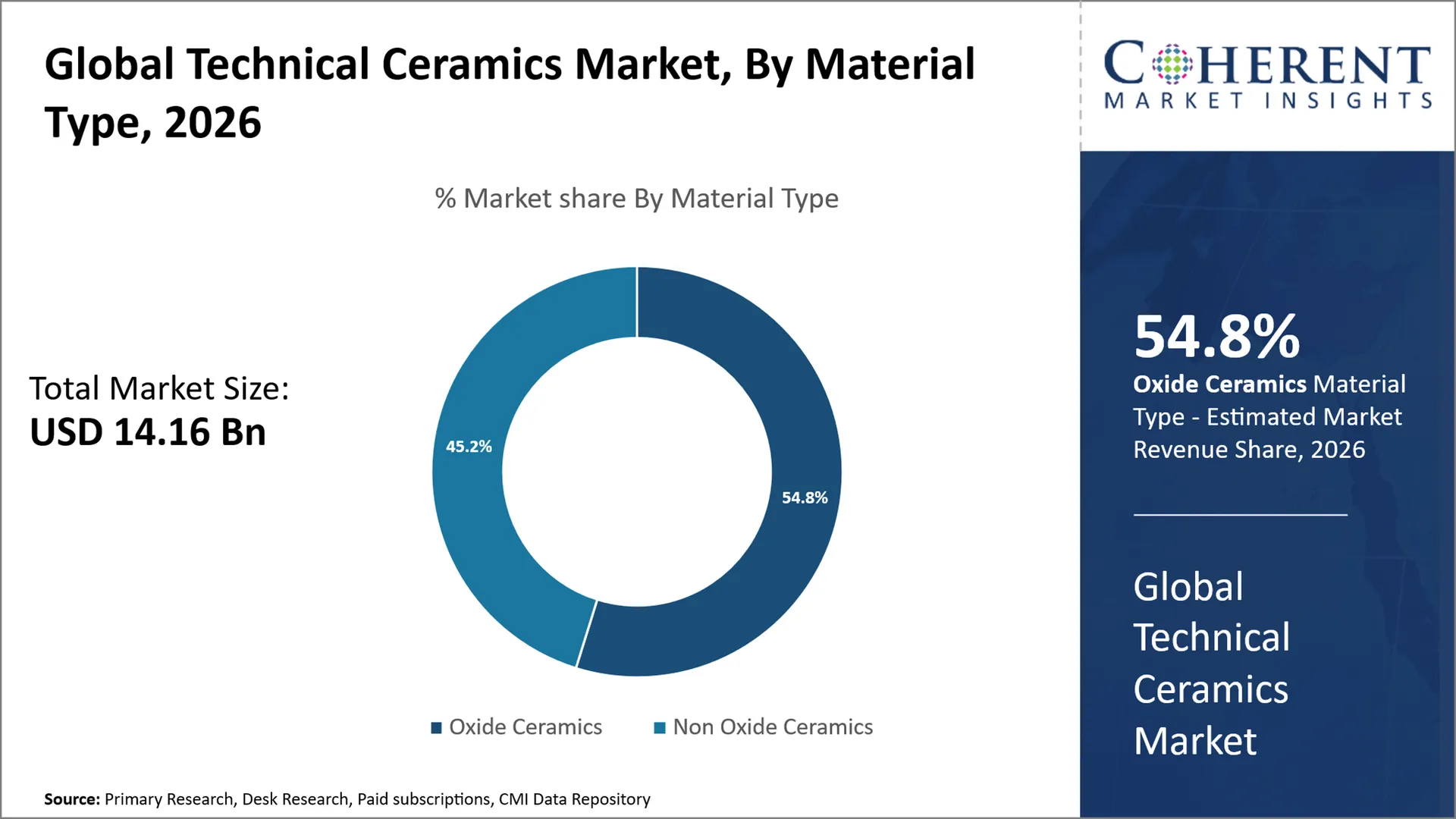
- Oxide Ceramics is projected to record an estimated 7.2% CAGR during 2026–2033 and is expected to hold 54.8% of the global technical ceramics market in 2026. Its lead reflects alumina and zirconia’s balance of dielectric strength, wear resistance, chemical stability, process maturity, and scalable cost economics across electronics and industrial components. In August 2026, CeramTec highlighted aluminium oxide solutions for semiconductor manufacturing and power-electronics applications at SEMICON India.
- Monolithic Ceramics should expand at an estimated 7.1% CAGR during 2026–2033 while commanding 83.6% of the global technical ceramics market in 2026. Mature forming and sintering routes, consistent bulk properties, geometry flexibility, and established OEM qualification make dense ceramic components economical for repeated high-specification use. In September 2026, Kyocera completed its Nagasaki Isahaya Plant for fine ceramic components and semiconductor packages, reinforcing scalable component supply.
- Electronic Devices is likely to achieve an estimated 8.2% CAGR during 2026–2033 and account for 27.8% of the global technical ceramics market in 2026. Higher component density and thermal loads increase the value of ceramic dielectrics, substrates, insulators, and packages in compact electronics. In July 2025, Murata began mass production of a compact high-capacitance MLCC using proprietary ceramic dielectric-layer technology for demanding electronic systems.
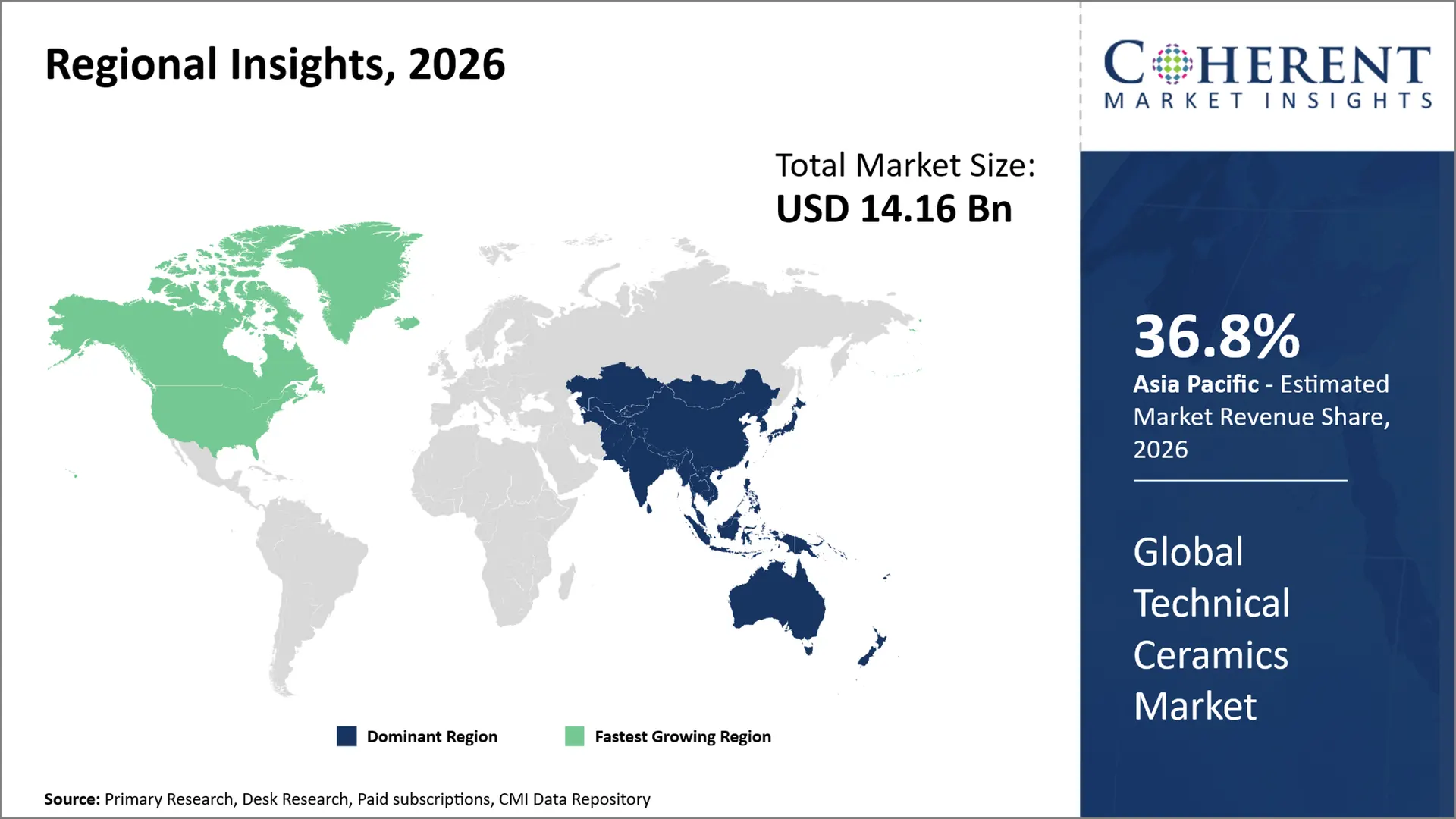
- Asia Pacific is expected to deliver an estimated 7.8% CAGR during 2026–2033 and represent 36.8% of the global technical ceramics market in 2026. The region combines major semiconductor, electronics, automotive, and precision-manufacturing clusters with deep ceramics-processing supply chains. In February 2024, TSMC announced further investment in Japan’s JASM Kumamoto operation, taking planned investment above US$20 Bn and expanding the region’s advanced wafer-production base.
- North America is forecast to register an estimated 8.4% CAGR during 2026–2033 and hold 27.8% of the global technical ceramics market in 2026. Its faster trajectory reflects semiconductor localization, aerospace manufacturing, medical technology, and high-specification industrial equipment requiring purity, insulation, and thermal stability. In June 2025, the U.S. Department of Commerce announced Micron’s planned US$200 Bn semiconductor manufacturing and R&D investment across several states.
Segmental Insights
Why Do Oxide Ceramics Dominate the Global Technical Ceramics Market?
Oxide ceramics are expected to lead the material category with 54.8 % share in the global technical ceramics market because alumina and zirconia combine electrical insulation, corrosion resistance, thermal stability, biocompatibility, and established processing economics across a wider application base than most non-oxide alternatives. Their mature powder supply, pressing, sintering, machining, and increasingly additive-manufacturing routes make qualification easier for semiconductor equipment, electronics, medical devices, wear components, and industrial systems. This breadth supports repeat orders while giving producers flexibility to offer both standardized and engineered grades. In June 2026, Lithoz, Alumina Systems, and Plasway-Technologies developed a 500 mm dual-channel alumina gas-distribution ring for high-speed PEALD and ALE semiconductor processing, demonstrating how oxide ceramics are moving into larger, precision-critical wafer-tool components. Commercially, suppliers with high-purity feedstocks, near-net-shape forming, and precision finishing should capture higher-value programs.
- Current Industry Events of 2026
- Market Size Estimation
- Regional Breakdown
- Competitive Landscape
- Customer Intelligence
- Segmental Analysis
- Pricing Analysis
- Key Market Drivers, Challenges & Future Trends
- Customized Insights Section
Why Do Monolithic Ceramics Represent the Largest Product Type in the Global Technical Ceramics Market?
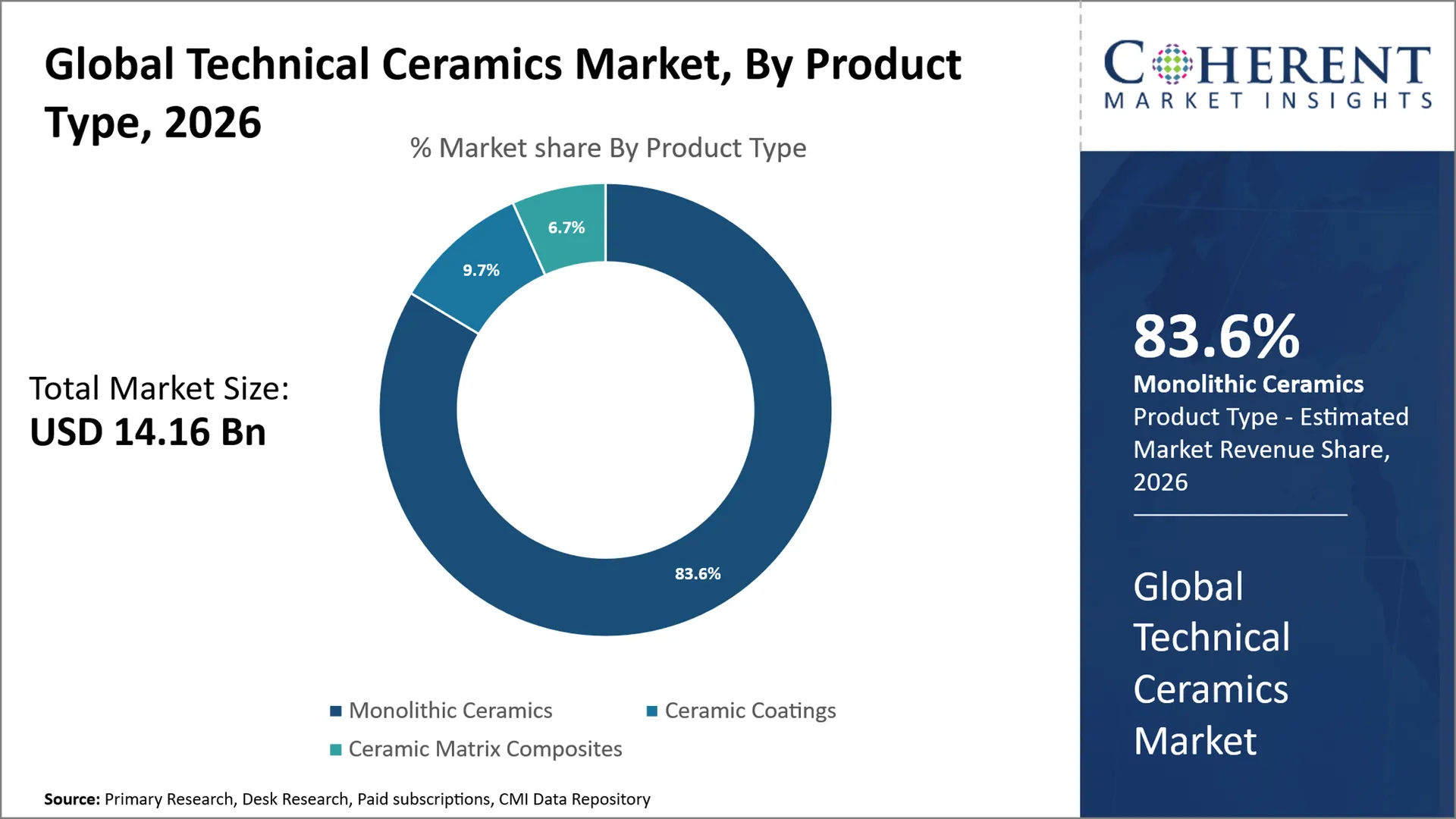
Monolithic ceramics should remain the largest product type with 83.6 % share in global technical ceramics market because buyers can obtain dense, single-body components with predictable mechanical, dielectric, thermal, and wear properties without the additional interfaces or processing steps associated with coatings and ceramic-matrix composites. Mature pressing, injection molding, extrusion, machining, and sintering infrastructure also supports production from prototypes through serial volumes, making monolithic parts easier to specify and qualify across semiconductor, aerospace, energy, automotive, and industrial equipment. In February 2026, Prodways announced that its CERAM PRO 365 would be showcased at Ceramitec 2026 for high-precision functional prototypes and small-series ceramic production using alumina- and silica-based slurries. This illustrates how digital manufacturing is widening design freedom for monolithic components while retaining dense ceramic performance. Suppliers able to combine design engineering with repeatable post-processing can defend stronger margins.
Why Do Electronic Devices Dominate the Application Segment of the Global Technical Ceramics Market?
Electronic devices are expected to lead the application category with 30.8 % in global technical ceramics market because technical ceramics perform several functions that conventional polymers or metals cannot combine efficiently: dielectric isolation, dimensional stability, heat resistance, miniaturized multilayer construction, and reliable operation under electrical and mechanical stress. Demand therefore spans capacitors, substrates, packages, sensors, resonators, insulators, and power-management assemblies used in AI servers, industrial electronics, vehicles, communications hardware, and compact consumer systems. In September 2026, TDK expanded its CN-series 100 V X7R multilayer ceramic capacitors with a 10 μF 3225-format component for AI servers, humanoid robots, xEVs, and industrial equipment, with mass production scheduled for September. The development shows how higher power density is translating into more demanding ceramic component specifications. Manufacturers with advanced dielectric formulations and high-yield multilayer processing should benefit most.
Current Events and their Impact
Current Event | Description and Its Impact |
May 2024 – EU Critical Raw Materials Act takes effect |
|
May 2026 – Mandatory EUDAMED modules introduced in the European Union |
|
February 2024 – India approves three additional semiconductor manufacturing units |
|
Global Technical Ceramics Market Dynamics
Key Market Drivers
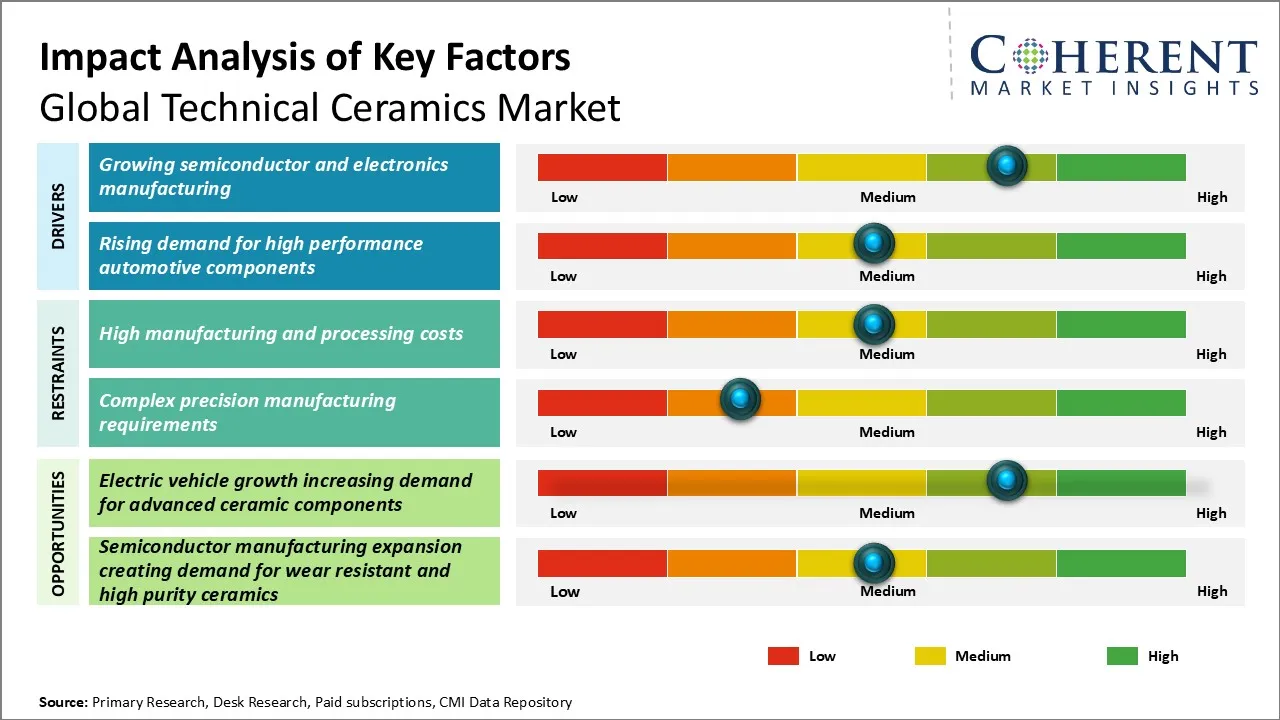
- Growing semiconductor and electronics manufacturing: Growing semiconductor and electronics manufacturing is expanding the addressable demand for ultra-pure alumina, aluminum nitride, silicon carbide, and other technical ceramics used in wafer handling, process chambers, heaters, insulators, and precision assemblies. Suppliers with contamination-control capability, tight dimensional tolerances, low particle generation, and repeatable high-volume processing stand to benefit most as fabs tighten process specifications. In July 2026, Infineon opened its USD 5.69 billion Smart Power Fab in Dresden, doubling manufacturing capacity at the site and reinforcing the equipment ecosystem that consumes high-performance ceramic components.
- Rising demand for high performance automotive components: Rising demand for high performance automotive components is increasing the value of ceramic materials where metals face electrical, thermal, friction, or wear limitations. Hybrid bearings, power-module substrates, sensors, and insulating components can improve durability and efficiency in electrified drivetrains, creating qualification opportunities for ceramic processors and automotive Tier suppliers. The commercial advantage is strongest where reliability justifies material premiums. In April 2025, Schaeffler presented volume-production-ready heavy-duty electric motors whose bearings use ceramic balls to reduce friction and prevent damaging electrical current passage.
Emerging Market Trends
- Shift Toward Multifunctional Ceramic Assemblies and Hybrid Architectures: Multifunctional ceramic assemblies are becoming more important than standalone ceramic parts as customers seek fewer interfaces, lower thermal resistance, better sealing, and easier system integration. This is pushing suppliers toward ceramic-to-metal brazing, embedded channels, metallized surfaces, integrated electrical insulation, and application-specific joining. The commercial shift favors manufacturers that can co-design assemblies, control several process steps internally, and validate system-level performance. Pure component makers may face pressure as procurement increasingly values integrated functionality, qualification support, and reduced downstream assembly complexity over isolated material performance.
- Qualification Data and Lifecycle Traceability Becoming Purchase Criteria: Qualification data and lifecycle traceability are becoming part of the technical ceramics value proposition, particularly in semiconductor, medical, aerospace, and power-electronics programs. Buyers increasingly expect lot-level material consistency, documented process windows, contamination control, inspection records, and evidence that properties remain stable after machining, coating, joining, or sterilization. This trend should move competition away from catalogue specifications alone. Suppliers with digital quality systems, reproducible test methods, and application-specific validation support will be better positioned to secure long-duration design-ins and defend premium pricing.
Regional Insights
Why Does Asia Pacific Dominate the Global Technical Ceramics Market?
Asia Pacific is expected to account for 36.8% of the global technical ceramics market in 2026, supported by the region’s concentration of component manufacturing, semiconductor fabrication, electronics assembly, precision engineering, and ceramics processing capacity. Its advantage extends beyond end-use demand because ceramic powder suppliers, component fabricators, equipment makers, and high-volume OEM customers operate within closely connected manufacturing ecosystems, reducing qualification time and supporting cost-efficient scale-up. This is particularly important for alumina, silicon nitride, silicon carbide, substrates, chamber parts, and electronic ceramic components. In January 2025, SEMI reported that Japan would start four semiconductor fab construction projects during 2025, while China, Korea, Taiwan, and Southeast Asia would add further projects across the regional manufacturing network. This expands the equipment base requiring high-purity ceramic components.
Why Is North America Emerging as the Fastest-Growing Region in the Global Technical Ceramics Market?
North America is expected to hold 27.8% of the global technical ceramics market in 2026 and emerge as the fastest-growing region, with growth increasingly linked to localized production of performance-critical ceramic components rather than dependence on imported finished parts. Buyers in energy processing, refining, chemicals, medical equipment, and advanced industrial systems value traceability, engineered geometries, extended service life, and secure supply, supporting premium ceramic grades and closer supplier-OEM collaboration. Regional producers are consequently adding capacity where process ceramics directly influence plant efficiency and uptime. In February 2025, Saint-Gobain Ceramics announced an investment exceeding USD 40 million in a new Wheatfield, New York facility for ceramic catalyst carriers serving energy production, refining, biofuels, and chemical manufacturing. The investment strengthens regional manufacturing depth and customer access.
Global Technical Ceramics Market Outlook for Key Countries
Why Is the U.S. a Key Market for the Global Technical Ceramics Market?
The U.S. is a key technical ceramics market because it combines high-value aerospace, defense, semiconductor, medical, energy, and precision-manufacturing applications with customers willing to qualify materials for demanding operating environments. The country is particularly important for ceramic matrix composites, silicon carbide systems, wear-resistant parts, electrical insulation, and thermal-management components where performance gains can offset higher material and processing costs. Domestic engineering capability also encourages co-development between material suppliers and equipment or engine manufacturers. In March 2025, GE Aerospace announced nearly USD 1 billion of U.S. manufacturing investment, including more than USD 100 million to scale innovative materials and parts such as ceramic matrix composites and additive-manufactured components. This reinforces domestic commercialization of high-temperature ceramics for larger aerospace production programs.
Why Does China Support Growth in the Global Technical Ceramics Market?
China is strategically important to the global technical ceramics market because its semiconductor, electronics, electric-vehicle, industrial equipment, and automation supply chains require both high-volume ceramic components and increasingly sophisticated locally qualified materials. A key shift is occurring from production scale toward tighter performance standards for semiconductor-process ceramics, where plasma resistance, contamination control, dimensional stability, and repeatability determine equipment reliability. This increases the commercial value of advanced testing and domestic materials engineering. In April 2025, China’s national standards platform registered a project establishing a plasma-resistance test method for advanced technical ceramic components used in semiconductor manufacturing equipment. The proposed standard adopts ISO 21859:2019 and covers ceramics for dry-etch chambers, supporting more consistent qualification of domestic components and higher-specification semiconductor equipment applications.
Why Is Japan Important in the Global Technical Ceramics Market?
Japan remains a key country in the technical ceramics market because its materials companies supply power electronics, semiconductor equipment, automotive electrification, precision machinery, and advanced industrial systems requiring tightly controlled thermal and mechanical performance. Its competitive strength lies in converting specialized ceramic formulations into reliable substrates and components with consistent quality across long production cycles. Power semiconductor applications are especially important because electrical insulation and rapid heat dissipation must be achieved simultaneously within compact modules. In July 2025, Japan Fine Ceramics completed a new factory in Tomiya, Miyagi, to increase production of high-thermal-conductivity silicon nitride substrates for power semiconductors, representing an investment of USD 0.064 billion. The project followed additional production requests from power-semiconductor circuit-board manufacturers, directly connecting electrification demand with expanded domestic ceramic capacity.
Why Is Germany a Strategic Country in the Global Technical Ceramics Market?
Germany is a strategic technical ceramics market because its industrial base rewards materials that extend wear life, withstand thermal and chemical stress, provide electrical insulation, and improve process efficiency in machinery, chemicals, mobility, energy systems, and specialized equipment. The country also has established competence in engineering ceramics and additive manufacturing, opening opportunities for complex silicon carbide components that would be difficult or costly to manufacture through conventional machining. Feedstock security is becoming equally important for producers. In January 2025, Schunk Group acquired ESK-SIC in Frechen, a producer of high-quality silicon carbide powder used by Schunk’s Technical Ceramics business for 3D-printed high-tech components. The companies also plan to industrialize a silicon carbide recycling process, strengthening Germany’s control over both ceramic raw materials and advanced component manufacturing.
Why Is South Korea an Important Growth Market for the Global Technical Ceramics Market?
South Korea is an important growth market for technical ceramics because its semiconductor, display, advanced packaging, battery, and power-electronics industries require materials providing electrical insulation, heat management, plasma resistance, dimensional control, and high-purity performance. More importantly, the country is moving toward domestic source technology for ceramic materials and processes used in next-generation semiconductor systems, widening opportunities for local powder developers, substrate manufacturers, precision processors, and equipment-component suppliers. In January 2026, South Korea’s Ministry of Science and ICT finalized a USD 0.91 billion implementation plan covering semiconductor, display, and battery source technologies. The plan specifically introduced a Semiconductor Advanced Ceramic Materials, Components, and Process Development Project for advanced packaging and power semiconductors, directly linking national R&D investment with technical ceramic localization and future commercial manufacturing capability.
Innovation Production & Manufacturing Landscape
Manufacturing Technology | Adoption Position | Technical Role in Technical Ceramics | Commercial Significance | |
Ceramic Additive Manufacturing | Emerging to scaling | Enables complex internal channels lattice structures customized geometries and near-net-shape production using alumina zirconia silicon carbide and other ceramic systems | Reduces tooling dependence for complex low-to-medium volume parts and opens opportunities in semiconductor aerospace medical and specialized industrial applications | |
Spark Plasma and Field Assisted Sintering | Selective advanced adoption | Uses rapid electrically assisted densification to shorten thermal cycles and control microstructure in advanced ceramic compositions | Valuable for high-performance grades where grain control density or unusual material combinations justify premium processing economics | |
Hot Isostatic Pressing | Established in high-specification applications | Applies elevated temperature and isostatic gas pressure to reduce residual porosity and improve density strength and reliability | Supports premium aerospace medical wear and structural components where defect minimization and repeatable mechanical properties are central to qualification | |
Tape Casting and Multilayer Co-Firing | Mature with continuing refinement | Produces thin ceramic layers and multilayer architectures for substrates packages sensors dielectric structures and electronic modules | Remains essential for miniaturized electronics and power modules and rewards suppliers capable of precise thickness control metallization and high-yield co-firing | |
CVD PVD and Functional Ceramic Coatings | Expanding in harsh-environment applications | Adds plasma resistance wear protection corrosion resistance electrical functionality or controlled surface chemistry without replacing the entire structural component | Allows suppliers to compete through surface performance and component-life extension while supporting semiconductor industrial and energy applications | |
Precision Laser Ultrasonic and Diamond Machining | High adoption in advanced components | Enables micron-level holes slots surfaces contours and finishing after densification where conventional tooling is limited by ceramic hardness | Increasingly differentiates suppliers through tolerance capability surface integrity lower reject rates and the ability to deliver production-ready customized geometries | |
How Are Hydrogen and High-Temperature Electrochemical Systems Creating New Growth Opportunities in the Global Technical Ceramics Market?
Hydrogen production, conversion, and utilization create a white-space opportunity for ceramics that can tolerate corrosive gases, thermal cycling, electrical isolation requirements, and sustained high-temperature operation. Potential demand spans electrolyzers, solid-oxide electrolysis and fuel-cell systems, ammonia cracking, hydrogen purification, burner systems, seals, insulating supports, sensor housings, and porous functional structures. Suppliers can capture this opportunity by developing application-specific alumina, zirconia, silicon carbide, and ceramic-metal assemblies rather than selling standard shapes. Commercial success will depend on long-duration durability testing, gas-tight joining, controlled porosity, thermal-shock resistance, and scalable manufacturing economics. The opportunity should favor specialists and vertically integrated suppliers able to combine materials development with precision forming, coatings, joining, and validation. Market entry also requires collaboration with system OEMs early in the design cycle because ceramic components are often engineered around operating temperature, gas chemistry, pressure, and stack architecture.
Market Players, Key Development, and Competitive Intelligence
Key Developments
- In November 2025, Bosch Advanced Ceramics became part of the Sintokogio Group after developing into a contract manufacturer for additively manufactured technical ceramics. The move matters for the global technical ceramics market because it places ceramic additive manufacturing within a broader industrial manufacturing platform and supports commercialization beyond prototyping.
- In June 2025, Morgan Advanced Materials reported its first real-time ceramic sintering research using high-temperature X-ray diffraction at Diamond Light Source to study alumina firing behavior. This matters for the global technical ceramics market because better visibility into phase formation can improve sintering control process optimization consistency and material-performance retention.
- In January 2025, NGK and the AIST Group began joint research to improve thermal-diffusivity evaluation for thin silicon nitride ceramic substrates used in power semiconductor modules. This is important for the global technical ceramics market because stronger measurement comparability can support thinner high-performance substrates supplier qualification and future standardization.
Competitive Landscape
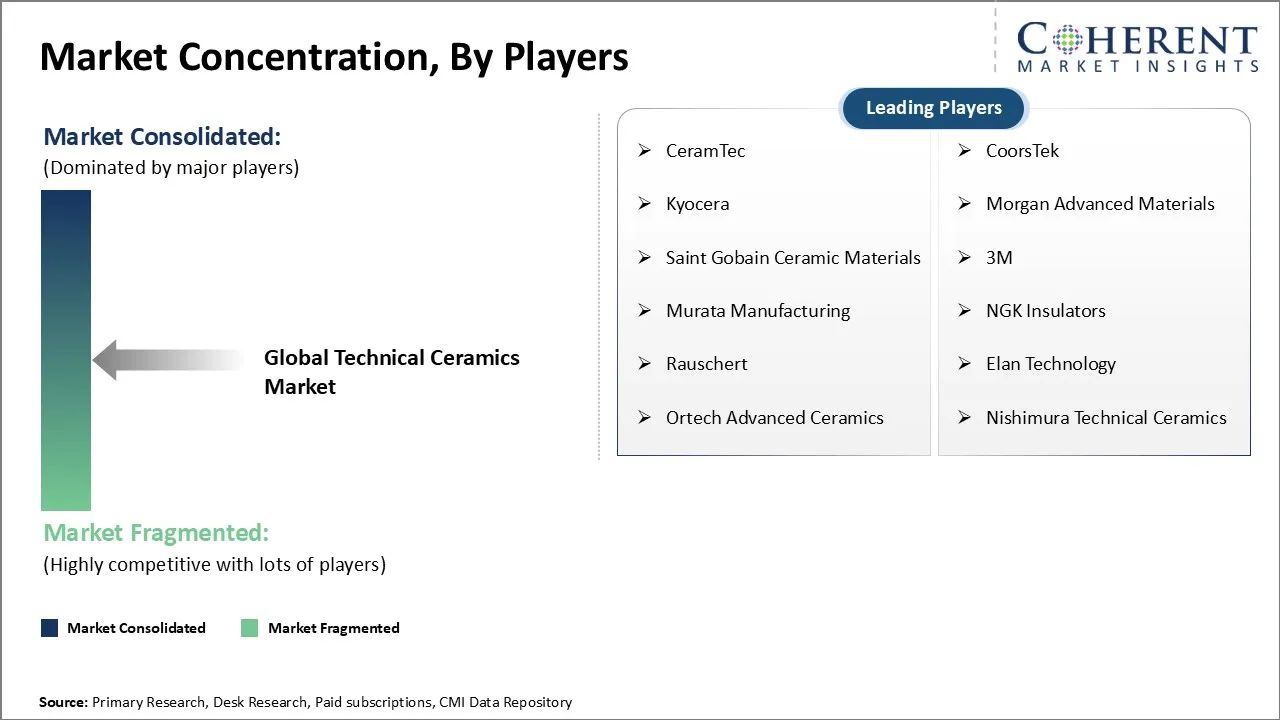
The global technical ceramics market is moderately fragmented, with diversified multinational suppliers competing alongside regional processors and application specialists. Competitive advantage depends less on commodity scale than on material formulation, process control, qualification history, precision finishing, and supply reliability. Regional firms remain relevant where customization and response time matter, while specialists can defend attractive niches through proprietary grades, complex geometries, joining expertise, and deep customer engineering relationships.
Key focus areas include
- Material performance differentiation: Competitors increasingly differentiate through purity thermal conductivity dielectric behavior fracture toughness chemical resistance and wear performance rather than basic ceramic availability.
- Production yield and process repeatability: Powder preparation forming firing and final machining economics materially affect cost competitiveness because late-stage ceramic defects can carry high accumulated processing value.
- Customer qualification capability: Long validation cycles favor suppliers that can maintain stable formulations manufacturing routes documentation and change-control procedures throughout a customer program.
- Supply reliability: Dual sourcing of ceramic powders regional manufacturing flexibility and predictable lead times are becoming stronger procurement considerations for semiconductor automotive medical and industrial buyers.
- Customization and application engineering: Complex geometries ceramic-to-metal joining surface engineering and design-for-manufacturing support help suppliers move away from price-led component competition.
- Pricing and total cost of ownership: Premium pricing is more defensible where ceramic components extend equipment life reduce maintenance prevent electrical damage or improve thermal management.
- Regional localization and technical service: Local machining finishing inventory and engineering support can shorten development cycles and strengthen supplier positions against larger global competitors.
Market Report Scope
Global Technical Ceramics Market Report Coverage | |||
Report Coverage | Details | ||
Base Year | 2025 | Market Size in 2026: | USD 14.16 Bn |
Historical Data For: | 2020 To 2024 | Forecast Period: | 2026 To 2033 |
Forecast Period 2026 To 2033 CAGR: | 7.60% | 2033 Value Projection: | USD 23.65 Bn |
Geographies covered: |
| ||
Segments covered: |
| ||
Companies covered: | CeramTec, CoorsTek, Kyocera, Morgan Advanced Materials, Saint Gobain Ceramic Materials, 3M, Murata Manufacturing, NGK Insulators, Rauschert, Elan Technology, Ortech Advanced Ceramics, Nishimura Technical Ceramics | ||
Growth Drivers: |
| ||
Restraints & Challenges: |
| ||
Analyst Opinion (Expert Opinion)
- The global technical ceramics market leadership is likely to shift toward portfolios built around defensible application niches rather than maximum breadth of ceramic grades. Suppliers that concentrate capital on programs with repeat production qualification barriers and meaningful aftermarket or replacement requirements should generate stronger customer retention. Broad commodity portfolios may increasingly migrate toward regional producers while global specialists prioritize applications where material performance meaningfully affects equipment uptime safety or system economics.
- Computational materials engineering combined with process simulation could materially change how new ceramic grades move from formulation to commercial qualification. Digital modeling of shrinkage grain development thermal gradients residual stress and machining behavior can reduce dependence on iterative physical trials. Participants that integrate materials databases simulation tools and manufacturing feedback loops may shorten development cycles while traditional trial-and-error development models face growing cost and speed disadvantages.
- Manufacturers should prioritize secure powder sourcing high-yield finishing capabilities scalable joining technologies and early customer co-development rather than adding undifferentiated firing capacity. Margin protection will depend on reducing scrap controlling energy-intensive processing and pricing complex qualification work appropriately. Suppliers should also diversify critical raw-material sources and localize selected finishing operations near major customers while avoiding overinvestment in standard ceramic grades where specification barriers are low and price competition is structurally stronger.
Speak to the analyst
Want personalized insights?
Take the findings above to one of our principal consultants, or have the report rebuilt around the segments, geographies and competitors you actually track.
Market Segmentation
- Material Type Insights (Revenue, USD Bn, 2021 - 2033)
- Oxide Ceramics
- Non Oxide Ceramics
- Product Type Insights (Revenue, USD Bn, 2021 - 2033)
- Monolithic Ceramics
- Ceramic Coatings
- Ceramic Matrix Composites
- Application Insights (Revenue, USD Bn, 2021 - 2033)
- Electronic Devices
- Electrical Equipment
- Wear Parts
- Engine Parts
- Medical Applications
- Catalyst Supports
- Filters and Others
- End Use Industry Insights (Revenue, USD Bn, 2021 - 2033)
- Electronics and Semiconductor
- Automotive
- Machinery and Industrial
- Energy and Power
- Medical
- Aerospace and Defense
- Distribution Channel Insights (Revenue, USD Bn, 2021 - 2033)
- Direct Sales
- Indirect Sales
- Regional Insights (Revenue, USD Bn, 2021 - 2033)
- North America
- U.S.
- Canada
- Latin America
- Brazil
- Argentina
- Mexico
- Rest of Latin America
- Europe
- Germany
- U.K.
- Spain
- France
- Italy
- Russia
- Rest of Europe
- Asia Pacific
- China
- India
- Japan
- Australia
- South Korea
- ASEAN
- Rest of Asia Pacific
- Middle East
- GCC Countries
- Israel
- Rest of Middle East
- Africa
- South Africa
- North Africa
- Central Africa
- North America
Sources
Primary Research Interviews
- Technical ceramics manufacturers, ceramic powder suppliers, component fabricators, coating providers, and distributors
- Materials engineers, R&D heads, production managers, procurement teams, application engineers, and OEM representatives
- Semiconductor, electronics, automotive, medical, aerospace, energy, and industrial equipment manufacturers
Stakeholders
- Alumina, zirconia, silicon carbide, silicon nitride, and other advanced ceramic manufacturers
- Raw material suppliers, precision processors, coating providers, distributors, and engineering service companies
- Electronics, semiconductor, automotive, industrial, medical, aerospace, and defense OEMs
- Testing laboratories, research institutes, universities, and certification organizations
End-use Sectors
- Electronics and semiconductor
- Automotive and electric mobility
- Machinery and industrial equipment
- Energy and power
- Medical devices
- Aerospace and defense
Regulatory and Industry Bodies
- International Organization for Standardization ISO/TC 206 Fine Ceramics
- ASTM International Committee C28 on Advanced Ceramics
- American Ceramic Society ACerS
- International Ceramic Federation ICF
- Cerame-Unie
- Japan Fine Ceramics Association JFCA
- Relevant national regulatory and standards authorities
Databases
- Company annual reports and regulatory filings
- UN Comtrade and national customs databases
- Eurostat and industrial production databases
- U.S. Geological Survey mineral databases
- Patent and technical ceramic product databases
- ISO and ASTM standards databases
Magazines and Journals
- Journal of the American Ceramic Society
- Journal of the European Ceramic Society
- Ceramics International
- International Journal of Applied Ceramic Technology
- Journal of Advanced Ceramics
Associations
- American Ceramic Society ACerS
- International Ceramic Federation ICF
- European Ceramic Society ECerS
- Cerame-Unie
- Japan Fine Ceramics Association JFCA
- German Ceramic Society DKG
Public Domain Sources
- Technical ceramic and raw material production statistics
- Semiconductor, automotive, aerospace, medical, and energy industry data
- Import export statistics
- Government-funded advanced material research programs
- Patent publications and university research
- Manufacturing and technology investment announcements
Key Standards and Regulations
- ISO/TC 206 standards for fine and advanced ceramics
- ASTM C28 standards for advanced ceramics
- ASTM C1145 terminology for advanced ceramics
- ASTM C1421 fracture toughness testing
- ISO standards covering hardness, strength, and ceramic characterization
- REACH, CLP, RoHS, medical-device, aerospace, and material qualification requirements
Proprietary Elements
- CMI Data Analytics Tool
- Proprietary CMI repository containing 10+ years of technical ceramics, advanced materials, semiconductor, electronics, automotive, industrial, medical, energy, and aerospace market intelligence
Get access to 250+ pages report
Every segment, forecast, competitor profile and data table behind the analysis above — available for instant download.
- ESOMAR Member
- ISO 9001:2015 Certified
- D-U-N-S Registered
- GDPR & CCPA Compliant
Frequently Asked Questions
The CAGR of global technical ceramics market is projected to be 7.60% from 2026 to 2033.
The global technical ceramics market is estimated to be valued at USD 14.16 Bn in 2026 and is expected to reach USD 23.65 Bn by 2033.
Growth of the global technical ceramics market is primarily supported by expanding semiconductor and electronics manufacturing, along with increasing use of high-performance ceramic components in automotive applications.
High manufacturing and processing costs and Complex precision manufacturing requirements are the major factors hampering the growth of global technical ceramics market.
In terms of material type, oxide ceramics are estimated to dominate the market revenue share in 2026.
CeramTec, CoorsTek, Kyocera, Morgan Advanced Materials, Saint Gobain Ceramic Materials, 3M, Murata Manufacturing, NGK Insulators, Rauschert, Elan Technology, Ortech Advanced Ceramics, Nishimura Technical Ceramics are the major players.
Asia Pacific is expected to lead the global technical ceramics market in 2026.