

Global Thin Film Resistors Market Size and Forecast – 2026 To 2033
The Global Thin Film Resistors Market is estimated to be valued at USD 740.2 Mn in 2026 and is expected to reach USD 1,048.5 Mn by 2033, growing at a compound annual growth rate (CAGR) of 5.10% from 2026 to 2033. This growth reflects increasing adoption of high-precision passive components across automotive electronics, telecommunications infrastructure, semiconductor equipment, medical devices, and consumer electronics, where manufacturers require compact components with improved resistance stability, low temperature coefficients, and reliable performance under demanding operating conditions.
The shift toward electric vehicles, advanced driver assistance systems (ADAS), high-frequency communication systems, and miniaturized electronic architectures is further strengthening demand for thin film resistor technologies. In June 2025, Vishay Intertechnology expanded its AEC-Q200 qualified CHA series thin film chip resistors with new 0402 case-size devices capable of high-frequency performance up to 50 GHz, targeting automotive, telecom, medical, space, and avionics applications. This development highlights the industry's movement toward smaller, higher-performance resistor solutions for next-generation electronic systems.
Key takeaways of the Global Thin Film Resistors Market
- Thin Film Chip Resistors are estimated to register a 5.6% CAGR and account for 48.6% share of the global thin film resistors market in 2026, supported by their adoption in compact high-frequency and reliability-focused electronic designs across automotive and communication systems. In June 2025, Vishay expanded its AEC-Q200 qualified CHA thin film chip resistor series with 0402 devices designed for automotive, telecom, medical, and aerospace applications.
- Thin Film Precision Resistors are projected to achieve a 5.3% CAGR and hold 28.7% share of the global thin film resistors market in 2026, as measurement systems, converters, servers, and advanced control electronics require low temperature coefficients and tighter resistance accuracy. In August 2024, Susumu showcased thin film resistor technologies and high-frequency components at COMNEXT 2024, highlighting precision component development for next-generation communication applications.
- Thin Film Network Resistors are expected to expand at a 4.9% CAGR and represent 12.8% share of the global thin film resistors market in 2026, reflecting demand for space-efficient circuit integration where multiple matched resistive elements are required. In 2025, Vishay continued offering thin film resistor network solutions with matched precision characteristics for applications requiring stability, ratio accuracy, and compact packaging.
- Asia Pacific is forecast to grow at a 5.4% CAGR and contribute 44.8% share of the global thin film resistors market in 2026, supported by its semiconductor manufacturing base, electronics production ecosystem, and strong presence of passive component suppliers. In February 2025, ROHM expanded its chip resistor portfolio with smaller and higher-performance components targeting automotive and industrial electronics markets from its Japan-based operations.
- Europe is anticipated to record a 5.7% CAGR and account for 24.7% share of the global thin film resistors market in 2026, driven by demand from automotive electronics, industrial systems, and semiconductor value chains. In December 2025, the European Investment Bank and STMicroelectronics announced financing support for semiconductor manufacturing and R&D activities in Italy and France, strengthening regional electronics capabilities.
Segmental Insights
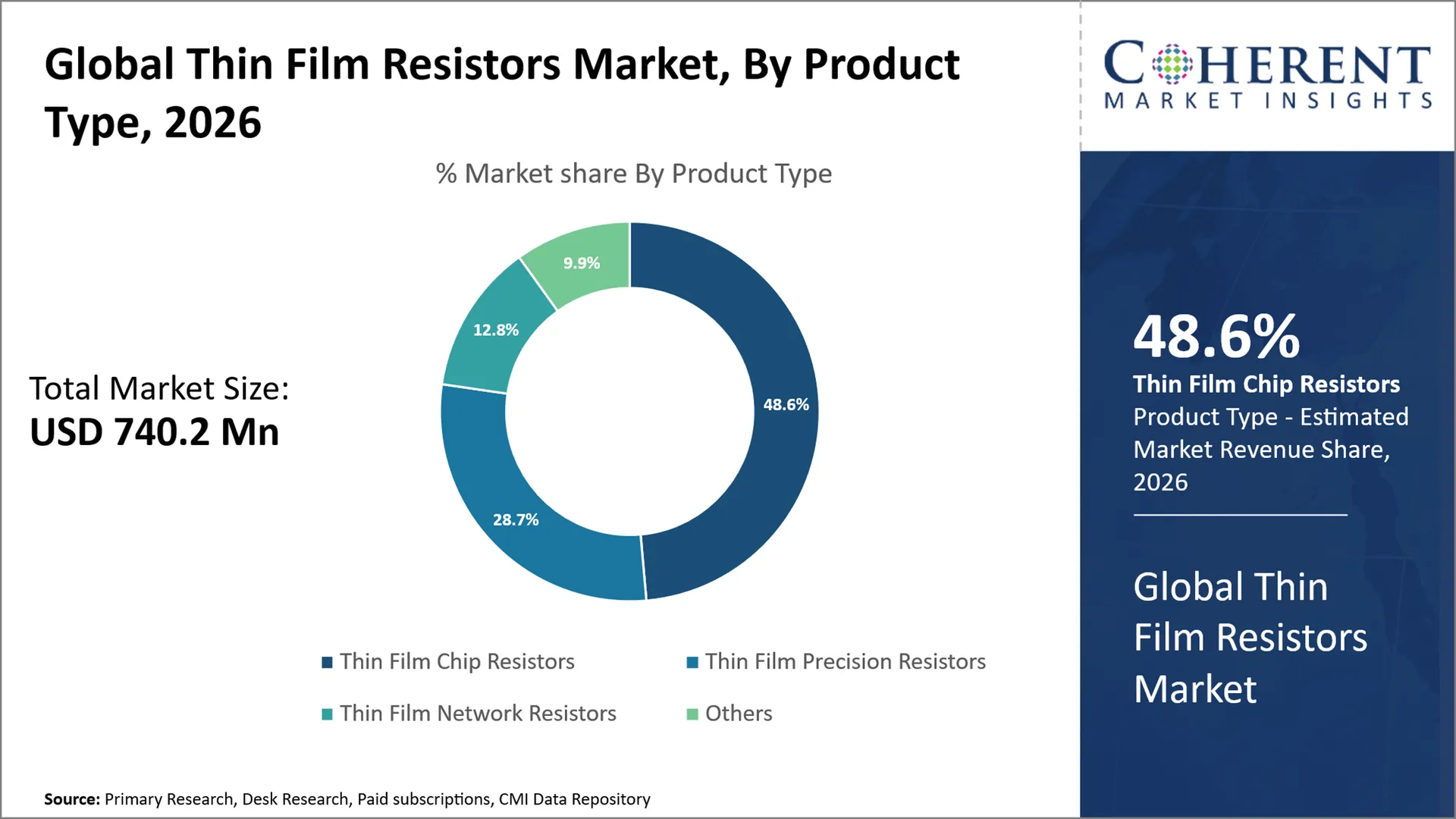
Why Do Thin Film Chip Resistors Dominate the Global Thin Film Resistors Market?
Thin Film Chip Resistors are expected to account for 48.6% of the global thin film resistors market in 2026, leading the product-type category because surface-mount architectures fit automated PCB assembly while delivering precision in compact footprints. Demand is concentrated in automotive electronics, memory modules, camera systems, mobile devices, and control electronics, where board density and resistance stability are procurement priorities. On the supply side, mature sputtering, photolithography, trimming, and reel-based SMD production enable manufacturers to serve high-volume OEM programs with tightly controlled specifications. In August 2024, Bourns launched its AEC-Q200 compliant CRT-A automotive-grade thin film chip resistor series in 0402, 0603, 0805, and 1206 sizes, offering tolerances from ±0.1% to ±1% and TCR options down to ±10 ppm/°C. This strengthens the segment’s commercial position where miniaturization must coexist with automotive qualification and resistance accuracy.
- Current Industry Events of 2026
- Market Size Estimation
- Regional Breakdown
- Competitive Landscape
- Customer Intelligence
- Segmental Analysis
- Pricing Analysis
- Key Market Drivers, Challenges & Future Trends
- Customized Insights Section
Why Does Nickel Chromium Represent the Largest Resistor Material Segment in the Global Thin Film Resistors Market?
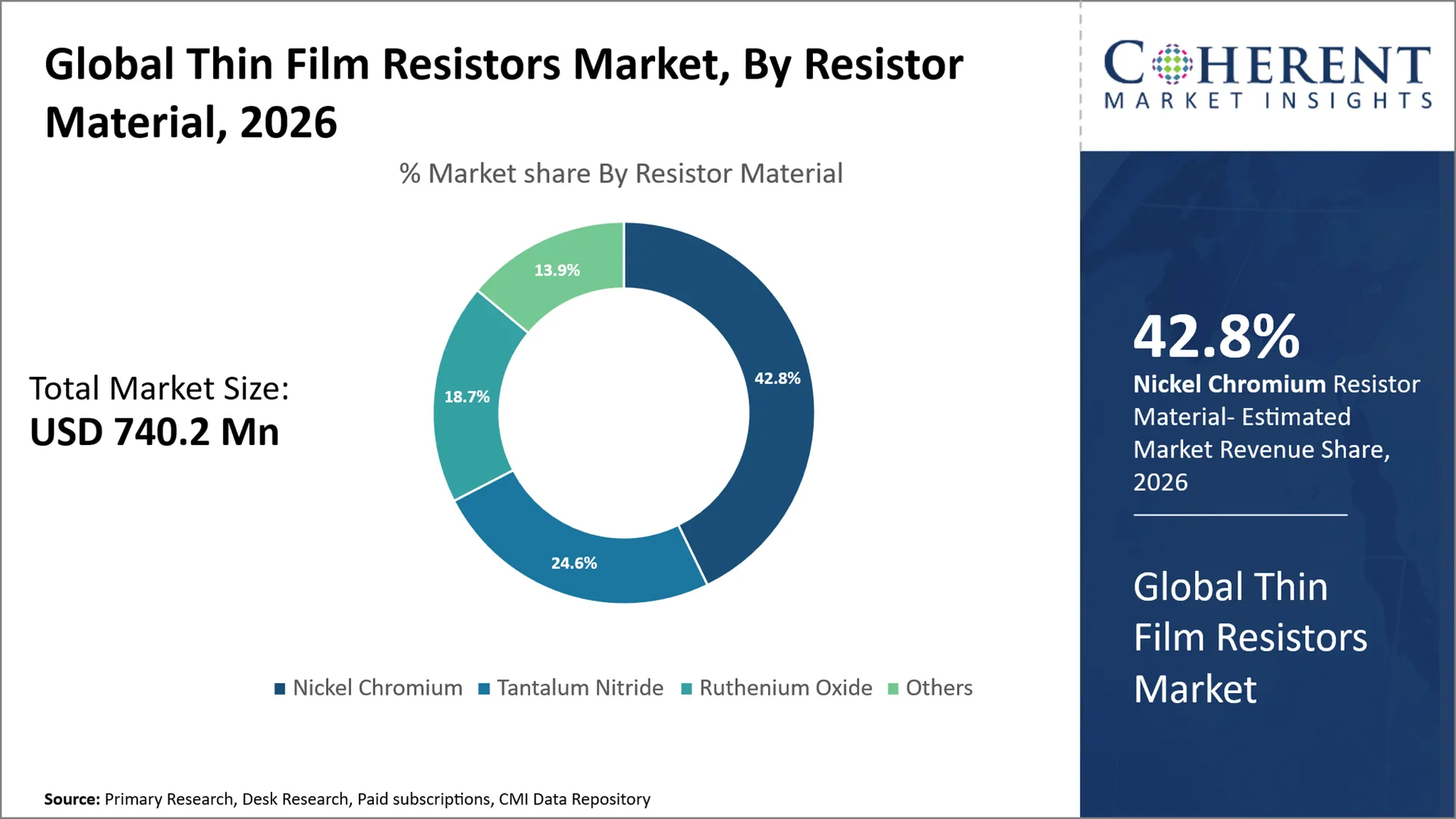
Nickel Chromium is expected to represent 42.8% of the global thin film resistors market in 2026, making it the largest resistor-material segment because NiCr thin films combine controllable sheet resistance, stable temperature behavior, and compatibility with sputter-based precision manufacturing. These properties support designers seeking predictable electrical performance across instrumentation, industrial controls, automotive electronics, and precision sensing circuits. For manufacturers, NiCr also provides a well-established process platform that can be integrated into high-volume thin-film fabrication and laser-trimming workflows, reducing qualification risk compared with less standardized material systems. In November 2024, TT Electronics issued a product-change notification moving multiple resistor series from titanium and palladium sputtered edge terminations to NiCr sputtered thin-film material and introducing a NiCr sputter plant for product standardization. The move demonstrates continued industrial investment in NiCr processing infrastructure and reinforces supplier confidence in the material’s manufacturability and process consistency.
Why Does Below 1% Tolerance Dominate the Tolerance Segment of the Global Thin Film Resistors Market?
Below 1% Tolerance is expected to hold 38.6% of the global thin film resistors market in 2026, leading the tolerance category as circuit designers increasingly require tighter resistance control for sensing, measurement, calibration, signal conditioning, and feedback functions. Sub-1% devices reduce accumulated error in precision circuits and are therefore more relevant to medical electronics, industrial instrumentation, automotive control modules, test equipment, and power-management systems than general-purpose loose-tolerance alternatives. Suppliers benefit because tighter-tolerance portfolios support specification-based selling and greater design-in stickiness with OEM customers. In December 2024, Ever Ohms released its TQ Series AEC-Q200 compliant thin-film chip resistor specification covering tolerance options including ±0.05%, ±0.1%, ±0.25%, and ±0.5%, alongside low TCR grades and multiple package sizes. This breadth shows how suppliers are expanding qualified precision ranges to address applications where resistance accuracy and temperature stability are purchased together.
Current Events and their Impact
Current Event | Description and Its Impact |
European Semiconductor Manufacturing Initiatives – 2025 |
|
U.S. Semiconductor Supply Chain Strengthening Programs – 2025 |
|
Automotive Electronics Safety and Reliability Standards Expansion – 2025 |
|
Global Thin Film Resistors Market Dynamics
Key Market Drivers
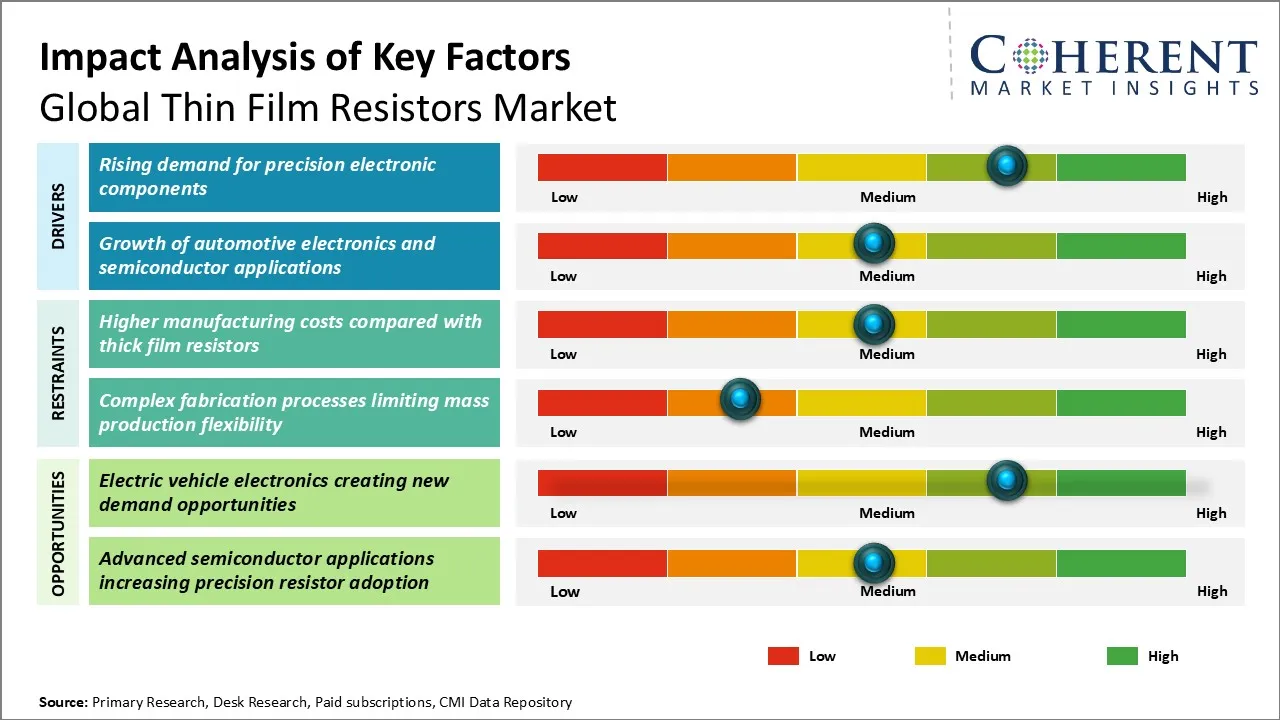
- Rising Demand for Precision Electronic Components: The global thin film resistors market is benefiting from increasing requirements for components that provide tighter tolerance control, lower temperature coefficients, and stable electrical performance in advanced electronic systems. Precision thin film resistors are becoming essential in measurement equipment, semiconductor testing systems, medical electronics, aerospace instrumentation, and high-frequency circuits where performance variation directly affects system reliability. Manufacturers of precision components, OEMs, and electronics designers are increasingly prioritizing thin film technologies over conventional alternatives for applications requiring accuracy and repeatability. In June 2025, Vishay introduced expanded AEC-Q200 qualified thin film chip resistor availability in the 0402 package size, supporting miniaturized automotive and high-reliability electronic designs.
- Growth of Automotive Electronics and Semiconductor Applications: The expansion of vehicle electrification, advanced driver assistance systems, battery management systems, and semiconductor-based control architectures is strengthening demand for thin film resistors with high reliability and environmental stability. Automotive suppliers and semiconductor manufacturers require passive components capable of operating under strict thermal, vibration, and performance conditions. Thin film resistors support accurate sensing, signal conditioning, and power management functions across modern electronic platforms. This creates commercial opportunities for component manufacturers supplying automotive-grade and industrial-grade solutions. In April 2025, the European semiconductor ecosystem continued receiving strategic investment support through initiatives aimed at strengthening regional semiconductor manufacturing capabilities and supply-chain resilience, indirectly supporting demand for advanced passive components.
Emerging Market Trends
- Miniaturization and Higher Functional Density in Electronic Designs: Thin film resistor development is increasingly influenced by the transition toward smaller electronic architectures with higher functionality per circuit board area. Device manufacturers are focusing on reducing component footprints while maintaining accuracy, thermal stability, and electrical performance. This trend is reshaping product development priorities, encouraging suppliers to improve deposition techniques, packaging approaches, and integration capabilities. Component providers that can combine compact dimensions with reliable performance are positioned to support evolving requirements across automotive electronics, communication infrastructure, semiconductor equipment, and industrial control systems.
- Shift Toward Application-Specific Passive Component Solutions: The global thin film resistor market is gradually moving from standardized resistor offerings toward customized solutions designed around specific operating environments and customer requirements. Electronics manufacturers increasingly require resistors optimized for frequency performance, temperature stability, reliability standards, and application-specific electrical characteristics. This shift encourages suppliers to strengthen engineering support, customization capabilities, and design collaboration with OEM customers. The competitive landscape is expected to increasingly favor companies capable of providing application-focused solutions rather than only competing through manufacturing scale and pricing.
Regional Insights

Why Does Asia Pacific Dominate the Global Thin Film Resistors Market?
Asia Pacific is expected to account for 44.8% share of the global thin film resistors market in 2026, supported by its extensive electronics manufacturing ecosystem, strong semiconductor supply chain, and concentration of passive component production facilities. Countries including China, Japan, South Korea, and Taiwan provide integrated capabilities across semiconductor fabrication, PCB assembly, automotive electronics, and consumer devices, creating consistent demand for precision resistive components. The region’s large-scale electronics export base also enables thin film resistor suppliers to serve global OEM customers through established manufacturing networks. Demand is further supported by electric vehicle production, industrial automation, communication infrastructure, and advanced consumer electronics requiring compact and reliable passive components. In January 2025, Japan’s Ministry of Economy Trade and Industry announced additional semiconductor supply-chain strengthening initiatives through government-backed investment support programs, reinforcing the regional electronics manufacturing environment supporting advanced component demand.
Why Is Europe Emerging as the Fastest-Growing Region in the Global Thin Film Resistors Market?
Europe is expected to represent 24.7% share of the global thin film resistors market in 2026 and is emerging as the fastest-growing regional market due to increasing demand from automotive electrification, industrial automation, renewable energy systems, and advanced manufacturing applications. European manufacturers increasingly require high-reliability passive components for electric vehicles, battery management systems, power electronics, and precision industrial equipment. The region’s focus on localized semiconductor capabilities and resilient electronics supply chains is encouraging greater investment in advanced component technologies. Automotive suppliers and industrial OEMs are also shifting toward higher-performance electronic architectures requiring stable thin film resistor solutions. In March 2025, the European Commission continued implementation activities under the European Chips Act to strengthen semiconductor capabilities and support regional electronics manufacturing resilience, improving the ecosystem for advanced electronic component suppliers.
Global Thin Film Resistors Market Outlook for Key Countries
Why Is China a Key Market for the Global Thin Film Resistors Market?
China remains a critical market for the global thin film resistors market due to its position as one of the world’s largest electronics manufacturing hubs, supported by extensive semiconductor packaging, consumer electronics, automotive electronics, and industrial equipment production. The country provides a broad customer base for passive component manufacturers through domestic OEMs, contract manufacturers, and electronics assembly networks. Thin film resistor demand is strengthened by electric vehicle development, smart manufacturing initiatives, telecommunications infrastructure, and increasing requirements for precision electronic components. China’s established supply chain for ceramic substrates, semiconductor materials, and electronic assembly reduces manufacturing complexity and supports competitive production capabilities. In February 2025, China’s Ministry of Industry and Information Technology highlighted continued advancement of electronic information manufacturing and industrial digitalization initiatives, supporting downstream demand for precision electronic components.
Why Is Japan Important in the Global Thin Film Resistors Market?
Japan holds strategic importance in the global thin film resistors market due to its advanced passive component manufacturing capabilities, precision engineering expertise, and strong presence in automotive electronics, industrial equipment, semiconductor manufacturing, and instrumentation sectors. Japanese companies have historically developed specialized thin film technologies focused on high reliability, miniaturization, and stringent quality requirements. The country’s automotive industry and semiconductor equipment manufacturers create demand for resistors requiring stable electrical characteristics under demanding operating conditions. Japan also maintains strong R&D capabilities in materials engineering, enabling improvements in thin film deposition, resistance control, and component durability. In April 2025, Japan’s Ministry of Economy Trade and Industry continued supporting semiconductor and advanced manufacturing initiatives through its domestic technology investment programs, strengthening the environment for precision electronic component suppliers.
Why Does South Korea Support Growth in the Global Thin Film Resistors Market?
South Korea supports growth in the global thin film resistors market through its globally significant semiconductor, display, automotive electronics, and advanced manufacturing industries. The country’s large semiconductor ecosystem creates demand for precision components used in manufacturing equipment, testing systems, and electronic assemblies. Thin film resistors are particularly relevant in applications requiring electrical stability, compact designs, and consistent performance within high-value electronic systems. South Korea’s expansion in electric vehicles, memory semiconductors, and smart electronics further strengthens opportunities for component suppliers. Domestic electronics manufacturers also encourage localization of reliable passive component supply chains to improve manufacturing resilience. In May 2025, South Korea’s Ministry of Trade Industry and Energy announced continued investment measures to strengthen semiconductor competitiveness and related industrial infrastructure, supporting broader demand for advanced electronic components.
Why Is Germany a Strategic Country in the Global Thin Film Resistors Market?
Germany represents a strategic thin film resistors market due to its strong automotive manufacturing base, industrial automation leadership, and demand for high-quality electronic components in precision applications. German automotive suppliers, machinery manufacturers, and industrial equipment producers increasingly rely on reliable passive components for control systems, sensors, power electronics, and advanced vehicle architectures. The country’s engineering-focused industrial structure supports adoption of higher-performance resistor technologies where accuracy, durability, and qualification standards are important purchasing criteria. Germany also acts as a major European manufacturing and export center, connecting component suppliers with global industrial customers. In November 2024, Germany’s Federal Ministry for Economic Affairs and Climate Action continued supporting semiconductor and microelectronics projects through strategic technology funding initiatives, strengthening domestic electronics manufacturing capabilities.
Why Is the U.S. an Important Growth Market for the Global Thin Film Resistors Market?
The U.S. is an important thin film resistors market due to its strong demand from aerospace electronics, defense systems, medical devices, semiconductor equipment, telecommunications infrastructure, and advanced industrial applications. U.S.-based technology companies and electronic system manufacturers require precision passive components capable of meeting strict reliability, thermal stability, and performance requirements. The country’s semiconductor manufacturing expansion, research ecosystem, and high-value electronics production create opportunities for thin film resistor suppliers focused on specialized applications rather than only high-volume production. Demand is particularly relevant in applications involving instrumentation, sensing, RF systems, and mission-critical electronics. In September 2025, the U.S. Department of Commerce continued implementing semiconductor manufacturing support programs under the CHIPS initiative, strengthening domestic electronics production capabilities and related component demand.
Technology Innovation, Production & Manufacturing Landscape
Technology | Description | Commercial Impact | Adoption Stage |
Thin Film Deposition Technology | Uses precision deposition methods to create controlled resistive layers on ceramic substrates. | Enables improved resistance accuracy and electrical stability for precision applications. | Mature |
Advanced Metal Film Materials | Development of optimized materials such as nickel chromium and tantalum nitride films. | Improves temperature coefficient performance and long-term reliability. | Mature to Advanced |
Miniature Chip Packaging | Smaller resistor packages designed for compact electronic assemblies. | Supports automotive electronics, mobile devices, and high-density circuit designs. | Widely Adopted |
High-Frequency Thin Film Solutions | Designed for RF, communication, and high-speed electronic applications. | Enables improved signal integrity in advanced communication systems. | Growing |
Integrated Resistor Networks | Multiple resistor elements combined into compact packages. | Reduces board space requirements and simplifies circuit design. | Growing |
Automotive-Grade Thin Film Manufacturing | Production processes aligned with automotive qualification requirements. | Expands usage in electric vehicles and safety-critical electronic systems. | Advanced |
How Are Advanced Automotive Electronics and High-Frequency Applications Creating New Growth Opportunities in the Global Thin Film Resistors Market?
Advanced automotive electronics, semiconductor testing infrastructure, and high-frequency communication systems are creating new opportunities for thin film resistor manufacturers to move toward specialized, performance-driven solutions. The opportunity lies in developing application-specific resistors optimized for electric vehicles, autonomous systems, 5G infrastructure, aerospace electronics, and precision measurement equipment. Companies can capture this opportunity by investing in advanced material engineering, miniaturized packaging, high-frequency performance capabilities, and customer-specific design support. Suppliers with strong manufacturing control and engineering collaboration capabilities are better positioned to serve OEMs requiring customized solutions rather than standard components. The opportunity will favor manufacturers that combine reliable production capacity with application expertise, enabling premium positioning through performance differentiation, technical support, and long-term customer partnerships.
Market Players, Key Development, and Competitive Intelligence
Key Developments
- In June 2025, Vishay Intertechnology expanded its CHA series of AEC-Q200 qualified thin film chip resistors with 0402 devices operating up to 50 GHz. The addition strengthens Vishay’s offering for ADAS, radar, telecommunications, medical, space, and avionics designs requiring compact resistors with stable high-frequency performance under harsh conditions.
- In July 2026, Panasonic Industry introduced the ERA-8X Series high-resistance and high-voltage thin film chip resistors, offering resistance values up to 10 MΩ. The series targets battery-management and voltage-sensing circuits, supporting designers seeking precision, long-term stability, reduced component counts, and simplified architectures for demanding high-voltage electronic systems.
- In July 2026, KOA Corporation released the RN73H 1H, a 0201-size high-reliability thin film chip resistor rated at 0.075 W and qualified to AEC-Q200. Its combination of miniaturization, precision, and power density supports dense optical modules, automotive ADAS, industrial equipment, and medical electronics requiring compact high-performance circuit designs.
Competitive Landscape
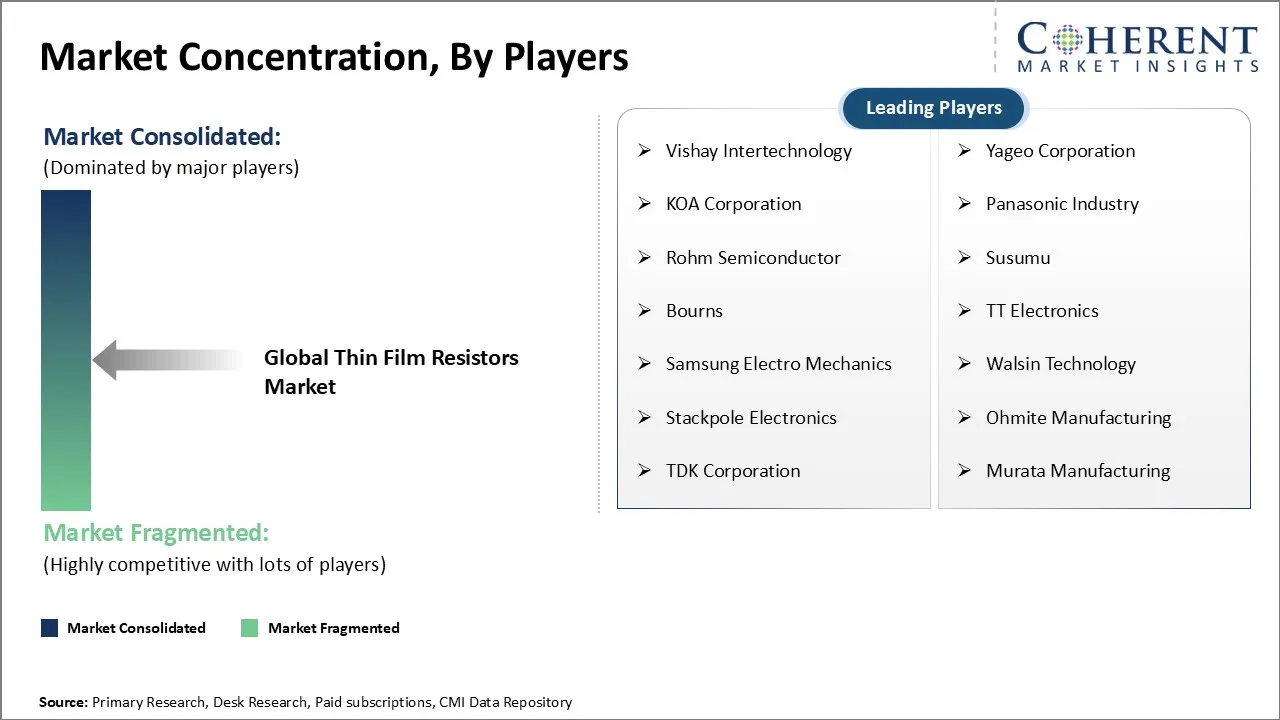
The global thin film resistors market is moderately consolidated, with competition concentrated among established passive electronic component manufacturers, specialized precision resistor suppliers, and regional component producers. Competitive differentiation is based on resistance accuracy, material technology, manufacturing consistency, reliability certifications, customization capability, and supply-chain responsiveness. Leading suppliers compete through advanced thin film deposition processes, automotive-grade qualification capabilities, application engineering support, and global distribution networks. Regional manufacturers continue gaining opportunities through cost competitiveness and localized customer support.
Key focus areas include
- Precision performance and resistance tolerance capabilities for demanding electronic applications
- Advanced thin film materials including nickel chromium and tantalum nitride technologies
- Manufacturing quality control and process consistency across high-volume production
- Automotive qualification capabilities and compliance with reliability standards
- Custom resistor solutions for aerospace medical telecommunications and industrial applications
- High-frequency performance capabilities for RF communication and semiconductor equipment
- Global supply reliability and regional production flexibility
- Technical support and collaborative design assistance for OEM customers
Market Report Scope
Global Thin Film Resistors Market Report Coverage | |||
Report Coverage | Details | ||
Base Year | 2025 | Market Size in 2026: | USD 740.2 Mn |
Historical Data For: | 2020 To 2024 | Forecast Period: | 2026 To 2033 |
Forecast Period 2026 To 2033 CAGR: | 5.10% | 2033 Value Projection: | USD 1,048.5 Mn |
Geographies covered: |
| ||
Segments covered: |
| ||
Companies covered: | Vishay Intertechnology, Yageo Corporation, KOA Corporation, Panasonic Industry, Rohm Semiconductor, Susumu, Bourns, TT Electronics, Samsung Electro Mechanics, Walsin Technology, Stackpole Electronics, Ohmite Manufacturing, TDK Corporation, Murata Manufacturing | ||
Growth Drivers: |
| ||
Restraints & Challenges: |
| ||
Analyst Opinion (Expert Opinion)
- The global thin film resistors market is likely to transition from a component-focused business model toward application-engineered solutions. Future competitiveness will depend less on basic resistor manufacturing capability and more on suppliers’ ability to support complex electronic architectures through customization, simulation support, reliability testing, and co-development with OEM customers.
- The most significant market transformation will come from increasing integration between passive components and advanced electronic systems. Manufacturers that develop specialized solutions for autonomous vehicles, high-frequency communication, semiconductor equipment, and precision electronics may gain stronger strategic positioning, while suppliers relying primarily on standardized products may face increasing margin pressure.
- Market participants should prioritize material innovation, manufacturing automation, customer-specific engineering capabilities, and supply-chain resilience. Companies should carefully balance investment between high-growth application areas and traditional volume markets, as pricing pressure, raw material availability, and increasing customer expectations for shorter development cycles may influence profitability.
Speak to the analyst
Want personalized insights?
Take the findings above to one of our principal consultants, or have the report rebuilt around the segments, geographies and competitors you actually track.
Market Segmentation
- Product Type Insights (Revenue, USD Mn, 2021 - 2033)
- Thin Film Chip Resistors
- Thin Film Precision Resistors
- Thin Film Network Resistors
- Others
- Resistor Material Insights (Revenue, USD Mn, 2021 - 2033)
- Nickel Chromium
- Tantalum Nitride
- Ruthenium Oxide
- Others
- Tolerance Insights (Revenue, USD Mn, 2021 - 2033)
- Below 1% Tolerance
- 1% Tolerance
- Above 1% Tolerance
- Application Insights (Revenue, USD Mn, 2021 - 2033)
- Automotive Electronics
- Consumer Electronics
- Industrial Equipment
- Telecommunications
- Medical Devices
- Others
- End User Insights (Revenue, USD Mn, 2021 - 2033)
- Electronics and Semiconductor
- Automotive
- Industrial Automation
- Healthcare
- Aerospace and Defense
- Others
- Distribution Channel Insights (Revenue, USD Mn, 2021 - 2033)
- Direct Sales
- Indirect Sales
- Regional Insights (Revenue, USD Mn, 2021 - 2033)
- North America
- U.S.
- Canada
- Latin America
- Brazil
- Argentina
- Mexico
- Rest of Latin America
- Europe
- Germany
- U.K.
- Spain
- France
- Italy
- Russia
- Rest of Europe
- Asia Pacific
- China
- India
- Japan
- Australia
- South Korea
- ASEAN
- Rest of Asia Pacific
- Middle East
- GCC Countries
- Israel
- Rest of Middle East
- Africa
- South Africa
- North Africa
- Central Africa
- North America
Sources
Primary Research Interviews
- Thin film resistor manufacturers, passive component producers, semiconductor companies, and electronic component suppliers
- Automotive electronics manufacturers, industrial equipment companies, telecommunications providers, and consumer electronics OEMs
- Electronics design engineers, semiconductor specialists, circuit designers, and material technology experts
- Distributors, component distributors, system integrators, and application solution providers
Stakeholders
- Thin film resistor manufacturers, passive electronic component companies, semiconductor suppliers, and precision electronics providers
- Raw material suppliers including ceramic substrate manufacturers, metal film material suppliers, conductive material providers, and component processing companies
- Automotive electronics suppliers, telecommunications equipment manufacturers, industrial automation companies, medical electronics providers, and consumer electronics brands
- Distributors, electronic component suppliers, contract manufacturers, and technology solution integrators
End-use Sectors
- Automotive electronics including EV systems, ADAS, battery management systems, and vehicle control units
- Consumer electronics including smartphones, wearables, computing devices, and smart home electronics
- Telecommunications applications including RF systems, networking equipment, and communication infrastructure
- Industrial applications including automation systems, instrumentation, semiconductor equipment, and control systems
- Medical devices, aerospace electronics, defense systems, and precision measurement equipment
Regulatory and Industry Bodies
- Semiconductor and electronics industry associations
- Automotive electronics standard organizations
- International electrical and electronic component regulatory bodies
- Quality and reliability certification organizations
- Environmental compliance authorities supporting electronic component manufacturing
Databases
- Company annual reports, investor presentations, regulatory filings, and corporate disclosures
- Semiconductor and electronic component industry databases
- Passive component supplier databases and product portfolio repositories
- Import-export trade databases for electronic components and semiconductor products
- Patent databases covering thin film materials, resistor technologies, and semiconductor manufacturing processes
Magazines and Journals
- Semiconductor technology publications
- Electronics manufacturing and passive component journals
- Materials science and thin film technology research journals
- Automotive electronics and industrial automation publications
- Telecommunications and advanced electronics innovation journals
Associations
- IEEE
- Semiconductor Industry Association (SIA)
- Japan Electronics and Information Technology Industries Association (JEITA)
- European Semiconductor Industry Association
- Regional electronics and passive component industry organizations
Public Domain Sources
- Semiconductor manufacturing capacity developments and electronics supply-chain updates
- Passive component technology advancements and material innovations
- Automotive electrification and electronic architecture developments
- Industrial automation and high-precision electronics adoption trends
- Advanced semiconductor packaging and component miniaturization developments
Key Standards and Regulations
- Automotive electronics reliability standards including AEC-Q200 qualification requirements
- Electronic component quality and reliability standards
- Semiconductor manufacturing and testing standards
- Environmental compliance requirements including RoHS and REACH regulations
- International trade regulations and certification requirements for electronic components
Proprietary Elements
- CMI Data Analytics Tool
- Proprietary CMI repository containing 10+ years of semiconductor, electronics components, passive components, automotive electronics, and advanced materials market intelligence.
Get access to 250+ pages report
Every segment, forecast, competitor profile and data table behind the analysis above — available for instant download.
- ESOMAR Member
- ISO 9001:2015 Certified
- D-U-N-S Registered
- GDPR & CCPA Compliant
Missing comfort of reading report in your local language? Find your preferred language:
Frequently Asked Questions
The CAGR of global thin film resistors market is projected to be 5.10% from 2026 to 2033.
The global thin film resistors market is estimated to be valued at USD 740.2 Mn in 2026 and is expected to reach USD 1,048.5 Mn by 2033.
Thin film resistors are mainly used in applications requiring high accuracy, stability, and reliability such as automotive electronics, telecommunications equipment, industrial systems, medical devices, semiconductor equipment, and precision instrumentation.
Thin film resistors are preferred for applications requiring tighter tolerance, lower temperature coefficient, improved electrical stability, and better performance consistency in advanced electronic systems.
Thin film resistors are widely used across automotive, consumer electronics, telecommunications, semiconductor manufacturing, industrial automation, healthcare electronics, aerospace, and defense industries.
Companies typically evaluate supplier capabilities based on product reliability, tolerance accuracy, customization support, qualification standards, manufacturing consistency, supply-chain reliability, and technical support capabilities.Top of FormBottom of Form
Rising demand for precision electronic components and Growth of automotive electronics and semiconductor applications are the major factors driving the growth of global thin film resistors market.