

Global Turpentine Oil Market Size and Forecast – 2026 To 2033
The Global Turpentine Oil Market is estimated to be valued at USD 1.28 Bn in 2026 and is expected to reach USD 1.85 Bn by 2033, growing at a compound annual growth rate (CAGR) of 5.40% from 2026 to 2033. Market growth is supported by turpentine oil’s role as both an industrial solvent and a renewable terpene feedstock for fragrances, coatings, adhesives, personal care, pharmaceuticals, and specialty chemicals.
Demand from aroma ingredients and fragrance formulations remains particularly relevant for downstream terpene consumption. In September 2025, Takasago International reported that its Aroma Ingredients business recorded 20.7% sales growth in FY2024, supported by strong demand for high-value specialty products, while its Fragrances business expanded by 18.8%. This reinforces the commercial outlook for terpene-derived raw materials used across fragrance and aroma-chemical value chains.
Key Takeaways of the Global Turpentine Oil Market
- Sulfate Turpentine is estimated to expand at a CAGR of 5.8% during 2026–2033 and is expected to hold 42.6% of the global turpentine oil market in 2026. Its leadership reflects scalable recovery from kraft pulp operations, dependable supply, and fit with circular chemical production. In May 2025, Metsä Fibre highlighted crude sulphate turpentine production across its Finnish and Swedish pulp mills while noting demand exceeding supply.
- Alpha Pinene is estimated to record a CAGR of 6.1% during 2026–2033 and is expected to capture 36.8% of the global turpentine oil market in 2026. Its commercial importance comes from its role as a versatile building block for terpineol, pine oil, camphor, and aroma chemicals. In June 2025, Privi highlighted turpentine-refinery backward integration securing alpha-pinene supply alongside 9,000 TPA combined terpineol and pine-oil capacity.
- Paints, Coatings and Solvents is estimated to grow at a CAGR of 5.6% during 2026–2033 and is expected to represent 32.8% of the global turpentine oil market in 2026. Turpentine retains value where solvency, thinning performance, resin compatibility, and renewable feedstock positioning matter. In April 2024, Nordmann expanded its Kraton partnership to distribute pine chemicals, resins, and terpenes for paint, coatings, and adhesive applications across European countries.
- Asia Pacific is estimated to advance at a CAGR of 5.7% during 2026–2033 and is expected to account for 38.8% of the global turpentine oil market in 2026. Regional leadership is supported by pine-resin availability, terpene processing, and chemical manufacturing in China, India, and Southeast Asia. In December 2025, Indonesia’s Perhutani announced a contract channel for large-volume procurement of turpentine, gum rosin, and derivatives effective January 2026.
- Europe is estimated to post a CAGR of 6.4% during 2026–2033 and is expected to hold 24.7% of the global turpentine oil market in 2026. Growth is increasingly linked to bio-based formulation, traceable forest feedstocks, and conversion of turpentine into higher-value fragrance and specialty chemical ingredients. In February 2026, dsm-firmenich reported that its 2025 perfumery collection included Firsantol, an ingredient made from upcycled turpentine.
Segmental Insights
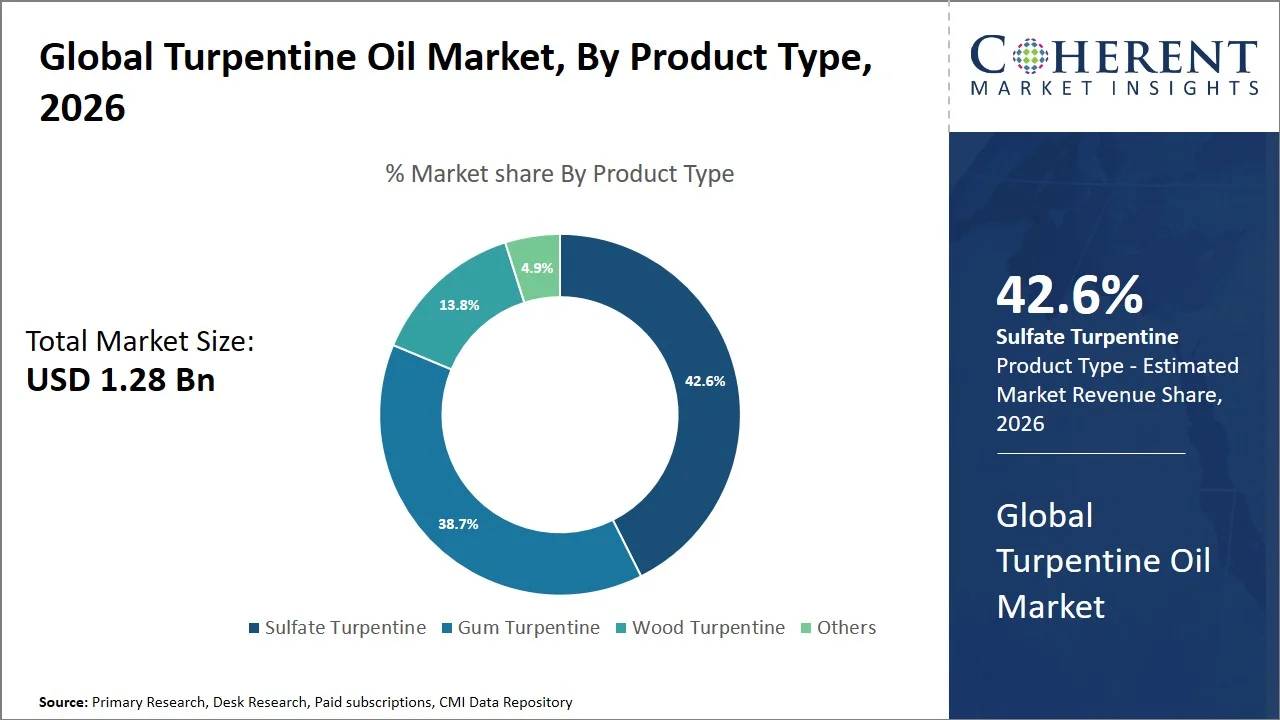
Why Does Sulfate Turpentine Dominate the Global Turpentine Oil Market?
Sulfate Turpentine is expected to account for 42.6% of the global turpentine oil market in 2026, leading the product-type category because its production is closely linked with kraft-pulp operations that recover turpentine as a commercially usable side stream. This integration improves raw-material efficiency, supports more predictable industrial-scale supply, and provides refiners with feedstock for fragrances, cleaning chemicals, resins, and terpene derivatives. Compared with wood turpentine, sulfate turpentine benefits from stronger mill-based collection and established bulk handling infrastructure, improving supply continuity for industrial buyers. In March 2025, Billerud stated that its North American pulp and paper mills sell turpentine recovered as a pulping-process byproduct to companies using it in perfumes, cleaning products, and other applications, demonstrating continued commercialization of pulp-derived turpentine streams.
- Current Industry Events of 2026
- Market Size Estimation
- Regional Breakdown
- Competitive Landscape
- Customer Intelligence
- Segmental Analysis
- Pricing Analysis
- Key Market Drivers, Challenges & Future Trends
- Customized Insights Section
Why Does Alpha Pinene Represent the Largest Derivative Type in the Global Turpentine Oil Market?
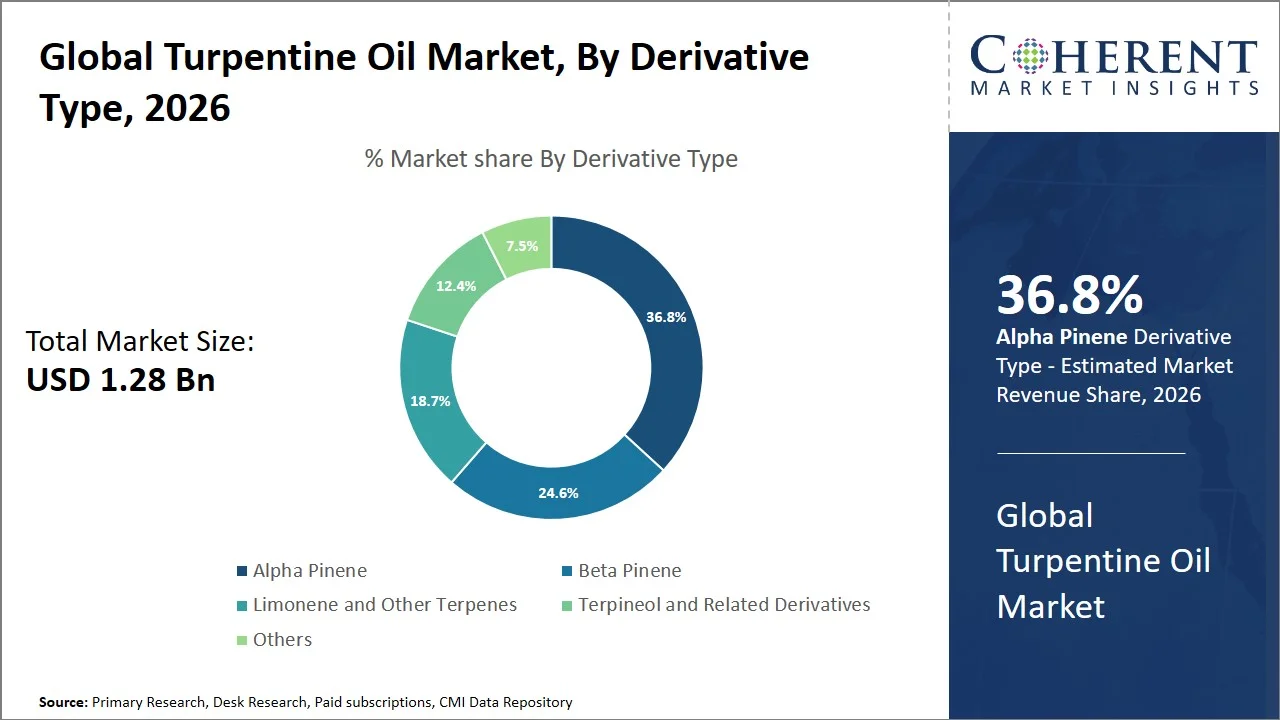
Alpha Pinene is expected to represent 36.8% of the global turpentine oil market in 2026, making it the largest derivative type because it sits at the center of multiple downstream pine-chemistry conversion routes. Producers use pinene-rich feedstock to manufacture camphor, isoborneol, terpineol, fragrance intermediates, resins, and other specialty chemicals, enabling refiners to diversify revenue across several end-use industries. Its commercial importance also encourages investment in fractionation, purification, and intermediate recovery rather than sale of crude turpentine alone. In May 2024, Mangalam Organics filed an investor presentation with the National Stock Exchange of India showing turpentine as its principal raw material for camphor production and mapping gum turpentine through pinene into camphene, isoborneol, camphor, and other value-added intermediates, illustrating pinene’s central role in integrated terpene manufacturing.
Why Do Paints, Coatings and Solvents Dominate the Application Segment of the Global Turpentine Oil Market?
Paints, Coatings and Solvents are expected to hold 32.8% of the global turpentine oil market in 2026 because terpene chemistry provides solvency, dilution, resin compatibility, cleaning performance, and formulation flexibility across industrial processing applications. Established use of terpene-based solvents in inks, coating-related materials, cleaning systems, and specialty formulations supports recurring procurement from chemical formulators and industrial users. Suppliers also benefit from mature handling, blending, and distribution infrastructure for solvent products, lowering commercialization barriers compared with newer niche applications. In April 2025, Nippon Terpene Chemicals announced its participation in JPCA Show 2025 together with an official seminar on terpene-based solvents for electronics manufacturing. The company also identifies terpene solvents among products used in painting and printing-ink applications, supporting the continued industrial relevance of terpene-based solvent systems.
Current Events and their Impact
Current Event | Description and Business Impact |
Council of the European Union – June 2025: Updated Autonomous Tariff Quota Framework Covering Sulphate Turpentine |
|
European Chemicals Agency – May 2025: REACH Dossier-Evaluation Follow-Up for Turpentine Oil |
|
European Parliament and Council – November 2024: New Construction Products Regulation Adopted |
|
Global Turpentine Oil Market Dynamics
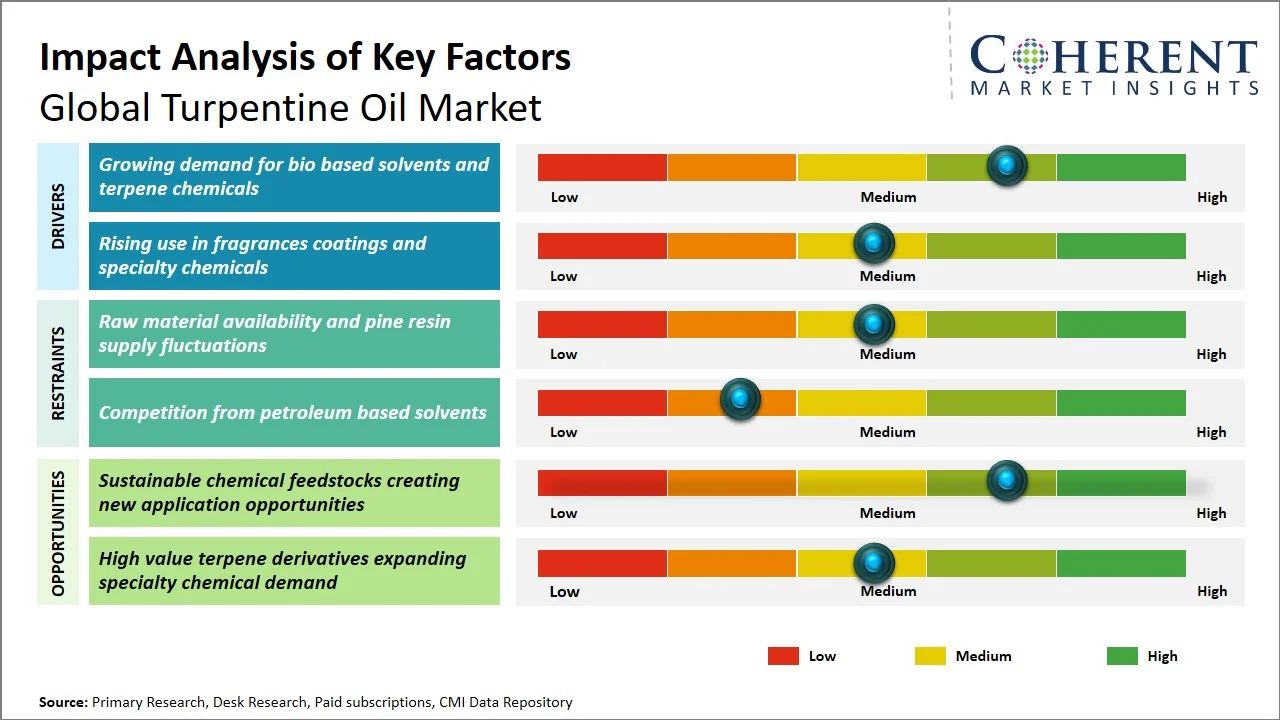
Key Market Drivers
Growing Demand for Bio-Based Solvents and Terpene Chemicals
Turpentine oil is gaining commercial relevance as formulators seek renewable carbon sources capable of replacing part of their fossil-derived solvent and chemical feedstock requirements. Crude sulphate turpentine is particularly attractive because it is recovered alongside kraft pulp production, allowing producers to monetize an existing process stream while supplying refiners with terpene-rich feedstock. This supports circular manufacturing, downstream fractionation investment, and differentiated sourcing strategies. In May 2025, Metsä Fibre reported that global demand for crude turpentine exceeds supply and highlighted its role as a renewable input for multiple specialty applications.
Rising Use in Fragrances, Coatings and Specialty Chemicals
Turpentine is increasingly valuable as an intermediate rather than only a conventional thinner, as alpha-pinene, beta-pinene, and downstream terpene molecules provide functionality across fragrances, specialty formulations, coatings, and personal-care ingredients. This broadens purchasing interest from chemical formulators and aroma-ingredient manufacturers while supporting investment in fractionation, purification, and higher-value conversion processes. In February 2026, dsm-firmenich published its 2025 Integrated Annual Report highlighting Firsantol, a perfumery ingredient manufactured from upcycled turpentine, demonstrating commercial conversion of pine-derived feedstock into differentiated fragrance chemistry.
Emerging Market Trends
Shift from Crude Turpentine Trading Toward Fractionated Terpene Portfolios
Producers are progressively moving value creation downstream by separating crude turpentine into purer terpene fractions and converting these streams into application-specific intermediates. This changes manufacturing priorities from basic recovery and bulk trading toward yield optimization, specification control, purification, and derivative chemistry. Buyers increasingly evaluate suppliers on terpene consistency and suitability for subsequent synthesis rather than crude volume alone. The transition also encourages longer technical qualification cycles and closer supplier-formulator collaboration, creating stronger competitive positions for manufacturers capable of supplying both feedstock and specialized downstream fractions.
Traceability Is Becoming a Procurement Requirement for Pine-Derived Feedstocks
Turpentine procurement is moving toward greater scrutiny of forest origin, processing chain visibility, renewable-content claims, environmental management, and material traceability. This transition is particularly relevant where downstream customers use pine-derived chemistry to support sustainability objectives or product-level environmental declarations. Producers therefore need stronger chain-of-custody documentation, supplier qualification systems, and auditable sourcing practices. Distribution models are also changing as customers prefer counterparties capable of demonstrating reliable origin information alongside technical specifications, making traceability increasingly important to supplier qualification, premium positioning, and long-term purchasing relationships.
Regional Insights
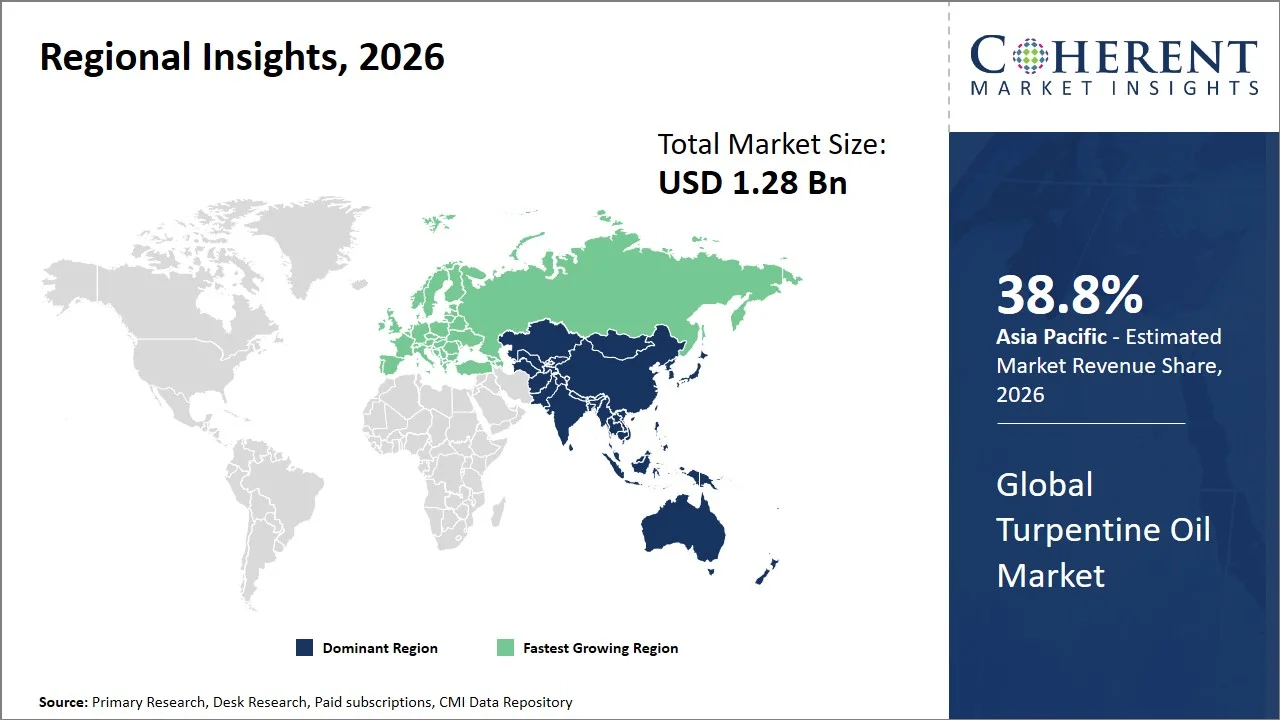
Why Does Asia Pacific Dominate the Global Turpentine Oil Market?
Asia Pacific is expected to account for 38.8% of the global turpentine oil market in 2026, supported by its combination of pine-rich forestry resources, established gum-turpentine processing, and large downstream manufacturing bases for camphor, aroma chemicals, coatings, adhesives, and specialty solvents. China and India provide substantial conversion capacity, while Southeast Asian producers strengthen regional feedstock availability and export supply. The region also benefits from integrated resin collection, distillation, and terpene-derivative manufacturing, helping processors capture value beyond crude turpentine. In April 2026, the Fujian Provincial Forestry Bureau stated that the province would support upgrades in rosin and turpentine processing, promote industrial clustering, and encourage adoption of new catalysts, processes, and equipment. This policy direction reinforces Asia Pacific’s advantage in both raw-material availability and downstream pine-chemical upgrading.
Why Is Europe Emerging as the Fastest-Growing Region in the Global Turpentine Oil Market?
Europe is expected to hold 24.7% of the global turpentine oil market in 2026 and emerge as the fastest-growing region, supported by the region’s established kraft-pulp industry and growing commercial emphasis on renewable, forest-derived chemical feedstocks. European processors can recover crude sulfate turpentine from softwood pulping and channel it into fragrances, solvents, adhesives, resins, coatings, and other specialty chemicals. Strong sustainability requirements and sophisticated downstream formulation industries further encourage the utilization of traceable bio-based inputs in place of selected fossil-derived materials. In February 2026, Stora Enso published its 2025 Annual Report, identifying turpentine among its commercial products and reporting that biological materials represented the overwhelming majority of its resource inflows. This demonstrates continued industrial integration of renewable forest-based chemical streams within Europe’s manufacturing ecosystem.
Global Turpentine Oil Market Outlook for Key Countries
Why Is the U.S. a Key Market for the Global Turpentine Oil Market?
The U.S. is strategically important to the global turpentine oil market because its southeastern pine belt, kraft pulp and paper infrastructure, and specialty chemical industry connect crude sulfate turpentine recovery with downstream terpene conversion. Domestic processors transform alpha-pinene and beta-pinene into ingredients used in fragrances, household care, personal care, coatings, adhesives, and other formulated products, extending the turpentine oil market well beyond traditional solvent consumption. Established refining and application-development capabilities also support stable relationships between pulp mills and specialty ingredient producers. In March 2025, Symrise published its 2024 Corporate Report confirming that renewable fragrance and flavor ingredients based on crude sulfate turpentine and gum turpentine are produced at its Jacksonville, Florida, and Colonels Island, Georgia, facilities. This demonstrates the U.S. industry's capacity to convert pulp-production side streams into higher-value aroma molecules.
Why Is India Important in the Global Turpentine Oil Market?
India is important in the global turpentine oil market because domestic demand extends from paints and varnishes to camphor, fragrances, pharmaceuticals, household products, and specialty terpene chemicals. Pine-resin availability in northern hill states provides a domestic raw-material pathway, while India’s established aroma-chemical and camphor manufacturing base creates downstream demand for alpha-pinene and other turpentine fractions. Cost-competitive chemical processing and a large formulation industry allow manufacturers to utilize both domestic and imported feedstocks. In July 2025, Oriental Aromatics published its 2024–25 annual disclosures identifying itself as a leading producer of camphor and terpene chemicals and explaining that camphor can be derived from alpha-pinene obtained from turpentine. This illustrates India’s capability to move turpentine-derived raw materials further along the value chain into higher-value products serving diverse industrial customers.
Why Does China Support Growth in the Global Turpentine Oil Market?
China supports growth in the global turpentine oil market through its combination of pine-resin processing, large-scale forest-chemical manufacturing, and extensive downstream consumption of terpene derivatives. Domestic producers serve coatings, adhesives, fragrance ingredients, synthetic camphor, terpene resins, and other specialty chemical applications, allowing turpentine to pass through several value-added conversion stages before reaching end users. Industrial clustering also supports integration between resin collection, distillation, purification, and derivative production. In March 2025, the Ganzhou Administrative Approval Bureau approved the environmental assessment for Anyuan Songyuan Forestry Chemical’s technical renovation project covering annual production of 3,000 tonnes of rosin and 600 tonnes of turpentine. The approval demonstrates continued investment in compliant pine-chemical processing capacity and reinforces China’s commercial position as both a turpentine supply base and a major downstream conversion center.
Why Is Germany a Strategic Country in the Global Turpentine Oil Market?
Germany is strategically relevant to the global turpentine oil market because its specialty chemicals, fragrances, coatings, engineered wood, and process-technology industries create commercial pathways for turpentine beyond conventional solvent applications. German manufacturing places considerable emphasis on emissions control, resource efficiency, circular processing, and product safety, encouraging recovery of useful terpene streams that might otherwise be treated as emissions or process losses. In December 2025, Berlin University of Applied Sciences and Technology documented the MDF-Turpentine project at Fiberboard GmbH in Baruth. The European Commission’s INCITE platform indicates that the full recovery stage is scheduled for industrial operation in late 2026, with capacity of up to 1,200 tonnes of turpentine annually. This demonstrates how environmental process improvement can simultaneously create an additional marketable chemical stream.
Why Is Brazil an Important Growth Market for the Global Turpentine Oil Market?
Brazil is an important growth market for turpentine oil because extensive commercial pine plantations, an established resin-tapping industry, and export-oriented forest-product activity provide a strong feedstock platform for gum turpentine production. Domestic processors serve paints, varnishes, cosmetics, pharmaceuticals, adhesives, and other chemical formulations, while international demand provides an additional route for monetizing pine-resin derivatives. Brazil’s competitive position therefore depends heavily on plantation productivity, tapping efficiency, resin quality, logistics, and sustainable forest-management credentials. In July 2025, the Brazilian Resin Tappers Association (ARESB) reported an active domestic resin market and identified China and India as major buyers of Brazilian resin derivatives, including turpentine. These trade links connect Brazil directly with two major Asian pine-chemical processing markets and strengthen its role as an internationally relevant gum-turpentine supply base.
Feedstock, Production & Circular Pine-Chemicals Landscape
Category | Current Status / Adoption Level | Key Application or Impact | Business Implication |
Kraft-Pulp Turpentine Recovery | Commercially established and integrated into suitable softwood kraft-pulp operations | Captures crude sulphate turpentine from pulping side streams for subsequent refining | Enables pulp producers to monetize secondary process streams and provides scalable renewable chemical feedstock |
Gum Turpentine Production | Established in major pine-resin producing economies but dependent on tapping economics and labor availability | Supplies terpene-rich material obtained from pine oleoresin | Producers with secure plantation and tapping networks gain stronger control over feedstock quality and availability |
Fractional Distillation | Core refining capability across organized terpene producers | Separates crude turpentine into alpha-pinene, beta-pinene and other terpene fractions | Separation efficiency and purity directly influence downstream product economics and customer qualification |
Derivative Conversion | Increasingly important for integrated specialty-chemical producers | Converts terpene fractions into aroma intermediates, pine oils, terpineols and other functional chemicals | Moves suppliers away from commodity exposure and creates higher-value customer relationships |
Traceable Renewable Sourcing | Moving from sustainability differentiation toward procurement qualification | Supports renewable-content claims, responsible forestry positioning and customer supply-chain audits | Strong traceability systems can improve access to multinational fragrance, personal-care and specialty-chemical customers |
Hazard, Storage & Transportation Management | Mature but commercially critical due to flammability and chemical-handling requirements | Governs bulk storage, packaging, transport, workplace handling and customer acceptance | Safe logistics infrastructure and regulatory competence reduce disruption risk and improve reliability for international buyers |
How Can High-Purity Terpene Fractionation Create New Growth Opportunities in the Global Turpentine Oil Market?
The strongest value-creation opportunity lies in upgrading crude turpentine into tightly specified terpene fractions and application-ready intermediates rather than competing primarily in bulk feedstock supply. Fragrance houses, pharmaceutical formulators, specialty chemical companies, coating manufacturers, and personal-care ingredient suppliers increasingly require consistent purity, odor profile, reactivity, color, and impurity control. Capturing this opportunity requires advanced distillation, analytical testing, process control, product-development capability, and technical sales support. Producers must also secure stable crude feedstock because derivative economics deteriorate when terpene composition or input availability changes sharply. Entry barriers therefore extend beyond plant investment to sourcing relationships, chemical-processing expertise, customer qualification, safety management, and regulatory documentation. Integrated suppliers capable of connecting renewable feedstock procurement with purification and derivative development can diversify revenue streams, reduce exposure to commodity pricing cycles, and build longer-duration relationships with formulation-driven customers.
Market Players, Key Development, and Competitive Intelligence
Key Developments
- In December 2025, Perum Perhutani announced a new contract transaction channel for gum rosin, turpentine, and pine-derived products, effective January 2026 and designed for regular, large-volume procurement. The model improves purchasing visibility for industrial customers and creates a more structured route to secure Indonesian turpentine feedstock under recurring supply arrangements.
- In February 2025, Harima Chemicals Group announced ISCC PLUS and ISCC EU certifications covering its biomass-based pine-chemical supply chain. Harima specifically identifies turpentine among its core pine-derived raw materials. The certification strengthens traceability and sustainability assurance, supporting customer qualification where renewable feedstock origin and auditable supply-chain management influence chemical procurement decisions.
- In April 2024, Nordmann expanded its partnership with Kraton Corporation to distribute Kraton's pine chemicals and specialty-resin portfolio across a wider group of European countries. The expanded portfolio includes terpene-based products for coatings and adhesives and strengthens downstream availability of products linked to crude sulphate turpentine processing in European industrial channels.
Competitive Landscape
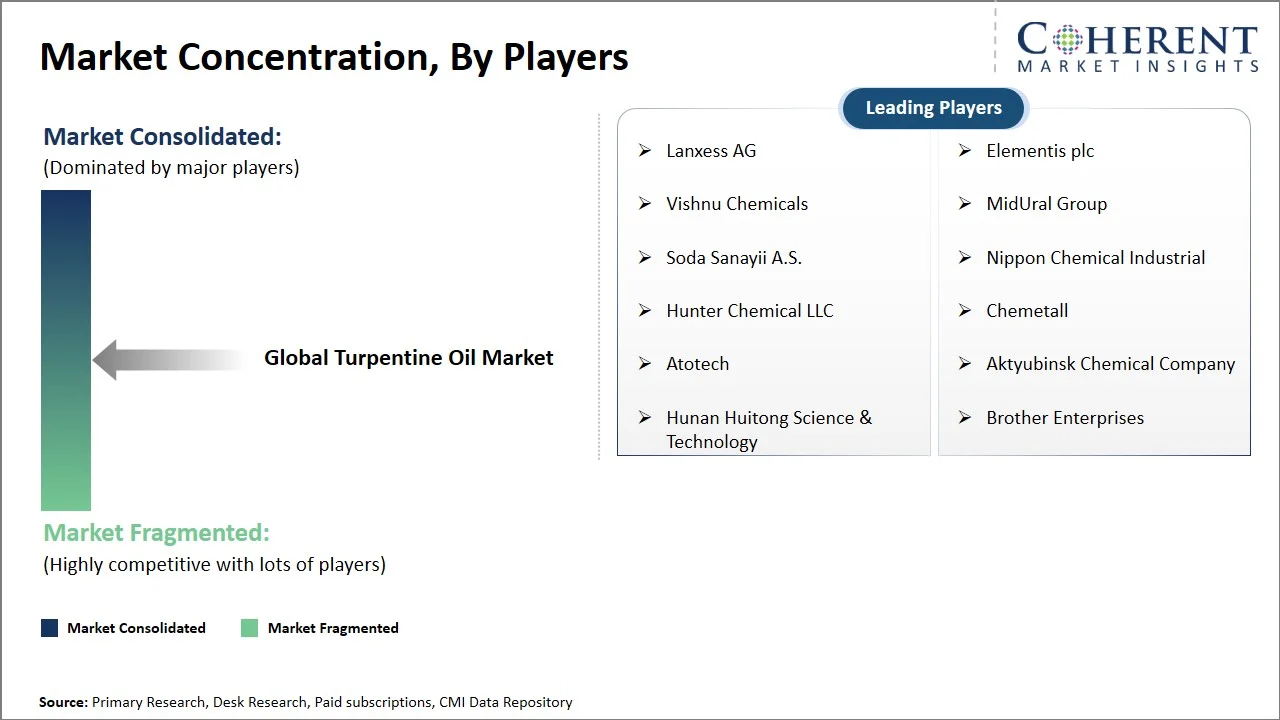
The global turpentine oil market is moderately fragmented, combining integrated pine-chemical groups, pulp-industry by-product suppliers, gum-turpentine producers, regional distillers, terpene refiners, and specialty aroma-chemical manufacturers. Competition increasingly extends beyond bulk price toward feedstock security, fractionation yield, chemical purity, supply consistency, application support, regulatory documentation, and renewable sourcing credentials. Integrated participants generally possess stronger protection against volatile feedstock availability and changing customer specifications.
Key focus areas include
- Feedstock security and long-term sourcing arrangements
- Alpha- and beta-pinene recovery efficiency
- Purity, odor profile and consistency of refined grades
- Manufacturing cost and distillation yield optimization
- Storage, hazardous-material handling and logistics reliability
- Technical support for formulation and derivative conversion
- Regulatory documentation and customer qualification capability
- Ability to supply both bulk turpentine and higher-value derivatives
Market Report Scope
Turpentine Oil Market Report Coverage
| Report Coverage | Details | ||
|---|---|---|---|
| Base Year: | 2025 | Market Size in 2026: | USD 1.28 Bn |
| Historical Data for: | 2020 To 2024 | Forecast Period: | 2026 To 2033 |
| Forecast Period 2026 to 2033 CAGR: | 5.40% | 2033 Value Projection: | USD 1.85 Bn |
| Geographies covered: |
| ||
| Segments covered: |
| ||
| Companies covered: | Lanxess AG, Elementis plc, Vishnu Chemicals, MidUral Group, Soda Sanayii A.S., Nippon Chemical Industrial, Hunter Chemical LLC, Chemetall, Atotech, Aktyubinsk Chemical Company, Hunan Huitong Science & Technology, Brother Enterprises | ||
| Growth Drivers: |
| ||
| Restraints & Challenges: |
| ||
Analyst Opinion (Expert Onion)
- The global turpentine oil market is likely to evolve from a feedstock-oriented structure toward a more integrated pine-chemicals value chain. Competitive leadership will increasingly depend on securing reliable crude material and converting it into tightly controlled fractions and functional intermediates. Companies that combine procurement strength, refining expertise, analytical quality control, application development, and customer-specific formulation support should be better positioned than suppliers whose business model remains concentrated on undifferentiated bulk turpentine.
- The most important structural transition is the movement from viewing turpentine as a conventional solvent toward treating it as a renewable molecular platform. This favors refiners, fragrance-ingredient manufacturers, specialty-chemical processors, and integrated pine-chemical producers capable of extracting more value from individual terpene streams. Commodity-only suppliers face greater pressure because buyers can increasingly distinguish suppliers by derivative capability, traceability, consistency, and technical performance rather than relying mainly on availability and transaction price.
- Investment priorities should center on feedstock diversification, fractionation efficiency, high-purity derivative capability, analytical laboratories, safe bulk logistics, and stronger regulatory documentation. The main strategic risks remain fluctuations in pine-resin availability, dependence on pulp-industry operating rates, variation in crude terpene composition, hazardous-material handling requirements, and substitution in conventional solvent applications. Producers should therefore balance bulk-market exposure with higher-value downstream applications while maintaining flexible sourcing across both kraft-pulp and gum-turpentine supply chains.
Speak to the analyst
Want personalized insights?
Take the findings above to one of our principal consultants, or have the report rebuilt around the segments, geographies and competitors you actually track.
Market Segmentation
- Product Type Insights (Revenue, USD Bn, 2021 - 2033)
- Sulfate Turpentine
- Gum Turpentine
- Wood Turpentine
- Others
- Derivative Type Insights (Revenue, USD Bn, 2021 - 2033)
- Alpha Pinene
- Beta Pinene
- Limonene and Other Terpenes
- Terpineol and Related Derivatives
- Others
- Application Insights (Revenue, USD Bn, 2021 - 2033)
- Paints Coatings and Solvents
- Fragrances and Flavors
- Adhesives and Sealants
- Pharmaceuticals and Personal Care
- Rubber and Chemical Processing
- Others
- Distribution Channel Insights (Revenue, USD Bn, 2021 - 2033)
- Direct Sales
- Indirect Sales
- Regional Insights (Revenue, USD Bn, 2021 - 2033)
- North America
- U.S.
- Canada
- Latin America
- Brazil
- Argentina
- Mexico
- Rest of Latin America
- Europe
- Germany
- U.K.
- Spain
- France
- Italy
- Russia
- Rest of Europe
- Asia Pacific
- China
- India
- Japan
- Australia
- South Korea
- ASEAN
- Rest of Asia Pacific
- Middle East
- GCC Countries
- Israel
- Rest of Middle East
- Africa
- South Africa
- North Africa
- Central Africa
- North America
Sources
Primary Research Interviews
- Turpentine oil producers, pine-chemical manufacturers, kraft pulp mills, resin processors, distributors, traders, and specialty chemical suppliers
- Procurement managers, formulation specialists, chemical engineers, forestry experts, and industry consultants
Stakeholders
- Sulfate, gum, and wood turpentine producers
- Alpha-pinene, beta-pinene, terpineol, camphor, and terpene-derivative manufacturers
- Paint, coating, adhesive, fragrance, pharmaceutical, and personal-care companies
- Chemical distributors, importers, exporters, and forestry companies
End-use Sectors
- Paints, coatings, and solvents
- Fragrances and flavors
- Adhesives and sealants
- Pharmaceuticals and personal care
- Rubber and specialty chemical processing
Regulatory and Industry Bodies
- European Chemicals Agency (ECHA)
- European Commission
- U.S. Environmental Protection Agency (EPA)
- U.S. Occupational Safety and Health Administration (OSHA)
- National forestry, chemical safety, and environmental authorities
Databases
- UN Comtrade and ITC Trade Map
- Eurostat and national customs databases
- Government forestry and chemical production databases
- Company annual reports, sustainability reports, and investor presentations
- Chemical trade and pine-resin industry databases
Magazines and Journals
- Industrial Crops and Products
- European Polymer Journal
- Journal of Cleaner Production
- Progress in Organic Coatings
- Forest Products Journal
Associations
- Pine Chemicals Association International
- European Chemical Industry Council (Cefic)
- American Forest & Paper Association
- Confederation of European Paper Industries (Cepi)
- National pine resin and forestry associations
Public Domain Sources
- Pine resin and turpentine production publications
- Kraft pulp and biochemical industry reports
- Turpentine derivative and application developments
- Government trade, forestry, environmental, and chemical-safety publications
Key Standards and Regulations
- REACH chemical registration and substance-safety requirements
- GHS classification and Safety Data Sheet requirements
- VOC and solvent-emission regulations
- Hazardous-material storage and transportation requirements
- Sustainable forestry and chain-of-custody certifications
Proprietary Elements
- CMI Data Analytics Tool
- Proprietary CMI Existing Repository of information for the last 10 years
Get access to 250+ pages report
Every segment, forecast, competitor profile and data table behind the analysis above — available for instant download.
- ESOMAR Member
- ISO 9001:2015 Certified
- D-U-N-S Registered
- GDPR & CCPA Compliant
Missing comfort of reading report in your local language? Find your preferred language:
Frequently Asked Questions
The CAGR of global turpentine oil market is projected to be 5.40% from 2026 to 2033.
The global turpentine oil market is estimated to be valued at USD 1.28 Bn in 2026 and is expected to reach USD 1.85 Bn by 2033
Turpentine oil is widely used in paints and coatings, solvents, fragrances and flavors, adhesives, pharmaceuticals, personal care products, and specialty chemical manufacturing.
Turpentine oil is primarily obtained from pine resin, kraft pulping processes, and wood distillation, depending on the production method and regional feedstock availability.
Major buyers include paint and coating manufacturers, fragrance and aroma chemical companies, adhesive producers, pharmaceutical companies, personal care manufacturers, and specialty chemical processors.
Turpentine oil pricing is influenced by pine resin availability, pulp industry production levels, feedstock quality, processing and distillation costs, transportation expenses, derivative demand, and regional supply-demand conditions.
Growing demand for bio based solvents and terpene chemicals and rising use in fragrances coatings and specialty chemicals are the major factors driving the growth of global turpentine oil market.