

Global Venture Capital Market Size and Forecast – 2026 To 2033
The global venture capital market is expected to reach USD 1,477.8 Bn by 2033, expanding at a compound annual growth rate (CAGR) of 8.2% from 2026 to 2033. The market was estimated at USD 851.2 Bn in 2026. The market is growing due to the sustained funding requirements in artificial intelligence, biotechnology, fintech and enterprise software, the growing participation of institutional investors and the growing capital commitments to technology startups.
Venture capital companies are also developing their investment capabilities to support startups from the early development stage to commercial growth. Insight Partners said in January 2025 it had closed on USD 12.5 billion of funds, including its flagship Fund XIII and Opportunities Fund II, to fund software companies globally. That’s a reflection of the ongoing institutional appetite for venture investments in tech and the availability of capital to grow new businesses.
Key Takeaways of the Global Venture Capital Market
- Late Stage (Series C and Beyond) is projected to hold 58.2% of the global venture capital market in 2026 and grow at an estimated CAGR of 8.7% over the forecast period 2026-2033. For larger investments, investors tend to look for proven customer traction and clearer scaling economics. In October 2025, ŌURA raised over USD 900 million in financing to expand its global distribution and preventive health platform.
- IT, AI and software investments are expected to grow at a compound annual growth rate (CAGR) of 10.4% through 2033 with a global venture capital market share of 56.8% in 2026. Capital is flowing to software platforms due to recurring enterprise revenues and developer ecosystems enabling international expansion and scalable business models. In March 2026 OpenAI raised $122 billion in funding to scale up AI computing infrastructure and commercial deployment.
- Venture Capital Firms are expected to account for 62.3% of total investment in the global venture capital market and are expected to register an estimated compound annual growth rate (CAGR) of 8.1% through 2033. Dedicated managers are more adept at sourcing deals, building diversified portfolios and arranging follow-on funding.
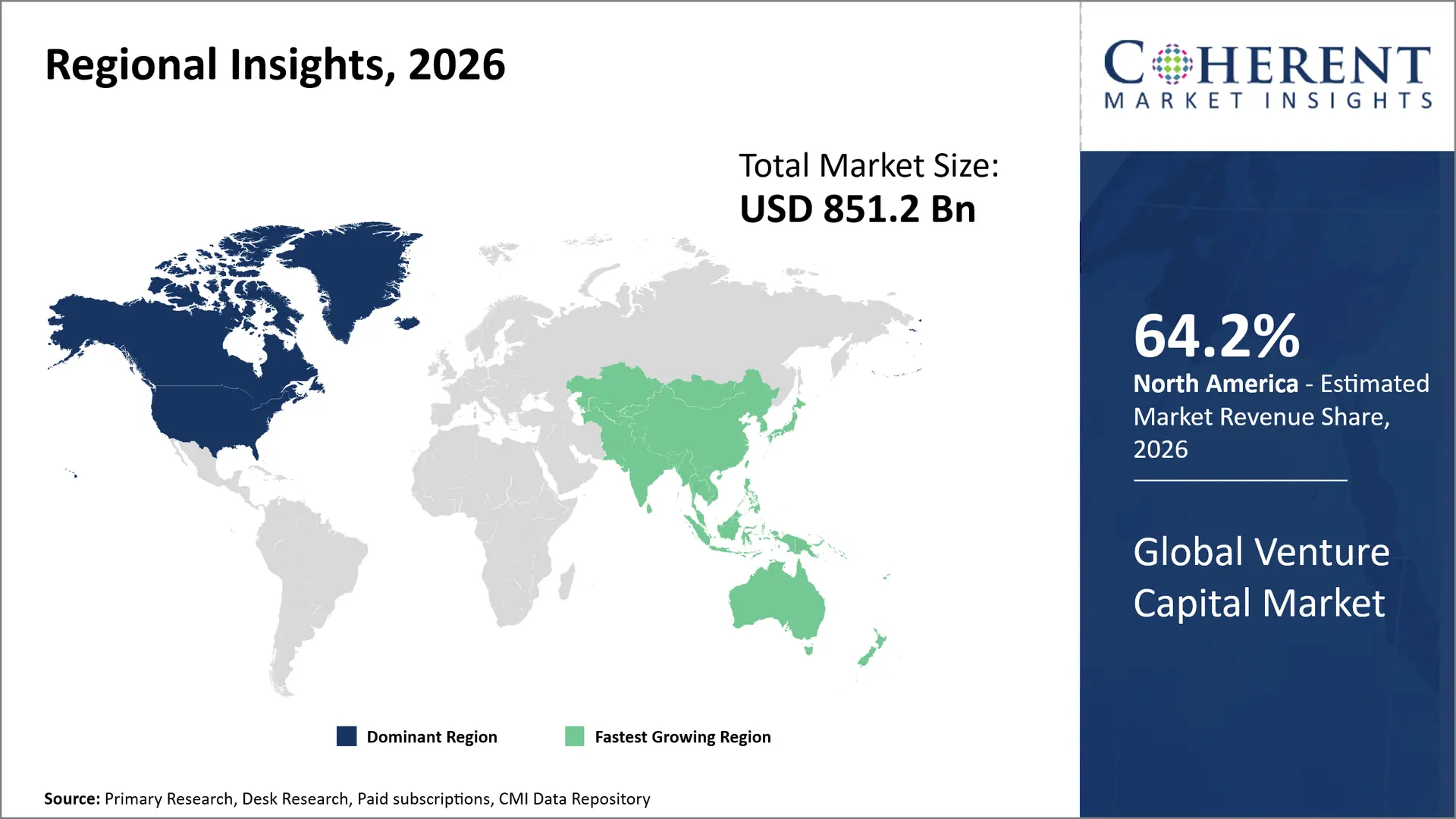
- North America is anticipated to hold 64.2% of the global venture capital market by 2026 and is expected to grow at a compound annual growth rate (CAGR) of 7.3% between 2023 and 2033. It’s leadership shows the presence of mature exit markets, experienced founders, university research commercialization and concentrated institutional funding. In April 2026, the National Venture Capital Association reported that U.S. venture firms closed USD 320 billion in investment deals in 2025.
- The Asia Pacific region is projected to grow at an estimated 11.5% CAGR through 2033, accounting for 17.0% share of the global venture capital market in 2026. Investment could speed up beyond the usual startup hubs by expanding domestic pools of funding and ecosystems of technology manufacturing. In April 2026, India announced a USD 105.34 million Startup India Fund of Funds 2.0 to facilitate venture financing.
Segmental Insights
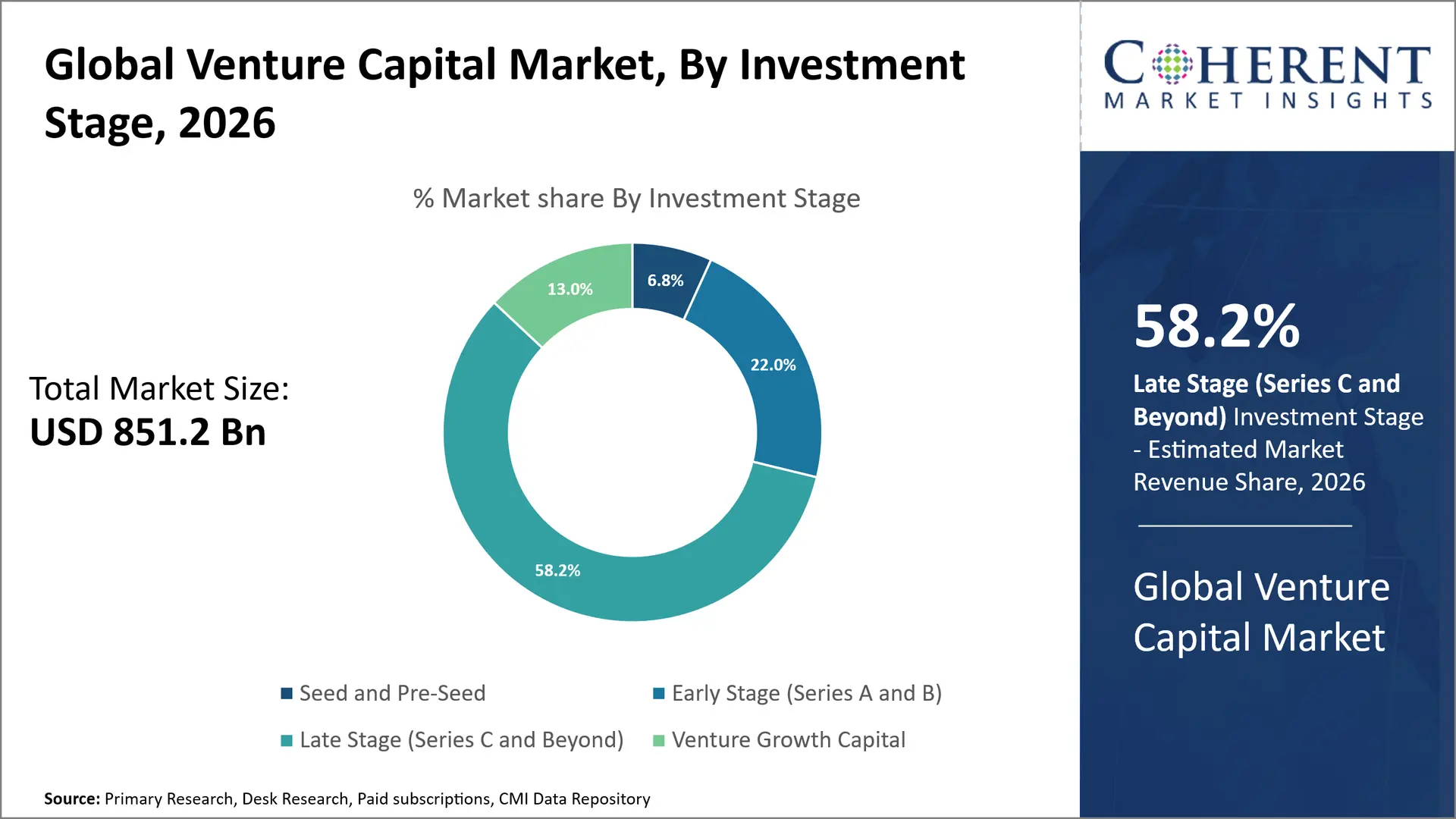
Why Does Late Stage (Series C and Beyond) Dominate the Global Venture Capital Market?
Late Stage (Series C and beyond) is expected to account for 58.2% of the global venture capital market in 2026 as the capital required to transform proven technology into repeatable commercial capacity often exceeds that of earlier funding rounds. Here investors can review customer contracts, construction milestones, supply agreements and technical performance, instead of relying largely on prototype projections. Industrial technology, advanced manufacturing and clean-energy infrastructure are especially in need of large financing packages, as they require initial investment followed by steady operating cash flows. The supply side features dedicated engineering teams and staged project schedules so investors can gage deployment risk and the timing of further investments. In December 2025, Fervo Energy closed a USD 462 million Series E round to advance construction of its Cape Station geothermal development and prepare additional projects. The transaction illustrates how late-stage equity bridges validated technology and large-scale commercialization.
- Current Industry Events of 2026
- Market Size Estimation
- Regional Breakdown
- Competitive Landscape
- Customer Intelligence
- Segmental Analysis
- Pricing Analysis
- Key Market Drivers, Challenges & Future Trends
- Customized Insights Section
Why Do IT, AI and Software Represent the Largest Industry Segment in the Global Venture Capital Market?
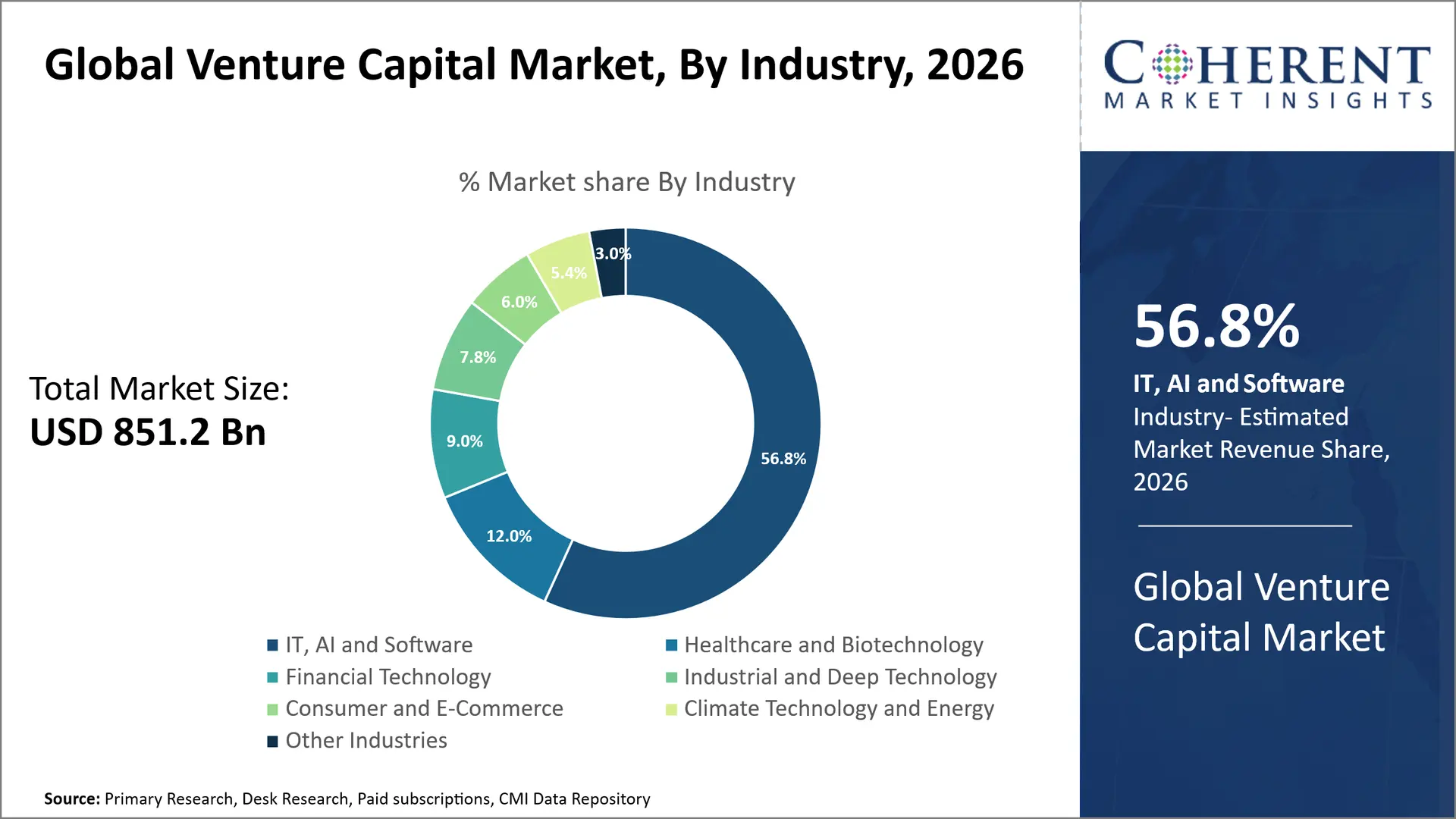
IT, AI and software is expected to account for 56.8% of the global venture capital market in 2026, reflecting the commercial appeal of programmable services used across customer support, publishing, education and media. Cloud delivery and application programming interfaces allow software vendors to connect to existing business systems without having to create large physical distribution networks. That enables investors to see deployment velocity, usage-based revenue and the migration from pilot projects to paying customer workloads. Businesses that need automated customer interaction, accessible interfaces and multilingual content generation benefit greatly from specialized speech technologies. In January 2025, ElevenLabs raised USD 180 million in Series C financing to advance its AI audio technology and expand offerings for developers and enterprises. This funding illustrates investor interest in reusable software capabilities that address several business functions through a common technical platform.
Why Do Venture Capital Firms Dominate the Investor Type Segment of the Global Venture Capital Market?
Venture capital firms are estimated to hold 62.3% of the global venture capital market by 2026. This is because partnerships that are professionally managed can invest without the product priorities of a corporate parent. They have investment committees that take into account ownership rights, have shareholder protections in place and allocate capital according to pre-set fund mandates. Managers can align the size of their investment and their risk appetite with the different stages of a company’s development through dedicated venture and growth vehicles. In July 2024 Index Ventures raised USD 2.3 billion of new capital to create a USD 800 million venture fund and a USD 1.5 billion growth fund. This structure illustrates how individual venture capital firms structure separate pools of capital based on startup financing requirements.
Current Events and their Impact
Current Event | Description and Its Impact |
October 2024 – U.S. Treasury Finalizes Outbound Investment Restrictions |
|
July 2024 – India Announces Abolition of Angel Tax |
|
Global Venture Capital Market Dynamics
Key Market Drivers
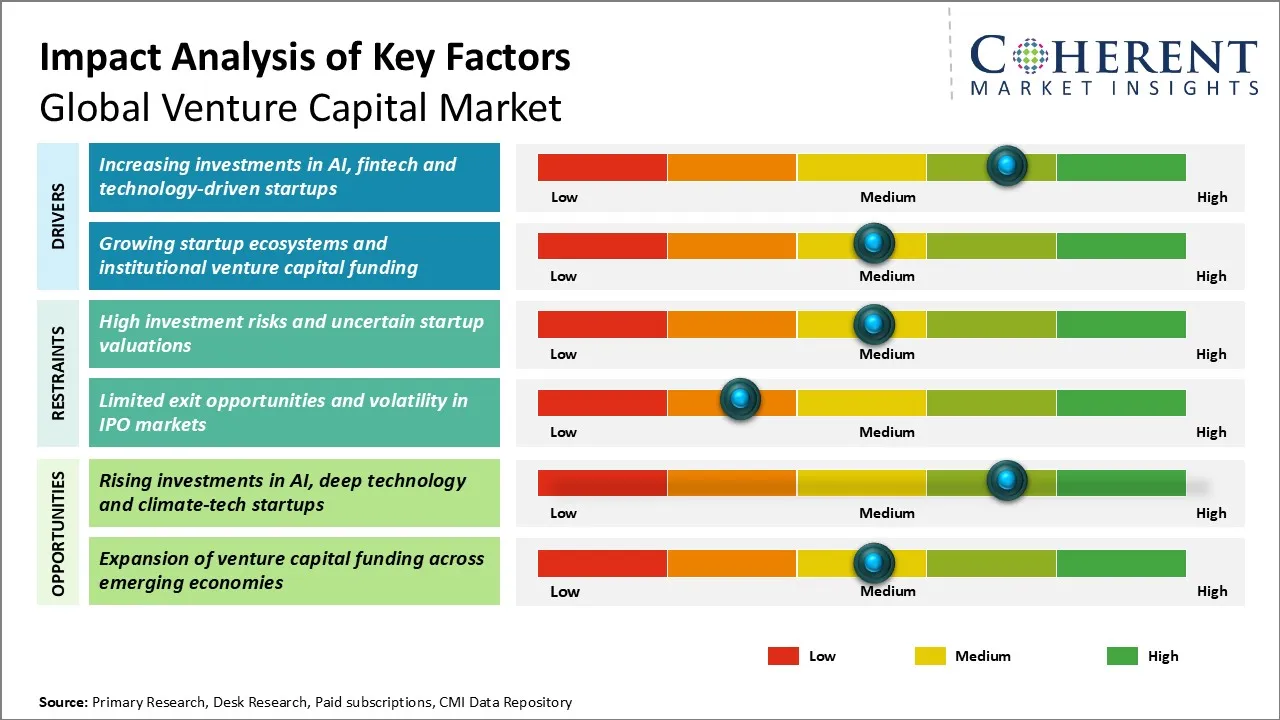
- Increasing investments in AI, fintech and technology-driven startups: Increased investment in AI, fintech and technology-driven startups is enabling more businesses to attract venture financing, particularly those that are turning advanced computing into paid enterprise workflows. The capital-intensive model development also offers opportunities for infrastructure providers, specialist software vendors and financial technology platforms. The commercial attraction for investors is scalable revenue opportunities. But substantial computing costs add to capital requirements and execution risks. In September 2025, Anthropic completed a USD 13 billion Series F financing to expand enterprise AI capacity, safety research, and international operations.
- Growing startup ecosystems and institutional venture capital funding: Access to financing outside of established technology centers is improving due to growing startup ecosystems and institutional venture capital funding. Commitments from pension funds, development finance institutions and sovereign investors can provide venture managers with the investment horizon to support companies through several funding rounds. Local investment teams benefit from increased fundraising capacity, and founders get access to professional governance and global networks. In February 2024, Partech closed its second Africa-focused fund at USD 314.75 million, attracting institutional investors and expanding its regional presence in Lagos.
Emerging Market Trends
- Expansion of Flexible Syndicated Investment Models: Venture syndication is evolving toward more flexible arrangements where lead investors coordinate specialist funds, corporate participants and smaller co-investment vehicles around well-defined financing needs. That changes the way fund managers build portfolios and set aside reserves, where relationships and executing transactions are as important as the size of the fund. Smaller specialists can take on transactions that would be too big for them otherwise and the founders may benefit from more specific expertise from investors. Disciplined syndicate governance and transparent allocation policies will become increasingly important to maintain investor confidence over the forecast period.
- Transition Toward Operationally Integrated Venture Capital Platforms: Venture managers are moving beyond periodic board oversight toward hands-on commercial support delivered through shared operating resources. Recruitment assistance, enterprise introductions, procurement expertise, and international market entry planning are becoming part of the relationship investors offer portfolio companies. This raises the cost of operating a credible venture platform but can strengthen founder retention and improve execution quality. Specialized funds without broad operating teams may respond by collaborating with external advisers. During the forecast period, measurable portfolio support outcomes are likely to influence which managers secure repeat commitments.
Regional Insights
Why Does North America Dominate the Global Venture Capital Market?
North America is expected to command 64.2% of the global venture capital market in 2026, reflecting its ability to connect private fund managers with institutional asset owners, established legal structures, and cross-border investment networks. Pension funds, endowments, and specialized limited partners provide multiple routes for raising venture capital, while U.S. and Canadian companies can access investors experienced in complex financing transactions. Regional depth also supports secondary sales and acquisitions that allow funds to return capital to investors. In November 2025, Canada's federal budget proposed CAD 1 billion over three years, beginning in 2026–27, for a new Venture and Growth Capital Catalyst Initiative managed by the Business Development Bank of Canada. By seeking additional pension fund and private investment commitments, the measure illustrates how institutional capital formation can reinforce North America's established venture ecosystem.
Why Is Asia Pacific Emerging as the Fastest-Growing Region in the Global Venture Capital Market?
Asia Pacific region is identified as the fastest-growing region and is projected to hold 17.0% share in the global venture capital market in 2026. Its growth potential is based on the ability to link real commercial needs and specific technologies in economies at different levels of development. Leading innovation centers can offer technical know-how, and new markets create opportunities in logistics, agriculture, clean energy, and inclusive financial services. The main investment hurdle is the transition from solutions at laboratory or pilot scale to commercially viable products. The Southeast Asia Emerging Entrepreneurs Kickstart program launched in July 2026 by the Asian Development Bank and Japan International Cooperation Agency provides market-entry assistance and seed financing up to USD 400,000. This initiative shows how technical assistance and risk capital can work together to overcome the challenges of commercialization for startups as they enter markets in Southeast Asia and the Pacific.
Global Venture Capital Market Outlook for Key Countries
Why Is the U.S. a Key Market for the Global Venture Capital Market?
The U.S. remains a critical component of the global venture capital ecosystem because it can support so many different strategies from scaling large private companies to developing their first products. Universities and research labs generate intellectual property. Scientific breakthroughs become companies that sell to government and enterprise customers through specialized venture partnerships. The nation has its own domestic customer base, giving founders the chance to test pricing, procurement, and sales models before taking on international markets. What makes it special is that you can have fund managers that can invest at various stages and you don’t necessarily have to list right away. In March 2026, Kleiner Perkins announced USD 3.5 billion in new vehicles, including a USD 1 billion early-stage fund and USD 2.5 billion in growth funds. This is an example of how U.S. investors create different pools of capital to match different financing needs and risk profiles.
Why Is India Important in the Global Venture Capital Market?
India has a huge domestic consumer base and digital public infrastructure, which makes it a major venture capital market and allows startups to build products for payments, financial distribution, commerce and business services. Founders are also filling operational gaps in domestic manufacturing, logistics and technology-enabled professional services, as well as in consumer internet companies. Investors can look for companies with knowledge of the local market and the potential to serve international customers, especially in enterprise software. But the variations in income levels and price sensitivity require careful testing of customer acquisition costs and repeat usage. Accel said it will start its eighth early-stage fund for India in January 2025, with $650 million set aside for startups in manufacturing, fintech, consumer businesses and artificial intelligence. The fund aims to extend its investment strategy from conventional consumer applications to encompass locally pertinent industrial and enterprise opportunities.
Why Does China Support Growth in the Global Venture Capital Market?
China's industrial clusters boost venture capital by connecting engineering talent, component suppliers, laboratories, and potential buyers. Venture investors can also support companies with identifiable technical development milestones in semiconductor equipment, advanced materials, biomedical technology and industrial automation. But international trade restrictions and long product qualification cycles could complicate cross-border financing and exits. Therefore, companies needing a significant amount of research and testing before commercialization must focus on domestic investment vehicles. In December 2025, China launched a national venture capital guidance fund, backed by the National Development and Reform Commission and the Ministry of Finance. Regional funds are assigned to key innovation corridors. Its mandate is patient capital and early-stage investment in strategic technologies that can improve the availability of financing for research-intensive startups.
Why Is Germany a Strategic Country in the Global Venture Capital Market?
The strategic importance is that Germany’s industrial research base creates investment opportunities that need technical validation, not fast consumer adoption, which is why it is a strategic player in the global venture capital market. Established manufacturers offer potential partners for testing and commercialization, while university spinouts and engineering-led startups can benefit from their expertise in automotive, semiconductor, chemical and medical technology. However, when prototypes require extensive qualification and production readiness, financing remains a challenge, highlighting the significance of public-private co-investment and specialist venture investors. German semiconductor developer FMC has raised some USD 112.04 million in a Series C financing round to commercialize advanced memory technologies, including USD 86.27million in equity and USD 25.77million in public funds, in November 2025. The deal underscores the ability of Germany’s industrial knowhow to attract venture investments into hardware companies geared to global technology supply chains.
Why Is Brazil an Important Growth Market for the Global Venture Capital Market?
Brazil is a key player in the global venture capital market because startups can address gaps in access to finance, agricultural productivity, business digitization, and service delivery in a large domestic economy. Its agricultural and industrial customers offer opportunities for locally developed software, monitoring tools and operational technologies with measurable cost savings. But early stage founders often find it difficult to make the transition from grant-funded innovation to commercially funded growth, especially when investors are looking for proof of recurring revenue. In June 2026, Brazil’s development bank BNDES and innovation agency Finep launched a public call to select a manager for the FIP Conexões Startups investment fund, with the goal of connecting institutional investors with startups already supported by public innovation and acceleration programs. This can increase investment readiness and provide a structured pathway to private venture capital.
Digital Transformation and Investment Platform Evolution Landscape in the Global Venture Capital Market
Technology | Application in Venture Capital | Adoption Landscape | Commercial Impact |
AI-Powered Deal Sourcing | Identifies investment opportunities with startup activity, hiring trends, patent applications and company information. | More take-up from digitally-enabled venture managers. | Expands investment pipelines and decreases dependence on traditional referral networks. |
Natural Language Processing (NLP) | Reviews financial documents, legal documents, investment materials and due diligence materials. | Deeper integration with investment research and document workflows. | Lowers manual review loads and enables faster initial investment screening. |
Predictive Investment Analytics | It models portfolio returns, funding requirements, valuation scenarios and possible investment risks. | Chosen by certain data-heavy investment houses. | It helps in reserve planning and portfolio construction and leads to more consistent investment decisions. |
Digital Cap Table Management | Keeps track of ownership structures, equity dilution, stock options, and financing rounds. | Based in technology-focused startup and venture ecosystems. | It improves the accuracy of transactions and builds greater transparency between founders and investors. |
Cloud-Based Fund Administration | Includes capital calls, fund accounting, investor reporting and portfolio information. | Increasingly adopted by venture firms looking for scalable operating infrastructure. | Increases operational efficiency and streamlines reporting for fund managers. |
Secure Digital Data Rooms | Allows controlled sharing of confidential financial, commercial and intellectual property documents. | Used for institutional transactions, with new security features. | Enhances information governance and facilitates efficient cross-border due diligence |
How Are Structured Secondary Liquidity Solutions Creating New Growth Opportunities in the Global Venture Capital Market?
Structured liquidity solutions for employees and early investors are an under-explored opportunity in the global venture capital market. When private companies stay out of public markets longer, shareholders may need ways to monetize part of their holdings without forcing a full company sale or public listing. Venture managers, secondary specialists and financial intermediaries could establish company-approved tender programs, pooled acquisition vehicles and managed share-transfer services.
Potential customers include founders that want to preserve continuity of ownership, employees with concentrated wealth and limited partners that want better visibility on cash distributions. The commercial viability would depend on the independent valuation processes, verified capitalization records, investor eligibility checks and jurisdiction specific securities compliance.
Providers also need enough transactions to absorb legal, custody and settlement costs without excessive discounting of sellers. Providers would also be further distinguished by robust mechanisms for addressing transfer restrictions and preventing information asymmetry. The opportunity might favor partnerships between established fund managers and specialist technology-enabled intermediaries rather than poorly capitalized standalone trading venues.
Market Players, Key Development, and Competitive Landscape
Key Developments
- In September 2026, Carta introduced fund-administration workflow capabilities allowing managers to initiate capital-call tasks and monitor work through an AI-connected interface. The development matters to the global venture capital market because it reduces operational friction and offers fund teams more efficient coordination of investor servicing and portfolio processes.
- In January 2025, Y Combinator announced a spring accelerator batch as part of its move to four annual cohorts. The increased intake cadence gives early-stage founders more frequent access to mentorship and initial financing, while expanding the pipeline of startup investment opportunities for participating venture investors.
Competitive Landscape
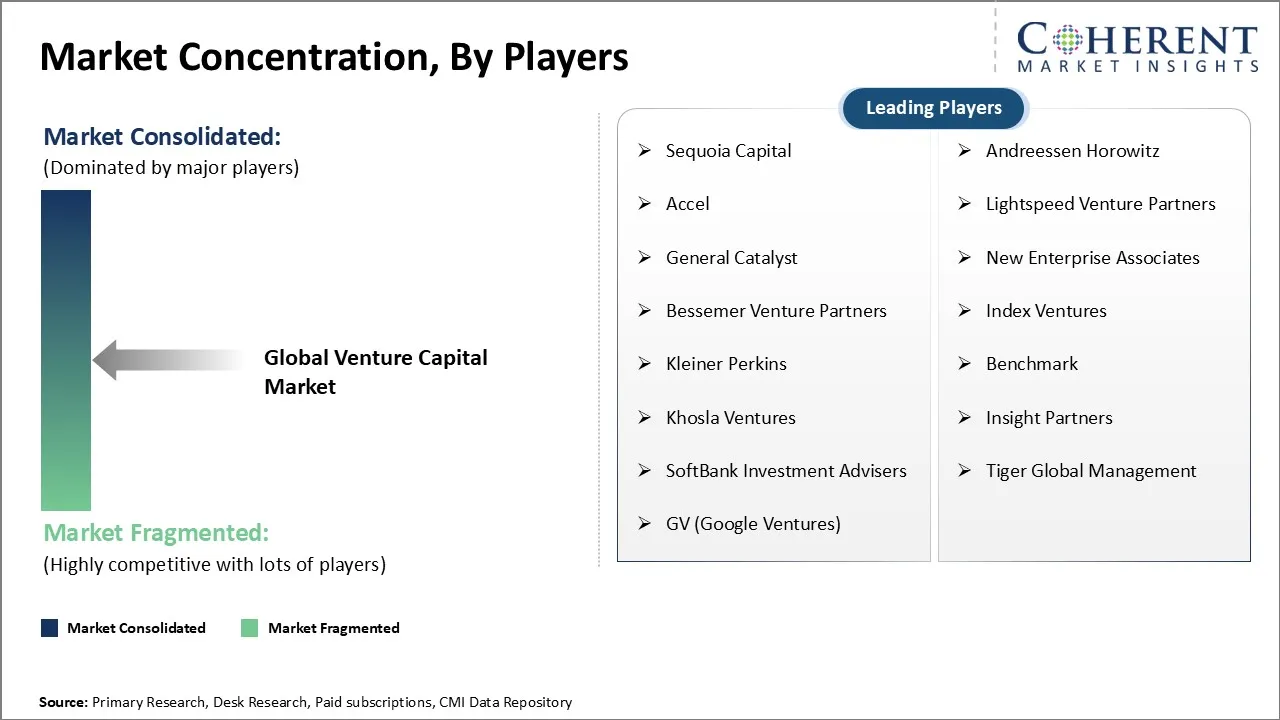
The global venture capital market is fragmented by manager count, although a smaller group of multistage firms commands substantial fundraising and transaction access. Competition spans independent venture partnerships, corporate investment units, public-backed vehicles, seed accelerators, and specialized sector funds. Managers differentiate through realized investment performance, founder access, underwriting judgment, follow-on capacity, and limited-partner relationships. Regional specialists compete by providing local regulatory expertise and sector-specific sourcing networks.
Key competitive factors include
- Investment Track Record: Realized returns and consistent fund performance influence institutional investor commitments.
- Proprietary Deal Access: Exclusive founder relationships and early investment opportunities strengthen portfolio selection.
- Investment Specialization: Sector knowledge supports differentiated underwriting and risk assessment.
- Capital Deployment Discipline: Appropriate entry valuations and follow-on reserves help protect long-term returns.
- Limited-Partner Relationships: Transparent reporting and reliable investor communication support repeat fundraising.
- Cross-Border Investment Capabilities: Local market knowledge and legal expertise strengthen international investment execution.
- Portfolio Risk Management: Diversification, concentration controls, and structured investment oversight improve portfolio resilience.
Market Report Scope
Venture Capital Market Report Coverage | |||
Report Coverage | Details | ||
Base Year | 2025 | Market Size in 2026: | USD 851.2 Bn |
Historical Data For: | 2020 To 2024 | Forecast Period: | 2026 To 2033 |
Forecast Period 2026 To 2033 CAGR: | 8.2% | 2033 Value Projection: | USD 1477.8 Bn |
Geographies covered: |
| ||
Segments covered: |
| ||
Companies covered: | Sequoia Capital, Andreessen Horowitz, Accel, Lightspeed Venture Partners, General Catalyst, New Enterprise Associates, Bessemer Venture Partners, Index Ventures, Kleiner Perkins, Benchmark, Khosla Ventures, Insight Partners, SoftBank Investment Advisers, Tiger Global Management, GV (Google Ventures) | ||
Growth Drivers: |
| ||
Restraints & Challenges: |
| ||
Analyst Opinion (Expert Opinion)
- The global venture capital market is likely to develop a sharper divide between large investment platforms and highly specialized boutique managers. Mid-sized generalist firms could face increasing pressure as they compete for institutional allocations without matching the resources of larger competitors. Future market leadership may depend less on aggregate assets under management and more on disciplined investment selection, differentiated access, and consistent realized performance across market cycles.
- The falling cost of software development might change the economics of venture investment at a fundamental level. AI-enabled development is making it easier to replicate the basics of software functionality and that could make it more difficult for startups focused mostly on technical features to hold onto premium valuations. Investors may increasingly view favorably companies with proprietary distribution channels, exclusive commercial rights or customer relationships that are difficult to replicate. The shift could make traditional software investment approaches less appealing, rewarding those firms that can identify durable competitive advantages.
- Venture capital managers should concentrate on realistic entry valuations, disciplined follow-on funding and improved assessments of capital efficiency. Particular attention should be paid to companies with credible routes to commercialization and manageable refinancing requirements. Investors should put in place stricter limits on exposure, regulatory due diligence and stress testing of portfolios, and avoid over-committing to companies reliant on repeated external financing. Maintaining diversified institutional funding relationships and flexible investment reserves will be essential for protecting long-term fund performance.
Speak to the analyst
Want personalized insights?
Take the findings above to one of our principal consultants, or have the report rebuilt around the segments, geographies and competitors you actually track.
Market Segmentation
- Investment Stage Insights (Revenue, USD Bn, 2021 - 2033)
- Seed and Pre-Seed
- Early Stage (Series A and B)
- Late Stage (Series C and Beyond)
- Venture Growth Capital
- Industry Insights (Revenue, USD Bn, 2021 - 2033)
- IT, AI and Software
- Healthcare and Biotechnology
- Financial Technology
- Industrial and Deep Technology
- Consumer and E-Commerce
- Climate Technology and Energy
- Other Industries
- Investor Type Insights (Revenue, USD Bn, 2021 - 2033)
- Venture Capital Firms
- Corporate Venture Capital
- Government and Sovereign Funds
- Angel Investors and Family Offices
- Private Equity and Growth Investors
- Investment Type Insights (Revenue, USD Bn, 2021 - 2033)
- Equity Financing
- Convertible Notes and SAFEs
- Other Venture Financing
- Regional Insights (Revenue, USD Bn, 2021 - 2033)
- North America
- U.S.
- Canada
- Latin America
- Brazil
- Argentina
- Mexico
- Rest of Latin America
- Europe
- Germany
- U.K.
- Spain
- France
- Italy
- Russia
- Rest of Europe
- Asia Pacific
- China
- India
- Japan
- Australia
- South Korea
- ASEAN
- Rest of Asia Pacific
- Middle East
- GCC Countries
- Israel
- Rest of Middle East
- Africa
- South Africa
- North Africa
- Central Africa
- North America
- Key Players Insights
- Sequoia Capital
- Andreessen Horowitz
- Accel
- Lightspeed Venture Partners
- General Catalyst
- New Enterprise Associates
- Bessemer Venture Partners
- Index Ventures
- Kleiner Perkins
- Benchmark
- Khosla Ventures
- Insight Partners
- SoftBank Investment Advisers
- Tiger Global Management
- GV (Google Ventures)
Sources
Primary Research Interviews
- Venture capital firms, corporate venture investors, and fund managers
- Startup founders, angel investors, accelerators, and incubators
- Institutional investors, investment bankers, and industry experts
Stakeholders
- Venture capital firms, corporate investors, and sovereign wealth funds
- Angel investors, family offices, and private equity investors
- Startups, institutional limited partners, fund administrators, and investment advisers
End-use Sectors
- IT, AI and software
- Healthcare and biotechnology
- Financial technology
- Industrial and deep technology
- Consumer and e-commerce
- Climate technology and energy
Regulatory and Industry Bodies
- U.S. Securities and Exchange Commission (SEC)
- European Securities and Markets Authority (ESMA)
- Securities and Exchange Board of India (SEBI)
- China Securities Regulatory Commission (CSRC)
- German Federal Financial Supervisory Authority (BaFin)
- Brazilian Securities and Exchange Commission (CVM)
Databases
- PitchBook, Crunchbase, Dealroom, and Preqin
- Company annual reports, fund disclosures, and investor presentations
- OECD entrepreneurial finance and World Bank entrepreneurship databases
- Venture funding, deal valuation, fundraising, and exit transaction databases
Magazines and Journals
- Journal of Business Venturing
- Venture Capital: An International Journal of Entrepreneurial Finance
- Entrepreneurship Theory and Practice
- Research Policy
- TechCrunch and Sifted
Associations
- National Venture Capital Association (NVCA)
- Invest Europe
- Indian Venture and Alternate Capital Association (IVCA)
- German Private Equity and Venture Capital Association (BVK)
- Brazilian Private Equity and Venture Capital Association (ABVCAP)
- Asset Management Association of China (AMAC)
Public Domain Sources
- Venture capital fundraising, investment volumes, and deal statistics
- Startup financing rounds, valuations, and institutional capital commitments
- IPOs, mergers, acquisitions, and venture-backed exit transactions
- Government startup funding programs and regulatory developments
- AI, biotechnology, fintech, and deep-tech investment activities
Key Standards and Regulations
- U.S. Securities Act of 1933 – Regulation D
- U.S. Investment Advisers Act of 1940 – Venture Capital Fund Adviser Exemption
- EU Regulation No. 345/2013 – European Venture Capital Funds (EuVECA)
- SEBI (Alternative Investment Funds) Regulations, 2012
- Brazil CVM Resolution 175 – Investment Fund Regulations
- IPEV Valuation Guidelines (2025) – Private Capital Fair Value Guidance
- ILPA Reporting and Performance Templates – Industry Reporting Guidance
Proprietary Elements
- CMI Data Analytics Tool and proprietary CMI research repository, incorporating available venture capital intelligence covering startup financing, investment stages, industry-wise capital allocation, investor participation, funding trends, valuations, regional investment activity, exit strategies, regulatory developments, and competitive intelligence.
Get access to 250+ pages report
Every segment, forecast, competitor profile and data table behind the analysis above — available for instant download.
- ESOMAR Member
- ISO 9001:2015 Certified
- D-U-N-S Registered
- GDPR & CCPA Compliant
Frequently Asked Questions
The CAGR of global venture capital market is projected to be 8.2% from 2026 to 2033.
The global venture capital market is expected to be valued at USD 851.2 billion in 2026, and is projected to reach USD 1,477.8 billion by 2033.
Venture capital investors should consider artificial intelligence, enterprise software, biotechnology, fintech, climate technology and deep-tech startups as key investment opportunities.
Investors are seeking capital-efficient startups, sustainable business models, stronger corporate governance and clearer commercialization strategies to deliver better long-term returns.
Venture capital investors generally have four main exit strategies: initial public offerings (IPOs), mergers and acquisitions, secondary share sales and strategic buyouts.
decisions are startup valuation, market potential, founding team expertise, revenue scalability, competitive positioning, regulatory risks, and exit opportunity potential.
Increasing investments in AI, fintech and technology-driven startups and Growing startup ecosystems and institutional venture capital funding are the major factor driving the growth of global venture capital market.