

Global Vibe Coding Tools Market Size and Forecast – 2026 To 2033
The global vibe coding tools market is expected to grow from USD 7.05 Bn in 2026 to USD 21.00 Bn by 2033, registering a compound annual growth rate (CAGR) of 11.6% from 2026 to 2033. The global vibe coding tools market is driven by rising adoption of autonomous software development agents. On March 11, 2026, Databricks launched Genie Code, an autonomous AI agent that fundamentally changes how data work gets done. Genie Code can carry out complex tasks such as building pipelines, debugging failures, shipping dashboards, and maintaining production systems.
Key Takeaways of the Global Vibe Coding Tools Market
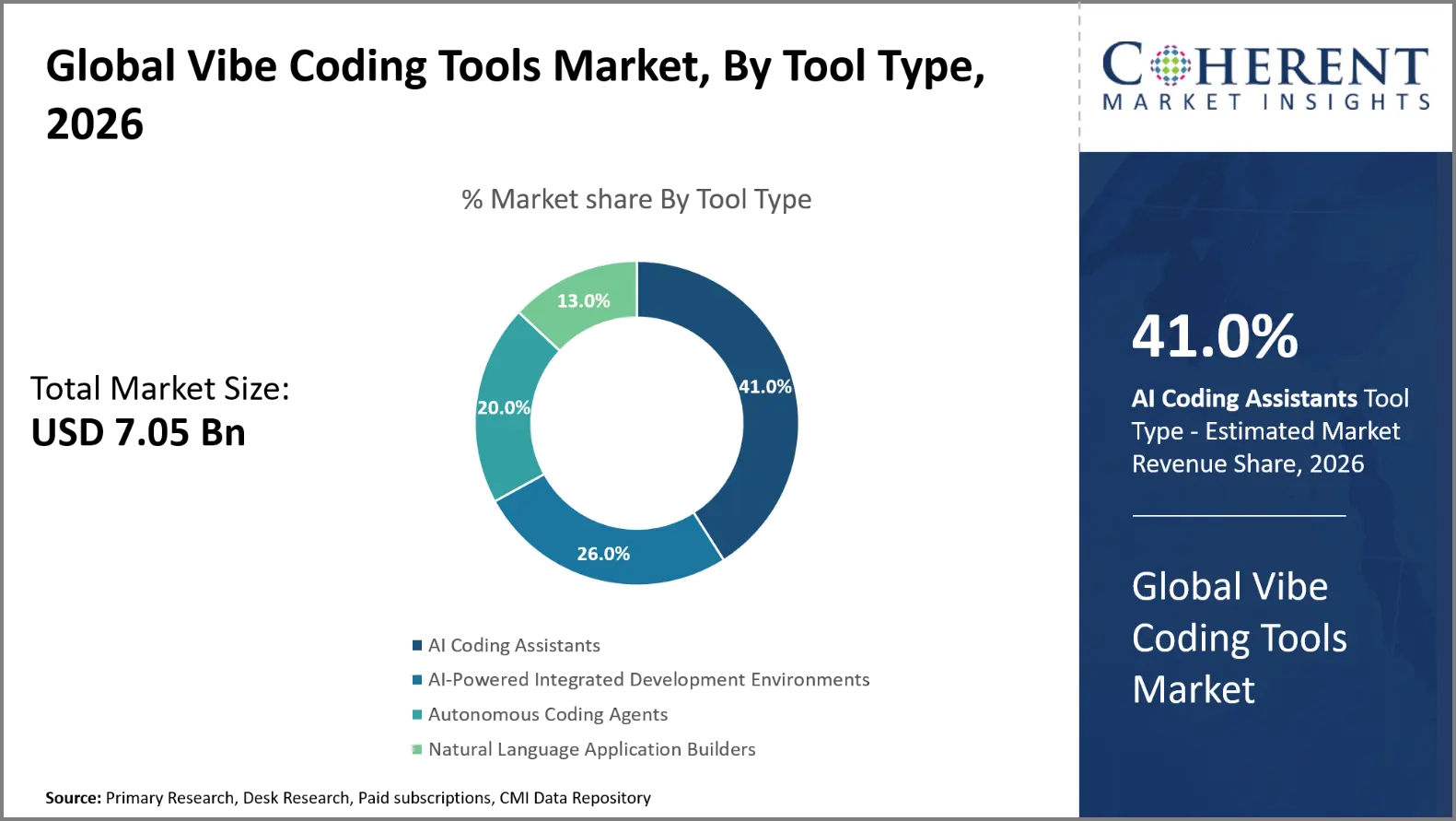
- The AI Coding Assistants segment is expected to account for 41.0% of the global vibe coding tools market share in 2026. Expansion of low-code and no-code application development is driving the growth of the segment. On January 30, 2025, OutSystems announced general availability of Mentor on its OutSystems Developer Cloud platform. This launch strengthens AI-powered low-code development for enterprise application teams.
- The Cloud-Based segment is estimated to capture 51.0% of the market share in 2026. Increasing demand for rapid software prototyping is majorly driving the growth of the segment. On April 9, 2025, Google launched Firebase Studio as a cloud-based development environment for building and testing AI applications. Its App Prototyping agent builds working Next.js applications using natural-language prompts, photos and sketches.
- The Code Generation segment is estimated to capture 33.0% of the market share in 2026. Growing adoption of generative AI across development teams is driving the growth of the segment. On May 1, 2025, Amazon Web Services introduced an agentic coding experience within Amazon Q Developer. The tool executes complex programming tasks using natural-language instructions.
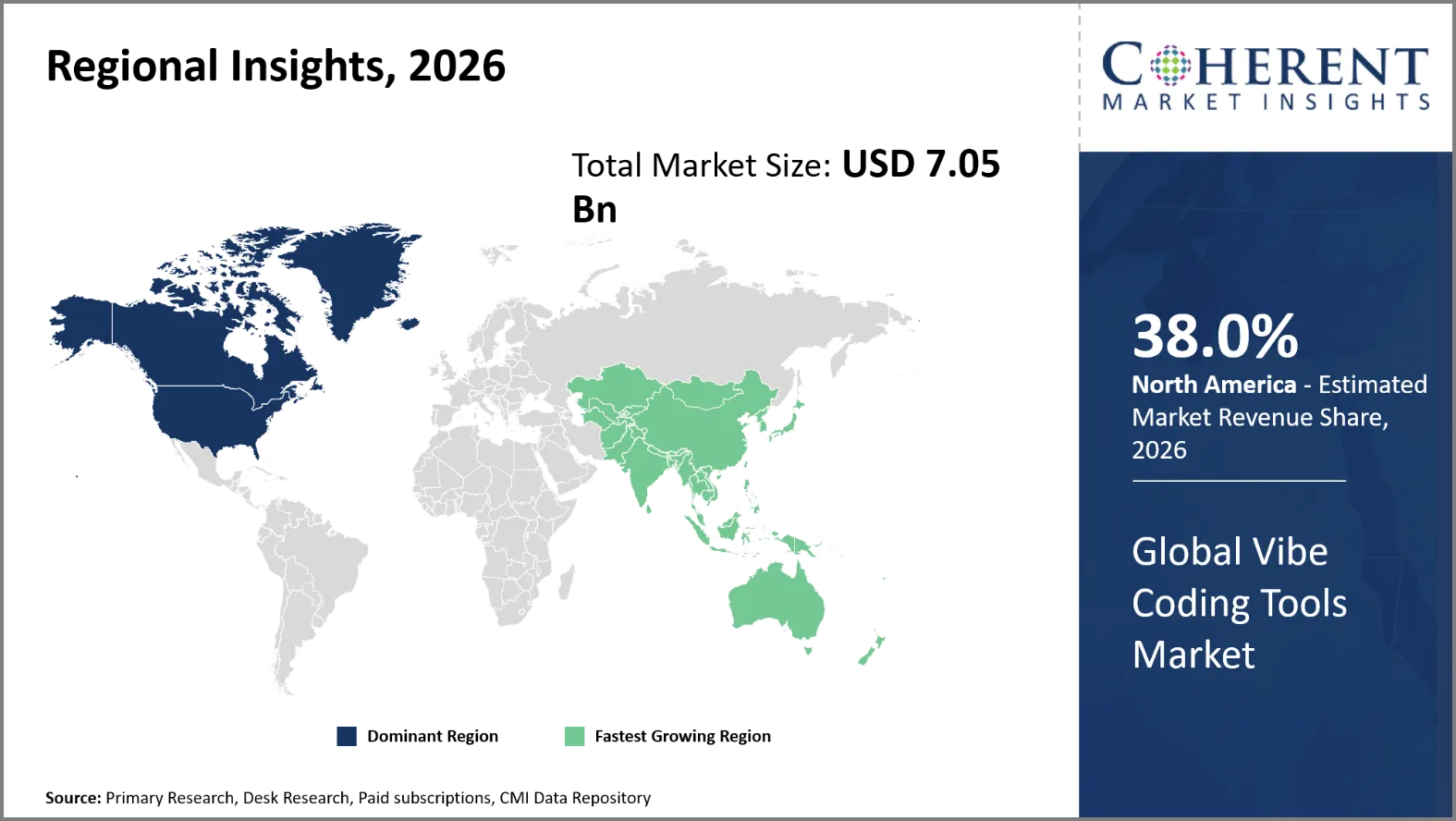
- North America is expected to dominate the vibe coding tools market in 2026 with a market share of 38.0%. Increasing availability of enterprise AI coding subscriptions in North America is driving the growth of the regional market. On August 20, 2025, Anthropic introduced premium seats combining Claude Code with its Claude Team and Enterprise subscriptions. The offering enables developers to access conversational AI and terminal-based coding assistance under one organizational subscription.
- Asia Pacific is expected to account for 30.0% share in 2026. Integration of AI coding agents with development environments in Asia Pacific is driving the growth of the regional market. On January 27, 2026, Infosys announced a strategic collaboration with Cursor to accelerate AI-powered software engineering across global enterprises. The companies planned a Cursor Center of Excellence for developing and modernizing enterprise applications.
Segmental Insights
Why Does AI Coding Assistants Dominate the Global Vibe Coding Tools Market?
The AI coding assistants segment is expected to account for 41.0% of the global vibe coding tools market share in 2026. AI coding assistants simplify software development with natural-language instructions and auto-generated code. These tools assist developers to write, debug, explain and optimize code faster. They connect to development environments to make them more accessible and to automate repetitive programming jobs. More and more businesses are turning to AI helpers to tackle developer shortages and speed up application delivery. Continuous developments in big language models increase code correctness and context understanding. The growing need for speedier software development also helps segment the leadership.
On February 6, 2025, GitHub introduced Agent Mode and Next Edit Suggestions for GitHub Copilot. Agent Mode lets developers make changes across several files, and create and refactor using natural-language prompts. GitHub also revealed autonomous software engineering capabilities and the widespread availability of Copilot Edits.
- Current Industry Events of 2026
- Market Size Estimation
- Regional Breakdown
- Competitive Landscape
- Customer Intelligence
- Segmental Analysis
- Pricing Analysis
- Key Market Drivers, Challenges & Future Trends
- Customized Insights Section
Why is Cloud-Based the Most Preferred Deployment Type?
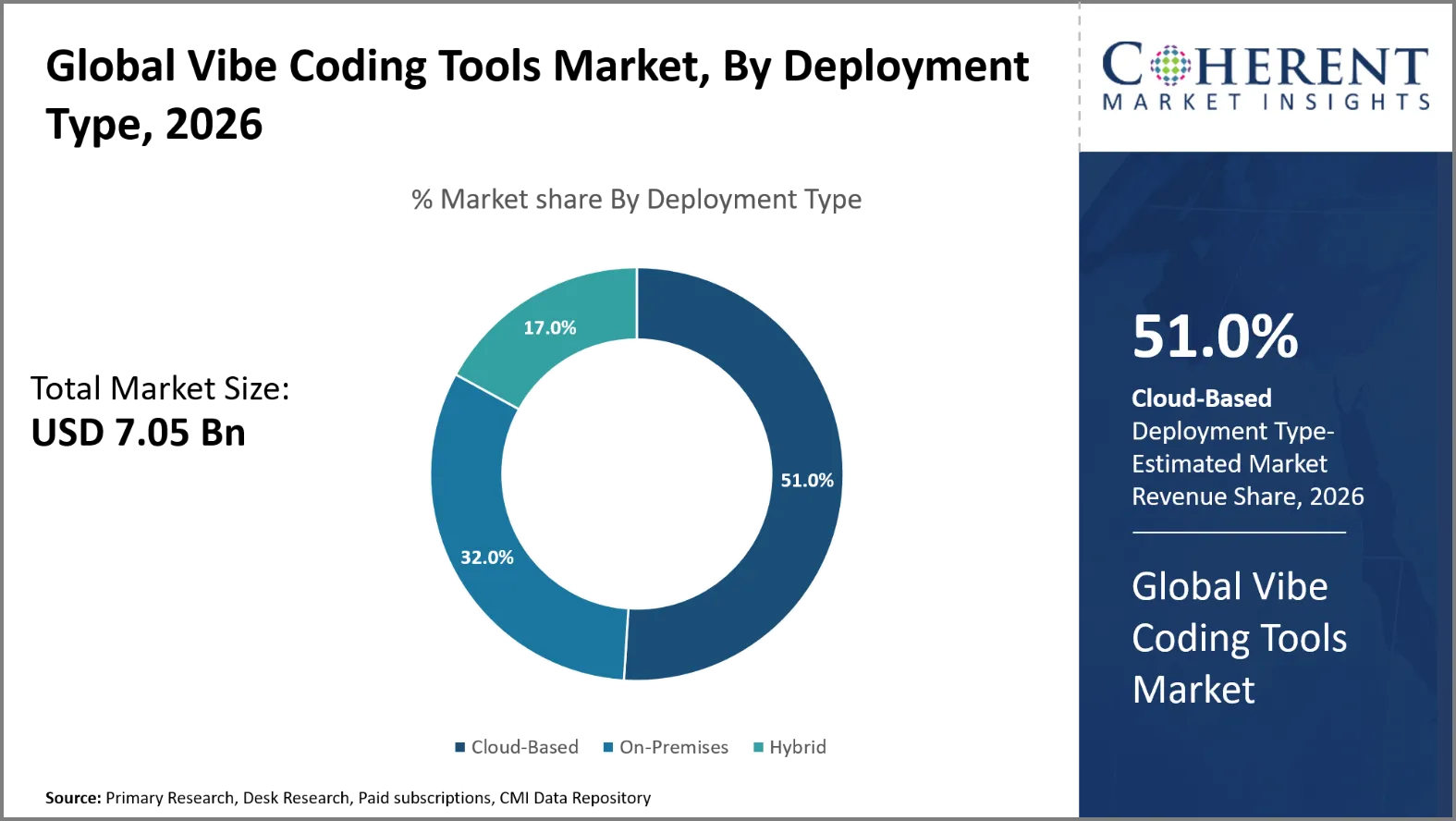
The cloud-based segment is expected to account for 51.0% of the global vibe coding tools market share in 2026. The leader is cloud-based deployment, since it provides flexible access, faster deployment and less infrastructure management. For developers, coding aids are available across devices and development environments. Cloud platforms allows to update models continuously and control security centrally. Their scalable computing capacity can handle varying workloads and growing development teams. Programmers can collaborate across different locations by connecting to cloud development environments. These benefits make cloud deployment attractive to startups, corporations and independent developers.
On February 10, 2026, Warp announced the launch of Oz, a cloud-based platform for executing, managing and orchestrating coding bots at scale. With Oz, visibility, auditability and developer control are built in, so enterprises can deploy hundreds of coding agents in simultaneously without the time and effort of designing custom infrastructure.
Code Generation Dominates the Global Vibe Coding Tools Market
The code generation segment is expected to account for 33.0% of the global vibe coding tools market share in 2026. Code generation dominated as it directly serves the fundamental objective of most coding platforms. Developers are able to turn natural-language cues into working code without drafting every programming instruction by hand. That capacity speeds application development and lessens the requirement for deep programming experience. AI-powered systems can build frontend components, backend logic, database structures, and application interfaces. Automated code generation also enables rapid prototyping and faster product iterations. The segment’s demand is further driven by the increased usage by startups, corporations, and independent developers.
On May 21, 2025, Mistral AI announced the launch of Devstral, an open-source model dedicated to software engineering. Devstral is an AI-driven tool that is designed to solve coding problems, dealing with massive repositories and inter-connected software components. It can detect errors, close issues on GitHub and make changes to code on its own.
Current Events and their Impact
Current Events | Description and its Impact |
European Union - Artificial Intelligence Act Regulation (EU) 2024/1689 |
|
China - Measures for Labeling Artificial Intelligence-Generated Synthetic Content, National Internet Information Office Notice No. 2 of 2025 |
|
Vibe Coding Tools Market Dynamics
Market Drivers
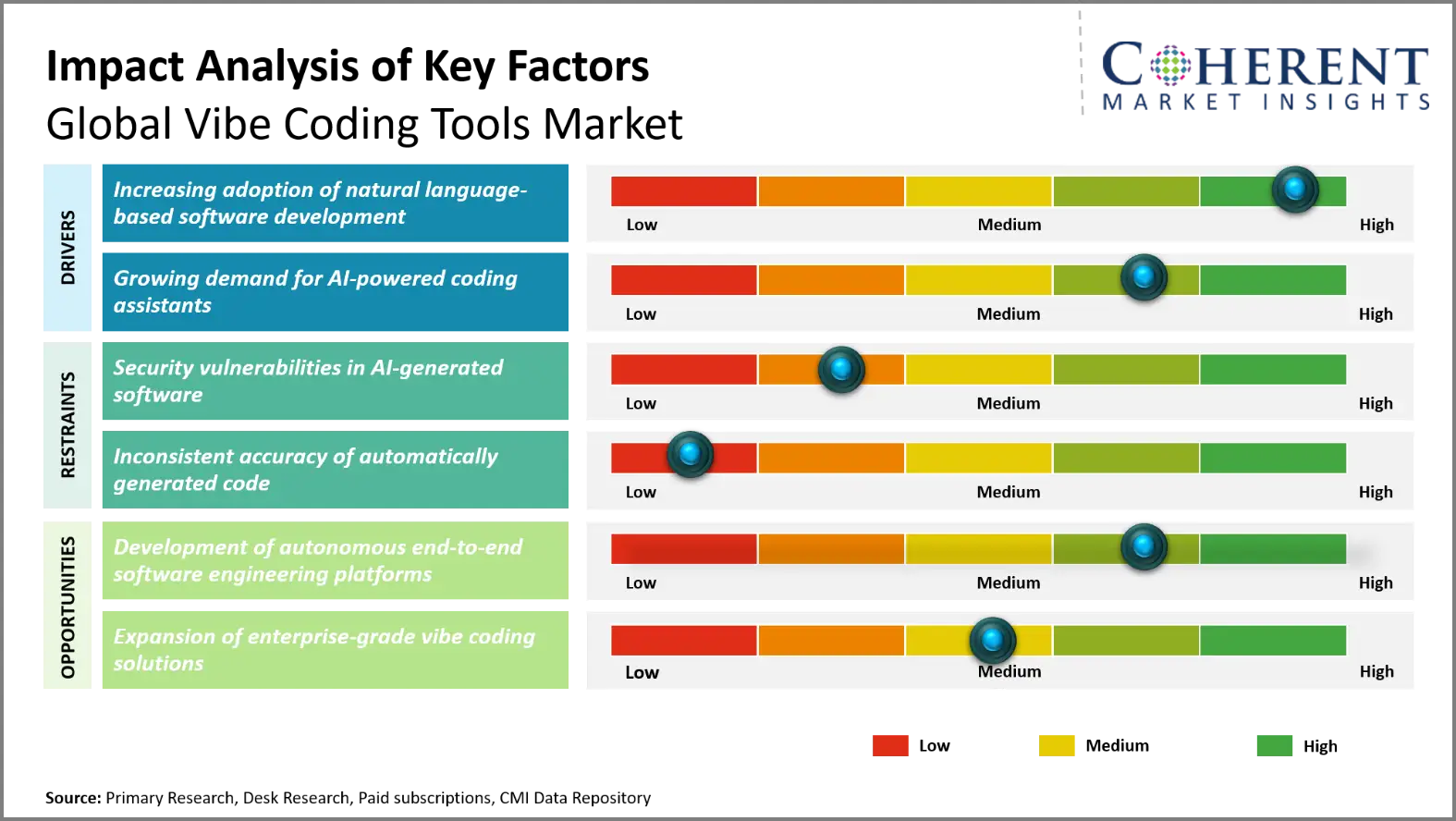
- Increasing adoption of natural language-based software development: Natural language-based software development is becoming popular as organizations simplify application development. More and more developers are using conversational prompts to transform requirements into working software components. This strategy lowers the need for hand coding and speeds up application prototyping. Startups and non-tech experts are able to construct apps with little to no coding knowledge. Platforms like Lovable, Replit and Bolt enable prompt-driven app development. Better language models also improve how instructions are interpreted and code is polished. Such skills generate demand for accessible software development solutions across industries.
- On June 23, 2026, Jotform launched its AI App Builder for creating applications through natural-language prompts. Users can create application pages, navigation, workflow, layout, and data connections. Later they can enhance apps using chat commands, audio directions, screenshots and uploaded files.
- Growing demand for AI-powered coding assistants: Increasing software complexity is fueling demand for AI-powered coding helpers amongst development teams. These tools simplify repetitious programming chores, find problems and offer code improvements. Developers are able to work at speed with tools such as GitHub Copilot, Cursor and Claude Code. They're becoming better. They can debug, they can browse repositories, they can generate tests, they can do tasks on their own. These technologies are rapidly being adopted by enterprises to enhance developer productivity and minimize development cycles. Another factor that helps acceptance is integration with current development environments. Artificial intelligence models are getting better all the time, too, extending coding assistant capabilities across programming languages and apps.
- On February 12, 2026, Atlassian announced the widespread release of Rovo Dev in VS Code as a part of the Atlassian VS Code extension. Rovo Dev uses Atlassian’s Teamwork Graph to interact with Atlassian context and third-party technologies like GitHub using its Jira integration, providing developers with access to work items, documentation, code history and team knowledge.
Emerging Trends
- Emergence of Autonomous AI Coding Agents: Autonomous AI coding agents are progressively taking on multi-step development responsibilities, such as planning, coding, debugging, testing, and deployment. Their expanding capabilities are taking vibe coding beyond just prompt-based code creation and into independent software development workflows.
- Impact: Autonomous agents decrease repetitious developer tasks, speed up application delivery and improve development efficiency. They also create a need for reliable execution controls, human supervision, and automated testing capabilities.
- Relevance to the market: This shift is embodied by Devin from Cognition and Codex from OpenAI, which can execute tasks autonomously. Their capabilities are fueling demand from enterprise software teams for agent-based development platforms.
- Expansion of Multimodal and Context-Aware Coding Interfaces: Vibe coding systems are increasingly interpreting screens shots, design references, papers and conversational directions. These multimodal capabilities allow developers to convert visual thoughts and business needs into effective software applications.
- Impact: Multimodal interfaces simplify front end development, increase accuracy of the design and decrease communication gaps. They also make it easier for designers, entrepreneurs and other professionals who don’t have a lot of programming experience.
- Relevance to the market: Lovable supports prompt-driven application creation, while Bolt enables browser-based development. The platforms are indicative of an increasing desire for interfaces that fuse visual inputs and natural language programming.
Regional Insights
Why is North America a Strong Market for Vibe Coding Tools?
North America is expected to account for a market share of 38.0% in 2026. North America benefits from concentrated investment in AI infrastructure, developer platforms and corporate software modernization. Microsoft, Amazon Web Services and Google are embedding coding helpers into their current cloud ecosystems. The adoption of GitHub Copilot in enterprise is evidence of the desire for developer productivity solutions across the firm. Canada’s artificial intelligence research environment also encourages regional innovation. The Vector Institute and Mila provide research skills to promote commercial AI development. More and more enterprises are looking at code platforms to protect intellectual property, regulate access to repositories and manage software. These requirements favor vendors offering integrated development environments, centralized administration, and enterprise security capabilities.
Why Does Asia Pacific Vibe Coding Tools Market Exhibit High Growth?
Asia Pacific is expected to register the fastest growth with a CAGR of 12.4% over the forecast period. Asia Pacific is projected to account for 30.0% of the global vibe coding tools market in 2026. Asia Pacific has various software development ecosystems and a high demand for regional artificial intelligence (AI) technology. China’s domestic model ecosystem, Japan’s organizational modernization requirements, and India’s technology services industry present unique adoption pathways. Singapore and South Korea also promote AI development in the area through national innovation initiatives. China’s DeepSeek ecosystem and Alibaba’s Tongyi Lingma are examples of domestic coding assistants’ progress. Japan’s established industrial software providers are increasingly turning to AI-assisted development. Regional demand also reflects the needs for multilingual development and interoperability with local cloud infrastructure. Such factors lead coding platforms to adopt regional languages, homegrown models and preferences for enterprise-specific implementation.
Global Vibe Coding Tools Market Outlook for Key Countries
Why is U.S. Emerging as a Major Hub in the Vibe Coding Tools Market?
The U.S. has the advantage of concentrated development of foundation models and commercial AI programming platforms. Specialized tools from companies such as GitHub, Anysphere, Anthropic and OpenAI are constantly expanding the coding capabilities. In GitHub’s 2024 enterprise survey, 99% of U.S. respondents stated they had used AI coding tools at work. Also, 90% reported seeing increases in code quality. Microsoft brings GitHub Copilot into already existing developer workflows. Cursor, in contrast, is an AI-native coding environment. Specialized coding agents are also speeding up autonomous software development at venture-backed enterprises. Financial services, healthcare and technology firms are driving adoption with their purchasing power.
Is China the Next Growth Engine for the Vibe Coding Tools Market?
China’s market is benefiting from increased demand for locally controlled software technologies and development of domestic major language models. Alibaba’s Tongyi Lingma and Baidu’s Comate offer coding support that caters to domestic tech ecosystems. DeepSeek’s models have also been a driver for developer interest in alternate code architectures. According to the JetBrains developer survey 2025, 25% of Chinese respondents used Cursor, while it was 12% worldwide. Chinese developers also shown more robust use of low-code, with 24% embracing these platforms for website and app development. The availability of domestic models, and the inclination of self-hosted deployment, also contribute to the use of coding assistants.
Brazil Vibe Coding Tools Market Analysis and Trends
Brazil's market is supported by a developing ecosystem of technology startups and growing production of digital products. Fintechs like Nubank and Mercado Livre are creating the need for speedier software engineering and application adaptation. The country’s developer community also plays a major role in the creation of open-source software. The need to develop the Portuguese language pushes platforms to better understand multilingual prompts. Increasing startup activity also helps the adoption of affordable coding aids for constructing financial applications and digital services.
Japan Vibe Coding Tools Market Analysis and Trends
Japan's market is being helped by enterprise software modernization and growing demand to deal with aged technological infrastructure. Manufacturing firms demand specific software for factory automation, robotics and production management systems. Fujitsu, NEC and Hitachi are among the companies boosting enterprise artificial intelligence capabilities. 94% of the respondents to TokyoDev’s 2025 Developer Survey reported using AI technologies daily. The most frequent application was code generation. Also, 86% of Devin users surveyed worked at organizations with headquarters in Japan. The results indicate an increasing interest in AI-assisted programming among domestic technology enterprises.
India Vibe Coding Tools Market Analysis and Trends
India’s market benefits from its large IT services industry and increasing role in global software development projects. Tata Consultancy Services, Infosys and Wipro are adding generative AI capabilities to their corporate engineering services. In GitHub’s 2024 survey, 81% of respondents from India reported their code quality improved after using AI tools. India has a large developer community that causes a lot of demand for economical programming help. The IndiaAI Mission supports the development of local AI infrastructure and ecosystem. Increasing adoption among engineering students, software startups and technology service providers further augments the market prospects.
Global Vibe Coding Tools Market - AI Adoption by Software Development Activity (2025)
Development activity | Respondents |
Writing, editing, or generating code | 72.9% |
Debugging and troubleshooting | 62.2% |
Writing or maintaining tests | 50.6% |
Documentation creation and maintenance | 48.3% |
Code review and pull-request analysis | 44.9% |
Technical design and architecture | 26.4% |
Incident investigation | 25.9% |
Security and compliance issue detection | 19.5% |
Production code and infrastructure changes | 18.9% |
Software deployment and releases | 9.8% |
How is Development of Autonomous End-To-End Software Engineering Platforms Creating New Growth Opportunities in the Vibe Coding Tools Market?
The emergence of autonomous end-to-end software engineering platforms is leading to the generalization of vibe coding beyond isolated code-generation jobs. Platforms like Cognition’s Devin are able to explore repositories, edit code, run tests and fix development issues on their own. With Codex by OpenAI discrete development environments can enable concurrent software engineering tasks. This opens up avenues for providers to offer autonomous debugging, repository maintenance, automated testing and deployment management subscriptions. Enterprises can also automate legacy application upgrade and backlog clearance. New sources of income can be created by specialized agents for cloud infra, app security and DB migration. This ability makes autonomous engineering platforms a more general alternative to traditional coding assistants.
On February 24, 2026, SoftServe introduced its Agentic Engineering Suite, a comprehensive methodology and centralized service for modernizing and/or creating, developing, testing, and deploying software solutions with Agentic AI. SoftServe’s Agentic Engineering Suite enables intelligent AI agents to automate every step of the software development lifecycle (SDLC) from planning to deployment, reducing manual effort by up to 90%.
Market Players, Key Development, and Competitive Landscape
Key Developments
- On August 5, 2026, Meta launched Muse Code (beta), a terminal-based coding agent that runs on Muse Spark 1.2, Meta’s newest model. This marks Meta’s next step toward the frontier, with larger and much more capable models on the way.
- On April 28, 2026, IBM announced the global availability of IBM Bob, an AI-first development partner built for enterprise teams. Bob doesn’t just help developers write code fast. It works across the full software development lifecycle (SDLC), from planning and coding to testing, deployment, and modernization, with the governance and security controls enterprises need.
- On February 3, 2026, Snowflake announced the launch of a new Snowflake-native AI coding agent and additional tools to help enterprises accelerate the journey of data and AI projects from idea to production. Cortex Code is a data-native AI coding agent that automates and accelerates end-to-end enterprise development, giving users an agent that truly understands and works inside their corporate data environment.
Competitive Landscape
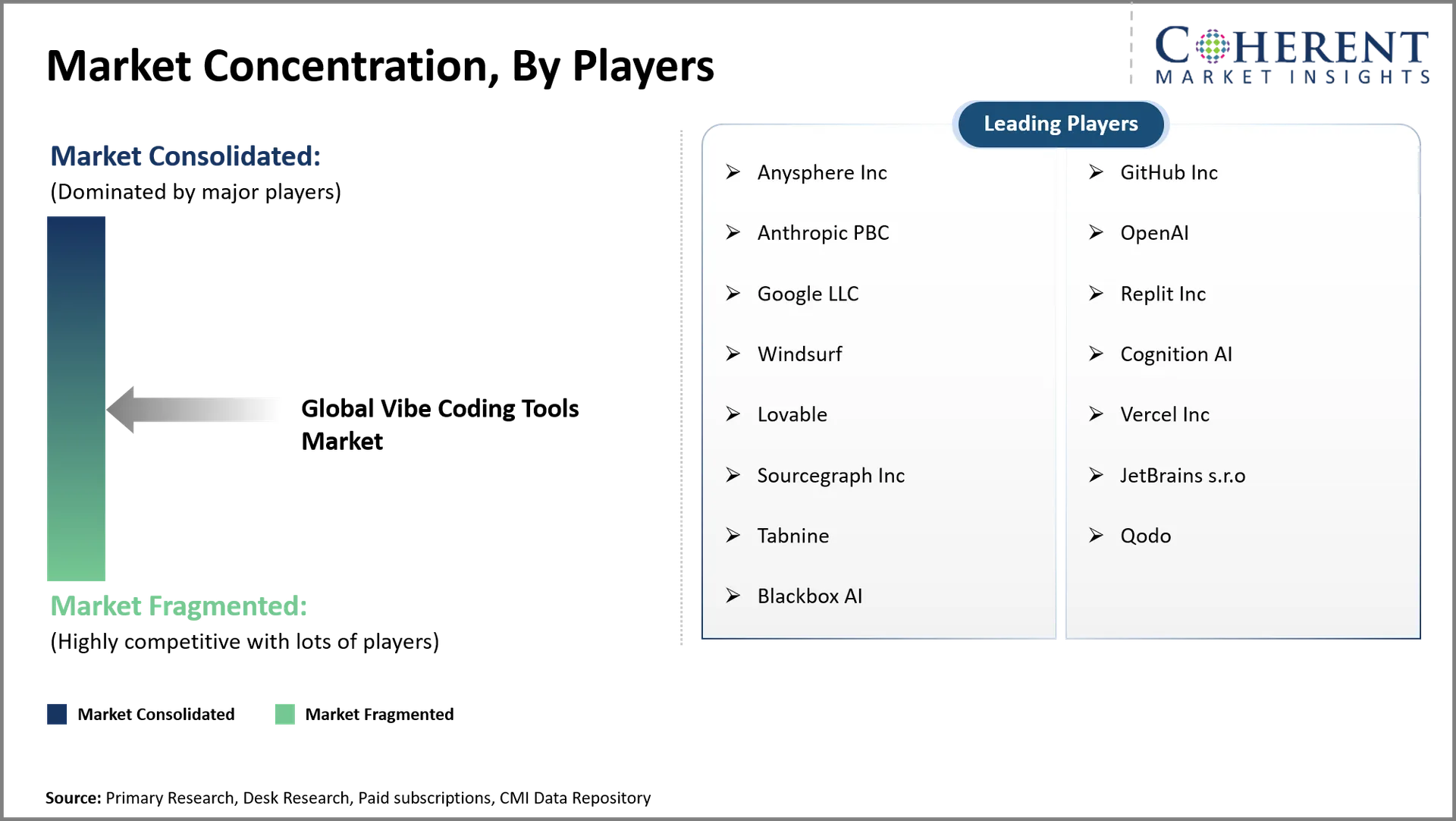
The global vibe coding tools market is competitive with established technology vendors and specialist AI development startups competing for market share. Microsoft has extended its GitHub Copilot service to Visual Studio Code, GitHub repos, and enterprise dev workflows. Anysphere differentiates Cursor by providing an AI-native coding environment, multi-file editing, and autonomous agent capabilities. Anthropic is focused on complicated, repository-level programming with Claude Code and extensive reasoning skills. Codex scales with cloud-based coding agents, simultaneous development activities. Google is improving Gemini Code Assist and Antigravity with model integration and agent-oriented development environments. Devin is focused on autonomous software engineering through cognation. Meanwhile, Replit, Lovable, and Bolt target prompt-driven application development and rapid prototyping.
Top Manufacturers and Notable Products/Solutions in the Vibe Coding Tools Market
Manufacturer | Notable Product/Solution | Key features |
Anysphere | Cursor | AI-native code editor, multi-file code generation, codebase understanding, autonomous agents, debugging, terminal integration |
Microsoft | GitHub Copilot | AI code completion, chat-based coding, agent mode, pull-request assistance, code review, IDE integration |
Anthropic | Claude Code | Natural-language coding, repository analysis, multi-file editing, debugging, automated testing, terminal-based execution |
OpenAI | Codex | Autonomous coding agents, code generation, debugging, parallel task execution, repository management, cloud-based development |
Replit | Replit Agent | Natural-language application generation, frontend and backend development, database integration, automated testing, application deployment |
Market Report Scope
Global Vibe Coding Tools Market Report Coverage | |||
Report Coverage | Details | ||
Base Year | 2025 | Market Size in 2026: | USD 7.05 Bn |
Historical Data For: | 2020 To 2024 | Forecast Period: | 2026 To 2033 |
Forecast Period 2026 To 2033 CAGR: | 11.60% | 2033 Value Projection: | USD 21.00 Bn |
Geographies covered: |
| ||
Segments covered: |
| ||
Companies covered: | Anysphere Inc, GitHub Inc, Anthropic PBC, OpenAI, Google LLC, Replit Inc, Windsurf, Cognition AI, Lovable, Vercel Inc, Sourcegraph Inc, JetBrains s.r.o, Tabnine, Qodo, Blackbox AI | ||
Growth Drivers: |
| ||
Restraints & Challenges: |
| ||
Analyst Opinion (Expert Opinion)
- The future of the vibe coding industry will increasingly revolve around autonomous software engineering rather than basic code completion. AI agents will progressively manage repository analysis, application architecture, debugging, testing, and deployment. Platforms combining natural-language interfaces with reliable execution environments will gain stronger commercial positioning. However, production adoption will depend on code reliability, security validation, and compatibility with existing development infrastructure. Vendors should prioritize measurable engineering outcomes instead of promoting code generation speed alone.
- The maximum opportunity lies in enterprise-oriented autonomous coding agents and full-stack application development platforms. Financial services, healthcare technology, manufacturing software, and enterprise resource planning applications offer attractive specialization opportunities. The U.S. presents strong opportunities for enterprise agent deployment and advanced developer tooling. India offers promising opportunities for coding assistants targeting software services companies and large engineering teams. China presents opportunities for locally hosted coding platforms supporting domestic foundation models. Browser-based application builders also offer considerable potential among startups and independent entrepreneurs.
- Market participants should differentiate through proprietary agent orchestration, repository-level context retention, and dependable software testing capabilities. Vendors need to collaborate with GitHub, GitLab, Jira and key cloud infrastructure providers. Enterprises must have private deployment, authorization control, audit trails and intellectual property protection. Companies should also create dedicated agents for database migration, application security and legacy modernization. Transparent usage-based pricing and predictable computing costs can help retain customers. Strategic alliances with cloud providers and software engineering consultants help speed up enterprise adoption.
Speak to the analyst
Want personalized insights?
Take the findings above to one of our principal consultants, or have the report rebuilt around the segments, geographies and competitors you actually track.
Market Segmentation
- Tool Type Insights (Revenue, USD Billion, 2021 - 2033)
- AI Coding Assistants
- AI-Powered Integrated Development Environments
- Autonomous Coding Agents
- Natural Language Application Builders
- Deployment Type Insights (Revenue, USD Billion, 2021 - 2033)
- Cloud-Based
- On-Premises
- Hybrid
- Application Insights (Revenue, USD Billion, 2021 - 2033)
- Code Generation
- Code Completion
- Code Debugging
- Software Testing
- Application Development
- Code Documentation
- Software Refactoring
- End User Insights (Revenue, USD Billion, 2021 - 2033)
- Individual Developers
- Small and Medium Enterprises
- Large Enterprises
- Educational Institutions
- Startups
- Government Organizations
- Regional Insights (Revenue, USD Billion, 2021 - 2033)
- North America
- U.S.
- Canada
- Latin America
- Brazil
- Argentina
- Mexico
- Rest of Latin America
- Europe
- Germany
- U.K.
- Spain
- France
- Italy
- Russia
- Rest of Europe
- Asia Pacific
- China
- India
- Japan
- Australia
- South Korea
- ASEAN
- Rest of Asia Pacific
- Middle East
- GCC Countries
- Israel
- Rest of Middle East
- Africa
- South Africa
- North Africa
- Central Africa
- North America
- Key Players Insights
- Anysphere Inc
- GitHub Inc
- Anthropic PBC
- OpenAI
- Google LLC
- Replit Inc
- Windsurf
- Cognition AI
- Lovable
- Vercel Inc
- Sourcegraph Inc
- JetBrains s.r.o
- Tabnine
- Qodo
- Blackbox AI
Sources
Primary Research Interviews
- Software Developers & Engineers
- AI/ML Tool Vendors & Product Managers
- Cloud Infrastructure & DevOps Specialists
- Enterprise IT Decision Makers & CTO/CTOs
Magazines
- IEEE Software Magazine
- Wired (Technology & AI Innovation Coverage)
- MIT Technology Review
- InfoWorld
Journals
- Journal of Software Engineering Research and Development
- ACM Transactions on Software Engineering and Methodology
- Empirical Software Engineering Journal
Associations
- Association for Computing Machinery (ACM)
- Institute of Electrical and Electronics Engineers (IEEE)
- International Association of Software Architects (IASA)
- Open Source Initiative (OSI)
Public Domain Sources
- GitHub Public Repositories & Developer Trend Reports
- U.S. Bureau of Labor Statistics – Software Occupation Data
- European Commission – Digital Economy and Society Reports
- World Economic Forum – Future of Jobs & Technology Reports
Proprietary Elements
- CMI Data Analytics Tool
- Proprietary CMI Existing Repository of Information for Last 10 Years
Get access to 250+ pages report
Every segment, forecast, competitor profile and data table behind the analysis above — available for instant download.
- ESOMAR Member
- ISO 9001:2015 Certified
- D-U-N-S Registered
- GDPR & CCPA Compliant
Frequently Asked Questions
The global vibe coding tools market is expected to stand at USD 7.05 Bn in 2026 and is expected to reach USD 21.00 Bn by 2033.
The CAGR of the global vibe coding tools market is projected to be 11.6% from 2026 to 2033.
Increasing adoption of natural language-based software development and Growing demand for AI-powered coding assistants are the major factors driving the growth of the global vibe coding tools market.
Security vulnerabilities in AI-generated software and Inconsistent accuracy of automatically generated code are the major factors hampering the growth of the global vibe coding tools market.
In terms of tool type, AI coding assistants segment is estimated to dominate the market revenue share in 2026.
Vibe coding tools are AI-powered software development platforms that convert natural-language instructions into functional code and applications.
Large language models interpret programming instructions, generate code, explain errors, and support application development.