

Global Water-Based Fragrance Carriers Market Size and Forecast – 2026 To 2033
The Global Water-Based Fragrance Carriers Market is estimated to be valued at USD 1.79 Bn in 2026 and is projected to reach USD 3.5 Bn by 2033, registering a CAGR of 10.10% during 2026–2033. Increasing adoption of alcohol-free fragrance formulations, sustainable ingredient solutions, and water-compatible fragrance delivery systems in cosmetics, personal care, and household products is driving market growth.
Manufacturers are investigating advanced solubilization technologies and biodegradable carrier materials to enhance the dispersion, stability and performance of fragrances, while taking environmental considerations into account. In June 2026, Iberchem launched NovaSilka concentrated alcohol-free fragrance technology for fine-fragrance applications, to be diluted in water. This development shows the industry's commercial shift to water-dilutable fragrance formulations and provides opportunities for specialized carrier technology suppliers.
Key Takeaways of the Global Water-Based Fragrance Carriers Market
- The Microencapsulation Systems segment is estimated to grow at a CAGR of 10.6% between 2026-2033 and will account for 42.8% share of the global water-based fragrance carriers market in 2026. Their ability to encapsulate volatile fragrance molecules and allow controlled release of fragrance is the basis for premium personal care and fabric care formulations. In July 2026 Givaudan teamed up with Microcaps to drive precision encapsulation for non-alcoholic fragrances.
- Synthetic Polymer-Based Carriers are expected to record a 9.3% CAGR during 2026–2033, accounting for 30.5% of global water-based fragrance carriers market revenue in 2026. Tunable polymer structures help formulators balance fragrance retention, controlled release, and compatibility with aqueous bases, while biodegradability increasingly influences material selection. In July 2026, Croda highlighted Iberchem's biodegradable polyurea microcapsules developed for alcohol-free fragrance systems.
- Liquid Solubilized Concentrates are projected to grow at a CAGR of 9.7% by 2033 and account for 39.5% share of the global water-based fragrance carriers market by 2026. Concentrated formats allow the fragrance houses to transport less water and allow the fragrance houses to control dilution and visual clarity during final blending. In September 2026, IFF introduced AQUASCENT, a water-based fragrance carrier, as a concentrate for dilution during final production.
- North America is forecast to grow at a 9.5% CAGR during 2026–2033, contributing 36.7% of the global water-based fragrance carriers market in 2026. Established fragrance development infrastructure and major personal care and household manufacturers support specialized carrier procurement and formulation testing. In July 2025, Unilever opened its U.S. Fragrance Lab in Connecticut, strengthening its fragrance compounding and evaluation capabilities.
- Europe is projected to register an 11.9% CAGR during 2026–2033, capturing 29.3% of global water-based fragrance carriers market revenue in 2026. Regulatory scrutiny of persistent microplastics strengthens the commercial case for biodegradable and soluble fragrance-delivery materials, encouraging product reformulation. In April 2025, the European Commission published implementation guidance for REACH microplastics restrictions, helping manufacturers interpret compliance requirements.
Segmental Insights
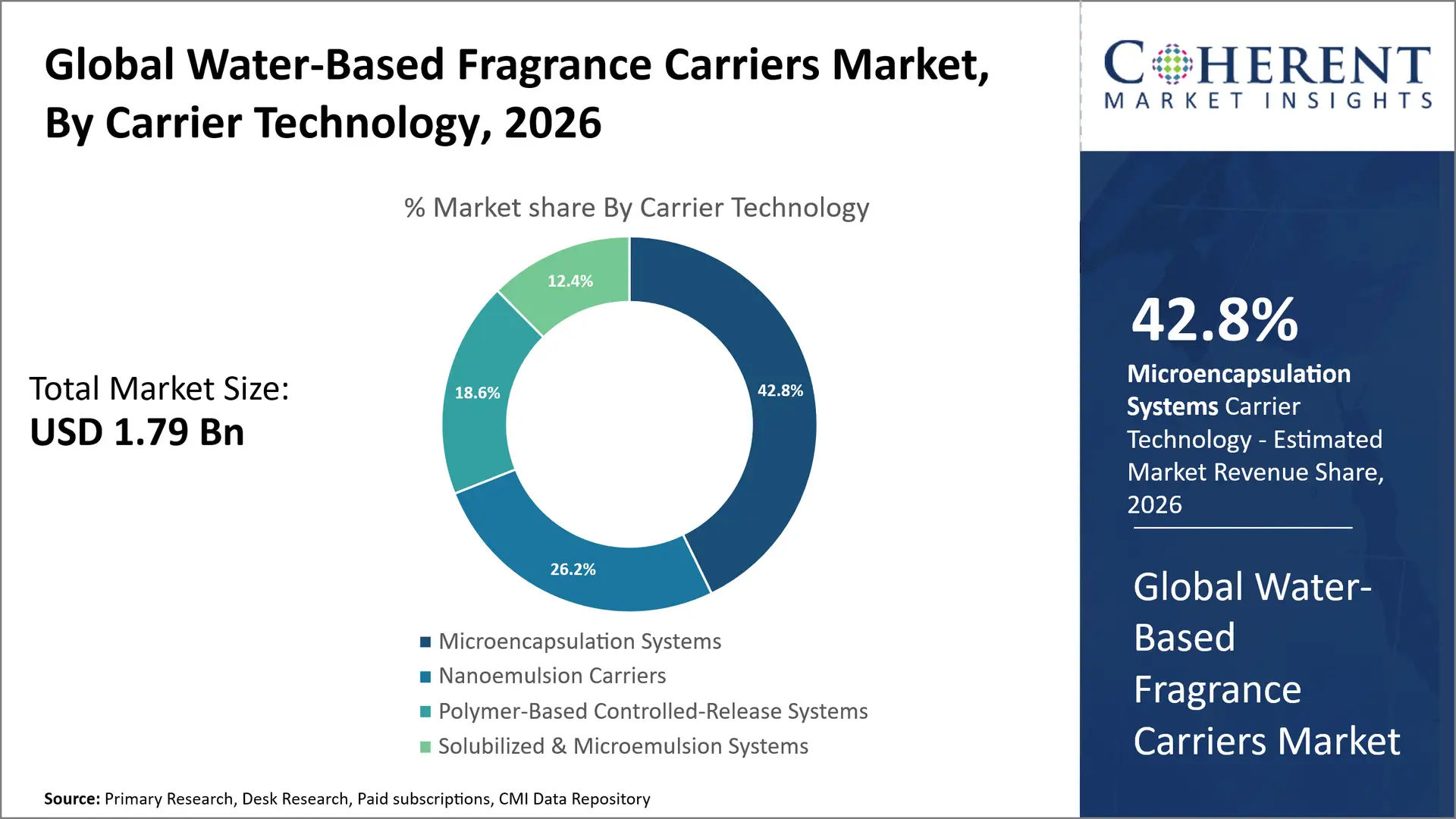
Why Do Microencapsulation Systems Dominate the Global Water-Based Fragrance Carriers Market?
Microencapsulation Systems account for 42.8% of the global water-based fragrance carriers market in 2026, making them the leading carrier technology. Their position reflects a practical formulation advantage: fragrance oils can be protected from direct exposure to water, surfactants and other ingredients, then released through rubbing, dilution or other use conditions. This separates fragrance retention from the initial product base and allows scent delivery to be tailored for conditioners, hair-care products, fabric-care products and other aqueous systems. Capsule-wall design, particle size and loading efficiency give suppliers additional control over performance across applications. In March 2026, researchers reported a sodium-alginate double-encapsulation approach for lipophilic fragrances, achieving detectable scent release for up to 30 days and stability in conditioner matrices for four months. The findings reinforce microencapsulation’s relevance to water-rich personal-care formulations.
- Current Industry Events of 2026
- Market Size Estimation
- Regional Breakdown
- Competitive Landscape
- Customer Intelligence
- Segmental Analysis
- Pricing Analysis
- Key Market Drivers, Challenges & Future Trends
- Customized Insights Section
Why Do Synthetic Polymer-Based Carriers Represent the Largest Composition Segment in the Global Water-Based Fragrance Carriers Market?
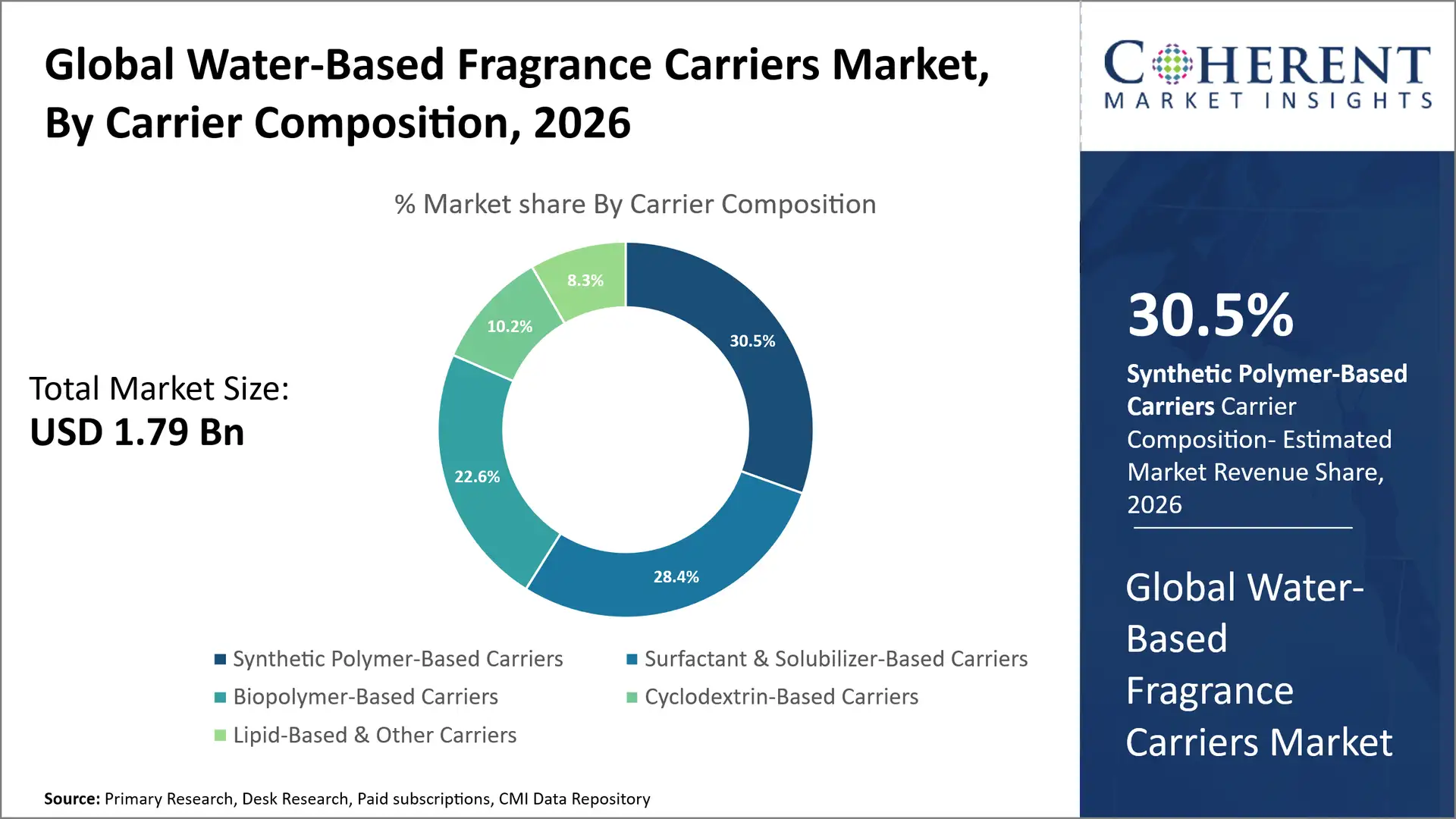
Synthetic Polymer-Based Carriers represent 30.5% of the global water-based fragrance carriers market in 2026, the largest share within carrier composition. Their commercial appeal lies in formulation control: polymer networks and water-soluble polymer domains can regulate fragrance retention, viscosity, deposition and release while helping maintain product structure through storage and use. Compared with a single-purpose solubilizer, a polymeric carrier can perform several functions in one system, particularly in fabric-care products that must deposit fragrance during washing and release it afterward. This versatility supports repeat procurement by household-product manufacturers and allows suppliers to customize molecular weight, concentration and dissolution behavior. In February 2024, Procter & Gamble published a patent application describing low-water fragrance compositions built around polyethylene glycol domains and perfume capsules, designed to dissolve during laundering and deliver fragrance to fabrics.
Why Do Liquid Solubilized Concentrates Dominate the Product Form Segment in the Global Water-Based Fragrance Carriers Market?
Liquid Solubilized Concentrates are forecast to hold 39.5% share of the global market for water-based fragrance carriers in 2026, driven by their compatibility with current liquid blending, filling and dosing operations. With a pre-solubilized concentrate, manufacturers can add fragrance in water-based products through a controlled dilution process, lessening the need to build an entire solubilizing system for each formulation. It is a good choice for fine-fragrance sprays, body mists and personal-care liquids, where product quality is affected by fragrance loading, clarity and sprayability. Concentration of supply may also facilitate storage and transportation, by enabling addition of water closer to final production. In October 2026, Expressions Parfumées introduced Aquaco Boost Essence, a fragrance-in-water technology for alcohol-free formulations with up to 25% fragrance concentrate. The launch is testimony to the ongoing innovation in concentrated aqueous fragrance formulations.
Current Events and their Impact
Current Event | Description and Its Impact |
July 2026 – EU Expanded Fragrance Allergen Labelling Requirements |
|
July 2026 – Revised EU Classification, Labelling and Packaging (CLP) Requirements |
|
August 2026 – EU Packaging and Packaging Waste Regulation Begins Applying |
|
Global Water-Based Fragrance Carriers Market Dynamics
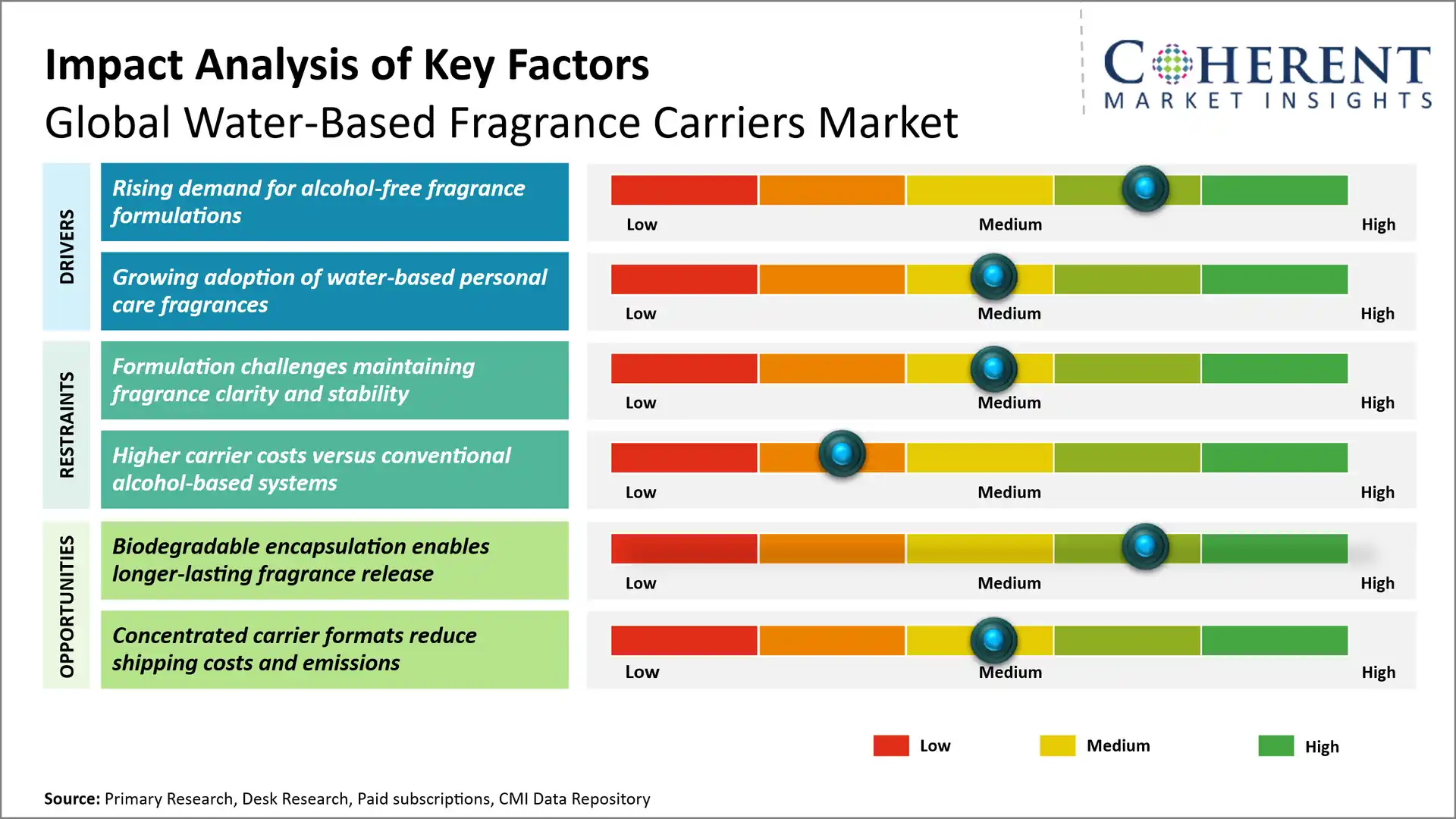
Key Market Drivers
- Rising Demand for Alcohol-Free Fragrance Formulations: Alcohol-free fragrance formulations require carriers that disperse fragrance oils in water while preserving scent intensity, sprayability, clarity and skin feel. This shifts formulation work from conventional ethanol bases toward engineered solubilized concentrates, emulsions and co-solvent systems. Fragrance houses, carrier formulators and personal-care contract manufacturers benefit when they can supply stable, ready-to-dilute platforms and support brand reformulation. In February 2026, CPL Aromas launched AromaHydro, a concentrated water-based, alcohol-free technology designed to be diluted into fine fragrance. This is particularly relevant to fine-fragrance brands seeking additional application formats.
- Growing Adoption of Water-Based Personal Care Fragrances: Water-based personal-care fragrances are extending beyond conventional perfume sprays into body-and-hair mists and layering formats, increasing the range of products requiring compatible aqueous carriers. This creates demand for stable biphasic emulsions and botanical-water bases that distribute fragrance evenly while retaining a pleasant application feel. Personal-care brands, fragrance houses and specialist emulsifier suppliers can benefit through co-development of formats intended for repeat application. In April 2026, Orebella introduced Body & Hair Perfume Mists using an alcohol-free, two-phase blend of fragrance oils and botanical waters.
Emerging Market Trends
- Hybrid Immediate-and-Delayed Fragrance Release: Hybrid immediate-and-delayed fragrance release is emerging as a way to create more controlled scent profiles in water-based products. Formulators can combine a readily available fragrance fraction with encapsulated or inclusion-complexed material that releases later under moisture, friction or temperature changes.
- Impact: This approach shifts development toward multi-stage performance testing across storage, application and use conditions. It also increases demand for release-kinetics data.
- Relevance of Market: Release engineering skills of fragrance houses and carriers can provide differentiated systems. Basic solubilizer providers may have to provide value beyond initial dispersion.
- Predictive Formulation and Compatibility Engineering: As water-based fragrance systems are adapted to a variety of surfactants, preservatives, pH levels and actives, predictive formulation and compatibility engineering will likely become more important. Pilot production can be preceded by narrowing down carrier choices via digital ingredient libraries, computational screening and automated stability testing.
- Impact: Faster screening can reduce reformulation cycles and improve scale-up decisions. It can also make custom blends more feasible for smaller brands and contract manufactures.
- Relevance of Market: Suppliers with validated formulation data and application laboratories should gain an advantage. Competitors relying mainly on ingredient availability and price may face pressure.
Regional Insights
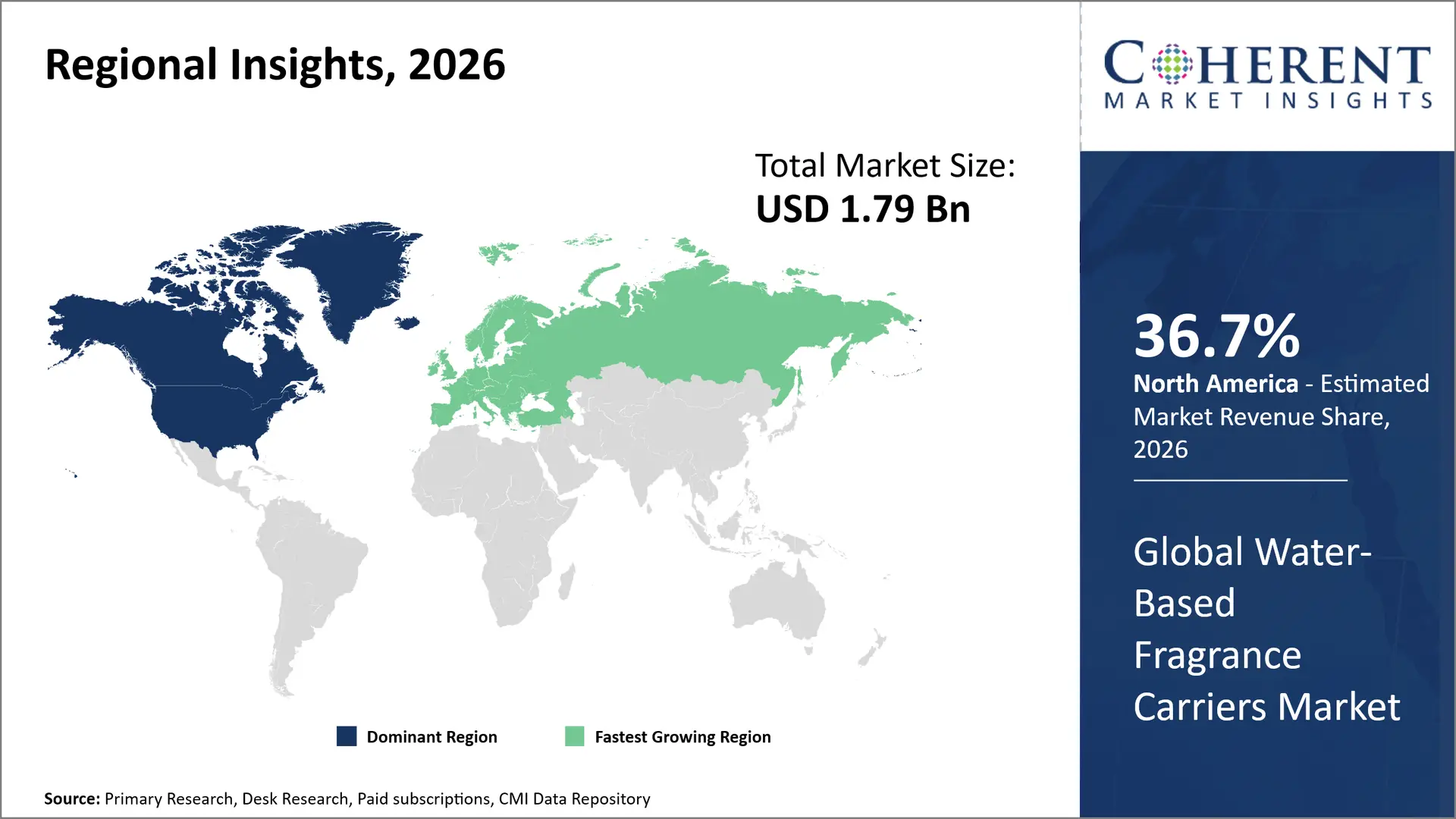
Why Does North America Dominate the Global Water-Based Fragrance Carriers Market?
North America is expected to account for 36.7% of the global water-based fragrance carriers market in 2026. Its leading position reflects a broad base of personal-care, household-cleaning and home-fragrance manufacturers that purchase fragrance ingredients and formulation systems at scale. Established fragrance houses, contract formulators and specialty-chemical distributors support rapid product development, technical testing and reliable supply to national brands. Demand spans fragranced body washes, liquid soaps, detergents, air-care sprays and other aqueous products. In March 2026, Bath & Body Works reported that home fragrance represented approximately 42% of its FY2025 North American sales mix, while body care contributed approximately 37%. This illustrates the breadth of fragranced product categories across the region.
Why Is Europe Emerging as the Fastest-Growing Region in the Global Water-Based Fragrance Carriers Market?
Europe is expected to represent 29.3% of the global water-based fragrance carriers market in 2026 and is identified as the fastest-growing region. The industry has growth potential thanks to a mature perfumery ecosystem, specialized fragrance makers and high demand for premium personal care, fabric care and home care formulations. The region's network of fragrance makers and ingredient suppliers enables collaboration on carrier compatibility, scent stability and performance for specific applications. Export-oriented production creates demand for consistent formulations across international markets as well. In June 2025, Eurofragance invested USD 10.99 million in its Rubí, Barcelona facility, tripling production capacity and boosting automation. This expansion strengthens the fabric of European fragrance manufacturing.
Global Water-Based Fragrance Carriers Market Outlook for Key Countries
Why Is the U.S. a Key Market for the Global Water-Based Fragrance Carriers Market?
The United States is an important national global water-based fragrance carriers market because it combines large-scale beauty and personal-care consumption with substantial household and fragrance-product manufacturing. Demand for body mists, liquid soaps, shampoos, detergents and air-care products provides a broad downstream customer base for aqueous fragrance carriers. Domestic manufacturing also matters to suppliers because local production can reduce replenishment lead times and improve responsiveness to product launches and retailer requirements. In August 2025, Coty's fiscal-year filing disclosed that it had transferred mass-fragrance production and fragrance mists to its U.S. manufacturing site, with further production transfers planned. This confirms the strategic importance of domestic fragrance manufacturing.
Why Is India Important in the Global Water-Based Fragrance Carriers Market?
India presents a development opportunity with its growing beauty, grooming and household-care industries, coupled with a large consumer base with diverse fragrance tastes and price points. Local fragrance creation and application capabilities are important as carrier systems need to be adapted to different product bases, climatic conditions and cost requirements. Domestic fragrance houses and ingredient suppliers also can be a source for regional brands looking for shorter development cycles and regionally relevant scent profiles. In April 2024, Takasago opened its India Fragrance Center in Mumbai, bringing fragrance research and development, creation, sensory evaluation and application functions closer to the customers. This strengthens the local ecosystem for formulation and opportunities for collaborative carrier testing.
Why Does China Support Growth in the Global Water-Based Fragrance Carriers Market?
China is important to the global water-based fragrance carriers market because it combines a large cosmetics and home-care manufacturing base with growing local fragrance-production capabilities. Industrial clusters support access to packaging, formulation services and downstream manufacturers, while domestic production can improve supply responsiveness for regional and international brands. The country is also building capabilities across several fragrance formats, including encapsulated systems relevant to controlled-release carrier development. In December 2025, MANE announced a USD 70 million expansion of its Pinghu production facility, with planned capabilities covering liquid fragrances, spray drying, microencapsulation and macroencapsulation. The project demonstrates investment in local fragrance technology and manufacturing capacity, with completion scheduled for 2027.
Why Is Germany a Strategic Country in the Global Water-Based Fragrance Carriers Market?
Germany holds strategic importance through its advanced chemical-manufacturing base, established home-care producers and strong technical capabilities in aroma ingredients. Laundry detergents, fabric-care products, body care and household cleaners require fragrance materials that remain compatible with surfactants and other formulation ingredients. This creates a technical customer base for carrier suppliers able to demonstrate stability, dosing accuracy and repeatable performance. In April 2026, BASF announced commercial production from expanded menthol and linalool facilities at Ludwigshafen. BASF identifies linalool applications in laundry care, home care, personal care and fine fragrance. This strengthens the local supply of aroma ingredients used in aqueous fragrance formulations.
Why Is France a Key Market for the Global Water-Based Fragrance Carriers Market?
France is a strategic country because its perfumery heritage is supported by luxury fragrance brands, specialist suppliers, creative talent and advanced product-development capabilities. Specialized carrier systems are finding opportunities in new product formats, as premium fragrance producers are seeking precise control over scent profiles, clarity, stability and sensory performance. France is also an innovation and commercial center connecting fragrance creators with global beauty portfolios. In October 2025, The Estée Lauder Companies opened its Global Fragrance Atelier in Paris, uniting perfumers, scientists and technology capabilities to speed up fragrance creation and formulation. This development further consolidates France's position in high value fragrance innovation.
Why Is Brazil an Important Growth Market for the Global Water-Based Fragrance Carriers Market?
Brazil offers an important Latin American opportunity through its established beauty and personal-care industry, strong fragrance culture and locally developed product portfolios. Demand across body care, hair care, deodorants and personal fragrances creates opportunities for carrier suppliers that can adapt formulations to local preferences, climate and retail price points. The country's biodiversity-linked ingredient base also supports differentiated fragrance concepts, increasing the need for formulation flexibility. In August 2026, Natura announced a pilot using artificial intelligence to create personalized fragrances in real time through an ANVISA regulatory sandbox. Although the initiative does not disclose carrier chemistry, it signals movement toward customized fragrance production and adaptable formulation platforms.
Water-Based Fragrance Carrier Formulation and Delivery Landscape
Technology | Technical Function | Relevant Market Applications | Adoption Considerations |
Hydrotrope-Assisted Solubilization | Uses hydrotropes and compatible co-solvents to improve fragrance-oil solubility in aqueous formulations. | Liquid solubilized concentrates, transparent fragrance sprays and aqueous personal-care formulations. | Maintaining clarity, fragrance loading and stability during dilution and temperature changes. |
Surfactant-Stabilized Microemulsions | Uses surfactants and co-surfactants to create fine, thermodynamically stable oil-water systems. | Transparent fragrance products, household cleaning formulations and personal-care sprays. | Balancing surfactant concentration, fragrance compatibility, foaming and skin feel. |
Nanoemulsion Processing | Uses high-pressure homogenization or ultrasonication to produce finely dispersed fragrance-oil droplets. | Aqueous fragrance mists, personal-care formulations and household fragrance products. | Controlling droplet size, physical stability, energy consumption and commercial-scale processing. |
Cyclodextrin Inclusion Complexation | Uses cyclodextrin molecules to accommodate fragrance compounds within their molecular cavities. | Water-dispersible fragrance powders, fabric-care products and controlled-release formulations. | Ensuring fragrance compatibility, complexation efficiency and predictable fragrance release. |
Polymeric Microencapsulation | Encloses fragrance materials within polymeric shells or matrices to protect volatile compounds and regulate their release. | Fabric conditioners, laundry products, textile-care formulations and long-lasting fragrance products. | Capsule integrity, deposition performance, wash resistance and shell-material selection. |
Liposomal and Vesicular Carriers | Uses phospholipid-based vesicles to incorporate fragrance compounds into aqueous dispersions. | Premium personal-care formulations and specialized skin-contact fragrance products. | Oxidation resistance, preservative compatibility, manufacturing costs and storage stability. |
How Are Water-Activatable Fragrance Carriers Creating New Growth Opportunities in Concentrated and Solid Home-Care Formats?
An underdeveloped opportunity lies in fragrance systems supplied as dry or highly concentrated intermediates that disperse reliably when consumers add water. Detergent sheets, cleaning tablets, powdered laundry products and refill concentrates need carriers to survive storage, humidity and compression and then to release evenly during dilution or washing. Suppliers can take up this space by combining cyclodextrin complexes, encapsulated fragrance powders and compatible solubilizers, along with application-specific testing for dissolution, scent retention and compatibility with enzymes and surfactants. The commercial proposition is predictable scent performance in lower-water formats with less risk of fragrance loss in transit and storage. Entry requires moisture barrier packaging, controlled particle size, pilot scale drying or encapsulation capabilities, and formulation support for brand owners and contract manufacturers. Specialist developers are able to establish beachheads and large fragrance houses and ingredient groups can develop validated platforms across regional product portfolios. That allows for brand differentiation without having to re-formulate entire cleaning formulas with every new scent.
Market Players, Key Developments, and Competitive Intelligence
Key Developments
- In October 2026, Symrise opened a Scent Creative Center and Global Skin Cleansing Center of Excellence in Singapore. The facilities bring perfumers, customers and sensory-evaluation capabilities together, improving regional co-development of fragrance systems for shower gels, handwash and other water-rich cleansing products.
- In February 2026, dsm-firmenich reported that its popscent Eco-Max fragrance-encapsulation technology had undergone manufacturing scale-up during 2025. The expansion strengthens supply readiness for biodegradable capsules and supports broader use of controlled-release systems at commercial scale in fabric-care and personal-care formulations.
- In September 2024, Cosmo International Fragrances launched AquaElixir, a patent-pending, plant-origin water-based technology for alcohol-free fragrances. The launch shows specialist investment in proprietary aqueous bases and offers brands another route to water-dispersible formulations with skin-compatible sensory performance and high fragrance loading.
Competitive Landscape
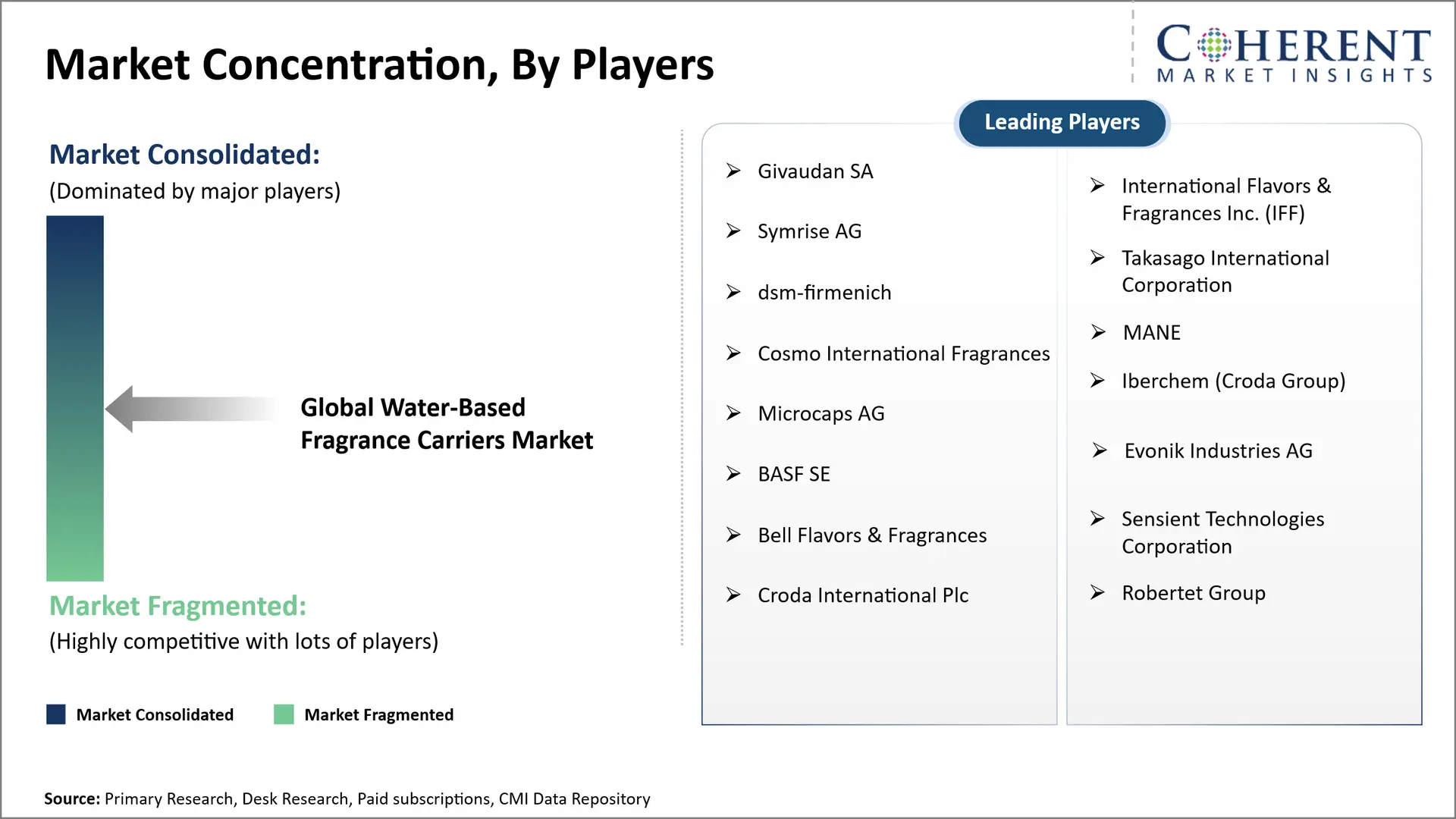
The global water-based fragrance carriers market appears moderately fragmented, with fragrance houses, specialty chemical formulators, surfactant suppliers and encapsulation specialists competing across different carrier chemistries. Large groups benefit from global customer access and formulation laboratories, while specialists compete through proprietary solubilization, release performance and custom blends. Qualification, stability evidence and reliable scale-up can matter as much as unit price.
Key Competitive Focus Areas
- Solubilization efficiency and clarity across varying fragrance loads, water hardness, pH and temperature.
- Compatibility with surfactants, preservatives, active ingredients and finished-product packaging.
- Fragrance retention and controlled release under washing, heat, humidity and friction.
- Batch consistency, shelf life and scale-up from laboratory samples to commercial production.
- Cost-in-use, dosage efficiency and transport and storage requirements.
- Regulatory documentation, allergen traceability and safety-data quality.
- Proprietary carrier chemistries, patent protection and customization flexibility.
- Application testing, co-development speed and technical support.
Market Report Scope
Global Water-Based Fragrance Carriers Market Report Coverage | |||
Report Coverage | Details | ||
Base Year | 2025 | Market Size in 2026: | USD 1.79 Bn |
Historical Data For: | 2020 to 2024 | Forecast Period: | 2026 to 2033 |
Forecast Period 2026 To 2033 CAGR: | 10.10% | 2033 Value Projection: | USD 3.5 Bn |
Geographies covered: |
| ||
Segments covered: |
| ||
Companies covered: | Givaudan SA, International Flavors & Fragrances Inc. (IFF), Symrise AG, Takasago International Corporation, dsm-firmenich, MANE, Cosmo International Fragrances, Iberchem (Croda Group), Microcaps AG, Evonik Industries AG, BASF SE, Sensient Technologies Corporation, Bell Flavors & Fragrances, Robertet Group, Croda International Plc | ||
Growth Drivers: |
| ||
Restraints & Challenges: |
| ||
Analyst Opinion (Expert Opinion)
- Future Market Direction: The global water-based fragrance carriers market is likely to move from selling individual solubilizers or capsule ingredients toward application-ready carrier systems supported by formulation assistance, performance data and compliance documentation. Suppliers able to validate the complete concentrate-to-finished-product pathway should build stronger customer relationships than those competing primarily on raw-material prices.
- Transformative Trend or Disruption: One potentially transformative shift is the development of modular carrier platforms that enable brands to change fragrance compositions or product formats without re-engineering the entire aqueous base. Standardized compatibility libraries and pre-qualified formulation modules would make product development easier for smaller brands. Suppliers with flexible carrier architectures, application expertise and defensible intellectual property would be better positioned to benefit.
- Recommendations, Risks and Strategic Priorities: Stability in use conditions, compatibility with preservatives, allergen traceability and reliable production at commercial scale are the things that the global water-based fragrance carriers market players should focus on. We need to focus more on technical partnerships with contract manufacturers, home-care formulators. Companies should avoid investing excessively in single-application carrier systems before securing repeat customer commitments. Margin pressure will remain particularly relevant where formulations are easily substituted and purchasing decisions depend primarily on ingredient price.
Speak to the analyst
Want personalized insights?
Take the findings above to one of our principal consultants, or have the report rebuilt around the segments, geographies and competitors you actually track.
Market Segmentation
- Carrier Technology Insights (Revenue, USD Bn, 2021 - 2033)
- Microencapsulation Systems
- Nanoemulsion Carriers
- Polymer-Based Controlled-Release Systems
- Solubilized & Microemulsion Systems
- Carrier Composition Insights (Revenue, USD Bn, 2021 - 2033)
- Synthetic Polymer-Based Carriers
- Surfactant & Solubilizer-Based Carriers
- Biopolymer-Based Carriers
- Cyclodextrin-Based Carriers
- Lipid-Based & Other Carriers
- Product Form Insights (Revenue, USD Bn, 2021 - 2033)
- Liquid Solubilized Concentrates
- Aqueous Emulsions & Dispersions
- Microcapsule Suspensions
- Dry Encapsulated Powders
- Application Insights (Revenue, USD Bn, 2021 - 2033)
- Personal Care & Cosmetics
- Household Cleaning & Air Care
- Textile & Fabric Care
- Automotive Interior Fragrance
- Other Applications
- End User Insights (Revenue, USD Bn, 2021 - 2033)
- Personal Care & Cosmetics Manufacturers
- Household Product Manufacturers
- Fragrance Houses & Compounders
- Textile Care Product Manufacturers
- Automotive & Other Product Manufacturers
- Regional Insights (Revenue, USD Bn, 2021 - 2033)
- North America
- U.S.
- Canada
- Latin America
- Brazil
- Argentina
- Mexico
- Rest of Latin America
- Europe
- Germany
- U.K.
- Spain
- France
- Italy
- Russia
- Rest of Europe
- Asia Pacific
- China
- India
- Japan
- Australia
- South Korea
- ASEAN
- Rest of Asia Pacific
- Middle East
- GCC Countries
- Israel
- Rest of Middle East
- Africa
- South Africa
- North Africa
- Central Africa
- North America
- Key Players Insights
- Givaudan SA
- International Flavors & Fragrances Inc. (IFF)
- Symrise AG
- Takasago International Corporation
- dsm-firmenich
- MANE
- Cosmo International Fragrances
- Iberchem (Croda Group)
- Microcaps AG
- Evonik Industries AG
- BASF SE
- Sensient Technologies Corporation
- Bell Flavors & Fragrances
- Robertet Group
- Croda International Plc
Sources
Primary Research Interviews
- Water-based fragrance carrier manufacturers, fragrance houses, encapsulation technology developers, and specialty chemical suppliers
- Personal care formulators, cosmetics manufacturers, household cleaning product manufacturers, and fragrance procurement managers
- Solubilizer, emulsifier, polymer, surfactant, and controlled-release technology specialists
Stakeholders
- Fragrance ingredient suppliers, essential oil producers, aroma chemical manufacturers, and perfumery compounders
- Synthetic polymer, biopolymer, cyclodextrin, lipid, surfactant, and solubilizer manufacturers
- Microencapsulation technology providers, nanoemulsion developers, and specialty chemical manufacturers
- Preservative suppliers, formulation laboratories, packaging manufacturers, and product testing laboratories
End-use Sectors
- Personal Care & Cosmetics: Alcohol-free perfumes, body mists, hair fragrances, skincare, and fragranced personal-care formulations
- Household Cleaning & Air Care: Liquid detergents, surface cleaners, air fresheners, room sprays, and household fragrance products
- Textile & Fabric Care: Fabric conditioners, laundry detergents, textile sprays, and fragrance-release formulations
- Automotive Interior Fragrance: Car air fresheners, interior fragrance sprays, and cabin fragrance systems
- Other Applications: Specialized aqueous fragrance formulations and emerging consumer applications
Regulatory and Industry Bodies
- European Commission and European Chemicals Agency (ECHA)
- International Fragrance Association (IFRA) and Research Institute for Fragrance Materials (RIFM)
- U.S. Food and Drug Administration (FDA) and Environmental Protection Agency (EPA)
- Personal Care Products Council (PCPC), U.S.
- Central Drugs Standard Control Organisation (CDSCO), India
- Bureau of Indian Standards (BIS)
- National Medical Products Administration (NMPA), China
- State Administration for Market Regulation (SAMR), China
Databases
- UN Comtrade and ITC Trade Map
- Eurostat COMEXT and PRODCOM
- U.S. Census Bureau Foreign Trade Statistics and USITC DataWeb
- India TradeStat and Directorate General of Commercial Intelligence and Statistics (DGCI&S)
- China Customs Trade Statistics
Magazines and Journals
- Flavour and Fragrance Journal
- International Journal of Cosmetic Science
- Journal of Surfactants and Detergents
- Journal of Microencapsulation
- Colloids and Surfaces A: Physicochemical and Engineering Aspects
- Cosmetics
- Perfumer & Flavorist
- Cosmetics & Toiletries
- Happi (Household and Personal Products Industry)
Associations
- International Fragrance Association (IFRA)
- Research Institute for Fragrance Materials (RIFM)
- International Federation of Essential Oils and Aroma Trades (IFEAT)
- Personal Care Products Council (PCPC)
- Cosmetics Europe
- American Cleaning Institute (ACI)
- Household & Commercial Products Association (HCPA)
- Society of Cosmetic Chemists (SCC)
- Indian Fragrance & Flavours Association (IFFA)
Public Domain Sources
- Water-based fragrance carrier product catalogues, technical datasheets, safety data sheets (SDS), and formulation specifications
- Fragrance solubility, carrier composition, polymer concentration, encapsulation efficiency, particle size, viscosity, and stability specifications
- Company annual reports, product launches, patents, manufacturing investments, capacity expansions, and sustainability reports
- Fragrance formulation studies, product ingredient disclosures, cosmetic product listings, and household-care product specifications
- Research publications covering microencapsulation, nanoemulsions, cyclodextrin complexation, solubilization, and controlled-release fragrance technologies
Key Standards and Regulations
- EU Regulation (EC) No. 1223/2009 – Cosmetics Regulation
- EU Regulation (EU) 2023/1545 – Fragrance Allergen Labelling Requirements
- EU Regulation (EC) No. 1907/2006 – REACH
- EU Regulation (EC) No. 1272/2008 – Classification, Labelling and Packaging (CLP)
- EU Regulation (EC) No. 648/2004 – Detergents Regulation
- U.S. Federal Food, Drug, and Cosmetic Act (FD&C Act) and Modernization of Cosmetics Regulation Act (MoCRA), 2022
- U.S. Toxic Substances Control Act (TSCA) – Chemical Substance Requirements, where applicable
- India Drugs and Cosmetics Act, 1940 and Cosmetics Rules, 2020
- China Cosmetics Supervision and Administration Regulation (CSAR), 2021
- IFRA Standards, 51st Amendment – Fragrance Ingredient Safety and Usage Restrictions (voluntary industry standards)
- ISO 22716:2007 – Cosmetics: Good Manufacturing Practices
- ISO 16128 – Guidelines on Technical Definitions and Criteria for Natural and Organic Cosmetic Ingredients
Proprietary Elements
- CMI Data Analytics Tool
- Proprietary research repository, supported by primary interviews, carrier cost and composition analysis, technology benchmarking, capacity assessment, market sizing, ASP analysis, trade evaluation, and competitive intelligence.
Get access to 250+ pages report
Every segment, forecast, competitor profile and data table behind the analysis above — available for instant download.
- ESOMAR Member
- ISO 9001:2015 Certified
- D-U-N-S Registered
- GDPR & CCPA Compliant
Frequently Asked Questions
The CAGR of the global water-based fragrance carriers market is projected to be 10.10% from 2026 to 2033.
The global water-based fragrance carriers market is estimated to be valued at USD 1.79 Bn in 2026 and is projected to reach USD 3.5 Bn by 2033.
Water-based fragrance carriers are primarily used in personal care and cosmetics, household cleaning and air care, textile and fabric care, automotive interior fragrance, and other applications.
The major carrier compositions include synthetic polymer-based carriers, surfactant and solubilizer-based carriers, biopolymer-based carriers, cyclodextrin-based carriers, and lipid-based and other carriers.
The major product forms include liquid solubilized concentrates, aqueous emulsions and dispersions, microcapsule suspensions, and dry encapsulated powders.
Personal care and cosmetics manufacturers, household product manufacturers, fragrance houses and compounders, textile care product manufacturers, and automotive and other product manufacturers are the major end users.
Growing demand for alcohol-free fragrance formulations and increasing use of water-based fragrances in personal care products are key factors driving the growth of the global water-based fragrance carriers market.