

Global Wireless Intercom Systems Market Size and Forecast – 2026 To 2033
The global wireless intercom systems market is expected to grow from USD 8 Bn in 2026 to USD 13 Bn by 2033, registering a compound annual growth rate (CAGR) of 7% from 2026 to 2033. The global wireless intercom systems market is driven by increasing adoption across live events and broadcasting. On September 12, 2025, Hollyland launched the Solidcom H1 wireless intercom system for mid-to-large production teams. It supports up to 80 beltpacks, 500-meter line-of-sight transmission, and roaming.
Key Takeaways of the Global Wireless Intercom Systems Market
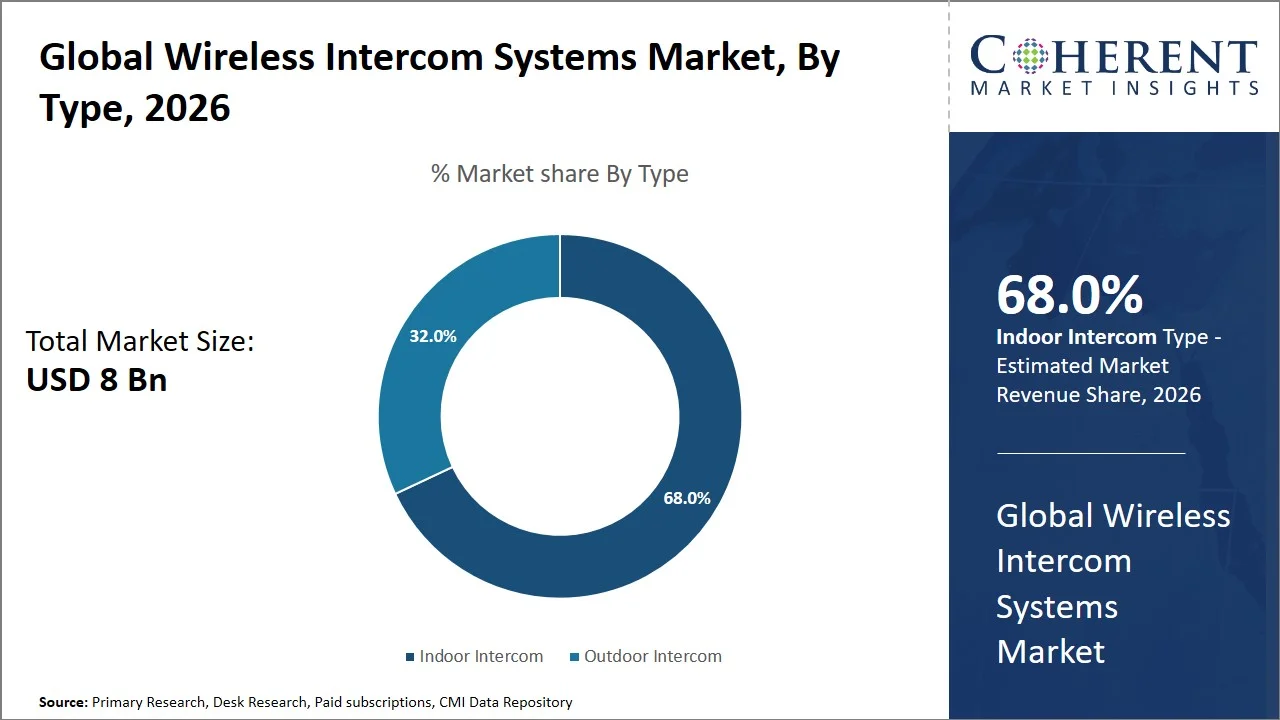
- The Indoor Intercom segment is expected to account for 68.0 % of the global wireless intercom systems market share in 2026. Growing demand for rapid system deployment is driving the growth of the segment. On March 27, 2025, Pliant Technologies announced availability of new CrewCom wireless accessories and headsets. The company also released CrewCom CB2 Version 1.2 for existing systems.
- The Audio Intercom segment is estimated to capture 71.0 % of the market share in 2026. Growing adoption of IP-based communication systems is majorly driving the growth of the segment. On June 15, 2026, Clear-Com introduced Avalon, a 1RU IP intercom platform for broadcast and live production. It supports AES67, Dante, and I.V. Direct connectivity.
- The Wi-Fi segment is estimated to capture 42.0 % of the market share in 2026. Expansion of wireless security infrastructure is majorly driving the growth of the segment. In March 2026, Panasonic launched the VL-VQ Series SIP-based IP video intercom system in India. It combines door stations, lobby displays, room monitors, guard stations, and centralized management.
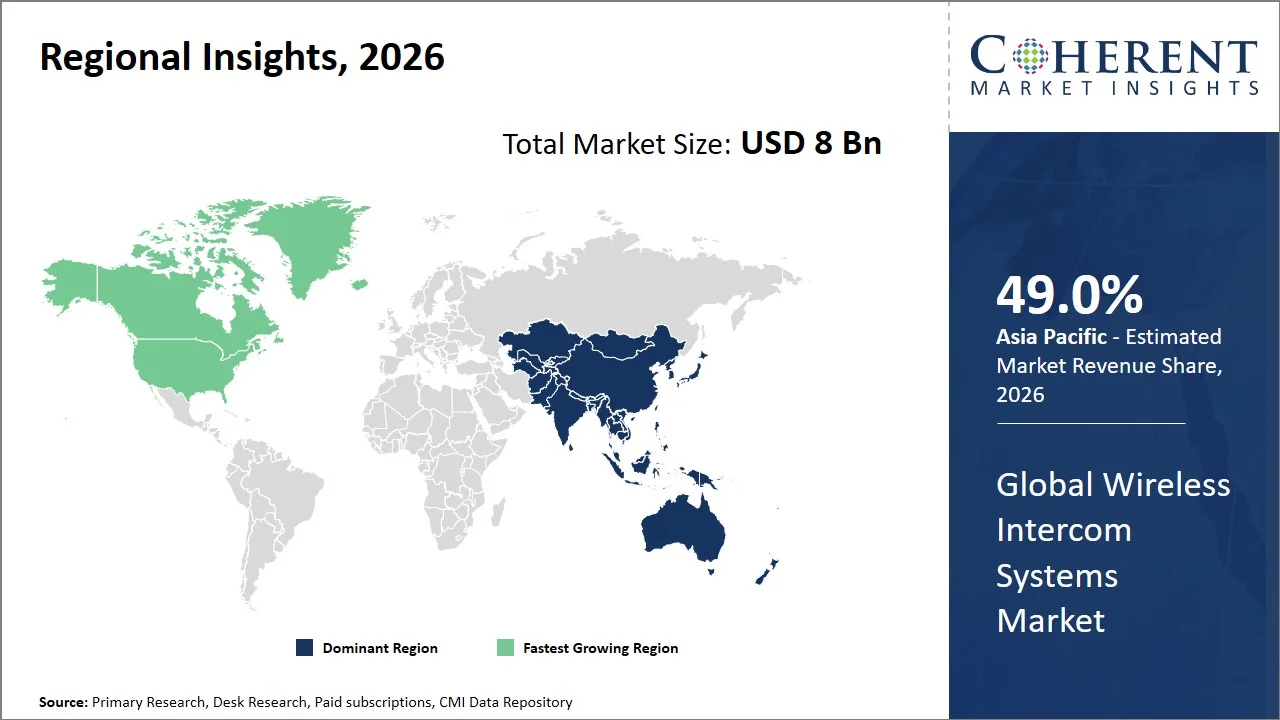
- Asia Pacific is expected to dominate the wireless intercom systems market in 2026 with a market share of 49.0 %. Integration with cloud communication platforms in Asia Pacific is driving the growth of the regional market. On March 23, 2026, IPC introduced One Link keypanels for its One Connect WebRTC matrix intercom platform. One Connect supports cloud-hosted, on-premises, and hybrid communication models for broadcast and live production.
- North America is expected to account for 29.0% share in 2026 and is projected to record the fastest growth over the forecast period. Increasing demand for wireless systems in smart buildings in North America is driving the growth of the regional market. In March 2025, Johnson Controls introduced PowerG+ for next-generation wireless security and building automation.
Segmental Insights
Why Does Indoor Intercom Dominate the Global Wireless Intercom Systems Market?
The indoor intercom segment is expected to account for 68.0% of the global wireless intercom systems market share in 2026. Indoor intercoms are in high demand in residential and commercial buildings where simple communication between occupants is needed. They enable building occupants to screen visitors and regulate access without coming to building entrances. Panasonic Corporation has launched the most sophisticated integrated indoor communication and access management system for residential use in India. Aiphone Co., Ltd has developed indoor communication systems for apartment complexes, office buildings and multi-tenant buildings. Wide utility at the building level encourages continued use in residential and business wireless intercom applications. In September 2025, Hikvision launched their IP Series video door phone system for apartments and suburban homes. The inside station provides touchscreen communication, mobile controls, remote unlocking, and security system integration.
- Current Industry Events of 2026
- Market Size Estimation
- Regional Breakdown
- Competitive Landscape
- Customer Intelligence
- Segmental Analysis
- Pricing Analysis
- Key Market Drivers, Challenges & Future Trends
- Customized Insights Section
Why is Audio Intercom the Most Preferred Communication Type?
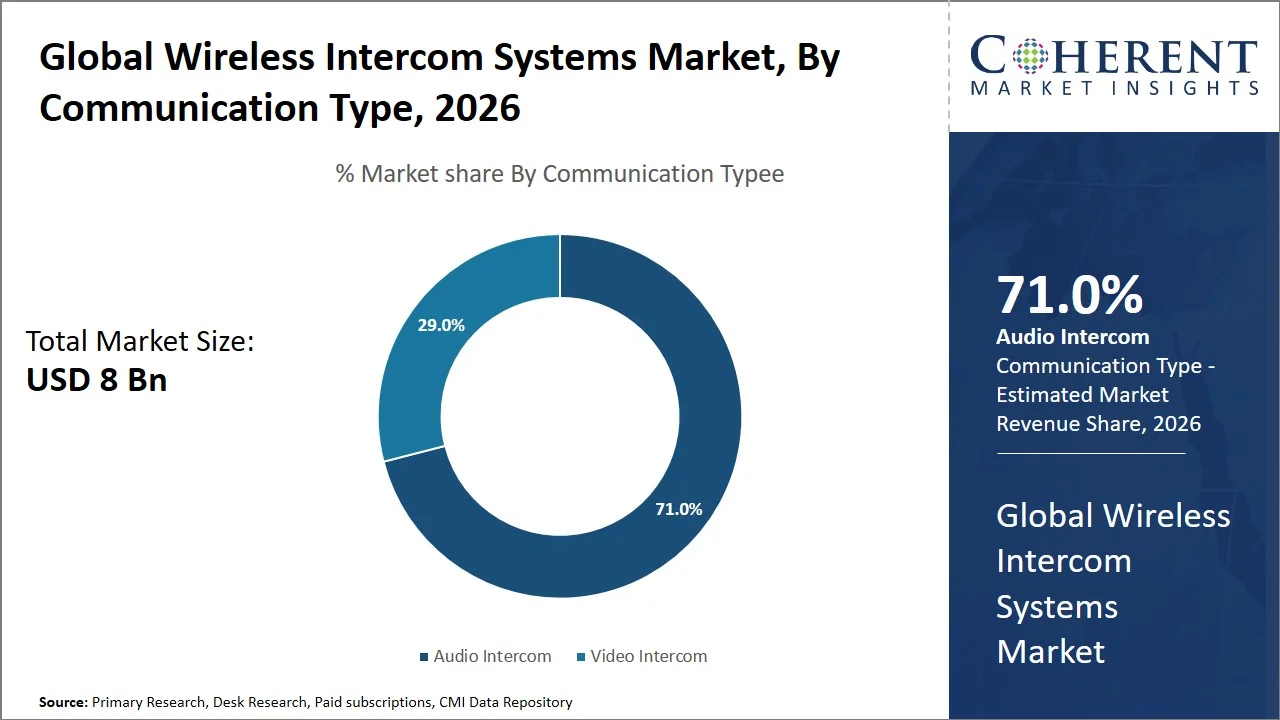
The audio intercom segment is expected to account for 71.0% of the global wireless intercom systems market share in 2026. A primary reason of demand for audio intercoms is that voice communication is still the primary usage in many applications of an intercom. Clear voice allows users to communicate rapidly, without displays or other visual interfaces. Clear-Com provides full-duplex audio and noise cancelation for the most demanding professional applications. TOA India also focuses on noise cancelation and clear transmission of voice over the intercom systems. The significance of intelligibility results in a high preference for audio-based communication in security and operational situations. On April 8, 2025, Riedel Communications unveiled the DSP-1216HL SmartPanel at the 2025 NAB Show, introducing a compact, ergonomic desktop intercom panel designed to complement the company’s industry-leading 1200 Series SmartPanels.
Wi-Fi Dominates the Global Wireless Intercom Systems Market
The Wi-Fi segment is expected to account for 42.0% of the global wireless intercom systems market share in 2026. Wi-Fi supports intercom deployment by using existing wireless network infrastructure in buildings and facilities. Icom highlights scalable communication using existing or newly installed Internet Protocol and Wi-Fi networks. The reason for audio intercoms is that voice communication is still the primary usage in many applications of an intercom. Clear voice allows users to communicate rapidly, without displays or other visual interfaces. Clear-Com provides full-duplex audio and noise cancelation for the most demanding professional applications. TOA India also focuses on noise cancelation and clear transmission of voice over the intercom systems. The significance of intelligibility results in a high preference for audio-based communication in security and operational situations. On April 29, 2025, 2N connected its IP intercoms with Microsoft Teams using Microsoft’s Session Initiation Protocol Gateway.
Current Events and their Impact
Current Events | Description and its Impact |
Radio Equipment Directive Delegated Regulation (EU) 2022/30 - European Union |
|
Product Security and Telecommunications Infrastructure Act 2022 - U.K. |
|
Wireless Intercom Systems Market Dynamics
Market Drivers
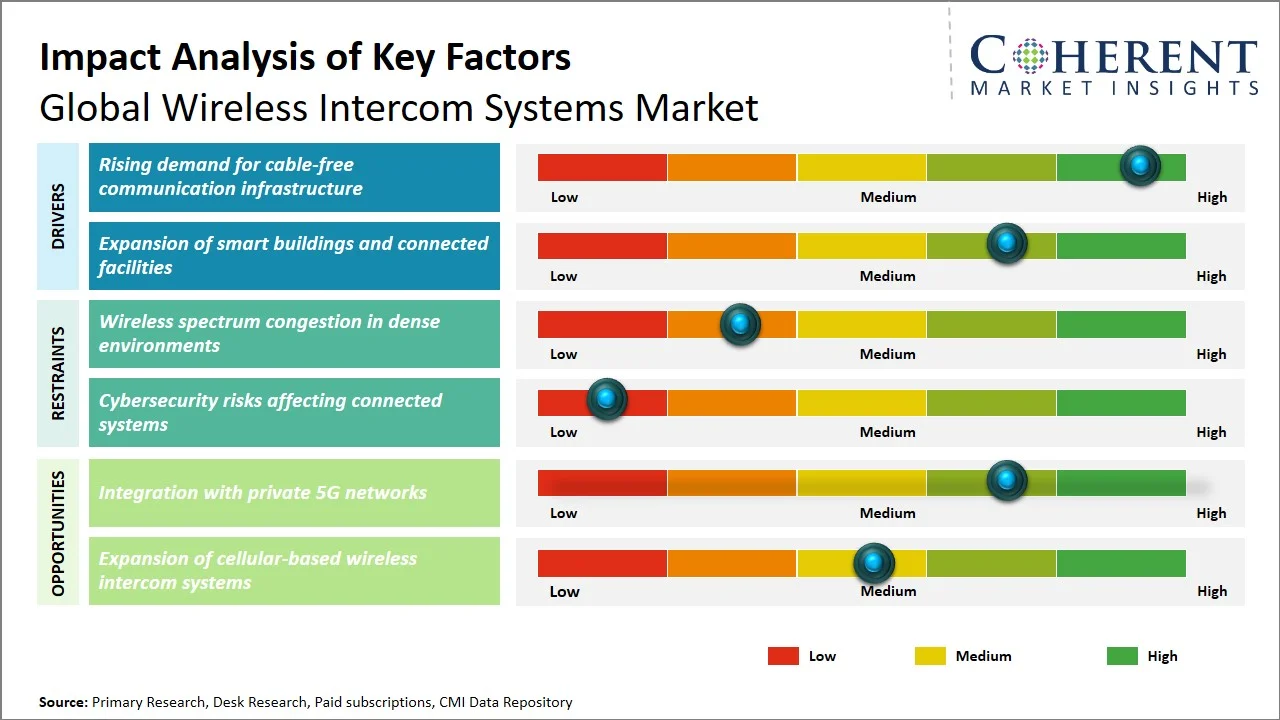
- Rising demand for cable-free communication infrastructure: The rising trend of cable-free communication is boosting the demand for wireless intercom systems in commercial and industrial sectors. Wireless solutions can minimize the need for significant communication infrastructure in new construction and facility expansions. They also allow quicker deployment in areas where more cable would mean structural changes. Increasingly construction sites, warehouses, hotels and event venues require flexible communication between distant staff. This infrastructural flexibility allows for a larger adoption of wireless intercom solutions for both temporary and permanent communication needs. For example, Riedel has increased wireless communication capabilities throughout professional production environments. Its Bolero wireless intercom device is ideal for mobility teams that need to move freely across industrial sites.
- Expansion of smart buildings and connected facilities: The growing trend of smart buildings is boosting the demand for communication systems interlinked for security and facility management. Wireless intercoms also combine with access control, surveillance cameras, mobile devices and building management platforms. Network connectivity allows communication endpoints to be located throughout buildings without a lot of dedicated wiring. Connected security infrastructure is becoming increasingly popular in commercial workplaces, residential complexes, hospitals, and educational facilities. This combination drives the demand for wireless intercom systems in the ever-automating building environment. On July 9, 2026, Panasonic stated that it will be the first partner to employ the Open Digital Platform (ODP), Punggol Digital District’s (PDD) smart operating system, to develop and pilot solutions for deployment in PDD’s live urban environment.
Emerging Trends
- Artificial intelligence integration is increasing: More wireless intercom solutions are integrating artificial intelligence features such as intelligent noise suppression, speech augmentation, and automatic monitoring. These capabilities increase speech quality and allow for speedier communications in busy commercial, industrial, and security contexts.
- Cloud-connected intercom architectures are expanding: Cloud-connected intercom architectures are growing, with manufacturers creating systems that allow for remote administration, centralized device management, software updates, and multi-site communication. This method allows enterprises to manage distributed intercom networks across offices, campuses, residential homes and facilities.
- Private 5G connectivity is emerging for professional deployments: The high dependability, low latency and dedicated network capacity can facilitate intercom communication across industrial sites. Manufacturers are increasingly turning to cellular connectivity for demanding operational situations that need reliable wireless communication.
- Integration with security ecosystems is accelerating: Intercoms are increasingly being integrated with access control, video surveillance cameras, mobile apps and building management platforms. Unified systems enable enterprises to integrate visitor communication, identification, monitoring and entry management into connected security settings.
Regional Insights
Why is Asia Pacific a Strong Market for Wireless Intercom Systems?
Asia Pacific is expected to account for a market share of 49.0% in 2026. Rapid smart-building implementation and huge residential complexes are shaping Asia Pacific. China is now incorporating smart communication infrastructure into new business and residential constructions. Japan has always had deep intercom adoption, with AIPHONE boasting >50% domestic share. AIPHONE systems are installed in railroad stations, factories, hospitals and residential buildings. AIPHONE is also known to be deployed at Changi International Airport in Singapore. India sees more residential demand from gated communities and integrated townships. Panasonic Life Solutions India launched its VL-VQ Series in March 2026. The system combines room monitors, guard stations, door stations, and centralized management.
Why Does North America Wireless Intercom Systems Market Exhibit High Growth?
North America is expected to register the fastest growth with a CAGR of 8.2% over the forecast period. It is projected to account for 29.0% of the global wireless intercom systems market in 2026. Demand in this region is strongly connected with professional security communication and large institutional facilities. Healthcare facilities increasingly require reliable communication between security personnel, staff, and controlled areas. AIPHONE documents deployments and customer use across U.S. hospitals and construction projects. Its systems support visitor screening, tenant communication, and remote door release. Airport security also creates specialized requirements for emergency communication and access management. AIPHONE identifies airport passenger assistance points as applications across terminals and restricted areas. Commercial property operators increasingly combine intercoms with access credentials and security infrastructure. This supports demand for connected communication systems across offices, hospitals, campuses, and transportation facilities.
Global Wireless Intercom Systems Market Outlook for Key Countries
Why is China Emerging as a Major Hub in the Wireless Intercom Systems Market?
China is being driven by large-scale deployment of connected residential and commercial infrastructure. High-rise developments increasingly require centralized communication between residents, entrances, security rooms, and property managers. Industrial facilities also provide opportunities because distributed operations require rapid personnel communication. AIPHONE has plants in Thailand and Vietnam and supplies products in over 70 countries. Demand in China is also driven by the widespread use of intelligent building technologies and networked security devices. The integration with cameras, access control and mobile applications is becoming more and more relevant. These deployments create opportunities for wireless and Internet Protocol-based intercom architectures across newly constructed facilities.
Is U.S. the Next Growth Engine for the Wireless Intercom Systems Market?
The U.S. wireless intercom systems market is benefiting from advanced commercial security requirements and large institutional building infrastructure. Hospitals need communication systems that allow for regulated access, staff coordination and emergency response. AIPHONE identifies U.S. hospital security managers among its documented users. Construction companies also use intercom systems for secure visitor management and building access. Office buildings increasingly connect intercoms with credential management and remote door release. Airports represent another specialized application because passenger assistance points require immediate communication with airport personnel. These applications encourage higher integration between intercoms, access control, surveillance, and facility security systems.
Germany Wireless Intercom Systems Market Analysis and Trends
Germany presents opportunities through sophisticated building automation and professional facility communication requirements. Industry facilities require reliable communication between manufacturing areas, control rooms, warehouses and security officers. Controlled communication between different departments and limited areas is also required in healthcare facilities. AIPHONE lists hospitals, police stations, fire stations and factories as some of the applications it supports. Visitor communication is progressively becoming integrated in commercial buildings with access control and security credentials. These criteria favor migration toward networked intercom designs that provide centralized administration. Additionally, Germany’s robust industrial automation infrastructure gives chances for intercoms to be integrated into connected operating contexts.
Japan Wireless Intercom Systems Market Analysis and Trends
Japan has an exceptionally established intercom ecosystem supported by long-term residential and commercial adoption. AIPHONE reports more than 50% domestic market share and over 75 years of industry experience. Apartment buildings represent an important application because replacement systems are designed around long operational lifecycles. AIPHONE states that its apartment systems target a 15-year service life. Railway stations, factories, hospitals, airports, and emergency facilities further diversify demand. AIPHONE also reports annual shipments of approximately four million units globally. Japan therefore provides strong demand for reliable, durable, and integrated communication infrastructure.
India Wireless Intercom Systems Market Analysis and Trends
India is experiencing particularly strong demand from gated communities, high-rise apartments, and integrated townships. The platform links homes, building entrances, guard stations and central management. The technology integrates face recognition, QR codes, cellphones and access management. Its room monitor includes Wi-Fi connectivity and smartphone application integration. India also has documented AIPHONE installations at Northeast Frontier Railway facilities. Large residential projects therefore create distinct demand for scalable communication and centralized security management.
Global Wireless Intercom Systems Market - Wireless Intercom Operating Frequency by Country
Country | Primary operating frequency used in wireless intercom systems | Common wireless technology |
U.S. | 1.920-1.930 GHz; 2.4 GHz; 5 GHz | DECT 6.0; Wi-Fi; FHSS |
Canada | 1.920-1.930 GHz; 2.4 GHz; 5 GHz | DECT 6.0; Wi-Fi; FHSS |
Germany | 1.880-1.900 GHz; 2.4 GHz; 5 GHz | DECT; Wi-Fi |
United Kingdom | 1.880-1.900 GHz; 2.4 GHz; 5 GHz | DECT; Wi-Fi |
France | 1.880-1.900 GHz; 2.4 GHz; 5 GHz | DECT; Wi-Fi |
Japan | 1.895-1.904 GHz; 2.4 GHz; 5 GHz | J-DECT; Wi-Fi |
China | 2.4 GHz; 5 GHz | Wi-Fi; proprietary digital wireless |
India | 1.880-1.900 GHz; 2.4 GHz; 5 GHz | DECT; Wi-Fi |
South Korea | 1.786-1.792 GHz; 2.4 GHz; 5 GHz | K-DECT; Wi-Fi |
Australia | 1.880-1.900 GHz; 2.4 GHz; 5 GHz | DECT; Wi-Fi |
How is Integration with Private 5G Networks Creating New Growth Opportunities in the Wireless Intercom Systems Market?
Private 5G is enabling intercoms in huge industrial sites where Wi-Fi congestion might interrupt communications. In 2025, Siemens developed its private 5G infrastructure to include larger industrial sites and up to 24 radio units. In April 2026, Clear-Com announced FreeSpeak Cell, which supports intercom communications across private LTE and 5G networks. This system is designed for big production facilities where the normal UHF, DECT and Wi-Fi bands can be congested. Private 5G also allows intercoms to mix audio, video and data with industrial worker applications. This is demonstrated by Nokia’s Team Comms with priority calling, location info, video sharing and emergency functions. On December 3, 2025, Riedel Communications announced a new partnership with Haivision. By combining Haivision’s ultra-low-latency live video transmission systems with Riedel’s Easy5G Private 5G solution, customers will be able to source comprehensive wireless video solutions from a single provider.
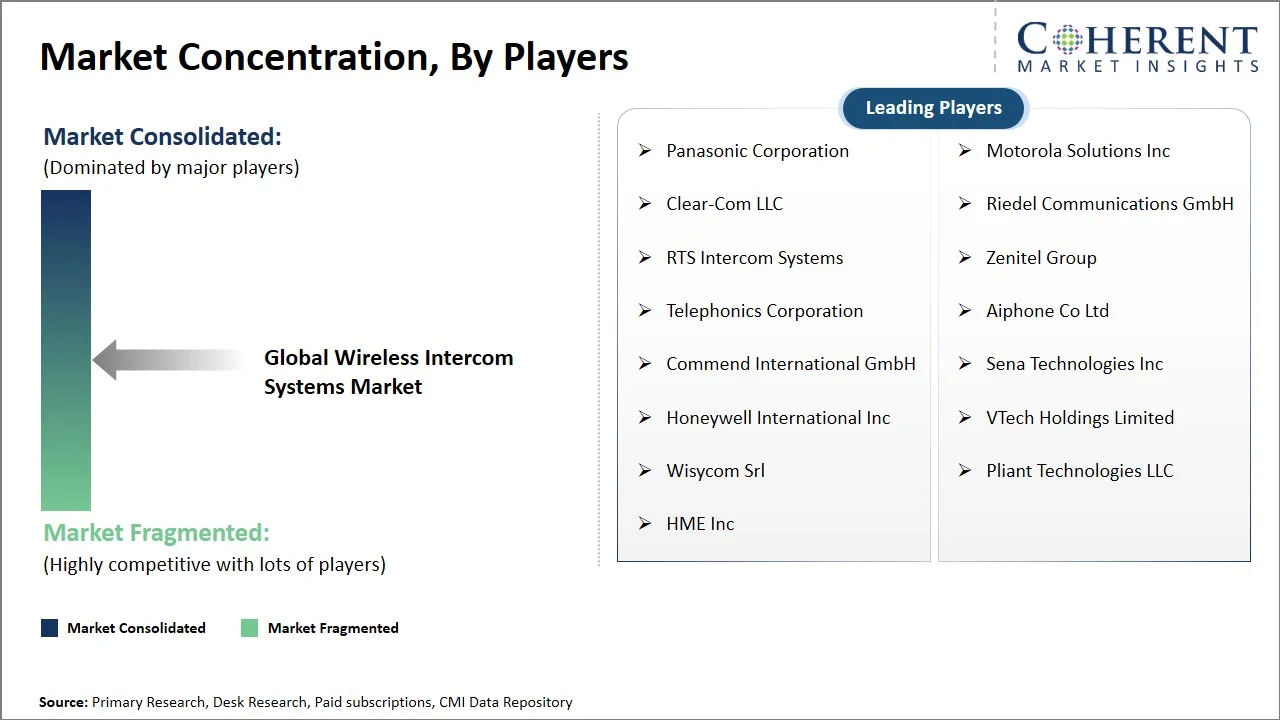
Market Players, Key Development, and Competitive Landscape
Key Developments
- On August 4, 2025, 2N launched the IP Force 2.0 rugged video intercom with a 5-megapixel camera. It targets parking garages, industrial sites, and other high-risk locations. The platform also supports secure OSDP access control and third-party security integration.
- On March 31, 2025, Zenitel announced it is launching two new innovations for mixed-use building communication solutions, the Zenitel Display Door intercom (ZDD-1) and the Zenitel Slim Door intercom (ZSD-1). This launch further strengthens Zenitel’s position as a market leader in audio communication solutions.
Competitive Landscape
The competitive environment is evolving toward integrated, networked and cellular-enabled communications platforms. Clear-Com is looking beyond standard radio-frequency networks, launching FreeSpeak Cell in April 2026. The system supports hundreds of beltpack users on private and public 4G LTE and 5G networks. Clear-Com is targeting broadcast, sports, entertainment and regionally spread productions. Motorola Solutions has a broader security ecosystem plan with Avigilon, including intercom, access control, video security and visitor management. The acquisition of InVisit in 2025 added cloud-based visitor management to this platform. The AIPHONE IXG System is designed for big residential and commercial premises. The platform integrates smartphone apps, access control, property management and third-party Internet Protocol. Riedel Communications continues focusing on professional wireless production communications and integrated intercom workflows. These strategies indicate increasing competition around ecosystem integration rather than standalone intercom hardware.
Market Report Scope
Wireless Intercom Systems Market Report Coverage
| Report Coverage | Details | ||
|---|---|---|---|
| Base Year: | 2025 | Market Size in 2026: | USD 8 Bn |
| Historical Data for: | 2020 To 2024 | Forecast Period: | 2026 To 2033 |
| Forecast Period 2026 to 2033 CAGR: | 7% | 2033 Value Projection: | USD 13 Bn |
| Geographies covered: |
| ||
| Segments covered: |
| ||
| Companies covered: | Panasonic Corporation, Motorola Solutions Inc, Clear-Com LLC, Riedel Communications GmbH, RTS Intercom Systems, Zenitel Group, Telephonics Corporation, Aiphone Co Ltd, Commend International GmbH, Sena Technologies Inc, Honeywell International Inc, VTech Holdings Limited, Wisycom Srl, Pliant Technologies LLC, HME Inc | ||
| Growth Drivers: |
| ||
| Restraints & Challenges: |
| ||
Analyst Opinion (Expert Opinion)
- The industry's future is expected to move toward network-based wireless intercom architectures supporting wider coverage and simpler deployment. Cellular connectivity will become particularly important for large venues, broadcast compounds, industrial campuses, and distributed facilities. Clear-Com's FreeSpeak Cell already demonstrates this direction through private 5G and LTE connectivity. Its Nürburgring deployment with RTL Deutschland further demonstrates cellular intercom use across a large racing venue. The strongest opportunity is expected in professional applications requiring mobility across large geographic areas. Players should therefore prioritize cellular-capable beltpacks, roaming, low-latency voice, and hybrid network compatibility.
- The maximum opportunity is expected to emerge across large commercial facilities, industrial campuses, sports venues, and live production environments. Asia Pacific should receive particular attention because large residential developments and connected infrastructure create extensive deployment opportunities. India offers a notable residential opportunity through high-rise communities and gated developments. Japan presents a different opportunity through replacement demand and established apartment communication infrastructure. Companies should develop region-specific products supporting local spectrum requirements, building configurations, and installation practices.
- Competitive advantage will increasingly depend on interoperability rather than standalone wireless communication performance. Players should connect intercoms with access control, video surveillance, visitor management, mobile applications, and emergency communication platforms. Motorola Solutions demonstrates this direction by integrating intercoms within its broader Avigilon security ecosystem. Manufacturers should also offer hybrid architectures supporting conventional radio frequency, Wi-Fi, private LTE, and private 5G. This approach would allow customers to select connectivity according to venue size, spectrum conditions, and operational requirements.
Speak to the analyst
Want personalized insights?
Take the findings above to one of our principal consultants, or have the report rebuilt around the segments, geographies and competitors you actually track.
Market Segmentation
- Type Insights (Revenue, USD Billion, 2021 - 2033)
- Indoor Intercom
- Outdoor Intercom
- Communication Type Insights (Revenue, USD Billion, 2021 - 2033)
- Audio Intercom
- Video Intercom
- Technology Type Insights (Revenue, USD Billion, 2021 - 2033)
- Wi-Fi
- Radio Frequency
- DECT
- Bluetooth
- Cellular
- Network Type Insights (Revenue, USD Billion, 2021 - 2033)
- Standalone Wireless
- Internet Protocol
- Private LTE
- Private 5G
- Application Insights (Revenue, USD Billion, 2021 - 2033)
- Residential
- Commercial
- Industrial
- End User Insights (Revenue, USD Billion, 2021 - 2033)
- Broadcasting
- Live Events
- Security
- Healthcare
- Education
- Manufacturing
- Regional Insights (Revenue, USD Billion, 2021 - 2033)
- North America
- U.S.
- Canada
- Latin America
- Brazil
- Argentina
- Mexico
- Rest of Latin America
- Europe
- Germany
- U.K.
- Spain
- France
- Italy
- Russia
- Rest of Europe
- Asia Pacific
- China
- India
- Japan
- Australia
- South Korea
- ASEAN
- Rest of Asia Pacific
- Middle East
- GCC Countries
- Israel
- Rest of Middle East
- Africa
- South Africa
- North Africa
- Central Africa
- North America
- Key Players Insights
- Panasonic Corporation
- Motorola Solutions Inc
- Clear-Com LLC
- Riedel Communications GmbH
- RTS Intercom Systems
- Zenitel Group
- Telephonics Corporation
- Aiphone Co Ltd
- Commend International GmbH
- Sena Technologies Inc
- Honeywell International Inc
- VTech Holdings Limited
- Wisycom Srl
- Pliant Technologies LLC
- HME Inc
Sources
Primary Research Interviews
- Wireless Intercom System Manufacturers & OEMs
- Security & Surveillance Solution Providers
- System Integrators & Installers
- Commercial & Residential End-Users
Magazines
- Security Technology Executive (STE)
- SDM (Security Dealer & Integrator) Magazine
- CE Pro (Custom Electronics Professional) Magazine
- Residential Systems Magazine
Journals
- IEEE Transactions on Wireless Communications
- Journal of Security and Safety Technology
- International Journal of Communication Systems
Associations
- Security Industry Association (SIA)
- Consumer Technology Association (CTA)
- Electronic Security Association (ESA)
- International Electrotechnical Commission (IEC)
Public Domain Sources
- U.S. Federal Communications Commission (FCC) Reports
- European Telecommunications Standards Institute (ETSI) Publications
- World Trade Organization (WTO) Trade Data
Proprietary Elements
- CMI Data Analytics Tool
- Proprietary CMI Existing Repository of Information for the last 10 years
Get access to 250+ pages report
Every segment, forecast, competitor profile and data table behind the analysis above — available for instant download.
- ESOMAR Member
- ISO 9001:2015 Certified
- D-U-N-S Registered
- GDPR & CCPA Compliant
Missing comfort of reading report in your local language? Find your preferred language:
Frequently Asked Questions
The global wireless intercom systems market is expected to stand at USD 8 Bn in 2026 and is expected to reach USD 13 Bn by 2033.
The CAGR of the global wireless intercom systems market is projected to be 7% from 2026 to 2033.
Wireless intercom systems enable real-time voice or video communication without dedicated intercom wiring.
Yes, cellular intercom platforms can operate on private LTE and 5G networks.
They connect communication with access control, surveillance, visitor management, and building automation systems.
Yes, modern systems can provide smartphone connectivity for remote communication and door access.
Cloud connectivity enables centralized administration, remote monitoring, software updates, and multi-site system management.