

Molecular Sieve Catalyst Market Size and Forecast — 2026 - 2033
The Global Molecular Sieve Catalyst Market size is estimated to be valued at USD 3.45 billion in 2026 and is expected to reach USD 5.90 billion by 2033, exhibiting a compound annual growth rate (CAGR) of 8.6% from 2026 to 2033.
Overview
The molecular sieve catalyst market is driven by rising demand in petrochemical refining, where zeolite‑based sieves improve hydrocarbon cracking efficiency and yield. Growth in global energy consumption and stringent fuel quality standards boost refinery investments in catalysts that enhance octane and minimize emissions. Expanding LNG production and gas purification applications increase use of molecular sieves for moisture and CO₂ removal. Additionally, robust growth in chemical intermediates production, such as olefins and aromatics—underpins catalyst adoption. Technological advancements in tailored sieve pore structures optimize selectivity and lifespan, while rapid industrialization in Asia‑Pacific fuels market expansion, particularly in China and India’s refining and petrochemical sectors.
Key Takeaways
Zeolite based catalysts dominate the Molecular Sieve Catalyst Market with nearly 52% market share because of their superior selectivity, thermal stability, and regeneration capabilities in petrochemical refining and chemical processing applications.
Petrochemical refining represents the leading application segment in terms of revenue, supported by rising global demand for gasoline, olefins, and cleaner fuel production technologies.
Asia Pacific holds the largest market share in the Molecular Sieve Catalyst industry due to rapid industrialization, refinery expansion, and growing petrochemical production in countries such as China and India. Local companies including Sinopec Corp continue to contribute significantly to regional market growth.
North America is projected to record the fastest CAGR, driven by shale gas development, expanding refining activities, and stringent environmental regulations supporting cleaner industrial processing in the United States and Canada.
Molecular Sieve Catalyst Market Segmentation Analysis
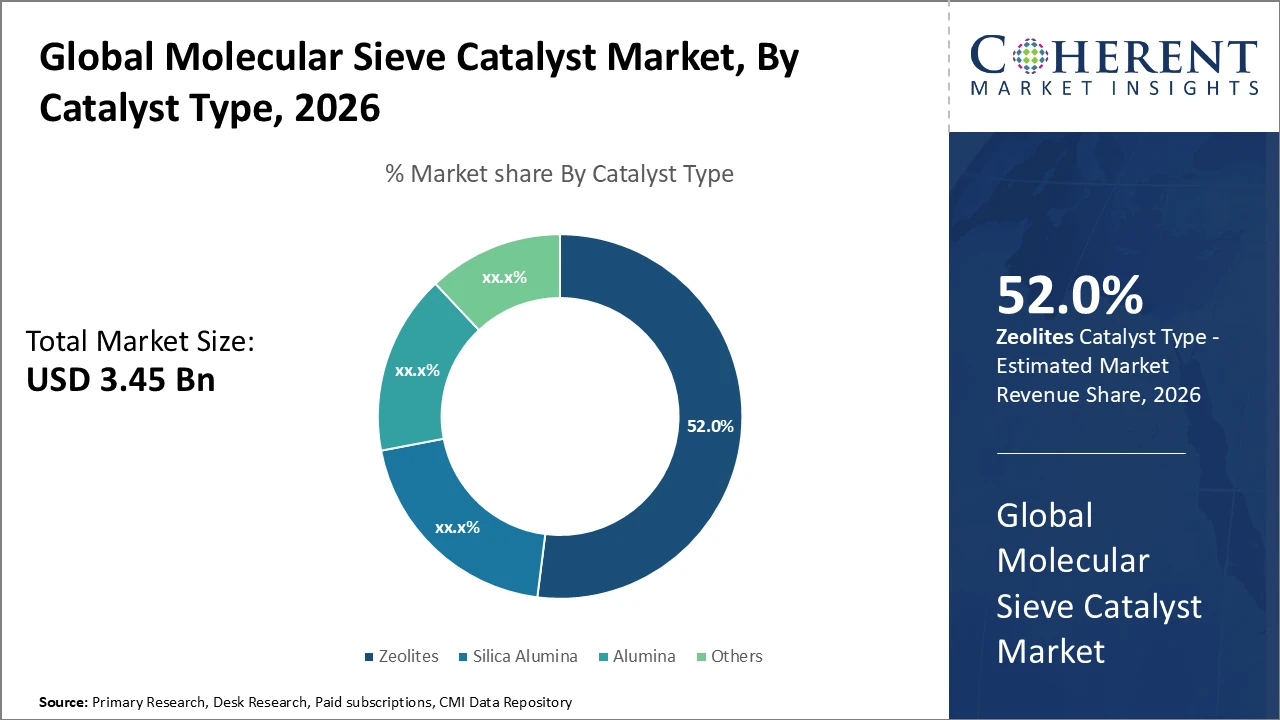
Molecular Sieve Catalyst Market Insights, By Catalyst Type
Zeolites dominate the Molecular Sieve Catalyst Market with approximately 52% market share because of their exceptional catalytic selectivity, high thermal stability, and strong regeneration performance under demanding industrial conditions. These properties make zeolites essential for petrochemical refining, fluid catalytic cracking, and chemical synthesis applications. Silica alumina represents the fastest growing subsegment due to its cost effectiveness and broad application in hydrocarbon cracking and isomerization processes. Alumina based molecular sieve catalysts continue to play an important role as stable catalyst supports in high temperature industrial operations. Other emerging materials, including mesoporous molecular sieves, currently serve niche applications but are gradually gaining industrial attention for specialized catalytic processes.
Molecular Sieve Catalyst Market Insights, By Application
Petrochemical refining dominates the Molecular Sieve Catalyst Market because of extensive utilization in catalytic cracking, hydrocracking, and olefin separation processes that support large scale downstream chemical and fuel production. Gas separation is the fastest growing application segment, driven by increasing natural gas consumption and rising demand for purified gases in hydrogen production and fuel cell technologies. Chemical synthesis applications are expanding steadily as industries increasingly adopt molecular sieve catalysts for efficient and environmentally sustainable specialty chemical manufacturing. Air drying catalysts remain important in industrial drying systems and humidity control operations across multiple sectors.
Molecular Sieve Catalyst Market Insights, By End Use Industry
The oil and gas industry dominates the Molecular Sieve Catalyst Market because of extensive refinery operations, natural gas processing activities, and increasing demand for advanced catalyst technologies that support cleaner fuel production and regulatory compliance. Chemicals and petrochemicals represent a rapidly growing segment driven by rising production of polymers, specialty chemicals, and industrial intermediates that rely on molecular sieve catalysts for efficient processing reactions. Environmental protection applications are expanding steadily as molecular sieve catalysts gain importance in emission control, carbon capture, and industrial waste gas purification systems.
Molecular Sieve Catalyst Market Trends
The Molecular Sieve Catalyst Market is witnessing growing adoption of ultra stable zeolite catalysts with improved hydrothermal resistance to meet increasingly stringent global emission regulations.
In 2026, a refinery in Europe reported nearly 15% reduction in catalyst replacement frequency after implementing advanced zeolite-based catalyst technologies.
Clean energy initiatives across North America are accelerating the use of molecular sieve catalysts in hydrogen production, gas purification, and sustainable industrial processing applications.
Demand for molecular sieve catalysts in hydrogen and gas purification applications increased by approximately 12% during 2025 due to expanding low emission energy projects.
Asia Pacific continues strengthening localized molecular sieve catalyst manufacturing to support rapidly expanding petrochemical industries and refinery operations.
China recorded nearly 10% year over year growth in molecular sieve catalyst production output during 2024 because of rising demand from domestic petrochemical and industrial processing sectors.
Molecular Sieve Catalyst Market Insights, By Geography
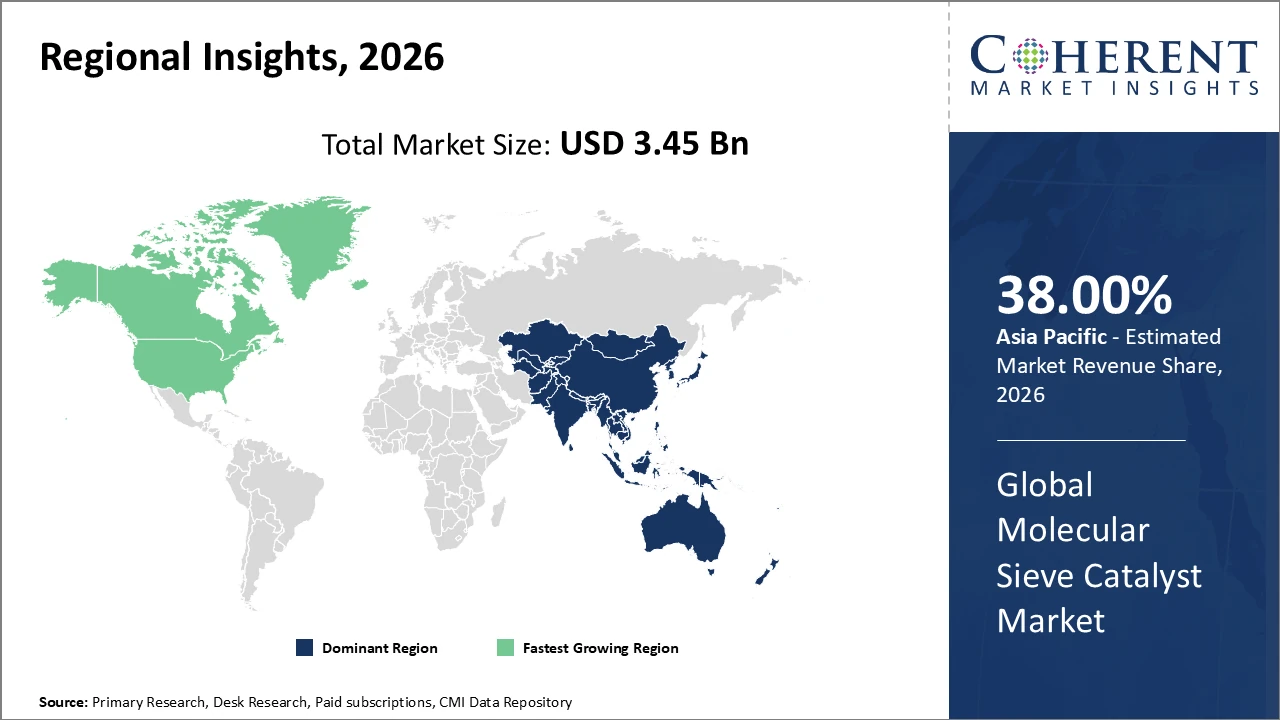
Asia Pacific Molecular Sieve Catalyst Market Analysis and Trends
Asia Pacific dominates the global Molecular Sieve Catalyst Market, accounting for nearly 38% of total market share in 2026. The region’s leadership is supported by rapid industrialization, expanding infrastructure projects, and increasing petrochemical and refinery investments in countries such as China and India. Availability of raw materials, rising refining capacities, and favorable government policies promoting industrial and petrochemical growth continue to strengthen regional demand. Local manufacturers and strategic collaborations between multinational companies and regional producers are also enhancing technological capabilities, production efficiency, and overall competitiveness within the Asia Pacific molecular sieve catalyst industry.
North America Molecular Sieve Catalyst Market Analysis and Trends
North America is projected to register the fastest growth in the Molecular Sieve Catalyst Market, with a CAGR exceeding 9% during the forecast period. Market expansion is strongly supported by increasing shale gas exploration, rising investments in cleaner hydrocarbon processing technologies, and strict environmental regulations promoting low emission industrial operations. The United States remains the primary contributor due to substantial investments in catalyst research, refinery modernization, and process efficiency optimization by major industry participants. Growing adoption of molecular sieve catalysts in gas purification, hydrogen production, and sustainable refining applications further strengthens North America’s position as a rapidly expanding regional market.
Molecular Sieve Catalyst Market Outlook for Key Countries
USA Molecular Sieve Catalyst Market Analysis and Trends
The United States molecular sieve catalyst market represents a major hub within the global industry due to abundant shale gas reserves and advanced petrochemical refining infrastructure. Leading companies such as Honeywell and Grace Catalysts Technologies have expanded pilot projects focused on improving catalyst regeneration efficiency, achieving process yield improvements of nearly 7% during 2025. Government initiatives promoting cleaner fuel production and stricter emission control standards are accelerating adoption of molecular sieve catalysts for sulfur removal, hydrocracking, and gas dehydration applications. Strong research and development investments continue positioning the United States as a global leader in catalyst innovation and industrial demand generation.
Germany Molecular Sieve Catalyst Market Analysis and Trends
Germany represents a key market within the European Molecular Sieve Catalyst industry due to its strong petrochemical, refining, and specialty chemicals sectors. Demand for advanced zeolite and molecular sieve catalysts is increasing as industries focus on cleaner fuel production, emission reduction, and process optimization. The market is witnessing growing adoption of high-performance catalysts in fluid catalytic cracking, hydrocracking, and gas purification applications. Germany also benefits from expanding investments in renewable energy, hydrogen purification, and carbon capture technologies, which increasingly utilize molecular sieve materials. Technological innovation, sustainability initiatives, and strict environmental regulations continue to shape market trends and support steady long term industry growth.
Analyst Opinion
Rising demand for molecular sieve catalysts in petrochemical refining is a major growth driver for the industry. In 2025, petroleum refining facilities increased molecular sieve catalyst consumption by approximately 12% because of expanding light olefin production and refinery modernization projects.
Production capacity expansion across Asia Pacific is supporting increased adoption of advanced catalyst technologies, particularly in newly developed refinery and petrochemical processing facilities.
Growing imports of natural gas with diverse compositions have accelerated the need for advanced molecular sieve catalysts in gas separation and purification applications. During 2024, gas processing plants utilizing molecular sieve catalyst systems increased by nearly 15% across North America and Europe.
Integration of molecular sieve catalysts into sustainable chemical manufacturing processes is improving operational efficiency and industrial output. In 2026, a major chemical production facility reported nearly 20% improvement in product yield through catalyst innovation and process optimization.
Premium pricing for high performance molecular sieve catalysts increased by around 7.5% during 2025 due to advancements in material science, catalyst customization, and demand for specialized industrial applications.
Companies investing aggressively in research, development, and application specific catalyst technologies are strengthening their competitive position and expanding market share across refining, petrochemical, and gas processing industries.
- Current Industry Events of 2026
- Market Size Estimation
- Regional Breakdown
- Competitive Landscape
- Customer Intelligence
- Segmental Analysis
- Pricing Analysis
- Key Market Drivers, Challenges & Future Trends
- Customized Insights Section
Market Scope
| Report Coverage | Details | ||
|---|---|---|---|
| Base Year: | 2025 | Market Size in 2026: | USD 3.45 billion |
| Historical Data for: | 2020 To 2024 | Forecast Period: | 2026 To 2033 |
| Forecast Period 2026 to 2033 CAGR: | 8.6% | 2033 Value Projection: | USD 5.90 billion |
| Geographies covered: |
| ||
| Segments covered: |
| ||
| Companies covered: | UOP LLC, Linde plc, Honeywell International Inc., BASF SE, Axens, Zeochem AG, Clariant AG, Sinopec Corp., Tosoh Corporation, Albemarle Corporation | ||
| Growth Drivers: |
| ||
Molecular Sieve Catalyst Market Growth Factors
The Molecular Sieve Catalyst Market is experiencing strong growth due to continuous advancements in catalyst regeneration technologies that reduce operational costs and improve catalyst lifecycle efficiency. Rising global demand for light olefins and petrochemical intermediates remains a key market driver, with catalytic cracking applications increasing by nearly 14% during 2025. Strict environmental regulations focused on sulfur emission reduction are accelerating adoption of ultra pure gas processing and advanced purification systems utilizing molecular sieve catalysts. Expansion of shale gas production in North America has further strengthened demand for specialized molecular sieve technologies, with the region recording approximately 12% growth in catalyst procurement during 2024 for gas separation and refining operations.
Molecular Sieve Catalyst Market Development
In November 2024, BASF SE announced an expansion of its X3D catalyst shaping production at Ludwigshafen, Germany, using additive manufacturing to optimize catalyst shapes for improved reactor performance and lower energy consumption.
Key Players
Leading Companies of the Market
UOP LLC
Linde plc
Honeywell International Inc.
BASF SE
Axens
Zeochem AG
Clariant AG
Sinopec Corp.
Tosoh Corporation
Albemarle Corporation
Leading companies in the Molecular Sieve Catalyst Market are increasingly adopting strategic partnerships, technology licensing agreements, and research driven expansion strategies to strengthen their competitive positions. UOP LLC collaborated with major refinery operators to pilot next generation zeolitic molecular sieve catalysts that improved refining throughput by more than 8% during 2026, enhancing operational efficiency and competitive advantage. Meanwhile, BASF SE significantly increased investments in research and development to expand its portfolio of high performance catalyst technologies. These initiatives contributed to nearly 10% growth in market share across major petrochemical hubs during 2025, reinforcing the company’s presence in advanced refining and chemical processing applications.
Molecular Sieve Catalyst Market Future Outlook
The Molecular Sieve Catalyst Market is expected to witness strong growth in the coming years due to increasing demand for cleaner fuels, sustainable chemical production, and advanced refining technologies. Expanding applications in petrochemical processing, gas separation, emission control, and hydrogen purification are anticipated to drive market expansion globally. Technological advancements in zeolite catalyst formulations and energy efficient catalytic systems will further enhance industrial adoption. Growing investments in renewable energy, carbon capture, and low emission industrial processes are also expected to create new opportunities for molecular sieve catalysts. Asia Pacific is projected to remain a key growth region because of rapid industrialization and refinery capacity expansion.
Molecular Sieve Catalyst Market Historical Analysis
The Molecular Sieve Catalyst Market has experienced consistent growth over the past decade due to rising demand from petroleum refining, petrochemical manufacturing, and industrial gas processing industries. Historically, increasing global fuel consumption and stricter environmental regulations accelerated adoption of zeolite and advanced molecular sieve catalysts in hydrocracking, fluid catalytic cracking, and emission control applications. Between 2018 and 2025, technological improvements enhanced catalyst efficiency, thermal stability, and selectivity, supporting broader industrial utilization. North America and Europe historically dominated the market because of advanced refining infrastructure, while Asia Pacific emerged as a rapidly expanding region driven by industrialization, refinery expansion, and growing chemical production capacity.
Sources
Primary Research Interviews:
Refinery managers, petrochemical plant operators, and industrial processing companies utilizing molecular sieve catalysts in hydrocracking, gas separation, and catalytic cracking applications.
Supply chain executives, catalyst technology developers, and procurement specialists responsible for sourcing zeolites, alumina materials, and specialty catalyst components.
Market analysts, R&D directors, and regulatory experts involved in catalyst innovation, clean fuel technologies, and sustainable chemical manufacturing processes.
Magazines:
Hydrocarbon Processing – Updates on refining technologies, catalyst developments, and petrochemical industry trends.
Chemical Engineering – Insights into industrial catalyst innovations, process optimization, and chemical production technologies.
Oil & Gas Journal – Coverage of refinery operations, petrochemical market developments, and advanced catalyst applications.
Journals:
Journal of Catalysis – Studies on molecular sieve catalyst performance, reaction mechanisms, and process efficiency.
Catalysis Today – Research on catalyst technologies, zeolite materials, and industrial catalytic processes.
Applied Catalysis A: General – Research focused on catalytic materials, sustainable processing, and industrial chemistry applications.
Newspapers:
Financial Times – Coverage of global petrochemical investments, energy transition initiatives, and industrial manufacturing growth.
Reuters – Reporting on refinery expansions, catalyst product launches, and developments in the chemicals and energy sectors.
Bloomberg – Insights into mergers, acquisitions, R&D investments, and sustainability strategies in the catalyst and petrochemical industries.
Associations:
American Fuel and Petrochemical Manufacturers – Industry standards, refining technology insights, and petrochemical market analysis.
European Chemical Industry Council – Regulatory updates, sustainability initiatives, and chemical manufacturing research.
International Zeolite Association – Research developments, conferences, and innovation updates related to zeolite and molecular sieve technologies.
Get access to 250+ pages report
Every segment, forecast, competitor profile and data table behind the analysis above — available for instant download.
- ESOMAR Member
- ISO 9001:2015 Certified
- D-U-N-S Registered
- GDPR & CCPA Compliant
Missing comfort of reading report in your local language? Find your preferred language:
Transform your Strategy with Exclusive Trending Reports
Frequently Asked Questions
Leading companies in the Molecular Sieve Catalyst Market include UOP LLC, BASF SE, Honeywell International Inc., and Linde plc, all of which maintain strong market positions through technological innovation and extensive industrial partnerships.
The Molecular Sieve Catalyst Market is projected to reach USD 5.90 billion by 2033, expanding at a compound annual growth rate (CAGR) of 8.6% from 2026 to 2033.
The oil & gas industry is expected to provide the largest growth opportunity because of extensive utilization of molecular sieve catalysts in catalytic cracking, hydrocracking, and olefin production processes.
Market trends are expected to focus on advanced zeolite catalyst technologies, digitalized manufacturing systems, sustainable refining processes, hydrogen purification, and biogas upgrading applications.
The market is highly competitive and innovation driven, with companies emphasizing research and development, catalyst customization, and strategic collaborations. Key challenges include raw material price volatility, strict environmental regulations, and increasing demand for application specific catalyst performance.
Common strategies include technology licensing agreements, regional joint ventures, expansion of high performance catalyst portfolios, and targeted product development tailored to refining, petrochemical, and gas processing industry requirements.