

Polarizing Film Market Size and Forecast — 2026 - 2033
The Global Polarizing Film Market size is estimated to be valued at USD 2.5 billion in 2026 and is expected to reach USD 4.1 billion by 2033, exhibiting a compound annual growth rate (CAGR) of 7.2% from 2026 to 2033.
Overview
The polarizing film market is driven by rising demand for LCD and OLED displays in smartphones, televisions, laptops, and automotive infotainment systems. Rapid growth in consumer electronics, especially in Asia-Pacific, is significantly boosting adoption of high-performance display components. Expanding penetration of smart devices and increasing screen size and resolution requirements are further supporting market growth. The automotive sector is also contributing, with rising integration of advanced display panels in electric and connected vehicles. Technological advancements in thin, high-transmittance, and durable polarizing films are improving display quality and energy efficiency. Additionally, growing investments in flexible displays and next-generation screen technologies are accelerating market expansion.
Key Takeaways
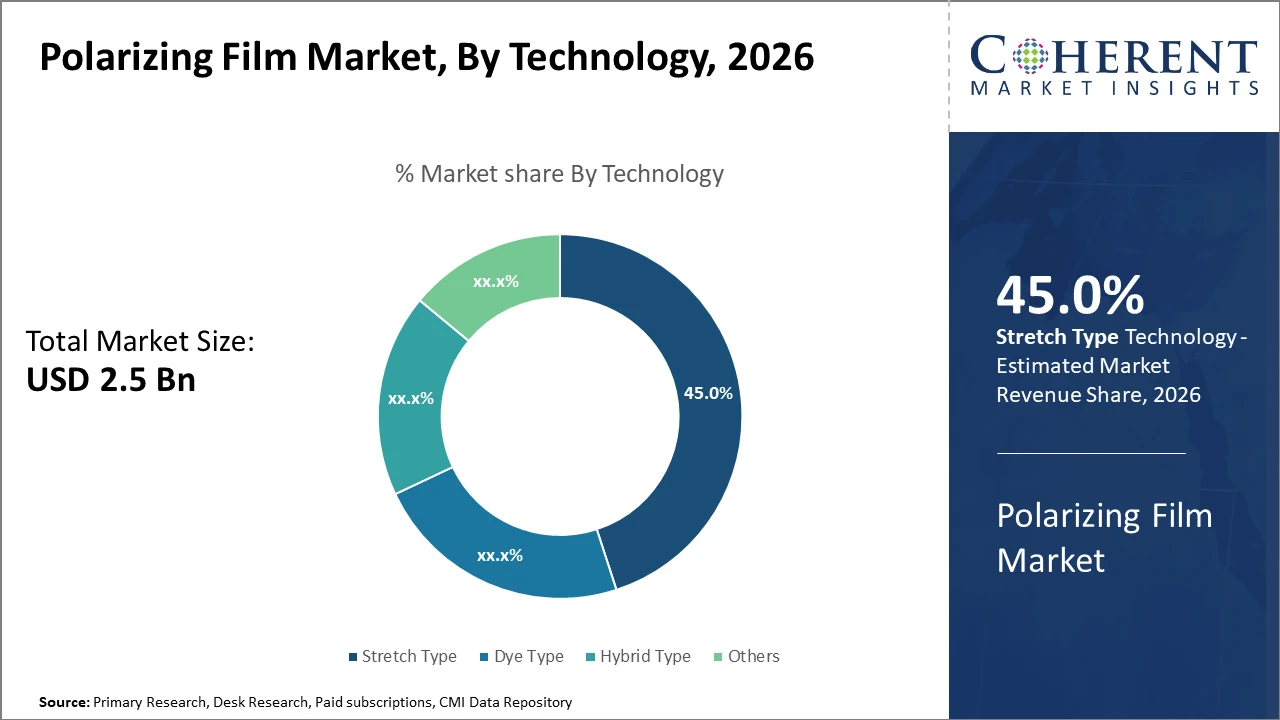
The Stretch Type segment dominates the polarizing film market with approximately 45% share, driven by its superior optical performance, flexibility, and suitability for advanced applications such as foldable displays and wearable electronics.
Consumer electronics remains the largest end-use industry, contributing nearly 50% of total market revenue, supported by continuous demand for smartphones, televisions, and display panels.
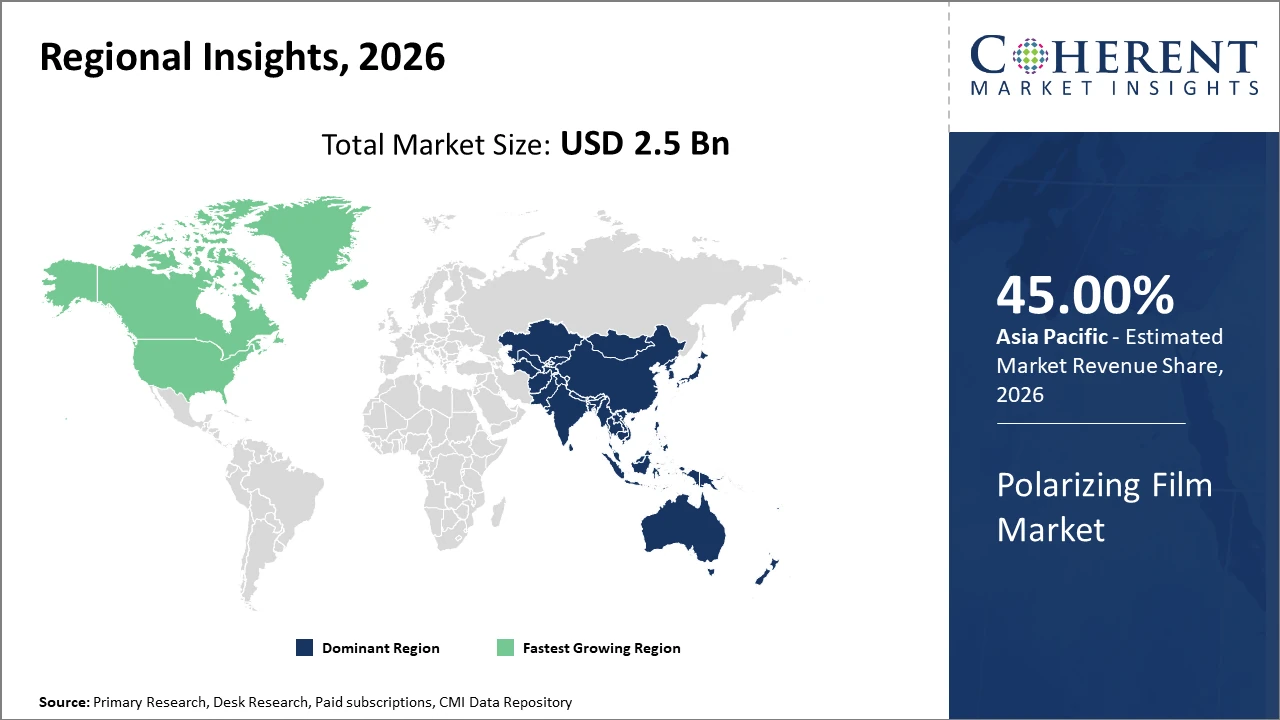
Asia Pacific holds the largest regional share due to strong manufacturing capabilities and high production volumes in countries such as China, Japan, and South Korea, which serve as key global display hubs.
North America is the fastest-growing region, with a CAGR exceeding 8%, driven by rising adoption in automotive displays, military-grade systems, and increasing investments in advanced display and optical technologies.
Polarizing Film Market Segmentation Analysis
Polarizing Film Market Insights, By Technology
Stretch Type dominates the polarizing film market with approximately 45% share due to its superior optical clarity, high durability, and strong adaptability for advanced applications such as flexible, foldable displays and wearable electronics. Its performance advantages make it a preferred choice in high-end consumer electronics. The fastest-growing subsegment is Dye Type, driven by lower production costs and rising adoption in conventional LCD panels that require moderate optical performance. Hybrid Type films combine characteristics of both stretch and dye technologies, offering customized functionality for specialized applications. The Others segment includes emerging and experimental polarizing film technologies that may gain future adoption with ongoing innovation.
Polarizing Film Market Insights, By Application
LCD displays dominate the polarizing film market with around 60% share, driven by their extensive use in televisions, smartphones, monitors, and a wide range of consumer electronics. This segment continues to benefit from ongoing improvements in display resolution, brightness, and energy efficiency, which rely heavily on advanced polarizing film technologies. Automotive displays represent the fastest-growing subsegment, fueled by increasing adoption of digital dashboards, infotainment systems, and advanced driver assistance interfaces that require high-performance films for glare reduction and visibility enhancement. Meanwhile, touch panels and other applications are growing steadily, supported by rising demand from smartphones, tablets, and emerging AR/VR devices.
Polarizing Film Market Insights, By End Use Industry
Consumer electronics dominate the polarizing film market with approximately 50% share, driven by strong smartphone penetration, rising demand for high-resolution displays, and growing adoption of flexible and foldable screen technologies. Continuous innovation in display quality and energy efficiency further strengthens this segment’s leadership. The automotive and transportation segment is the fastest-growing, supported by rapid digital transformation in vehicles, including infotainment systems, digital dashboards, and advanced safety displays requiring high-performance optical films. The industrial segment includes applications in medical imaging and renewable energy systems, while the others category covers niche uses such as aerospace and defense, where specialized polarizing films are increasingly adopted.
Polarizing Film Market Trends
Flexible and stretch-type polarizing films are becoming central to next-generation display technologies, enabling foldable and rollable screens, with wearable device applications recording a 22% increase in sales volume in 2026 due to rising demand for flexible electronics.
Sustainability has emerged as a key industry trend, with manufacturers increasingly adopting recyclable substrates and eco-friendly production processes to reduce environmental impact and align with global environmental regulations.
The market is also witnessing growing adoption of advanced polarization technologies in automotive heads-up displays and AR devices, reflecting a shift toward multifunctional, high-performance films that support immersive and intelligent display systems.
Polarizing Film Market Insights, By Geography
Asia Pacific Polarizing Film Market Analysis and Trends
In Asia Pacific, the polarizing film market holds a dominant position due to a highly developed electronics manufacturing ecosystem concentrated in China, Japan, and South Korea, which together account for over 45% of global volume share. Strong government support, including subsidies and industrial policies promoting display manufacturing, has created a favorable environment for sustained growth. The presence of leading material and chemical companies such as Toray Industries and LG Chem further strengthens regional capabilities in advanced optical film production. These firms leverage integrated supply chains and technological expertise to efficiently meet both domestic demand and large-scale export requirements across global display markets.
North America Polarizing Film Market Analysis and Trends
Meanwhile, North America exhibits the fastest growth with a CAGR exceeding 8%. This growth is driven by increasing demand for polarizing films in automotive HUDs and aerospace applications, along with rising investments in smart window technologies. The U.S. government's backing of energy-efficient innovations and the presence of high-tech firms in California and Texas further reinforce this momentum, supporting market expansion despite global supply chain uncertainties. Strong innovation ecosystems, combined with increasing R&D investment in advanced optical materials and display technologies, continue to strengthen regional competitiveness and ensure sustained long-term growth across automotive, aerospace, and smart infrastructure applications globally overall industry.
Polarizing Film Market Outlook for Key Countries
USA Polarizing Film Market Analysis and Trends
The USA’s polarizing film market plays a pivotal role in driving advanced applications, particularly across automotive and aerospace industries. Leading manufacturers in the country have invested more than USD 120 million between 2024 and 2026 in developing high-performance optical films, focusing on heat-resistant and high-transmittance properties for use in head-up displays (HUDs) and augmented reality (AR) systems. Strong demand from the consumer electronics sector, along with rapid adoption of smart home technologies, further supports market expansion. Additionally, government-led regulatory incentives promoting energy efficiency are encouraging OEMs to integrate advanced polarizing films into next-generation devices, thereby boosting overall market growth and innovation.
Germany Polarizing Film Market Analysis and Trends
Germany plays a significant role in the polarizing film market due to its strong automotive industry, advanced electronics manufacturing base, and high adoption of display technologies. The country’s demand is primarily driven by automotive display integration, industrial equipment screens, and premium consumer electronics. Trends indicate increasing use of high-performance and heat-resistant polarizing films in automotive infotainment systems and digital instrument clusters. Germany’s emphasis on energy-efficient and high-quality optical components supports the adoption of advanced film technologies. Additionally, collaboration between material science firms and display manufacturers is accelerating innovation. Strict quality standards and growing demand for OLED and smart display systems further strengthen market growth.
Analyst Opinion
Production capacity optimization has significantly influenced the polarizing film market size, with manufacturing plants adopting advanced coating technologies in 2025 reporting a 15% improvement in yield efficiency, directly supporting higher output and revenue growth to meet global OLED and LCD demand.
Pricing dynamics remained favorable due to stable supply chains and scalable production processes, with the average price per square meter of polarizing films declining by 3.6% in 2024, thereby enhancing affordability and adoption in price-sensitive emerging markets.
Demand-side growth is strongly driven by rapid adoption of flexible displays and augmented reality devices, which accounted for over 20% of total polarizing film consumption in 2026, alongside expanding applications in automotive HUDs and smart energy-efficient windows.
Trade flows highlight strong Asia-Pacific export dominance, with shipments from Japan and South Korea increasing by 12% in 2025, supplying key markets in North America and Europe and reinforcing global market integration.
- Current Industry Events of 2026
- Market Size Estimation
- Regional Breakdown
- Competitive Landscape
- Customer Intelligence
- Segmental Analysis
- Pricing Analysis
- Key Market Drivers, Challenges & Future Trends
- Customized Insights Section
Market Scope
| Report Coverage | Details | ||
|---|---|---|---|
| Base Year: | 2025 | Market Size in 2026: | USD 2.5 billion |
| Historical Data for: | 2020 To 2024 | Forecast Period: | 2026 To 2033 |
| Forecast Period 2026 to 2033 CAGR: | 7.2% | 2033 Value Projection: | USD 4.1 billion |
| Geographies covered: |
| ||
| Segments covered: |
| ||
| Companies covered: | Toray Industries, LG Chem, 3M Company, LG Display, Samsung SDI, DIC Corporation, Sumitomo Chemical, Mitsubishi Chemical Company, Asahi Glass Co., Fuji Electric Co. | ||
| Growth Drivers: |
| ||
Polarizing Film Market Growth Factors
The expanding consumer electronics industry continues to be a major driver of the polarizing film market, with smartphone penetration exceeding 75% in key Asian markets by 2026, increasing demand for high-performance display components. The automotive sector’s shift toward electrification and the adoption of digital dashboards is further accelerating the need for advanced polarizing films that enhance display clarity and reduce glare under varying lighting conditions. Technological innovations in OTFT (Organic Thin-Film Transistor) and flexible OLED displays are also widening application areas and supporting market expansion. Additionally, government incentives promoting energy-efficient electronic devices in regions such as the U.S. and Europe are boosting adoption, while rising investments in smart glass technologies are emerging as a new growth avenue.
Polarizing Film Market Development
In March 2025, SK Hynix introduced an eco-friendly multilayer polarizing film featuring recyclable substrates and water-based coatings.
Key Players
Leading Companies of the Market
Toray Industries
LG Chem
3M Company
LG Display
Samsung SDI
DIC Corporation
Sumitomo Chemical
Asahi Glass Co.
Mitsubishi Chemical Company
Fuji Glass Co.
Leading companies are increasingly focusing on R&D to improve durability, heat resistance, and ultrathin polarizing film production. For instance, Toray Industries launched a next-generation film with enhanced light control in 2025, securing long-term contracts with flexible display manufacturers. Similarly, Nitto Denko Corporation expanded its automotive-focused film portfolio, resulting in a 10% increase in its North American market share in 2024, driven by rising demand for advanced automotive display applications.
Polarizing Film Market Future Outlook
The global polarizing film market is expected to witness steady growth driven by rising demand for advanced display technologies across consumer electronics, automotive, and industrial applications. Increasing adoption of OLED, micro-LED, and flexible displays will significantly boost demand for high-performance polarizing films with improved optical efficiency and durability. Automotive digitalization, including advanced infotainment systems and head-up displays, will further support market expansion. Technological advancements focused on ultra-thin, energy-efficient, and heat-resistant films are expected to enhance product performance. Additionally, growing investments in display manufacturing capacity and rising consumer preference for high-resolution screens will continue to drive long-term market growth globally.
Polarizing Film Market Historical Analysis
The polarizing film market has evolved significantly alongside the growth of the display industry. Initially, demand was driven by the expansion of LCD technology in televisions, monitors, and mobile devices during the early 2000s. Linear polarizing films became essential components in improving display clarity and contrast. Over time, advancements in material science enabled thinner, more durable, and higher-efficiency films, supporting rapid smartphone and flat-panel TV adoption. The shift from CRT to LCD and later to LED displays marked a major growth phase. In recent years, increasing demand for OLED and automotive displays has further strengthened market expansion and technological innovation globally.
Sources
Primary Research Interviews:
Display panel manufacturers, consumer electronics OEMs, automotive display integrators, optical film suppliers, semiconductor material companies, and supply chain managers involved in polarizing film production and distribution.
Materials scientists, optical engineers, display technology experts, quality assurance professionals, regulatory consultants, and R&D directors specializing in LCD, OLED, micro-LED, and advanced optical film technologies.
Magazines:
Display Daily – Coverage of display technologies, optical films, and panel manufacturing innovations.
Information Display (SID Magazine) – Insights into display industry advancements, polarizer technologies, and panel integration trends.
Electronics Weekly – Updates on consumer electronics components, display materials, and semiconductor ecosystem developments.
Journals:
Journal of the Society for Information Display – Research on LCD/OLED technologies, polarizing films, and display performance optimization.
Optical Materials Express – Studies on optical film innovation, light control materials, and photonic applications.
Thin Solid Films – Research on thin-film coatings, optical layers, and advanced material engineering.
Newspapers:
Financial Times – Coverage of electronics manufacturing investments, display industry growth, and supply chain trends.
Reuters – Reporting on semiconductor supply chains, electronics production, and technology sector developments.
Bloomberg – Insights into display panel manufacturers, consumer electronics markets, and global tech industry strategies.
Associations:
Society for Information Display (SID) – Standards, research, and industry development in display technologies.
International Display Manufacturing Association – Industry collaboration, supply chain insights, and manufacturing trends.
IEEE Photonics Society – Research and standards for optical materials and photonic technologies.
Get access to 250+ pages report
Every segment, forecast, competitor profile and data table behind the analysis above — available for instant download.
- ESOMAR Member
- ISO 9001:2015 Certified
- D-U-N-S Registered
- GDPR & CCPA Compliant
Missing comfort of reading report in your local language? Find your preferred language:
Transform your Strategy with Exclusive Trending Reports
Frequently Asked Questions
Dominant players in the polarizing film market include Toray Industries, DIC Corporation, and 3M Company. These companies maintain strong positions due to their advanced R&D capabilities, extensive manufacturing expertise, and diversified product portfolios serving consumer electronics, automotive displays, and industrial applications.
The polarizing film market is projected to grow from USD 2.5 billion in 2026 to approximately USD 4.1 billion by 2033, driven by increasing demand for advanced display technologies such as flexible, OLED, and transparent screens.
Consumer electronics remains the largest end-user segment, while automotive displays represent a rapidly growing opportunity due to the rising adoption of smart dashboards, infotainment systems, and heads-up displays integrated with advanced polarizing films.
Market trends will be shaped by innovations in nanostructured and eco-friendly films, dynamic polarization technologies, and expanding applications in healthcare imaging, automotive systems, and renewable energy sectors.
The market is highly competitive, with firms focusing on technological differentiation and cost efficiency. Key challenges include raw material price volatility, high R&D requirements, and continuous pressure to meet evolving display technology demands.
Companies typically adopt strategies such as technology partnerships, expansion into emerging regions, and customized product development tailored for high-growth verticals like automotive, consumer electronics, and flexible display applications.