

Global Injection Molded Plastic Market Size and Share Analysis
The Global Injection Molded Plastic Market is estimated to be valued at USD 385.16 Bn in 2026 and is expected to reach USD 506.85 Bn by 2033, exhibiting a compound annual growth rate (CAGR) of 4.0% from 2026 to 2033.
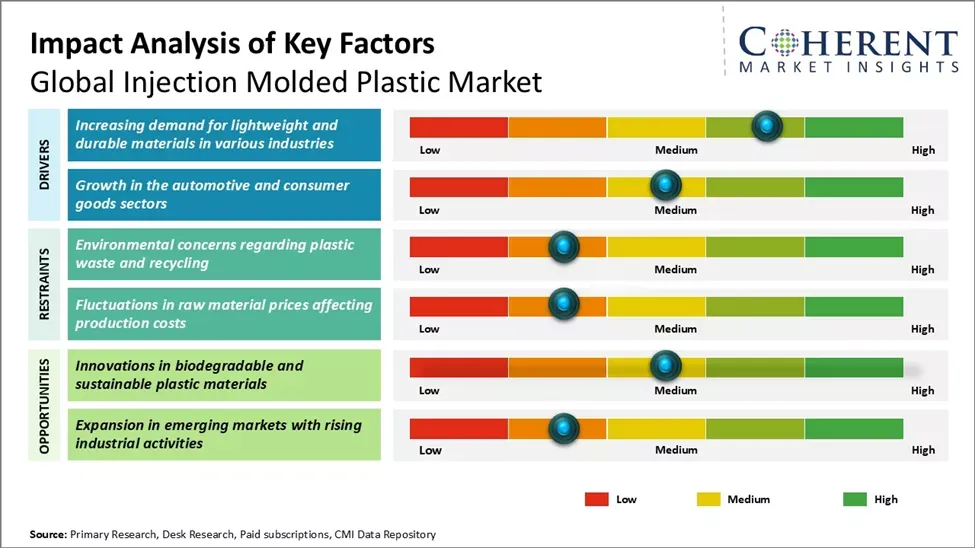
Key Takeaways of the Injection Molded Plastic Market
- Based on Raw Material, The Polypropylene (PP) Segment is expected to account for 36.9% of the global injection molded plastic market share in 2026. This is due to its uniquely advantageous properties.
- Based on Application, The Packaging Segment is expected to hold a 39.0% share of the global injection molded plastic market in 2026. This is because plastics offer major advantages over traditional packaging materials.
- North America projected to top the market with 39.7% share, followed by Asia Pacific with 32.0% share in 2026. This is due to the strong presence of major OEMs and a robust manufacturing industry.
Market Overview
The market is driven by the growing demand from various end-use industries such as packaging, automotive, consumer goods, electronics, and construction among others. The market is expected to witness steady growth over the forecast period owing to increasing plastic consumption globally. Rapid urbanization and growth in individual income levels in emerging economies will significantly drive the sales of injection molded plastic products. However, growing environmental impact of injection molded plastics usage and the implementation of stringent regulations may hamper the market growth to some extent.
Current Events and Its Impact on Injection Molded Plastics Market
Current Events | Description and its impact |
AI-Driven Defect Prediction and Smart Process Control |
|
Adoption of Electric Injection Molding Machines for Energy Efficiency |
|
Pipeline Analysis
In 2025, market leaders have undertaken high-investment capacity and innovation initiatives to secure growth in the growth markets of the key end-use industries. In April 2024, Borealis took over Integra Plastics AD in Bulgaria, expanding by more than 20,000 metric tonnes/year of recycled polypropylene compounding capacity—placing itself as a supplier to automotive, packaging, and consumer goods industries that increasingly call for sustainable feedstocks.
At the same time, U.S. OEMs and molding processors like Champion Plastics increased automation and "lights-out" manufacturing cells in 2024, including high-tonnage presses, three-axis robots, gravimetric feeding and automatic inspection to make injection molding operations more streamlined and predictive of quality.
Within the larger machine space, ENGEL has presented e‑mac 500, a fully electric injection moulding machine, at Fakuma 2024. It is an energy-efficient high-tonnage molding that is suited for modern production lines: lower operating costs and more precision.
Additional industry-wide innovation is unfolding in machine learning and AI-based optimization. A mid‑2025 report presented a deep reinforcement learning (DRL) approach to real-time process control that dynamically optimizes product quality against cost through soft actor-critic and PPO algorithms—providing up to 135× acceleration over conventional approaches and supporting adaptive molding under changing conditions.
Collectively, these projects—capacity expansion with recycle content, automation-driven process expansions, energy-saving equipment deployments, and AI-powered process control—form the pipeline for injection-molded plastics today. They set the market up to address booming demand in automotive, packaging, electronics, medicine, and consumer durables, while deflecting regulation pressures and emerging sustainability requirements.
- Current Industry Events of 2026
- Market Size Estimation
- Regional Breakdown
- Competitive Landscape
- Customer Intelligence
- Segmental Analysis
- Pricing Analysis
- Key Market Drivers, Challenges & Future Trends
- Customized Insights Section
Technological advancement and Integration of AI
Technological innovation in the injection molded plastics sector is quickly transforming manufacturing efficiency, product quality, and sustainability. Over the past few years, the industry has seen a sharp demand for new generation, fully electric and hybrid injection molding machines, such as ENGEL's e-mac 500 unveiled in 2024, that provide increased precision, reduced energy usage, and less noise—best suited for high-performance applications across the automotive, medical, and electronics industries.
Aside from hardware innovation, AI and machine learning are becoming more a part of injection molding process optimization. Latest AI algorithms now monitor real-time sensor data (pressure, temperature, mold fill speeds) to predict and correct defects like warping, sink marks, and short shots in advance. Sepro Group and Wittmann Battenfeld are some of the companies who have incorporated AI-enabled robots and predictive maintenance software in their molding cells, eliminating cycle times and unplanned downtime.
A notable breakthrough in 2025 was applying deep reinforcement learning (DRL) for dynamic process control in advanced multi-cavity mold technology. DRL-based algorithms, such as those using soft actor-critic algorithms, can adapt to material variation and external variations and maintain product quality as well as minimize scrap rate. In a study conducted in 2025, the process achieved up to 135× faster decision-making than traditional rule-based systems.
These technologies not only increase productivity and cost-effectiveness but also work in sync with sustainability targets by reducing wastage of materials and consumption of energy. As the integration of AI continues to develop, intelligent factories in the injection molding industry will become more autonomous, consistent, and competitive in global markets.
Injection Molded Plastic Market Growth Factors
- Increasing demand for lightweight and durable materials in various industries
The global market for injection molded plastics has witnessed substantial growth in recent years driven primarily by the increasing demand for lightweight and durable materials across various industries. With innovation becoming the buzzword, manufacturers are constantly looking for materials that can provide strength without added weight.
Plastics made through injection molding technique perfectly fit this description as they can be engineered to possess high strength-to-weight ratio. Injection molded plastics allow complex parts to be produced in high volumes with uniform quality at relatively low cost. Their lightweight yet robust characteristics have made them an ideal substitute for metals and other conventional materials in diverse applications.
In October 2024, GS-Caltex introduced its HiPrene® ALG14BF Long Fiber Thermoplastic (LFT) compound for automotive applications—used to injection mold the sunroof frame in the Hyundai/Kia Sorrento. By replacing the traditional steel frame, the part achieved a 51% weight reduction, improved structural rigidity, and reduced part count through design consolidation—while cutting costs by around 24%.
Injection Molded Plastic Market Opportunity - Innovations in Biodegradable and Sustainable Plastic Materials
One of the key opportunities for the market is the innovations happening in the area of biodegradable plastics and sustainable plastic materials. With environmental regulations get stricter, there is a growing demand for eco-friendly plastic alternatives that can degrade quickly in landfills or natural surroundings. Material scientists and R&D teams across the world are engaged in developing new bio-based and marine-degradable plastic formulations.
Key players are also experimenting with recycled plastic content in their products to reduce virgin material usage. Adoption of renewable energy sources in the manufacturing process helps in obtaining certifications like CARBONNEUTRAL. Such developments are expanding the portfolio of green injection molded plastic materials and parts. It is boosting growth while addressing the priority around sustainability and circular economy.
Global Injection Molded Plastics Market - Segmental Insights
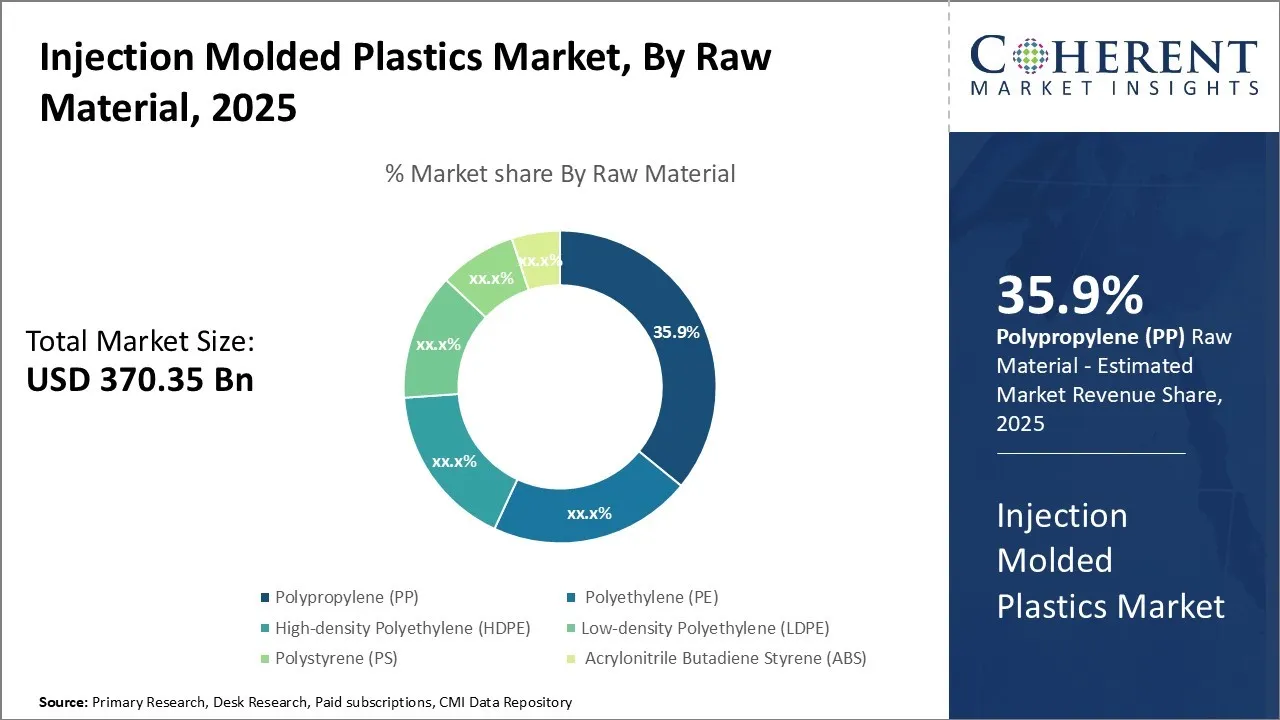
Injection Molded Plastic Market Insights, By Raw Material
In terms of raw material, the polypropylene (PP) segment is expected to contribute 36.9% share of the market in 2026, due to its uniquely advantageous properties. Polypropylene is highly durable, making it suitable for applications that require withstanding wear and tear. It maintains its strength across a wide range of temperatures, retaining flexibility even at sub-zero levels. Polypropylene's resistance to moisture and chemicals allows it to perform well in harsh or corrosive environments.
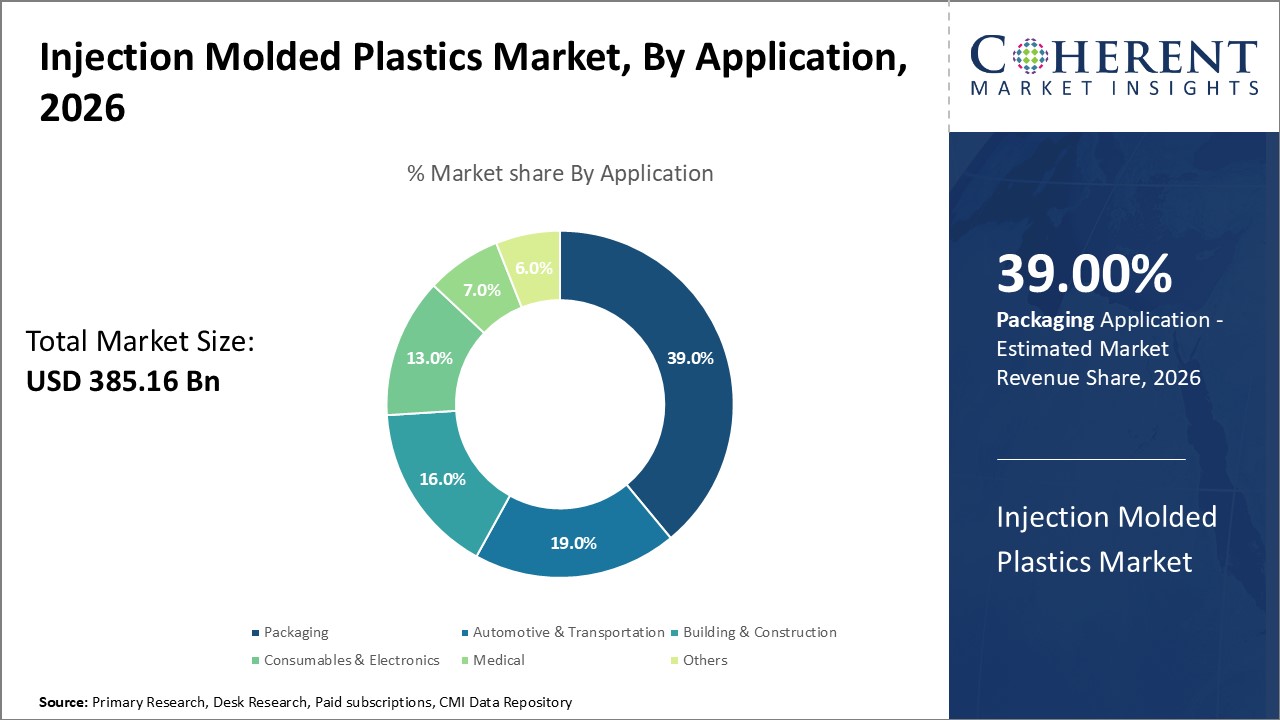
Injection Molded Plastic Market Insights, By Application
In terms of application, the packaging segment is expected to contribute 39% share of the market in 2026. Plastics offer major advantages over traditional packaging materials like glass and metal in terms of lightweight properties, variability of shapes and sizes, strength and shatter-resistance. Their low cost of production has made injection molded plastics the material of choice for single-use and disposable packaging.
Injection Molded Plastic Market - Regional Insights
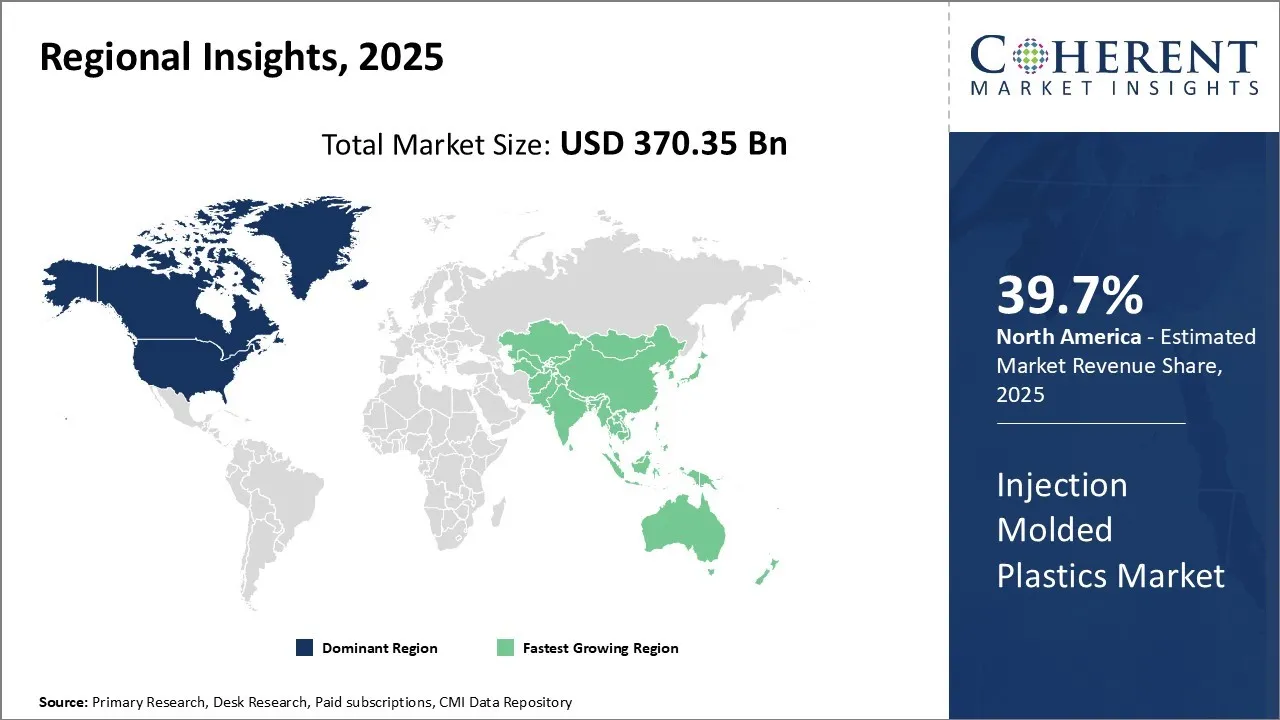
North America Injection Molded Plastic Market Trends
North America is expected to lead the market, holding the largest share at 39.7% of the market in 2026. North America's dominance in this market is largely due to the strong presence of major OEMs and a robust manufacturing industry. The U.S. and Canada benefit from supportive government policies that encourage industrial development and R&D in advanced materials
Asia Pacific Injection Molded Plastic Market Trends
The Asia Pacific region is expected to showcase the fastest growth, accounting for 32% of the market share in 2026. This growth is driven by increasing demand from key end-use industries including automotive, consumer goods, and packaging. Additionally, the rise in e-commerce activities, advancements in technology for lightweight and sustainable materials, and government initiatives to boost industrial output are driving the market's expansion in the region.
Injection Molded Plastic Market Dominating Countries
U.S. Injection Molded Plastic Market Analysis and Trends
The U.S. injection molded plastic market is set to grow steadily, driven by rising demand in automotive and medical applications. The automotive industry is increasingly using lightweight plastic components to improve fuel efficiency, supported by recent investments in production capacity.
Germany Injection Molded Plastic Market Analysis and Trends
Germany's market is expected to grow steadily, driven by consistent demand in the automotive and precision engineering sectors. The automotive industry is increasingly adopting advanced materials to comply with environmental standards. Companies like BASF are investing in sustainable manufacturing processes to support this transition.
China Injection Molded Plastic Market Analysis and Trends
China is set to dominate the injection molded plastic market, driven by the rapid growth of electric vehicle (EV) sales. The market is projected to reach USD 32.6 billion by 2034, fueled by government initiatives supporting EV production and infrastructure development, reflecting the country's emphasis on sustainable automotive solutions.
India Injection Molded Plastic Market Analysis and Trends
India's injection molded plastic market growth is propelled by the expanding packaging industry. The Indian government's allocation of US$ 6.44 billion (INR 48,000 crores) for the 'PM Aawas Yojana' scheme in the Union Budget 2022-23 aims to build 80,00,000 affordable housing units, which is expected to boost the demand for injection molded plastics in construction-related applications.
Spain Injection Molded Plastic Market Analysis and Trends
Spain is experiencing growth in the injection molded plastic market, driven by increasing demand for automotive and EV components. As a hub for automotive manufacturing, companies like SEAT are expanding production to incorporate more plastic components, aligning with the European Union's sustainability goals to promote lightweight materials.
Market Players, Key Development, and Competitive Intelligence
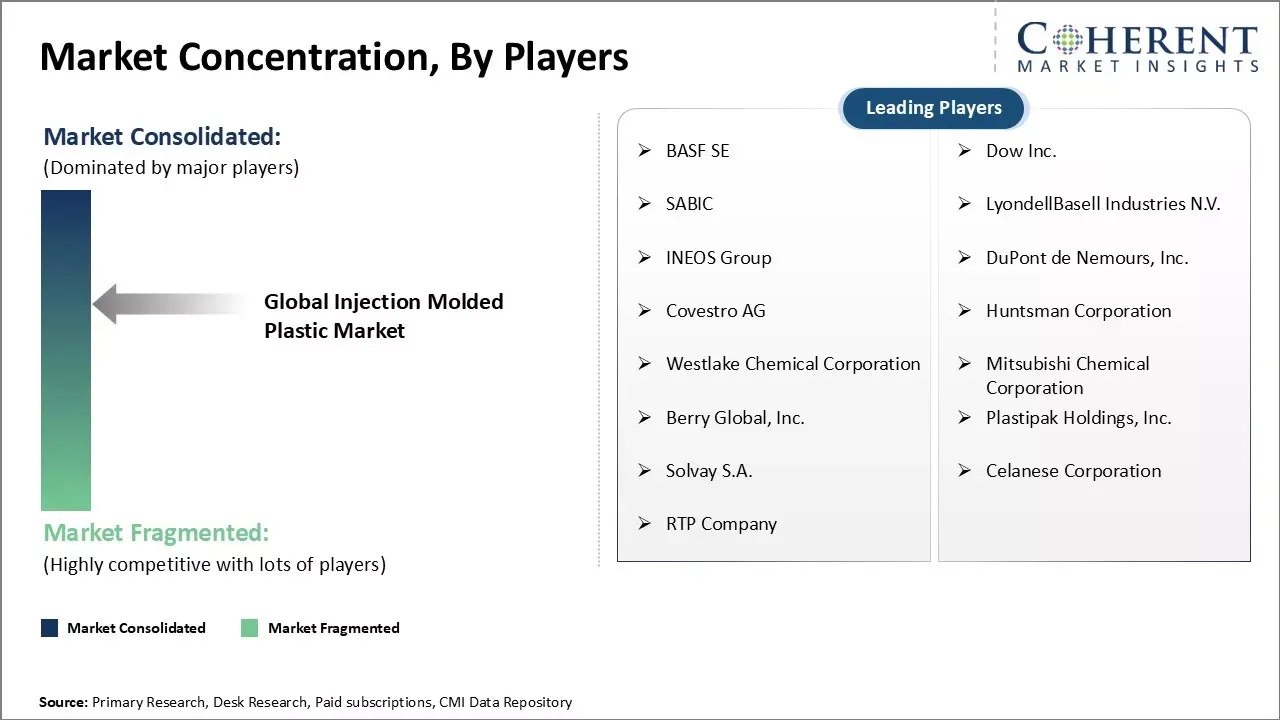
Top Strategies Followed by Global Injection Molded Plastic Market Players
- Established Players: Leading players heavily invest in research and development to deliver innovative product solutions. Large players form strategic alliances with OEMs and other material manufacturers to gain industry expertise, expand product portfolio, and establish stronger global supply chains. For example, LyondellBasell has partnered with major vehicle manufacturers to supply specialized plastics for electric vehicles.
- For instance, companies like DuPont and BASF invest over 5% of their annual revenue in R&D focused on developing high-performance plastics with improved strength, resistance and functionality.
- Mid-Level Players: Mid-sized companies cater to price-sensitive consumer segments by offering generic injection molded products at competitive rates without compromising on quality.
- For example, Covestro provides sustainable, wallet-friendly solutions for appliances and home furnishings. Companies also pursue technical partnerships to bolster technological capabilities and production facilities. Sabic's recent tie-up with ExxonMobil is aimed at developing new grades of polypropylene using advanced manufacturing technologies.
- Small-Scale Players: Small players rely on novelty and innovation to carve a niche. Firms like Vention focus entirely on introducing novel designs and materials for medical devices through injection molding. Startups leverage the latest digital technologies like CAD/CAM systems and 3D printing to optimize designs and processes. Digital Mold uses additive manufacturing for rapid custom tooling.
Emerging Startups - Global Injection Molded Plastic Industry Ecosystem
- Innovative Technologies: Replika 3D prints biodegradable sensors embedded in plastics for smart product applications. Such technologies could enable real-time monitoring and advanced functionality. Firms like Transcend Packaging are embracing circular economy practices by using agricultural residues to reduce the carbon footprint.
- Sustainable Solutions: Transcend Packaging creates molded pulp products from agricultural residue rather than virgin timber, reducing the carbon footprint. By repurposing agricultural by-products, the company minimizes waste and supports a circular economy. Transcend Packaging’s commitment to eco-friendly practices makes it a key player in delivering sustainable alternatives that align with global efforts to reduce environmental impact.
Market Report Scope
Injection Molded Plastics Market Report Coverage
| Report Coverage | Details | ||
|---|---|---|---|
| Base Year: | 2025 | Market Size in 2026: | USD 385.16 Bn |
| Historical Data for: | 2020 To 2024 | Forecast Period: | 2026 To 2033 |
| Forecast Period 2026 to 2033 CAGR: | 4.0%2033 Value Projection: | USD 506.85 Bn | |
| Geographies covered: |
| ||
| Segments covered: |
| ||
| Companies covered: | BASF SE, Dow Inc., SABIC, LyondellBasell Industries N.V., INEOS Group, DuPont de Nemours, Inc., Covestro AG, Huntsman Corporation, Westlake Chemical Corporation, Mitsubishi Chemical Corporation, Berry Global, Inc., Plastipak Holdings, Inc., Solvay S.A., Celanese Corporation, and RTP Company | ||
| Growth Drivers: |
| ||
| Restraints & Challenges: |
| ||
Injection Molded Plastic Market Recent Development
- In April 2023, Nexa3D acquired Addifab, the parent company of Freeform Injection Molding. The acquisition strengthens the ability of Addifab's high-temperature soluble and high-impact resins to be used in conjunction with Nexa3D's ultrafast 3D printers to produce advanced tools that can be used with any type of injection molding feedstock.
- In March 2023, ABC Technologies Holdings Inc. acquired WMG Technologies for a sum of USD 165 million. ABC Technologies Holdings Inc. offers products to its clients in three categories: fluids, HVAC, outside systems, interior systems, and others. Likewise, WMGT supplies sophisticated tooling for injection-molded exterior and interior parts, lighting molds, and optic inserts to significant global automotive OEMs at tier-1 and tier-2 levels. Additionally, it offers a wide range of other outside goods.
Analyst Opinion
- The automotive industry will continue driving the demand for plastics given the increasing use of high-performance plastics to reduce vehicle weight and meet stringent emissions regulations. Growing consumption of consumer electronics and appliances is another key growth driver as plastics allow manufacturers to produce durable yet affordable devices.
- North America will remain a prominent market owing to well-established automotive and consumer goods industries. However, Asia Pacific is projected to be the fastest-growing region supported by rising incomes, urbanization, and industrialization across developing countries like China and India.
- While opportunities abound, volatility in raw material prices poses a threat. Plastics are crude oil-based and fluctuations in petrochemical costs can squeeze profit margins for molders. Also, stringent environmental norms around plastic usage and recycling may dampen prospects to some extent. Injection molders need to invest in developing bio-plastics and recyclable resins to tap the potential of sustainable markets. Competition is intensifying with the entry of new players in Asia Pacific offering competitive production capabilities.
Speak to the analyst
Want personalized insights?
Take the findings above to one of our principal consultants, or have the report rebuilt around the segments, geographies and competitors you actually track.
Market Segmentation
- Raw Material Insights (Revenue, USD Bn, 2021 - 2033)
- Polypropylene (PP)
- Polyethylene (PE)
- High-density Polyethylene (HDPE)
- Low-density Polyethylene (LDPE)
- Polystyrene (PS)
- Acrylonitrile Butadiene Styrene (ABS)
- Application Insights (Revenue, USD Bn, 2021 - 2033)
- Packaging
- Automotive & Transportation
- Building & Construction
- Consumables & Electronics
- Medical
- Others
- Regional Insights (Revenue, USD Bn, 2021 - 2033)
- North America
- U.S.
- Canada
- Latin America
- Brazil
- Argentina
- Mexico
- Rest of Latin America
- Europe
- Germany
- U.K.
- Spain
- France
- Italy
- Russia
- Rest of Europe
- Asia Pacific
- China
- India
- Japan
- Australia
- South Korea
- ASEAN
- Rest of Asia Pacific
- Middle East
- GCC Countries
- Israel
- Rest of Middle East
- Africa
- South Africa
- North Africa
- Central Africa
- Key Players Insights
- BASF SE
- Dow Inc.
- SABIC
- LyondellBasell Industries N.V.
- INEOS Group
- DuPont de Nemours, Inc.
- Covestro AG
- Huntsman Corporation
- Westlake Chemical Corporation
- Mitsubishi Chemical Corporation
- Berry Global, Inc.
- Plastipak Holdings, Inc.
- Solvay S.A.
- Celanese Corporation
- RTP Company
Sources
Primary Research Interviews
- Injection molding equipment manufacturers
- Plastic raw material suppliers
- Contract manufacturing service providers
- End-user industry representatives (automotive, packaging, consumer goods)
- Others
Databases
- Plastics Industry Trade Database
- Manufacturing Industry Statistics Database
- Global Chemical Industry Database
- Polymer Materials Database
- Others
Magazines
- Plastics Technology Magazine
- Injection Molding Magazine
- Modern Plastics Worldwide
- Plastics News Magazine
- Others
Journals
- Journal of Injection Molding Technology
- Polymer Processing and Manufacturing Journal
- International Journal of Advanced Manufacturing Technology
- Others
Newspapers
- Plastics News
- Chemical Week
- Manufacturing Business Technology
- Industrial Distribution News
- Others
Associations
- Society of Plastics Engineers (SPE)
- Plastics Industry Association (PLASTICS)
- International Association of Plastics Distribution (IAPD)
- European Plastics Converters (EuPC)
- Others
Public Domain Sources
- U.S. Census Bureau Manufacturing Reports
- European Chemicals Agency (ECHA) Publications
- Industry trade organization white papers
- Government manufacturing statistics portals
- Others
Proprietary Elements
- CMI Data Analytics Tool
- Proprietary CMI Existing Repository of information for last 8 years
Get access to 250+ pages report
Every segment, forecast, competitor profile and data table behind the analysis above — available for instant download.
- ESOMAR Member
- ISO 9001:2015 Certified
- D-U-N-S Registered
- GDPR & CCPA Compliant
Missing comfort of reading report in your local language? Find your preferred language:
Transform your Strategy with Exclusive Trending Reports
Frequently Asked Questions
The Injection Molded Plastics Market size is estimated to be valued at USD 385.16 Bn in 2026, and is expected to reach USD 506.85 Bn by 2033.
The CAGR of the global Market is projected to be 4.0% from 2026 to 2033.
Environmental concerns regarding plastic waste and recycling and fluctuations in raw material prices affecting production costs are the major factors hampering the market growth for injection molded plastic.
In terms of raw material, the Polypropylene (PP) segment is estimated to dominate the market revenue share in 2026.
The global injection molded plastics market is evolving through automation, adoption of electric molding machines, and rising demand from healthcare, automotive, and electronics sectors, especially in emerging economies.
Sustainability is driving the market toward bio-based resins, recycled plastics, and energy-efficient production, with manufacturers investing in green technologies and circular economy practices.
BASF SE, Dow Inc., SABIC, LyondellBasell Industries N.V., INEOS Group, DuPont de Nemours, Inc., Covestro AG, Huntsman Corporation, Westlake Chemical Corporation, Mitsubishi Chemical Corporation, Berry Global, Inc., Plastipak Holdings, Inc., Solvay S.A., Celanese Corporation, and RTP Company are the major players.