

Technical Coil Coatings Market Analysis & Forecast
The technical coil coatings market is estimated to be valued at USD 5.06 Bn in 2026 and is expected to reach USD 7.07 Bn by 2033, exhibiting a compound annual growth rate (CAGR) of 4.9% from 2026 to 2033.
Key Takeaways
- Based on the Material, the Polyvinylidene fluoride (PVDF) segment dominates the market due to its Superior Corrosion and Weather Resistance properties.
- Based on the Technology, the solvent-borne segment dominates the market due to Heightened Demand from the Industrial Sector Boosts Solvent-borne Technology.
- Based on the Product Type, the top coat segment dominates the market due to its Wide Use in Building Integrated Applications Boosting the Top Coat Demand.
- On the basis of Region, North America has dominated the technical coil coatings market and is expected to hold a 35.9% share in 2026 owing to the growing construction activities across the United States.
Market Overview
The rise in the technical coil coating market is driven by the increasing demand for pre-coated metal in the construction, automotive, and appliance industries due to its durability and aesthetic appeal.
Current Events and Their Impact on the Technical Coil Coatings Market
Current Events | Description and its impact |
Technological Innovations in Coating Formulations |
|
Sustainability-Driven Market Shifts |
|
End-user Feedback and Unmet Needs in the Technical Coil Coatings Market
End-user Feedback
- Durability and Corrosion Resistance: End users constantly highlight the importance of coatings that offer superior corrosion protection in harsh environments, particularly in marine, industrial, and construction applications.
- Sustainability Focus: Manufacturers and builders are seeking eco-friendly, low-VOC coatings that comply with increasingly strict environmental regulations without compromising performance.
- Customization and Aesthetics: Users in the architecture and appliance sectors appreciate innovations in color retention, gloss levels, and surface textures, demanding more customizable.
Unmet Needs
- Faster Curing Technologies: There is a strong demand for faster curing coil coating technologies that reduce processing time and energy consumption while maintaining quality.
- High-Performance Coating for Lightweight Substrates: As industries shift to lightweight metals like aluminum, users face challenges in finding coatings that provide strong adhesion and flexibility without cracking.
- Smart and Functional Coatings: The market lacks widespread availability of smart coatings that offer self-healing, anti-bacterial, or thermal-regulating properties, which are increasingly being requested by advanced application sectors.
- Current Industry Events of 2026
- Market Size Estimation
- Regional Breakdown
- Competitive Landscape
- Customer Intelligence
- Segmental Analysis
- Pricing Analysis
- Key Market Drivers, Challenges & Future Trends
- Customized Insights Section
Segmental Insights
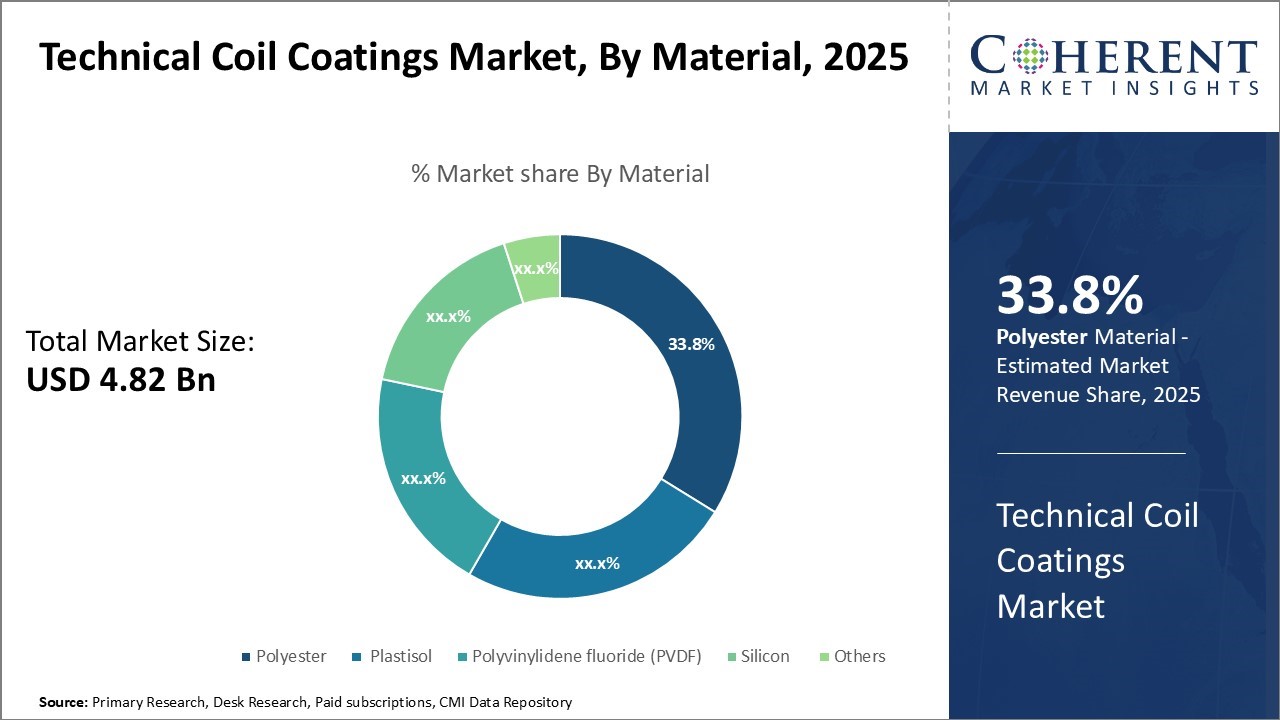
Technical Coil Coatings Market Insights, by Material
The Polyvinylidene fluoride (PVDF) segment dominates the market
In terms of material, Polyvinylidene fluoride (PVDF) is expected to contribute a 34.8% share of the market in 2026, owing to its excellent corrosion and weather resistance properties. PVDF coatings can withstand harsh weathering for over 30 years without losing their gloss or color, making them highly suitable for architecture and construction applications. They effectively protect substrates like steel and aluminum from corrosion caused by acid rain, chemicals, pollution, or damp conditions. Furthermore, PVDF retains its mechanical strength even after years of UV exposure, ensuring long-lasting performance. Its non-stick quality also simplifies the cleaning and maintenance of surfaces. PVDF coatings have gained widespread adoption in applications like metal roofing, cladding, exterior walls, and pipeline exteriors where corrosion resistance and durability are key priorities.
For instance, a new type of polyvinylidene fluoride (PVDF) coil coating, TRINAR® TC (Tough Coat), has been launched by AkzoNobel. This new coating system combines the benefits of 70% PVDF performance with improved durability and ease of use, offering enhanced scratch, abrasion, and stain resistance for various applications like metal roofing and construction.
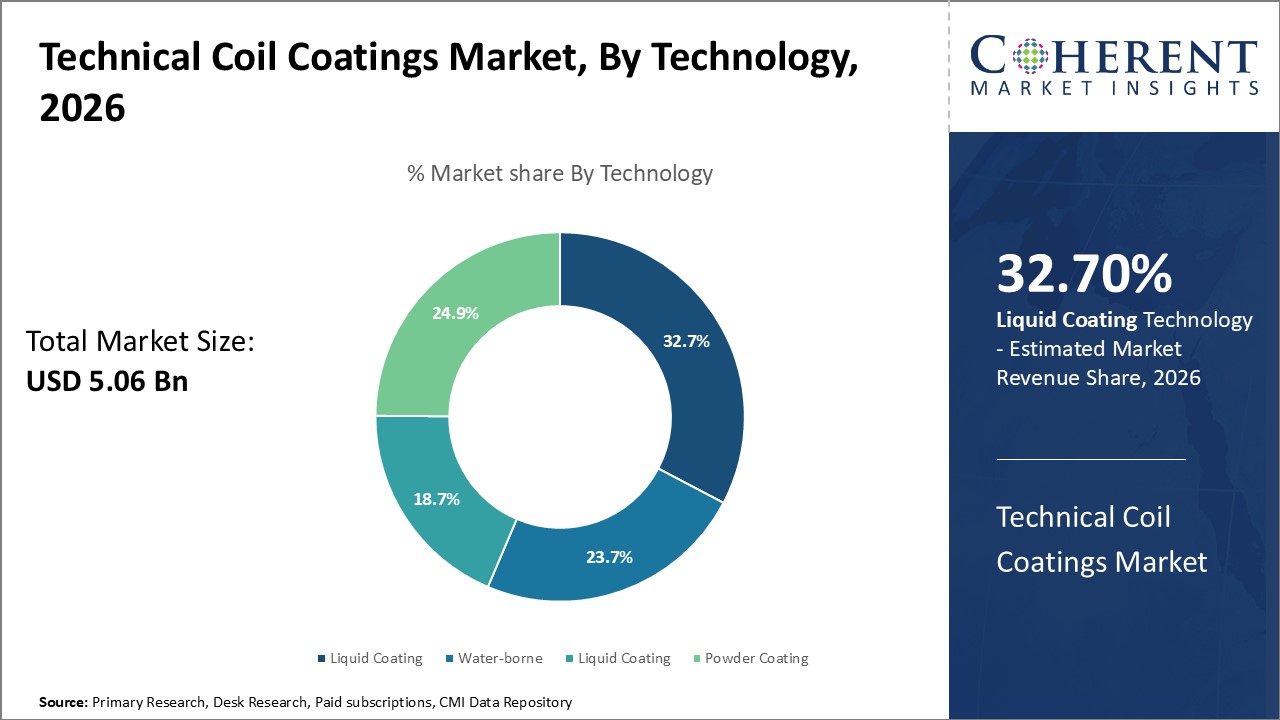
Technical Coil Coatings Market Insights, by Technology
The solvent-borne segment dominates the market due to Heightened Demand from the Industrial Sector Boosts Solvent-borne Technology
In terms of technology, the solvent-borne segment is expected to contribute 32.7% share of the market in 2026, owing to their applicability in industrial applications and compatibility with various substrates like metal, wood, plastic, and concrete. Solvent-borne coatings can sufficiently penetrate porous surfaces and offer excellent adhesion. They are suitable for high-production applications as they dry quickly through the evaporation of solvents. Their low viscosity allows easy application through spraying with minimal risk of runs or sags on vertical surfaces. They are compatible with a variety of substrates and impart gloss, hardness, flexibility, and UV resistance to finished products. Heightened industrial activity along with infrastructure growth in regions like the Asia Pacific and the Middle East is driving demand from the metal fabrication, heavy machinery, automotive, and construction sectors, propelling the solvent-borne segment.
For instance, BASF launched new polyacrylate-based leveling agents Efka® FL 3750 and Efka® FL 3755 for solvent-borne and solvent-free coatings, demonstrating their commitment to enhancing coating performance and compatibility.
Technical Coil Coatings Market Insights, by Product Type
The top coats segment dominates the market due to Wide Use in Building Integrated Applications Boosts the Top Coat Demand
In terms of product type, top coats are expected to contribute a 31.3% share of the market in 2026, driven by their ubiquitous use in building-integrated applications and demand from the construction industry. Top coats act as the finishing layer that protects the substrate and lower costs from environmental damage. They impart critical properties like scratch resistance, UV protection, dullness prevention, and color fastness. Top coats are designed to form a protective barrier and maintain an aesthetic appearance over time. Their widespread use in roofing, cladding, rain gutters, flashings, and curtain wall applications stems from the need to beautify and shield the façade of buildings from weathering.
Rapid urbanization and infrastructure growth especially in the Asia Pacific and Latin America are driving higher consumption of top coats. Their availability in a wide palette of aesthetic and functional variants allows architects to achieve diverse design aesthetics. For instance, Chemcoaters has developed a new thin-film coating for HRPO and CR steel that provides corrosion-inhibiting metal coating for several industries, and has successfully developed and launched a thin-film coating for cold-rolled and hot-rolled pickled and oiled steel.
Regional Insights
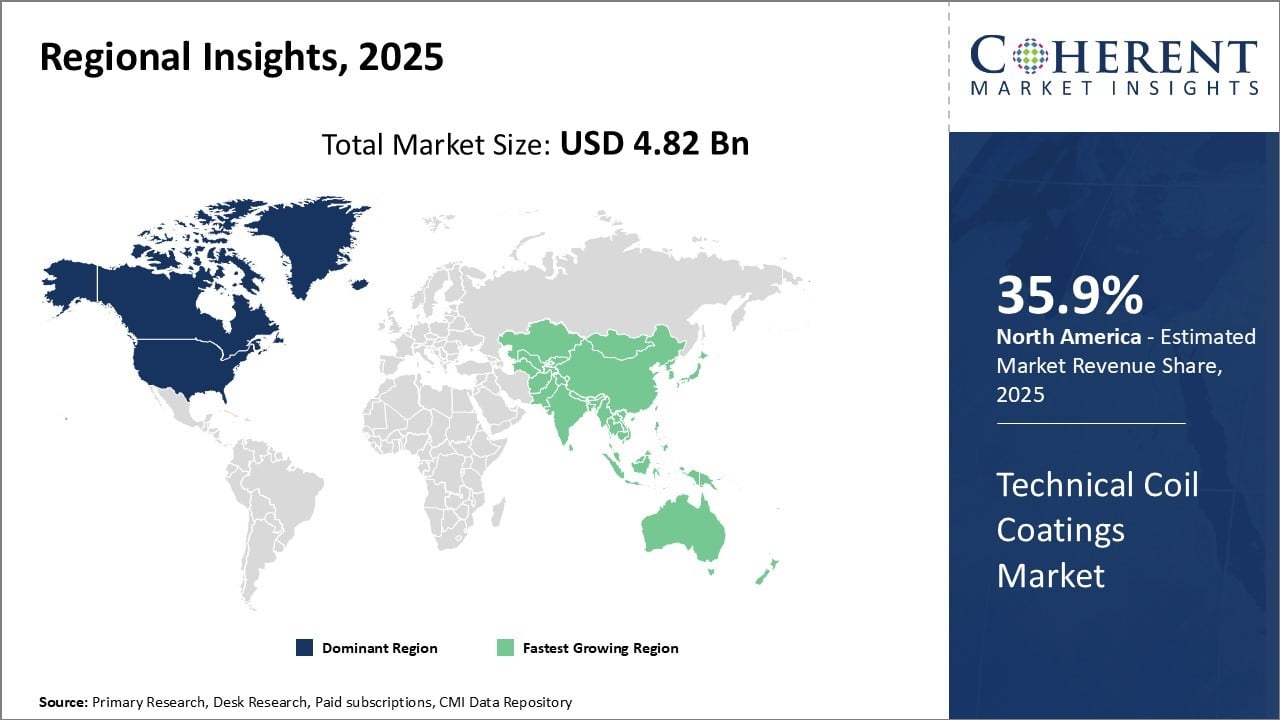
North America Technical Coil Coatings Market Trends
North America has dominated the technical coil coatings market for many years owing to a strong presence of key end-use industries in the region. The region is expected to hold a 35.9% share in 2026. Countries like the U.S. and Canada have robust construction and automotive sectors which are the major consumers of technical coil coatings.
Given the scale of operations of American and Canadian companies, they require huge volumes of coated steel and aluminum coils for various applications. This dependable demand has led many global coating suppliers to set up their largest production facilities in this region to serve clients without delays. For instance, the US company Lorin Industries has launched a new batch anodizing line for aluminum coils, enhancing the material’s corrosion resistance, aesthetic options, and efficiency. This new line offers a range of standard and custom colors with different anodizing types including Type II, modified hard coat, Type III, and Lorin’s propriety ColorIn® process.
Asia Pacific Technical Coil Coatings Market Trends
The Asia Pacific region has emerged as the fastest-growing market for technical coil coatings in recent times. Rapid industrialization and infrastructure development activities across developing nations have boosted the uptake of these solutions. China, in particular, has tremendous unfinished construction projects requiring coated metal panels and roofing components. This vast untapped opportunity has caught the eye of international coating vendors looking to penetrate new markets. Other Asian countries like India and Vietnam are also witnessing accelerated urbanization, which is driving the use of pre-painted steel and aluminum building materials. The availability of low-cost manpower in the region has made it an attractive production base for end users to rely on local fabricators and roll-forming plants. This localized supply chain helps lower costs and ensure timely deliveries for projects across densely populated cities. Local governments also offer subsidies and tax incentives to boost local manufacturing and support increased imports of raw materials.
For instance, JSW Steel announced to raise its share in the domestic coil-coating segment and launched JSW Radiance where the firm said the company expects a large play in the specialty coil-coating business and added overall Indian coil-coating business is estimated at 2.5 million tonnes per annum. This is further accelerating the technical coil coatings market growth.
United States Technical Coil Coatings Market Trends
The United States technical coil coating market is witnessing growth due to rising demand from the construction and automotive sectors for durable, corrosion-resistant, and aesthetic metal surfaces. Technological advancements in eco-friendly coatings and energy-efficient production processes are further accelerating adoption. For instance, the US based company PPG Industries have launched a range of coil coatings for commercial residential, and industrial metal building products at Metalcon. Additionally, government regulations promoting sustainable building materials are driving the use of high-performance coated coils.
India Technical Coil Coatings Market Trends
The Indian technical coil coating market is witnessing growth due to rising demand from the automotive, appliance, and construction sectors driven by rapid urbanization and infrastructure development. Government initiatives like “Make in India” and increased foreign investment are encouraging domestic manufacturing, boosting the need for pre-coated metal.
For instance, Tata Steel increased its coil coating capacity in India to support the growing needs of the automotive and construction sectors. This expansion is part of their broader strategy to capitalize on growth opportunities in the Indian market. Additionally, growing environmental awareness is accelerating the adoption of sustainable and energy-effective coating technologies, further contributing to the technical coil coatings market share.
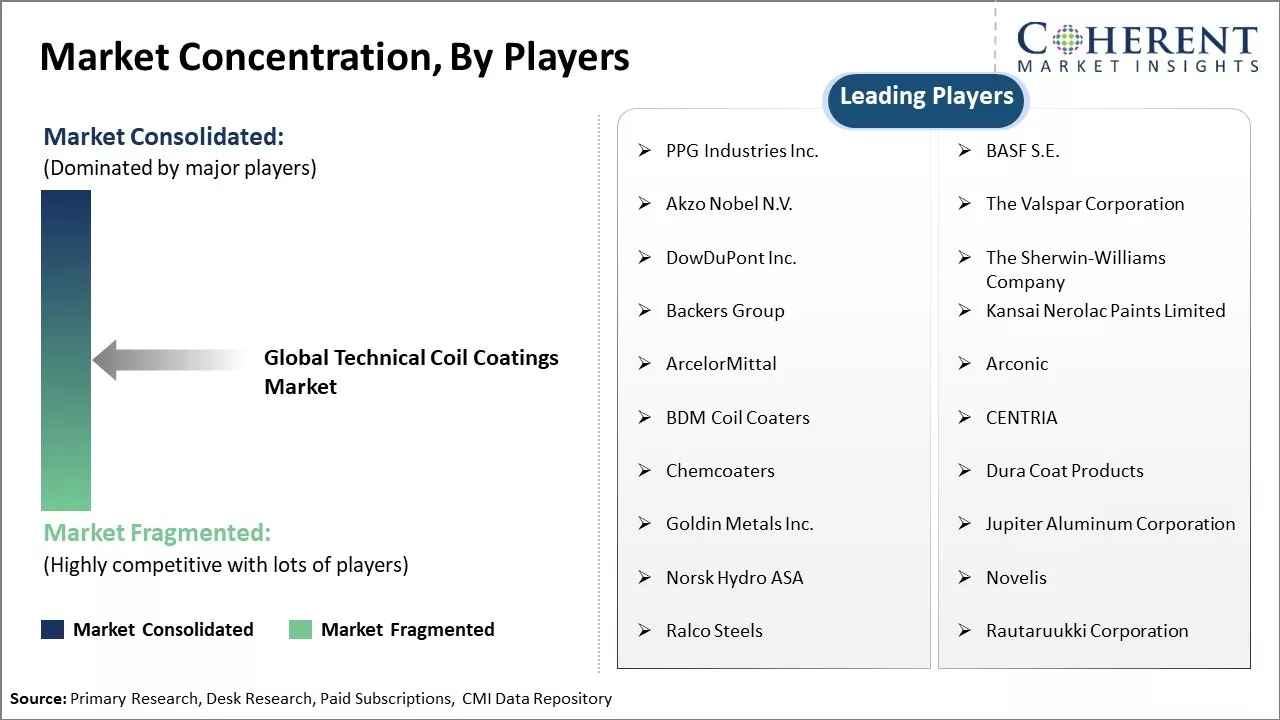
Market Concentration and Competitive Landscape
Technical Coil Coatings Industry News
- In April 2025, Jindal (India) Ltd, a key player in downstream steel products and part of the B.C. Jindal Group, announced its official foray into the renewable energy sector with the launch of its cutting-edge Jindalume product line. The newly introduced aluminium-zinc (Al-Zn) coated coils are specifically engineered for use in solar module mounting structures.
- In July 2024, PPG launched the PPG DURANEXT portfolio, a specialized range of electron-beam and UV-curable coatings developed for the metal coil coating industry.
- In March 2025, AzZ acquired Precoat Metals for a value of USD 1.28 billion, Precoat Metals, which is North America’s largest independent metal coil-coating provider.
- In 2023, Chemcoaters launched new corrosion-inhibiting coil-coating for HRPO and CR Steel.
Market Report Scope
Technical Coil Coatings Market Report Coverage
| Report Coverage | Details | ||
|---|---|---|---|
| Base Year: | 2025 | Market Size in 2026: | USD 5.06 Bn |
| Historical Data for: | 2020 To 2024 | Forecast Period: | 2026 To 2033 |
| Forecast Period 2026 to 2033 CAGR: | 4.9% | 2033 Value Projection: | USD 7.07 Bn |
| Geographies covered: |
| ||
| Segments covered: |
| ||
| Companies covered: | PPG Industries Inc., BASF S.E., Akzo Nobel N.V., The Valspar Corporation, DowDuPont Inc., The Sherwin-Williams Company, Backers Group, Kansai Nerolac Paints Limited, ArcelorMittal, Arconic, BDM Coil Coaters, CENTRIA, Chemcoaters, Dura Coat Products, Goldin Metals Inc., Jupiter Aluminum Corporation, Norsk Hydro ASA, Novelis, Ralco Steels, and Rautaruukki Corporation | ||
| Growth Drivers: |
| ||
| Restraints & Challenges: |
| ||
Market Dynamics
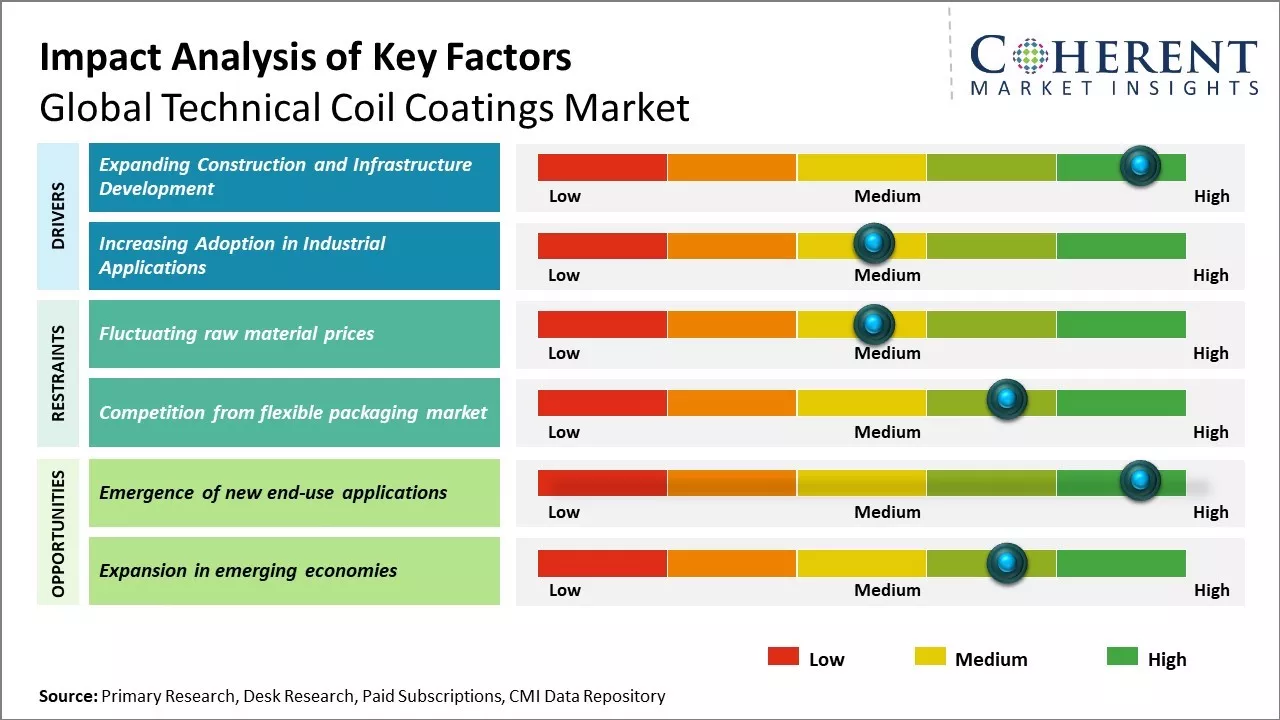
Technical Coil Coatings Market Growth Drivers
Technical coil coatings find widespread applications in the construction, automotive, and appliance industries. The growth of these end-use industries is expected to drive the demand for technical coil coatings during the forecast period. The rising commercial construction in developing nations of Asia Pacific and Middle East & Africa is expected to propel the technical coil coatings market during the forecast period. Additionally, the increasing automotive production in countries, such as China, India, Mexico, and Brazil, due to growing demand is further anticipated to augment the sales of technical coil coatings.
Expanding Construction and Infrastructure Development
Rapid urbanization coupled with rising disposable income levels in developing nations such as China, India, Indonesia, etc. have increased both residential and commercial construction spending. Mega infrastructure projects related to highways, rail networks, power transmission lines, pipelines, and renewable energy farms are also witnessing significant investments. All such construction projects extensively use prepainted or pre-coated metal sheets for roofing, cladding, fencing, and other exterior applications. The protective and aesthetic properties provided by technical coil coatings make them ideal for long-term building exteriors that require low maintenance. The expansion of construction industries in Asia Pacific and Middle East & Africa regions in particular is likely to generate substantial opportunities for technical coil coating manufacturers.
Another key factor is the refurbishment and renovation of older buildings and structures across both developed and developing economies. With growing environmental consciousness, replacing or retrofitting existing buildings with eco-friendly and energy-efficient materials is gaining prominence. This represents an opportunity to replace outdated metal panels and components with new ones featuring advanced technical coil coatings. Government mandates towards green building codes and standards will further bolster the replacement demand. Overall, the pervasive nature of construction activities coupled with the benefits of technical coil coatings in enhancing durability, aesthetics, and sustainability of infrastructure projects is envisioned to majorly drive its consumption globally in the upcoming decade.
Increasing Adoption in Industrial Applications
Besides construction, the industrial sector is also turning to technical coil coatings for various metal processing needs. Manufacturing plants across diverse segments increasingly rely on pre-painted or pre-coated metal sheets for equipment housing, storage containers, and various fabricated structural components. The key advantages offered including corrosion protection, scratch resistance, and ability to withstand harsh operating environments make them a preferred option compared to field-applied paints. The growing automation and emphasis on aesthetics even in industrial applications has lifted the usage of visually appealing and long-lasting coatings. Meanwhile, strict environmental regulations regarding VOC emissions from liquid paints are positively impacting the demand for powder-coated coil products.
Moreover, technical coil coatings are gaining prominence for specialized applications like signage, automotive parts, and white goods. The revolutionary surface properties provided by nanotechnology-incorporated coatings are outstanding in various legacy materials.
Market Opportunities: Emergence of new end-use applications
The technical coil coatings market is poised to benefit significantly from the emergence of new end-use applications in various industries. One such major opportunity lies in the food packaging sector. As consumers demand more sustainable and recyclable packaging solutions, coil-coated steel is increasingly being used for packaging various food products. According to a 2021 report by UNEP, over 50% of steel used in food packaging globally now has some form of coil coating for corrosion protection and aesthetics. Coil-coated steel provides an excellent moisture and gas barrier while retaining recyclability. Many big food brands have committed to using higher percentages of recycled steel in their packaging by 2025. This is expected to drive additional demand for technical coil coatings from the food industry.
Analyst Opinion (Expert Opinion)
The growing construction industry globally is a major driver boosting the demand for coated steel and aluminum coils used in building construction and infrastructure development. The Asia Pacific region, led by China, India, and other Southeast Asian countries is expected to dominate market demand due to the rise in construction activities in the region. Additional opportunities exist in the form of the replacement of traditional architectural materials with metals that have longer lifespans and need lesser maintenance when coated with superior technical coatings.
Stringent environmental regulations over volatile organic compound emissions during coil coating processes may act as a restraint. High capital investments required for establishing coil coating facilities also pose a challenge for new vendors.
The continued urbanization and industrialization trend indicates more construction of commercial and industrial buildings. This will augment the market growth over the coming years. Leading players are investing in R&D to develop advanced high-performance coating solutions with reduced environmental impact.
Speak to the analyst
Want personalized insights?
Take the findings above to one of our principal consultants, or have the report rebuilt around the segments, geographies and competitors you actually track.
Market Segmentation
- By Material (Revenue, USD Bn, 2021 - 2033)
- Polyester
- Plastisol
- Polyvinylidene fluoride (PVDF)
- Silicon
- Others
- By Technology (Revenue, USD Bn, 2021 - 2033)
- Liquid Coating
- Water-borne
- Solvent-borne
- Powder Coating
- By Product Type (Revenue, USD Bn, 2021 - 2033)
- Top Coat
- Primer
- Backing Coat
- Others
- By End-use Industry (Revenue, USD Bn, 2021 - 2033)
- Construction
- Automotive
- Furniture
- Others
- By Region (Revenue, USD Bn, 2021 - 2033)
- North America
- U.S.
- Canada
- Latin America
- Brazil
- Argentina
- Mexico
- Rest of Latin America
- Europe
- Germany
- U.K.
- Spain
- France
- Italy
- Russia
- Rest of Europe
- Asia Pacific
- China
- India
- Japan
- Australia
- South Korea
- ASEAN
- Rest of Asia Pacific
- Middle East
- GCC Countries
- Israel
- Rest of Middle East
- Africa
- South Africa
- North Africa
- Central Africa
- North America
- Company Profiles
- PPG Industries Inc.
- BASF S.E.
- Akzo Nobel N.V.
- The Valspar Corporation
- DowDuPont Inc.
- The Sherwin-Williams Company
- Backers Group
- Kansai Nerolac Paints Limited
- ArcelorMittal
- Arconic
- BDM Coil Coaters
- CENTRIA
- Chemcoaters
- Dura Coat Products
- Goldin Metals Inc.
- Jupiter Aluminum Corporation
- Norsk Hydro ASA
- Novelis
- Ralco Steels
- Rautaruukki Corporation
Sources
Primary Research
Interviews from the following stakeholders
Stakeholders
- Interviews with marketing managers, business development heads, plant operations managers, R&D directors, supply chain leaders, and procurement heads involved in the manufacturing, distribution, and application of technical coil coatings across sectors such as construction, automotive, appliances, HVAC, and industrial equipment.
- Specific stakeholders: Coil coating manufacturers, metal processors, OEMs in end-use sectors (e.g., appliance and HVAC manufacturers), raw material suppliers (resins, pigments, solvents), equipment suppliers, industrial architects, regulatory experts, coatings technology consultants, and quality assurance professionals.
Databases
- UN Comtrade – Global Trade Statistics
- ITC Trade Map – Coating Exports & Imports
- Eurostat – Industrial Coating and Manufacturing Statistics
- U.S. International Trade Commission (USITC) Database
- Indian Ministry of Commerce & Industry – Export/Import Data
- National Bureau of Statistics (China) – Coating Sector Data
- U.S. Census Bureau – Manufacturing and Trade Reports
Magazines
- Coatings World
- PCI (Paint & Coatings Industry) Magazine
- European Coatings Journal
- Asia Pacific Coatings Journal
- Paint & Coatings Industry India
- Chemical Weekly
Journals
- Progress in Organic Coatings
- Journal of Coatings Technology and Research
- Surface and Coatings Technology
- Industrial & Engineering Chemistry Research
- Materials Performance and Characterization
- Journal of Applied Polymer Science
Newspapers
- The Economic Times – Chemicals & Manufacturing Section
- Business Standard – Industrial Materials Coverage
- The Hindu BusinessLine – Engineering & Industrial Markets
- Reuters – Chemicals and Materials Industry News
- Financial Times – Global Manufacturing and Trade
Associations
- National Coil Coating Association (NCCA)
- European Coil Coating Association (ECCA)
- Indian Paint Association (IPA)
- Federation of Indian Chambers of Commerce and Industry (FICCI) – Paints & Coatings Division
- American Coatings Association (ACA)
- Asia-Pacific Coatings Show and Technical Committees
Public Domain Sources
- U.S. Environmental Protection Agency (EPA) – Coating Regulations
- European Chemicals Agency (ECHA) – REACH Coatings Compliance
- Bureau of Indian Standards (BIS) – Paints and Coatings Standards
- World Steel Association – Market Data Relevant to Coil Substrates
- Government of India – Ministry of Chemicals & Fertilizers Reports
- OECD – Coatings and Sustainable Materials Insights
Proprietary Elements
- CMI Data Analytics Tool and proprietary CMI repository of technical coil coating market intelligence, innovation tracking, and end-use segment insights built and refined over the past 8 years.
*Definition: The technical coil coatings market involves the production and sale of specialty coatings that are applied to coils of steel or aluminum as part of the manufacturing process. These coil coatings provide protection against corrosion, increase the lifespan of metal substrates, and allow for unique aesthetics and surface finishes. Technical coil coatings are engineered to withstand the rigors of forming and fabrication and are used in a variety of applications such as construction, transportation, HVAC, and home appliances where superior performance and durability are required.
Get access to 250+ pages report
Every segment, forecast, competitor profile and data table behind the analysis above — available for instant download.
- ESOMAR Member
- ISO 9001:2015 Certified
- D-U-N-S Registered
- GDPR & CCPA Compliant
Missing comfort of reading report in your local language? Find your preferred language:
Transform your Strategy with Exclusive Trending Reports
Frequently Asked Questions
The Technical Coil Coatings Market is estimated to be valued at USD 5.06 Bn in 2026, and is expected to reach USD 7.07 Bn by 2033.
The CAGR of the Technical Coil Coatings Market is projected to be 4.9% from 2026 to 2033.
Expanding construction and infrastructure development and increasing adoption in industrial applications are the major factors driving the growth of the global technical coil coatings market.
Fluctuating raw material prices and competition from the flexible packaging market are the major factors hampering the growth of the global technical coil coatings market.
In terms of material, Polyvinylidene fluoride (PVDF) is estimated to dominate the market revenue share in 2026.
PPG Industries Inc., BASF S.E., Akzo Nobel N.V., The Valspar Corporation, DowDuPont Inc., The Sherwin-Williams Company, Backers Group, Kansai Nerolac Paints Limited, ArcelorMittal, Arconic, BDM Coil Coaters, CENTRIA, Chemcoaters, Dura Coat Products, Goldin Metals Inc., Jupiter Aluminum Corporation, Norsk Hydro ASA, Novelis, Ralco Steels, and Rautaruukki Corporation are the major players.
North America is expected to lead the global technical coil coatings market.