

Self-Healing Materials Market Size and Forecast – 2026 to 2033
The Self-Healing Materials Market is anticipated to grow at a CAGR of 20.3% with USD 3.1 Bn in 2026 and is expected to reach USD 14.4 Bn in 2033. Industries are increasingly adopting self-healing materials to extend product lifespan, reduce maintenance costs, and improve safety across a wide range of applications.
Key Takeaways
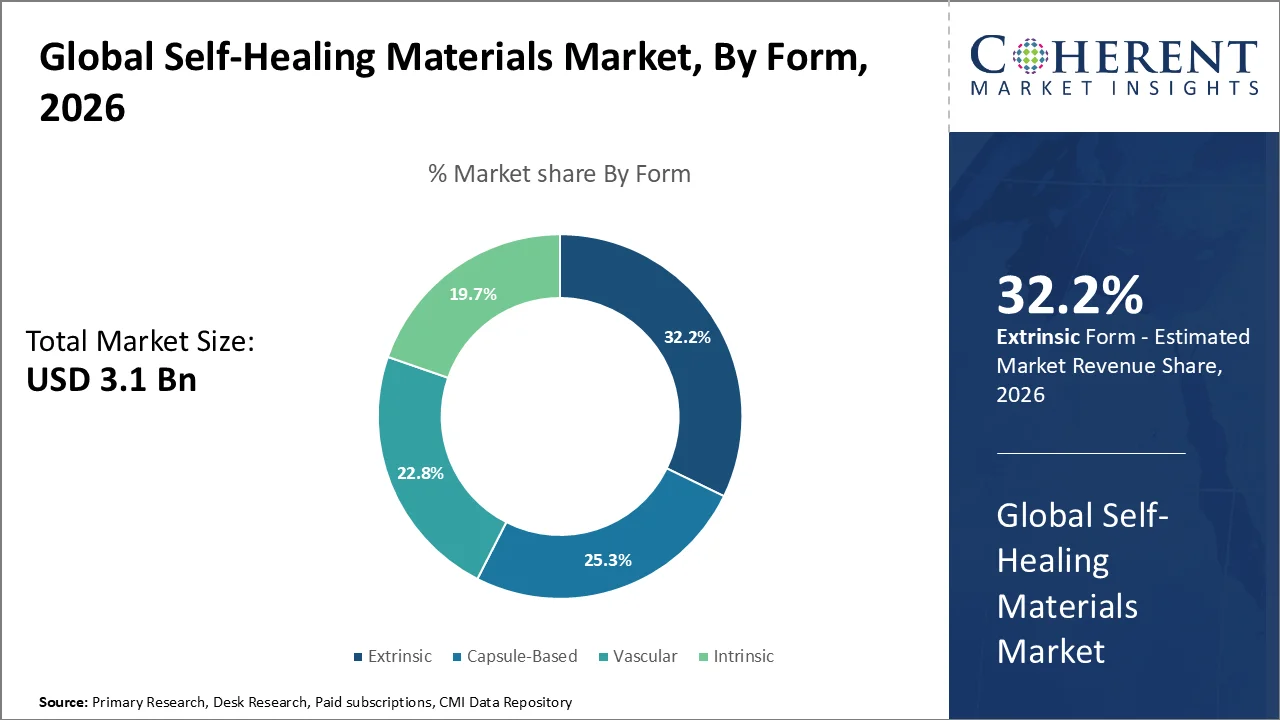
- Extrinsic hold the largest market share of 32.2% in 2026 owing to its growing demand for durable and long-lasting materials. Extrinsic self-healing materials repair damage by releasing embedded healing agents when the material is damaged.
- Ceramic expected to hold largest market share of 32.2% in 2026 owing to the growing demand in aerospace and aviation. Self-healing ceramic coatings repair microcracks and restore protective performance in high-temperature and corrosive environments.
- Reversible Polymers acquired the prominent market share of 34.4% in 2026 owing to the rising demand for smart and adaptive materials. According to a ScienceDirect publication, reversible polymerization enables repeated microscopic repair, restoring the material's original properties.
- Electrical & Electronics captures the largest market share of 37.7% in 2026 owing to the rapid growth of flexible and wearable electronics.
- North America is expected to acquire the dominant share of 39.2% in 2026 owing to its strong aerospace and defense industry. In 2024, the U.S. aerospace and defense industry generated approximately USD 995 Bn in combined sales.
Current Events and Their Impact on the Self-Healing Materials Market
Current Event | Description and its Impact |
European Commission Launches Advanced Materials Strategy (2024) |
|
EU Critical Raw Materials Act Enters into Force (2024) |
|
Segmental Insights
- Current Industry Events of 2026
- Market Size Estimation
- Regional Breakdown
- Competitive Landscape
- Customer Intelligence
- Segmental Analysis
- Pricing Analysis
- Key Market Drivers, Challenges & Future Trends
- Customized Insights Section
Why is Extrinsic Acquiring the Largest Market Share?
Extrinsic hold the largest market share of 32.2% in 2026. Manufacturers are driving the extrinsic self-healing materials market by increasing the adoption of durable, low-maintenance materials across aerospace, automotive, construction, and industrial applications. They integrate embedded healing agents, such as microcapsules and vascular networks, to repair cracks, extend component lifespan, and reduce downtime and replacement costs. Researchers continue to advance material science, improving healing efficiency and enabling broader commercialization. At the same time, industries are prioritizing sustainable solutions that reduce material waste, while expanding the use of self-healing materials in protective coatings, infrastructure, electronics, and energy systems.
Ceramic expected to hold largest market share
Ceramic expected to hold largest market share of 32.2% in 2026 owing to the expansion of high-temperature industrial applications. Industries are driving the ceramic self-healing materials market by adopting high-temperature and wear-resistant materials for aerospace, energy, defense, and industrial manufacturing applications. These advanced ceramics repair microcracks under extreme conditions, helping companies improve durability, reliability, and service life while lowering maintenance needs. Researchers and manufacturers are advancing ceramic matrix composites, nanotechnology, and additive manufacturing techniques to enhance healing performance and expand applications. Increased investments in advanced materials research and the demand for sustainable, long-lasting solutions are further encouraging the adoption of self-healing ceramics across critical industries. For instance, Deep tech startup Cybosense BV partnered with SenseGlove to develop self-healing, bioelectronic 3D-printed smart gloves. Based in Delft, Netherlands, SenseGlove creates wearable haptic gloves that enable users to experience touch sensations in VR and AR environments.
Reversible Polymers acquired the prominent market share
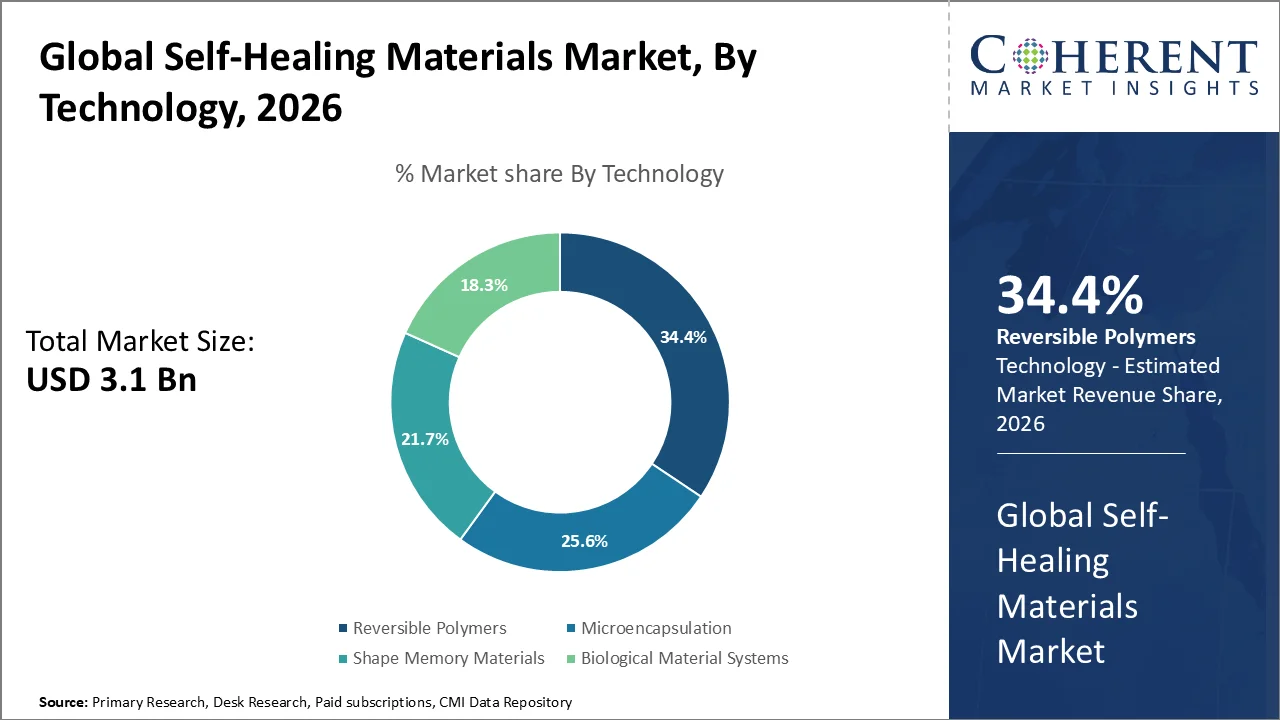
Reversible Polymers acquired the prominent market share of 34.4% in 2026. Industries are driving the reversible polymers self-healing materials market by adopting smart, flexible, and durable materials across electronics, automotive, healthcare, and industrial sectors. These advanced polymers use reversible chemical bonds and physical interactions to repair damage, enabling multiple healing cycles and extending product life. Researchers and manufacturers are advancing polymer chemistry through dynamic bonding technologies and supramolecular systems to enhance performance and broaden commercial applications. Growing sustainability initiatives, waste reduction efforts, and demand for recyclable materials are further encouraging industries to integrate reversible polymers into next-generation products.
Which End Use segment dominates the market?
Electrical & Electronics captures the largest market share of 37.7% in 2026. The electrical and electronics self-healing materials market is driven by the adoption of durable, high-performance materials for consumer electronics, flexible devices, IoT systems, and advanced components. These materials help repair damage, maintain functionality, and extend device lifespans. Growing demand for wearable technology, electric vehicles, and miniaturized electronics is accelerating the development of self-healing solutions. Advances in conductive polymers, smart coatings, and sustainable materials are further supporting market growth. For instance, Dow launched DOWSIL EG-4175 Silicone Gel, a high-voltage protection material for next-generation IGBT modules that absorbs vibrations and self-heals minor cracks without external intervention.
Self-Healing Materials Market Trends
- Growing demand for durable and low-maintenance materials across aerospace, automotive, construction, electronics, and industrial sectors is accelerating the adoption of self-healing technologies. According to the U.S. Department of Energy (DOE), corrosion costs the U.S. economy approximately USD 276 billion annually, highlighting the need for advanced materials that reduce degradation, maintenance, and lifecycle costs.
- Increasing adoption of self-healing polymers and coatings in consumer electronics, automotive components, and protective surfaces improves resistance to scratches, cracks, and environmental damage. According to International Data Corporation (IDC), global smartphone shipments reached 1.24 billion units in 2024, expanding opportunities for durable and self-healing protective materials in consumer electronics.
- Growing infrastructure maintenance requirements are boosting demand for self-healing concrete and construction materials. According to the American Society of Civil Engineers (ASCE), the United States requires an estimated USD 9.1 trillion in infrastructure investment by 2029 to close the nation's infrastructure gap, creating opportunities for durable, low-maintenance construction materials.
Regional Insights
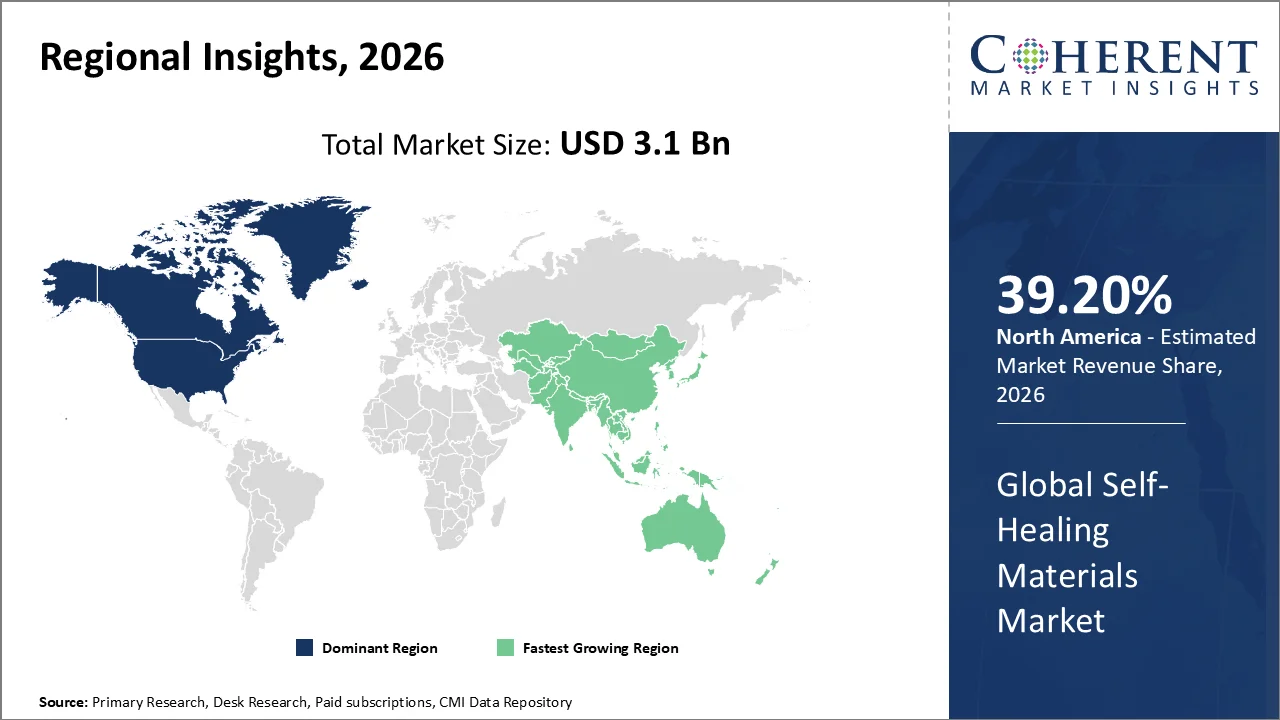
North America dominates owing to increasing adoption in healthcare and medical devices
North America is expected to acquire the dominant share of 39.20% in 2026. Industries across North America are driving the self-healing materials market by adopting durable and sustainable solutions in aerospace, automotive, electronics, healthcare, and construction applications. Companies and research institutions are leveraging advanced infrastructure, technological innovation, and investments in smart materials to accelerate product development. Manufacturers are increasingly using self-healing coatings, composites, and polymers to reduce maintenance needs and extend product lifespans. Growing emphasis on sustainability, advanced manufacturing, and high-performance materials continues to encourage market growth across diverse industrial sectors.
Asia Pacific Self-Healing Materials Market Trends
Rapid urbanization, infrastructure expansion, and investments in sustainable technologies encourage industries to adopt self-repairing materials. The region’s expanding manufacturing sector, focus on enhancing durability, reducing maintenance requirements, and advancements in material science continue to strengthen market development. Increasing environmental awareness and the demand for long-lasting products further promote the adoption of self-healing materials across diverse applications. For instance, AM/NS India, a joint venture between ArcelorMittal and Nippon Steel, began producing Zagnelis Protect, a patented zinc-aluminium-magnesium coated steel for automotive applications. The coating provides a self-healing effect by automatically repairing minor damage.
United States Self-Healing Materials Market Trends
The United States self-healing materials market is expanding as aerospace, automotive, construction, and electronics industries adopt advanced materials to improve durability and reduce maintenance needs. Research advancements in polymers, composites, and smart coatings are driving innovation, while infrastructure growth and demand for sustainable solutions are increasing the adoption of self-healing technologies across various sectors.
Japan Self-Healing Materials Market Trends
Japan advances its self-healing materials market through continuous investment in advanced material technologies, rising demand for long-lasting sustainable solutions, and innovation in industries such as automotive, electronics, construction, and healthcare. Companies and researchers in the country develop self-repairing polymers, coatings, and composites to enhance product durability, lower maintenance requirements, and support environmental goals. Japan’s strong research ecosystem, engineering capabilities, and manufacturing expertise actively drive the commercialization and expansion of self-healing material applications across various sectors. For instance, Aizawa Concrete Corporation is scaling up production of its self-healing concrete, Basilisk, which has supported infrastructure projects since 2020. The company established the Fukushima RDM Center to promote concrete innovation.
Who are the Major Companies in Self-Healing Materials Industry
Some of the major key players in Self-Healing Materials are Acciona S.A., AkzoNobel N.V., Applied Thin Films, Inc., Arkema SA, Autonomic Materials Inc., Avecom N.V., BASF SE, Devan Chemicals, E.I. Du Pont De Nemours and Company, Evonik Industries, Sensor Coating Systems Ltd., and Slips Technologies, Inc.
Key News
- In April 2026, Buckinghamshire Council pledged stronger action to address potholes by trialling self-healing road technology.
- In May 2025, researchers at Texas A&M University developed a dynamic polymer material with unprecedented self-healing properties. The material can switch between solid and liquid states, allowing it to repair puncture damage. When hit by a high-speed projectile, it stretches to reduce the size of the resulting hole, offering potential applications in spacecraft protection and other advanced technologies.
Market Report Scope
Self-Healing Materials Market Report Coverage
| Report Coverage | Details | ||
|---|---|---|---|
| Base Year: | 2025 | Market Size in 2026: | USD 3.1 Bn |
| Historical Data for: | 2020 To 2024 | Forecast Period: | 2026 To 2033 |
| Forecast Period 2026 to 2033 CAGR: | 20.3% | 2033 Value Projection: | USD 14.4 Bn |
| Geographies covered: |
| ||
| Segments covered: |
| ||
| Companies covered: | Acciona S.A., AkzoNobel N.V., Applied Thin Films, Inc., Arkema SA, Autonomic Materials Inc., Avecom N.V., BASF SE, Devan Chemicals, E.I. Du Pont De Nemours and Company, Evonik Industries, Sensor Coating Systems Ltd., and Slips Technologies, Inc. | ||
Analyst Opinion
- Self-healing materials are moving from laboratory innovation to industrial necessity, particularly as manufacturers face rising pressure to improve durability and reduce lifecycle costs. The strongest growth driver is not novelty but the economic advantage of extending product life. For example, the global cost of corrosion is estimated at more than $2.5 trillion annually, representing a major opportunity for self-healing coatings and composites that can automatically repair microcracks and prevent material degradation in infrastructure, automotive, and aerospace applications.
- The automotive and aerospace sectors will remain the most influential adopters of self-healing materials because failure prevention directly impacts safety and operating efficiency. Research demonstrations of self-healing polymers have shown the ability to recover more than 80% of mechanical strength after damage, highlighting their potential for next-generation components, protective coatings, and lightweight structures. Companies exploring advanced composites are increasingly focusing on materials that can reduce inspection frequency and extend service intervals.
- Smart coatings represent one of the most commercially realistic pathways for self-healing materials adoption, especially in high-value assets exposed to harsh environments. For instance, self-healing coating technologies using microcapsules and reversible chemical bonds have demonstrated crack repair at the microscopic level, helping protect metals against corrosion and wear. Industries such as marine, construction, and electronics will accelerate adoption as manufacturers prioritize lower maintenance requirements and longer-lasting products over traditional replacement-based approaches.
Speak to the analyst
Want personalized insights?
Take the findings above to one of our principal consultants, or have the report rebuilt around the segments, geographies and competitors you actually track.
Market Segmentation
- By Form (Revenue, USD Bn, 2021-2033)
- Extrinsic
- Capsule-Based
- Vascular
- Intrinsic
- By Materials (Revenue, USD Bn, 2021-2033)
- Concrete
- Polymer
- Asphalt
- Fiber-Reinforced Composites
- Ceramic
- Metals
- Others
- By Technology (Revenue, USD Bn, 2021-2033)
- Reversible Polymers
- Microencapsulation
- Shape Memory Materials
- Biological Material Systems
- By End-Use Industry (Revenue, USD Bn, 2021-2033)
- Construction
- Automotive
- Aerospace
- Electrical & Electronics
- Others
- By Region (Revenue, USD Bn, 2021-2033)
- North America
- U.S.
- Canada
- Latin America
- Brazil
- Mexico
- Argentina
- Rest of Latin America
- Europe
- Germany
- U.K.
- France
- Italy
- Spain
- Russia
- Rest of Europe
- Asia Pacific
- China
- India
- Japan
- Australia
- South Korea
- ASEAN
- Rest of Asia Pacific
- Middle East
- GCC
- Israel
- Rest of Middle East
- Africa
- South Africa
- Central Africa
- North Africa
- North America
Sources
Primary Research interviews
- Interviews with industry stakeholders, including material scientists, researchers, product developers, manufacturers, technology providers, and end users involved in self-healing materials applications.
- Discussions with experts across sectors such as construction, automotive, aerospace, electronics, healthcare, and coatings to understand market trends, adoption factors, and technological developments.
Databases
- Government databases and statistical repositories related to materials science, manufacturing, infrastructure, automotive, aerospace, and industrial production.
- Scientific and technical databases covering research publications, patents, innovations, and advancements in self-healing materials technologies.
- Trade and import-export databases for understanding material flows, applications, and industry developments.
Magazines
- Industry magazines and trade publications covering advanced materials, nanotechnology, coatings, composites, polymers, construction materials, and engineering innovations.
Journals
- Peer-reviewed scientific journals covering polymer science, materials engineering, nanotechnology, biomaterials, composites, and self-healing technologies.
- Academic publications focused on research advancements, material performance, and application developments.
Newspapers
- Business and technology newspapers covering industrial investments, innovation trends, manufacturing developments, and sustainability initiatives related to advanced materials.
Associations
- Industry associations and professional organizations related to materials science, chemical engineering, construction, automotive, aerospace, and manufacturing sectors.
- Technical societies and research organizations providing industry standards, technology updates, and sector insights.
Public Domain sources
- Government publications, regulatory documents, research reports, policy papers, and sustainability initiatives related to advanced materials.
- Patent databases, academic repositories, university research publications, and publicly available technical documents.
- Company filings, product announcements, and publicly accessible innovation updates.
Proprietary Elements
- CMI Data Analytics Tool
- Proprietary CMI Existing Repository of information for last 10 years
Get access to 250+ pages report
Every segment, forecast, competitor profile and data table behind the analysis above — available for instant download.
- ESOMAR Member
- ISO 9001:2015 Certified
- D-U-N-S Registered
- GDPR & CCPA Compliant
Missing comfort of reading report in your local language? Find your preferred language:
Transform your Strategy with Exclusive Trending Reports
Frequently Asked Questions
Self-healing materials are advanced materials designed to automatically repair damage such as cracks, scratches, or structural defects without requiring external intervention.
The automotive, aerospace, construction, electronics, healthcare, and energy sectors are major contributors to demand.
Self-healing materials are becoming important because industries are shifting toward sustainable and cost-efficient solutions.
Key applications include self-healing coatings for corrosion protection, self-repairing polymers, concrete that seals its own cracks, composite materials for aerospace and automotive components, and smart materials used in medical devices and electronics.
Self-healing polymers and coatings currently represent some of the most commercially developed categories due to their easier integration into existing manufacturing processes.