

Global Bamboo Powder Market Size and Share Analysis – Growth Trends and Forecasts (2026-2033)
The global bamboo powder market is estimated to be valued at USD 176.4 Mn in 2026 and is expected to reach USD 227.5 Mn by 2033, exhibiting a compound annual growth rate (CAGR) of 3.7% from 2026 to 2033.
Key Takeaways of the Bamboo Powder Market
- Based on Application, Food and beverage segment is estimated to account for 58.5% % of the market share in 2026. This is due to increasing health consciousness among consumers.
- Based on region, Asia Pacific dominates the market with 40.1%% market share. This is due to growing consumer preference for natural and plant-based products.
Market Overview
The increasing application of bamboo powder across various industries like food, cosmetics, and personal care products is one of the key factors driving the market growth. Bamboo powder offers benefits like moisture absorption, anti-bacterial properties, and texture improvement which makes it suitable for use in a variety of products. Moreover, rising consumer awareness regarding the benefits of natural and herbal products is further expected to support the demand for bamboo powder-based goods. Wide availability of raw bamboo at lower costs along with various government initiatives to support bamboo farming will proliferate the production of bamboo powder and boost the market growth in the coming years.
Current Events and Its Impact on Bamboo Powder Market
Current Events | Description and its impact |
Geopolitical and Regulatory Developments |
|
Economic and industry trends |
|
Consumer and Lifestyle Trends |
|
Pricing Analysis
The price of bamboo powder in the market, depends on several factors like the availability of raw materials, processing methods, end-use applications and the factors associated with plant dynamic regionally. For larger quantities or industrial-scale needs, suppliers in Asia commonly offer bulk cosmetic or pharmaceutical-grade bamboo powder at competitive prices (~$15–$25/kg).
Naturally, price will depend on the level of quality and refinement of the powder. Ultra-fine, food-grade, or cosmetic-grade bamboo powder is the most expensive level of bamboo powder, because it sustains a higher purity level.
- Current Industry Events of 2026
- Market Size Estimation
- Regional Breakdown
- Competitive Landscape
- Customer Intelligence
- Segmental Analysis
- Pricing Analysis
- Key Market Drivers, Challenges & Future Trends
- Customized Insights Section
Export Import Analysis
Between June 2024 and May 2025, India exported 535 shipments of bamboo, involving 154 exporters and reaching 211 buyers. This represents a 15% increase compared to the previous twelve months. In May 2025 alone, India shipped 28 bamboo consignments, showing no growth year-on-year compared to May 2024 and no change from April 2025. The primary destinations for India's bamboo exports are the United States, United Kingdom, and United Arab Emirates. On the global stage, the leading bamboo exporters are China, Vietnam, and Indonesia, with China at the forefront with 80,840 shipments, followed closely by Vietnam with 79,816 shipments, and Indonesia in third place with 9,376 shipments.
Segmental Insights
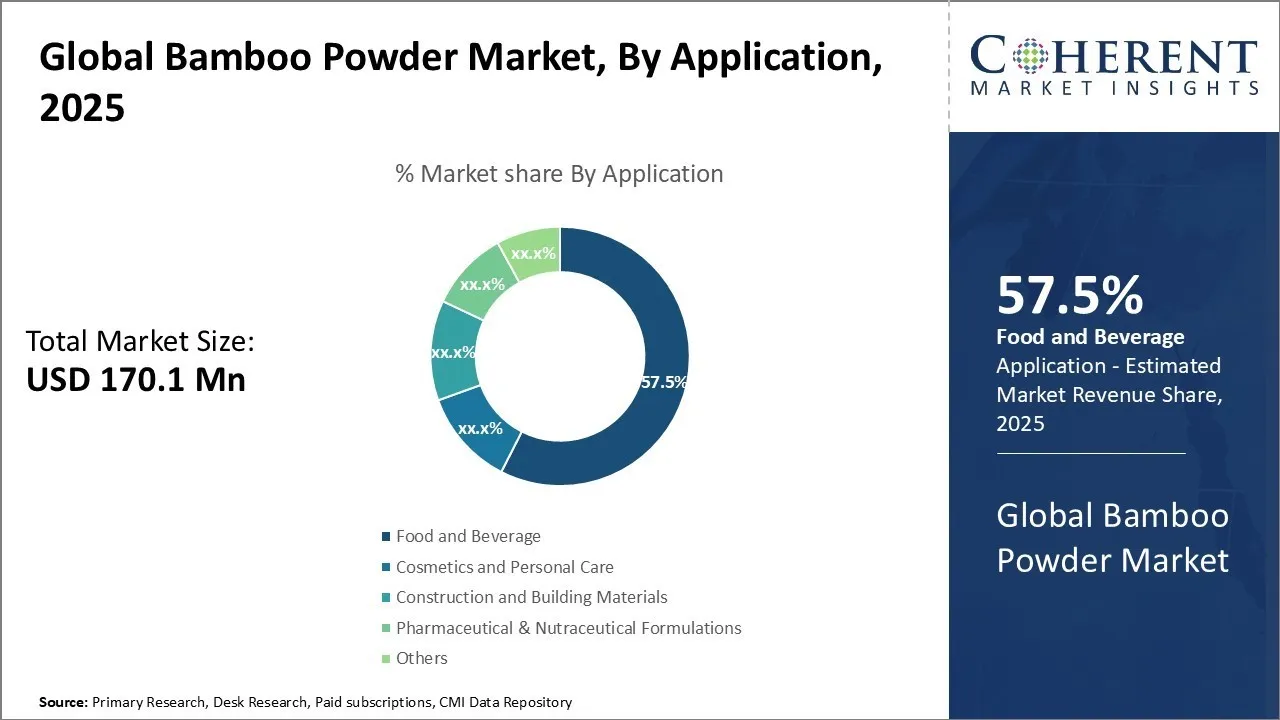
Bamboo Powder Market Insights, By Application: Food and Beverage dominates the market due to rising health consciousness
In terms of application, the food and beverage segment are estimated to contribute 58.5% share of the market in 2026, owing to increasing health consciousness among consumers. Bamboo powder is nutrient-dense and contains high levels of vitamins, minerals, antioxidants, and fiber. It is a suitable substitute for wheat and soy flour in many recipes as it has a mild and nutty flavor that does not alter the taste of finished food products significantly. Bamboo powder is gaining popularity as a superfood ingredient. It supports gut health and digestion since it contains prebiotic fiber. For instance, Micro Ingredients, a U.S.-based company, offers Organic Bamboo Fiber Powder as a gluten-free, low-carb alternative suitable for various baking applications. This product is marketed as a source of prebiotics and minerals, catering to health-conscious consumers seeking natural ingredients to support digestive health.
Regional Insights
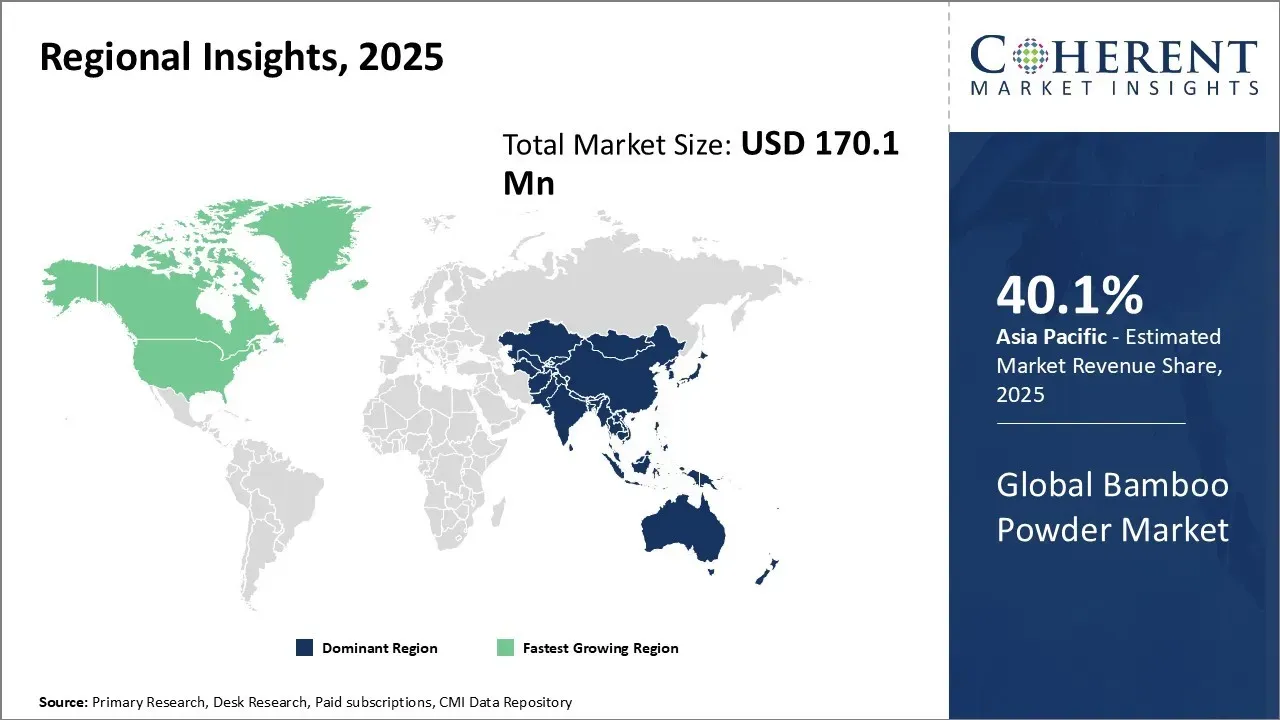
Asia Pacific Bamboo Powder Market Trends
Abundant bamboo resources across China, India, and Southeast Asia, combined with favorable climates and traditional expertise, anchor the region’s dominance in the bamboo powder market, projected to hold around 40.1% global share. Rising consumer demand for natural and sustainable products—especially in cosmetics, food, and personal care—is fueling adoption in applications like exfoliating skincare, functional foods, and eco‑friendly packaging. Government incentives and technological advances—such as improved grinding processes and processing infrastructure—are boosting production efficiency; for example, companies in China and India are expanding operations under sustainability programs like India’s National Bamboo Mission.
North America Bamboo Powder Market Trends
North America is expected to account for 21.80% of the bamboo powder market share in 2026. The region is experiencing the fastest growth, fueled by a growing consumer preference for natural and plant-based products. Increasing environmental awareness has accelerated the use of bamboo powder as a sustainable alternative to plastic and other synthetic materials across diverse industries including construction and personal care.
In April 2026, Sprouts Farmers Market in Denver launched a pilot initiative by partnering with South Min Champs SNO to introduce flow-wrapped mushroom packaging made with bamboo—a move supporting eco-friendly retail innovations and reducing plastic in fresh produce packaging. Such innovations are accelerating the bamboo powder market growth.
Bamboo Powder Market Dominating Countries
China Bamboo Powder Market Analysis and Trends
China is as a leader in bamboo production worldwide, heavily supported by government policy in various bamboo-based industries. Policies to promote reforestation, sustainable development, and the production of eco-friendly products have led to a rapid increase in using bamboo powder in construction, packaging, and various products for daily use.
For instance, Fujian Sanming City has established itself as a center of bamboo production and sales in China while promoting bamboo powder production using industrial parks and subsidies to build more value-added bamboo composites and export packaging made from biodegradable bamboo powder.
India Bamboo Powder Market Bamboo Powder Market Analysis and Trends
India boasts substantial bamboo reserves, especially in the northeastern regions and states like Assam, Tripura, and Mizoram. The National Bamboo Mission (NBM), launched by the Ministry of Agriculture & Farmers Welfare, is actively promoting bamboo cultivation, focusing on enhancing production, processing, and commercial utilization. For example, researchers at IIT Guwahati have engineered a sustainable composite material combining local Bambusa tulda bamboo with biodegradable polymers—ideal for automotive parts like dashboards, seat backs, and door panels—supporting eco-friendly manufacturing under the Make in India initiative.
Market Report Scope
Bamboo Powder Market Report Coverage
| Report Coverage | Details | ||
|---|---|---|---|
| Base Year: | 2025 | Market Size in 2026: | USD 176.4 Mn |
| Historical Data for: | 2020 To 2024 | Forecast Period: | 2026 To 2033 |
| Forecast Period 2026 to 2033 CAGR: | 3.7% | 2033 Value Projection: | USD 227.5 Mn |
| Geographies covered: |
| ||
| Segments covered: |
| ||
| Companies covered: | Botanic Healthcare, Medikonda Nutrients, Natural Sourcing, LLC, JELU-WERK J. Ehrler GmbH & Co. KG, Lessonia, SOCRI S.r.l., Smart Village, Kshipra Biotech Private Limited, Ambe Ns Agro Product Pvt Ltd, Alpspure Lifesciences Pvt. Ltd., Herbo Nutra Extract Private Limited, Jeeva Organic Private Limited, Arkure Health Care, Aaron Aromatics, and Bamboo Village | ||
| Growth Drivers: |
| ||
| Restraints & Challenges: |
| ||
Bamboo Powder Market Driver
- Increasing Demand for Sustainable and Eco-friendly Products
The increasing demand for sustainable and eco-friendly products is significantly driving the bamboo powder market demand. Bamboo, renowned for its fast growth and minimal need for pesticides and fertilizers, presents an ideal sustainable raw material, increasingly used in diverse applications such as textiles, personal care, and construction. This shift is primarily propelled by the burgeoning awareness and proactive stance on environmental preservation.
For instance, in January 2025, Southwest Airlines rolled out a bamboo cold-serve cup and wooden stir stick for in-flight service. This initiative was part of their broader strategy to reduce single-use plastics by 50% by 2025.
Bamboo Powder Market Opportunity
- Growing Interest in Natural Health and Wellness Products
One of the key opportunities for growth in the market is the expansion of the vegan and plant-based food market. Increasing health consciousness and growing preference for sustainable ingredients are prompting many consumers to opt for vegan diets and reduce meat consumption. Bamboo powder is being widely explored as a plant-based substitute for meat in various food applications due to its high protein content. It is gaining popularity as an important ingredient in vegan meatballs, burger patties, sausages, and other vegan snacks. The global market for vegan food products has been expanding at a rapid pace over the past few years. If this rising demand continues to grow for vegan alternatives, it will translate into higher demand for bamboo powder from the food industry. Manufacturers should focus on innovative product development and strategic marketing to tap into the sizable opportunities in vegan food markets. In 2024, Beyond Meat announced pilot trials incorporating bamboo powder as a natural fiber and protein source in its new line of plant-based burger patties. The addition aimed to improve texture and nutritional profile while aligning with consumer demand for cleaner, sustainable ingredients in vegan products.
Key Developments
- In July 2025, Torrent Pharmaceuticals, based in Ahmedabad, unveiled Shelcal Total, a nutrition supplement powder for adults. This supplement delivers targeted nutrients that include calcium, and magnesium. Also, it has bamboo shoot extract and helps in joint health.
- In April 2025, the Indian government launched the National Bamboo Mission (NBM) 2025 to boost bamboo cultivation on non-forest lands, increase farmer incomes, reduce imports, and ensure a steady supply of raw material for industries.
Analyst Opinion
- The market is driven by increasing demand from construction and textile industries where bamboo powder is used as an alternate to wood flour and wood fibers. Growing awareness about environment-friendly and sustainable products is boosting the consumption of bamboo powder worldwide. the purpose of bamboo powder is rapidly moving away from a "green alternative." In 2024, Vinabamboo Co. located in Vietnam increased their provision of food-grade bamboo powder for vegan meat producers and optimized the function of bamboo powder by being specifically focused on the textural enhancement of vegan meat substitutes, as well as the fiber enrichment for meat-based substitutes.
- New product development is another key opportunity in this space. Market players are investing in R&D to develop innovative application of bamboo powder in industries such as pharmaceuticals and food & beverages. The market is also witnessing a shift towards organic and non-toxic bamboo powder offerings.
- North America and Western Europe are expected to offer lucrative business opportunities for players during the forecast period. This is due to stringent environmental regulations and rising eco-conscious population in these regions. However, stringent quality standards and certifications remain a barrier to entry for emerging manufacturers.
Speak to the analyst
Want personalized insights?
Take the findings above to one of our principal consultants, or have the report rebuilt around the segments, geographies and competitors you actually track.
Market Segmentation
- Application Insights (Revenue, USD Mn, 2021 - 2033)
- Food and Beverage
- Cosmetics and Personal Care
- Construction and Building Materials
- Pharmaceutical & Nutraceutical Formulations
- Others (Textiles, Plastic Composites, etc.)
- Distribution Channel Insights (Revenue, USD Mn, 2021 - 2033)
- Online
- Offline
- Regional Insights (Revenue, USD Mn, 2021 - 2033)
- North America
- U.S.
- Canada
- Latin America
- Brazil
- Argentina
- Mexico
- Rest of Latin America
- Europe
- Germany
- U.K.
- Spain
- France
- Italy
- Russia
- Rest of Europe
- Asia Pacific
- China
- India
- Japan
- Australia
- South Korea
- ASEAN
- Rest of Asia Pacific
- Middle East
- GCC Countries
- Israel
- Rest of Middle East
- Africa
- South Africa
- North Africa
- Central Africa
- North America
- Key Players Insights
- Botanic Healthcare
- Medikonda Nutrients
- Natural Sourcing, LLC
- JELU WERK J. Ehrler GmbH & Co. KG
- Lessonia
- SOCRI S.r.l.
- Smart Village
- Kshipra Biotech Private Limited
- Ambe Ns Agro Product Pvt Ltd.
- Alpspure Lifesciences Pvt. Ltd.
- Herbo Nutra Extract Private Limited
- Jeeva Organic Private Limited
- Arkure Health Care
- Aaron Aromatics
- Bamboo Village
Sources
Primary Research Interviews
- Bamboo powder manufacturers and producers
- Food and beverage industry executives
- Cosmetics and personal care product developers
- Dietary supplement distributors
- Others
Databases
- Euromonitor International
- Global Trade Atlas
Magazines
- Natural Products Insider
- Food Processing Magazine
- Cosmetics & Toiletries
- Nutraceuticals World
- Others
Journals
- Journal of Food Science and Technology
- Industrial Crops and Products
- International Journal of Cosmetic Science
- Others
Newspapers
- Financial Times
- The Wall Street Journal
- Reuters Business News
- Bloomberg News
- Others
Associations
- International Bamboo and Rattan Organisation (INBAR)
- Natural Products Association (NPA)
- Global Organization for EPA and DHA Omega 3s (GOED)
- American Herbal Products Association (AHPA)
- Others
Public Domain Sources
- U.S. Food and Drug Administration (FDA)
- European Food Safety Authority (EFSA)
- World Trade Organization (WTO) Trade Statistics
- United Nations Comtrade Database
- Others
Proprietary Elements
- CMI Data Analytics Tool
- Proprietary CMI Existing Repository of information for last 8 years
Get access to 250+ pages report
Every segment, forecast, competitor profile and data table behind the analysis above — available for instant download.
- ESOMAR Member
- ISO 9001:2015 Certified
- D-U-N-S Registered
- GDPR & CCPA Compliant
Missing comfort of reading report in your local language? Find your preferred language:
Transform your Strategy with Exclusive Trending Reports
Frequently Asked Questions
The global bamboo powder market is estimated to be valued at USD 176.4 Mn in 2026 and is expected to reach USD 227.5 Mn by 2033.
The CAGR of the global bamboo powder market is projected to be 3.7% from 2026 to 2033.
Increasing consumer awareness of the health benefits of bamboo powder and growing demand for natural and organic ingredients in various industries are the major factors driving the growth of the global bamboo powder market.
Limited availability of raw bamboo resources and high production costs compared to synthetic alternatives are the major factors hampering the growth of the global bamboo powder market.
In terms of application, the food and beverage segment is estimated to dominate the market revenue share in 2026.
Bamboo powder is used as a natural ingredient in food, cosmetics, personal care products, and as a sustainable material in various industries due to its moisture-absorbing, antibacterial, and texturizing properties.
Bamboo powder does not fully dissolve in water but can disperse as a fine suspension depending on the processing and particle size.