

Precast Concrete Market Analysis & Forecast: 2026 to 2033
Precast Concrete Market is estimated to be valued at USD 124.49 Bn in 2026 and is expected to reach USD 182.30 Bn in 2033, exhibiting a compound annual growth rate (CAGR) of 5.6% from 2026 to 2033.
Key Takeaways
- Based on Product, the Structural Building Components segment is expected to lead the market with 38% share in 2026, led by walls, beams, and slabs.
- Based on Application, the Residential segment is projected to capture the largest share of the market in 2026, driven by urbanization and modular housing demand.
- Based on Region, Asia Pacific is set to lead the precast concrete market with 40% share in 2026. While, Europe is anticipated to be the fastest growing region.
Market Overview
The precast concrete market is gaining traction globally as an effective construction material. Its high-quality and durability are the main reasons for its wide usage across various building projects. The demand for these products is expected to increase in the future due to the rise in global population and economic growth. Furthermore, the rising per capita income across developing countries is further expected to stimulate the market growth for housing and infrastructure development. In addition, the governments of developing countries are supporting the construction industry by providing infrastructure and affordable homes to the lower-income sections.
Current Events and Its Impacts on the Precast Concrete Market
Current Event | Description and its Impact |
Global Infrastructure Investment Surge and Policy Initiatives |
|
Technological Advancement and Digital Transformation |
|
Global Investments in Precast Concrete Projects
Company / Entity | Location | Investment Amount | Purpose / Focus |
FIT Precast | Gaston County, North Carolina, USA | USD 102 million | Flagship manufacturing headquarters to expand precast production capacity |
Jianhua PHC & RAK Ports | Ras Al Khaimah, UAE | AED 120 million (~USD 32 million) | Concrete piles plant for infrastructure and foundation projects |
Thomas Gruppe (with Putzmeister tech) | Germany | Not disclosed | Modernization of precast plant to improve efficiency and sustainability |
Maharashtra Government | Mumbai, India | Policy-driven (developer investments) | Mandated precast construction to reduce pollution and accelerate urban projects |
MoRTH (Govt. of India) | Nationwide (Highway projects) | Large-scale public investment | Mandated precast for non-critical highway components to speed up construction |
NEOM Project (Saudi Arabia) | Saudi Arabia | Multi-billion (part of mega project) | Heavy use of precast modules for rapid smart city development |
- Current Industry Events of 2026
- Market Size Estimation
- Regional Breakdown
- Competitive Landscape
- Customer Intelligence
- Segmental Analysis
- Pricing Analysis
- Key Market Drivers, Challenges & Future Trends
- Customized Insights Section
Segmental Insights
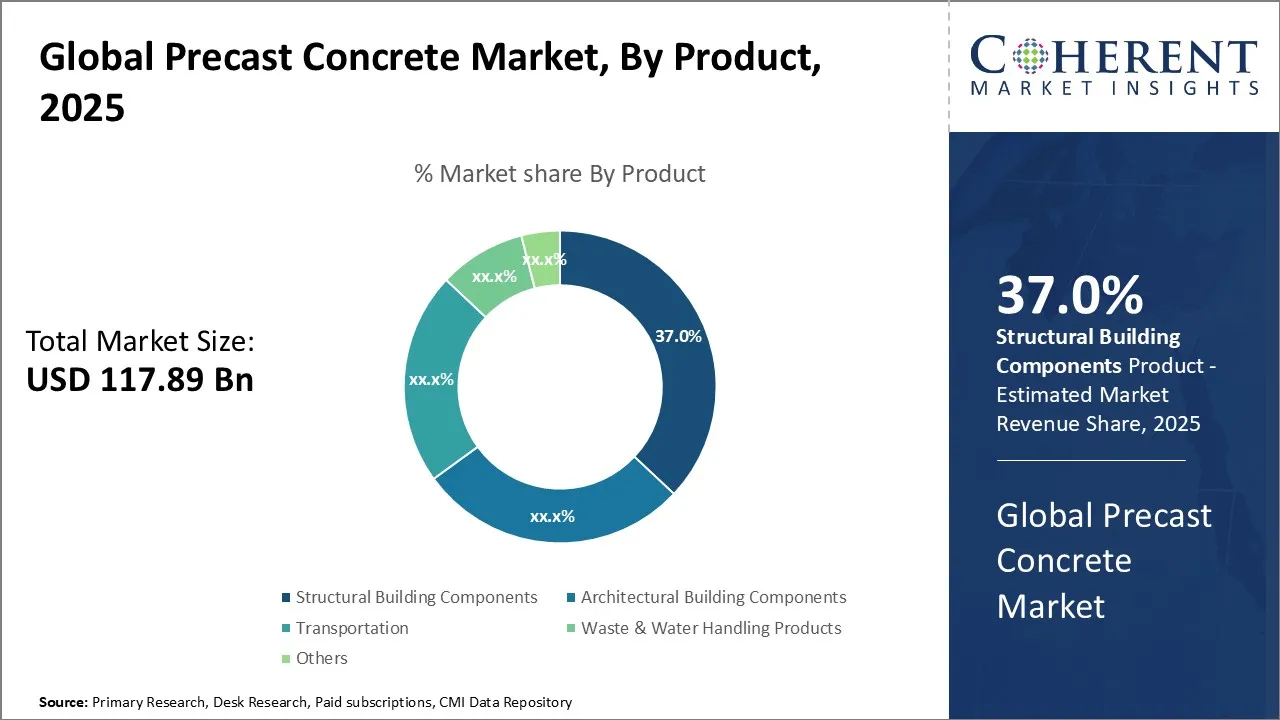
Global Precast Concrete Market Insights, By Product - Structural Building Components Dominance Is Led by Walls, Beams, And Slabs
In terms of product, the structural building components segment is expected to grow rapidly with 38% share in 2026, led by walls, beams, and slabs. They are popular because they are efficient, last a long time, and save money on big projects. Precast walls make up the largest part of the market. This is because of the demand for modular housing and the rapid growth of cities, which makes them essential for modern construction.
For instance, in September 2026, NIST engineers unveiled five innovative methods to connect precast concrete pieces, aiming to make structures more resilient. The breakthrough focuses on improving joints in structural building components such as walls, beams, and slabs, which are critical for safety and durability. This advancement is expected to strengthen precast construction across residential, commercial, and infrastructure projects.
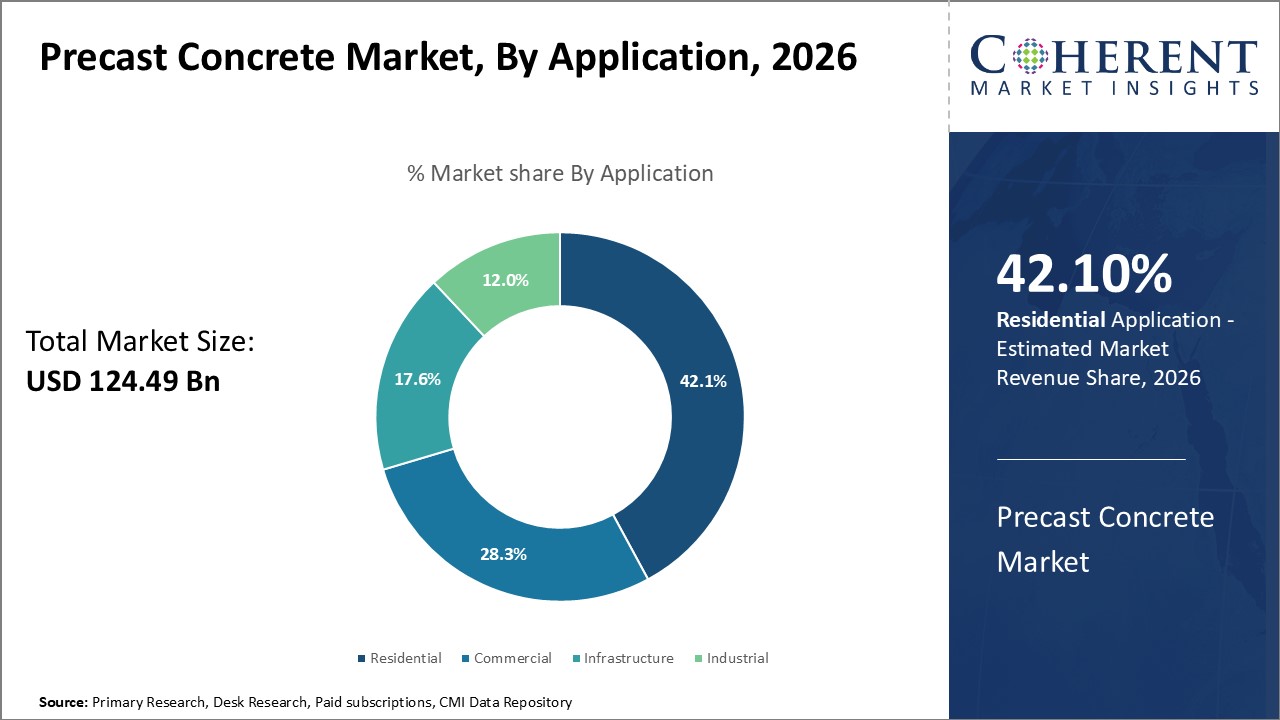
Global Precast Concrete Market Insights, By Application - Residential Construction Lead is Driven by Urbanization and Modular Housing Demand
Based on Application, the residential segment is expected to dominate the market with the largest share in 2026. Rising urban populations, affordable housing initiatives, and modular building techniques fuel demand. Precast elements enable faster project completion, reduced labor costs, and enhanced quality, positioning residential projects as the primary driver of market expansion globally.
For instance, in September 2026, Suraksha Group made an important move toward mechanizing construction by building one of the largest captive precast factories in Asia. The facility is meant to speed up residential construction projects, which will lead to faster delivery, better quality, and lower costs. This project shows how precast concrete is becoming more important in meeting India's need for urban housing.
Regional Insights
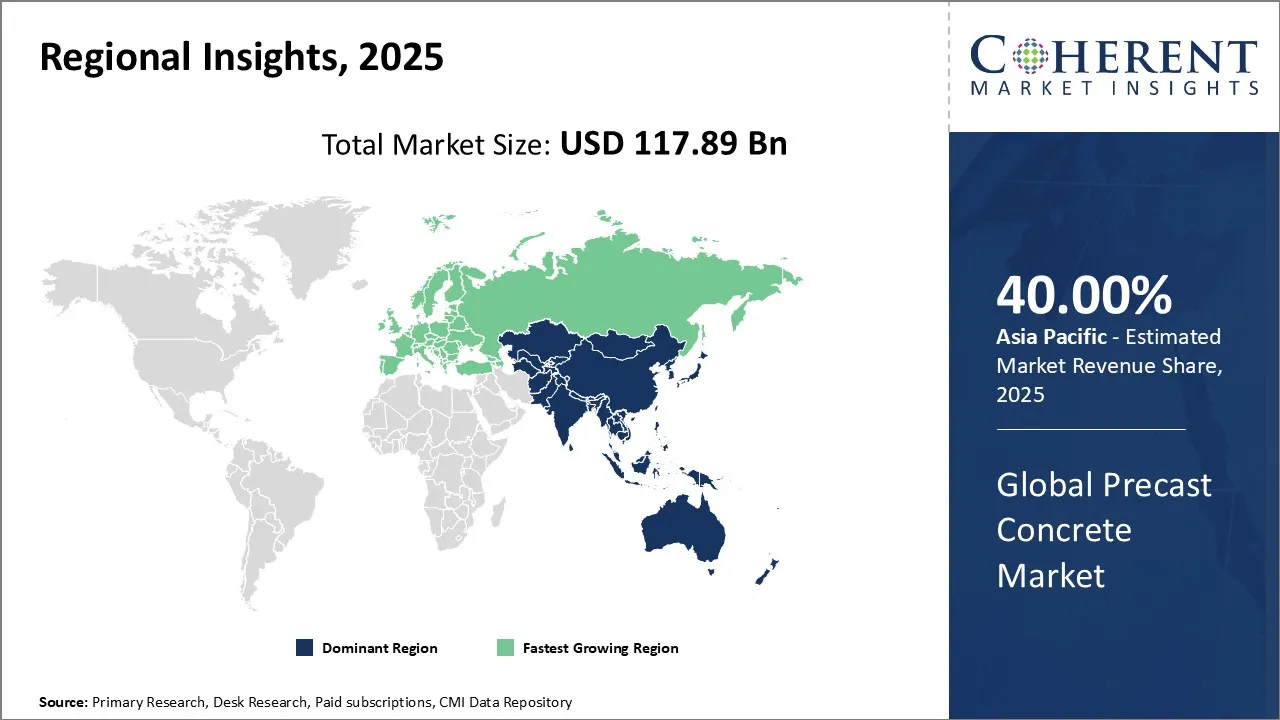
Asia Pacific Precast Concrete Market Analysis & Trends
The Asia Pacific region is expected to dominate the global precast concrete market with 40% in 2026, due to cities are growing quickly, infrastructure is expanding, and countries like China, India, and Southeast Asia need more housing. Precast is in line with government plans for smart cities and sustainable development because it speeds up construction, saves money, and lasts longer. More money is going into transportation, business, and housing projects, which is making the region grow even faster.
For instance, in October 2026, RAK Ports and China's Jianhua PHC opened an AED 120 million concrete piles plant in Ras Al Khaimah, UAE. The plant will make precast concrete piles for major construction and infrastructure projects. This investment makes the Middle East a stronger player in the precast concrete industry, which helps the region grow and supports sustainable development efforts.
Europe Precast Concrete Market Analysis & Trends
Europe is the second largest contributor and the fastest growing region in the global precast concrete market. This is attributed to the fact that the region is home to many key players that offer goods and services that are geared towards societal needs, offering a wide range of products and building solutions. In the United Kingdom, precast concrete plays an important role in the building and construction industry. It is used in a wide variety of applications and is particularly popular for its rapid turnaround from sign-off.
For instance, in November 2026, Lipa Betoni launched the world’s first factory using Carbonaide’s CO₂ storage technology in Finland. The facility integrates carbon capture into precast concrete production, enhancing sustainability while reducing emissions. This breakthrough positions Europe as a leader in green construction, marking a significant step toward climate-friendly building solutions in the precast industry.
Precast Concrete Market Outlook Country-Wise
The U.S. Precast Concrete Market Trends
In 2026, the U.S. precast concrete market is expected to be highly competitive because of rising construction costs, urban renewal, and infrastructure modernization. Precast is great for homes, businesses, and factories because it is quick to install, cost-effective, and long-lasting. Government programs, a skilled workforce, and new ideas in eco-friendly building materials all help to make this trend even stronger across the country.
For instance, in November 2026, FIT Precast announced it would spend more than $102 million to build its main manufacturing headquarters in Gaston County, North Carolina. The building will increase the amount of precast concrete that can be made and provide a lot of jobs in the area. This news shows how much more the U.S. construction market needs precast solutions and strengthens North America's position in the industry.
Germany Precast Concrete Market Trends
Germany’s demand for precast concrete market in 2026 is driven by rapid urban development, infrastructure modernization, and sustainability goals. Precast is faster to build, costs less in labor, and lasts a long time, which fits with Germany's push for building solutions that are good for the environment and use less energy. Government programs and new manufacturing technologies make it even easier for people to use it in residential, commercial, and civil engineering projects.
For instance, in May 2026, Thomas Gruppe modernized its precast concrete plant in Germany with advanced Putzmeister technology. The facility enhances efficiency and quality in producing precast components for building and civil engineering projects. This success story highlights Europe’s growing role in innovative precast manufacturing, meeting rising demand for durable and sustainable construction solutions
Market Report Scope
Precast Concrete Market Report Coverage
| Report Coverage | Details | ||
|---|---|---|---|
| Base Year: | 2025 | Market Size in 2026: | USD 124.49 Bn |
| Historical Data for: | 2020 To 2024 | Forecast Period: | 2026 To 2033 |
| Forecast Period 2026 to 2033 CAGR: | 5.6% | 2033 Value Projection: | USD 182.30 Bn |
| Geographies covered: |
| ||
| Segments covered: |
| ||
| Companies covered: | Oldcastle Inc., Cemex Inc., Lafarge North America, HeidelbergCement, Holcim Inc., Vulcan Materials Co., Colas S.A., Martin Marietta Materials, MDU Resources, and Buzzi Unicem | ||
| Growth Drivers: |
| ||
| Restraints & Challenges: |
| ||
Global Precast Concrete Market Drivers
Growing awareness regarding the advantages of precast concrete to propel market growth
The precast concrete market has experienced significant growth over the past few years. This is because of its ability to be used in a wide variety of construction applications, and its versatility in design. The most common use for this material is for construction of large structures, such as skyscrapers, stadiums, and homes. Precast concrete consists of ready-mixed, mixed-bed concrete that is then transported and placed on a construction site. It is used for a variety of purposes, such as floor slabs, beams, walls, and columns.
Increasing reconstructing and modernizing infrastructural facilities to augment market growth
The growth of the precast concrete market is largely attributed to growing investments in commercial and industrial infrastructure in emerging markets. These investments include new commercial buildings, bridges, metros, airports, and railroads. Additionally, the deteriorating condition of some infrastructural assets is prompting governments to replace them with modern and advanced structures that are compatible with future needs.
Global Precast Concrete Market Opportunities
Growing application in water and waste management sector is expected to provide significant growth opportunities. The water and waste management application of the precast concrete market is expected grow rapidly over the next few years, primarily owing to the increasing demand for modern stormwater runoff management systems. The industry is also impacted by the increasing use of precast concrete forming systems in wastewater treatment facilities, which offer superior durability, resiliency, and weather-resistance.
The market for precast concrete is projected to expand significantly over the next few years, driven by increasing construction activities around the world and a growing focus on the use of green building materials. Moreover, the market is gaining traction as a result of an increase in demand for high-quality building materials, as well as the development of technologically advanced processes and equipment that allow the industry to produce precast concrete products more efficiently and economically. This is expected to provide additional market opportunities.
Global Precast Concrete Market Trends
Growing merger and acquisition in the market
Major players in the precast concrete market size are accelerating growth through strategic investments in research and development, focusing on innovative, sustainable building solutions. Additionally, mergers and acquisitions are strengthening global footprints, enhancing production capacity, and expanding product portfolios. These initiatives drive competitiveness, efficiency, and long-term expansion across diverse construction sectors worldwide.
Increasing focus on energy-efficient building techniques
The market is mainly driven by the increasing focus on energy-efficient building techniques and life-cycle management, and the growing infrastructure development plans in emerging economies. In addition, the rising urbanization and industrialization in developing countries is also expected to drive demand for precast concrete.
Analyst Opinion (Expert Opinion)
- The global precast concrete market is growing promptly as more individuals are building, cities are growing, and there is a need for more efficient building solutions. The move from traditional cast-in-place concrete to factory-made, quality-controlled precast parts is especially clear in structural building parts like walls, slabs, beams, and columns, as well as in infrastructure and modular housing projects.
- Rapid urbanization in emerging economies, especially in South Asia and the Asia-Pacific region, is driving up the need for residential, commercial, and public infrastructure projects. Precast concrete is a good choice for developers and governments because it is faster to build, has consistent quality, needs less on-site labor, and is cheaper. Modular and pre-engineered construction methods make it more feasible to adopt due to their help with rising labor costs and the need for building processes that are exactly the same every time.
- Infrastructure projects like bridges, roads, transit systems, and public utilities are still driving demand. This shows how strong and scalable the material has proven. Walls, slabs, and beams are still the most popular precast products considering they are easy to install and work with modern building styles.
Speak to the analyst
Want personalized insights?
Take the findings above to one of our principal consultants, or have the report rebuilt around the segments, geographies and competitors you actually track.
Key Global Precast Concrete Market: Key Developments
- In November 2025, Roman Stone and RockFiber introduced basalt fiber reinforcement for precast concrete to the US. The new technology makes walls, slabs, and other structural parts stronger, more durable, and more flexible, which helps with building and civil engineering projects. This progress is a big step forward for precast concrete solutions that are both environmentally friendly and high-performing.
- In June 2025, The Ministry of Road Transport and Highways (MoRTH) ordered that precast concrete be used for parts of highway projects in India that are not very important. The goal of the directive is to speed up construction, lower costs, and make things more environmentally friendly. The government wants to modernize infrastructure development and make the country's growing road network more efficient by making precast adoption more common.
- In March 2025, The Maharashtra government ordered that precast construction be used in Mumbai, to cut down on pollution and damage to the environment. The goal of the initiative is to reduce dust, speed up project timelines, and make things more sustainable by encouraging the use of factory-made concrete parts. This policy is a big step toward making cities in India's financial capital more environmentally friendly and updating how buildings are built.
Market Segmentation
- Global Precast Concrete Market, By Product (Revenue, USD Bn, 2021 - 2033)
- Structural Building Components
- Architectural Building Components
- Transportation
- Waste & Water Handling Products
- Others
- Global Precast Concrete Market, By Application (Revenue, USD Bn, 2021 - 2033)
- Residential
- Commercial
- Infrastructure
- Industrial
- Global Precast Concrete Market, By Region (Revenue, USD Bn, 2021 - 2033)
- North America
- U.S.
- Canada
- Latin America
- Brazil
- Argentina
- Mexico
- Rest of Latin America
- Europe
- Germany
- U.K.
- Spain
- France
- Italy
- Russia
- Rest of Europe
- Asia Pacific
- China
- India
- Japan
- Australia
- South Korea
- ASEAN
- Rest of Asia Pacific
- Middle East & Africa
- GCC Countries
- Israel
- Rest of Middle East & Africa
- North America
- Global Precast Concrete Market: Companies Insights (Revenue, USD Bn, 2021 - 2033)
- Oldcastle Inc.
- Cemex Inc.
- Lafarge North America
- HeidelbergCement
- Holcim Inc.
- Vulcan Materials Co.
- Colas S.A.
- Martin Marietta Materials
- MDU Resources
- Buzzi Unicem
Sources
Primary Research Interviews
- Precast Concrete Manufacturers
- Construction & Infrastructure Companies
- Engineering, Procurement & Construction (EPC) Contractors
- Architects & Civil Engineers
- Material Suppliers & Concrete Technology Providers
- Others
Databases
- Bloomberg Terminal
- Thomson Reuters Eikon
- IHS Markit
- Euromonitor International
- S&P Global Market Intelligence
- Others
Magazines
- Engineering News-Record (ENR)
- Concrete Construction Magazine
- Construction Today
- World Cement Magazine
- Others
Journals
- Journal of Construction and Building Materials
- Cement and Concrete Research
- International Journal of Concrete Structures and Materials
- Journal of Structural Engineering
- Others
Newspapers
- Financial Times
- The Wall Street Journal
- Reuters
- Bloomberg News
- Others
Associations
- Precast/Prestressed Concrete Institute (PCI)
- American Concrete Institute (ACI)
- European Precast Concrete Association (EUPCA)
- International Federation for Structural Concrete (fib)
- Others
Public Domain Sources
- U.S. Department of Transportation (DOT) – Federal Highway Administration
- World Bank Open Data – Infrastructure Projects
- European Commission – Construction & Infrastructure Statistics
- National Ready Mixed Concrete Association (NRMCA)
- International Concrete Sustainability Conference Publications
- Others
Proprietary Elements
- CMI Data Analytics Tool
- Proprietary CMI Existing Repository of Information for the Last 8 Years
Definition: Precast concrete is an essential part of construction, as it can be used in almost all kinds of buildings and structures, including residential, commercial, and industrial ones. It is also widely used in the manufacture of a variety of elements, such as columns, beams, and joints.
Get access to 250+ pages report
Every segment, forecast, competitor profile and data table behind the analysis above — available for instant download.
- ESOMAR Member
- ISO 9001:2015 Certified
- D-U-N-S Registered
- GDPR & CCPA Compliant
Missing comfort of reading report in your local language? Find your preferred language:
Transform your Strategy with Exclusive Trending Reports
Frequently Asked Questions
The Precast Concrete Market is estimated to be valued at USD 124.49 Bn in 2026, and is expected to reach USD 182.30 Bn by 2033.
The CAGR of the Precast Concrete Market is projected to be 5.6% from 2026 to 2033.
Growing awareness regarding the advantages of precast concrete and increasing reconstructing and modernizing infrastructural facilities are fuelling growth of the market.
The Structural Building Components segment is the leading product segment in the market.
High initial investment is the major factors restraining growth of the market.
Oldcastle Inc., Cemex Inc., Lafarge North America, HeidelbergCement, Holcim Inc., Vulcan Materials Co., Colas S.A., Martin Marietta Materials, MDU Resources, and Buzzi Unicem