

Smart Coatings Market Size and Share Analysis- 2026 To 2033
The Smart Coatings Market size is anticipated to grow at a CAGR of 15.5%, with USD 7.74 Bn in 2026 and is expected to reach USD 21.22 Bn by 2033. The primary drivers are largely defined by the rising demand for corrosion-resistant and self-healing coatings, increasing adoption of smart materials across automotive and aerospace applications, growing use of antimicrobial and responsive coatings in healthcare and construction, and increasing investments in advanced functional surface technologies. According to OICA reported that the addressable base for protective, self-healing, anti-corrosion and functional automotive coatings increased as global motor vehicle production grew 3.9% to 96.4 million units in 2025 from 92.7 million units in 2024.
Key Takeaways
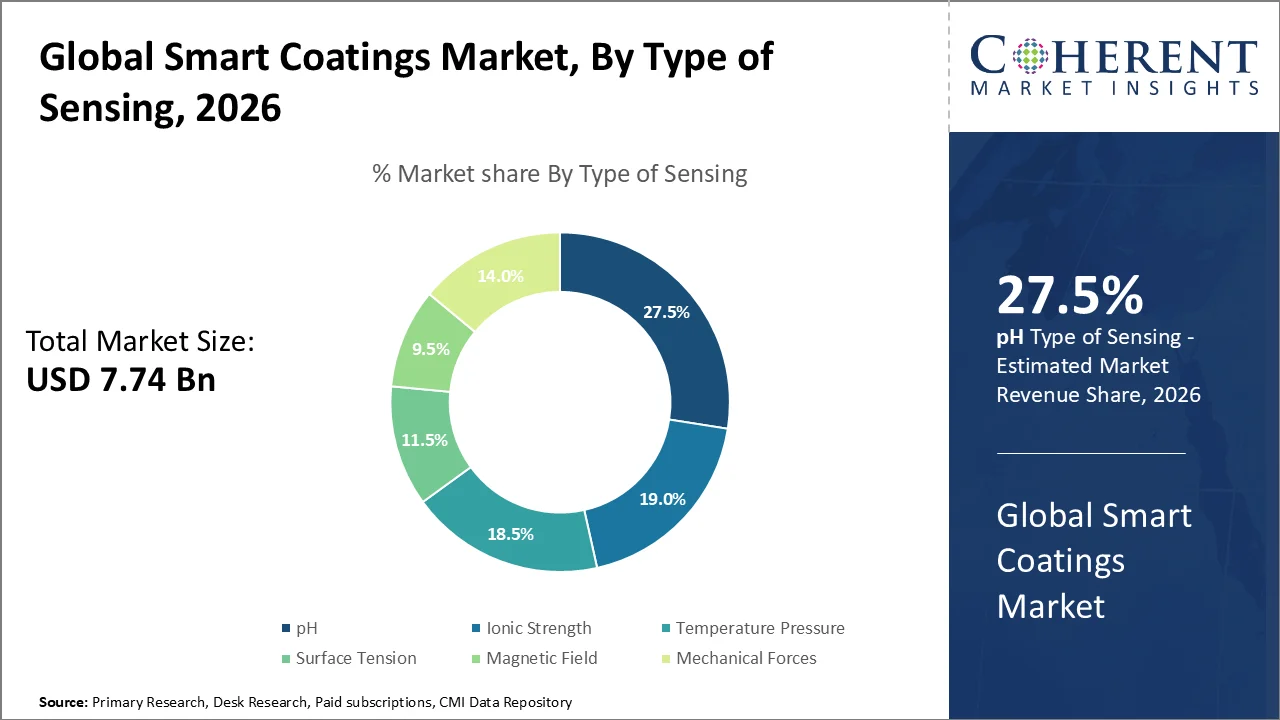
- The pH segment is likely to dominate the type of sensing category with approximately 27.5% in 2026. The segment’s growth is owing to the increasing use of pH-responsive mechanisms for early corrosion detection, controlled release of corrosion inhibitors, self-healing activation, and condition monitoring of metallic surfaces. The U.S. Federal Highway Administration’s 2025 National Bridge Inventory continues to classify a substantial portion of the U.S. bridge stock as being in fair or poor condition, reinforcing the need for advanced corrosion-monitoring and protective technologies across aging infrastructure.
- The anti-corrosion segment is expected to dominate the product type category with approximately 34.5% in 2026. The segment’s growth is owing to the increasing requirement to extend infrastructure and equipment life, lower inspection and maintenance costs, and protect assets exposed to moisture, chemicals, salt, and severe environmental conditions.
- The single-layer segment is set to lead the number of layers category with approximately 60.5% in 2026. The segment’s growth is owing to easier application, lower material and processing requirements, shorter coating cycles, and the ability to integrate multiple protective or responsive functions into a single coating system.
- The automotive segment is anticipated to dominate the end-use industry category with approximately 24.5% in 2026. The segment’s growth is owing to increasing adoption of scratch-resistant, self-healing, anti-corrosion, hydrophobic, and responsive coatings across vehicle exteriors, structural components, sensors, electronics, and electric vehicles. According to Eurostat, 1.89 million new battery-only electric passenger cars were registered in the EU in 2025, representing a 29.7% increase over 2024. The total EU battery-electric passenger car fleet reached 7.59 million units, up 31.5% year-on-year.
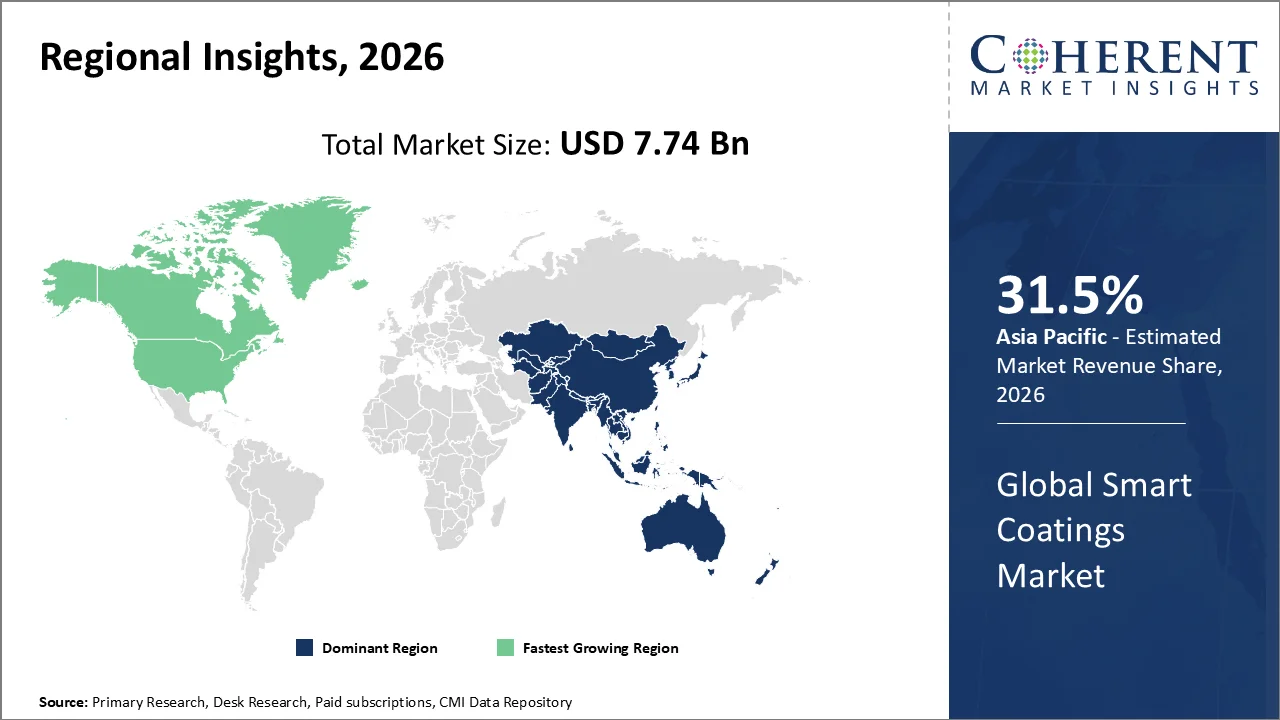
- Asia Pacific is expected to acquire the prominent regional share of approximately 37.0% in 2026. The region’s growth is owing to its large automotive and electronics manufacturing base, accelerating infrastructure development, growing aerospace activities, and increasing defense modernization across China, India, Japan, South Korea, and Southeast Asia. According to the Semiconductor Industry Association, semiconductor sales in Asia Pacific/All Others increased 45.0% year-on-year in 2025, highlighting the rapid expansion of advanced electronics manufacturing and demand for high-performance protective surface technologies in the region.
Market Drivers
Aging Infrastructure and Rising Maintenance Requirements are Driving Adoption of Self-Healing Smart Coatings
The Smart Coatings Market is witnessing strong growth as governments and infrastructure operators increasingly focus on extending the service life of bridges, highways, utilities, and other exposed structures. Smart coatings with capabilities such as corrosion sensing, self-healing agents, moisture responsiveness and damage detection can offer active protection as opposed to the traditional passive coatings.
According to the American Society of Civil Engineers (ASCE) 2025 Infrastructure Report Card, the U.S. has approximately 623,218 bridges with an average age of about 47 years. Around 49.1% of these bridges are classified in fair condition and 6.8% are in poor condition. The ASCE further estimates that an additional USD 373 billion in investment would be required over 10 years to bring U.S. bridges into a state of good repair.
Expansion of the Global Maritime Fleet is Increasing Demand for Corrosion and Fouling-Resistant Smart Coatings
The marine industry is emerging as an important application area for smart coatings owing to continuous exposure of ships and offshore structures to saltwater, humidity, biological fouling, and extreme environmental conditions. Self-healing, anti-corrosion, superhydrophobic, and fouling-responsive coatings can improve vessel durability and reduce maintenance requirements.
According to UN Trade and Development (UNCTAD), the global merchant fleet comprised approximately 116,000 vessels of at least 100 gross tons at the beginning of 2026. Global fleet carrying capacity reached approximately 2.5 billion deadweight tons, increasing by about 85 million deadweight tons from the previous year.
Current Events and Their Impact on the Smart Coatings Market
Current Event | Description and its Impact |
European Union Advances Broad PFAS Restriction Framework Under REACH (2026) |
|
U.S. EPA Strengthens PFAS Reporting Requirements Under TSCA (2026) |
|
- Current Industry Events of 2026
- Market Size Estimation
- Regional Breakdown
- Competitive Landscape
- Customer Intelligence
- Segmental Analysis
- Pricing Analysis
- Key Market Drivers, Challenges & Future Trends
- Customized Insights Section
Segmental Insights
Why is pH Acquiring the Largest Share?
On the basis of type of sensing, the pH segment is projected to account for the largest Smart Coatings Market share of approximately 27.5% in 2026. The segment’s growth is owing to the ability of pH-responsive coatings to detect localized chemical changes associated with corrosion and trigger the controlled release of inhibitors, enabling early warning, autonomous protection, and reduced dependence on manual surface inspection.
A study in Progress in Organic Coatings in 2026 developed pH-responsive chitosan microspheres for epoxy coatings that provided a visible corrosion-warning response in only 30 seconds after scratches were exposed to an alkaline environment. This demonstrates the potential of pH sensing to provide a rapid visual identification of coating damage before extensive substrate deterioration has occurred.
Why is Anti-Corrosion Acquiring the Largest Share?
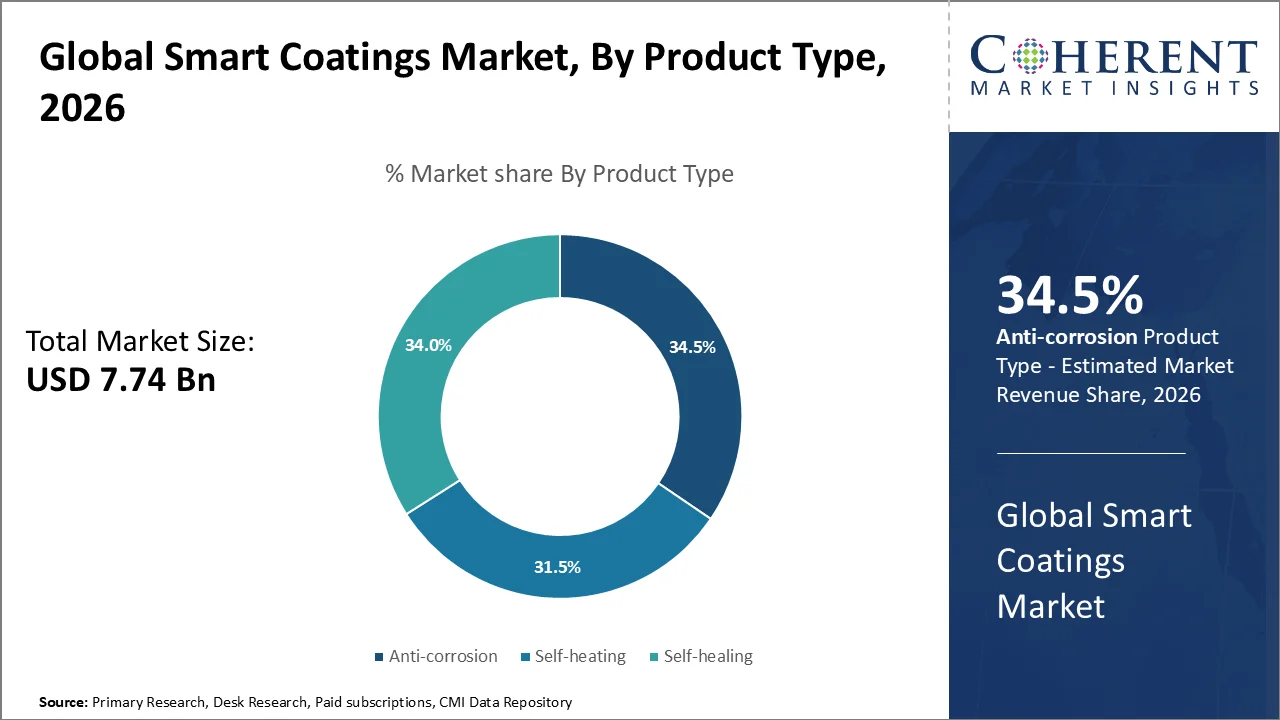
On the basis of product type, the anti-corrosion segment is expected to dominate the Smart Coatings Market with approximately 34.5% share in 2026. The segment’s growth is owing to the increasing requirement for coatings that not only provide passive barriers but can also detect damage, autonomously repair microcracks, release corrosion inhibitors, and extend the operating life of high-value metallic assets.
A separate May 2026 study on an environmentally oriented smart epoxy coating incorporating silica nanoparticles, lanthanum, and a plant-based inhibitor achieved approximately 98% corrosion inhibition in a 3.5 wt.% NaCl environment.
In March 2026, the Risk Assessment Committee and the Socio-Economic Analysis Committee of the European Chemicals Agency approved a restriction on the manufacture, marketing and use of PFAS at the European level with specific derogations and emission control measures. Regulators continued to review the proposal in 2026 and the SEAC was expected to issue its final opinion by the end of the year.
Why is Single-Layer Acquiring the Largest Share?
On the basis of number of layers, the single-layer segment is set to lead the Smart Coatings Market with approximately 60.5% share in 2026. The segment’s growth is owing to reduced application complexity, lower coating consumption, fewer curing and processing stages, faster turnaround, and growing ability to incorporate multiple protective functions within a single coating architecture.
AkzoNobel reported that its single-coat Chartek ONE protective coating can reduce workshop hours by up to 59%, while providing fire protection for as long as three hours. The company has also developed coating systems that can deliver up to 30% higher application productivity, 20%-time savings, and 15% lower material consumption compared with traditional three-coat systems.
Why is Automotive Holding the Largest End-use Industry Share?
On the basis of end-use industry, the automotive segment is anticipated to dominate the Smart Coatings Market with approximately 24.5% share in 2026. The segment’s growth is owing to increasing demand for corrosion-resistant, scratch-resistant, self-healing, hydrophobic, sensing, and digitally applied functional coatings across vehicle bodies, components, batteries, electronics, and decorative surfaces.
PPG reported that its advanced automotive electrocoat technology can reduce paint-shop emissions by approximately 10% and save around 10 kWh of energy per vehicle, while its thin-film pretreatment technology can provide savings of up to 35 kWh per vehicle by reducing requirements for heated process baths.
In May 2026, BASF Coatings won the Sustainability Award in Automotive 2026 for its Overspray Free Application technology. Digital control coating process provides 100% transfer efficiency and no overspray in two-tone vehicle painting. The technology can also reduce energy demand, CO₂ emissions, masking waste, and paint consumption during OEM vehicle production.
Smart Coatings Market Trends
- The rising development of multi-stimuli self-healing coatings is shifting smart coatings from passive surface protection toward autonomous damage repair. New formulations are increasingly combining light, heat, pH and mechanical-response mechanisms to repair coating integrity after scratches or microdamage. In a 2026 study, researchers created an MXene-polyurethane coating that responded to near-infrared and heat and recovered 89.32% of its mechanical strength after combined NIR and thermal stimulation.
- The growing use of electrochromic and dynamically controlled coatings is expanding the range of smart-coating applications in energy-efficient buildings. New-generation surfaces are increasingly able to control the incoming solar radiation and thermal emission, not only the visible transparency. A dual-band electrochromic window that could reduce the summer daytime temperature by as much as 22.2°C relative to normal glass and achieved an average 19.5% HVAC energy saving in global climate zones was demonstrated in a study published in Nature Communications in July 2026.
- Rising development of multifunctional anti-icing and de-icing coatings is driving applications across aviation, transportation and power infrastructure. The technology is moving toward coatings that combine hydrophobicity, electrical conductivity, durability and active ice removal all at once. A 2025 study of a carbon-nanotube/polyurethane nanocomposite coating reported a 200% improvement in anti-icing performance, while its electrical conductivity enabled electrothermal de-icing.
Regional Insights
Asia Pacific Dominates Owing to the Strong Industrial Manufacturing and Shipbuilding Base
The Asia Pacific region accounts for approximately 37.0% of the Smart Coatings Market share in 2026. The region’s dominance is owing to its extensive industrial manufacturing base, strong marine and shipbuilding industries, expanding infrastructure, and increasing adoption of high-performance protective and functional coatings across China, Japan, South Korea, India, and Southeast Asia.
According to data released by China’s Ministry of Industry and Information Technology, the country’s shipbuilding output reached 53.69 million deadweight tones (DWT) in 2025, increasing 11.4% year-on-year and accounting for 56.1% of global shipbuilding output.
North America Smart Coatings Market Trends
North America is expected to witness the fastest growth in the Smart Coatings Market over the forecast period. The region’s growth is owing to strong coating-technology innovation, rapid commercialization of advanced functional surfaces, expansion of domestic coating-manufacturing capacity, and increasing demand from aerospace, construction, industrial equipment, and high-performance infrastructure applications.
In May 2025, PPG announced a USD 380 million investment in a new 198,000-square-foot aerospace coatings and sealants manufacturing facility in North Carolina. The facility is expected to begin operations after completion in the first half of 2027 and will produce PPG’s full range of aerospace coatings and sealants.
In March 2026, Sherwin-Williams completed a major expansion of its Bowling Green, Kentucky coil coatings facility that more than doubled the plant’s manufacturing capacity. The facility incorporates advanced automation, larger batch capabilities, and upgraded production technology to address accelerating demand from metal roofing, construction, and OEM customers.
Strong Industrial Coatings Base and Federal Support for Functional Materials are Accelerating the Smart Coatings Market in the United States
The U.S. Smart Coatings Market is witnessing strong development owing to its established coatings manufacturing ecosystem, growing adoption of self-healing and sensing technologies, and federal support for advanced functional materials across batteries, infrastructure, aerospace, healthcare, and industrial applications.
According to the American Coatings Association (ACA), the U.S. paint and coatings industry produced approximately 1.33 billion gallons valued at USD 34.1 billion in 2025. Within this, industrial maintenance and protective coatings represented 63.6 million gallons valued at USD 2.67 billion.
China Smart Coatings Market Trends
China is expected to witness strong growth in the Smart Coatings Market owing to its advanced materials research ecosystem, rapid development of electrochromic and multifunctional surfaces, and increasing integration of artificial intelligence into materials discovery and testing.
In January 2026, researchers at the Chinese Academy of Sciences (CAS) created a manganese-based electrochromic metallopolymer film that can change between three optical states. The device demonstrated switching times as fast as 1.4 seconds for coloration and 0.4 seconds for bleaching, while retaining 80% of its initial optical contrast after 10,000 switching cycles.
Who are the Major Companies in Smart Coatings Industry
Some of the major key players in Smart Coatings Market are Balcony Systems Solutions Ltd, Nanoshell, Research Frontiers, Inc., New Energy technologies, Cima Nano tech., Ancatt Inc., Debiotech SA.
Key News
- In June 2026, J.H. Global, an eco-friendly high-performance surface materials company incubated by the Incheon Center for Creative Economy Innovation, was selected for the 2026 Incheon Airport Startup Incubation Program, organized by Incheon Technopark. The company will demonstrate its eco-friendly smart coating technology at Incheon International Airport as part of the program.
Market Report Scope
Smart Coatings Market Report Coverage
| Report Coverage | Details | ||
|---|---|---|---|
| Base Year: | 2025 | Market Size in 2026: | USD 7.74 Bn |
| Historical Data for: | 2020 To 2024 | Forecast Period: | 2026 To 2033 |
| Forecast Period 2026 to 2033 CAGR: | 15.5% | 2033 Value Projection: | USD 21.22 Bn |
| Geographies covered: |
| ||
| Segments covered: |
| ||
| Companies covered: | Balcony Systems Solutions Ltd, Nanoshell, Research Frontiers, Inc., New Energy technologies, Cima Nano tech., Ancatt Inc., Debiotech SA. | ||
| Growth Drivers: |
| ||
| Restraints & Challenges: |
| ||
Analyst Opinion
- The Smart Coatings Market is increasingly moving from specialty applications toward broader commercialization as governments and manufacturers prioritize advanced materials that reduce energy consumption, maintenance requirements, and lifecycle costs. In September 2026, the U.S. Department of Energy announced the investment of USD 117 million in 56 industrial technology projects as a demonstration of ongoing public support for technologies that improve material and manufacturing efficiency.
- Sustainability requirements will play a major role in the next generation of smart-coating formulations. In July 2025, the U.S. Environmental Protection Agency added 18 chemicals to its Safer Chemical Ingredients List, bringing the total list of approved safer-chemistry ingredients to 983.
- Antimicrobial smart coatings are expected to develop into a more performance-driven market as regulators increase scrutiny of durability and long-lasting efficacy claims. The U.S. EPA updated its residual antimicrobial coatings research in November 2025, evaluating whether coated surfaces can maintain antimicrobial effectiveness after routine cleaning, abrasion, weathering, and extended use.
Speak to the analyst
Want personalized insights?
Take the findings above to one of our principal consultants, or have the report rebuilt around the segments, geographies and competitors you actually track.
Market Segmentation
- By Type of Sensing (Revenue, USD Bn, 2021-2033)
- Ionic Strength
- pH
- Temperature Pressure
- Surface Tension
- Magnetic Field
- Mechanical Forces
- By Product Type (Revenue, USD Bn, 2021-2033)
- Self-heating
- Self-healing
- Anti-corrosion
- By Number of Layers (Revenue, USD Bn, 2021-2033)
- Single Layer
- Multi-layer
- By End Use Industry (Revenue, USD Bn, 2021-2033)
- Construction
- Military
- Healthcare
- Automotive
- Aerospace
- Consumer Electronics
- By Region (Revenue, USD Bn, 2021-2033)
- North America
- U.S.
- Canada
- Latin America
- Brazil
- Mexico
- Argentina
- Rest of Latin America
- Europe
- Germany
- U.K.
- France
- Italy
- Spain
- Russia
- Rest of Europe
- Asia Pacific
- China
- India
- Japan
- Australia
- South Korea
- ASEAN
- Rest of Asia Pacific
- Middle East
- GCC
- Israel
- Rest of Middle East
- Africa
- South Africa
- Central Africa
- North Africa
- North America
Sources
Primary Research Interviews
- Smart coating manufacturers and formulators
- Coating chemists and materials scientists
- R&D heads from specialty coatings companies
- Surface engineering and functional materials experts
- Automotive, aerospace, marine, and construction coating specialists
- Procurement managers from industrial coating end users
- Key opinion leaders (KOLs) in self-healing, anti-corrosion, antimicrobial, and responsive coatings
Databases
- World Bank
- Organisation for Economic Co-operation and Development (OECD)
- U.S. Environmental Protection Agency (EPA)
- European Chemicals Agency (ECHA)
- U.S. Department of Energy (DOE)
- National Institute of Standards and Technology (NIST)
- Eurostat
Magazines
- Coatings World
- Paint & Coatings Industry Magazine
- European Coatings Journal
- Materials Performance
- Chemical & Engineering News
- Paint & Coatings Industry
Journals
- Progress in Organic Coatings
- Surface and Coatings Technology
- Journal of Coatings Technology and Research
- ACS Applied Materials & Interfaces
- Advanced Functional Materials
- Corrosion Science
- Materials & Design
Newspapers
- The Wall Street Journal
- Financial Times
- Reuters
- The Economic Times
- Nikkei Asia
Associations
- American Coatings Association (ACA)
- European Council of the Paint, Printing Ink and Artists’ Colours Industry (CEPE)
- Association for Materials Protection and Performance (AMPP)
- The Society for Protective Coatings (SSPC)
- ASTM International
- International Organization for Standardization (ISO)
- World Coatings Council
Public Domain Sources
- Company Annual Reports and Investor Presentations
- Company Product Launches and Technical Data Sheets
- Government Environmental and Chemical Regulatory Publications
- University and Research Institute Publications on Smart Coatings
- Patent Databases such as WIPO, USPTO, EPO, and Google Patents
- Publicly Available Research Reports on Self-Healing, Anti-corrosion, Antimicrobial, and Responsive Coatings
- Regulatory Publications Related to PFAS, VOCs, Biocides, and Coating Chemicals
- Government Infrastructure, Automotive, Aerospace, Marine, and Manufacturing Statistics
Proprietary Elements
- CMI Data Analytics Tool
- Proprietary CMI Existing Repository of Information for the Last 10 Years
Get access to 250+ pages report
Every segment, forecast, competitor profile and data table behind the analysis above — available for instant download.
- ESOMAR Member
- ISO 9001:2015 Certified
- D-U-N-S Registered
- GDPR & CCPA Compliant
Missing comfort of reading report in your local language? Find your preferred language:
Transform your Strategy with Exclusive Trending Reports
Frequently Asked Questions
The Smart Coatings Market is expected to reach USD 21.22 Bn in 2033, increasing from USD 7.74 Bn in 2026.
Major players operating in the global Smart Coatings Market include Balcony Systems Solutions Ltd, Nanoshell, Research Frontiers, Inc., New Energy technologies, Cima Nano tech., Ancatt Inc., and Debiotech SA.
The high investment cost and complex manufacturing and formulation processes are the key factors hampering growth of the Smart Coatings Market.
The rising adoption of smart coatings in automotive applications and increasing demand for anti-corrosion and self-healing coatings are major factors driving market growth. Growing applications across aerospace, healthcare, construction, and advanced functional surfaces are further supporting demand.
The Smart Coatings Market is anticipated to grow at a CAGR of 15.5% between 2026 and 2033.
Among regions, Asia Pacific is expected to dominate the Smart Coatings Market with approximately 37.0% share in 2026. Its dominance is supported by strong automotive and electronics manufacturing, infrastructure development, shipbuilding, and adoption of advanced protective coatings.
North America is expected to witness the fastest growth over the forecast period owing to strong coating-technology innovation, commercialization of functional surfaces, expansion of domestic manufacturing capacity, and demand from aerospace, construction, industrial equipment, and infrastructure applications.