

Wood Preservatives Market Analysis & Forecast: 2026-2033
The Wood Preservatives Market size is estimated to be valued at USD 1.74 Bn in 2026 and is expected to reach USD 2.49 Bn by 2033, exhibiting a compound annual growth rate (CAGR) of 5.3% from 2026 to 2033.
Key Takeaways
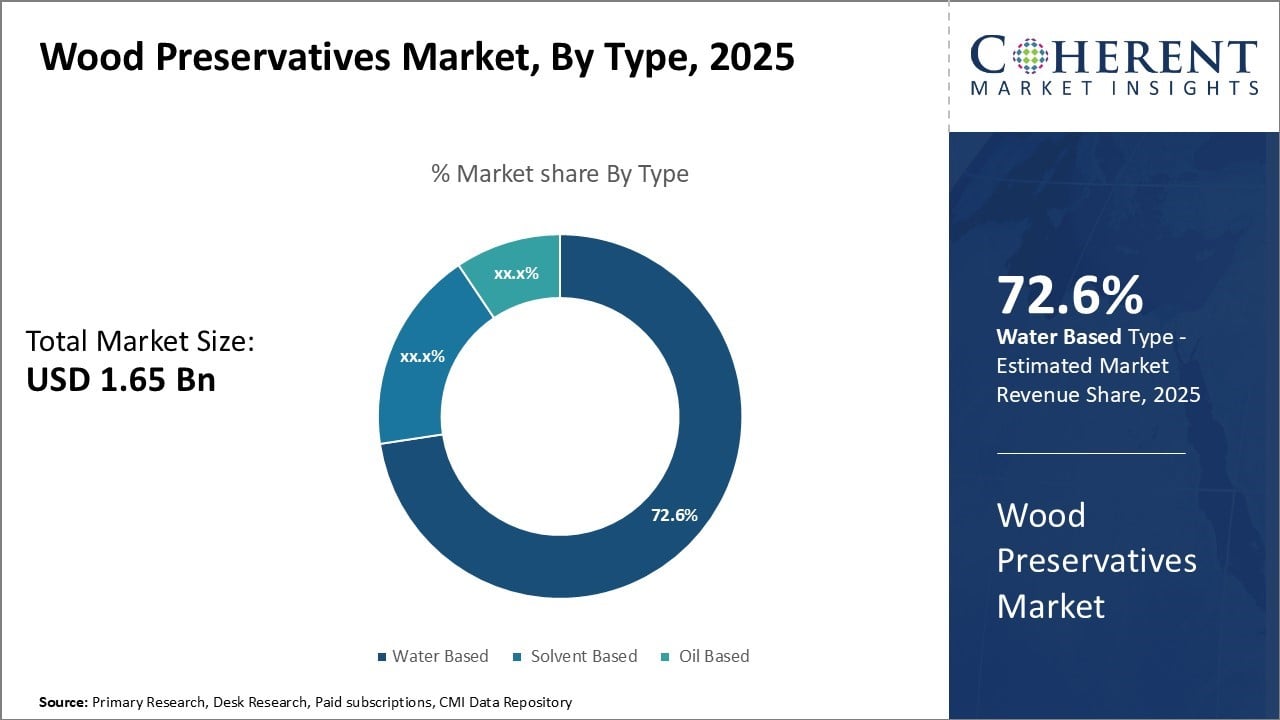
- By Type, Water-based Wood Preservatives dominate the market with 73.6% shares in 2026, due to their lower environmental impact and regulatory compliance compared to oil- and solvent-based alternatives.
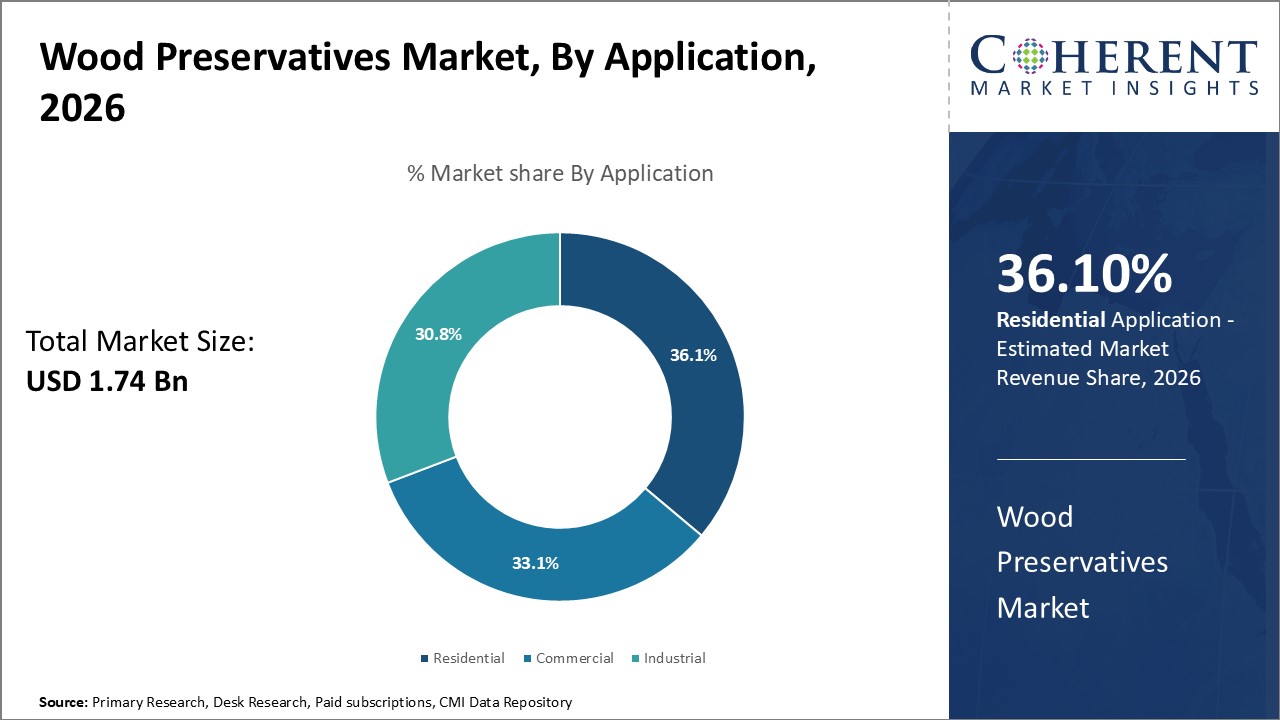
- By Application, Residential segment holds 36.1% share in the global market during the forecast period, fueled by increasing use of treated wood in decking, fencing, and home construction.
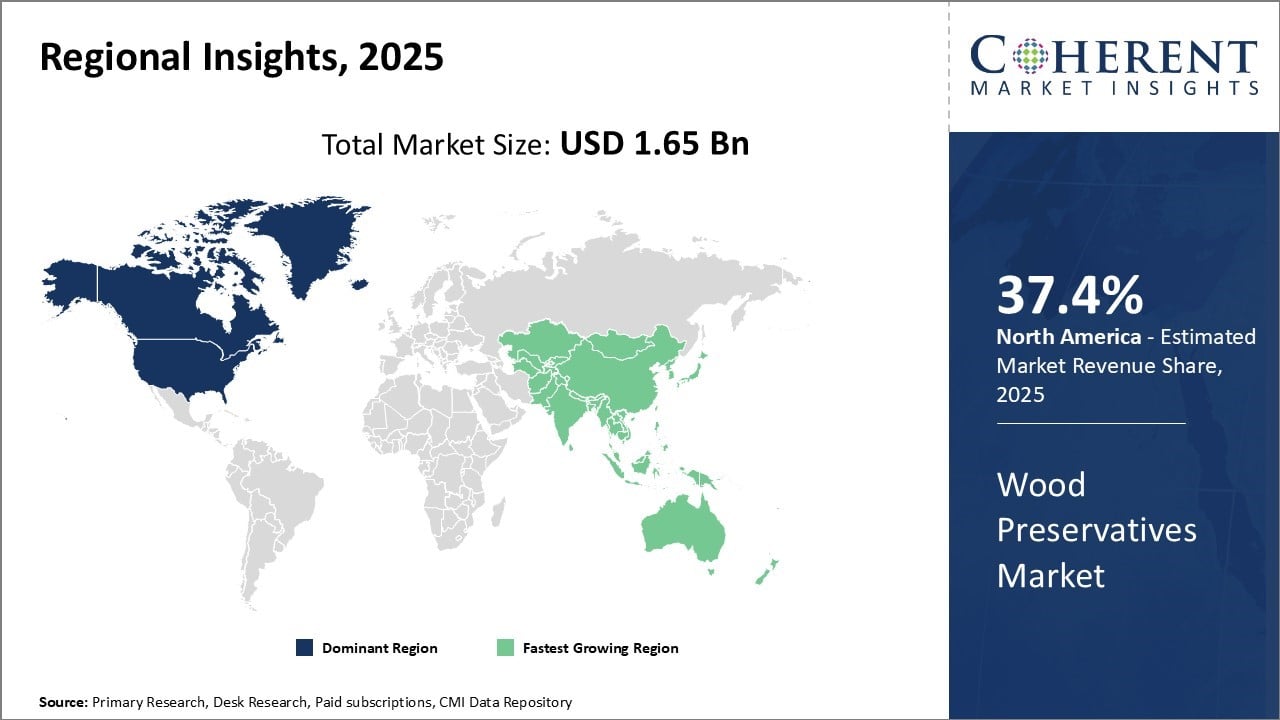
- By Region, North America leads the market in 2025with 37.4% shares, owing to strong demand from the construction and remodeling sectors, especially in the U.S. and Canada.
Market Overview
The wood preservatives market share is expected to grow steadily over the forecast period. Increasing residential and commercial construction activities across developed and developing countries is expected to drive the demand for wood preservatives. Rapid urbanization and growth in infrastructure development are further expected to propel the wood preservatives market. Additionally, growing remodeling and renovation activities of the existing infrastructure is also projected to support the wood preservatives market between 2025 and 2032. widespread use of wood in numerous applications such as fencing, decking, lumber, furniture, and others has been promoting the wood preservatives market growth over the years.
Current Events and Its Impact on the Wood Preservatives Market
Event | Description and Impact |
Stringent Environmental Regulations and Chemical Bans |
|
Russia-Ukraine Conflict and Supply Chain Disruptions |
|
Asia-Pacific Construction Boom and Infrastructure Development |
|
Role of Artificial Intelligence (AI) and Automation in the Wood Preservatives Market
Borate wood preservatives are benefiting from advancements in AI and automation, which are optimizing the entire value chain by improving formulation precision, plant efficiency, and regulatory compliance. In manufacturing, AI-integrated dosing systems now adjust borate concentrations in real time using predictive algorithms that analyze raw wood properties—reducing waste and ensuring more uniform treatment.
IoT-enabled autoclaves and pressure treatment systems monitor internal moisture, penetration depth, and chemical retention, allowing for dynamic process control and up to 25% energy savings. Machine learning models also flag deviations in wood density and chemical absorption using infrared imaging and sensor data—automating QA and reducing batch failures. This level of intelligent control is driving scalable, greener preservative applications across regions.
- Current Industry Events of 2026
- Market Size Estimation
- Regional Breakdown
- Competitive Landscape
- Customer Intelligence
- Segmental Analysis
- Pricing Analysis
- Key Market Drivers, Challenges & Future Trends
- Customized Insights Section
Pricing Analysis: Wood Preservatives Market
The wood preservatives sector features a tiered pricing structure influenced by formulation type, regional supply‑demand variations, and regulatory pressures. Base-grade water-borne preservatives, typically copper- or borate-based, are priced around US $1.5–2.5/kg in early 2025. Intermediate copper-azole blends fall between US $2.8–3.6/kg, while premium, eco-certified organic solutions can reach US $4.5–6.0/kg.
For instance, in Q1 2025, conventional copper-based products in North America averaged US $2.2/kg, while similar-grade options in China were priced at US $1.8/kg, reflecting lower raw-material and production costs. By Q2 2025, amid copper precursor tightness from Eastern Europe, North American prices climbed to US $2.5/kg, while Chinese prices edged up to US $2.1/kg.
By March 2025, eco-friendly organic-grade formulas were trading at approximately US $5.3/kg in Western Europe—an uptick driven by EU REACH regulation compliance—whereas the same products were about US $4.7/kg in North America. Specialty marine-grade preservatives command a further 10–15% premium over standard organic grades, often trading between US $6.0–7.0/kg due to added performance attributes.
Emergence of New Technologies in the Wood Preservatives Market
New technologies are reshaping wood preservation by prioritizing sustainability, precision, and longevity. Nano-enhanced preservatives, using metal oxide nanoparticles (e.g. copper or zinc), now offer deeper penetration and longer resistance to decay—reducing re-treatment cycles by up to 40%. These formulations are also less prone to leaching, meeting stricter global regulations.
Bio-based preservatives, derived from plant oils, tannins, or chitosan, are gaining traction as low-toxicity alternatives, particularly in Europe. Smart treatment chambers equipped with digital retention sensors and vacuum-pressure controllers ensure consistent application across wood species. Some systems integrate adaptive algorithms to optimize treatment duration, improving throughput while cutting chemical use and energy consumption.
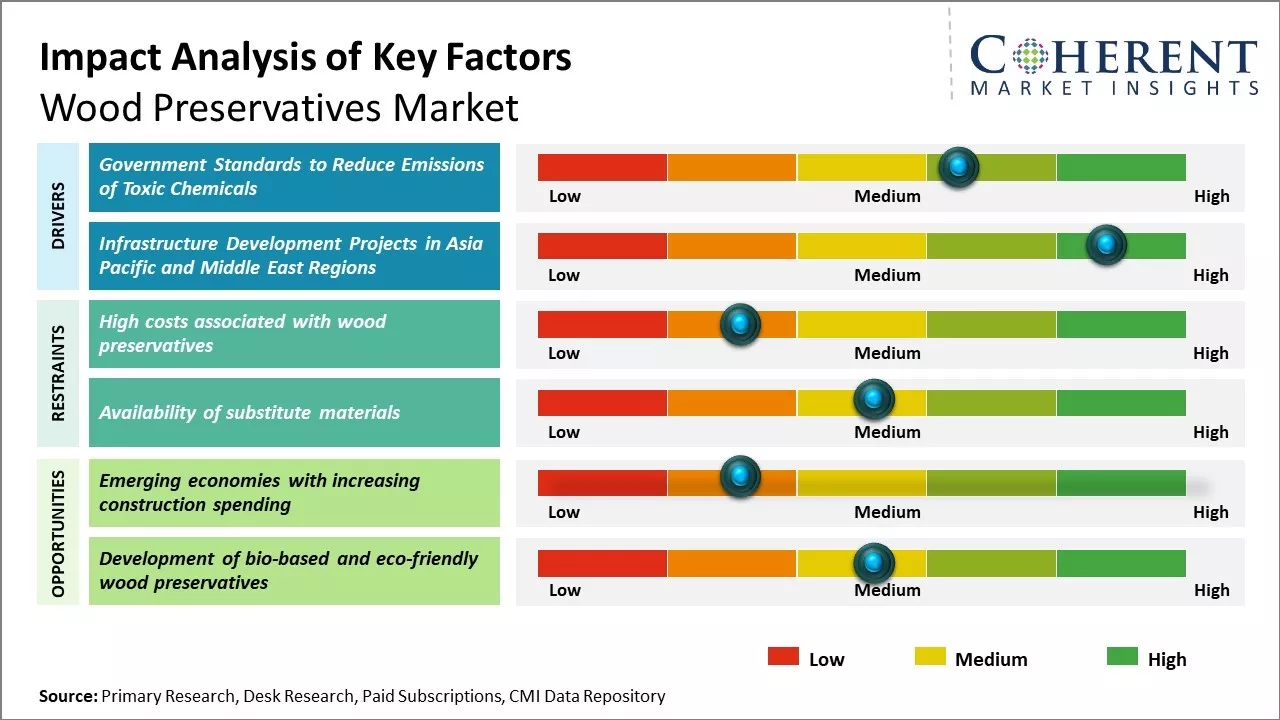
Government Standards to Reduce Emissions of Toxic Chemicals
Due to the harmful effects of toxic chemicals present in wood preservatives on both human health and environment, various governments across the globe are implementing stringent regulations regarding the use of hazardous substances in wood preservative formulations. Regulatory agencies are continuously updating and strengthening the guidelines to minimize the emissions and discharge of toxic chemicals from wood treatment processes.
For instance, the European Union has banned the use of arsenic and creosote in wood preservatives since 2003 and 2005 respectively owing to their classification as carcinogenic, mutagenic or reprotoxic substances. Similar restrictions have been implemented in other economically advanced markets like North America and Japan.
In the recent years, the permissible limits for heavy metals such as copper, chromium and arsenic have been lowered significantly. The wood preservative industry players are compelled to reformulate their product offerings to align with these regulatory thresholds.
Moreover, various countries have formulated rigorous environmental standards mandate monitoring of air quality, wastewater discharge and soil contamination arising from wood treatment plants. Advanced technologies for containment, collection and treatment of emissions are mandated to ensure compliance. This has forced producers to invest heavily in upgrading their production facilities with emission control systems and adopt greener manufacturing practices.
It has also stimulated the research efforts towards developing safer alternative biocides that are exempt from such regulatory hurdles. The tightening regulatory control over usage of toxic chemicals is expected to steer the demand for next-generation wood preservative technologies utilizing eco-friendly biocides.
Ongoing deployment of emission treatment systems will help sustain regulatory approval for continued operations. Overall, the government interventions to curb environmental pollution are functioning as a major driver for innovation and development of green wood preservatives domain.
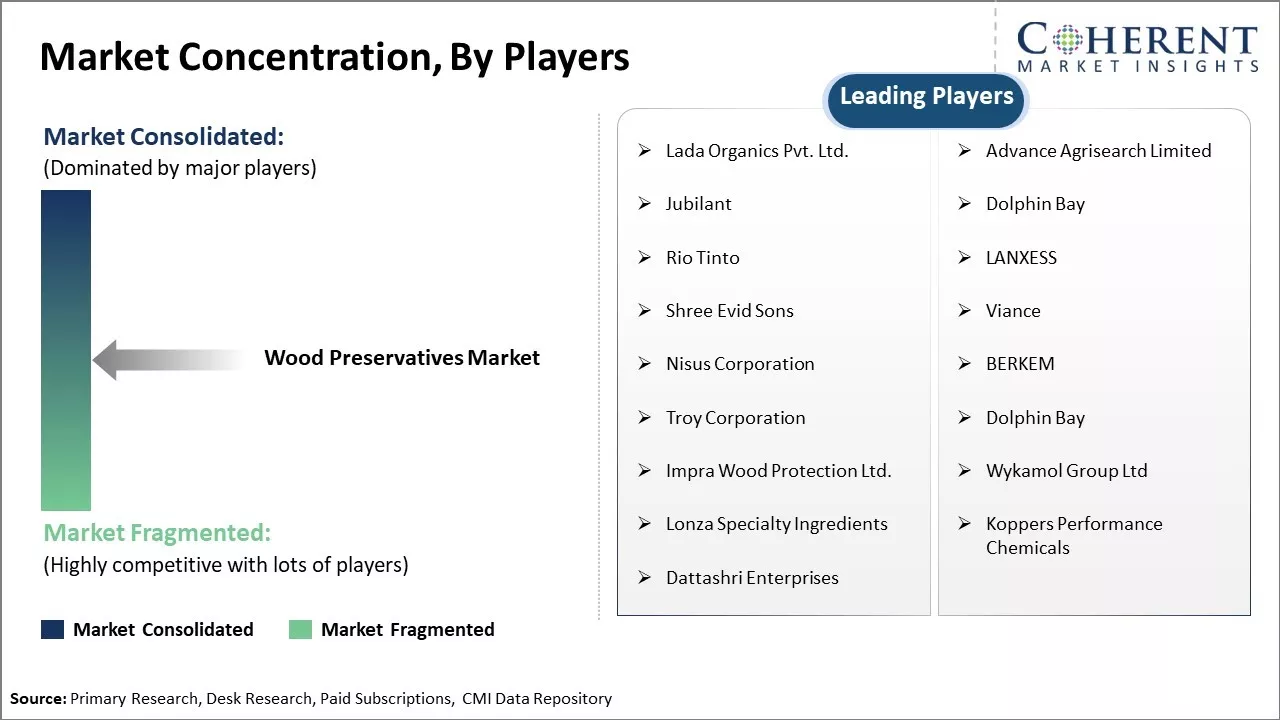
Market Concentration and Competitive Landscape
Infrastructure Development Projects in Asia Pacific and Middle East Regions
Over the past decade, the Asia Pacific and Middle East markets have emerged as global economic powerhouses underpinned by robust industrial and infrastructure growth. Mega construction projects spanning areas of transportation, urban planning, energy and utilities in countries like China, India, Vietnam, Indonesia and Saudi Arabia have bolstered the demand for wood and wood-based materials significantly.
Huge investments are channelized towards the development of roads, rail networks, ports, airports, bridges, commercial hubs, utility corridors and smart cities. Wood remains an important construction material owing to its sustainability, workability and affordability characteristics.
Opportunities: Emerging economies with increasing construction spending
Rising construction spending in emerging economies is significantly boosting the wood preservatives market value by creating immense opportunities for growth and expansion. Construction activities have been steadily rising in nations like India, China, Brazil and several Southeast Asian countries fuelled by rapid urbanization and industrialization.
As per data from the World Bank, construction spending as a percentage of GDP increased from 4.2% in 2010 to 5% in 2021 for India and from 4.6% to 5.3% during the same period for China. With ongoing infrastructure projects and expansion of real estate and commercial buildings, the demand for wood and wood products is surging in these developing nations.
Wood continues to be one of the most widely used construction materials due to its inherent advantages including availability, workability and affordability. However, wood also requires preservation treatments to protect it from decay caused by fungi, molds or insects during service life. This is where wood preservatives play a major role by preventing wooden structures and components from damages over time.
Segmental Insights
Global Wood Preservation Market Insights, By Type
Water based wood preservatives have the 73.6% share in global market in 2026, due to stringent environmental regulations imposed on solvent based and oil-based variants. Water based preservatives emit negligible amount of volatile organic compounds (VOCs) during product formulation and usage as water serves as the carrier.
Most solvent based and oil-based preservatives are made from coal tar and creosote which are classified as probable carcinogens by EPA and other health organizations. Water based wood preservatives comply with various certification standards like LEED, FSC and NFRC. The graded products enhance longevity of wood without releasing hazardous pollutants. They effectively treat wood problems like decay, corrosion and insect attacks while being safe for human and environmental exposure.
The water carrier allows for deep penetration into wood cellular structure to impart protection from inside. With growing sustainability priorities, builders prefer materials with eco-friendly credentials. Water based chemicals satisfy this demand along with match wood aesthetics without raising health concerns.
Global Wood Preservation Market Insights, By Application
Among different applications, residential sector contributes 36.1% share to the global wood preservatives in 2026. Greater portion of preserved wood is used in the construction of houses, buildings and outdoor structures. Rising global population has fueled the demand for housing units and related infrastructure development.
Expanding urbanization in developing regions has accelerated residential construction activities. Protection of wood from biotic and abiotic degradation factors ensures longer lifespan of frameworks, fixtures, deckings and furnishings installed in residential spaces.
Readily available wood preservative formulations are suitable for outdoor applications like fencing, window frames and outdoor flooring. Individual homeowners also use preservatives for maintenance of wooden articles, decks and outdoor sheds. Growth in DIY culture has raised the use of wood preservatives in maintenance and renovation of residential properties.
Global Wood Preservation Market - Regional Insights
North America Wood Preservation Market Analysis and Trends
North America is expected to maintain its dominant position with a 37.4% market share in 2026, continuing the strong presence it has established over the past few decades. With a well-established wood industry catering to both commercial and residential construction needs, the region accounts for the largest consumption of wood preservatives.
Stringent environmental regulations regarding the use of toxic wood preservatives have led to increased adoption of eco-friendly alternatives like micronized copper and ACQ preservatives.
Asia Pacific Wood Preservation Market Analysis and Trends
The Asia Pacific region has emerged as the fastest growing market for wood preservatives globally in recent years. Rapid urbanization and industrialization across developing nations such as China, India and Indonesia have driven tremendous growth in the construction industry. Huge government investments in infrastructure projects related to housing, rail, road and commercial construction have boosted wood consumption.
The region is also a major exporter of treated wood products to developed markets. While China dominates Asia Pacific consumption currently, other Southeast Asian countries are witnessing double digit annual growth. A key wood preservatives market trend in the region is the upward momentum driven by cost-competitive domestic production combined with a rise in structural wood imports.
Dominating Countries
- United States is expected to dominate the global wood preservatives market, accounting for a significant portion of North America's projected 37.4% market share by 2026. This dominance is driven by advanced infrastructure development, a strong housing sector, and widespread use of pressure-treated wood across construction and utility sectors.
- China and India are among the leading contributors in the Asia Pacific region, which is identified as the fastest-growing market. Their growth is fueled by rapid urbanization, increasing construction activities, and expansion in wood product manufacturing.
Market Report Scope
Wood Preservatives Market Report Coverage
| Report Coverage | Details | ||
|---|---|---|---|
| Base Year: | 2025 | Market Size in 2026: | USD 1.74 Bn |
| Historical Data for: | 2020 To 2024 | Forecast Period: | 2026 To 2033 |
| Forecast Period 2026 to 2033 CAGR: | 5.3% | 2033 Value Projection: | USD 2.49 Bn |
| Geographies covered: |
| ||
| Segments covered: |
| ||
| Companies covered: | Lada Organics Pvt. Ltd., Advance Agrisearch Limited, Jubilant, Dolphin Bay, Rio Tinto, LANXESS, Shree Evid Sons, Viance, Nisus Corporation, BERKEM, Troy Corporation, Dolphin Bay, Impra Wood Protection Ltd., Wykamol Group Ltd, Lonza Specialty Ingredients, Koppers Performance Chemicals, and Dattashri Enterprises | ||
| Growth Drivers: |
| ||
| Restraints & Challenges: |
| ||
Key Takeaways of Analyst
- The wood preservatives market demand is witnessing steady growth, driven by the global expansion of construction and infrastructure activities, along with rising needs for long-lasting, pest- and decay-resistant wood products. Innovations in eco-friendly and low-toxicity formulations are key growth enablers amid tightening environmental regulations.
- Emerging opportunities lie in bio-based preservatives and nano-technology enhanced solutions that promise higher efficacy and sustainability. Additionally, digitized treatment processes and AI-driven quality controls are improving operational efficiency and product consistency.
- Challenges include rising raw material costs, supply chain disruptions—especially for copper-based compounds—and stringent regulatory compliance which increase production complexity and costs. Adoption barriers also exist in price-sensitive emerging markets.
- North America leads the market, supported by mature construction sectors and regulatory focus on green building materials. The Asia-Pacific region is poised as the fastest-growing market, propelled by rapid urbanization, infrastructure investment, and increasing adoption of advanced wood treatment technologies.
Wood Preservatives Industry News
- Arch Chemicals announced in March 2023 that it is developing a new wood preservative product in partnership with a Chinese company, which is expected to launch in 2024.
- In January 2023, BASF announced the launch of a new wood preservative product called Wolman 5X. Wolman 5X is a water-based preservative that is designed to be more environmentally friendly than traditional oil-based preservatives.
- In 2022, Archroma introduced new biocide-free wood protection technology.
Market Segmentation
- Type Insights (Revenue, USD Bn, 2021 - 2033)
- Water Based
- Solvent Based
- Oil Based
- Application Insights (Revenue, USD Bn, 2021 - 2033)
- Residential
- Commercial
- Industrial
- Regional Insights (Revenue, USD Bn, 2021 - 2033)
- North America
- U.S.
- Canada
- Latin America
- Brazil
- Argentina
- Mexico
- Rest of Latin America
- Europe
- Germany
- U.K.
- Spain
- France
- Italy
- Russia
- Rest of Europe
- Asia Pacific
- China
- India
- Japan
- Australia
- South Korea
- ASEAN
- Rest of Asia Pacific
- Middle East & Africa
- GCC Countries
- Israel
- Rest of Middle East & Africa
- Key Players Insights
- Lada Organics Pvt. Ltd.
- Advance Agrisearch Limited
- Jubilant
- Dolphin Bay
- Rio Tinto
- LANXESS
- Shree Evid Sons
- Viance
- Nisus Corporation
- BERKEM
- Troy Corporation
- Dolphin Bay
- Impra Wood Protection Ltd.
- Wykamol Group Ltd.
- Lonza Specialty Ingredients
- Koppers Performance Chemicals
- Dattashri Enterprises
Sources
Primary Research Interviews
- Wood preservative manufacturers and suppliers
- Timber treatment facility operators
- Construction industry professionals
- Chemical distributors and retailers
- Others
Databases
- Chemical Market Analytics International (CMAI)
- Global Trade Information Services (GTIS)
- Wood Markets Database
- Forest Products Research Database
- Others
Magazines
- Wood & Wood Products Magazine
- Forest Products Journal Magazine
- Timber Processing Magazine
- Building Products Digest
- Others
Journals
- Journal of Wood Chemistry and Technology
- Wood Science and Technology
- Forest Products Journal
- Others
Newspapers
- Forest Industries Review
- Wood Business Magazine
- Timber Industry News
- Construction Daily News
- Others
Associations
- American Wood Protection Association (AWPA)
- International Research Group on Wood Protection (IRG)
- Forest Products Society (FPS)
- Wood Protection Association (WPA)
- Others
Public Domain Sources
- U.S. Environmental Protection Agency (EPA) databases
- European Chemicals Agency (ECHA) publications
- FAO Forestry Department reports
- National Institute of Standards and Technology (NIST) data
- Others
Proprietary Elements
- CMI Data Analytics Tool
- Proprietary CMI Existing Repository of information for last 8 years
*Definition: The wood preservatives market price is influenced by the range of chemicals and compounds produced and sold by companies to protect wood from damage caused by insects, molds, fungi, and other biological threats. Wood preservatives prevent rot and decay by making wood less hospitable for microscopic wood destroying organisms. The wood preservatives market for fences is growing steadily, as these products are specifically designed to extend the service life of wood used in applications such as fences, decks, siding, roofing materials, utility poles, and more, across both industrial and residential sectors.
Get access to 250+ pages report
Every segment, forecast, competitor profile and data table behind the analysis above — available for instant download.
- ESOMAR Member
- ISO 9001:2015 Certified
- D-U-N-S Registered
- GDPR & CCPA Compliant
Missing comfort of reading report in your local language? Find your preferred language:
Transform your Strategy with Exclusive Trending Reports
Frequently Asked Questions
The Wood Preservatives Market size is estimated to be valued at USD 1.74 Bn in 2026, and is expected to reach USD 2.49 Bn by 2033.
Increasing environmental awareness has driven the wood preservatives market toward eco-friendly, less toxic formulations, boosting demand for sustainable treatment solutions.
Government standards to reduce emissions of toxic chemicals and infrastructure development projects in Asia Pacific and Middle East regions are the major factor driving the growth of the global market.
Yes, wood preservatives like copper-based and creosote treatments are commonly used in marine applications to protect wood from water damage, decay, and marine organisms.
In terms of Type, Water Based is estimated to dominate the market revenue share in 2026.
Lada Organics Pvt. Ltd., Advance Agrisearch Limited, Jubilant, Dolphin Bay, Rio Tinto, LANXESS, Shree Evid Sons, Viance, Nisus Corporation, BERKEM, Troy Corporation, Dolphin Bay, Impra Wood Protection Ltd., Wykamol Group Ltd, Lonza Specialty Ingredients, Koppers Performance Chemicals, and Dattashri Enterprises are the major players.
North America is expected to lead the wood preservatives industry.