

The Global High Performance Pigment Market is estimated to be valued at USD 7.58 Bn in 2026 and is expected to reach USD 10.73 Bn in 2033, exhibiting a compound annual growth rate (CAGR) of 5.1% from 2026 to 2033.
Key Takeaways
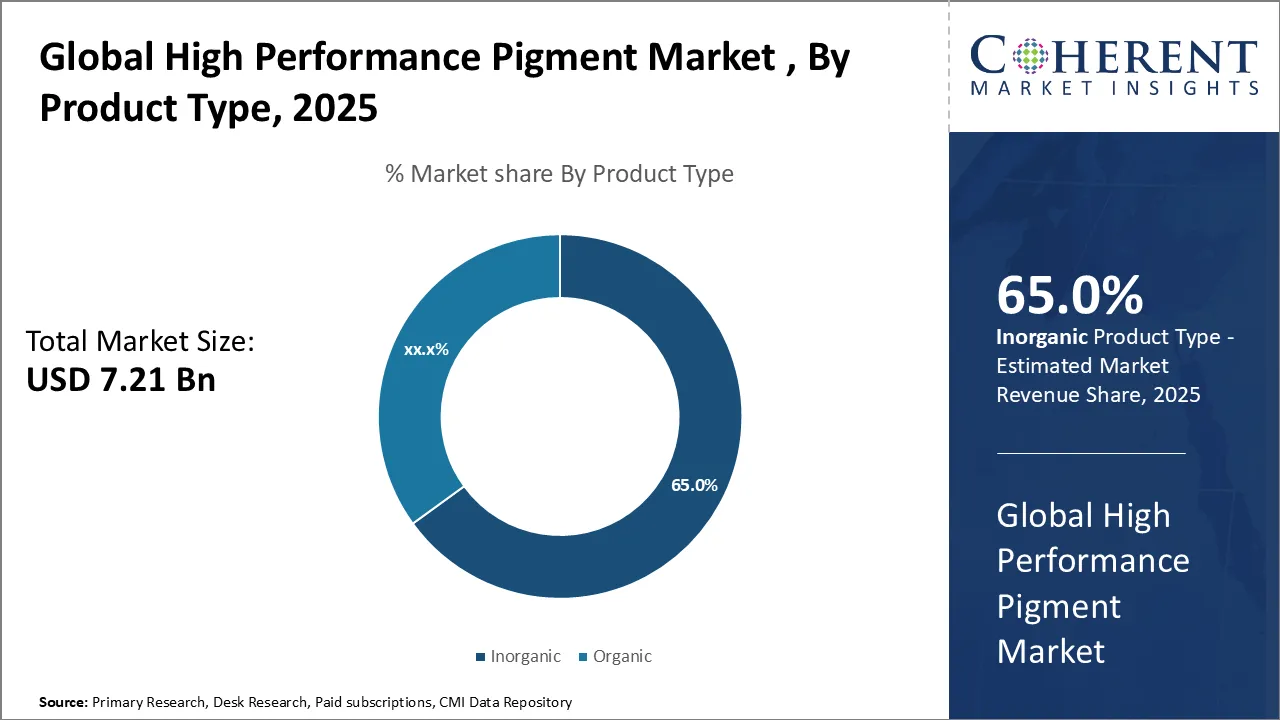
- By Product Type, Inorganic acquired the prominent share of 66% in 2026 as renowned for their superior lightfastness, chemical resistance, and thermal stability.
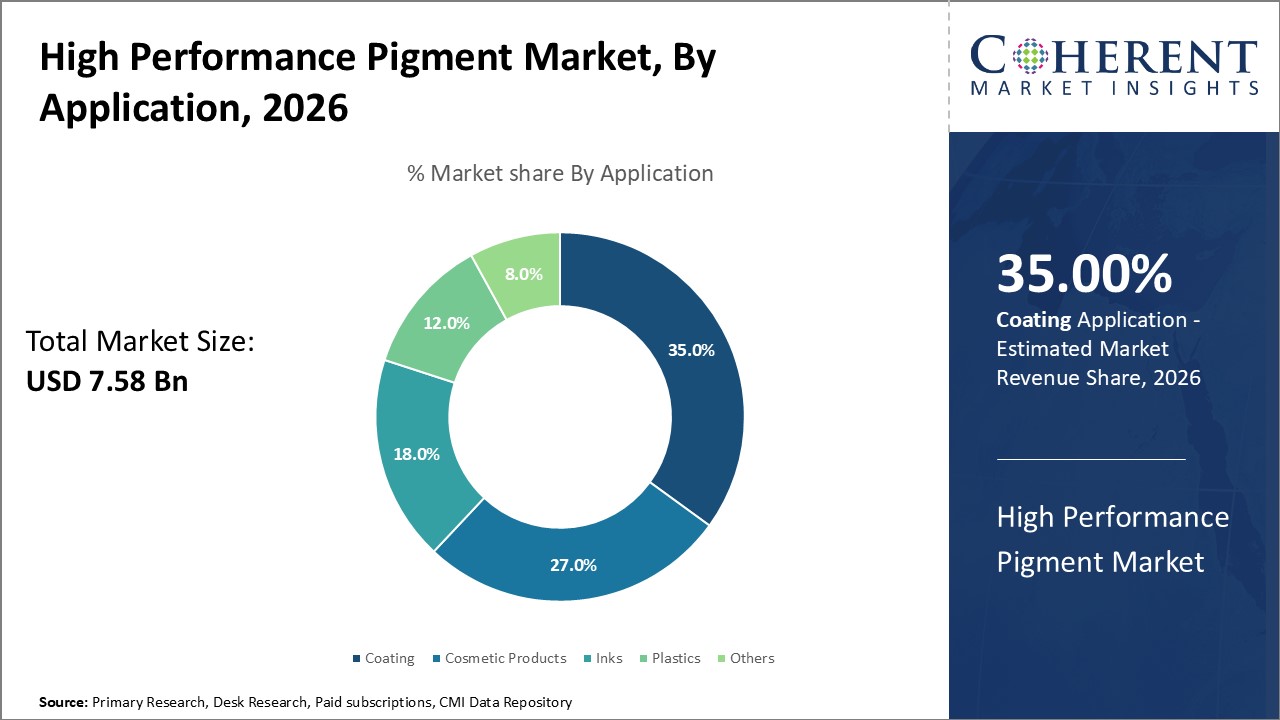
- By Application, in 2026, coating is expected to hold a 64% market share, dominating the entire industry. Because of their remarkable durability, UV resistance, and color retention, high-performance pigments are essential to industrial and automotive coatings.
- By Region, in 2026, Asia Pacific will have a dominant 40.06% of the market because to the notable rise in industries like consumer goods, construction, and automobiles in nations like China, India, Japan, and South Korea.
Market Overview
High performance pigments (HPPs) are both inorganic and organic pigments with high insolubility, color strength, heat stability, solvent fastness, light fastness properties, and low migration. Organic pigments are derivated from natural sources which contain carbon chains and carbon rings, and inorganic pigments are precipitated metallic salts. Moreover, these pigments are also used in indoor applications such as floor and wall coverings, in printing inks that are utilized for specialty packaging such as retort packaging, metal decorating inks, security inks, electro photographic toners, and in color filters that are utilized in liquid crystal displays.
Current Events and their Impact on the High Performance Pigment Market
Current Events | Description and its impact |
Geopolitical Tensions Affecting Raw Material Supply Chains |
|
Economic Pressures Reshaping Production Landscapes |
|
Supply Chain Disruptions Altering Regional Dynamics |
|
End-user Feedback and Unmet Needs in the High Performance Pigment Market
- Cost Sensitivity: When compared to traditional pigments, HPPs are too expensive for many end users, especially in emerging markets. The need for less expensive options without sacrificing functionality is evident.
- Limited Availability of Custom Shades: Although HPPs provide excellent performance, consumers frequently complain about a lack of adaptable, personalized color-matching options, particularly for specialized applications, in sectors like packaging, fashion, and cosmetics.
- Processing Compatibility Issues: Dispersion and processing stability issues are reported by certain sectors, especially when incorporating HPPs into low-VOC or aqueous systems. Pigments that are simpler to formulate in a variety of systems are what users are looking for.
- Sustainability Concerns: Despite HPPs' greater durability, which lessens the need for reapplication, end users are calling for more bio-based, non-toxic, and biodegradable pigment substitutes in order to comply with legal and environmental requirements.
- Current Industry Events of 2026
- Market Size Estimation
- Regional Breakdown
- Competitive Landscape
- Customer Intelligence
- Segmental Analysis
- Pricing Analysis
- Key Market Drivers, Challenges & Future Trends
- Customized Insights Section
End-Use Applications of High-Performance Pigments
- Coatings
Automotive: HPPs provide vibrant, long-lasting finishes that protect vehicles from environmental factors.
Aerospace: Essential for aircraft coatings, offering resistance to UV radiation and extreme temperatures.
Construction: Used in architectural paints and concrete, ensuring color stability and durability.
Industrial: Applied in machinery and equipment coatings for enhanced protection and aesthetics.
aerospace.basf.com
- Plastics and Polymers
Incorporated into consumer goods, packaging, and automotive parts, HPPs ensure consistent color and resistance to fading.
- Printing Inks
Employed in packaging, publishing, and textiles, HPPs offer high-quality prints with excellent color retention and resistance to environmental factors.
- Cosmetics
Utilized in makeup products like lipsticks and eyeshadows, HPPs provide vibrant colors while meeting safety standards.
- Textiles
Applied in fabrics for fashion and industrial use, ensuring colors remain vivid and resistant to washing and light exposure.
- Consumer Goods
Found in toys, electronics, and appliances, HPPs contribute to both the aesthetic appeal and durability of products.
Segmental Analysis
High Performance Pigment Market Insights, by Product Type
Inorganic contribute the highest share of the market owing to its Exceptional Durability and Stability.
Based on the product type, the global high performance pigment market is segmented into organic and inorganic. Out of which, inorganic segment held a dominant position in the market in 2026 with a market share of 66%, owing to high stability, durability, and opacity of inorganic HPPs. Bismuth vanadate pigments are environment-friendly, and have good gloss and hiding power, and are used in the production of orange, brilliant yellow, green, and red colors. Cadmium pigments are used in thermosetting and thermoplastic powder coatings, owing to heat resistance and high performance of these pigments. In January 2023, the Heubach Group, an inorganic pigment company, launched Ultrazur—a new line of four Ultramarine Blue shades ranging from greenish to reddish—at PlastIndia 2023 for diverse applications.
Organic segment is also expected to witness high growth, owing to increasing demand for environment-friendly products in various industries such as coatings. Organic HPPs such as perylenes, perinones, quinacridones, and diketo pyrrolo pyrroles provides red to orange shades, and has enhanced solvent fastness and light fastness, heat stability, and average migration properties.
High Performance Pigment Market Insights, by Application
Coating contribute the highest share of the market due to Rising Demand for Sustainable and Eco-Friendly Coatings.
The high performance pigment (HPP) market's leading and fastest-growing application is the coatings segment. Because of the exceptional practical and aesthetic qualities that HPPs provide, including UV resistance, weatherability, heat stability, and bright color retention, it accounts for a sizable portion of the global market. They are crucial in industrial, architectural, decorative, and automotive coatings because of their characteristics. HPPs contribute to great durability and glossy, long-lasting surfaces in vehicle coatings. They offer chemical and corrosion resistance in protective and industrial coatings. For Instances, EPS-Engineered Polymer Solutions launched PC-Mull 815, a biobased acrylic copolymer for high-performance wood treatments and furniture, in the EMEIA markets. Additionally, there is a growing need for long-lasting and color-stable architectural coatings as the worldwide infrastructure and building industries grow, particularly in Asia-Pacific.
Regional Insights 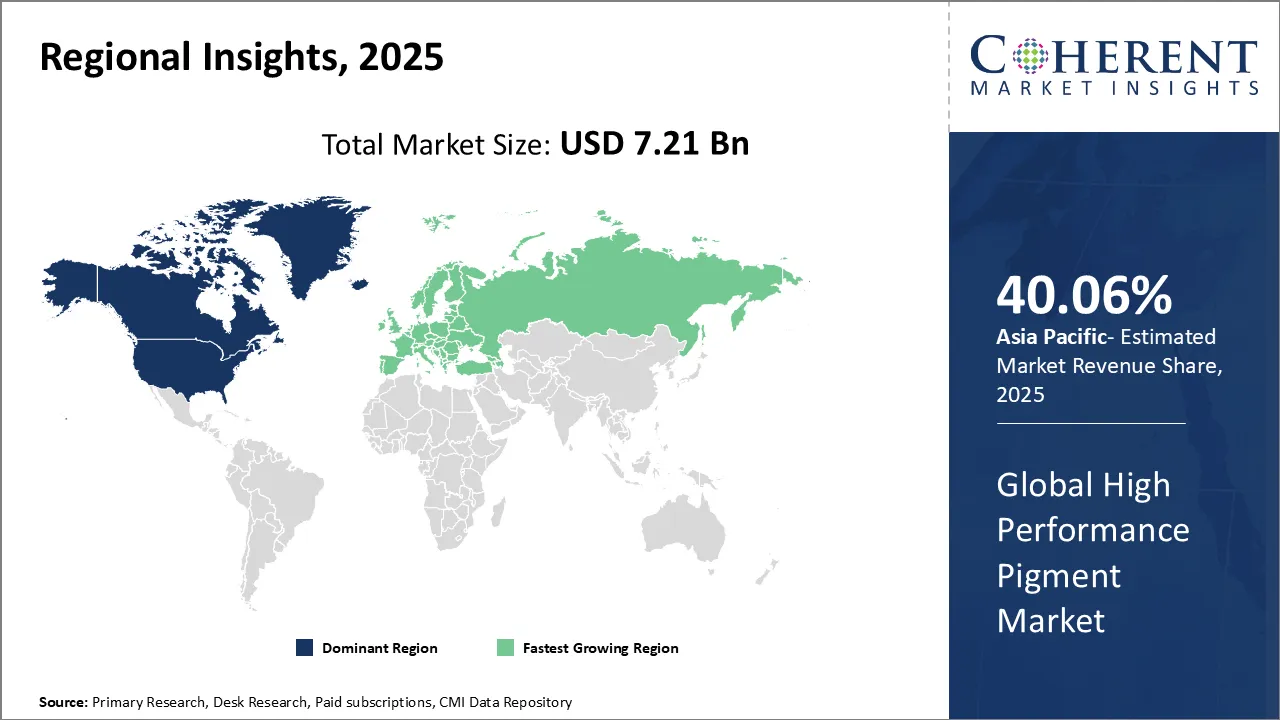
Asia Pacific High Performance Pigment Market Trends
The Asia Pacific dominates the overall market with a share of 40.06%, driven by rapid industrialization, urban development, and rising demand from end-use industries such as automotive, construction, and packaging. The coating demand is supported by the region’s expanding automotive sector and increasing infrastructure investments, particularly in countries like China and India. Inorganic pigments continue to lead in high performance pigment market share due to their superior durability and heat stability, although organic pigments are gaining momentum due to growing environmental awareness.
North America High Performance Pigment Market Trends
The market for high-performance pigments (HPP) in North America is expanding steadily due to a number of factors, including growing demand from different industries, technical improvements, and a move toward sustainable solutions. The growing consumer goods, construction, and automotive industries are the main drivers of this growth. Because of their higher durability, color stability, and resistance to environmental conditions, high-performance pigments are being used more and more in these industries. High-performance pigment usage is being driven by these industries' need for vivid, long-lasting colors. Furthermore, producers are now able to create specialized solutions that meet certain industry demands and consumer preferences thanks to the incorporation of AI-driven tools in pigment creation. EMD Electronics, the North American pigments branch of Merck KGaA, Darmstadt, Germany, has introduced Ronaflux® cosmetic pigments, a new generation of high-performance metallic pigments without metals.
India High Performance Pigment Market Trends
Due to the country's fast industrialization, rising need for brilliant and long-lasting colorants, and move toward sustainable materials, the high-performance pigments (HPP) market in India is expected to develop significantly between 2026 and 2031. Coatings are becoming the most popular application segment, and important industries like consumer products, construction, automotive, and packaging are driving this growth. This is because both industrial and architectural settings require coatings that are UV-stable and resistant to weather. For Instances, From May 9 to 12, STEER World will present state-of-the-art technologies at PlastAsia 2026 in Bengaluru. The business will introduce ground-breaking innovations for sectors looking for high-performance and sustainable polymer solutions in the areas of rubber and pigment compounding.
China High Performance Pigment Market Trends
Due to rising industrialization, technical developments, and a strong focus on sustainability, the high-performance pigment (HPP) market in China is expanding rapidly. The Chinese government's strict environmental restrictions, which are intended to lessen the negative effects of conventional chemical pigments, are driving the demand for organic pigments. These rules are encouraging businesses to make investments in safer substitutes that meet international environmental and health requirements. China's market for high-performance pigments is expected to rise further due to growing industrial applications, technical advancements, and a strong emphasis on sustainability.
High performance pigments market Trends
Increasing demand for HPPs from automotive and industrial coatings
Increasing demand for HPPs in automotive and industrial coatings, plastics, and cosmetic industries is the major factor that is expected to drive the global high performance pigment market growth. Furthermore, high demand for HPPs, owing to its wide variety of application range, excellent performance, and relatively low environmental impact is also expected to drive the market growth. Various research and development activities for development of new HPPs technologies such as nano-pigment technology is also propelling growth of the global market. For instance, according to India Brand Equity Foundation, a trust established by the Department of Commerce, Ministry of Commerce and Industry, Government of India, the Indian automotive market is expected to expand at a CAGR of 32.6% during 2014–2022.
Increasing demand from industries
Due to a supportive regulatory environment, important industries like polymers, textiles, cosmetics, and pharmaceuticals are expanding. These industries may see an increase in the demand for concentrated pigments that can withstand high temperatures. For instance, Graphene is known for its highly conductive qualities, you don't fully appreciate their potential impact until you see them in use. For instance, using graphene pigments in paint in a commercial setting can reduce the need for heating and cooling in office spaces because graphene absorbs heat before dispersing it over its entire surface.
High Performance Pigment Market Opportunities
Rising Demand for Sustainable and Bio-Based Pigments
With increasing environmental concerns and stringent regulatory frameworks, industries are shifting toward eco-friendly solutions. This shift presents a significant opportunity for the development and commercialization of sustainable, bio-based high performance pigments. These pigments, derived from renewable resources, align with consumer and governmental demand for safer, greener alternatives—especially in segments like cosmetics, food packaging, and children's toys. Companies investing in green chemistry and sustainable manufacturing practices can gain a competitive advantage by tapping into this demand. Additionally, bio-based pigments reduce environmental impact and help brands strengthen their ESG (Environmental, Social, and Governance) profiles, creating long-term market potential. In April 2024, Nature Coatings launched BioBlack, a 100% bio-based, high-performance, carbon-negative pigment that offers a sustainable alternative to traditional petroleum-derived carbon black.
Expansion in Emerging Economies
Emerging markets such as India, China, Brazil, and Southeast Asian nations are witnessing rapid industrialization, urbanization, and economic growth. These changes are driving increased consumption of paints, coatings, plastics, and construction materials—key applications of high performance pigments. Growing infrastructure projects, increasing vehicle production, and the expansion of consumer goods industries in these regions create a fertile environment for HPP adoption. Furthermore, rising disposable incomes and shifting consumer preferences toward premium, durable, and visually appealing products are increasing the demand for high-quality pigments. Companies that establish strong distribution networks and localized production facilities in these economies can unlock substantial growth.
Market Report Scope
High Performance Pigment Market Report Coverage
| Report Coverage | Details | ||
|---|---|---|---|
| Base Year: | 2025 | Market Size in 2026: | USD 7.58 Bn |
| Historical Data for: | 2020 To 2024 | Forecast Period: | 2026 To 2033 |
| Forecast Period 2026 to 2033 CAGR: | 5.1% | 2033 Value Projection: | USD 10.73 Bn |
| Geographies covered: |
| ||
| Segments covered: |
| ||
| Companies covered: | BASF SE, Clariant AG, Huntsman Corporation, Lanxess AG, Solvay SA, Heubach GmbH, Sun Chemical Corporation, Ferro Corporation, Merck KGaA, and Synthesia A.S. | ||
| Growth Drivers: |
| ||
| Restraints & Challenges: |
| ||
High Performance Pigment Market News
- In February 2025, A distinctive new series of high-performance metallic pigments without metals, Ronaflux cosmetic pigments, was introduced in Germany. They intensify chroma without reducing color saturation. Additionally, they are simple to produce and do not require dispersions or milling to acquire color.
- In January 2023, the Heubach Group, an inorganic and organic pigments solutions, introduced the new Ultrazur product line—featuring Ultramarine Blue pigments in four shades from greenish to reddish for a variety of standard and challenging applications—at PlastIndia 2023.
- In September 2024, Biosurfactants created especially for coating and ink compositions are being introduced by Evonik Coating Additives. With their remarkable sustainability profile and outstanding performance, the two new products, TEGO Wet 570 Terra and TEGO Wet 580 Terra, are poised to revolutionize the paint, coating, and inks sector.
- In June 2020, Clariant introduced a new line of pigment dispersions designed for precise color matching. Formulators who work on industrial, automotive, maintenance, and other demanding protective coatings have a direct requirement that our innovative approach addresses.
Analyst Opinion (Expert Opinion)
- The High-Performance Pigment market is undergoing a structural transformation, driven more by regulatory compulsion and downstream functional demand than by traditional price-volume gameplays. Pigment selection is no longer a mere matter of color fidelity—it’s an engineered decision influenced by compliance, end-use integration, and lifespan performance. Europe’s REACH regulation and California's Proposition 65 have effectively become global benchmarks, pushing pigment formulators toward metal-free, low-VOC, and non-carcinogenic alternatives.
- The idea that HPPs are only for premium or niche applications is now obsolete. For example, in automotive coatings, OEMs have already transitioned to high-performance pigments for first-layer applications that demand infrared reflectivity to meet vehicle cooling and fuel efficiency targets. BMW and Toyota have adopted IR-reflective pigments in their eco-coating systems, reducing cabin temperature by up to 5°C—an application that wouldn’t be possible with conventional pigments. The performance parameters—UV stability, thermal resistance, and gloss retention—are becoming mission-critical as product lifecycles elongate.
- Another pivotal factor is the convergence of material science and digital manufacturing, especially in segments like 3D printing and inkjet inks. These industries require pigments that can endure rapid curing, high shear processing, and long-term exposure without flaking or fading.
- However, the pricing inflexibility of HPPs remains a choke point. The average per-kilo cost of a high-performance pigment ranges from USD 100–USD 400, compared to USD 5–USD 25 for conventional pigments. That said, if formulators continue focusing on lifecycle economics rather than upfront costs, the total cost of ownership heavily favors HPPs. Case in point: in architectural coatings, using HPPs extends repaint cycles from 5 years to 10+ years in high UV zones like the Middle East and Southeast Asia—a tangible value proposition for both contractors and property developers.
Speak to the analyst
Want personalized insights?
Take the findings above to one of our principal consultants, or have the report rebuilt around the segments, geographies and competitors you actually track.
Market Segmentation
- Global High Performance Pigment Market, By Product Type (Revenue, USD Bn, 2021 - 2033)
- Organic
- Benzimidazolones HPPs
- Dioxazine Violet
- Isoindolinones and Isoindolines
- Perylenes
- Quinacridones
- Diketo-Pyrrolo-Pyrroles
- Phthalocyanines
- Imidazolone-Annellated Triphenedioxazine Pigments
- Others
- Inorganic
- Cadmium High Performance Pigments
- Cerium Pigment
- Titanate High Performance Pigments
- Bismuth Vanadate
- Others
- Organic
- Global High Performance Pigment Market, By Application (Revenue, USD Bn, 2021 - 2033)
- Coatings
- Automotive Coatings
- Decorative Coatings
- Industrial Coatings
- Cosmetic Products
- Inks
- Plastics
- Others
- Coatings
- Global High Performance Pigment Market, By Region (Revenue, USD Bn, 2021 - 2033)
- North America
- U.S.
- Canada
- Latin America
- Brazil
- Argentina
- Mexico
- Rest of Latin America
- Europe
- Germany
- U.K.
- Spain
- France
- Italy
- Russia
- Rest of Europe
- Asia Pacific
- China
- India
- Japan
- Australia
- South Korea
- ASEAN
- Rest of Asia Pacific
- Middle East
- GCC Countries
- Israel
- Rest of Middle East
- Africa
- South Africa
- North Africa
- Central Africa
- North America
- Key Players Insights
- BASF SE
- Clariant AG
- Huntsman Corporation
- Lanxess AG
- Solvay SA
- Heubach GmbH
- Sun Chemical Corporation
- Ferro Corporation
- Merck KGaA
- Synthesia A.S
Sources
Primary Research interviews:
- Product development managers from pigment manufacturing companies
- Technical directors from automotive and industrial coatings firms
- Procurement heads at cosmetics and packaging companies
- R&D specialists from chemical formulation labs
- Regulatory compliance officers in the paints and coatings industry
Databases:
- United Nations Comtrade Database
- World Bank Open Data
- OECD Stats (Chemicals and Environmental Performance datasets)
- Eurostat (Chemical Products segment)
- IndiaStat (for regional pigment production and consumption trends)
Magazines:
- Paint & Coatings Industry Magazine (PCI)
- Ink World Magazine
- Specialty Chemicals Magazine
- European Coatings Journal
- Cosmetics & Toiletries
Journals:
- Dyes and Pigments (Elsevier)
- Journal of Coatings Technology and Research (Springer)
- Pigment & Resin Technology (Emerald Insight)
- Color Research and Application (Wiley)
- ACS Applied Materials & Interfaces
Newspapers:
- The Chemical Engineer (IChemE)
- The Economic Times – Industry & Manufacturing section
- The Guardian – Environmental reporting on chemical use
- Nikkei Asia – Industry coverage from Japan and broader APAC
- Business Standard – Chemicals and materials coverage
Associations:
- European Chemicals Agency (ECHA)
- Society of Dyers and Colourists (SDC)
- Color Pigments Manufacturers Association (CPMA)
- American Coatings Association (ACA)
- Indian Paint Association (IPA)
Public Domain sources:
- World Intellectual Property Organization (WIPO) – Patent databases on pigments
- U.S. Environmental Protection Agency (EPA) – TSCA & safer chemicals programs
- National Institute for Occupational Safety and Health (NIOSH) – Pigment safety profiles
- Ministry of Chemicals and Fertilizers (India) – Annual reports
- European Union REACH compliance documents
Proprietary Elements:
- CMI Data Analytics Tool, and Proprietary CMI Existing Repository of information for last 8 years
Get access to 250+ pages report
Every segment, forecast, competitor profile and data table behind the analysis above — available for instant download.
- ESOMAR Member
- ISO 9001:2015 Certified
- D-U-N-S Registered
- GDPR & CCPA Compliant
Missing comfort of reading report in your local language? Find your preferred language:
Transform your Strategy with Exclusive Trending Reports
Frequently Asked Questions
The High Performance Pigment Market is estimated to be valued at USD 7.58 Bn in 2026, and is expected to reach USD 10.73 Bn by 2033.
Global high performance pigment market is estimated to surpass US$ 10.73 Bn by 2033.
Major players operating in the global high performance pigment market include BASF SE, Clariant AG, Huntsman Corporation, Lanxess AG, Solvay SA, Heubach GmbH, Sun Chemical Corporation, Ferro Corporation, Merck KGaA, and Synthesia A.S.
Increasing demand for HPPs in automotive and industrial coatings, plastics, and cosmetic industries is one of the major factors that is expected to propel growth of the market over the forecast period.
The CAGR of the High Performance Pigment Market is projected to be 5.1% from 2026 to 2033.
Among region, Asia Pacific accounted for the largest revenue share and contributed for 45% in the market in 2026.