

Anti-Corrosion Coating Market Size and Share Analysis- 2026 To 2033
The Anti-Corrosion Coating Market size is anticipated to grow at a CAGR of 3.6%, from USD 40.3 Bn in 2026 to approximately USD 51.7 Bn by 2033. The primary drivers are largely defined by increasing economic losses associated with corrosion, growing investments in infrastructure development, rising demand for protective coatings across marine, oil & gas, automotive, construction, and industrial applications, and increasing emphasis on extending the operational life of metal assets and equipment.
Key Takeaways
- The epoxy coating segment is likely to dominate the market with 39.0% in 2026. The segment’s growth is owing to strong adhesion to metal substrates, high chemical and moisture resistance, durability, and extensive use across construction, pipelines, industrial equipment, and offshore structures. According to the U.S. Census Bureau, total U.S. construction spending stood at a seasonally adjusted annual rate of approximately USD 2.17 trillion in June 2026, highlighting the large construction and infrastructure asset base requiring protective coating solutions.
- The solvent-borne coating segment is set to lead with 57.5% in 2026. The segment’s growth is owing to rapid drying, strong adhesion, reliable performance under high-humidity and harsh operating conditions, and established use across marine, oil & gas, heavy equipment, and industrial maintenance applications. According to the International Energy Agency (IEA), global upstream oil and gas investment was expected to remain at nearly USD 570 Bn in 2025, while the period from 2026 to 2028 is expected to witness some of the largest annual expansions in global LNG capacity, supporting demand for corrosion protection across production, processing, storage, and transportation assets.
- The marine segment is expected to dominate the end-user industry with approximately 28.0% in 2026. The segment’s growth is owing to continuous exposure of ship hulls, decks, ballast tanks, offshore structures, and other metallic components to seawater, salt, humidity, and aggressive marine conditions. According to UN Trade and Development (UNCTAD), the global commercial fleet reached around 112,500 vessels with 2.44 Bn deadweight tons of carrying capacity as of January 1, 2025, representing annual capacity growth of 3.4%.
- Asia Pacific is expected to acquire the prominent market share of 46.5% in 2026. The region’s growth is owing to rapid infrastructure development, large shipbuilding and manufacturing industries, expansion of oil & gas and petrochemical facilities, and increasing investments in transportation, energy, and industrial assets across China, India, Japan, South Korea, and Southeast Asia. According to the World Steel Association, Asia and Oceania produced approximately 1,324.5 million tonnes of crude steel in 2025, accounting for more than 71% of global crude steel production.
Market Drivers
Rising Energy and Industrial Infrastructure Investment is Accelerating Demand for Anti-Corrosion Coatings
The growth of the Anti-Corrosion Coating Market is driven by continued investments in energy, power transmission, oil & gas, renewable energy and industrial infrastructure. Moisture, chemicals, temperature fluctuations and adverse operating conditions are a constant threat to pipelines, storage tanks, transmission structures, processing facilities, wind installations and more, necessitating durable protective coating systems.
The latest Global Oil Infrastructure Tracker from Global Energy Monitor covers around 487,000 km of oil pipelines across the globe. By 2025, about 15,000 km of crude oil and natural gas liquids pipelines were under construction, and a further 27,000 km were proposed, indicating a 16% increase in pipeline development year on year.
Rapid Expansion of Shipbuilding and Offshore Infrastructure is Driving High-Performance Corrosion Protection
The expansion of global shipbuilding and offshore infrastructure is emerging as a key driver for anti-corrosion coatings. Very aggressive conditions, such as permanent contact with salt water, humidity, abrasion and ultraviolet radiation, are imposed on ships, offshore wind foundations, port infrastructure, marine equipment and other steel structures, which require the periodic application of specific protective coatings.
According to the Organization for Economic Co-operation and Development (OECD), the global shipbuilding production grew more than 25% from 2021 to 2025 and the global shipbuilding orderbook stood at about 169 million compensated gross tons (CGT) in 2025, or at around 16% of the existing global fleet.
Current Events and Their Impact on the Anti-Corrosion Coating Market
Current Event | Description and its Impact |
EU Advances Restrictions on Hexavalent Chromium Used in Corrosion-Protection Applications (2026) |
|
EU PFAS Restriction Process Targets Protective Coatings and Paint Applications (2026) |
|
- Current Industry Events of 2026
- Market Size Estimation
- Regional Breakdown
- Competitive Landscape
- Customer Intelligence
- Segmental Analysis
- Pricing Analysis
- Key Market Drivers, Challenges & Future Trends
- Customized Insights Section
Segmental Insights
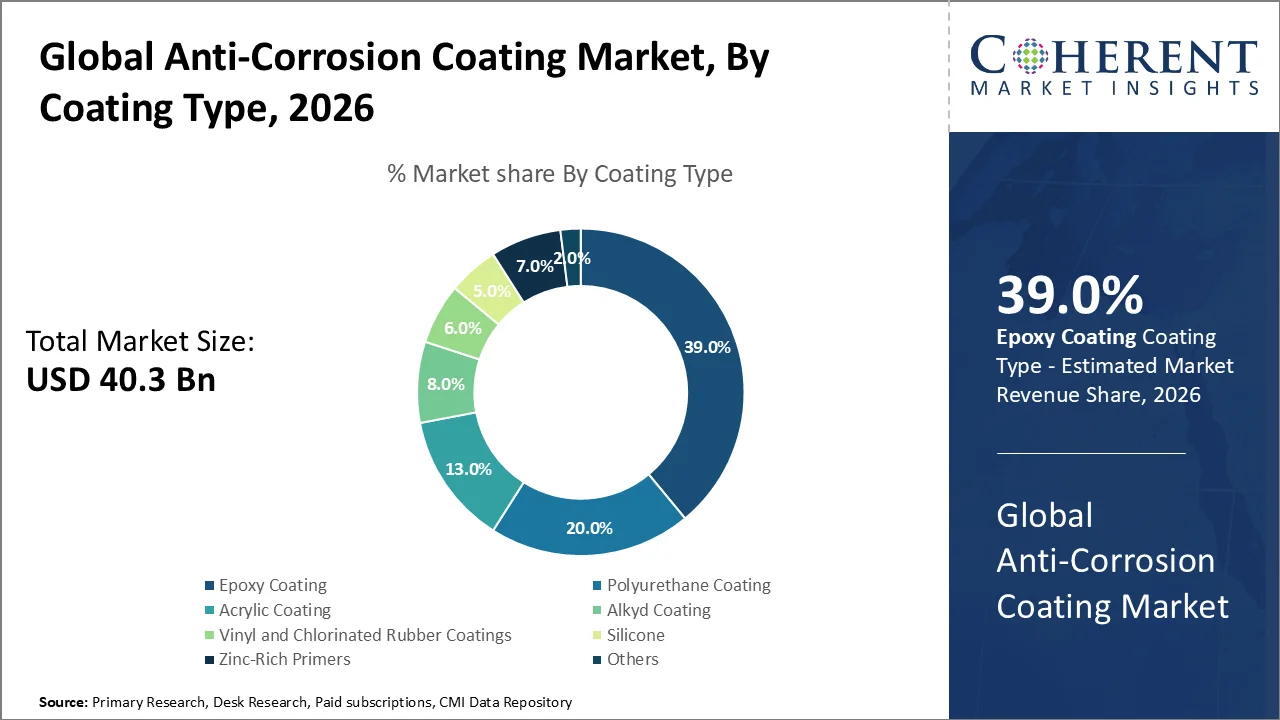
Why is Epoxy Coating Acquiring the Largest Share?
On the basis of coating type, the epoxy coating segment is projected to account for the largest Anti-Corrosion Coating Market share of 39.0% in 2026. The segment’s growth is owing to strong adhesion, chemical and moisture resistance, high mechanical durability, and extensive utilization for pipelines, storage tanks, structural steel, industrial equipment, and other assets operating in corrosive environments.
The scale of pipeline infrastructure provides a substantial recurring application base for epoxy-based corrosion protection. According to the U.S. Pipeline and Hazardous Materials Safety Administration (PHMSA), the U.S. had approximately 413,360 miles of natural gas transmission and gathering pipelines in 2025. PHMSA separately recorded another 227,997 miles of hazardous-liquid and carbon-dioxide pipelines, creating a combined infrastructure base of more than 641,000 miles across these two pipeline categories.
In March 2026, PPG launched PPG SIGMASHIELD 950 and PPG SIGMASHIELD 899 GF, two new glass-flake epoxy coatings developed for offshore energy, oil & gas, and infrastructure applications. The coatings are engineered to provide high corrosion, abrasion, and impact resistance in severe operating environments.
Why are Solvent-Borne Coatings Holding the Largest Market Share?
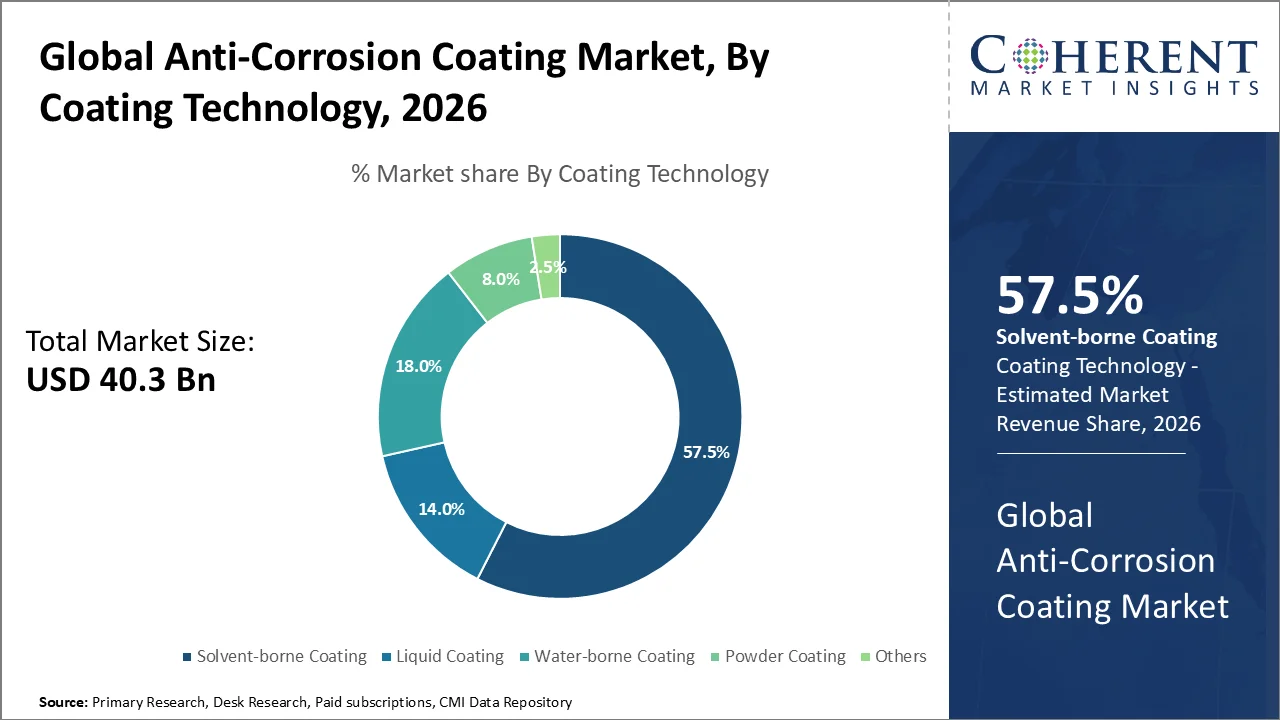
On the basis of coating technology, the solvent-borne coating segment is projected to lead the Anti-Corrosion Coating Market with 57.5% in 2026. The segment’s growth is owing to strong substrate wetting, rapid curing, reliable film formation, application flexibility, and established performance in marine, industrial maintenance, heavy equipment, oil & gas, and other demanding operating environments.
According to the American Coatings Association (ACA), the U.S. industrial maintenance and protective coatings market reached 63.6 million gallons valued at USD 2.67 billion in 2025 and is projected to increase to 65.2 million gallons worth USD 2.81 billion in 2026, representing 5.1% growth in value.
In July 2026, PPG introduced an enhanced formulation of its PPG SELEMIX 7-159 Direct Pro 2K acrylic topcoat for the light industrial coatings market across Europe, the Middle East, and Africa.
Why is the Marine Segment Acquiring the Largest Market Share?
On the basis of end-user industry, the marine segment is expected to account for the largest Anti-Corrosion Coating Market share of approximately 28.0% in 2026. The segment’s growth is owing to persistent exposure of ship hulls, ballast tanks, cargo areas, decks, offshore equipment, port infrastructure, and other metallic structures to seawater, salt spray, humidity, abrasion, and aggressive marine environments.
According to UN Trade and Development (UNCTAD), maritime transportation carries more than 80% of internationally traded goods by volume, highlighting the enormous operating infrastructure associated with global shipping.
In February 2026, PPG introduced PPG SIGMARINE ONE 648, a new one-component marine topcoat developed for onboard maintenance and above-water vessel applications.
Anti-Corrosion Coating Market Trends
- Rising demand for water-borne, high-solids and ultra-low-VOC anti-corrosion coatings is reshaping protective coating formulations, enabling manufacturers to balance environmental compliance and industrial-grade corrosion resistance. In March 2026, PPG launched its AQUACRON Waterborne Shop Primers for structural steel, which contain less than 24 g/L VOC and dry in approximately two minutes under normal heat conditions, resolving one of the traditional performance issues of water-borne primers.
- The increasing development of smart and self-healing anti-corrosion coatings is enabling coating systems to respond autonomously to scratches, microcracks and changes in the surrounding corrosive environment. In an advanced engineering materials study of 2026, a smart zinc-composite coating was able to achieve 87% self-healing efficiency after 168 hours of immersion after a scratch, illustrating the increasing technical feasibility of responsive corrosion-protection systems.
- The trend toward longer service life for coatings and lower maintenance throughout the lifecycle is driving the adoption of high-performance zinc-rich and advanced protective primers. Hempel launched Avantguard 750 Pro in 2025, which the company states can improve the durability of coatings by up to 50% and offer corrosion protection for steel structures for more than 35 years. The formulation also contains 76% solids by volume, a reflection of the industry trend toward more material efficient and longer lasting corrosion protection.
Regional Insights
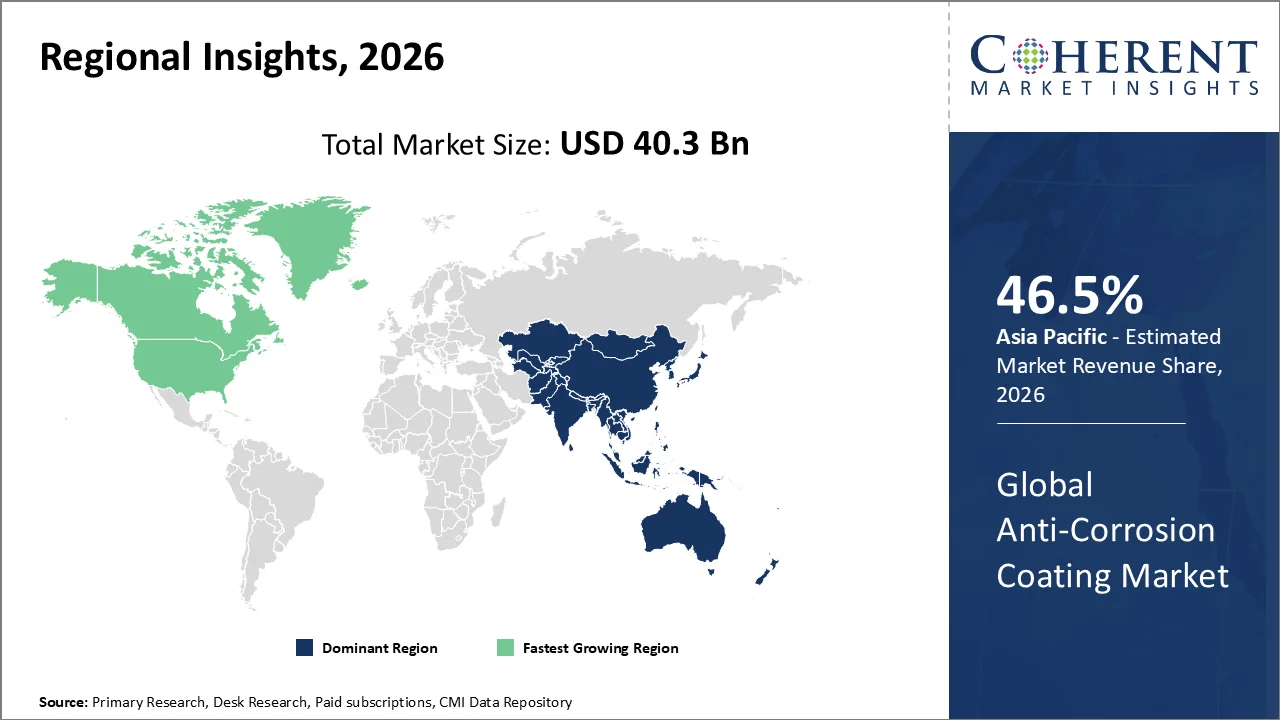
Asia Pacific Dominates Owing to the Large Shipbuilding, Industrial, and Infrastructure Base
The Asia Pacific region accounts for approximately 46.5% of the Anti-Corrosion Coating Market share in 2026. The region’s dominance is owing to its extensive shipbuilding and manufacturing base, rapid infrastructure development, expanding energy facilities, and significant consumption of protective coatings across marine, oil & gas, automotive, construction, and heavy industrial applications.
China continues to reinforce the region’s corrosion-protection demand through its large shipbuilding industry. According to China’s Ministry of Industry and Information Technology, China’s shipbuilding output in 2025 was 53.69 million deadweight tons, up 11.4% YoY, accounting for 56.1% of the world’s shipbuilding output. New ship orders amounted to 107.82 million DWT, 69% of the global total.
In August 2025, PPG and Asian Paints announced a 15-year renewal of their joint venture agreements in India, effective from 2026 through 2041. The renewed partnership will continue serving customers across industrial, protective, marine, automotive, packaging, and powder coatings in one of the region’s fastest-growing economies.
North America is Expected to Witness the Fastest Growth in the Anti-Corrosion Coating Market
North America is expected to witness the fastest growth in the Anti-Corrosion Coating Market over the forecast period, based on the rising modernization of aging energy infrastructure, expansion of transmission networks, new pipeline projects, and increasing adoption of high-performance protective coating technologies across the U.S. and Canada.
Canada is also expanding corrosion-intensive energy infrastructure. In July 2026, the federal government approved the USD 4 billion Sunrise Expansion Program in British Columbia, which is being constructed by Enbridge. The project is intended to add up to 300 million cubic feet per day of natural gas transportation capacity to the Westcoast transmission system.
In March 2026, the U.S. Department of Energy announced it was providing USD 1.9 billion in funding through its SPARK program to speed upgrades to the country’s electricity transmission infrastructure.
Energy Infrastructure Expansion and Aging Asset Base are Supporting the Anti-Corrosion Coating Market in the United States
The U.S. Anti-Corrosion Coating Market is witnessing consistent demand backed by large oil & gas infrastructure, aging bridges and utility assets and continuous investment in industrial maintenance and asset-life extension. This has created a greater need for anti-corrosion coatings for pipelines, storage facilities, refineries, transmission structures, bridges, ports and other steel-intensive infrastructure exposed to moisture, chemicals, weathering and aggressive operating conditions.
Significant infrastructure rehabilitation needs also persist. The U.S. is facing an estimated USD 3.7 trillion infrastructure investment gap, spanning transportation, water, energy, ports and other critical systems, according to the American Society of Civil Engineers’ 2025 Infrastructure Report Card. This further creates demand for anti-corrosion coating.
China Anti-Corrosion Coating Market Trends
China is expected to remain a major growth market for anti-corrosion coatings owing to its expanding energy infrastructure, manufacturing sector, pipeline transportation, renewable energy installations, and large-scale industrial asset base. Increasing investment in pipelines, power generation, transportation infrastructure, machinery, and chemical facilities is creating recurring requirements for corrosion-resistant coating systems.
In May 2026, AkzoNobel announced that its International protective coatings were being deployed at the Songyuan Hydrogen Energy Industrial Park in China, described as the world’s largest integrated green hydrogen-ammonia-methanol project.
Who are the Major Companies in Anti-Corrosion Coating Industry
Some of the major key players in Anti-Corrosion Coating Market are BASF, Ashland Inc., Nippon Paint Co. Ltd., AkzoNobel N.V., Jotun A/S, Axalta Coating System Ltd., The Sherwin-Williams Company, Kansai Paints Co. Ltd., PPG Industries Inc., Hempel A/S.
Key News
- In July 2026, Nippon Paint Marine announced an agreement with WAN HAI Lines to supply its FASTAR XI hull coating and EVER COOL exterior coating for two new methanol dual-fuel container vessels of 8,700 TEU and 16,000 TEU.
- In July 2026, Hempel launched Hempafire Optima 515, a waterborne protective coating for structural steel used in civil infrastructure projects. The coating contains 75% solids, can be applied at up to 1.5 mm dry-film thickness per coat, and provides certified fire protection of up to 150 minutes under BS 476.
Market Report Scope
Anti-Corrosion Coating Market Report Coverage
| Report Coverage | Details | ||
|---|---|---|---|
| Base Year: | 2025 | Market Size in 2026: | USD 40.3 Bn |
| Historical Data for: | 2020 To 2024 | Forecast Period: | 2026 To 2033 |
| Forecast Period 2026 to 2033 CAGR: | 3.6% | 2033 Value Projection: | USD 51.7 Bn |
| Geographies covered: |
| ||
| Segments covered: |
| ||
| Companies covered: | BASF, Ashland Inc., Nippon Paint Co. Ltd., AkzoNobel N.V., Jotun A/S, Axalta Coating System Ltd., The Sherwin-Williams Company, Kansai Paints Co. Ltd., PPG Industries Inc., Hempel A/S. | ||
| Growth Drivers: |
| ||
| Restraints & Challenges: |
| ||
Analyst Opinion
- The Anti-Corrosion Coatings Market has a strong structural demand base because corrosion remains a major lifecycle cost across infrastructure, energy, transportation, and industrial assets. In April 2025, the Association for Materials Protection and Performance (AMPP) estimated that corrosion costs the global economy more than USD 2.5 trillion per year. AMPP also reports that 15–35% of corrosion-related costs can be avoided with proper corrosion-control practices, which supports the economic argument for preventive protective coatings.
- Stricter asset protection standards to spur demand for high-performance marine coatings. The International Maritime Organization (IMO) adopted amendments to the IMO’s performance standards for protective coatings for dedicated seawater ballast tanks and cargo oil tanks. These changes came into effect on January 1, 2026, with an increased focus on standardized coating performance, inspection, maintenance and repair of commercial vessels.
- Emerging carbon-management infrastructure is creating a new long-term opportunity for specialized corrosion protection. More than 30 CCUS projects reached final investment decisions during 2024–2025, while investment increased more than 15-fold from 2020 to over USD 5 billion in 2025. Projects already under construction could nearly double global operational carbon-capture capacity by 2030.
Speak to the analyst
Want personalized insights?
Take the findings above to one of our principal consultants, or have the report rebuilt around the segments, geographies and competitors you actually track.
Market Segmentation
- By Coating Type (Revenue, USD Bn, 2021-2033)
- Epoxy Coating
- Polyurethane Coating
- Acrylic Coating
- Alkyd Coating
- Vinyl and Chlorinated Rubber Coatings
- Silicone
- Zinc-Rich Primers
- Others
- By Coating Technology (Revenue, USD Bn, 2021-2033)
- Liquid Coating
- Solvent borne
- Water borne
- Powder Coating
- Others (Laser, Radiation-cured etc.)
- By End User Industry (Revenue, USD Bn, 2021-2033)
- Marine
- Oil and Gas
- Refinery & Petrochemical Industry
- Automotive & Transportation
- Infrastructure
- Others
- By Region (Revenue, USD Bn, 2021-2033)
- North America
- U.S.
- Canada
- Latin America
- Brazil
- Mexico
- Argentina
- Rest of Latin America
- Europe
- Germany
- U.K.
- France
- Italy
- Spain
- Russia
- Rest of Europe
- Asia Pacific
- China
- India
- Japan
- Australia
- South Korea
- ASEAN
- Rest of Asia Pacific
- Middle East
- GCC
- Israel
- Rest of Middle East
- Africa
- South Africa
- Central Africa
- North Africa
- North America
Sources
Primary Research Interviews
- Anti-corrosion coating manufacturers
- Protective and marine coating formulator
- Resin, pigment, additive, and corrosion inhibitor suppliers
- R&D and technical heads from coating companies
- Corrosion engineers and materials scientists
- Marine, oil & gas, infrastructure, automotive, and industrial procurement managers
- Coating applicators, contractors, and inspection professionals
- Key opinion leaders (KOLs) in corrosion protection and surface engineering
Databases
- World Bank
- Organisation for Economic Co-operation and Development (OECD)
- UN Trade and Development (UNCTAD)
- International Energy Agency (IEA)
- U.S. Energy Information Administration (EIA)
- U.S. Pipeline and Hazardous Materials Safety Administration (PHMSA)
- Eurostat
- European Chemicals Agency (ECHA)
Magazines
- Coatings World
- Paint & Coatings Industry (PCI) Magazine
- European Coatings
- Protective Coatings Europe
- Marine Log
- Chemical Processing
Journals
- Corrosion Science
- Progress in Organic Coatings
- Surface and Coatings Technology
- Journal of Coatings Technology and Research
- Materials and Corrosion
- Journal of Materials Engineering and Performance
Newspapers
- Reuters
- The Wall Street Journal
- Financial Times
- The Economic Times
- Nikkei Asia
- Business Standard
Associations
- Association for Materials Protection and Performance (AMPP)
- American Coatings Association (ACA)
- European Council of the Paint, Printing Ink and Artists’ Colours Industry (CEPE)
- World Coatings Council (WCC)
- World Steel Association
- International Association of Oil & Gas Producers (IOGP)
- International Chamber of Shipping (ICS)
- ASTM International
Public Domain Sources
- Company Annual Reports and Investor Presentations
- Company Product Launches and Technical Data Sheets
- Government Infrastructure and Energy Publications
- International Maritime Organization (IMO) Regulations and Standards
- European Chemicals Agency (ECHA) Regulatory Publications
- U.S. Environmental Protection Agency (EPA) Coating Regulations
- Patent Databases such as WIPO, USPTO, and Google Patents
- Academic and University Research Publications on Corrosion Protection
- Publicly Available Infrastructure, Pipeline, Shipbuilding, and Energy Project Reports
Proprietary Elements
- CMI Data Analytics Tool
- Proprietary CMI Existing Repository of Information for the Last 10 Years
Get access to 250+ pages report
Every segment, forecast, competitor profile and data table behind the analysis above — available for instant download.
- ESOMAR Member
- ISO 9001:2015 Certified
- D-U-N-S Registered
- GDPR & CCPA Compliant
Missing comfort of reading report in your local language? Find your preferred language:
Transform your Strategy with Exclusive Trending Reports
Frequently Asked Questions
The Anti-Corrosion Coating Market is expected to reach approximately USD 51.7 Bn in 2033.
Major players operating in the global Anti-Corrosion Coating Market include BASF, Ashland Inc., Nippon Paint Co. Ltd., AkzoNobel N.V., Jotun A/S, Axalta Coating System Ltd., The Sherwin-Williams Company, Kansai Paints Co. Ltd., PPG Industries Inc., and Hempel A/S.
High raw material costs, stringent environmental regulations, volatility in resin and solvent prices, and increasing compliance requirements related to VOCs and hazardous chemicals are the key factors hampering market growth.
Increasing investments in infrastructure development, rising demand from marine and offshore industries, expansion of oil & gas infrastructure, and growing focus on extending the service life of industrial assets are driving market growth.
The Anti-Corrosion Coating Market is anticipated to grow at a CAGR of approximately 3.6% between 2026 and 2033.
Among regions, Asia Pacific is expected to account for the largest share of the global Anti-Corrosion Coating Market, with approximately 46.5% in 2026, supported by its large shipbuilding, manufacturing, infrastructure, and energy sectors.
Anti-corrosion coatings are protective materials applied to metal surfaces to reduce deterioration caused by moisture, chemicals, saltwater, oxidation, and other corrosive environmental conditions. They help extend asset life and reduce maintenance and replacement costs.