

Liquid Crystal Polymers Market Analysis & Forecast: 2026-2033
The liquid crystal polymers market is estimated to be valued at USD 1,882.8 Mn in 2026 and is expected to reach USD 3,486.3 Mn by 2033, exhibiting a compound annual growth rate (CAGR) of 9.2% from 2026 to 2033
Key Takeaways
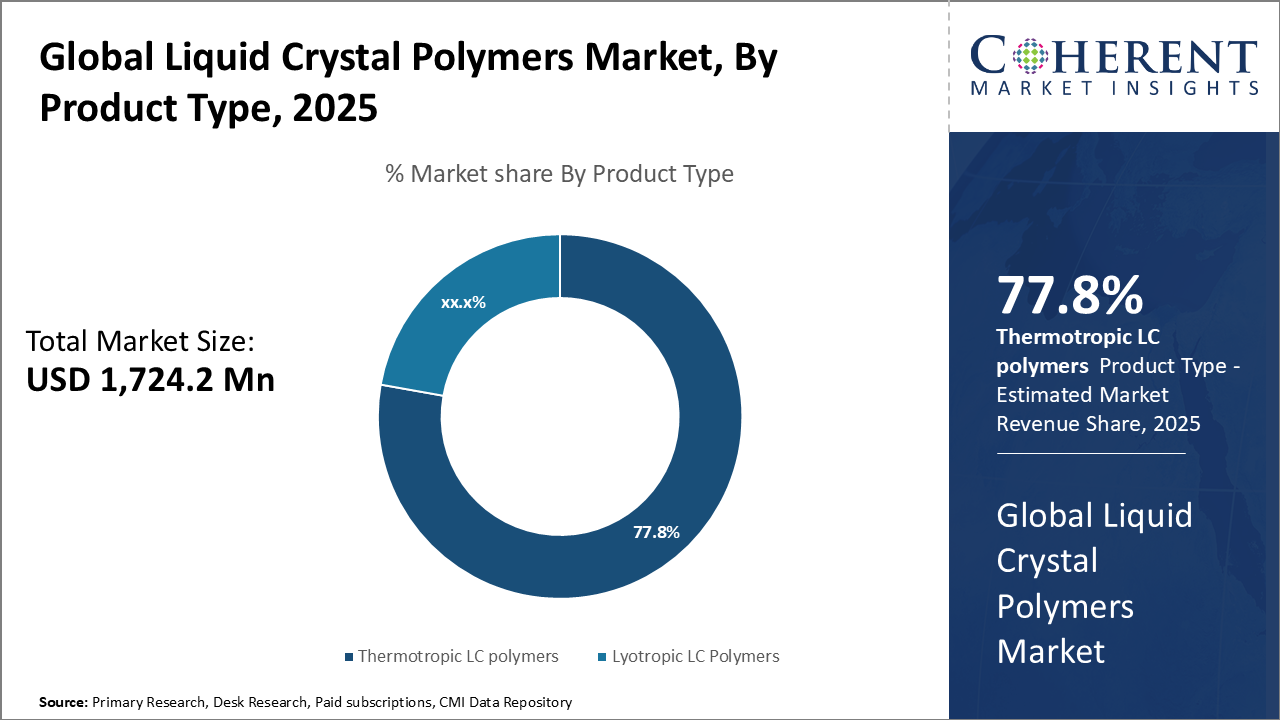
- By Product Type, Thermotropic LC polymers are anticipated to hold 78.8% of the total market share in 2026 driven by their exceptional thermal stability, mechanical strength, and chemical resistance, making them ideal for high-performance applications.
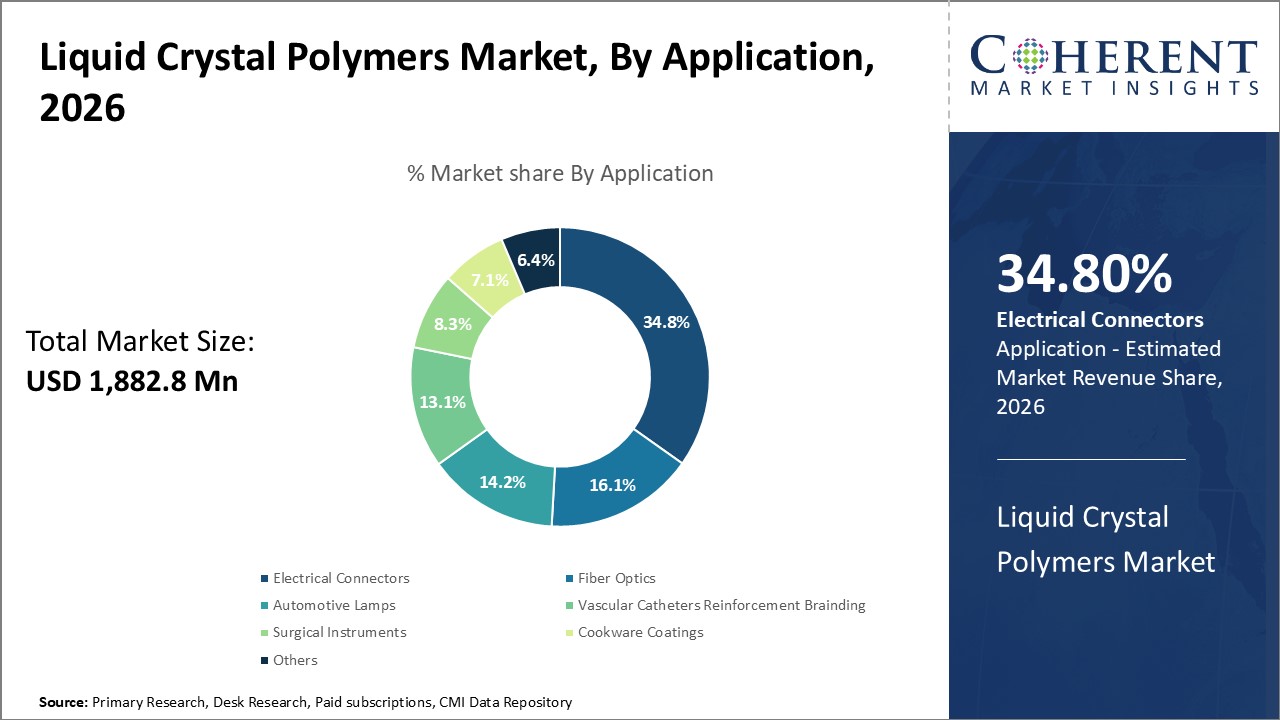
- By Application, Electrical Connectors segment is projected to hold largest shares in 2026. This growth is primarily driven by the exceptional electrical performance, dimensional stability, and low dielectric properties of liquid crystal polymers.
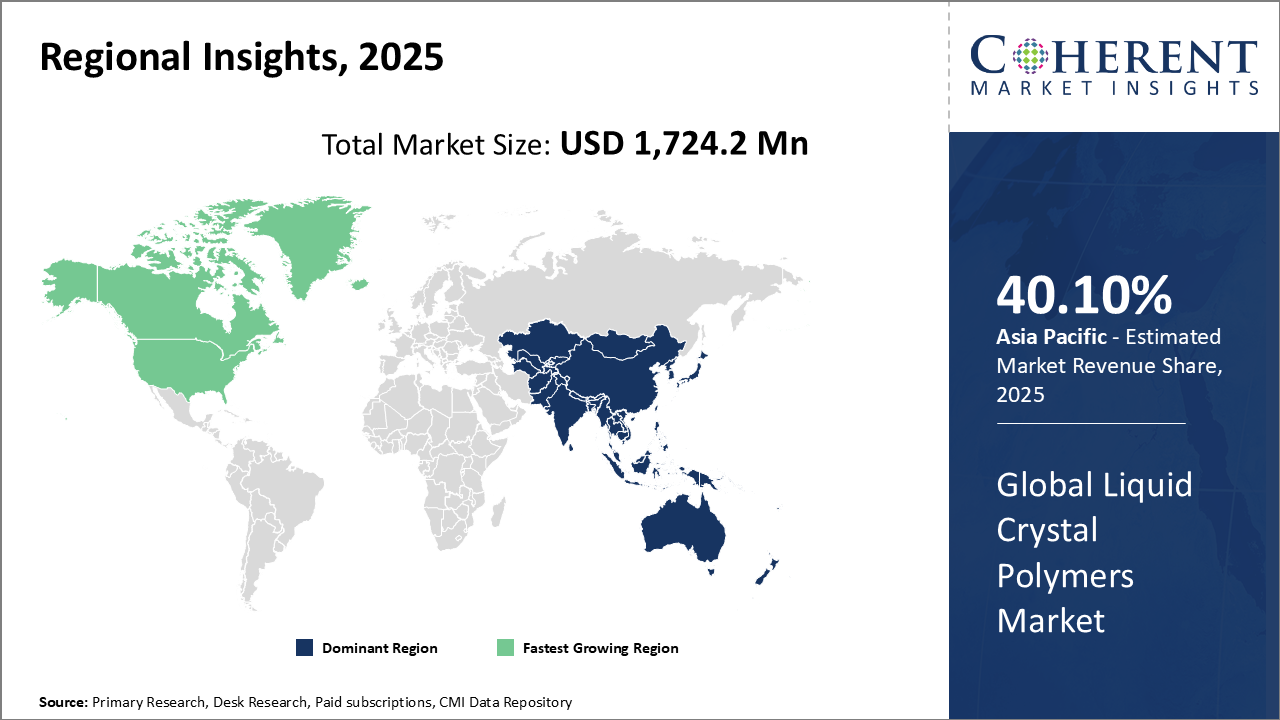
- By Region, Asia Pacific is expected to lead the global liquid crystal polymers market in 2026 with a 40.1% share in 2026. While, North America is expected to be the fastest growing region the global liquid crystal polymers market with a market share of approximately 13.3% in 2026.
Market Overview
The global liquid crystal polymers market is witnessing consistent growth, fueled by increasing liquid crystal polymers market demand for high-performance materials in electronics, automotive, and medical applications. Lyotropic LCPs dominate the market due to their superior thermal and mechanical properties. The material’s excellent electrical performance supports its widespread use in electrical connectors and precision components.
Current Events and its Impact on the Liquid Crystal Polymers Market
Current Event | Description and its impact |
Product Innovations and Regulatory Clearances |
|
Collaborations and Expansion Initiatives |
|
Policy Shifts and Compliance Impact |
|
Liquid Crystal Polymers Market Growth Factors
- Miniaturization & high-performance electronics: LCPs offer excellent dimensional stability, low coefficient of thermal expansion (CTE), good electrical insulation / low dielectric constant, and good flow into thin walls.
- Automotive / EV / lightweighting trends: Automotive sector is shifting to lighter materials to improve fuel‐efficiency, and materials that can tolerate high temperatures (under-hood, engine compartments, charging connectors) are needed.
- Growth in electronics manufacturing, especially in Asia-Pacific: Strong electronics manufacturing hubs (China, Japan, South Korea, etc) are driving demand. Asia-Pacific region often leads in adoption.
- Current Industry Events of 2026
- Market Size Estimation
- Regional Breakdown
- Competitive Landscape
- Customer Intelligence
- Segmental Analysis
- Pricing Analysis
- Key Market Drivers, Challenges & Future Trends
- Customized Insights Section
Segmental Insights
Global Liquid Crystal Polymers Market Insights, By Product Type
Thermotropic Liquid Crystal (LC) Polymers segment is projected to dominate the global liquid crystal polymers market, capturing approximately 78.8% of the total market share in 2026 driven by their exceptional thermal stability, mechanical strength, and chemical resistance, making them ideal for high-performance applications.
These polymers are increasingly used in electronics, automotive, aerospace, and medical devices, where miniaturization, high-frequency performance, and reliability are critical. Additionally, their ease of processing and dimensional stability supports mass production of connectors, antennas, and other precision components, further fueling market adoption and growth.
For instance, in October 2024, a recent study published in the Polymer journal details the synthesis of low-dielectric thermotropic liquid crystal polyarylates. Researchers achieved this by acetylating hydroxyl-containing monomers, resulting in materials with enhanced electro-optical properties. These advancements hold potential for applications in displays, optical devices, and other technologies requiring precise dielectric control.
Global Liquid Crystal Polymers Market Insights, By Application: Electrical Connectors Dominance Is Driven by the Exceptional Electrical Properties of LCPS
Electrical connectors are expected to account for 34.8% of the total market share in the liquid crystal polymers market in 2026. This leading position is driven by the exceptional electrical properties of LCPs, including low dielectric constant, minimal signal loss, and superior dimensional stability. As the demand for faster, smaller, and more reliable electronic devices grows, LCPs have emerged as the preferred material for producing high-density electrical connectors and sockets.
Their excellent resistance to heat and moisture, combined with ease of molding, supports consistent performance even in the most demanding environments. These properties are especially critical in sectors like telecommunications, automotive electronics, and consumer devices, where high signal integrity and miniaturization are paramount. The continued evolution of 5G, EVs, and IoT ecosystems further solidifies the application of LCPs in electrical connectors, ensuring long-term market growth.
For instance, in January 2025, ZhongShan Ylk Electronic Co., Ltd. introduced high-quality FFC connectors designed for reliable electrical connections across various industries, including consumer electronics, automotive, telecommunications, and industrial equipment. These connectors meet international standards such as UL, VDE, TUV, EXCE, CQC, RoHS, and REACH, ensuring stable and efficient performance. With a presence in over 60 countries, the company offers tailored solutions and technical support to meet diverse customer needs.
Regional Insights
Asia Pacific Liquid Crystal Polymers Market Analysis and Trends
Asia Pacific region is projected to lead the market with a 40.1% share in 2026, driven by the region’s strong electronics manufacturing base, particularly in China, Japan, South Korea, and Taiwan. Growing demand for miniaturized connectors, semiconductors, and 5G infrastructure drives LCP adoption. Additionally, expanding automotive, consumer electronics, and industrial sectors, coupled with cost-effective production and rising investments in high-performance materials, further fuel market demand.
For instance, in September 2026, Chinese firm WOTE Advanced Materials has launched a new liquid crystal polymer (LCP) engineered for precision component manufacturing. The material boasts superior stability under heat and chemical exposure, excellent flow for thin-wall and complex molds, low moisture absorption, and dimensional consistency. It is especially suited for connectors, sensors and miniaturized electronics.
North America Liquid Crystal Polymers Market Analysis and Trends
North America region is expected to exhibit the fastest growth in the market contributing 13.3% share in 2026, reaffirming its status as the most technologically advanced and innovation-driven region in the sector. This dominance is supported by the region's advanced manufacturing infrastructure, strong demand across the electronics, automotive, aerospace, and particularly the telecommunications sector, where the Liquid Crystal Polymers Market in Telecom is witnessing accelerated growth due to the rollout of 5G infrastructure and high-frequency applications.
For instance, in February 2026, Kuraray Co., Ltd. exhibited at the NW Materials Show 2026 in Portland, Oregon, to showcase its sustainable, high-performance materials for apparel and sports goods. Among them are LCP (liquid crystal polymer) fiber and film, branded “VECTRAN™” and “VECSTAR™”, known for low moisture absorption, dimensional stability, insulating properties, and flexibility.
Liquid Crystal Polymers Market Outlook Country-wise
United States Liquid Crystal Polymers Market Trends
The United States leads the global liquid crystal polymers market within the North American region, contributing significantly to the region's projected 37.3% market share in 2026. This leadership is driven by advanced manufacturing capabilities, robust demand for high-performance materials in the electronics, automotive, medical, and aerospace sectors, and strong innovation ecosystems.
The U.S. is home to major LCP manufacturers and polymer research hubs that actively invest in developing next-generation formulations tailored for miniaturized and high-frequency applications.
For instance, in May 2026, a research paper published at Cornell University states that, Researchers have developed a novel approach that integrates first-principles calculations with genetic algorithms to accelerate the discovery of liquid crystal polymers with low visible absorption and high refractive index. By iterating within a predefined space of molecular building blocks, the method rapidly identifies reactive mesogens that meet target specifications.
Japan Liquid Crystal Polymers Market Trends
The Liquid Crystal Polymers (LCP) Market is highly demanding in Japan due to the country’s leadership in electronics and semiconductor manufacturing, where LCPs are critical for miniaturized connectors, flexible circuits, and high-frequency components. The rollout of 5G networks, strong demand in automotive lightweighting and EV components, and Japan’s innovation-driven approach to high-performance materials further accelerate adoption of LCPs across industries.
For instance, in June 2026, Sumitomo Chemical has developed mass production technology for liquid crystal polymer (LCP) using biomass-derived monomers. The move aims to reduce reliance on fossil fuels and pave the way for sustainable super engineering plastics. Certified supply is expected by end of fiscal 2026, with commercial shipments from fiscal 2027.
Market Report Scope
Liquid Crystal Polymers Market Report Coverage
| Report Coverage | Details | ||
|---|---|---|---|
| Base Year: | 2025 | Market Size in 2026: | USD 1,882.8 Mn |
| Historical Data for: | 2020 To 2024 | Forecast Period: | 2026 To 2033 |
| Forecast Period 2026 to 2033 CAGR: | 9.2% | 2033 Value Projection: | USD 3,486.3 Mn |
| Geographies covered: |
| ||
| Segments covered: |
| ||
| Companies covered: | Celanese Corporation, Polyplastics Co Ltd., Sumitomo Chemical Co. Ltd., Toray Industries Inc., Solvay S.A., Ueno Fine Chemicals Industry Ltd., Shanghai PRET Composites Co. Ltd., RTP Company, Zeus Company Inc., Chang Chung Group, Polyplastics Co., and Daken Chem | ||
| Growth Drivers: |
| ||
| Restraints & Challenges: |
| ||
Market Dynamics
Liquid Crystal Polymers Market Driver
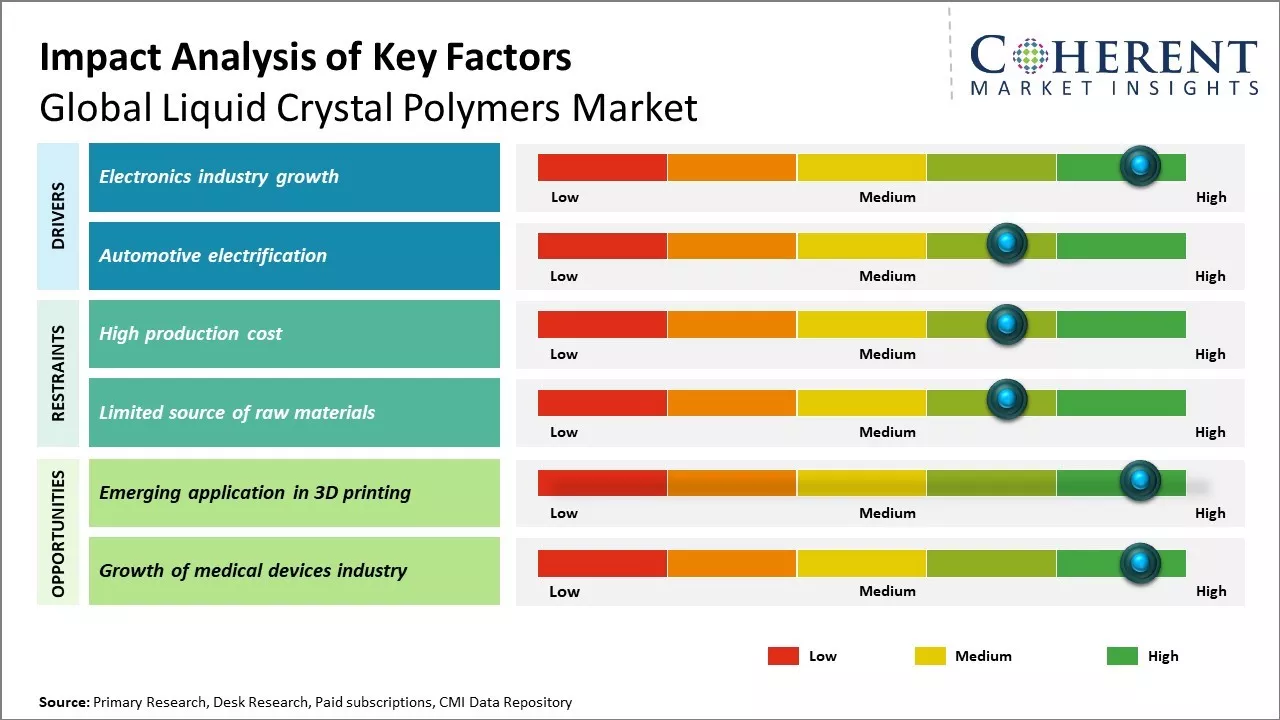
- Electronics industry growth
The liquid crystal polymers market is anticipated to experience an upward trend owing to the consistent growth of the electronics industry. LCPs find extensive applications in the manufacturing of various electronics components such as connectors, switches, circuit boards, and thermal management materials owing to their excellent dielectric and magnetic properties, high heat resistance, and dimensional stability.
Over the past few decades, the electronics industry has transformed significantly with the miniaturization of devices and increased demand for thin and lightweight electronic goods. Liquid crystal polymers perfectly complement these evolving needs of the electronics sector due to their ability to deliver high performance even at thin thicknesses. Their superior process ability allows for the precise printing of intricate circuit patterns.
The sustained proliferation of consumer electronics such as smartphones, laptops, wearable’s, and accessories is driving the increased adoption of LCPs. Technologies such as 5G network, artificial intelligence, IoT, autonomous vehicles, and augmented/virtual reality continue to open up new opportunities for electronics. This is bolstering the electronics production worldwide.
Further, industries such as aerospace and defence also incorporate advanced electronics extensively and are witnessing rising expenditure on R&D which utilizes high-end polymers including LCPs. Continued digitization of various industrial sectors is another factor fuelling the demand from electronics sector.
The liquid crystal polymers market players are actively engaging in new product development focusing on advanced applications to leverage new opportunities arising from this ongoing electronicization trend. Established uses along with emerging applications ensure the steady and predictable growth of the liquid crystal polymers market over the coming years.
- Automotive electrification
The automotive sector is poised to create significant demand for liquid crystal polymers in the foreseeable future driven by the electrification mega-trend. The thriving electric vehicle market and growing hybridization of conventional vehicles are leading to rising incorporation of advanced polymers in automotive electronics, electrical components, and powertrain systems.
Liquid crystal polymers have emerged as the material of choice for a wide range of auto parts that require heat resistance, high voltage insulation, dimensional stability, and other rigorous performance attributes. Some of the key automotive applications of LCPs include battery modules, DC/DC converters, electric motors, charging inlets, BUS bars, and other connectivity parts. Their use in electrical vehicle charging contacts ensure safety, reliability, and longevity of fast and ultra-fast charging interfaces.
Liquid Crystal Polymers Market Opportunities
- Emerging application in 3D printing
Emerging applications in 3D printing could provide tremendous opportunities for growth in the global liquid crystal polymers market. 3D printing technology is advancing rapidly, allowing for more complex shapes and designs to be created using a variety of materials. Liquid crystal polymers are increasingly being used as a feedstock for 3D printers due to their desirable properties.
LCPs maintain excellent layer-to-layer bonding and structural integrity even under force, heat, and wear overtime. Their high heat resistance and strength make them well-suited for 3D printed parts that must endure tough and demanding environments. As 3D printing expands into new industries like aviation, aerospace, automotive and medical devices, the need for high-performance engineering plastics like LCPs will grow substantially.
Manufacturers are utilizing 3D printed LCPs to create lighter, durable components with greater design complexity compared to traditional manufacturing methods. This brings the potential for reduced costs through waste reduction and customized production runs.
Analyst Viewpoint (Expert Opinion)
The global liquid crystal polymers market value is on a strong growth trajectory, driven by increasing demand for high-performance, lightweight materials across industries such as electronics, automotive, telecommunications, and medical devices. Analysts highlight Asia Pacific as the leading region, supported by advanced manufacturing infrastructure, significant R&D investments, and a strong presence of key market players.
Technological advancements in miniaturization, 5G communications, and electric vehicles are reshaping application needs, and experts emphasize that manufacturers focusing on high-heat resistance, low dielectric, and precision molding capabilities are gaining competitive advantage. Innovations in LCP processing and the use of AI for material optimization are also contributing to product diversification and market expansion.
Despite challenges like high production costs, limited recyclability, and raw material volatility, the long-term outlook remains highly favourable. Strategic collaborations, sustainability initiatives, and the integration of LCPs into next-gen devices are expected to propel continued market growth and innovation.
Key Developments
- In February 2025, Sumitomo Chemical acquired the liquid crystal polymer (LCP) neat resin business from Belgium-based Syensqo SA/NV. This acquisition enhances Sumitomo's capabilities in high-heat-resistant materials, supporting growth in ICT and mobility sectors. Leveraging Syensqo's technology and patents, Sumitomo aims to expand its product lineup and meet evolving market demands.
- In July 2022, Sumitomo Chemical Advanced Technologies developed and commercialized a new family of long-fiber thermoplastic (LFT) compounds with high-performance liquid crystal polymer (LCP) matrices reinforced with 13-mm chopped carbon fiber or fiberglass.
Market Segmentation
- By Product Type (Revenue, USD Mn, 2021 - 2033)
- Lyotropic LC Polymers
- Thermotropic LC polymers
- By Application (Revenue, USD Mn, 2021 - 2033)
- Electrical Connectors
- Fiber Optics
- Automotive Lamps
- Vascular Catheters Reinforcement Brainding
- Surgical Instruments
- Cookware Coatings
- Others
- By Region (Revenue, USD Mn, 2021 - 2033)
- North America
- U.S.
- Canada
- Latin America
- Brazil
- Argentina
- Mexico
- Rest of Latin America
- Europe
- Germany
- U.K.
- Spain
- France
- Italy
- Russia
- Rest of Europe
- Asia Pacific
- China
- India
- Japan
- Australia
- South Korea
- ASEAN
- Rest of Asia Pacific
- Middle East
- GCC Countries
- Israel
- Rest of Middle East
- Africa
- South Africa
- North Africa
- Central Africa
- Company Profiles
- Celanese Corporation
- Polyplastics Co Ltd.
- Sumitomo Chemical Co. Ltd.
- Toray Industries Inc.
- Solvay S.A.
- Ueno Fine Chemicals Industry Ltd.
- Shanghai PRET Composites Co. Ltd.
- RTP Company
- Zeus Company Inc.
- Chang Chung Group
- Polyplastics Co.
- Daken Chem
Sources
The Stakeholders Consulted
- Polymer engineers and materials scientists
- Manufacturers and suppliers of liquid crystal polymers and thermoplastics
- Electronics and automotive OEMs and tier-1 component suppliers
- Regulatory bodies and environmental compliance authorities
- Research institutions focused on advanced materials and polymer sciences
- Government infrastructure and industrial development agencies
- End-users across sectors such as electronics, telecommunications, automotive, medical devices, and aerospace
Databases Opened
- U.S. Department of Commerce – Advanced Manufacturing Data
- International Trade Centre (ITC) – Trade Statistics for Polymers
- Ministry of Chemicals and Fertilizers (India) – Petrochemical & Polymer Statistics
- World Bank Open Data – Industrial and Materials Innovation Metrics
Magazines & Trade Publications
- Plastics Technology Magazine
- Chemical & Engineering News (C&EN)
- Plastics Today
- Advanced Materials & Processes
- Design News – Materials & Manufacturing Section
Scientific and Industry Journals
- Polymer Journal
- Journal of Applied Polymer Science
- Materials Science and Engineering B
- Journal of Materials Chemistry C
- International Journal of Polymer Science
Newspapers & Media Outlets
- The Wall Street Journal – Advanced Materials & Manufacturing
- Bloomberg – Specialty Chemicals & Electronics Materials
- Reuters – Global Polymers and Industrial Materials News
- The Economic Times – Specialty Materials & Manufacturing Sector
- Business Standard – Polymers and Industrial Innovation Coverage
Associations and Regulatory Bodies
- American Chemical Society (ACS) – Division of Polymer Chemistry
- U.S. Environmental Protection Agency (EPA) – Advanced Manufacturing Materials
- Society of Plastics Engineers (SPE)
- Bureau of Indian Standards (BIS) – Polymer and Chemical Standards
- European Chemicals Agency (ECHA) – REACH Compliance
Public Domain Sources
- U.S. Energy Information Administration (EIA) – Industrial Applications of High-Performance Materials
- European Commission – Specialty Polymers and Eco-Design Guidelines
- World Bank – High-Value Material Use in Emerging Economies
- International Renewable Energy Agency (IRENA) – Sustainable Materials Roadmap
Proprietary Research Elements
- CMI Data Analytics Tool
- Proprietary CMI Repository of Market Data (covering the past 8 years)
- CMI Expert Interviews and Transcripts (focused on advanced polymers, electronics, and automotive material applications)
Get access to 250+ pages report
Every segment, forecast, competitor profile and data table behind the analysis above — available for instant download.
- ESOMAR Member
- ISO 9001:2015 Certified
- D-U-N-S Registered
- GDPR & CCPA Compliant
Missing comfort of reading report in your local language? Find your preferred language:
Transform your Strategy with Exclusive Trending Reports
Frequently Asked Questions
The Liquid Crystal Polymers Market size is estimated to be valued at USD 1,882.8 Mn in 2026, and is expected to reach USD 3,486.3 Mn by 2033.
The CAGR of the global Market is projected to be 9.2% from 2026 to 2033.
Electronics industry growth and automotive electrification are the major factors driving the growth of the global market.
High production cost and limited source of raw materials are the major factors hampering the growth of the global market.
In terms of product type, Thermotropic LC polymers is estimated to dominate the market revenue share in 2026.
Celanese Corporation, Polyplastics Co Ltd., Sumitomo Chemical Co. Ltd., Toray Industries Inc., Solvay S.A., Ueno Fine Chemicals Industry Ltd., Shanghai PRET Composites Co. Ltd., RTP Company, Zeus Company Inc., Chang Chung Group, Polyplastics Co., and Daken Chem are the major players.
Asia Pacific is expected to lead the global market.