

Top 15 Petrochemicals Market Size and Share Analysis - 2026 To 2033
The top 15 petrochemicals market is projected to grow from USD 630.2 Mn Tons in 2026 to USD 834.9 Mn Tons by 2033, registering a compound annual growth rate (CAGR) of 4.1% during the forecast period (2026–2033). Market growth is driven by rising demand for petrochemical derivatives across packaging, automotive, construction, and consumer goods sectors, along with expanding industrialization in emerging economies and rising investments in petrochemical production capacity worldwide. The Egyptian Petrochemicals Holding Company (ECHEM) has announced a five-year strategy to develop 10 projects aimed at localizing the production of more than 20 petrochemical products for both domestic and export markets. The plan targets a total production capacity of 7.5 million tons and investments of approximately $11 billion.
Key Takeaways from the Top 15 Petrochemicals Market Report
- Ethylene is predicted to account for the largest product type market share in 2026 at 28.4%. This growth is attributed to the increasing demand for ethylene in the manufacturing of polyethylene, ethylene oxide and other high-volume petrochemical derivatives. Industry data show ethylene continues to be the most-produced basic petrochemical in the world with a worldwide production capacity of more than 225 million metric tons.
- Polymers segment is anticipated to hold the greatest market share by application of 41.3% in 2026 owing to rising demand from packaging, consumer goods, automotive, and construction industries. The global plastic production reached around 430.9 million metric tons in 2024 and is anticipated to rise at a steady pace over the future decades, supporting the increased consumption of petrochemical-based polymers globally.
- Building & construction segment is projected to account for the largest share of 24.8% of the market in 2026, by end-use industry, owing to the continued importance of product derived from petrochemicals, such as pipes, insulation materials, roofing membranes, sealants, coatings, and composites in infrastructure development. In 2023, the building and construction sector was responsible for 32% of global energy demand and 34% of global CO₂ emissions, underscoring the massive size of construction operations globally and the associated demand for petrochemical material.
- Asia Pacific is projected to lead the worldwide top 15 petrochemicals market with a share of 60% in 2026, due to increasing industrialization, rise in production capacity of petrochemicals and high demand from packaging, building, automotive and consumer goods industries. China alone will account for roughly 50% of global petrochemical demand growth through 2030, driven by increased use of plastics, synthetic fibers and industrial chemicals, according to the International Energy Agency.
Market Drivers
Growing Demand for Sustainable Packaging is Driving Growth of the Top 15 Petrochemicals Market
The growing need for flexible, lightweight and cost-effective packaging materials is greatly driving the usage of petrochemical derivatives around the globe. Ethylene, propylene, benzene and other petrochemicals are the major feedstock utilized in the manufacture of plastics, films, containers and packaging resins used in food & beverage, healthcare, consumer goods and e-commerce industries. The growing consumption of packaged food and the rapid growth of online retail are driving the demand for high-performance polymer materials.
The Organisation for Economic Co-operation and Development estimate the world’s plastics demand will nearly triple from 460 million metric tons to around 1.23 billion metric tons by 2060. This highlights the long-term demand picture for petrochemical feedstocks.
Expanding Petrochemical Investments and Capacity Additions Accelerate Market Growth
Market growth is aided by large scale investments in petrochemical production facilities to support global supply chains. Asian and Middle Eastern countries are investing substantially in integrated refining and petrochemical complexes to fulfill expanding demand from the manufacturing, automotive, packaging and construction industries. These initiatives promote production efficiency, increase feedstock availability and allow industries to benefit from economies of scale.
According to the International Energy Agency, petrochemicals are expected to account for more than one-third of the growth in global oil demand by 2030, making them the largest driver of future oil demand growth.
Current Events and Their Impact on the Top 15 Petrochemicals Market
Current Event | Description and its Impact |
Expansion of Integrated Petrochemical Complexes Across Asia and the Middle East (2025–2026) |
|
Global Trade Tensions and Supply Chain Realignments |
|
- Current Industry Events of 2026
- Market Size Estimation
- Regional Breakdown
- Competitive Landscape
- Customer Intelligence
- Segmental Analysis
- Pricing Analysis
- Key Market Drivers, Challenges & Future Trends
- Customized Insights Section
Segmental Insights
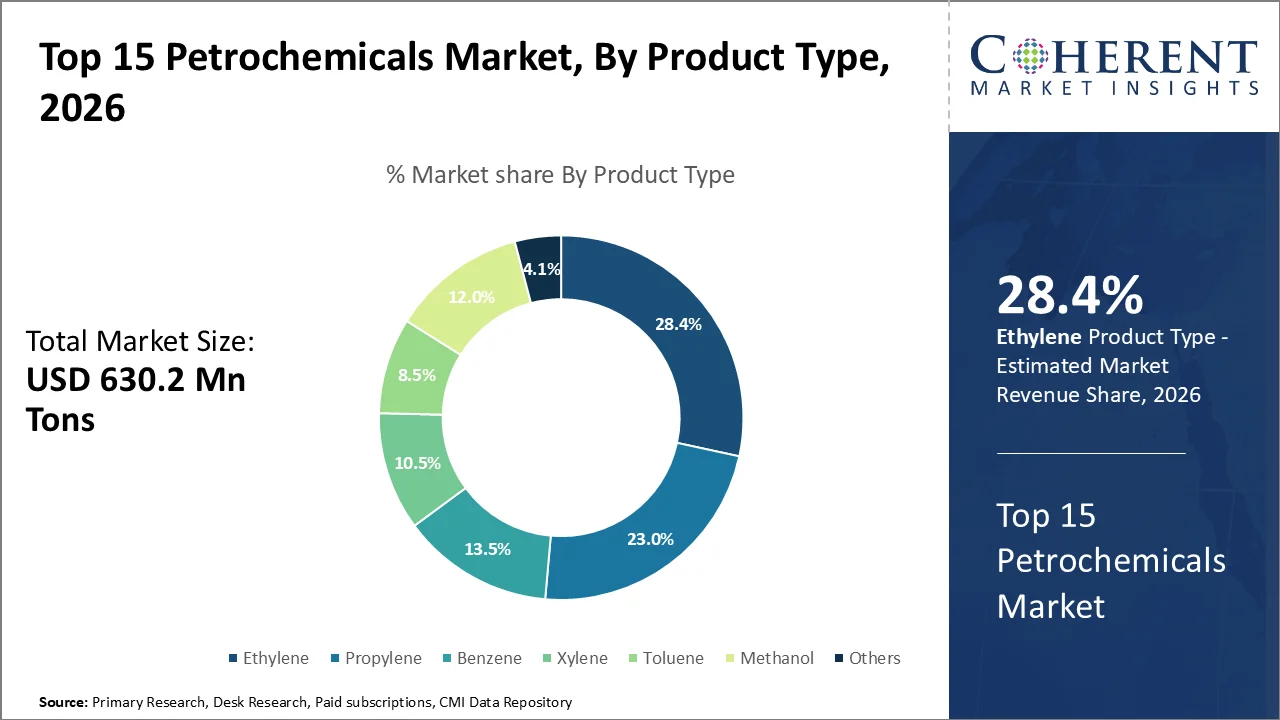
Why is Ethylene Acquiring the Largest Market Share?
In 2026, ethylene is projected to be the major contributor to the market volume among the top 15 petrochemicals with a share of approximately 28.4% of the total market volume. Such dominance is a reflection of its fundamental relevance as a feedstock for the production of polyethylene, ethylene oxide, ethylene dichloride, styrene and countless other downstream petrochemical products. Ethylene is the most important building block in the global petrochemical value chain. Derivatives based on the compound are widely utilized in packaging, automotive, construction, healthcare and consumer goods industries.
In March 2025, ExxonMobil announced continued expansion of its chemical production capabilities to meet growing global demand for high-performance polymers and petrochemical intermediates, reinforcing the strategic importance of ethylene production worldwide.
Which Application Segment Dominates the Market?
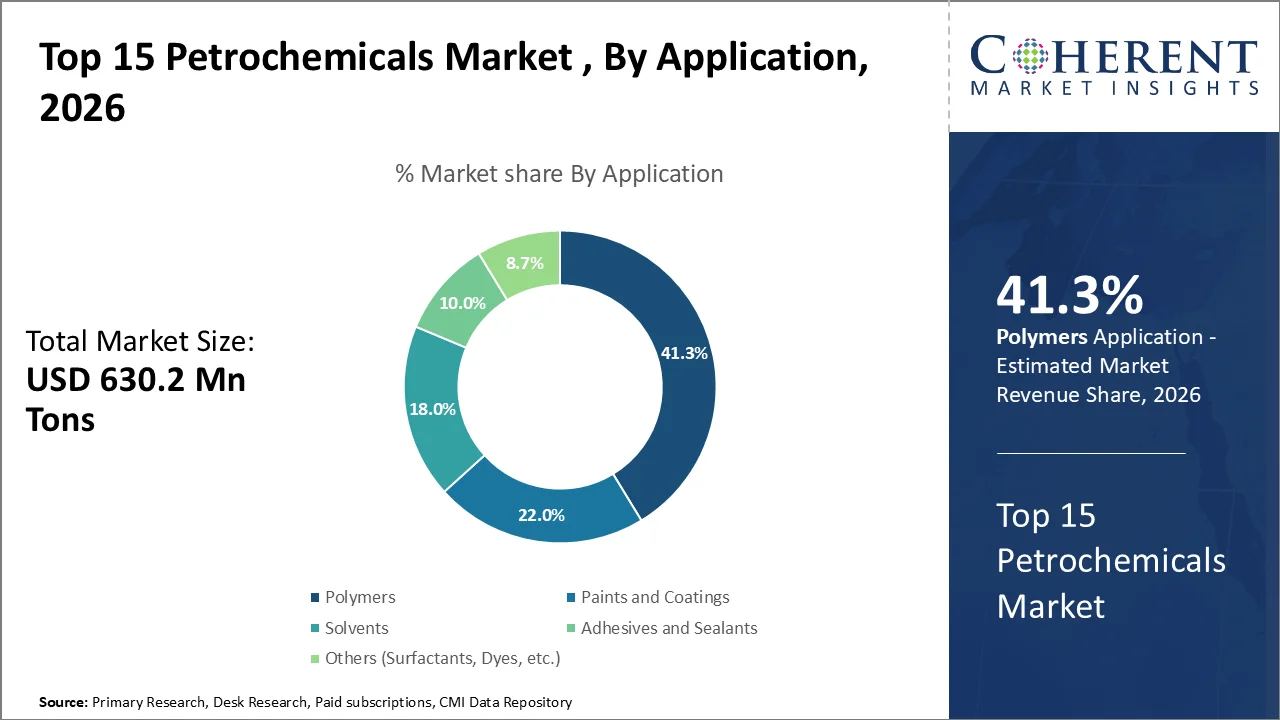
Polymers account for the highest share of the top 15 petrochemicals market and are expected to hold a share of about 41.3% of the market by 2026 due to their broad usage across packaging, automotive, consumer goods, healthcare, agricultural and construction industries. Polymer products made from petrochemicals such as polyethylene, polypropylene, polystyrene, and polyvinyl chloride are still key materials for modern production, due to their durability, low weight, and low cost.
Which End-Use Industry Segment Dominates the Market?
Building & Construction will account for the largest share of the top 15 petrochemicals market, accounting for more than 24.8% of the total demand in 2026. The sector is spurred by the widespread application of petrochemical-based goods such as pipes, insulation materials, roofing membranes, flooring, sealants, adhesives, varnishes and composites. These products are extensively used in residential, commercial and infrastructural development projects throughout the world.
Rapid urbanization and infrastructure investment continues to drive demand for construction materials. The World Bank estimates that around 56% of the world’s population lives in urban areas now, a figure that will increase to almost 70% by 2050, generating a large demand for housing, transportation networks and public infrastructure.
Top 15 Petrochemicals Market Trends
- Low recycling rate boosts circular economy push, only 9% of global plastic waste is recycled, increasing demand for chemical recycling and bio-based polymers.
- EV growth increases petrochemical demand, global EV sales crossed 17 million units in 2024, boosting engineering plastics usage.
- Petrochemical demand domination is being strengthened by Asia Pacific manufacturing rapid expansion. More than half of the world’s total chemical production capacity is concentrated in the Asia Pacific region, led by the growing industrial base in China, India and Southeast Asia. This is further cementing the region’s supremacy in ethylene, propylene and polymer consumption.
- Construction demand supports petrochemicals, Urban population expected to reach 70% by 2050, increasing material demand.
Regional Insights
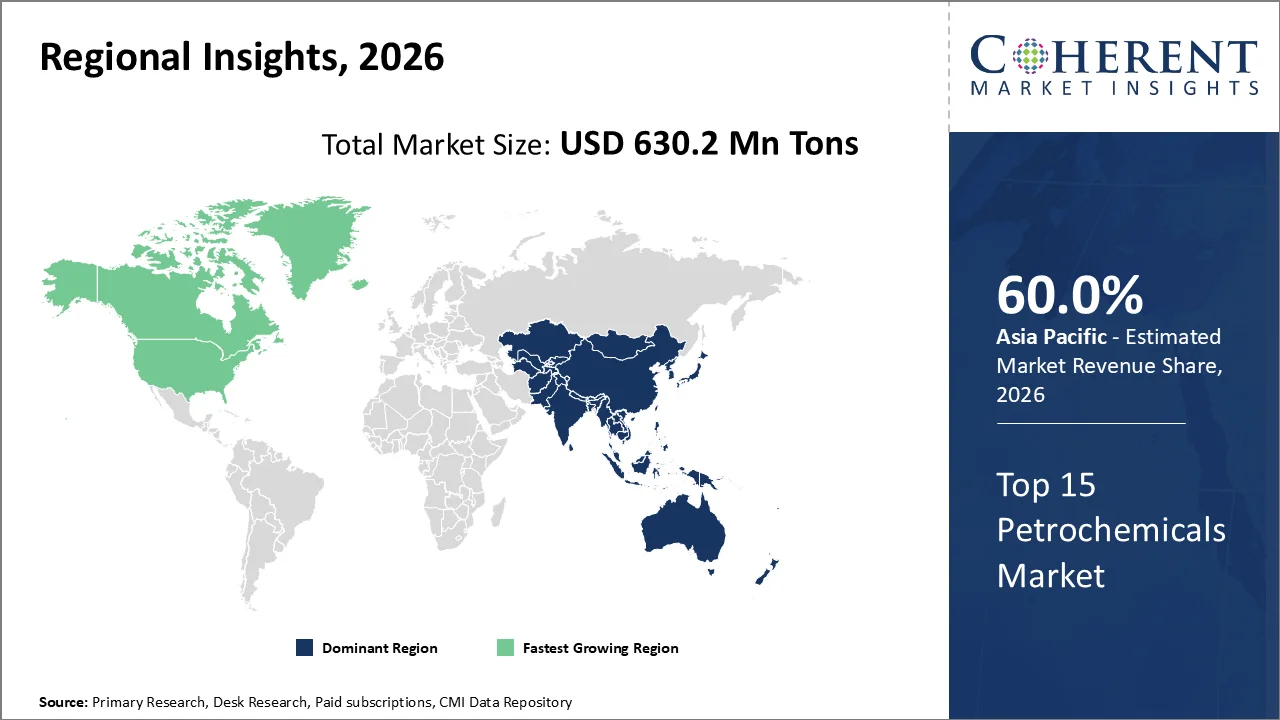
Asia Pacific Top 15 Petrochemicals Market Trends
Asia Pacific is predicted to lead the global top 15 petrochemicals market with a share of 60% by 2026 on account of rapid industrialization, rising petrochemical manufacturing capacity, and increasing packaging, construction, automotive, and consumer goods industrial demand.
The region’s growth is underpinned by extensive manufacturing expansion across China, India, Japan and Southeast Asia, which together represent more than half of the world’s petrochemical production capacity.
In October 2025, BASF SE announced key milestones at its Zhanjiang Verbund site in China, including the start-up of a butyl acrylate plant (400,000 tons/year capacity) and completion of a steam cracker and downstream petrochemical units.
North America Top 15 Petrochemicals Market Trends
North America is expected to be one of the fastest-growing regions in the global top 15 petrochemicals market due to strong availability of shale gas-based feedstock, continuous capacity expansions and increasing demand from packaging, automotive, construction and industrial manufacturing sectors. The region benefits from cost-competitive ethane feedstock that translates into cheaper production costs and big petrochemical expenditures, mainly in the United States and Canada.
Technological advancements and ongoing expansion of integrated refining-petrochemical complexes are further accelerating growth. For instance, leading players such as ExxonMobil are expanding chemical production capacity to meet increasing demand for high-performance polymers and specialty petrochemicals used across advanced industrial applications.
U.S. Top 15 Petrochemicals Market Trends
The U.S petrochemicals market is expected to witness steady growth over the forecast period due to the availability of abundant shale gas feedstock, large scale capacity expansions along the Gulf Coast and strong downstream demand from packaging, automotive, construction, and industrial manufacturing sectors. This has helped the country maintain its position as one of the most cost-competitive petrochemical producers in the world, with its ethane-rich feedstock advantage enabling large-scale ethylene and derivatives production such as polyethylene.
In May 2024, Chevron Phillips Chemical continued expansion of its Mont Belvieu, Texas facilities, improving ethylene fractionation, pipeline infrastructure, and polyethylene production capacity to meet growing demand from packaging and industrial sectors.
China Top 15 Petrochemicals Market Trends
China is projected to be the largest and most significant market in the global petrochemicals industry, supported by large-scale industrial production, growing refining-to-chemical integration projects, and robust demand from packaging, construction, automotive, electronics, and consumer goods sectors. China is still the world's largest user of ethylene, propylene, benzene and downstream polymers due to its rapid urbanization and scale of production.
In September 2025, Sinopec, along with Saudi Aramco and Fujian Petrochemical Company, advanced a major integrated refining and petrochemical complex in Fujian province.
Who are the Major Companies in Top 15 Petrochemicals Industry
Some of the major key players in Top 15 Petrochemicals are Chevron Phillips Chemical Company LLC, BASF SE, ExxonMobil, Shell Chemical Company, TotalEnergies SE, Sumitomo Chemical Co. Ltd., Reliance Industries Limited, Indian Oil Corporation, Bharat Petroleum Corporation Limited, and SABIC.
Industry News
- In October 2025, BASF SE advanced its Zhanjiang Verbund integrated petrochemical complex in China, increasing production capacity for acrylics and downstream petrochemical derivatives used in automotive, packaging, and construction industries.
- In April 2025, Sumitomo Chemical Co., Ltd. expanded its production of high-performance polymers, strengthening its specialty petrochemical portfolio.
Market Report Scope
Top 15 Petrochemicals Market Report Coverage
| Report Coverage | Details | ||
|---|---|---|---|
| Base Year: | 2025 | Market Size in 2026: | USD 630.2 Mn Tons |
| Historical Data for: | 2020 To 2024 | Forecast Period: | 2026 To 2033 |
| Forecast Period 2026 to 2033 CAGR: | 4.1% | 2033 Value Projection: | USD 834.9 Mn Tons |
| Geographies covered: |
| ||
| Segments covered: |
| ||
| Companies covered: | Chevron Phillips Chemical Company LLC, BASF SE, ExxonMobil, Shell Chemical Company, TotalEnergies SE, Sumitomo Chemical Co. Ltd., Reliance Industries Limited, Indian Oil Corporation, Bharat Petroleum Corporation Limited, and SABIC | ||
| Growth Drivers: |
| ||
| Restraints & Challenges: |
| ||
Analyst Opinion
- Ethylene, propylene, and benzene remain the core of modern manufacturing, representing basic inputs for more than 90% of chemical products used in packaging, automotive, construction and consumer goods industries. Hence, the market is significantly essential to the worldwide industrial activity.
- The Asia Pacific area is poised to be the center of demand growth, accounting for more than 50% of worldwide chemical production and consumption, driven by large-scale industrialization, urban development, and the dominance of manufacturing in China and India. This geographical specialization is likely to continue to be a fundamental structural advantage for market expansion.
- The shift to circular economy models is transforming the long-term structure of markets. But while recycling activities are on the rise, only around 9% of global plastic trash gets recycled today, suggesting demand for virgin petrochemicals is set to stay robust in the near- to medium-term due to a lack of recycling infrastructure.
- Capacity expansion by major players such as ExxonMobil, SABIC, BASF and Reliance Industries continue to outstrip demand in certain areas, leading to occasional oversupply pressure and margin volatility. The general trend of consumption remains positive over the long term.
Speak to the analyst
Want personalized insights?
Take the findings above to one of our principal consultants, or have the report rebuilt around the segments, geographies and competitors you actually track.
Market Segmentation
- By Product Type (Revenue, USD Mn Tons, 2021-2033)
- Ethylene
- Propylene
- Benzene
- Xylene
- Toluene
- Methanol
- Others
- By Application (Revenue, USD Mn Tons, 2021-2033)
- Paints and Coatings
- Solvents
- Polymers
- Adhesives and Sealants
- Others (Surfactants, Dyes, etc.)
- By End-Use Industry (Revenue, USD Mn Tons, 2021-2033)
- Aerospace
- Agriculture
- Automotive
- Building & Construction
- Consumer & Industrial Goods
- Electrical & Electronics
- Others (Packaging, etc.)
- By Region (Revenue, USD Mn Tons, 2021-2033)
- North America
- U.S.
- Canada
- Latin America
- Brazil
- Mexico
- Argentina
- Rest of Latin America
- Europe
- Germany
- U.K.
- France
- Italy
- Spain
- Russia
- Rest of Europe
- Asia Pacific
- China
- India
- Japan
- Australia
- South Korea
- ASEAN
- Rest of Asia Pacific
- Middle East
- GCC
- Israel
- Rest of Middle East
- Africa
- South Africa
- Central Africa
- North Africa
- North America
Sources
Primary Research Interviews
- Interviews with petrochemical plant operators, refinery managers, polymer production engineers, downstream chemical manufacturers, packaging industry stakeholders, automotive material suppliers, and industry technical experts
Databases
- Government energy and petrochemical production databases
- Global chemical production and capacity databases
- International trade statistics (ethylene, propylene, benzene, polymers, etc.)
- Customs/import-export data portals for chemicals and plastics
- National statistical bureaus (manufacturing and industrial output data)
Magazines
- Chemical industry trade magazines
- Petrochemical & refining industry publications
- Polymer and plastics industry magazines
- Energy and downstream manufacturing journals
Journals
- Peer-reviewed chemical engineering journals
- Polymer science and materials science journals
- Industrial chemistry and process engineering research publications
- Energy transition and sustainable chemicals journals
Newspapers
- Leading global and national newspapers covering energy, chemicals, and manufacturing sectors
- Business and financial newspapers reporting on petrochemical investments, capacity expansions, and trade developments
Associations
- International Energy Agency (IEA)
- American Chemistry Council (ACC)
- European Petrochemical Association (Cefic)
- Plastics Europe
- Asian Petrochemical Industry Conference (APIC)
- National chemical and refining industry associations
Public Domain Sources
- Government energy and chemical ministry reports
- Environmental regulatory agencies (emission standards, plastic regulations)
- International organizations (UNEP, World Bank industrial data, OECD chemical outlook)
- Company annual reports, investor presentations, and official press releases
- Patent databases and publicly available industrial filings
Proprietary Elements
- CMI Data Analytics Tool
- Proprietary CMI repository (over 10+ years)
Get access to 250+ pages report
Every segment, forecast, competitor profile and data table behind the analysis above — available for instant download.
- ESOMAR Member
- ISO 9001:2015 Certified
- D-U-N-S Registered
- GDPR & CCPA Compliant
Missing comfort of reading report in your local language? Find your preferred language:
Transform your Strategy with Exclusive Trending Reports
Frequently Asked Questions
The global Top 15 Petrochemicals Market is estimated to be valued at 630.2 Mn Tons in 2026.
The global Top 15 Petrochemicals Market value is expected to reach 834.9 Mn Tons by 2033.
The global market is poised to exhibit a CAGR of 4.1% from 2026 to 2033.
Major growth factors include rising demand for packaging plastics, increasing construction and infrastructure development, expanding automotive and EV production, and growing industrialization in emerging economies.
Ethylene dominates the market with around 28.4% share in 2026, driven by its extensive use in polyethylene, ethylene oxide, and other downstream petrochemicals.
Polymers dominate the market with around 41.3% share in 2026, due to strong demand from packaging, automotive, construction, and consumer goods industries.
Building & Construction leads the market with around 24.8% share in 2026, driven by high usage of pipes, insulation materials, coatings, adhesives, and composites.