

Molded Plastic Market Size and Forecast – 2026 To 2033
The Molded Plastic Market is estimated to be valued at USD 636.12 Bn in 2026 and is expected to reach USD 988.53 Bn by 2033, exhibiting a compound annual growth rate (CAGR) of 6.5% from 2026 to 2033. Measurable expansion across core end-use industries and rising global plastic consumption are boosting the market growth. On a broader scale, the global plastic consumption is expected to nearly double from 464 million tons in 2020 to around 884 million tons by 2050, highlighting long-term structural demand growth.
(Source: ScienceDirect)
Key Takeaways of the Global Molded Plastic Market
- Polyethylene is expected to hold 40.8 % of the global molded plastics in 2026, making it the dominant product segment. The product’s strong cost advantage makes it the preferred material for high-volume, price-sensitive applications. Its low production cost is supported by efficient ethane-based feedstock systems that reduce manufacturing costs by around 20–35% compared to oil-based routes.
- Injection molding dominates the molded plastics market with an estimated 31.8 % share in 2026, owing to its capability for high-volume production, cost efficiency, and precision in manufacturing complex components with tight tolerances and superior surface finishes. For instance, in the packaging industry, a single high-speed injection molding machine equipped with multi-cavity molds (e.g., 64–128 cavities) can produce over 1–2 million bottle caps per day, depending on cycle time and configuration, significantly lowering per-unit costs. (Source: Nestal)
- Packaging is estimated to hold 32.6 % share of the global molded plastic market in 2026, making it the dominant end-use industry, with Asia Pacific leading the dominance. Rising demand for lightweight, durable, and cost-effective plastic packaging in food, beverage, and e-commerce applications is contributing to the segment growth. Plastic packaging leads the Indian packaging industry, commanding 52% of the total market share in FY 2023. (Source: Brickwork Ratings)
- North America leads with a projected share of 38.6 % in 2026. North America’s dominance in the molded plastics market is primarily driven by its highly developed packaging sector, particularly in food, beverages, and e-commerce. The U.S. packaging industry alone was valued at over USD 200 billion in 2024, making it one of the largest globally.
- The Asian Pacific market will have the fastest growth, with 21.3 % share in 2026. The boom of industrialization, urbanization, and the expansion of end-use industries, such as automotive, drive demand in the region. Asia Pacific has become the automotive hub of the globe, with more than 58 percent of the vehicles being manufactured in the region. Simultaneously, the region is experiencing significant growth in EV production, with China making 12.4 million electric vehicles in 2024, accounting for 70% of all EV production worldwide. (Source: iea.org)
- Sustainability Transition: Increasing regulatory pressure and environmental concerns are accelerating the shift toward bio-based plastics and recycled plastics Circular economy practices are being actively adopted by manufacturers and are changing material selection, product design and manufacturing processes throughout the molded plastics value chain.
- Technology-Driven Growth: Technologies in molding, such as precision injection molding materials, automation and smart manufacturing, are increasing the production efficiency, minimization of waste, and complex product design.
Segmental Insights
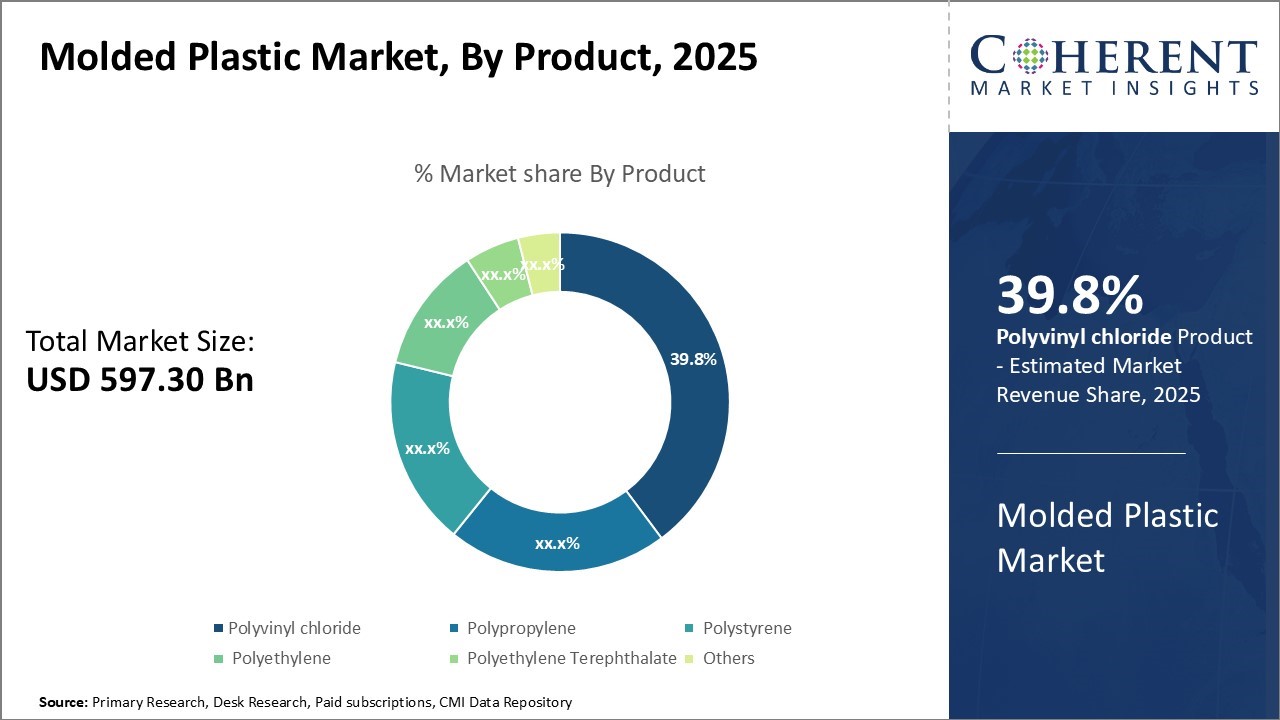
Why Does Polyethylene Dominate the Global Molded Plastic Market?
Polyethylene segment is projected to hold 40.8% share in the molded plastics market in 2026, mainly because of its unchallenged cost leadership. It is also the material of choice in high volume, price sensitive markets.
Polyethylene cost leadership is structurally determined and has been reinforced in the last 10 years because of significant changes in the world feedstock economics and efficiency. The ethylene production efficiency of ethane cracking is significantly higher (approximately 80-85% vs. about 30-35% with naphtha) and the cost of production per ton is greatly reduced. This has made the production of polyethylene in areas that have been advantaged by shale gas to be 20-35 percent cheaper than oil-dependent areas like parts of Europe and Asia making polyethylene one of the most economical commodity polymers in the world.
Low-density polyethylene (LDPE) and high-density polyethylene (HDPE) are widely used in grocery bags, shrink films, and milk packaging pouches in packaging due to their much lower material and conversion costs than other plastics such as polyethylene terephthalate (PET) or polypropylene (PP). An example of this is flexible milk sachets used by companies like Amul, which are based upon multilayer LDPE films, allowing ultra-low-cost per-unit packaging which would be significantly more expensive to convert to rigid PET bottles.
(Source: Amul)
- Current Industry Events of 2026
- Market Size Estimation
- Regional Breakdown
- Competitive Landscape
- Customer Intelligence
- Segmental Analysis
- Pricing Analysis
- Key Market Drivers, Challenges & Future Trends
- Customized Insights Section
Why is Injection Molding the Most Preferred Technology?
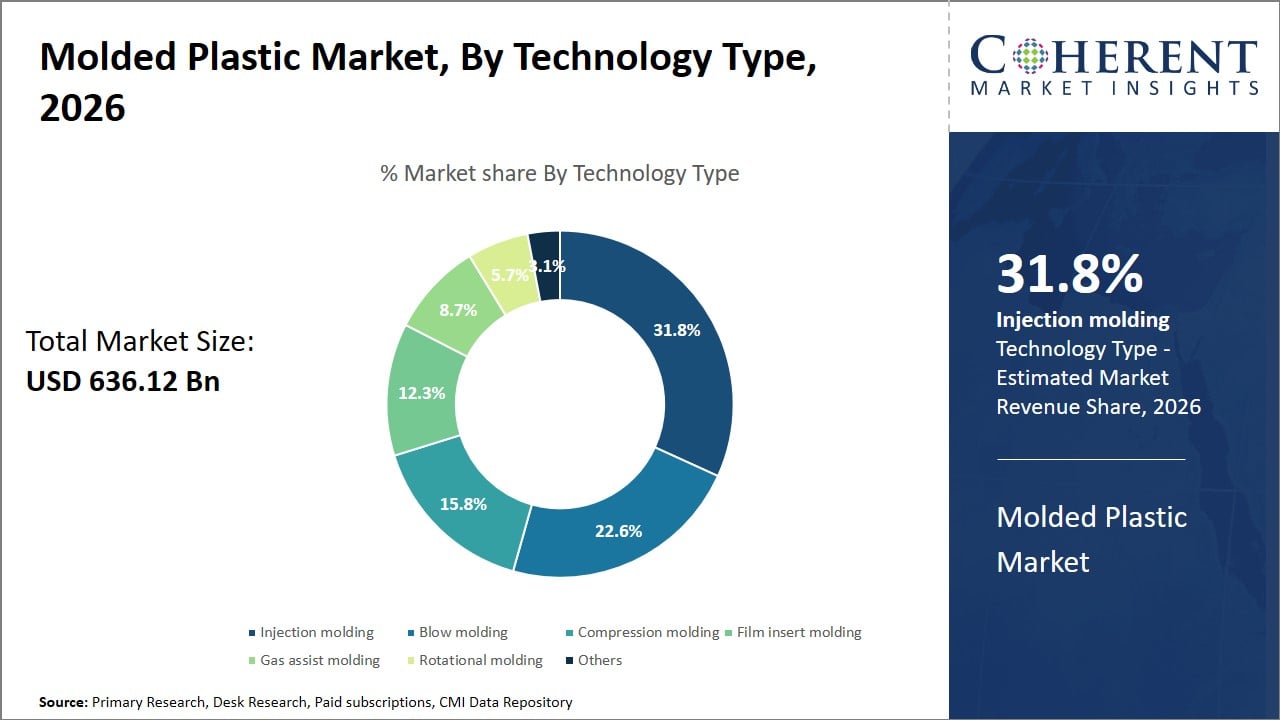
Injection molding is the technology desired the most as it enables to produce complex and precise plastic components in large amounts in the shortest time possible with minimum waste. It can also make complex geometries with tight tolerances.
The market will see injection molding capturing 31.8% share in 2026 due to its capability of high-volume production of precision-engineered complex plastic components at low per-unit cost. Injection molding is all about the efficiency and scalability of its cycles. A typical injection molding cycle is between 15 seconds and 60 seconds per part, depending on the complexity of the part and type of material, thus allowing very high production throughput. Output in high-cavity systems (16 to 128 cavities) can be in the hundreds of thousands to millions of the same part per day, and so it is the process of choice in mass production.
For example, Berry Global Group, in collaboration with Amcor, operates high-speed injection molding lines for closures, where a single machine can produce over 1 billion caps annually per production line configuration, depending on cavity count and cycle time.
(Source: Amcor)
Packaging Segment Dominates the Global Molded Plastic Market
Packaging segment is expected to contribute 32.6% share of the market in 2026, driven by the large-scale use of injection-molded and blow-molded components in rigid packaging formats.
Caps, closures, and food containers are mostly produced using injection molding whereas bottles and hollow shaped containers used in beverages, personal care, and household chemicals are mostly produced with blow molding. Thermoforming has also found extensive application in blister packs, trays, and disposable food packaging where high volume, uniform production is essential.
One of the growth driving factors of the segment is the development of FMCG distribution and e-commerce. According to census gov. Total e-commerce sales for 2025 were estimated at 1,233.7 billion, an increase of 5.4 percent (±1.2%) from 2024. Total retail sales in 2025 increased 3.5 percent (±0.4%) from 2024. (Source: census.com)
Currents Events and their Impact
Current Events | Description and its Impact |
Stringent Global Regulations on Single-Use Plastics (Regulatory Shift) |
|
Rapid Growth in Automotive & EV Plastics Demand (Industry Shift) |
|
(Source: oecd.org)
Molded Plastic Market Dynamics
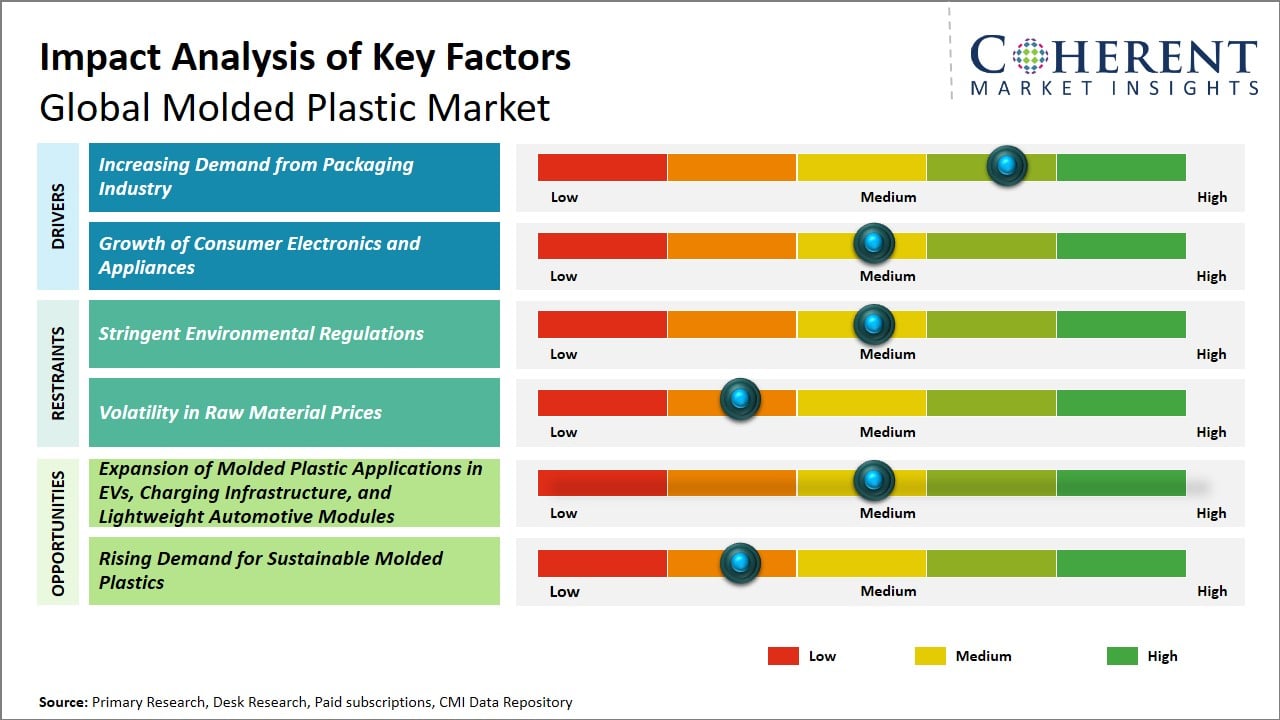
Market Driver
- Growth of Consumer Electronics and Appliances: Growth in consumer electronics and appliances is driving demand for molded plastics, as these products require high-volume, precision-engineered plastic components for devices such as smartphones and laptops. Plastics have been extensively used in the housing of devices, internal frames, connectors, and insulation parts because of their lightweight, durability, and flexibility in design. China is still the biggest electronics manufacturer in the world, with a total manufacturing output of more than 30 percent of the total world electronics manufacturing, according to World Trade Organization and UNIDO manufacturing statistics. Scales and affordability have seen the widespread use of injection-molded plastics by major manufacturers of devices (Foxconn and BYD) to make casings and internal parts of their devices. The Plastics Industry Association claims that plastics can cut product weight by 20-50 percent over conventional materials, which makes miniaturization and portability in electronics possible by itself. (Source: org)
- Increasing Demand from Packaging Industry: The packaging industry is the largest and fastest-growing end-use segment for plastics, directly driving demand for molded plastic products such as containers, caps, closures, trays, and films. Packaging accounts for a significant share of total plastic consumption, with plastics dominating due to their low cost, lightweight nature, durability, and barrier properties. For example, Coca-Cola produces over 100 billion plastic bottles annually, primarily using PET (a molded plastic), to meet global demand for packaged beverages. This massive volume directly drives demand for injection-molded components such as preforms, caps, and closures across its supply chain. (Source: com, coca-cola.com)
Emerging Trends
- Increasing Use of Sustainable and Bio-Based Plastics: Sustainability is no longer a choice – manufacturers are actively moving to biodegradable, recyclable, and bio-based plastics in reaction to regulatory and consumer demands.
- Moving to Lightweight and High-performance Materials: Automotive and electronics industries are moving towards using engineered plastics to substitute metals to realize a reduction in weight without losing strength.
Regional Insights
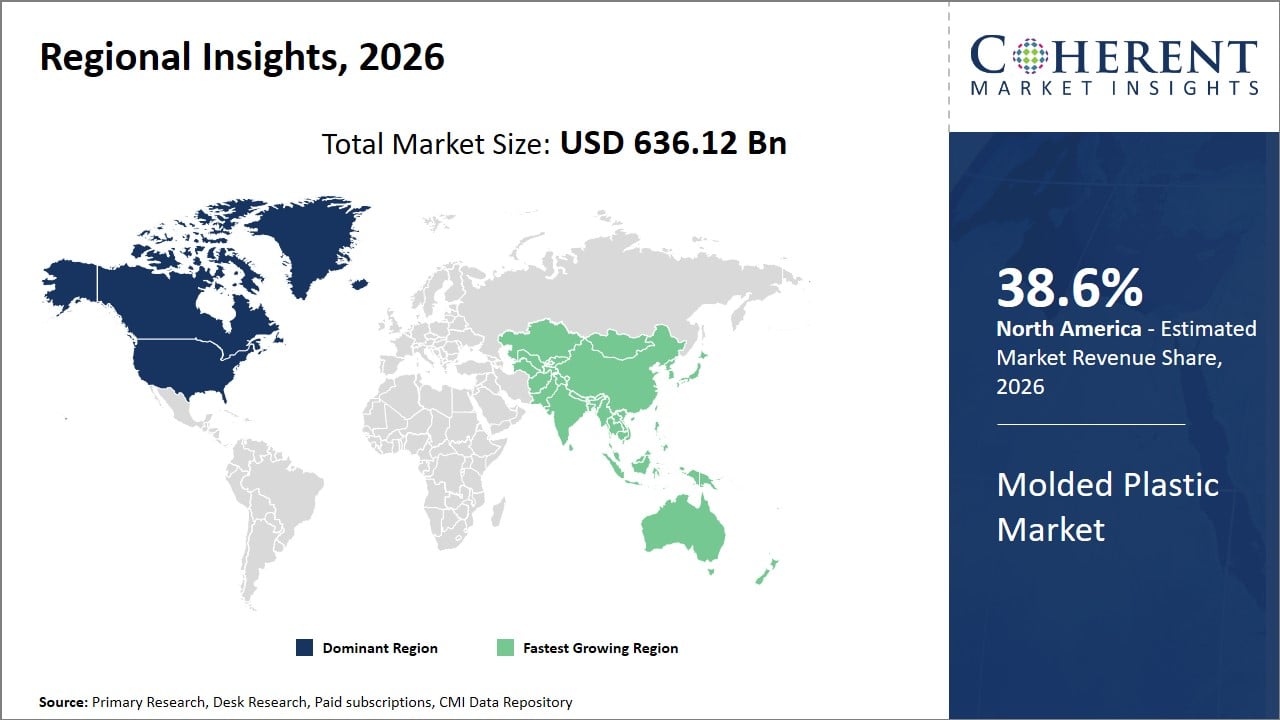
Why is North America a Strong Market for Molded Plastic?
North America is projected to account for approximately 38.6% of the global molded plastics market in 2026, supported by its advanced manufacturing base, strong presence of automotive and packaging industries, and favorable industrial policies. The U.S. occupies the biggest market share in the region because of high demand in the consumer goods, construction, electronics, and healthcare industries.
Strict energy-saving and construction standards (like (International Energy Conservation Code, ASHRAE Standard 90.1, and ENERGY STAR)) are putting pressure on the use of molded plastics in insulation, piping, window frames, and other building parts because of their thermal efficiency and durability.
Lightweight molded plastics are also increasingly utilized by automakers as a way of achieving fuel efficiency and electrification targets. To illustrate, the International Energy Agency reported that global electric car sales have topped 14 million vehicles in 2023, and the U.S. is estimated to have sold close to 10% of all EVs.
(Source: iea.org)
Why Does Asia Pacific Molded Plastic Market Exhibit High Growth?
Asia Pacific exhibits the fastest growth with an estimated contribution of 21.3% share of the global market in 2026, owing to the high rate of industrialization and manufacturing transfers. Increasing population of middle-income and urbanization drive demand for modern housing and consumer goods that require molded plastics to control moisture and efficiencies.
Multinational companies are increasingly expanding their local production of polymers to strengthen supply chains, reduce costs, and meet growing regional demand. Reliance Industries and China National Petroleum increase the production of polymers in local markets. Global ethylene demand increased by 2.2% Y-o-Y to 185 MMT in CY24 with capacity addition of 4.6 MMT resulting in a higher operating rate by 1.9%.
(Source: ril.com)
Global Molded Plastic Market Outlook for Key Countries
Why is the U.S. Leading Innovation and Adoption in the Molded Plastic Market?
The U.S is a well-established and highly penetrated molded plastic market. The U.S is the world leader in innovation and adoption of molded plastics due to its high-tech manufacturing infrastructure and a high level of investment in research and development. According to America’s Plastics Makers, in 2024, the U.S. plastics industry invested around US$ 17.5 billion in new facilities and equipment, reflecting continuous technological advancement and modernization. (Source: plasticmakers.org)
AI, machine learning, and robotics streamline production, reduce waste by up to 2 percent, and allow anticipating maintenance; 40 percent of manufacturers use such tools (Source: ScienceDirect). High-volume production enhances throughput with automation and digital controls, and increases design flexibility with 3D printing and smart materials. Companies such as Husky and ENGEL use AI in quality control, where the detection of defects is better than human. (Source: Aiwise.com)
Is China Emerging as a Key Growth Hub for the Molded Plastic Market?
China has taken over the Asia Pacific molded plastics market due to its large-scale manufacturing sector, high volume of production, and its export-oriented market. One of the most recent developments is the opening of a large-scale recycling project of chemicals in Guangdong province. In July 2025, a 200,000-ton-per-year mixed-scrap plastics deep catalytic cracking plant in Jieyang city commenced trial production, marking a shift from announcements to actual operational progress.
(Source: Recycling International)
What Makes India a High-Growth Molded Plastics Market?
India is emerging as a leading molded plastic market due to surging demand from the packaging and automotive sectors, supported by rising consumption, e-commerce growth, and increasing vehicle production. The Indian packaging industry alone is growing at over 10–12% annually, creating sustained demand for molded plastic products.
In July 2023, Reliance Industries Limited announced continued multi-billion-dollar investments to expand its petrochemical and new materials capacity at the Jamnagar complex, aimed at strengthening the domestic production of polymers and advanced materials used in plastics manufacturing. This expansion enhances India’s raw material self-reliance and supply chain efficiency for molded plastics.
(Source: ril.com)
Why Does Germany Top the European Molded Plastic Market?
Germany has an extensive system of large-scale plants. Germany is the largest plastics producer in Europe, accounting for over 20% of total European plastics production, with annual output of around 12.7–13 million tons. The country exports to the surrounding countries and recycles a lot of plastic waste into other products such as fibers and films. Its machinery division earned a total of USD 8.80 Bn in 2024, making it the world leader in plastics and rubber tools.
(Source: gtai.de)
Role of AI in Molded Plastic Market
AI is transforming the molded plastic industry by optimizing production, improving quality, and accelerating product development. Companies such as Danke Mold Limited are adopting AI in operations. For example, Husky uses AI to predict maintenance, minimizes waste, and maintains consistency, whereas the iQ weight control system of ENGEL automatically adjusts parameters to achieve precision and up to 2% savings on materials. Computer vision improves the detection of defects to increase reliability over human inspection. Berry Global uses AI in packaging design, cutting the development time by 30% and consuming less material by 15 percent. These innovations create efficiency, sustainability, and customer satisfaction making AI a major facilitator of competitiveness in the automotive, electronic, medical, and consumer plastic market.
(Source: dankemold.com)
Hitachi, Ltd. has created AI technology, which uses in-mold sensor data to automatically optimize plastic molding, resulting in a consistent quality despite changes in recycled materials. The aim is to minimize plastic waste and make a circular economy.
(Source: Hitachi.com)
How is the need for more durable, lightweight, and high-performance plastic components creating new growth opportunities in the molded plastics market?
The rapid advancement of polymer engineering and processing technologies, such as advanced injection molding, multi-material molding, 3D printing, and precision compounding, is significantly influencing the global molded plastics market by enabling the development of stronger, lighter, and high-performance components. Material science innovations, including high-performance thermoplastics, bio-based polymers, and reinforced composites, are highly enhancing mechanical strength, thermal stability, and chemical resistance, which are making molded plastics a more appropriate choice in challenging applications in the automotive, electronics, health, and packaging sectors.
The tensile strength of modern molded plastics has increased 20-40 percent and their weights have been reduced by up to 30-50% over traditional materials such as metals or conventional plastics. Also, emerging technologies in precision molding processes include injection molding, blow molding, rotational molding, and allowing tighter tolerances, better surface finishes, and intricate geometries, both of which add functionality and visual appeal. Polymers like PEEK, PPS, and the reinforced polyamides are high-performance polymers which can withstand heat over 200C and this greatly increases their application in the high-stress and high-heat areas.
Furthermore, innovations in micro-molding and multi-material molding are allowing manufacturers to integrate multiple functionalities into a single component, reducing assembly time and overall production costs. The adoption of recycled plastics and bio-based resins is also increasing, driven by sustainability mandates, with some manufacturers achieving up to 25–50% recycled content in molded products without compromising performance.
For example, BASF has developed advanced engineering plastics such as Ultramid and Ultradur, which are widely used in automotive and electrical applications due to their superior strength, heat resistance, and durability. Similarly, Dow Inc. is innovating in circular plastic solutions and high-performance resins that enhance product lifecycle and recyclability. These developments are accelerating the replacement of traditional materials with molded plastics, driving market expansion and creating new growth avenues across multiple end-use industries.
(Source: BASF.com)
Market Players, Key Development, and Competitive Intelligence
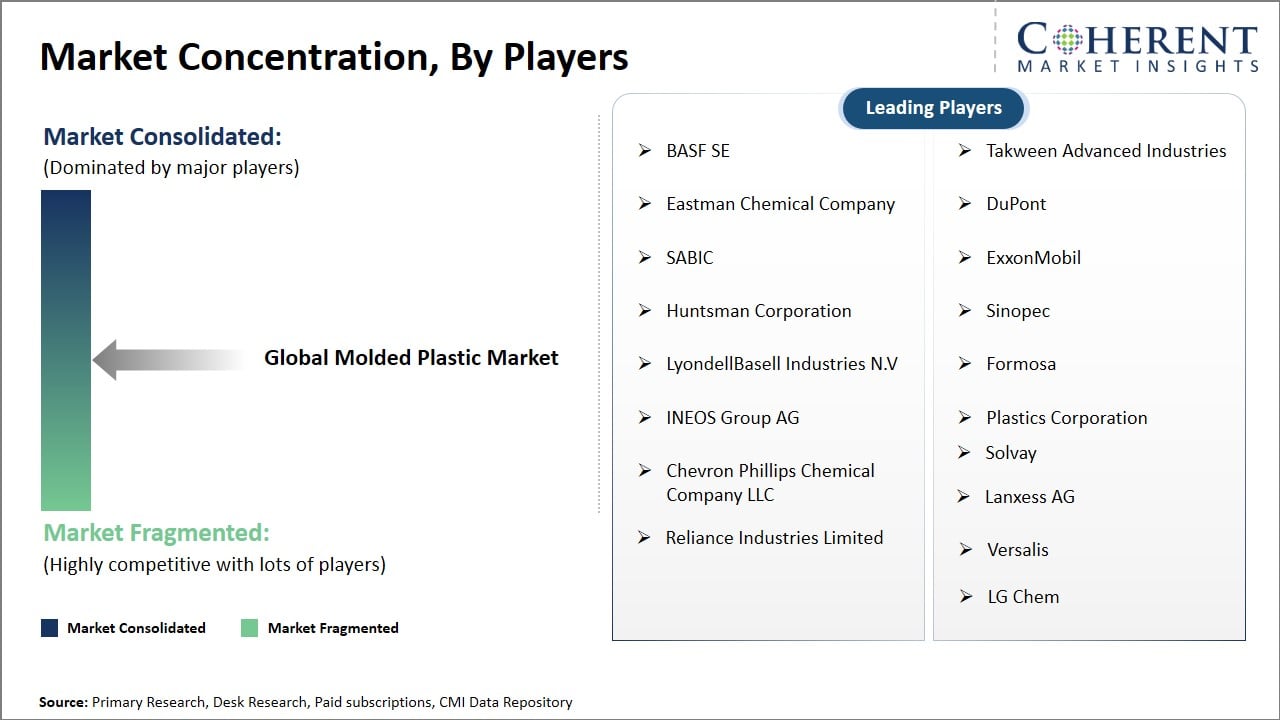
Key Developments
- In July 2025, SABIC launched the LNP Thermotube WF0087N compound, the first nano molding technology material made of polybutylene terephthalate and flame retardant as well as good mechanical performance. The new material rises to meet the increasing demand in the consumer electronics industry of lightweight and highly durable metal-plastic hybrid components, especially in smartphone middle frame components.
- In July 2025, APSX LLC launched APSX-LSR, a benchtop liquid silicone rubber injection molding machine. Intended to target engineers, med-tech startups, and research laboratories, the machine uses less than 1kW of power on a 115 V power outlet, with 6-gram shots being produced in 63 seconds.
- In April 2025, C&J Industries unveiled a significant facility and injection molded plastics expansion. The 25,000-square-foot addition includes a 12,000-square-foot molding cleanroom. Adding 20 new cleanroom and white room presses, the firm is increasing production capacity by over 100,000 hours.
- In February 2025, PSI Molded Plastics unveiled a USD 5 million expansion of its Marion, South Carolina, manufacturing facility. The expansion is aimed at enhancing the company's production strength, catering to increasing demand, and further improving customer satisfaction.
- In January 2025, the American Injection Molding Institute (AIM) teamed up with Pennsylvania Western University (PennWest) to create a new plastics injection molding concentration within the university’s Associate of Applied Science in Applied Technology (AAS-AT) program.
Competitive Landscape
The molded plastic market is very competitive and the global and local players are using the scale, technological forces, and integration into the end-use industry to enhance their market position. Established businesses have efficient supply chains and material knowledge to react more quickly to the changes in the industry needs and sustainability demands. Major areas of focus are:
- State-of-the-art molding technologies and accuracy (e.g., injection, blow, and rotational molding)
- Sustainable and recycled polymer solutions.
- Lightweighting and product innovation of end-use industries.
- Vertical integration, mergers and strategic alliances.
Market Report Scope
Molded Plastic Market Report Coverage
| Report Coverage | Details | ||
|---|---|---|---|
| Base Year: | 2025 | Market Size in 2026: | USD 636.12 Bn |
| Historical Data for: | 2020 To 2024 | Forecast Period: | 2026 To 2033 |
| Forecast Period 2026 to 2033 CAGR: | 6.5% | 2033 Value Projection: | USD 988.53 Bn |
| Geographies covered: |
| ||
| Segments covered: |
| ||
| Companies covered: | BASF SE, Eastman Chemical Company, SABIC, Huntsman Corporation, LyondellBasell Industries N.V, INEOS Group AG, Chevron Phillips Chemical Company LLC, Reliance Industries Limited, Takween Advanced Industries., DuPont, ExxonMobil, Sinopec, Formosa, Plastics Corporation, Solvay, Lanxess AG, Versalis, and LG Chem | ||
| Growth Drivers: |
| ||
| Restraints & Challenges: |
| ||
Analyst Opinion (Expert Opinion)
- The plastics molded industry will be characterized by a shift towards high-performance and lightweight and sustainable materials. Although the conventional uses in packaging and basic construction will keep on producing volume, the true growth will be in the advanced areas like electric vehicles, renewable energy, and smart infrastructure.
- Growing regulatory factors and environmental issues will hasten the transition to recycled and bio-based plastics, making sustainability a business necessity, as opposed to a point of differentiation. Asia Pacific will persist as the leader in terms of production and consumption, yet innovation-based growth will be more and more provided by North America and Europe.
- Firms should establish powerful capacities in the circular economy activities such as recycled materials that are used after consumption and the creation of bio-based products. The implementation of modern injection molding technologies, automation, and AI-controlled production will become important to enhance efficiency and accuracy. High value applications will be co-developed through strategic alliances with OEMs, particularly in the automotive and construction industries.
Speak to the analyst
Want personalized insights?
Take the findings above to one of our principal consultants, or have the report rebuilt around the segments, geographies and competitors you actually track.
Market Segmentation
- Product Insights (Revenue, USD Bn, 2021 - 2033)
- Polyethylene
- Polyvinyl chloride
- Polypropylene
- Polystyrene
- Polyethylene Terephthalate
- Others
- Technology Type Insights (Revenue, USD Bn, 2021 - 2033)
- Injection molding
- Blow molding
- Compression molding
- Film insert molding
- Gas assist molding
- Rotational molding
- Others
- End Use Industry Insights (Revenue, USD Bn, 2021 - 2033)
- Building and Construction
- Electrical and Electronics
- Automotive
- Packaging
- Others
- Regional Insights (Revenue, USD Bn, 2021 - 2033)
- North America
- U.S.
- Canada
- Latin America
- Brazil
- Argentina
- Mexico
- Rest of Latin America
- Europe
- Germany
- U.K.
- Spain
- France
- Italy
- Russia
- Rest of Europe
- Asia Pacific
- China
- India
- Japan
- Australia
- South Korea
- ASEAN
- Rest of Asia Pacific
- Middle East
- GCC Countries
- Israel
- Rest of Middle East
- Africa
- South Africa
- North Africa
- Central Africa
- North America
- Key Players Insights
- BASF SE
- Eastman Chemical Company
- SABIC
- Huntsman Corporation
- LyondellBasell Industries N.V
- INEOS Group AG
- Chevron Phillips Chemical Company LLC
- Reliance Industries Limited
- Takween Advanced Industries.
- DuPont
- ExxonMobil
- Sinopec
- Formosa
- Plastics Corporation
- Solvay
- Lanxess AG
- Versalis
- LG Chem
Sources
Primary Research Interviews
- Molded plastics manufacturer (injection molding specialist)
- Supply Chain Director of polymer processing company
- BASF (engineering plastics leader)
- Sustainability Officer of plastics industry certification body
Stakeholders
- Manufacturers of molded plastics and processing equipment (e.g., BASF, Dow Chemical, SABIC, LyondellBasell)
- End-use Sectors
- Automotive OEMs and Tier 1 Suppliers (e.g., Ford, Toyota, Magna International)
- Packaging Companies (e.g., Amcor, Berry Global)
- Consumer Electronics Producers (e.g., Apple suppliers, Foxconn)
- Medical Device Manufacturers (e.g., Medtronic, Johnson & Johnson)
- Regulatory & Certification Bodies: UL (flammability/safety standards), FDA (food/medical contact), REACH (EU chemicals), ASTM International (material testing).
- E-commerce Platforms and Retailers: McMaster-Carr, MSC Industrial Supply, Grainger.
- Technology Integration Players: Innovators in bio-based plastics/3D molding (e.g., Protolabs, Stratasys).
Databases
- UN Comtrade Database (HS Code 3923 for plastic articles via molding, HS 3901-3917 for polymers)
- India Import Export (EXIM) Database (plastic molded products imports)
- USGS Mineral Commodity Summaries (plastics and resins section)
- Eurostat Trade Statistics for Plastics Products
- USITC DataWeb for molded plastic imports/exports
Magazines
- Plastics Technology – Injection molding trends and equipment
- Plastics Engineering – Molded parts design innovations
- Molding Design – Process optimization for molded plastics
- Plastics News – Market dynamics and resin pricing
- Injection Molding Magazine – Automotive and packaging applications
Journals
- Polymer Engineering & Science – Mechanical properties of molded thermoplastics
- Journal of Applied Polymer Science – Molding process simulations
- Materials & Design – Sustainable molded composites
- Additive Manufacturing – Hybrid molding technologies
- Composites Part B: Engineering – Reinforced molded plastics
Newspapers
- The Wall Street Journal – Automotive plastics demand
- Plastics News Daily – Resin supply chain disruptions
- Business Standard (India) – Polymer imports growth
- Automotive News – Lightweighting via molded parts
Associations
- Society of Plastics Engineers (SPE)
- Plastics Industry Association (PLASTICS)
- Injection Molding & Design Division (SPE)
- American Society for Testing and Materials (ASTM) Plastics Committee
- Society of Automotive Engineers (SAE) Plastics Group
Public Domain Sources
- EPA – Plastics recycling guidelines and VOC emissions
- FDA – Regulations for molded plastics in food contact
- U.S. Department of Energy – Lightweight materials for efficiency
- OECD – Global plastics trade and circular economy reports
Proprietary Elements
- CMI Data Analytics Tool, Proprietary CMI Existing Repository of information for last 10 years.
Get access to 250+ pages report
Every segment, forecast, competitor profile and data table behind the analysis above — available for instant download.
- ESOMAR Member
- ISO 9001:2015 Certified
- D-U-N-S Registered
- GDPR & CCPA Compliant
Missing comfort of reading report in your local language? Find your preferred language:
Transform your Strategy with Exclusive Trending Reports
Frequently Asked Questions
The Molded Plastic Market is estimated to be valued at USD 636.12 Bn in 2026, and is expected to reach USD 988.53 Bn by 2033.
The molded plastics market refers to the production and sale of plastic components manufactured using molding processes such as injection, blow, compression, and rotational molding. These products are widely used across industries including automotive, packaging, construction, electronics, and healthcare.
Blow molding and rotational molding are expected to witness faster growth due to rising demand for hollow products (containers, tanks) and large industrial components.
The CAGR of the molded plastic market is projected to be 6.5% from 2026 to 2033.
Increasing demand from packaging industry and growth of consumer electronics and appliances are the major factors driving the growth of global molded plastic market.
Stringent environmental regulations and volatility in raw material prices are the major factors hampering the growth of global molded plastic market.
In terms of Product, Polyethylene is estimated to dominate the market revenue share in 2026.