

Recycled Plastics Market Analysis & Forecast – 2026 to 2033
The recycled plastics market is estimated to be valued at USD 51,202.7 Mn in 2026 and is expected to reach USD 99,146.4 Mn by 2033, exhibiting a compound annual growth rate (CAGR) of 9.9% from 2026 to 2033.
Key Takeaways
- Based on Product Type, Polypropylene (PP) segment is projected to account for 11.4 % of the global recycled plastics market in 2026, owing to its versatile applications, recyclability, and cost-effectiveness.
- Based on Sources, the Rigid Plastics segment is expected to capture the largest share of the market in 2026, due to their wide usage in packaging, bottles, containers, and caps & closures.
- Based on End Industry, the Building & Construction segment is projected to command the highest share of the market in 2026, due to its sustainability goals, durability, cost-effectiveness, and adoption in pipes, panels, and profiles.
- Based on Region, Asia Pacific is set to dominate the global recycled plastics market with a 38.2% share in 2026. While, North America, with an 11% share, will be the fastest growing region.
Market Overview
The recycled plastic market is witnessing steady growth, driven by rising environmental concerns, stringent regulations on plastic waste, and increasing adoption of sustainable packaging solutions. Growing consumer preference for eco-friendly products and corporate initiatives to reduce carbon footprint are boosting recycled plastics market demand across industries such as packaging, construction, automotive, and consumer goods.
Current Events and Its Impact
Current Event | Description and its Impact |
Extended Producer Responsibility (EPR) Law Implementation Across Multiple Regions |
|
Food Safety Regulatory Evolution and Chemical Concerns |
|
Sustainability and Environmental Impact of Recycled Plastics
- Waste Reduction: Recycling plastics diverts millions of tons of plastic waste from landfills annually. Globally, over 460 million metric tons of plastic are produced every year, according to the United Nations Environment Programme. However, a news OECD report states that less than 10% of plastic is recycled.
- Lower Carbon Footprint: Using recycled plastics can reduce greenhouse gas emissions by up to 50% compared to virgin plastics production, contributing to climate change mitigation.
- Resource Conservation: Recycling decreases dependence on crude oil and natural gas, conserving non-renewable resources used in virgin plastic production.
- Circular Economy Promotion: Companies are increasingly adopting closed-loop recycling and sustainable packaging solutions, supporting government initiatives like the EU’s Plastic Strategy aiming for 100% recyclable or reusable packaging by 2030.
- Consumer and Regulatory Pressure: Rising environmental awareness and regulations in North America, Europe, and Asia-Pacific are driving recycled plastics market demand and corporate sustainability commitments.
- Current Industry Events of 2026
- Market Size Estimation
- Regional Breakdown
- Competitive Landscape
- Customer Intelligence
- Segmental Analysis
- Pricing Analysis
- Key Market Drivers, Challenges & Future Trends
- Customized Insights Section
Segmental Insights
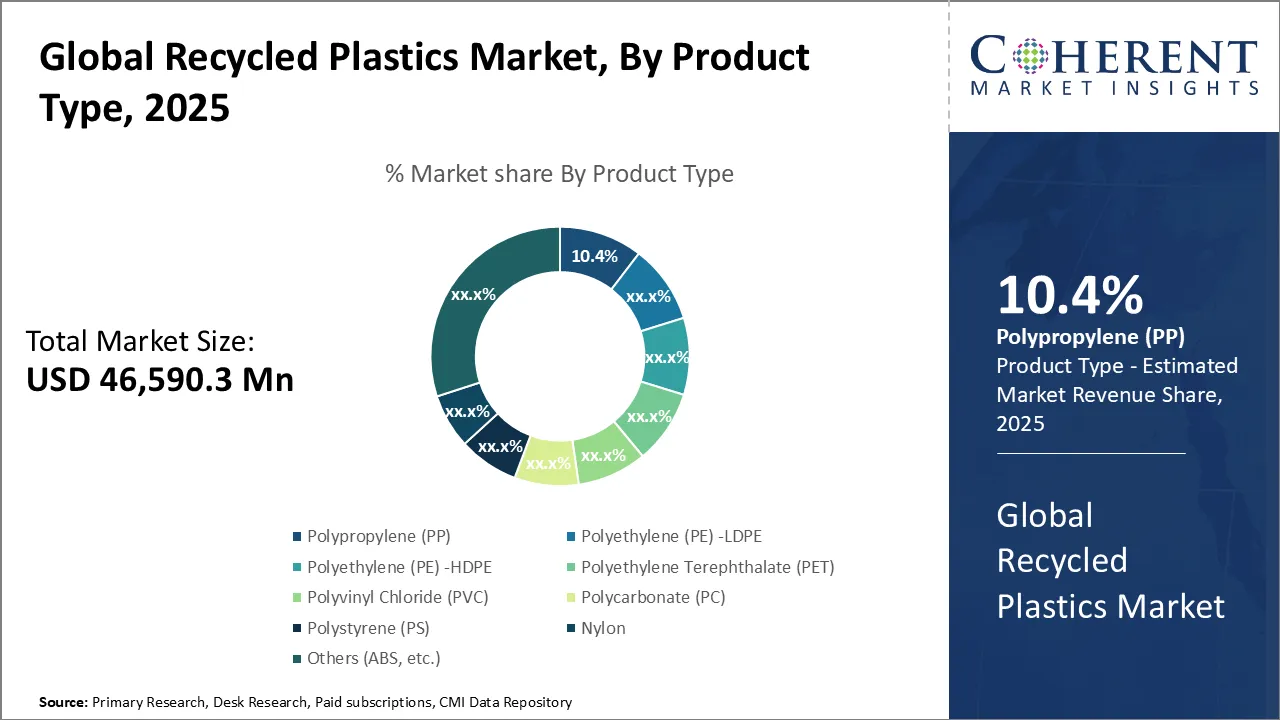
Recycled Plastics Market Insights, By Product Type - Polypropylene (PP) is Highly Demanding Due To Its Versatility, Durability, And Widespread Use in Packaging and Automotive Applications
In terms of product type, the polypropylene (PP) segment is expected to contribute 11.4% share of the market in 2026, owing to its versatile applications, recyclability, and cost-effectiveness. Its lightweight, high chemical resistance, and durability make it widely used in packaging (films, containers, caps), automotive components, textiles, and consumer goods. Additionally, rising demand for sustainable packaging solutions and circular economy initiatives further boost the adoption of recycled PP across industries.
For instance, in March 2025, Rialti, part of the Borealis Group, introduced polypropylene compounds with 30-40 % post-consumer recycled (PCR) and 20-40 % post-industrial recycled (PIR) content. Designed for structural applications in mobility, appliances, construction, and home & gardening, this hybrid grades aim to help manufacturers meet sustainability goals without sacrificing mechanical performance.
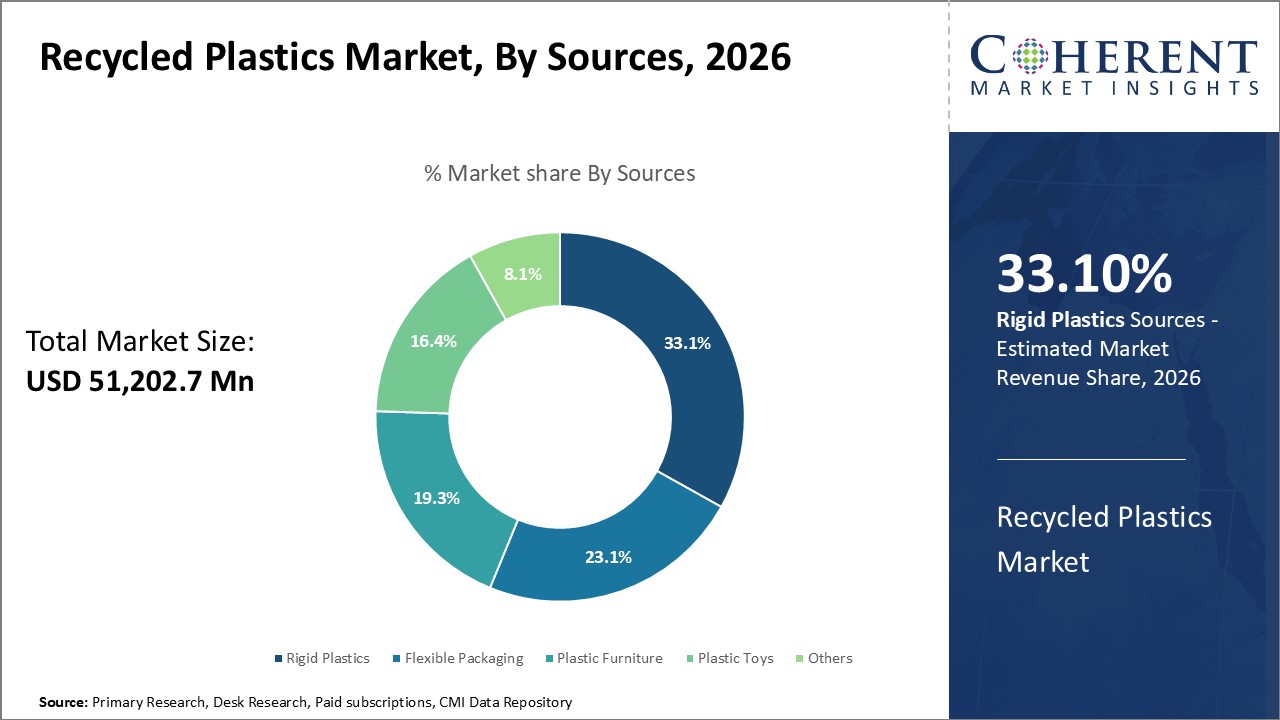
Recycled Plastics Market Insights, By Sources - Rigid Plastics Dominance is Driven by High Recyclability, Durability, And Wide Use in Bottles, Containers, And Packaging
In terms of sources, the rigid plastics segment is expected to hold the largest share of the market in 2026 due to their wide usage in packaging, pharmaceutical bottles, containers, and caps & closures, which form the largest share of single-use plastics collected for recycling. Their durability, ease of processing, and high recyclability rates make them attractive for FMCG, food & beverage, and household product manufacturers seeking cost-effective and sustainable packaging solutions.
For instance, in March 2025, LyondellBasell introduced Pro-fax EP649U, a polypropylene impact copolymer for rigid packaging, especially thin-walled food containers. It boasts fast crystallization, high flow, non-animal additives, and reduced odor risks. Offered through its CirculenRenew and CirculenRevive portfolios, the product supports recycled and renewable content certified by ISCC PLUS.
Recycled Plastics Market Insights, By End User Industry - Building & Construction is Led by Sustainability Goals, Durability, Cost-Effectiveness, And Adoption in Pipes, Panels, And Profiles
In terms of end user industry, the building & construction segment is expected to hold the highest share of the market in 2026, as these materials are extensively used in pipes, window profiles, insulation panels, roofing tiles, and flooring due to their durability and cost-effectiveness. The growing emphasis on sustainable construction, supported by certifications such as LEED and BREEAM, is accelerating adoption. Recycled plastics also provide advantages like lightweight design, corrosion resistance, and low maintenance, making them a preferred alternative to traditional materials. Furthermore, government incentives and regulations promoting green building practices and circular economy initiatives are strengthening the role of recycled plastics in the construction industry.
For instance, in May 2025, Signify Launches Europe’s First LED Tube Made with Recycled Plastic, in a move toward sustainability, Signify unveiled the Philips MASTER LEDtube T8 EM/mains, Europe’s first LED tube featuring an average of 40% post-consumer recycled plastic, derived from fishing nets, water jugs and car headlights
Regional Insights
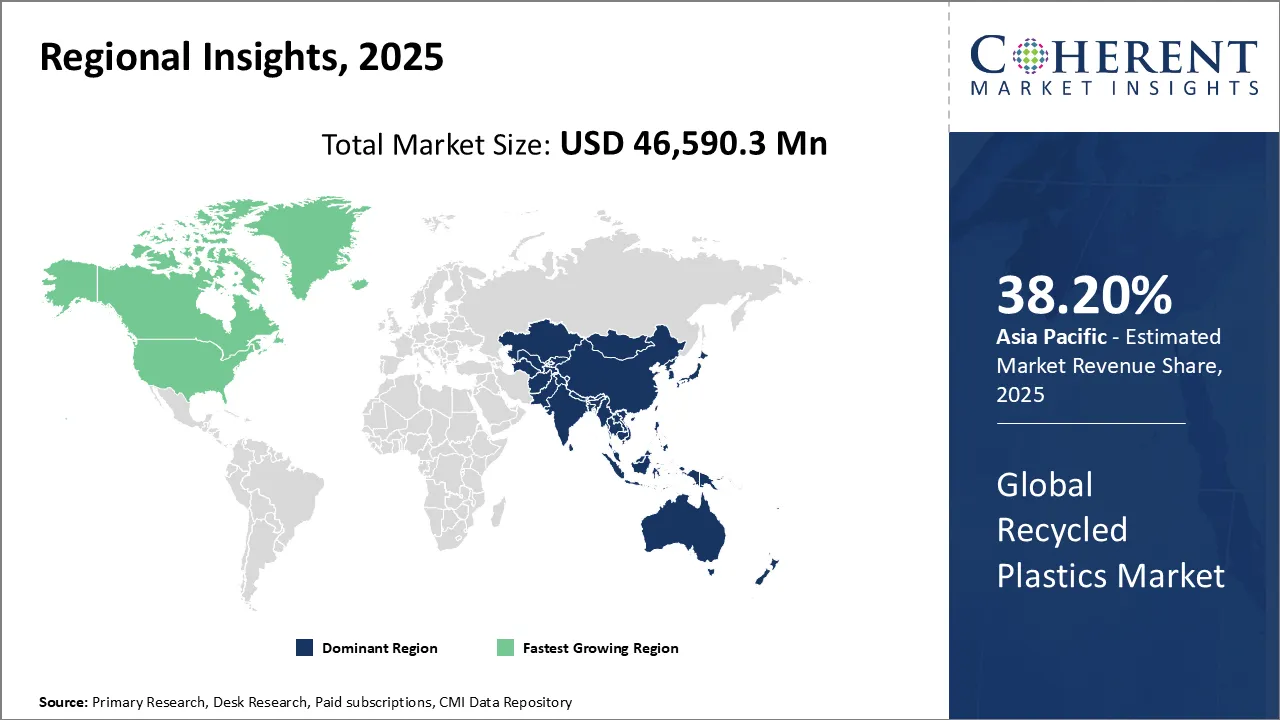
Asia Pacific Recycled Plastics Market Analysis & Trends
The Asia Pacific region is projected to lead the market with a 38.2% in 2026, fueled by high plastic consumption, supportive government policies, and rapid industrialization. Major economies like China and India drive adoption across packaging, automotive, textiles, and construction. Cost advantages, sustainability commitments from FMCG and electronics brands, and increasing urbanization further reinforce regional market growth and leadership.
For instance, in June 2026, Circular Plastics Company (CPC), a Singapore-based recycler, inaugurated a PET bottle recycling plant in Ba Ria, Vietnam. Located in the Chau Duc Industrial Park, the facility boasts an initial capacity of 30,000 metric tons of PET flakes annually, including 14,000 metric tons of food-grade recycled PET (rPET). The plant utilizes advanced European technologies from Sorema, Pellenc, Tomra, and Starlinger. Feedstock is sourced entirely from Vietnam, with rPET products destined for both domestic and international markets.
North America Recycled Plastics Market Analysis & Trends
North America region is projected to lead the market with a 11% share in 2026, due to strict environmental regulations, growing consumer preference for sustainable and eco-friendly products, and increasing adoption of recycled plastics in packaging, automotive, and construction industries. Additionally, advanced recycling technologies and strong corporate sustainability initiatives are driving higher recycled plastics market growth across the region.
For instance, in April 2026, Nestlé Purina PetCare and Berry Global introduced new 20oz and 30oz Friskies® Party Mix® cat treat canisters made entirely from 100% mechanically recycled PET (excluding the label and lid). Set to launch across the U.S., the initiative aims to eliminate over 500 metric tons of virgin plastic annually and reduce CO₂ emissions by 694 metric tons.
Recycled Plastics Market Outlook Country-Wise
China Recycled Plastics Market Trends
China leads the recycled plastics market due to massive plastic consumption, rapid expansion of recycling infrastructure, and growing adoption of recycled plastics across packaging, construction, and automotive industries, driving significant market demand and supporting sustainability initiatives nationwide.
For instance, in July 2026, China inaugurated its first large-scale industrial facility for the chemical recycling of mixed plastic waste in Jieyang, Guangdong province. Utilizing a proprietary one-step deep catalytic cracking technology developed by Guangdong Dongyue Chemical Technology, the plant can process over 200,000 tonnes of mixed plastics annually, converting them directly into high-value chemical feedstocks with a yield exceeding 92%. This innovation significantly reduces sorting costs and sets a new benchmark for the sector.
The U.S. Recycled Plastics Market Trends
The United States shows strong demand for recycled plastics due to its large packaging and automotive industries, strict recycling regulations, and active corporate sustainability initiatives promoting eco-friendly materials, driving the growth of the recycled plastic market across multiple sectors.
For instance, in May 2026, NOVA Chemicals inaugurated its first polyethylene (PE) film recycling facility, SYNDIGO1, in Connersville, Indiana, USA. This state-of-the-art plant aims to advance circular economy initiatives by converting post-consumer PE films into high-quality recycled resin. The facility is a significant step toward reducing plastic waste and supporting sustainable packaging solutions.
Market Report Scope
Recycled Plastics Market Report Coverage
| Report Coverage | Details | ||
|---|---|---|---|
| Base Year: | 2025 | Market Size in 2026: | USD 51,202.7 Mn |
| Historical Data for: | 2020 To 2024 | Forecast Period: | 2026 To 2033 |
| Forecast Period 2026 to 2033 CAGR: | 9.9% | 2033 Value Projection: | USD 99,146.4 Mn |
| Geographies covered: |
| ||
| Segments covered: |
| ||
| Companies covered: | BIFFA, MBA Polymers Inc., REMONDIS SE & Co. KG, Vanden Global Ltd., Veolia, and many more | ||
| Growth Drivers: |
| ||
| Restraints & Challenges: |
| ||
Recycled Plastics Market Driver
Growing environmental awareness and stringent regulations on plastic waste
Rising environmental awareness and stringent regulations on plastic waste are driving increased adoption of recycled plastics across industries. Governments and organizations are enforcing bans on single-use plastics and promoting circular economy initiatives, boosting demand for sustainable alternatives. These factors are directly contributing to the growth of the recycled plastics market size, particularly in packaging, automotive, and construction sectors.
Rising demand for sustainable packaging solutions
Rising awareness of environmental impact and consumer preference for eco-friendly products is driving the adoption of recycled materials in packaging. This trend is significantly boosting the recycled plastics market share, as companies increasingly replace virgin plastics with recycled alternatives in bottles, containers, films, and flexible packaging, ensuring sustainability while maintaining cost efficiency and regulatory compliance.
Recycled Plastics Market Opportunities
Expansion of recycled plastics in automotive and construction industries
The recycled plastics market is poised for significant growth as automotive and construction industries increasingly adopt recycled materials. In automotive, recycled plastics are used for interior components, bumpers, and under-the-hood parts, reducing costs and environmental impact. In construction, applications include piping, insulation, and panels. These trends are driving the recycled plastics market forecast upward, reflecting rising demand for sustainable, cost-effective materials.
Technological advancements in chemical recycling for higher-quality recycled plastics
Technological advancements in chemical recycling are transforming the recycled plastics market by enabling the production of higher-quality recycled plastics with properties comparable to virgin materials. Innovations such as depolymerization, pyrolysis, and solvent-based recycling improve purity, performance, and versatility, expanding applications in packaging, automotive, and construction. These breakthroughs are a key focus of ongoing recycled plastics market research, driving sustainable growth and industry adoption.
Analyst Opinion (Expert Opinion)
The recycled plastics market, while integral to advancing circular economy objectives, is currently ensnared in a confluence of systemic challenges that impede its potential. These challenges are not merely operational but are deeply embedded in the structural dynamics of the industry.
The recycling process inherently introduces contaminants, which accumulate with each cycle. This escalation in contamination levels poses significant risks, particularly in food-contact materials, where harmful substances such as endocrine disruptors and carcinogens may migrate into consumables. Consequently, achieving consistent food-grade recycled plastics becomes increasingly difficult, undermining consumer trust and regulatory compliance.
Despite escalating demand driven by sustainability mandates, the supply of high-quality recycled plastics remains constrained. This disparity is attributed to limited collection infrastructure, inadequate processing capabilities, and the complexity of sorting mixed plastic streams. For instance, in the United States, only 18% of polyethylene terephthalate (PET) bottle waste is recycled, highlighting the inefficiencies in the current system.
Speak to the analyst
Want personalized insights?
Take the findings above to one of our principal consultants, or have the report rebuilt around the segments, geographies and competitors you actually track.
Key Developments
- In August 2025, Recon Technology Ltd. completed construction of its 40,000-ton-per-year chemical recycling plant in Shandong, China, marking a significant milestone. The facility is expected to produce 30,000 tons of plastic pyrolysis oil and 6,000 tons of carbon residue annually, generating an estimated $30 million in annual returns. The plant is slated for commissioning in December 2025.
- In January 2025, Chandigarh-based startup PolyCycl introduced its innovative plastic recycling technology in Bengaluru. The patented ContiFlow Cracker™ and PyOilClean™ refining process transforms single-use plastics into high-quality, food-grade polymers, renewable chemicals, and sustainable fuels. This scalable and cost-effective solution addresses the city's plastic waste crisis, offering a closed-loop recycling approach with yields of 65–75%.
- In June 2024, Dow introduced two new grades of REVOLOOP™ Recycled Plastics Resins, both approved for non-food contact packaging applications. One grade comprises 100% post-consumer recycled (PCR) content, while the other contains up to 85% PCR sourced from household waste. These innovations aim to enhance recyclability and support Dow's goal of commercializing three million metric tons of circular and renewable solutions annually by 2030.
Market Segmentation
- Product Type Insights (Revenue, USD Mn, 2021 - 2033)
- Polyethylene Terephthalate (PET)
- High Density Polyethylene (HDPE)
- Low Density Polyethylene (LDPE)
- Polyvinyl Chloride (PVC)
- Others
- Source Insights (Revenue, USD Mn, 2021 - 2033)
- Plastic Bottles
- Plastic Bags & Films
- Synthetic Fiber
- Rigid Plastics & Foams
- Others
- End-Use Industry Insights (Revenue, USD Mn, 2021 - 2033)
- Plastic Bottles
- Plastic Bags & Films
- Synthetic Fiber
- Rigid Plastics & Foams
- Others
- Regional Insights (Revenue, USD Mn, 2021 - 2033)
- North America
- U.S.
- Canada
- Latin America
- Brazil
- Mexico
- Argentina
- Rest of Latin America
- Europe
- U.K.
- Germany
- Italy
- France
- Russia
- Spain
- Rest of Europe
- Asia Pacific
- China
- India
- Japan
- ASEAN
- Australia
- South Korea
- Rest of Asia Pacific
- Middle East
- GCC
- Israel
- Rest of Middle East
- Africa
- North Africa
- Central Africa
- South Africa
- North America
- Key Players Insights
- B&B Plastics
- Veolia
- Green Line Polymers
- Clear Path Recycling, B. Schoenberg & Co.
- Jayplas
- Suez
- Custom Polymers
- Plastipak Holdings
- KW Plastics.
Sources
Primary Research Interviews from the following stakeholders
Stakeholders
- Interviews with plastic recyclers, polymer compounders, packaging manufacturers, consumer goods producers, waste management companies, and procurement heads across leading global markets.
Specific stakeholders
- Sustainability and procurement lead at FMCG companies (e.g., Unilever, Nestlé, Procter & Gamble)
- Operations and facility managers at municipal waste management authorities and recycling hubs
- Product and R&D managers at packaging and plastic goods manufacturers (e.g., Amcor, Berry Global, Sealed Air)
- Supply chain and logistics managers in retail and e-commerce firms (e.g., Walmart, Amazon, Carrefour)
- Environmental compliance officers at industrial and automotive plastic users
- Polymer engineers and process specialists at plastic recycling technology providers
Databases
- United Nations Comtrade Database
- World Trade Organization (WTO) Trade Statistics
- Eurostat – Circular Economy and Waste Statistics
- China Customs Statistics
- Korea Customs Service Data Portal
- Japan External Trade Organization (JETRO)
- Directorate General of Commercial Intelligence and Statistics (DGCIS), India
- Ministry of Environment, Forest and Climate Change (MoEFCC), India
Magazines
- Plastics News
- Recycling Today
- Packaging Europe
- Resource Recycling
- Waste Management World
- Polymer Engineering & Science
- Packaging World
Journals
- Journal of Polymers and the Environment
- Waste Management (Elsevier)
- Resources, Conservation & Recycling
- Journal of Cleaner Production
- Polymer Degradation and Stability
Newspapers
- The Wall Street Journal – Environment & Sustainability
- The Economic Times – Industry & Environment
- The Hindu Business Line – Plastics & Packaging
- Financial Times – Sustainable Materials
- Nikkei Asia – Manufacturing & Recycling
- South China Morning Post – Environment & Industry
Associations
- Plastics Industry Association (PLASTICS)
- Society of the Plastics Industry (SPI)
- European Plastics Converters (EuPC)
- Association of Plastic Recyclers (APR)
- Confederation of Indian Industry (CII) – Plastics & Packaging Forum
- International Solid Waste Association (ISWA)
Public Domain Sources
- Ministry of Environment, Forest and Climate Change (MoEFCC), India
- Central Pollution Control Board (CPCB), India
- U.S. Environmental Protection Agency (EPA) – Plastics & Recycling Reports
- Japan Ministry of Economy, Trade and Industry (METI) – Plastics & Recycling
- European Environment Agency – Circular Economy & Waste Reports
- NITI Aayog – Sustainable Materials & Recycling Policy Reports
- India Investment Grid – Recycling & Plastics Sector
Proprietary Elements
- CMI Data Analytics Tool, and Proprietary CMI Existing Repository of recycled plastics data spanning over 8 years across polymer types, end-use applications, and regional recycling deployments.
Get access to 250+ pages report
Every segment, forecast, competitor profile and data table behind the analysis above — available for instant download.
- ESOMAR Member
- ISO 9001:2015 Certified
- D-U-N-S Registered
- GDPR & CCPA Compliant
Missing comfort of reading report in your local language? Find your preferred language:
Transform your Strategy with Exclusive Trending Reports
Frequently Asked Questions
The recycled plastics market is estimated to be valued at USD 51,202.7 Mn in 2026 and is expected to reach USD 99,146.4 Mn by 2033.
The CAGR of the Recycled Plastics Market is projected to be 9.9% from 2026 to 2033.
Rising environmental concerns, government regulations on plastic waste, and increasing demand for sustainable packaging are the primary growth drivers.
Asia-Pacific is the largest region due to industrial adoption and strong recycling infrastructure.
High contamination in plastic waste, inconsistent quality, and limited adoption of advanced recycling technologies pose challenges.
Chemical recycling, depolymerization, and solvent-based recycling are improving the quality and versatility of recycled plastics.
Corporate sustainability goals, circular economy initiatives, and regulatory mandates are increasing recycled plastic adoption and market demand.