

Automotive Interior Component Market Analysis & Forecast
The automotive interior components market is estimated to be valued at USD 187.81 Bn in 2026 and is expected to reach USD 299.62 Bn by 2033, growing at a compound annual growth rate (CAGR) of 6.9% from 2026 to 2033.
Key Takeaways
- By Vehicle Type, Passenger Vehicles are expected to dominate the automotive interior components market in 2026, holding approximately 61.5% share, driven by rising consumer demand for enhanced in-cabin comfort and infotainment features in personal vehicles.
- By Component, Door Panels are projected to capture the largest market share at 48.5% in 2026, supported by innovations in material design, aesthetics, and integrated smart controls.
- By Region, North America is set to lead the global automotive interior components market with an estimated 43.7% share in 2026, attributed to a strong presence of OEMs, technological adoption, and high consumer spending on premium vehicles.
Market Overview
The market has been witnessing steady growth on account of increasing vehicle production across the world. Further, rising spend on in-vehicle entertainment and comfort features by OEMs is also propelling the demand. The automotive interior components market is witnessing significant trends such as increased focus on sustainability and light weighting. Owing to stringent emission norms, auto manufacturers are adopting greener materials and technologies to manufacture interior components.
For instance, the use of bio-based and recycled plastics is gaining traction in the industry. Furthermore, with the goal of improving fuel-efficiency, various lightweight components such as seats made from aluminum and magnesium are being increasingly used. The trend towards electrically-powered vehicle is also influencing the materials and technologies used for interior components.
Current Events and Its Impact on the Automotive Interior Components Market
Event | Description and Impact |
Global Supply Chain Disruptions and Material Shortages |
|
Electric Vehicle (EV) Market Transformation |
|
US-China Trade Relations and Tariff Policies |
|
Pricing Analysis
The global automotive interior components market displays considerable pricing variation influenced by vehicle class, component complexity, technology integration, and regional production costs. Interior components typically account for 15–20% of a vehicle's total manufacturing cost, with the global market valued at over $180 billion annually.
Seating systems range widely—basic economy seats cost $200–$600 per unit, while premium performance seats can exceed $8,000, especially in luxury vehicles. Dashboard and instrument panels follow a similar pattern, with standard versions priced at $200–$800, while digital cluster systems in high-end models reach up to $2,500.
Door panels and trim for the mass market range between $100–$400, while luxury models with handcrafted or leather finishes can cost up to $8,000 per set. Center consoles vary from $150–$600 for standard designs to over $5,000 in premium vehicles, particularly with integrated infotainment systems. Roof systems and headliners, including panoramic and glass options, range from $800 to $3,000, depending on features and automotive interior component with materials sourcing.
Pricing strategies are further shaped by regional regulations, OEM partnerships, and increasing demand for sustainable and tech-enabled interiors.
- Current Industry Events of 2026
- Market Size Estimation
- Regional Breakdown
- Competitive Landscape
- Customer Intelligence
- Segmental Analysis
- Pricing Analysis
- Key Market Drivers, Challenges & Future Trends
- Customized Insights Section
Role of Advanced Technology
Technological innovation is reshaping the automotive interior component market, driven by connected mobility, sustainability goals, and user-centric design. Automakers are integrating curved OLED and AMOLED displays, transforming dashboards into fully digital cockpits. Systems like BMW’s iDrive 8 and Mercedes-Benz’s MBUX Hyperscreen showcase how advanced HMI, AI, and haptic feedback are enhancing in-cabin user experience.
The rise of materials sourcing is equally transformative. Automakers now utilize recycled ocean plastics, mycelium leather alternatives, wheat straw composites, and recycled carbon fiber, aligning product design with circular economy principles without compromising performance.
Ambient and personalized lighting systems using fiber optics and RGB LEDs are becoming standard in premium segments, offering mood-synchronized experiences and low power consumption. At the same time, biometric sensors and health-monitoring systems integrated into seats and steering wheels are bringing wellness tech into the cabin.
Further, wireless charging, OTA updates, and metamaterial-based acoustic insulation are redefining connectivity and comfort. These advancements not only improve aesthetics and functionality but also enable new revenue streams for OEMs through feature upgrades and software integration. The shift toward modular, tech-integrated interiors is intensifying competition between traditional suppliers and tech firms alike.
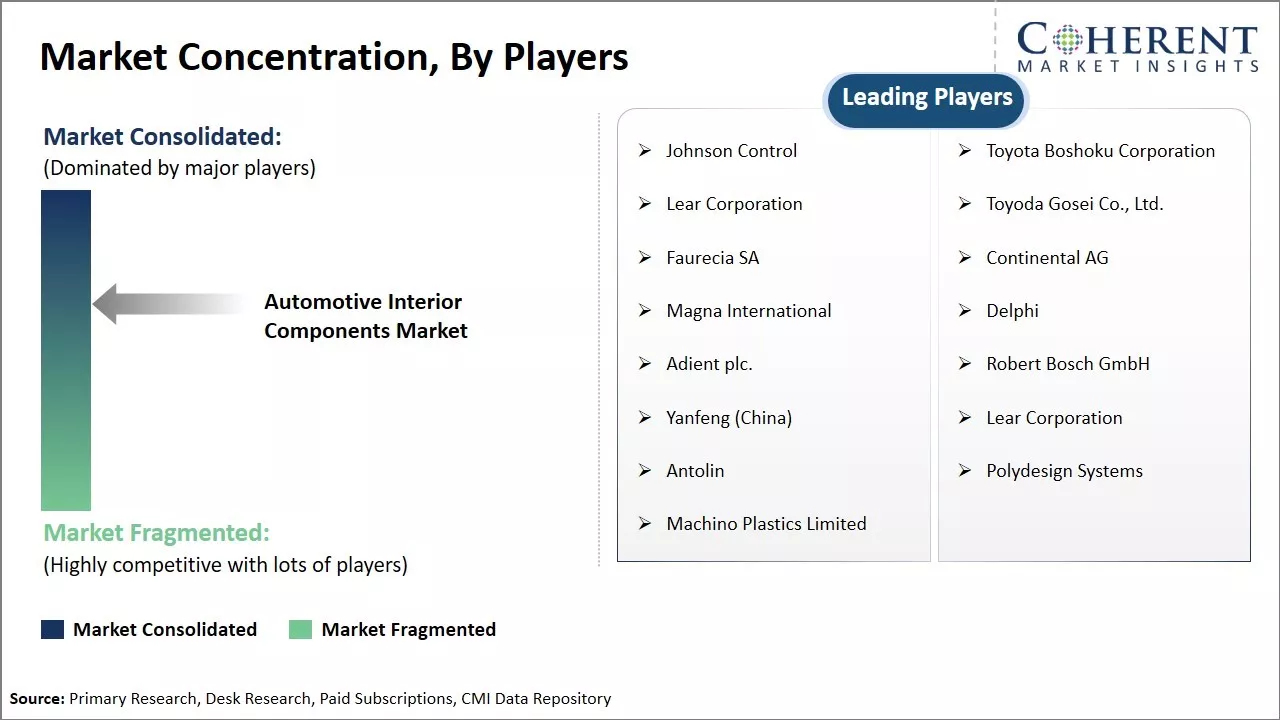
Market Concentration and Competitive Landscape
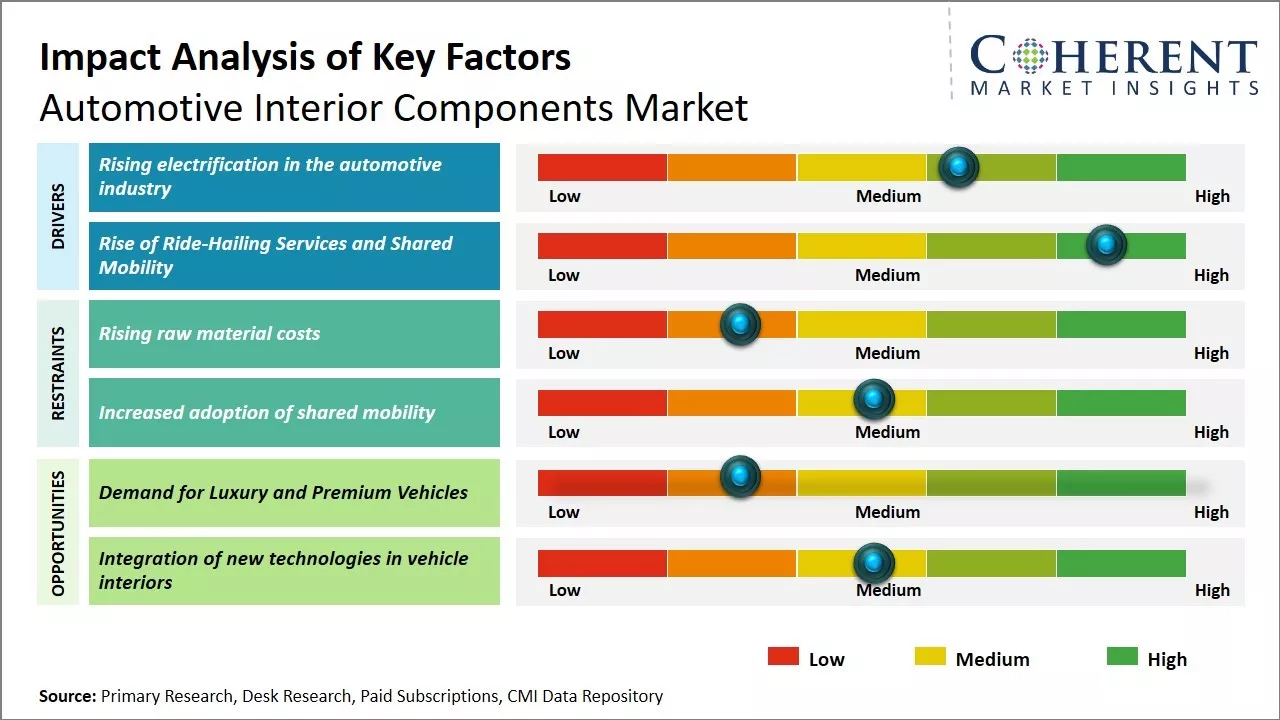
Rising electrification in the automotive industry
There has been a steady rise in demand for vehicles with luxury and premium features across all segments in recent years. For instance, according to data published by Economics tines in 2023, the passenger vehicle segment achieved a new all-time high in January, retailing 393,250 vehicles and surpassing the previous record set in November 2023. Customers who could earlier only afford compact or mid-sized econoboxes now have greater access to higher-trim versions of those same vehicles owing to strategic product planning by automakers.
Brands have introduced luxury and comfort focused trims of some of their most popular nameplates targeted at the "mass affluent" buyers seeking some indulgence without paying flagship prices. Features like leather upholstery, power-adjustable front seats, navigation, and premium audio have become much more common in the mid-segment cars and crossovers. This has driven the automotive interior components market growth.
Rise of Ride-Hailing Services and Shared Mobility
The rapid growth of transportation networks companies operating ride-hailing services has brought about new requirements for vehicle interiors. Fleet operators partnering with these companies need fleet vehicles that can efficiently serve multiple riders daily and withstand the rigors of commercial use. This has boosted demand for durable and easily cleanable interior components that can endure frequent disinfection without degrading in quality.
There is a growing focus on materials that do not absorb odors or stains and can be wiped down quickly between rides. Easy-to-clean leatherette and vinyl upholstery instead of fabric is now common in these fleet vehicles. Lighting manufacturers also provide customizable interior lighting solutions for driving and rider comfort. The exploding popularity of shared mobility is poised to open new verticals for automotive interior suppliers catering to commercial applications with an emphasis on parts tailored for vehicle sanitization requirements in between shared use. This novel mobility landscape will open fresh avenues for innovation and revenue growth.
Market Opportunities: Demand for Luxury and Premium Vehicles
Demand for luxury and premium vehicles is growing in developing markets, requiring high-end trims and amenities. Customization tools allow manufacturers to profit from customized interior packages. Partnerships across the supply chain can maximize the use of new light weighting and sustainable materials. Advanced driver assist systems also spur innovation in digital displays and intuitive control interfaces.
Segmental Insights
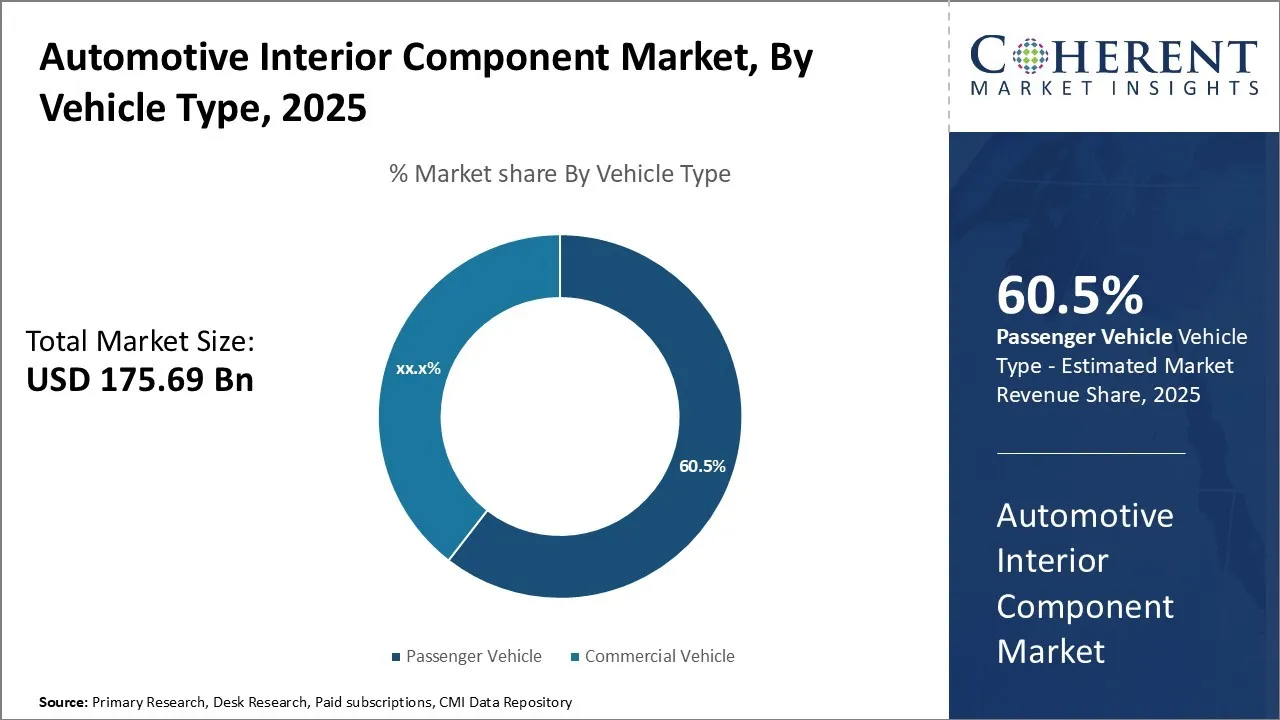
Automotive Interior Components Market Insights, By Vehicle Type
The passenger vehicle segment dominates the automotive interior components market with market share of 61.5% compared to its commercial vehicle counterpart. Massive production and sales figures of various passenger car models globally are a primary reason. Consumer preference for private transport instead of public modes especially in developed markets has boosted passenger car demand tremendously.
A wide range of vehicle segments exist to serve diverse needs, from small economical cars to large luxury limousines. Each type utilizes unique interior components tailored for its intended purpose.
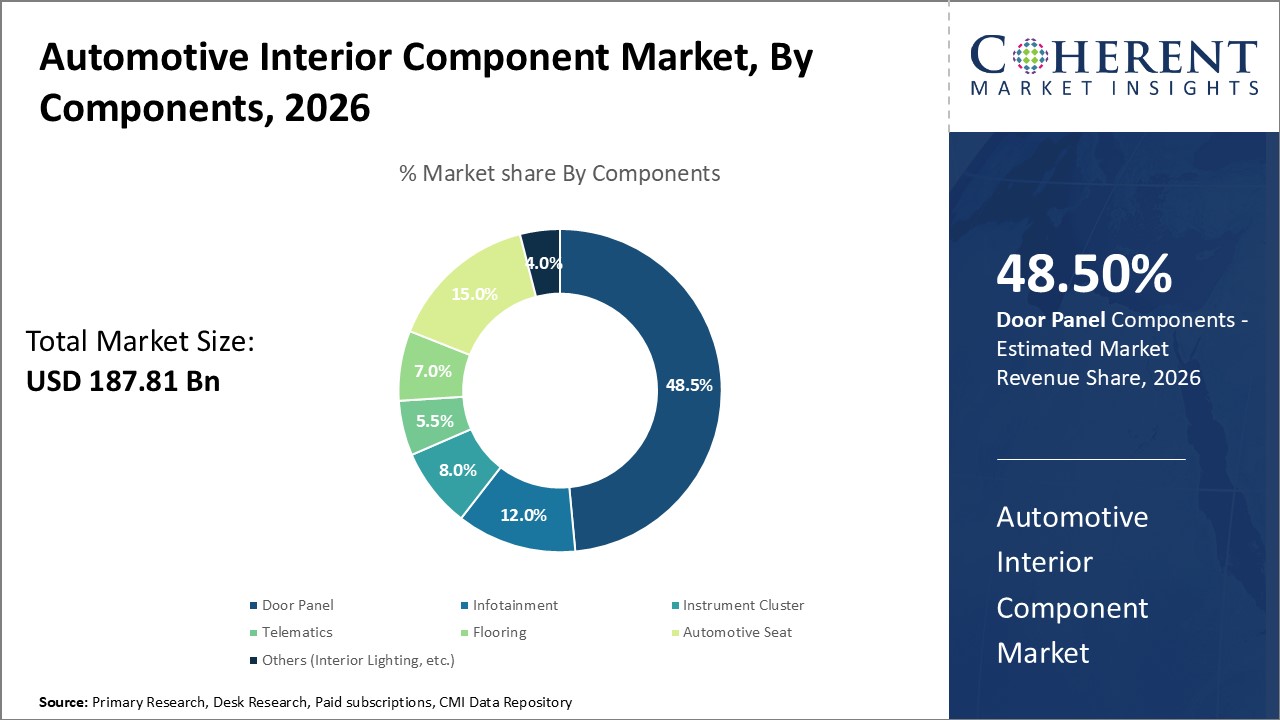
Automotive Interior Components Market Insights, By Components
The door panel segment within the automotive interior components market holds the 48.5% share globally. There are several factors contributing to its dominant position. Consumer preference for safety and comfort while traveling plays a big role. Door panels house important safety features like airbags and also contribute significantly to the overall in-cabin feel and ergonomics. Automakers therefore prioritize door panel design and quality to enhance occupant protection and experience.
Advanced materials and technologies are being increasingly used in door panel manufacture. Lightweight composites and premium leather or suede upholsteries are gaining preference to differentiate vehicles. Interactive surfaces and convenient storage spaces are other new concepts being evaluated. With autonomous driving on the rise, the interior is where much of the marketing emphasis lies presently.
Stylish and functional door panels thus serve as a crucial selling point. Growing automotive sector is expected to drive the segment growth. For instance, according to data published by The International Trade Administration, the U.S. Department of Commerce in 2024, the U.S. has one of the largest automotive markets in the world. In 2020, U.S. light vehicle sales were 14.5 million units.
Regional Insights
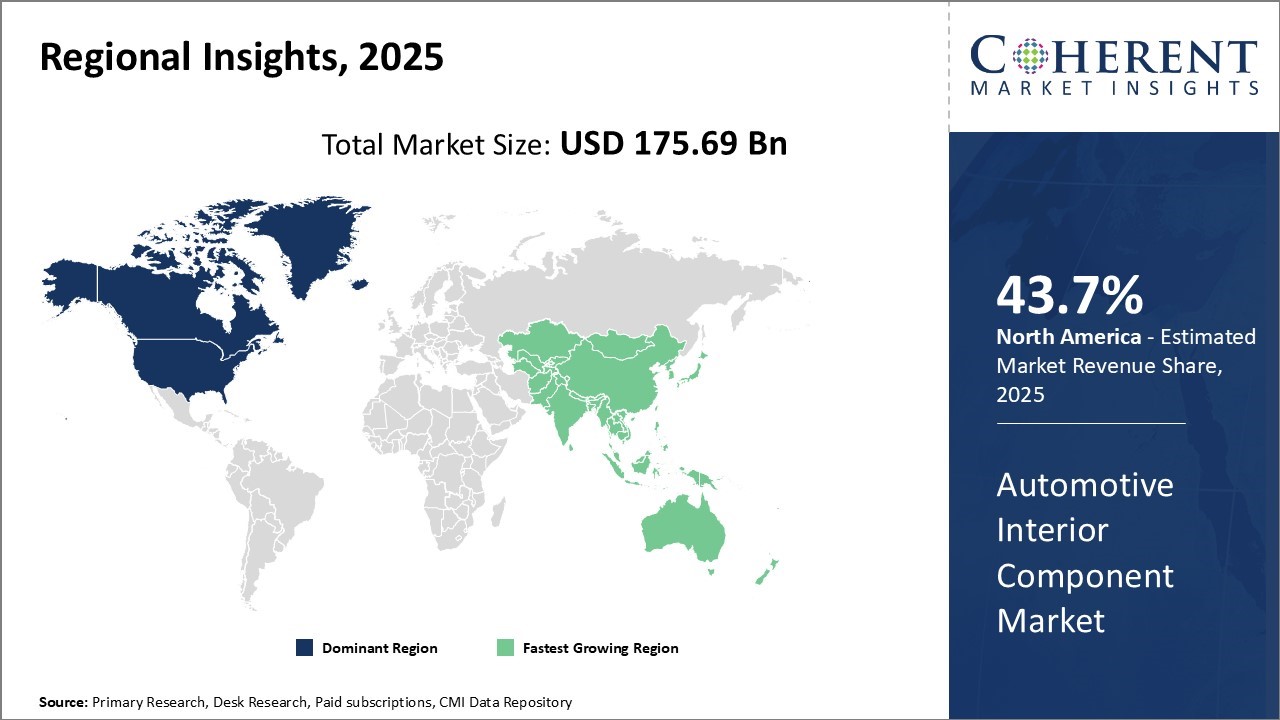
North America Automotive Interior Components Market Analysis and Trends
North America is set to lead the global automotive interior components market, accounting for an estimated 43.7% market share in 2026. This dominant position is driven by the strong presence of major automakers, including Ford and General Motors, whose regional and global headquarters are located in the United States. The region has developed a robust supply chain ecosystem, with numerous Tier 1 and Tier 2 suppliers operating extensive manufacturing networks.
Close integration between OEMs and suppliers enhances product customization and speed to market. Additionally, the region benefits from high consumer purchasing power, leading to increased average spending on premium and feature-rich vehicle interiors. This consumer preference for enhanced in-cabin experience continues to support sustained market demand.
Asia Pacific Automotive Interior Components Market Analysis and Trends
Asia Pacific is emerging as the fastest-growing regional market for automotive interior components, fueled by rising vehicle ownership across countries like China and India. Rapid urbanization, growing disposable incomes, and increased demand for mobility solutions are significantly boosting passenger vehicle sales in the region.
Government-backed initiatives such as ‘Make in India’ and China’s push for domestic auto production are attracting global OEMs to establish localized, cost-effective manufacturing bases. Furthermore, the region’s competitive supplier landscape—particularly in China—has matured quickly, offering advanced design capabilities and globally competitive pricing. This strategic proximity to both production plants and end markets positions Asia Pacific as a key growth engine for the global market.
Dominating Countries in the Automotive Interior Components Market
United States Automotive Interior Components Market Analysis and Trends
The United States remains the largest contributor to North America's automotive interior components market. Its leadership stems from a well-developed automotive industry supported by long-standing OEMs, advanced R&D centers, and a mature supply chain. High consumer expectations for comfort, technology integration, and aesthetic quality in vehicle cabins drive demand for advanced interior components. The integration of features like ambient lighting, ergonomic seating, and smart infotainment systems has become a hallmark of U.S. automotive interior trends.
China Automotive Interior Components Market Analysis and Trends
China is a pivotal market within Asia Pacific, experiencing rapid expansion due to a surge in vehicle production and ownership. The government's strategic push to strengthen local supply chains and encourage technology adoption has spurred the rise of globally competitive interior component manufacturers.
Many Chinese suppliers are now exporting to international OEMs, driven by their ability to offer cost-effective solutions and replicate complex designs. This transformation has elevated China as a dominant force in global automotive interiors.
India Automotive Interior Components Market Analysis and Trends
India is witnessing robust growth in its automotive interior components market, supported by initiatives such as ‘Make in India’ and increased investment in domestic automotive production. A young population, rising middle class, and increasing awareness of vehicle aesthetics are propelling demand for upgraded interior features.
The country’s competitive manufacturing costs and skilled workforce have attracted several global automakers to set up production hubs, positioning India as both a major consumer and exporter of interior automotive components.
Market Report Scope
Automotive Interior Component Market Report Coverage
| Report Coverage | Details | ||
|---|---|---|---|
| Base Year: | 2025 | Market Size in 2026: | USD 187.81 Bn |
| Historical Data for: | 2020 To 2024 | Forecast Period: | 2026 To 2033 |
| Forecast Period 2026 to 2033 CAGR: | 6.9% | 2033 Value Projection: | USD 299.62 Bn |
| Geographies covered: |
| ||
| Segments covered: |
| ||
| Companies covered: | Johnson Control, Toyota Boshoku Corporation, Lear Corporation, Toyoda Gosei Co., Ltd., Faurecia SA, Continental AG, Magna International, Delphi, Adient plc., Robert Bosch GmbH, Yanfeng (China), Lear Corporation, Antolin, Polydesign Systems, and Machino Plastics Limited | ||
| Growth Drivers: |
| ||
| Restraints & Challenges: |
| ||
Analyst Viewpoint
- Increasing consumer focus on in-cabin comfort and personalization is driving demand for features like ambient lighting, heated seating, and immersive infotainment systems.
- Electric vehicle adoption is accelerating the redesign of automotive interiors, with emphasis on minimalist aesthetics and integrated smart technologies.
- Advancements in connectivity and autonomous driving are reshaping the role of interior components, encouraging manufacturers to develop more interactive and adaptive systems.
- Rising costs of premium materials such as genuine leather, advanced automotive interior component polymer usage, and electronic modules are placing pressure on margins across the value chain.
- Persistent supply chain disruptions, especially related to semiconductors, continue to affect production continuity and delivery timelines.
- Asia-Pacific dominates global production, led by high output in China, India, and Japan, with growing vehicle ownership and middle-class expansion fueling demand.
- North America is the fastest-growing region, backed by rising consumer expenditure on premium vehicles and tech-enabled interiors.
- European markets show stable growth, particularly in high-end and electric vehicle segments.
- Sustainability trends are prompting a shift toward recycled materials and environmentally conscious manufacturing, creating both compliance challenges and competitive advantages.
- Integration of IoT, AI, and over-the-air (OTA) features in interior components is generating new revenue opportunities for OEMs and Tier 1 suppliers.
- Regulatory changes focused on safety, emissions, and recyclability are influencing interior material selection and design specifications globally.
Automotive Interior Component Market Key Developments
- In February 2023, TrinamiX and Continental is presenting a world innovation the Driver Identification Display with an integrated camera solution for biometric driver identification.
- In February 2023, Faurecia signed with the Motherson Group an agreement by which Motherson commits to acquire Faurecia SAS Cockpit Modules division (assembly and logistics services), reported as part of its Interiors Segment, for an enterprise value of USD 570.9 Million. The transaction will be subject to customary conditions precedents, including regulatory approvals.
- In January 2023, Technology Company Continental will present its Curved Ultrawide Display at CES September 2023. “Ultrawide” refers to a width of 1.29 meters, curving from one A-pillar to the other. The 47.5-inch TFT display is illuminated by more than 3,000 LEDs on a 7,680 by 660-pixel active area.
- In December 2022, Toyota Boshoku Corporation, Toyota Auto Body Co., LTD., and Toyota Body Seiko Co., LTD. concluded an agreement to transfer shares of Toyota Body Seiko, which is a subsidiary of Toyota Auto Body, to Toyota Boshoku to make Toyota Body Seiko a subsidiary of Toyota Boshoku.
Market Segmentation
- Components Insights (Revenue, USD Bn & Thousand Units, 2021 - 2033)
- Infotainment
- Instrument Cluster
- Telematics
- Flooring
- Door Panel
- Automotive Seat
- Others (Interior Lighting, etc.)
- Vehicle Type Insights (Revenue, USD Bn & Thousand Units, 2021 - 2033)
- Passenger Vehicle
- Commercial Vehicle
- Regional Insights (Revenue, USD Bn & Thousand Units, 2021 - 2033)
- North America
- U.S.
- Canada
- Latin America
- Brazil
- Argentina
- Mexico
- Rest of Latin America
- Europe
- Germany
- U.K.
- Spain
- France
- Italy
- Russia
- Rest of Europe
- Asia Pacific
- China
- India
- Japan
- Australia
- South Korea
- ASEAN
- Rest of Asia Pacific
- Middle East
- GCC Countries
- Israel
- Rest of Middle East
- Africa
- South Africa
- North Africa
- Central Africa
- Key Players Insights
- Johnson Control
- Toyota Boshoku Corporation
- Lear Corporation
- Toyoda Gosei Co., Ltd.
- Faurecia SA
- Continental AG
- Magna International
- Delphi
- Adient plc.
- Robert Bosch GmbH
- Yanfeng (China)
- Lear Corporation
- Antolin
- Polydesign Systems
- Machino Plastics Limited
Sources
Primary Research Interviews
- Automotive interior component manufacturers and suppliers
- Original Equipment Manufacturers (OEMs) procurement managers
- Automotive interior design specialists and engineers
- Automotive dealership representatives
- Others
Databases
- IHS Markit Automotive Database
- Automotive News Data Center
- OICA (Organisation Internationale des Constructeurs d'Automobiles) Database
- Ward's Automotive Database
- Others
Magazines
- Automotive Interior Design Magazine
- Ward's Auto Interior
- Automotive News
- Car and Driver Interior Focus
- Others
Journals
- International Journal of Automotive Technology
- SAE International Journal of Materials and Manufacturing
- Journal of Automotive Engineering
- Others
Newspapers
- Automotive News
- Financial Times (Automotive Section)
- The Wall Street Journal (Auto Industry Coverage)
- Reuters Auto Industry News
- Others
Associations
- Society of Automotive Engineers (SAE)
- Automotive Industry Association (AIA)
- International Association of Automotive Interior Manufacturers
- National Association of Automotive Component Manufacturers
- Others
Public Domain Sources
- U.S. Department of Transportation reports
- European Automobile Manufacturers Association (ACEA) publications
- Government automotive industry statistics
- International trade commission reports
- Others
Proprietary Elements
- CMI Data Analytics Tool
- Proprietary CMI Existing Repository of information for last 8 years
*Definition: The automotive interior components market includes all the parts and materials used inside a vehicle cabin. This includes dashboards, seats, doors, Headliners, Flooring's, air-conditioning system components and others. The market caters to the aftermarket as well as OEM segments. Some key products are instrument panels, consoles, armrests, door panels, seating, interior trim, and lighting components. The market aims to provide comfortable, durable, and aesthetically pleasing interior components and systems.
Get access to 250+ pages report
Every segment, forecast, competitor profile and data table behind the analysis above — available for instant download.
- ESOMAR Member
- ISO 9001:2015 Certified
- D-U-N-S Registered
- GDPR & CCPA Compliant
Missing comfort of reading report in your local language? Find your preferred language:
Transform your Strategy with Exclusive Trending Reports
Frequently Asked Questions
The Automotive Interior Component Market size is estimated to be valued at USD 187.81 Bn in 2026, and is expected to reach USD 299.62 Bn by 2033.
The CAGR of the global Market is projected to be 6.9% from 2026 to 2033.
Rising electrification in the automotive industry and rise of ride-hailing services and shared mobility are the major factor driving the growth of the automotive interior components industry.
Rising raw material costs and increasing competition from alternative modes of transportation are the major factor driving the growth of automotive interior components industry.
In terms of components, Door Panel is estimated to dominate the market revenue share 2026.
Johnson Control, Toyota Boshoku Corporation, Lear Corporation, Toyoda Gosei Co., Ltd., Faurecia SA, Continental AG, Magna International, Delphi, Adient plc., Robert Bosch GmbH, Yanfeng (China), Lear Corporation, Antolin, Polydesign Systems, and Machino Plastics Limited are the major players.
North America is expected to lead the Automotive Interior Components industry.