

Polybutadiene Market Size and Forecast — 2026-2033
Overview
Polybutadiene is a polymer formed by polymerization of 1, 3-butadiene. It is a synthetic rubber, which is mostly used in the production of tires, and also to enhance the resistance of polystyrene and ABS (acrylonitrile butadienestyrene). Production of golf balls and coating of electronics also require polybutadiene. High resistivity of polybutadiene is a major factor augmenting its demand in tire manufacturing plants.
One of the significant drivers for the global polybutadiene market is the rapid growth in automotive and plastic industries. Properties such as low transition, high resistance, high tensile strength, abrasion resistance, and toughness fuel the demand for polybutadiene globally. Moreover, increasing demand for ecofriendly and fuel efficient tires is also driving the global polybutadiene market. However, price volatility of raw materials is a prominent restraint in the polybutadiene market.
Polybutadiene Market Size and Forecast – 2026 – 2033
The Polybutadiene Market size is estimated to be valued at USD 4.44 billion in 2026 and is expected to reach USD 6.49 billion by 2033, exhibiting a compound annual growth rate (CAGR) of 5.6% from 2026 to 2033.
Key Takeaways
Tires as an application segment dominate the polybutadiene market, accounting for over 56% market revenue, driven by automotive sector demands, especially EV tire developments.
High-Cis polybutadiene leads the polymer type segment with significant preference due to its superior elastic properties needed for performance-intensive products.
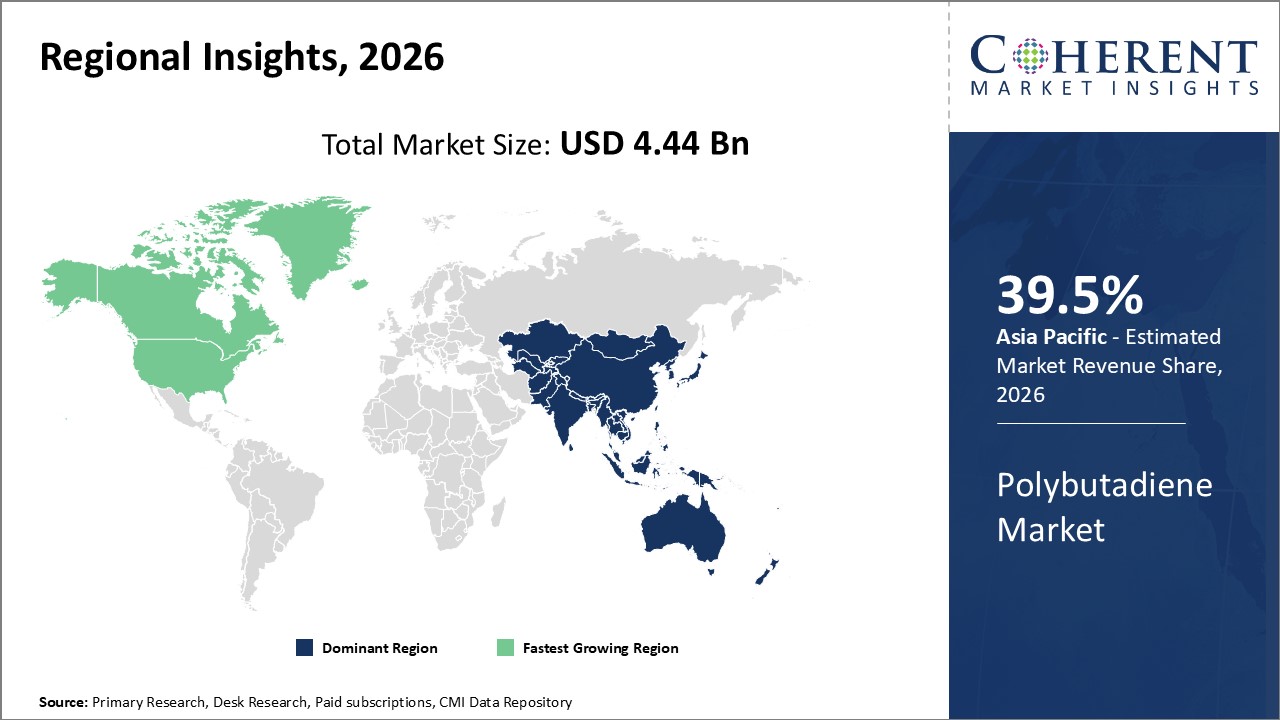
Asia Pacific holds the largest market share at 39.5%, backed by escalating production capabilities and consumption in China and India, supported by favorable government policies.
North America is focusing on innovation and sustainable production to capture niche segments amid stringent environmental regulations, providing lucrative growth avenues.
Polybutadiene Market – Segmentation Analysis
Polybutadiene Market Insights, By Application
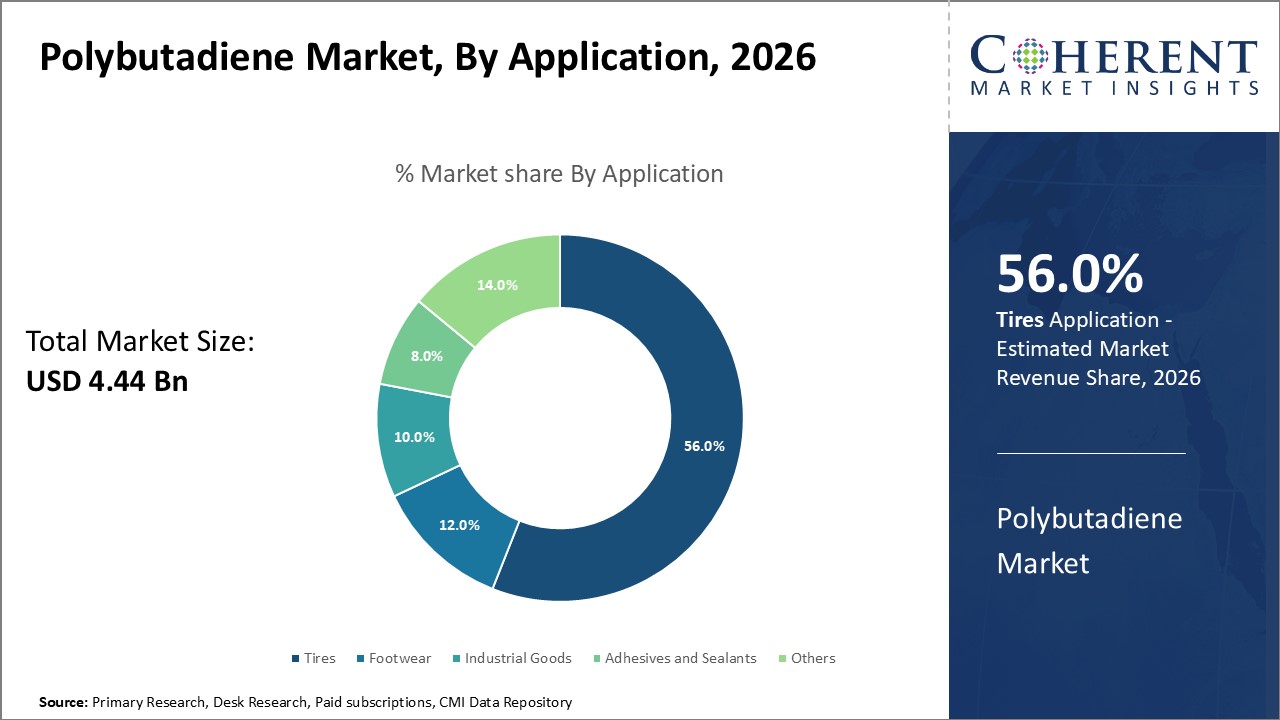
In terms of Application the market is segmented into Tires, Footwear, Industrial Goods, Adhesives and Sealants, and Others, among which Tires dominate the market share with 56%. The tire segment benefits from expanding automotive production, particularly driven by electric vehicles that demand enhanced polymer properties such as low rolling resistance and improved durability. Growing environmental norms encourage tire manufacturers to adopt polybutadiene for eco-friendly high-performance solutions.
Polybutadiene Market Insights, By Polymer Type
In terms of Polymer Type the market is segmented into High-Cis Polybutadiene, Low-Cis Polybutadiene, Neat Polybutadiene, Solution-Polymerized Polybutadiene, and Others, with High-Cis Polybutadiene dominating the share due to its superior elasticity and tensile strength valued in tire and industrial applications. High-Cis is preferred for tires, offering enhanced wear resistance crucial for automotive growth.
Polybutadiene Market Insights, By End-Use Industry
In terms of End-Use Industry, the market is segmented into Automotive, Electronics, Construction, Consumer Goods, and Others, where Automotive dominates market share due to vast tire production demands and polymer integration in vehicle components. The automotive sector is the largest consumer of polybutadiene, with tire manufacturing comprising the majority share facilitated by trends such as electric vehicles and lightweight tires.
Polybutadiene Market Insights, By Geography
Asia Pacific Polybutadiene Market Analysis and Trends
In Asia Pacific, the dominance in the Polybutadiene Market is substantiated by 39.50% market share as of 2025, led primarily by China and India’s expanding automotive and industrial sectors. Government incentives for manufacturing, large-scale capacity expansions, and rising domestic consumption underpin this leadership. Major companies such as Lanxess and Japan Synthetic Rubber Corporation have significant production footprints here, fueling growth.
North America Polybutadiene Market Analysis and Trends
North America, on the other hand, is growing at the quickest rate, with a CAGR predicted to be above 6% between 2026 and 2033. Technological developments in synthetic rubber grades, the growing demand for electric vehicles, and government backing for sustainable materials are all factors contributing to growth. The resurgence of the US auto industry and rising polybutadiene imports demonstrate dynamic trade flows and changing market environments.
Polybutadiene Market Outlook for Key Countries
Market Analysis and Trends for Polybutadiene in the United States
United States leads North America in demand for polybutadiene, accounting for more than 45% of domestic consumption in 2025. Performance elastomers like polybutadiene were more in demand as a result of increased EV production and green vehicle requirements. Businesses such as Kumho Petrochemical and Arlanxeo respond to sustainability regulations and supply chain realignment to lessen reliance on imports by enhancing their market presence through innovation centers and capacity augmentation.
Market Analysis and Trends for Polybutadiene in the China
According to ambitious capacity increases and vertical integration by major players like Japan Synthetic Rubber Corporation and regional producers, China's polybutadiene market continues to be the largest in the world. Production and application diversification are further accelerated by the government's "Made in China 2026" project, which includes consumer goods and electronics. Sustained market momentum is supported by rising domestic vehicle sales and increased investments in specialty elastomers for high-performance tires.
Analyst Opinion
Increasing production capacity in Asia Pacific has driven polybutadiene market expansion, especially given the region’s dominance in rubber and tire manufacturing. Asia Pacific accounted for approximately 39.5% of the global market share in 2025, fueled by government incentives and robust automotive sectors, particularly in China and India. For instance, China's production capacity for synthetic rubber increased by over 8% in 2025 alone, underpinning broader market growth.
Price dynamics continue to shape demand patterns, with raw material cost fluctuations related to synthetic butadiene monomer impacting polybutadiene pricing globally. The average price for polybutadiene declined marginally by 3% year-over-year in 2025, improving affordability and encouraging adoption in downstream segments such as footwear and adhesives.
On the demand front, tire manufacturing remains the principal end user, accounting for nearly 56% of global demand in 2025. Enhanced performance demands in electric vehicles have catalysed increased usage of polybutadiene as a critical component for low rolling-resistance tires, with EV tire production surging by 13% globally in 2025.
Regional import patterns illustrate shifting trade balances with North America increasing imports by 7% in 2025 to meet rising demand in the automotive sector due to recovery from supply chain constraints. This trade adjustment reflects evolving market dynamics amid broader economic realignments and regulatory incentives promoting domestic vehicle production.
- Current Industry Events of 2026
- Market Size Estimation
- Regional Breakdown
- Competitive Landscape
- Customer Intelligence
- Segmental Analysis
- Pricing Analysis
- Key Market Drivers, Challenges & Future Trends
- Customized Insights Section
Market Scope
| Report Coverage | Details | ||
|---|---|---|---|
| Base Year: | 2025 | Market Size in 2026: | USD 4.44 billion |
| Historical Data for: | 2020 To 2024 | Forecast Period: | 2026 To 2033 |
| Forecast Period 2026 to 2033 CAGR: | 5.6% | 2033 Value Projection: | USD 6.49 billion |
| Geographies covered: |
| ||
| Segments covered: |
| ||
| Companies covered: | Polychem Corporation, Japan Synthetic Rubber Corporation, Lanxess AG, Kumho Petrochemical Co., Ltd., Arlanxeo, Synthos S.A., Sibur Holding, TSRC Corporation, India Glycols Limited, JSR Corporation, Sinopec Limited | ||
| Growth Drivers: |
| ||
Growth factors
Increasing Demand from Automotive Tires: The rising adoption of electric vehicles (EVs) and performance tires necessitates elastomers with specific elasticity and wear resistance characteristics, directly driving polybutadiene consumption.
Expanding Industrial Applications: Growth in the adhesives and sealants segment is significantly propelling market revenue, supported by a 11% year-on-year growth in industrial adhesives consumption reported in 2025.
Raw Material Availability and Technological Advances: Enhanced polymerization technologies are reducing production costs while improving product quality, thereby attracting new market players and expanding capacity.
Government Regulations and Sustainability Awareness: Regulations promoting non-polluting materials have encouraged the use of polybutadiene, which is recyclable and compatible with EU’s Green Deal directives implemented since 2023.
Polybutadiene Market Development
In June 2026, Evonik made the decision to locate its POLYVEST® ST-E 60's last stage of manufacture in Shanghai, China. This choice demonstrates the business's dedication to improving customer closeness and supplier security in Asia. By Q3 2026, the expansion should be completely operational. The expansion of silane-functionalized polybutadienes' manufacturing capacity is a major step toward solidifying Evonik's standing as a trustworthy partner in the market for specialty chemicals. Evonik hopes to satisfy the continuous demand for this high-performance additive—which is essential for a number of applications, such as rubber compounds, adhesives, coatings, tires, and sealants—by localizing and increasing its capacity worldwide.
Market Trends
The polybutadiene market is evolving with a pronounced transition towards sustainable material alternatives to meet global environmental targets.
Recent developments in bio-based butadiene production, including collaborations by companies like Synthos and biorefinery firms in 2025, reflect a significant shift.
Moreover, the rise in specialty grades tailored for high-performance EV tires and demand for low-emission manufacturing processes indicate a paradigm shift in product development.
Digitalization and Industry 4.0 adoption in production workflows have enhanced production efficiency, reducing lead times and minimizing costs.
Emerging regional policies incentivizing cleaner raw materials also foster market realignment emphasizing circular economy principles.
Key Players
Polychem Corporation
Japan Synthetic Rubber Corporation
Lanxess AG
Kumho Petrochemical Co., Ltd.
Arlanxeo
Synthos S.A.
Sibur Holding
TSRC Corporation
India Glycols Limited
JSR Corporation
Sinopec Limited
Several market companies focus on backward integration strategies to ensure consistent supply of raw materials, significantly reducing pricing volatility.
For instance, Lanxess AG’s acquisition of synthetic butadiene production facilities in 2025 resulted in a 16% reduction in production costs, solidifying its market share. Another competing strategy includes strategic partnerships aimed at innovation; Arlanxeo collaborated with automotive tire manufacturers in 2025 to develop eco-friendly polybutadiene grades, boosting product portfolio competitiveness and enhancing revenue streams.
Outlook for the Polybutadiene Market in the Future
The market for polybutadiene has a promising future because of the growing demand from the automotive sector, especially for tires, which benefits from the polymer's superior wear resistance and fuel efficiency. Growing infrastructure development and building activity around the world further help the market. The increasing use of polybutadiene to improve the flexibility and durability of other polymers is anticipated to increase demand due to advancements in polymer modification. Sustainability is also becoming more and more important, as eco-friendly products and bio-based production techniques gain popularity.
Further driving market expansion are growing applications in sectors like consumer goods, adhesives, sealants, and aerospace. Market participants are spending money on R&D to launch high-performance, novel polybutadiene solutions that meet changing consumer demands and regulatory requirements. Regionally, rapid urbanization, increased vehicle production, and industrial expansion play significant roles in driving growth, especially in Asia Pacific, North America, and Europe. More competition and innovation are anticipated in the market, with an emphasis on advanced materials technology and sustainable sourcing.
Historical Analysis
In March 2013, Mitsubishi Corporation joined forces with Ube Industries, Ltd., Lotte Chemical Corporation and wholly owned Lotte Chemical subsidiary, Lotte Chemical Titan to set up a three-company joint venture in Malaysia for the manufacture and sale of poly-butadiene rubber. This joint venture was established to overcome the increasing demand of poly-butadiene rubber in Asia.
In May 2014, SIBUR, a leading Russian gas processing and petrochemicals company, signed a contract with China Petroleum and Chemical Corporation (“Sinopec”) to establish a joint venture for the construction of a 50 ktpa butadiene nitrile rubber (or “NBR”) plant at the Shanghai Chemical Industry Park. This venture was established for expanding its production and commercial operations.
In December 2018, Kuraray Co. Ltd, PTT Global Chemical PCL and Sumitomo Corp. announced their investment in a project for the manufacture of butadiene derivatives in Thailand. This project was operated by a joint venture called Kuraray GC Advanced Materials Co. Ltd. and it was expected to increase the company’s annual capacity.
Sources
Primary Research interviews:
Procurement managers in tire companies
R&D heads at automotive OEMs
Chemical engineers specializing in elastomers
Databases:
International Rubber Study Group (IRSG) Statistics
OECD Data
FAOSTAT (for agricultural rubber substitutes comparison)
Magazines:
Chemical & Engineering News
European Rubber Journal
Rubber Asia
Journals:
Rubber Chemistry and Technology
Journal of Elastomers and Plastics
Polymer Degradation and Stability
Newspapers:
The Hindu BusinessLine
Financial Times (Commodities & Chemicals section)
The Wall Street Journal
Associations:
American Chemical Society (ACS) – Rubber Division
All India Rubber Industries Association (AIRIA)
European Tyre and Rubber Manufacturers’ Association (ETRMA)
Get access to 250+ pages report
Every segment, forecast, competitor profile and data table behind the analysis above — available for instant download.
- ESOMAR Member
- ISO 9001:2015 Certified
- D-U-N-S Registered
- GDPR & CCPA Compliant
Missing comfort of reading report in your local language? Find your preferred language:
Transform your Strategy with Exclusive Trending Reports
Frequently Asked Questions
Leading market players include Polychem Corporation, Japan Synthetic Rubber Corporation, Lanxess AG, Kumho Petrochemical Co., and Arlanxeo, with these entities driving innovation and production scale.
The market is projected to grow from USD 4.44 billion in 2026 to USD 6.49 billion by 2033, reflecting a CAGR of 5.6%, powered by automotive, industrial, and sustainable product demands.
The tire manufacturing segment presents the largest growth opportunity, representing approximately 55% of global demand, fueled by increasing adoption of electric and high-performance vehicles.
Trends emphasize growth in sustainable bio-based polybutadiene, tailored product development for EV tires, and enhanced efficiency via production digitalization and regulatory compliance.
Competition hinges on capacity expansion, technology innovation, and cost management, with challenges including price volatility of raw materials and evolving environmental regulations.
Market players pursue vertical integration for raw material security, strategic collaborations for product innovation, and regional diversification to capitalize on emerging market growth.