

Protective Coatings Market Size and Trends Forecast: 2026 - 2033
The protective coatings market is estimated to be valued at USD 15.37 Bn in 2026 and is expected to reach USD 24.04 Bn by 2033, exhibiting a compound annual growth rate (CAGR) of 6.6% from 2026 to 2033.
Key Takeaways of the Protective Coatings Market
- Based on technology, the solvent-borne coatings segment is projected to dominate, holding an estimated share of 38% in 2026.
- Based on resin type, the epoxy segment is estimated to hold 36% of the market share in 2026.
- In application, the infrastructure segment is expected to hold 35.1% of the market share in 2026.
- North America is expected to dominate the protective coatings market with36. 7% of the market share in 2026.
Market Overview
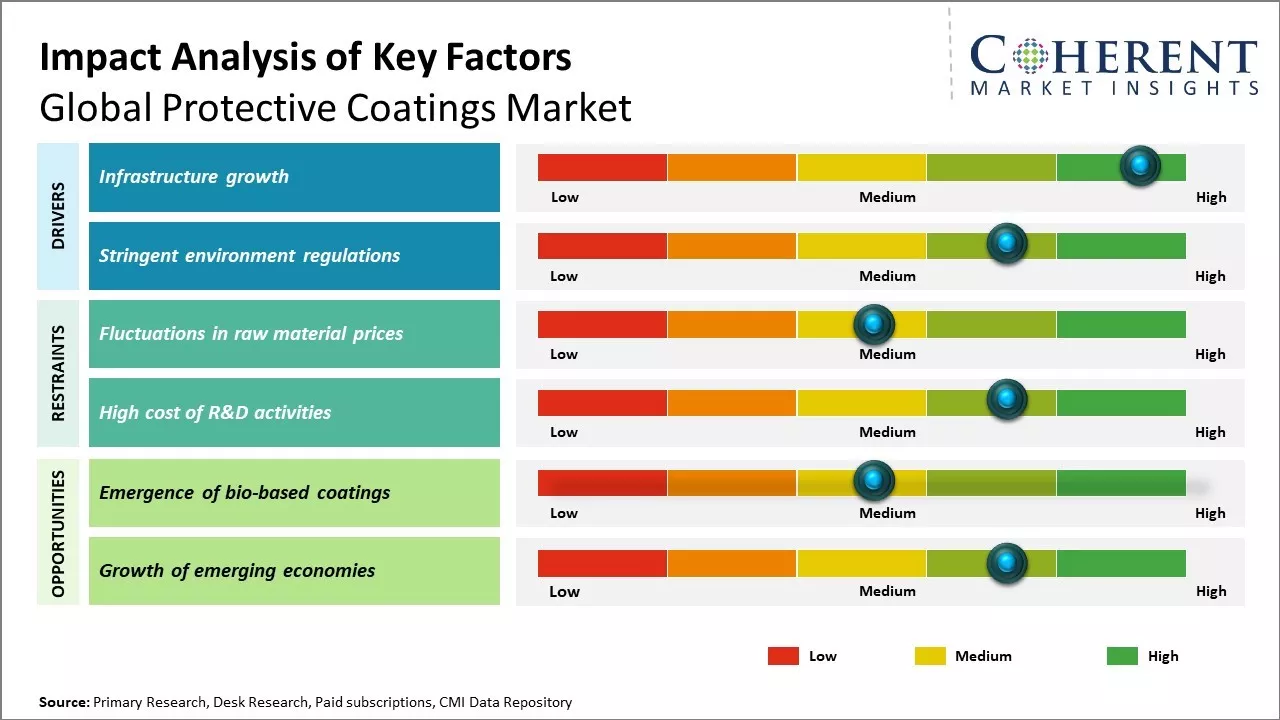
Protective coatings are widely used across various industries such as building and construction, automotive, marine, aerospace, and others. Rapid urbanization and infrastructural developments especially in emerging economies are major factors contributing to the growing demand. The increasing construction of new residential and commercial buildings for growing population will boost the building and construction industry worldwide.
However, stringent environmental regulations regarding volatile organic compounds (VOCs) emissions may hamper the market growth during the forecast timeline.
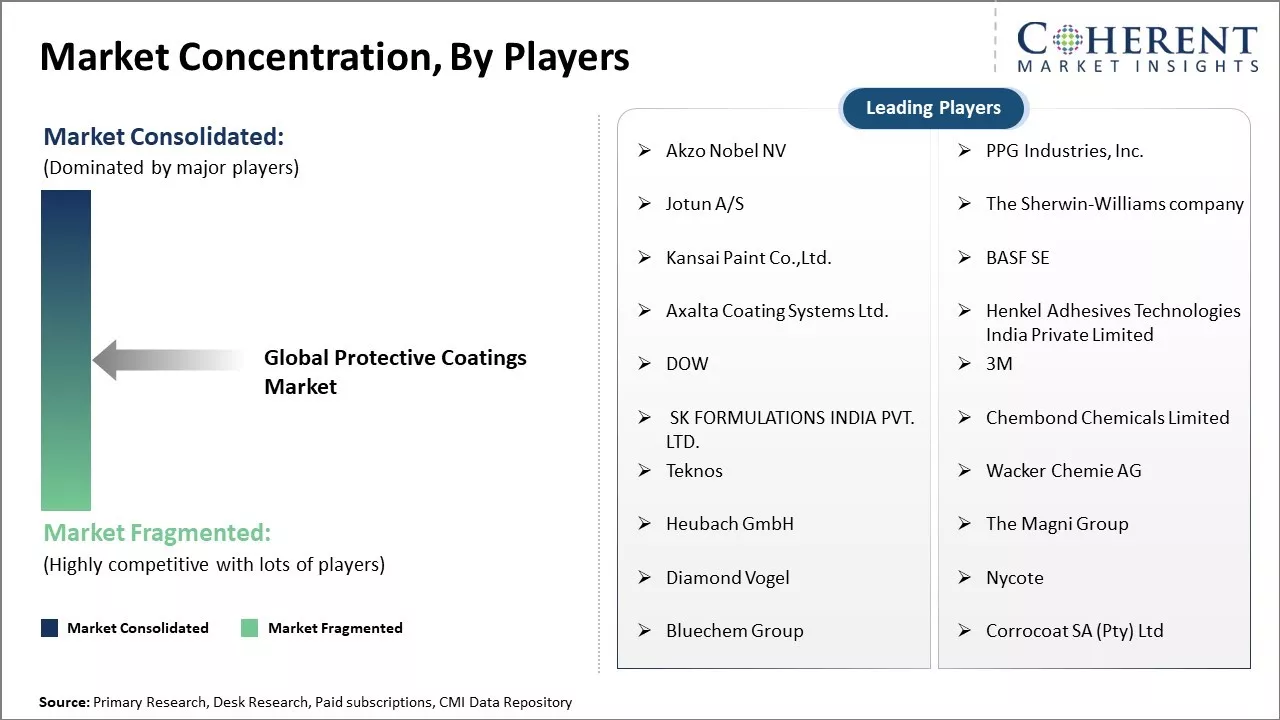
Market Concentration and Competitive Landscape
Current Events and their Impact on the Protective Coatings Market
Current Events | Description and its impact |
Protective Coatings |
|
Environmental and Sustainability Trends |
|
- Current Industry Events of 2026
- Market Size Estimation
- Regional Breakdown
- Competitive Landscape
- Customer Intelligence
- Segmental Analysis
- Pricing Analysis
- Key Market Drivers, Challenges & Future Trends
- Customized Insights Section
Market Trends
Growth in Infrastructure and Construction Activities
The steady rise in infrastructure and construction activities globally is significantly fueling the expansion of the protective coatings market. Governments worldwide are increasingly prioritizing infrastructure development to boost economic growth, enhance urbanization, and improve public amenities.
For instance, according to the U.S. Census Bureau, construction spending in the United States during May 2025 was estimated at a seasonally adjusted annual rate of USD 2,138.2 billion, which is 0.3 percent below the revised April estimate of USD 2,145.5 billion.
Segmental Insights
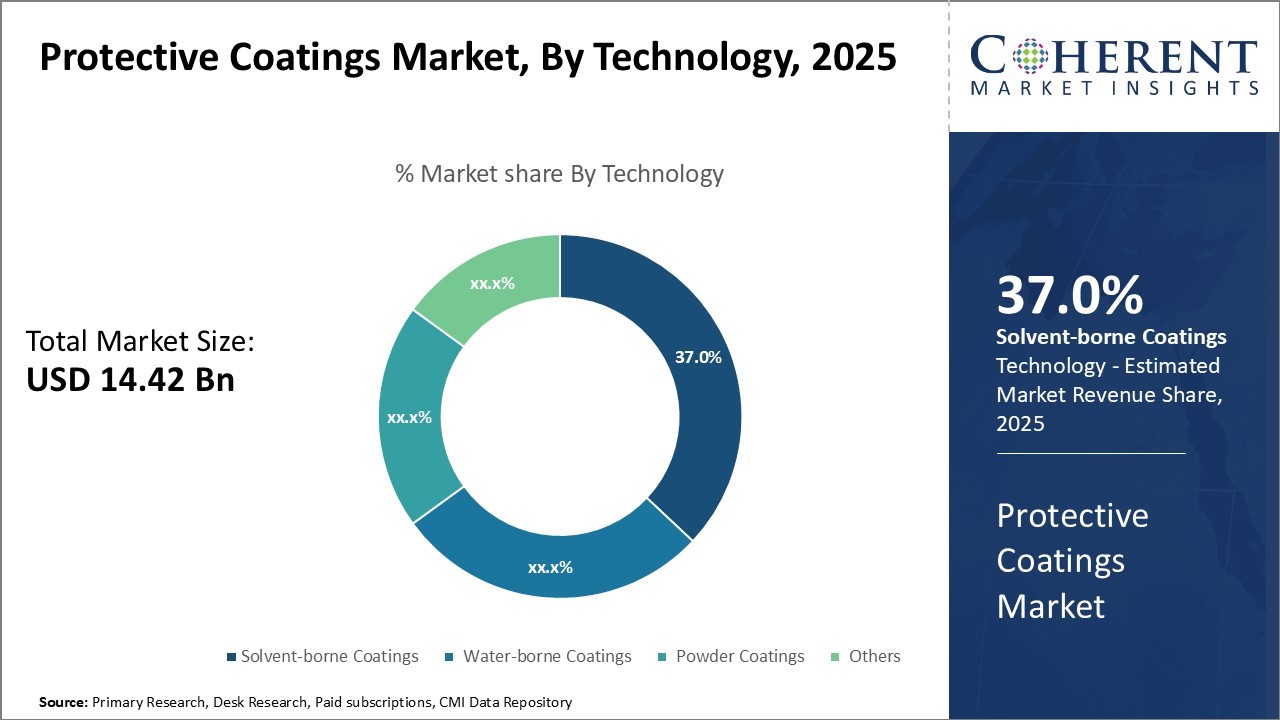
Protective Coatings Market Insights, By Technology: High Durability and Quality Drive Solvent-borne Coatings Adoption
In terms of technology, the solvent-borne coatings segment is expected to contribute 38.0% share of the market in 2026, owing to their exceptional durability and quality.
Solvent-borne coatings are known for their high gloss and ultra-smooth finish that protects surfaces from corrosion, weathering and other environmental damages extremely well. They penetrate substrate surfaces deeply forming a strong long-lasting bond that stands up to extreme climatic conditions and physical impacts. This enhances the life of assets and infrastructure significantly by preserving them for decades.
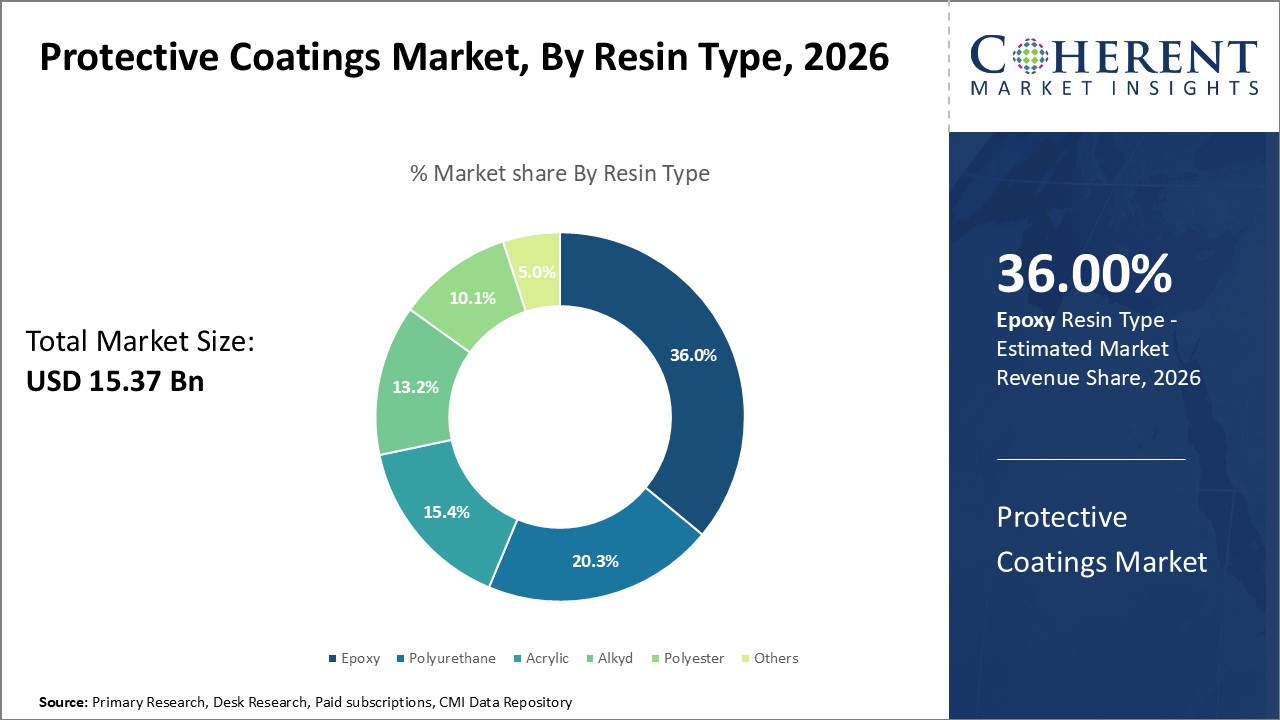
Protective Coatings Market Insights, By Resin Type: Strong Corrosion Resistance Drives Epoxy Resin Adoption
In terms of resin type, the epoxy segment is expected to contribute 36% of the market share in 2026, owing to its excellent chemical and corrosion resistance.
Epoxy resins form very hard, tough coatings capable of protecting metal surfaces from corrosion extremely well in even the harshest environmental conditions. They adhere strongly to substrates and seal them completely from corrosive elements. Epoxy coatings are impervious to a wide range of acids, alkalis, solvents and salts. Their corrosion resistance surpasses other resins making them ideal for protecting assets in highly corrosive environments like oil rigs, offshore platforms, petrochemical plants and ships.
Protective Coatings Market Insights, By Application: Demand from Mega Infrastructure Projects Boosts Infrastructure Segment
In terms of application, the infrastructure segment is expected to contribute 35.1% share of the market in 2026, driven by huge investment in large-scale infrastructure projects globally.
Protective coatings see substantial demand from new construction as well as maintenance, repair and renovation of roads, bridges, rail networks, power plants, ports and others. Mega projects like high-speed rail lines, tunnels, new power grids and smart city developments require massive quantities of protective coatings to safeguard costly infrastructure assets from environmental degradation for decades of operation. Their success relies on coatings to protect expensive installed capital and allow designed asset life. Investments in infrastructure are rising globally to support economic growth and development.
Emerging Innovations in the Protective Coatings Market
- The Increasing Focus on Sustainability and Environmental Compliance
- Traditional coatings, often solvent-based, have faced stringent regulations due to high volatile organic compound (VOC) emissions. In response, there is a surge in the development of low-VOC and zero-VOC formulations that significantly reduce environmental impact without compromising protective performance. Waterborne coatings are gaining prominence as an eco-friendlier alternative, offering lower toxicity and safer handling while achieving competitive durability and corrosion resistance.
- Introduction of Nanotechnology
- Nanotechnology represents another major trend that is reshaping protective coatings. Incorporation of nanoparticles, such as nano-silica, titanium dioxide, and zinc oxide, into coating formulations improves mechanical strength, UV resistance, and anti-corrosive properties at a microscopic level. Nanocoatings yield thinner films that maintain excellent barrier properties and improve surface hardness, scratch resistance, and self-cleaning ability. This technology is particularly valuable in highly demanding sectors like aerospace and automotive, where weight reduction and extended service life of components are imperative.
Regional Insights
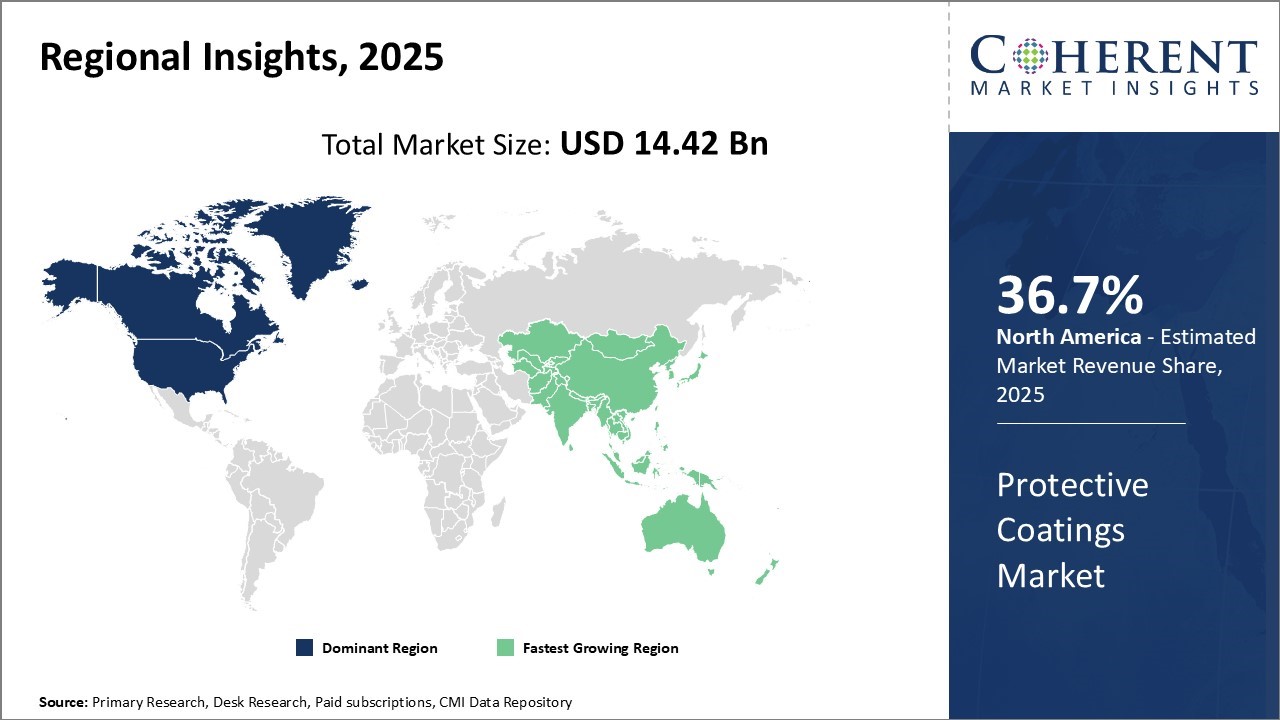
North America Protective Coatings Market Analysis and Trends
North America has established itself as the dominant region in the global protective coatings market. The region is expected to account for 36.7% of the market share in 2026. The region accounts for the largest share of demand, attributable to strong infrastructure and industrial base across the U.S and Canada. Major industries such as construction, automotive, oil & gas and manufacturing have been driving the consumption of protective coatings in the region.
The construction sector contributes around 4.5% to the U.S. GDP, supporting a large pool of over 745,000 general contractor firms employing more than 7.6 million workers—highlighting the scale and structural demand for protective coatings.
Asia Pacific Protective Coatings Market Analysis and Trends
Asia Pacific is emerging as the fastest growing market for protective coatings. Rapid urbanization, growing industrial and construction activities are fueling the demand from key countries including China, India, Japan, and South Korea. The infrastructure push by governments through various initiatives such as 'Make in India' and 'Golden Age of Infrastructure' are boosting coating consumption.
For instance, the Asian Development Bank estimates that developing Asia needs approximately USD 1.7 trillion per year in infrastructure investments through 2030 to sustain growth, reduce poverty, and address climate goals.
Protective Coatings Market Outlook for Key Countries
U.S Protective Coatings Market Analysis and Trends
The U.S. drives substantial demand for protective coatings through large-scale investments in infrastructure maintenance and a mature automotive sector. Aging bridges, roadways, and public utilities require corrosion- and weather-resistant coatings, while the expanding electric vehicle industry fuels the demand for high-performance coating solutions in auto manufacturing and repair.
China Protective Coatings Market Analysis and Trends
China dominates the East Asian protective coatings market owing to expanding industrialization, urbanization, as well as one of the largest infrastructure programs globally. Growth in manufacturing, shipbuilding, power generation, and construction sectors necessitates high volumes of durable coatings to protect assets from corrosion and wear.
India Protective Coatings Market Analysis and Trends
India is among the fastest-growing protective coatings markets, driven by unprecedented government-backed infrastructure investments, including flagship projects like the National Infrastructure Pipeline, PM Gati Shakti masterplan, Smart Cities Mission, and Bharatmala corridor. Buoyed by ongoing expansion in construction, transportation, and energy sector assets—particularly airports, railways, and ports—there’s a sustained surge in demand for high-performance coatings that offer corrosion resistance, weather durability, and lifecycle protection.
South Korea Protective Coatings Market Analysis and Trends
South Korea’s demand for protective coatings is propelled by continuous construction and infrastructure projects in its rapidly urbanizing economy. Rising investments in residential, commercial, and public infrastructure sectors intensify the need for coatings that offer superior protection against humidity, pollution, and temperature stress.
Pricing Analysis of the Protective Coatings Market
Product Type | Average Price Range per Liter (USD) |
Aliphatic PU Topcoats | 40 - 85 |
Aromatic PU Primers | 30 - 50 |
PU Clear Coats | 45 - 75 |
Market Report Scope
Protective Coatings Market Report Coverage
| Report Coverage | Details | ||
|---|---|---|---|
| Base Year: | 2025 | Market Size in 2026: | USD 15.37 Bn |
| Historical Data for: | 2020 To 2024 | Forecast Period: | 2026 To 2033 |
| Forecast Period 2026 to 2033 CAGR: | 6.6% | 2033 Value Projection: | USD 24.04 Bn |
| Geographies covered: |
| ||
| Segments covered: |
| ||
| Companies covered: | Akzo Nobel NV, PPG Industries, Inc., Jotun A/S, The Sherwin-Williams company, Kansai Paint Co.,Ltd., BASF SE, Axalta Coating Systems Ltd., Henkel Adhesives Technologies India Private Limited, DOW, 3M, SK FORMULATIONS INDIA PVT. LTD., Chembond Chemicals Limited, Teknos, Wacker Chemie AG, Heubach GmbH, The Magni Group, Diamond Vogel, Nycote, Bluechem Group, and Corrocoat SA (Pty) Ltd. | ||
| Growth Drivers: |
| ||
| Restraints & Challenges: |
| ||
Protective Coatings Industry News
- In June 2025, PPG announced it will showcase its architectural metal coatings made to meet the highest standards in weathering, design and durability at the AIA Conference on Architecture and Design.
- In June 2025, Jotun launched new powder coatings technologies to safeguard batteries. To help manufacturers improve battery life, safety and manufacturing efficiency, Jotun has introduced powder coatings systems engineered to meet different challenges.
- In May 2025, BASF Coatings pursued its strategic roadmap for sustainable development and is further expanding its business with biomass-balanced products. Following successful launches in Europe and Asia, the first products for the automotive refinish coatings market will now also be introduced in North America this year.
- In March 2025, Sherwin-Williams showcased its next-generation coatings for pharmaceutical cleanrooms at INTERPHEX 2025 the high-performance coatings, designed to support safe, sterile and efficient pharmaceutical manufacturing environments.
Analyst View
- The protective coatings market is witnessing substantial activity owing to increasing infrastructure development and the rising demand for corrosion-resistant materials across various industries such as automotive, aerospace, marine, and oil & gas. One of the primary drivers fueling this market is the growing emphasis on asset longevity and maintenance cost reduction, which compels industries to invest in advanced coatings that extend the lifespan of metals and concrete structures.
- Additionally, stringent environmental regulations are pushing manufacturers to develop eco-friendly and sustainable coating solutions, thereby driving innovation within the sector.
- However, the high cost of advanced protective coatings and fluctuations in raw material prices remain notable restraints that could impact widespread adoption, particularly among small and medium enterprises. Despite these challenges, significant opportunities lie in the adoption of nanotechnology and smart coatings, which offer self-healing and anti-fouling properties that cater to specialized applications.
- In conclusion, the protective coatings market is poised for steady growth driven by technological advancements and rising environmental awareness. Companies investing in R&D to create innovative, cost-effective, and eco-friendly products are likely to gain a competitive edge in this dynamic market landscape.
Market Segmentation
- Technology Insights (Revenue, USD Bn, 2021 - 2033)
- Solvent-borne Coatings
- Water-borne Coatings
- Powder Coatings
- Others
- Resin Type Insights (Revenue, USD Bn, 2021 - 2033)
- Epoxy
- Polyurethane
- Acrylic
- Alkyd
- Polyester
- Others
- Application Insights (Revenue, USD Bn, 2021 - 2033)
- Infrastructure
- Commercial Real Estate
- Industrial Plants and Facilities
- Oil & Gas
- Power
- Mining
- Regional Insights (Revenue, USD Bn, 2021 - 2033)
- North America
- U.S.
- Canada
- Latin America
- Brazil
- Argentina
- Mexico
- Rest of Latin America
- Europe
- Germany
- U.K.
- Spain
- France
- Italy
- Russia
- Rest of Europe
- Asia Pacific
- China
- India
- Japan
- Australia
- South Korea
- ASEAN
- Rest of Asia Pacific
- Middle East & Africa
- GCC Countries
- Israel
- Rest of Middle East & Africa
- Key Players Insights
- Akzo Nobel NV
- PPG Industries, Inc.
- Jotun A/S
- The Sherwin-Williams company
- Kansai Paint Co.,Ltd.
- BASF SE
- Axalta Coating Systems Ltd.
- Henkel Adhesives Technologies India Private Limited
- DOW
- 3M
- SK FORMULATIONS INDIA PVT. LTD.
- Chembond Chemicals Limited
- Teknos
- Wacker Chemie AG
- Heubach GmbH
- The Magni Group
- Diamond Vogel
- Nycote
- Bluechem Group
- Corrocoat SA (Pty) Ltd.
Sources
Primary Research Interviews
- Protective Coatings Platform Providers
- Hedge Funds & Asset Managers
- Proprietary Trading Firms
- Brokerage Firms
- Others
Magazines
- Protective Coatings Magazine
- Institutional Investor
- Traders Magazine
- Others
Journals
- Progress in Organic Coatings
- Surface and Coatings Technology
- Journal of Coatings Technology and Research
- Journal of Applied Polymer Science
- Others
Newspapers
- Financial Times
- The Wall Street Journal
- Economic Times
- Others
Associations
- American Coatings Association (ACA)
- European Coatings Association (CEPE)
- The Coatings Research Group (CRG)
- Powder Coating Institute (PCI)
- Others
Public Domain Sources
- Government Publications & Reports (e.g., EPA, USGS)
- Industry Whitepapers & Press Releases
- Trade Shows & Conference Proceedings
- Others
Proprietary Elements
- CMI Data Analytics Tool – Protective Coatings Market
- CMI Existing Repository of Information for the Last 8 Years
*Definition: The protective coatings market includes paints, coatings, and other protective layers that are applied to metal or other substrates to prevent corrosion and weathering. These coatings form a barrier between the substrate material and its environment, extending the useful lifetime and durability of assets. Common protective coating types include epoxy, polyurethane, acrylic, alkyd, and vinyl-based formulations that are used across various end-use industries like oil and gas, marine, construction, automotive, and aerospace.
Get access to 250+ pages report
Every segment, forecast, competitor profile and data table behind the analysis above — available for instant download.
- ESOMAR Member
- ISO 9001:2015 Certified
- D-U-N-S Registered
- GDPR & CCPA Compliant
Missing comfort of reading report in your local language? Find your preferred language:
Transform your Strategy with Exclusive Trending Reports
Frequently Asked Questions
The protective coatings market is estimated to be valued at USD 15.37 Bn in 2026, and is expected to reach USD 24.04 Bn by 2033.
The CAGR of the protective coatings market is projected to be 6.6% from 2026 to 2033.
Infrastructure growth and stringent environment regulations are the major factors driving the growth of the global protective coatings market.
Fluctuations in raw material prices and high cost of R&D activities are the major factors hampering the growth of the global protective coatings market.
In terms of technology, solvent-borne coatings are estimated to dominate the market revenue share in 2026.
Akzo Nobel NV , PPG Industries, Inc., Jotun A/S , The Sherwin-Williams company, Kansai Paint Co.,Ltd., BASF SE, Axalta Coating Systems Ltd., Henkel Adhesives Technologies India Private Limited, DOW, 3M, SK FORMULATIONS INDIA PVT. LTD., Chembond Chemicals Limited, Teknos, Wacker Chemie AG, Heubach GmbH, The Magni Group, Diamond Vogel, Nycote, Bluechem Group, and Corrocoat SA (Pty) Ltd are the major players in the global protective coatings market.
North America is expected to lead the protective coatings market in 2026.