

Automotive Coating Resin Market Size and Forecast — 2026-2033
The Global Automotive Coating Resin Market size is estimated to be valued at USD 6.83 billion in 2026 and is expected to reach USD 10.7 billion by 2033, exhibiting a compound annual growth rate (CAGR) of 8.4% from 2026 to 2033.
Overview
Automotive coating resins are polymer binders forming the essential film-forming matrix in primers, basecoats, clears and functional coatings used across OEM and refinish applications. Core resin chemistries include alkyds, acrylics, polyurethanes, polyester-polyols for 2K systems, epoxy primers, and waterborne acrylic dispersions tailored for reduced VOC emissions. Product innovation emphasizes high-solids and waterborne formulations that deliver improved durability, chemical resistance, UV stability, and gloss retention while meeting stringent environmental regulations.
Key Takeaways
Waterborne resins lead the segment with a 46% market share, largely driven by regulatory pressures and environmental compliance requirements, marking it as the most influential category in shaping market revenue.
Refinish coatings are rapidly growing, reflecting increasing demand for vehicle maintenance and repair, particularly in mature automotive markets such as North America and Europe.
Asia Pacific dominates the regional market, holding approximately 42% of the global automotive coating resin industry size, propelled by extensive automotive production hubs in China and India.
North America is the fastest-growing region with a CAGR of nearly 9%, supported by government initiatives promoting sustainable automotive manufacturing and use of low-VOC products.
Automotive Coating Resin Market Segmentation Analysis
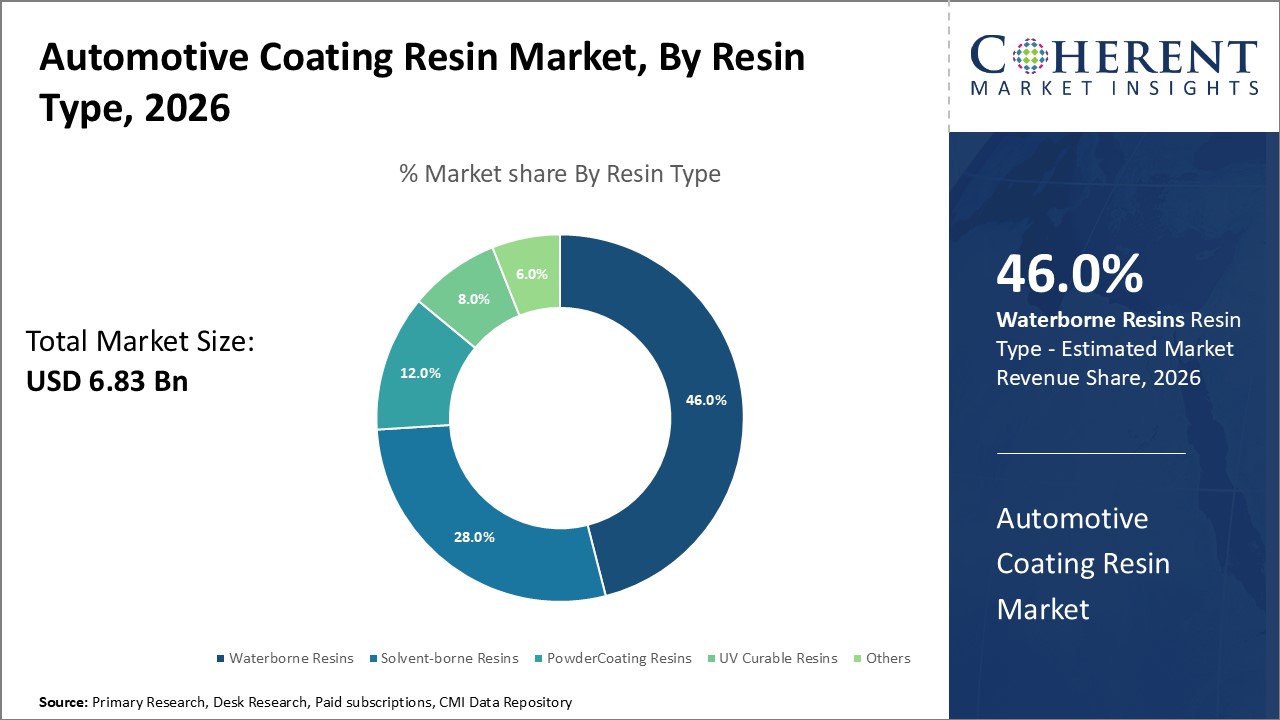
Automotive Coating Resin Market Insights, By Resin Type
Waterborne Resins dominate the market share. Waterborne resins enjoy dominant preference driven by regulatory mandates on VOC emissions and growing consumer demand for greener solutions. Their application in both OEM and refinish coatings has expanded significantly due to formulation improvements, enhancing performance parity with solvent-based resins. The fastest growing subsegment is UV Curable Resins, propelled by advances in rapid curing technologies facilitating high-efficiency production lines and superior surface durability, specifically in premium automotive segments. Solvent-borne resins, despite environmental challenges, remain relevant for applications requiring exceptional chemical resistance.
Automotive Coating Resin Market Insights, By Application
OEM Coatings lead the market due to the scale of new vehicle production worldwide, supported by stringent finish quality and durability demands. The growth of EV manufacturing further intensifies OEM coating resin requirements, necessitating specialized formulations. Refinish Coatings are the fastest growing segment as the increase in vehicle lifespan and usage intensifies the demand for automotive maintenance services. Market companies have focused on developing easy-to-apply and fast-drying resin formulas to capture this aftermarket growth.
Automotive Coating Resin Market Insights, By Vehicle Type
Passenger Cars represent the dominating segment with the largest market share, driven by global vehicle ownership and urbanization trends. This segment benefits from continuous innovation in coating aesthetics and surface protection. On the other hand, Electric Vehicles are the fastest-growing subsegment, experiencing rapid adoption driven by environmental mandates and technological advances in battery and motor systems. Coating resins in this segment often require enhanced thermal and chemical resistance tailored to EV-specific components.
Automotive Coating Resin Market Trends
The automotive coating resin market trend shows a significant momentum toward sustainable materials, with waterborne resin technologies becoming the cornerstone of environmentally compliant coatings.
Technologies enabling low VOC emissions have been widely adopted, with a 20% annual increase in waterborne resin deployment reported across Europe in 2025.
Additionally, the rise in electric and hybrid vehicle manufacturing demands advanced resin formulations tailored for thermal management and corrosion resistance, a segment that grew by 16% in 2026 alone.
Regions like Asia Pacific dominate the industry share due to their robust automotive manufacturing ecosystem and increasing regulatory oversight, driving the need for sustainable coatings.
The integration of nanoparticle technology to enhance resin performance also marks a shift in market dynamics.
Meanwhile, North America stands out as the fastest-growing region with nearly 9% CAGR, driven by federal clean air policies and investments in advanced resin production facilities, exemplified by BASF’s production expansions in the U.S.
Automotive Coating Resin Market Insights, By Geography
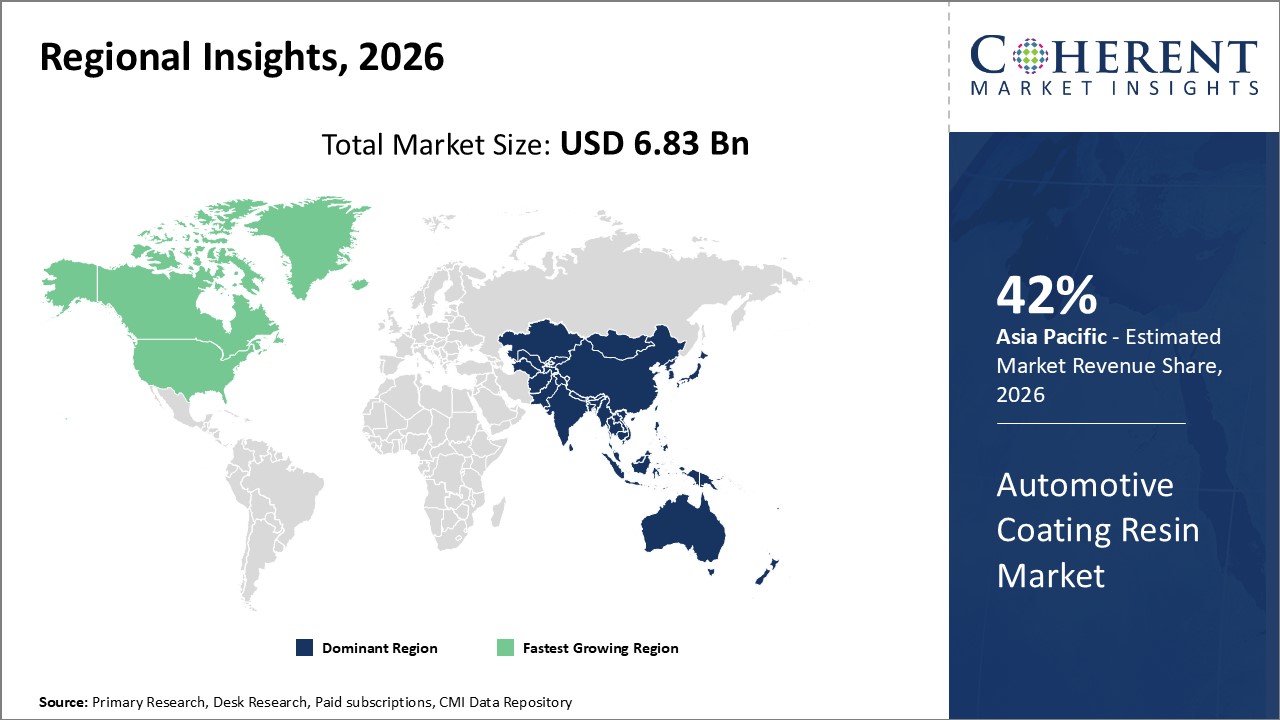
Asia Pacific Automotive Coating Resin Market Analysis and Trends
In the Asia Pacific region, the dominance in the Automotive Coating Resin market is fueled by the massive automotive manufacturing bases in China and India, accounting for approximately 42% of the global market share. Investment in eco-friendly resin technologies aligns with stricter local environmental standards, while active participation by companies like Nippon Paint Holdings and Kansai Paint supports continuous industrial growth.
North America Automotive Coating Resin Market Analysis and Trends
Meanwhile, North America exhibits the fastest growth with a CAGR close to 9%, driven by clean air policies in the U.S. and Canada promoting waterborne and powder coating resins. Strategic capacity expansions by companies such as BASF and PPG Industries support the increasing demand for advanced automotive coatings aligned with sustainability targets.
Automotive Coating Resin Market Outlook for Key Countries
USA Automotive Coating Resin Market Analysis and Trends
The USA’s automotive coating resin market has experienced robust growth, underpinned by stringent environmental laws and the increasing production of EVs and commercial vehicles. Leading manufacturers such as PPG Industries and Sherwin-Williams have invested over USD 200 million in R&D for low-VOC, high-durability resin technologies since 2023, capturing substantial market share. The aftermarket segment’s growth, driven by vehicle longevity and maintenance, further contributes to the market’s revenue, with refinishing accounting for over 30% of total resin sales.
China Automotive Coating Resin Market Analysis and Trends
China’s automotive coating resin market capitalizes on its status as the largest vehicle producer globally. In 2025, it manufactured nearly 28 million vehicles, propelling demand for advanced coating resins. Companies like Nippon Paint and Kansai Paint have established joint ventures with local firms to meet the surge in OEM demand with waterborne and UV curable resins. Additionally, government policies incentivizing electric vehicle adoption bolster the production and use of specialized resin types for battery compartments and underbody coatings, shaping the industry’s strategic direction.
Analyst Opinion
The sustained rise in automotive production globally has significantly driven the demand side of the automotive coating resin market. In 2025 alone, vehicle manufacturing saw a 6.5% uptick in Asia Pacific, especially fueled by production in China and India, increasing paint resin consumption proportionately. Furthermore, the expanding adoption of eco-friendly waterborne resins due to tightening VOC regulations boosted market revenue by nearly 12% year-over-year in regions like Europe.
Supply-side factors, such as improvements in resin manufacturing capacity and raw material availability, have steadily supported market expansion. For example, resin producers in North America increased their polymer output by 7.8% in early 2026, easing supply bottlenecks and stabilizing resin pricing, thereby enhancing market accessibility for OEMs and refinishers.
The demand for high-performance coating resins tailored for electric vehicles (EVs) is a key micro-market driver. EVs require specialized resin formulations to handle thermal variations and provide corrosion resistance in battery compartments. This niche application contributed to a 16% growth in resin demand within EV manufacturing plants in 2025, indicating a strong futuristic revenue stream.
Market dynamics are also influenced by increasing aftermarket refinishes driven by rising vehicle ownership longevity, particularly in mature markets like the U.S. and Germany, where refinishing accounts for nearly 36% of resin usage.
- Current Industry Events of 2026
- Market Size Estimation
- Regional Breakdown
- Competitive Landscape
- Customer Intelligence
- Segmental Analysis
- Pricing Analysis
- Key Market Drivers, Challenges & Future Trends
- Customized Insights Section
Market Scope
| Report Coverage | Details | ||
|---|---|---|---|
| Base Year: | 2025 | Market Size in 2026: | USD 6.83 billion |
| Historical Data for: | 2020 To 2024 | Forecast Period: | 2026 To 2033 |
| Forecast Period 2026 to 2033 CAGR: | 8.4% | 2033 Value Projection: | USD 10.7 billion |
| Geographies covered: |
| ||
| Segments covered: |
| ||
| Companies covered: | BASF SE, Sherwin-Williams, PPG Industries, AkzoNobel, Axalta Coating Systems, Nippon Paint Holdings, The Dow Chemical Company, Kansai Paint, Wacker Chemie AG, Jotun, Hexion Inc. | ||
| Growth Drivers: |
| ||
Automotive Coating Resin Market Growth Factors
The evolving automotive sector, notably the shift toward electric and hybrid vehicles, is driving enhanced demand for specialized coating resins that provide extended protection and compliance with eco-friendly standards. Increasing government regulations targeting low-VOC emissions globally, particularly in Europe and North America, are catalyzing the adoption of environmentally sustainable waterborne resins. The growing preference for premium paints and coatings to improve automotive aesthetics and durability further fuels market growth. In addition, rising vehicle production in rapidly urbanizing regions like the Asia Pacific plays a pivotal role, with countries such as China contributing nearly 40% to the global automotive output in 2025, directly impacting the automotive coating resin market revenue trajectory.
Automotive Coating Resin Market Development
In 2025, SABIC introduced LNP ELCRES SLX1271SR, a next-generation scratch-resistant, high-gloss specialty resin engineered specifically for automotive exterior applications, including spoilers, front grilles, mirror housings, and other styling components that demand long-term aesthetic durability. The material is designed to deliver superior surface hardness, enhanced abrasion resistance, and improved weatherability, enabling OEMs to achieve deep-gloss Class-A finishes without sacrificing structural integrity.
In July 2025, Axalta expanded its industrial coatings portfolio with Cerulean, a new waterborne wood coatings line engineered to replicate the rich aesthetics and depth of traditional solvent-based finishes while significantly reducing VOC emissions and environmental footprint. Cerulean coatings offer enhanced clarity, fast drying properties, improved stain resistance, and excellent film build, making them suitable for cabinetry, furniture, architectural millwork, and premium interior wood applications.
Key Players
Leading Companies of the Market
BASF SE
Sherwin-Williams
PPG Industries
AkzoNobel
Axalta Coating Systems
Nippon Paint Holdings
The Dow Chemical Company
Kansai Paint
Wacker Chemie AG
Jotun
Hexion Inc.
Noteworthy competitive strategies involve BASF’s expansion of its waterborne resin production facility in Germany, increasing supply by 26% and reducing lead times which resulted in capturing a greater market share in 2025. Similarly, PPG Industries' acquisition of specialty coating resin technologies enhanced its product portfolio, enabling successful penetration in the EV coatings segment, boosting its industry share by 5% during the last fiscal year. AkzoNobel implemented strategic partnerships with automotive OEMs in Asia Pacific to co-develop next-generation low-VOC resin formulations, sustaining continuous revenue growth.
Automotive Coating Resin Market Future Outlook
In the future, the resin innovation will pivot on sustainability, functionality for EV platforms, and process intensification. Expect accelerated adoption of low-carbon or bio-derived monomers and binders, radiation-curable chemistries (UV/EB) for energy-efficient curing, and waterborne formulations that meet both environmental and performance specifications. Functional resins that address EV-specific needs—thermally conductive clearcoats for battery-pack thermal management, electrically conductive or EMI-shielding primers for electronic components, and coatings that facilitate rapid charging infrastructure durability—will gain R&D priority. Self-healing microencapsulated resins and smart coatings with embedded sensors for coating integrity monitoring are likely to migrate from demonstrations to selective commercial uses as costs fall.
Automotive Coating Resin Market Historical Analysis
Automotive coating resins have undergone multiple technological waves driven by performance requirements, manufacturing process evolution, and environmental regulation. Early automotive finishes relied on solvent-borne alkyds and nitrocellulose lacquers that offered good appearance but poor durability; the shift to acrylics, polyurethanes, and polyester-based systems in the latter 20th century greatly improved chemical, UV and mechanical resistance. The need for corrosion protection on exposed substrates fostered the development of epoxy-based primers and nickel/zinc-containing pretreatments to prolong body integrity. During the 1990s–2010s regulatory pressure to reduce volatile organic compounds (VOCs) and improve worker safety catalyzed the movement from solvent-borne to high-solids and waterborne resin systems, compelling significant reformulation work to preserve film properties while meeting low-VOC targets.
Sources
Primary Research Interviews:
Coatings chemists
Automotive OEM paint engineers
Supply-chain procurement leads
R&D polymer scientists
Databases:
EPA VOC regulations database
REACH chemicals registry
SAE technical papers
PubMed materials
literature (coatings)
Magazines:
Coatings World
PCI Magazine
European Coatings Journal
Automotive Paints & Coatings
Journals:
Progress in Organic Coatings
Journal of Coatings Technology and Research
Surface and Coatings Technology
Polymer Chemistry
Newspapers:
Financial Times (Industry)
The Wall Street Journal (Automotive)
The Guardian (Environment)
The Hindu (Industry)
Associations:
American Coatings Association (ACA)
European Coatings Association (ECCA)
Society of Automotive Engineers (SAE)
ASTM International
Get access to 250+ pages report
Every segment, forecast, competitor profile and data table behind the analysis above — available for instant download.
- ESOMAR Member
- ISO 9001:2015 Certified
- D-U-N-S Registered
- GDPR & CCPA Compliant
Missing comfort of reading report in your local language? Find your preferred language:
Transform your Strategy with Exclusive Trending Reports
Frequently Asked Questions
The market is led by companies such as BASF SE, Sherwin-Williams, PPG Industries, AkzoNobel, and Axalta Coating Systems, which dominate through expanded production capacities and strategic alliances.
The market size is projected to grow from USD 6.83 billion in 2026 to USD 10.7 billion by 2033, demonstrating strong potential driven by evolving automotive trends and regulatory frameworks.
OEM coatings remain the largest application segment, driven by new vehicle production, while refinish coatings show the fastest growth due to rising aftermarket vehicle maintenance.
Key trends include a significant rise in waterborne and UV curable resins adoption, increased focus on EV-specific resin technologies, and integration of nanotechnology in resin formulations.
The landscape is competitive with a mix of global chemical giants focusing on innovation and capacity expansion. Key challenges include raw material price volatility and strict environmental regulations that require ongoing product adaptation.
Strategies include mergers and acquisitions, development of eco-friendly resin solutions, localization of production to meet regional demand, and forming partnerships with automotive OEMs to co-develop next-gen coatings.