

MEA Rough Terrain Cranes Market Size and Share Analysis- 2026 To 2033
The MEA Rough Terrain Cranes Market size is anticipated to grow at a CAGR of 6.6% with USD 380 Mn in 2026 and is expected to reach USD 600 Mn in 2033. The primary drivers are defined by rising investments in oil & gas projects, mining operations, industrial construction, power plants, ports, and large infrastructure developments across the Middle East and Africa. Some of the other factors include expansion of metro projects, airports, refineries, renewable energy sites, road and bridge construction, logistics hubs, and heavy civil engineering activities, where rough terrain cranes are preferred for lifting operations on uneven and off-road project sites. According to AECOM, MENA energy and utilities construction expanded by 5.3% in 2024, thereby supporting the higher demand for heavy lifting equipment across the region.
Key Takeaways
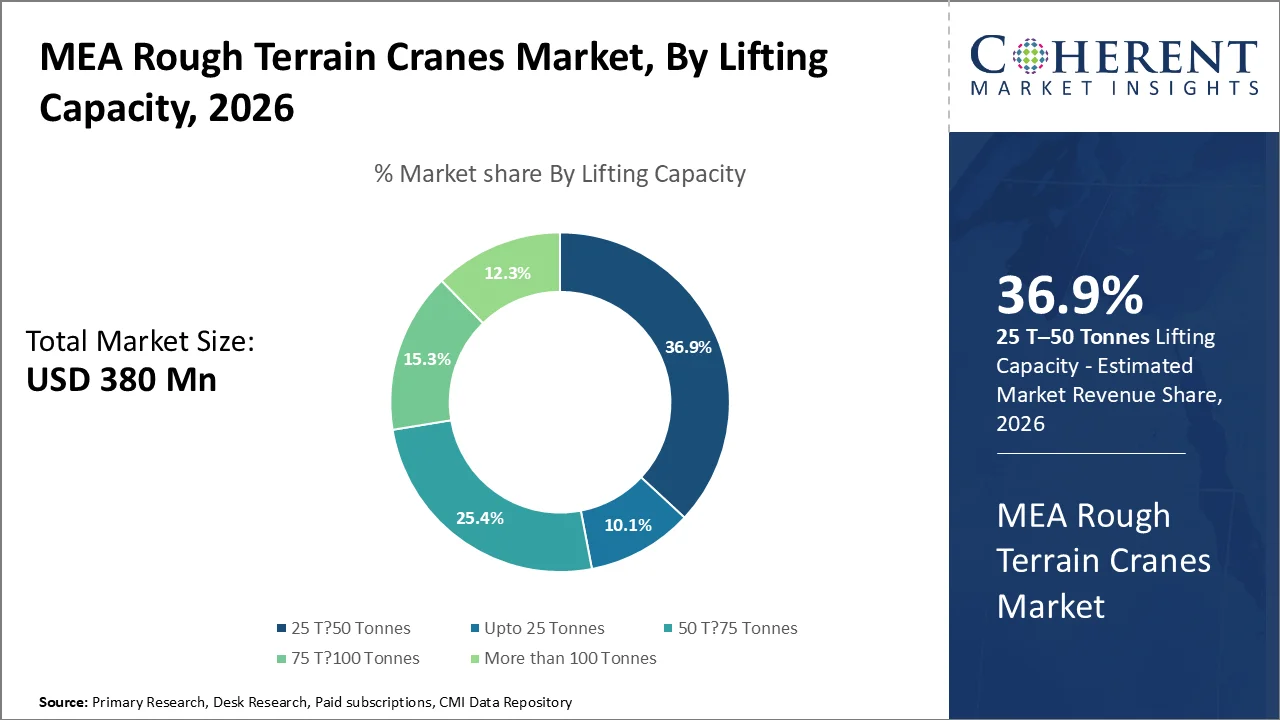
- The 25 T–50 Tonnes segment is likely to dominate the market with 36.9% in 2026. The segment’s growth is owing to increasing utilization in construction projects, oil & gas field operations, utility maintenance activities, and rental fleet expansion supporting mid-capacity lifting requirements across MEA infrastructure development sites.
- The 35 T–50 Tonnes segment is set to lead with 40.4% in 2026. The segment’s growth is owing to the rising deployment in large-scale infrastructure projects, energy installations, port development activities, wind farm maintenance, and industrial construction requiring higher reach, stability, and operational flexibility in complex terrains.
- GCC is expected to acquire the prominent share of 50.3% in 2026. The country’s growth is owing to the strong investment in mega infrastructure projects, expansion of oil & gas downstream facilities, rapid urbanization, transport corridor development, and large-scale construction activities under national transformation programs such as Saudi Vision 2030 and UAE industrial diversification initiatives.
Segmental Insights
Why is 25 T–50 Tonnes Segment Acquiring the Largest Share?
On the basis of lifting capacity, the 25 T–50 Tonnes segment is projected to account for the largest MEA Rough Terrain Cranes Market share of 36.9% in 2026. The segment’s growth is owing to the increasing deployment across large-scale oil & gas construction projects and cross-border infrastructure corridors in GCC countries, where medium-capacity cranes are preferred for balancing mobility and load efficiency in constrained desert terrains.
A key 2026 development is Sarens’ deployment expansion of its heavy equipment fleet in Saudi Arabia for Aramco-linked mega-project logistics, enhancing mid-capacity crane availability for modular lifting and refinery maintenance operations. These structural and project-driven dynamics continue to reinforce the dominance of the 25 T–50 Tonnes segment in the regional rough terrain cranes market.
- Current Industry Events of 2026
- Market Size Estimation
- Regional Breakdown
- Competitive Landscape
- Customer Intelligence
- Segmental Analysis
- Pricing Analysis
- Key Market Drivers, Challenges & Future Trends
- Customized Insights Section
35 T–50 Tonnes hold the Largest Market Share
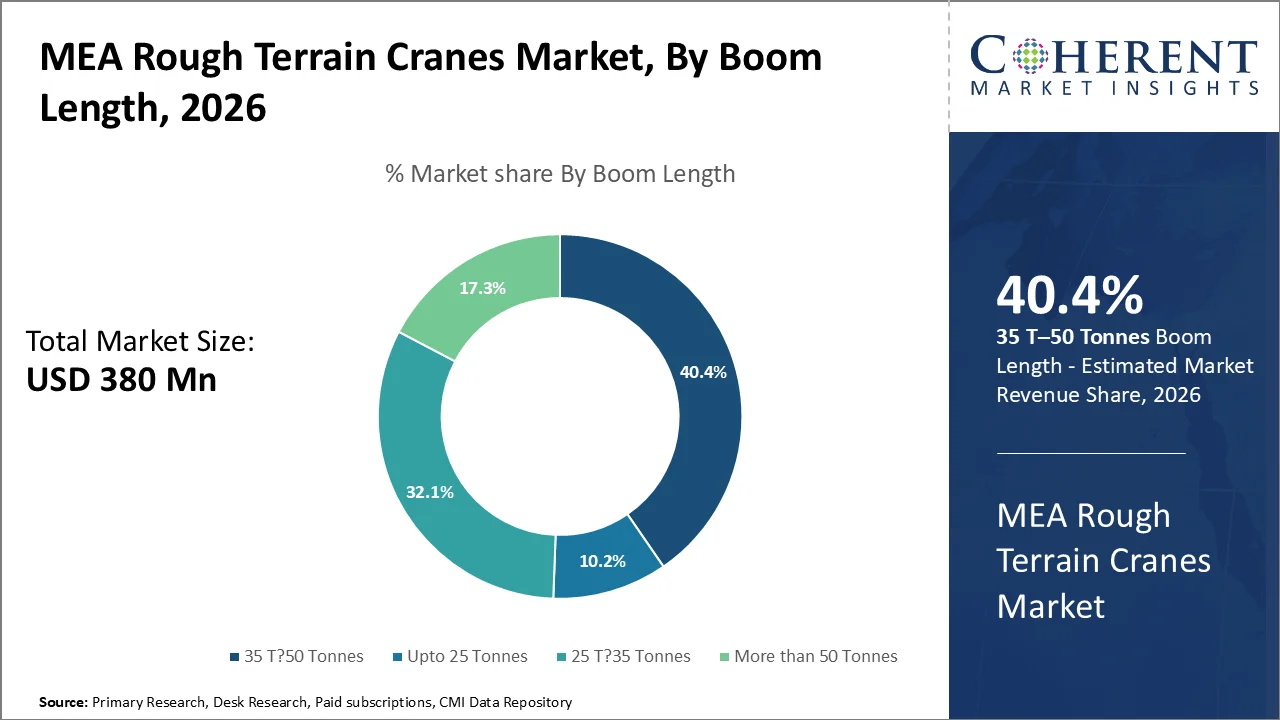
On the basis of boom length, the 35 T–50 Tonnes segment lead with a major 40.4% share in 2026. The segment’s growth is owing to the strong adoption across mid-capacity rough terrain crane configurations, particularly within infrastructure and industrial lifting applications where balanced reach and mobility are required.
OEM specifications and industry classification frameworks indicate that cranes in the 30–50 ton class (including 35-ton variants) are widely preferred due to their operational efficiency in off-road and constrained job-site conditions across the MEA region.
Technical datasets also show that 35-ton rough terrain cranes typically provide boom lengths of approximately 30–32 meters. This allows for effective performance in mid-rise construction, utility installation, and logistics yard operations where moderate reach and high maneuverability are essential.
Market Drivers
Megaprojects and Urbanization are Transforming the MEA Rough Terrain Cranes Market
Megaproject-driven infrastructure expansion under Saudi Arabia’s Vision 2030 continues to significantly strengthen demand for rough terrain cranes across MEA.
According to Saudi Arabia’s Public Investment Fund (PIF)–backed NEOM development authority, the NEOM region spans 26,500 sq. km and is one of the world’s largest active construction zones, requiring continuous deployment of heavy lifting and mobile crane systems for urban, energy, and logistics infrastructure buildout.
A key development is AMHEC’s expansion of its heavy crane fleet to over 500 units, including capacity upgrades up to 800 tons through a major Liebherr order, reinforcing strong rental-driven demand for rough terrain cranes in Saudi Arabia’s construction ecosystem.
Integration of Telematics and AI-driven Smart Load Monitoring: A Major Breakthrough in the MEA Rough Terrain Cranes Market
Integration of telematics and AI-driven smart load monitoring is emerging as a critical advancement in the MEA rough terrain cranes market, particularly across GCC infrastructure and energy projects.
According to Tadano’s official Middle East technology disclosures, modern rough terrain cranes are now equipped with “Hello-Net” telematics systems enabling real-time monitoring of operational status, position, and maintenance data across fleet operations.
The automated crane deployments at Saudi Arabia’s Port of NEOM include remote-controlled RTG and ship-to-shore crane systems implemented in 2025. This marks an early-stage adoption of AI-assisted lifting infrastructure.
Current Events and Their Impact on the MEA Rough Terrain Cranes Market
Current Event | Description and its Impact |
2026 GCC Infrastructure Acceleration under Vision 2030 and National Development Programs |
|
Stricter Safety Regulations and Equipment Compliance Standards in GCC Construction Sector |
|
MEA Rough Terrain Cranes Market Trends
- The rising infrastructure construction across roads, bridges, ports, airports, metros, and industrial zones is increasing the demand for mobile lifting equipment across uneven sites.
- The expansion of oil & gas, petrochemical, refinery, LNG, and power projects is supporting the rental and fleet demand for rough terrain cranes.
- The growing preference for rental-based crane deployment helps contractors in managing high equipment costs, project variability, as well as short-term lifting requirements.
- Saudi Arabia, UAE, Qatar, and other GCC countries continue to propel the crane utilization through giga projects, utilities, real estate, and transport construction. In 2024, GCC construction project contract awards reached approximately USD 264.4 billion, up 6% from USD 249.4 billion in 2023, with Saudi Arabia contributing about USD 142.4 billion.
- African infrastructure development, mining projects, energy corridors, and urban upgrades are creating the demand for cranes suited to rough terrain and remote sites. AfDB estimates Africa’s infrastructure needs at USD 181–221 billion annually over 2023–2030. Also, Africa invests only around 4% of GDP in infrastructure, thereby indicating a large project pipeline.
Regional Insights
GCC Dominates Owing to the Giga-project Activity and Industrial Expansion
GCC accounts for 50.3% of the market share in 2026. The country’s growth is owing to the giga-project activity, oil & gas maintenance, industrial expansion, and logistics development. Projects such as Qiddiya, Red Sea Global, ROSHN, NEOM, and Diriyah create demand for rough terrain cranes across construction, modular lifting, utilities, and industrial support. PIF states that Qiddiya spans more than 360 sq. km, while Red Sea Global covers 28,000 sq. km, thereby indicating the scale of project sites requiring mobile equipment.
In February 2024, Terex appointed Zahid Tractor & Heavy Machinery Co. Ltd. as authorized distributor for Saudi Arabia. This strengthens market access, service coverage, and equipment support, which is critical for rough terrain cranes operating in high-temperature, high-utilization environments.
South Africa MEA Rough Terrain Cranes Market Trends
South Africa is expected to witness strong growth in MEA Rough Terrain Cranes Market over the forecast period. The growth is owing to the mining, ports, renewables, public infrastructure, and industrial maintenance. The country’s infrastructure program includes more than R940 billion in planned spending over three years, with allocations for roads, bridges, dams, ports, airports, and energy. This creates direct demand for rugged lifting equipment across public works, utilities, logistics, and industrial sites.
Terex’s deployment of the TRT 35 rough terrain crane at the Coleskop Wind Farm in South Africa in Jaunuary 2024, shows how RT cranes are used beyond conventional construction, especially in renewable energy and remote-site lifting. South Africa is expected to remain a priority African market due to its larger equipment rental base, industrial fleet requirements, and public-private infrastructure pipeline.
Who are the Major Companies in MEA Rough Terrain Cranes Industry
Some of the major key players in MEA Rough Terrain Cranes Market are The Manitowoc Company, Inc., Terex Corporation, KATO WORKS CO., LTD., Tadano Ltd., Sany Heavy Industry Co., Ltd, Zoomlion Heavy Industry Science And Technology Co., Ltd., Xuzhou Construction Machinery Group Co., Ltd., and Liebherr Group.
Key News
- In September 2025, Raimondi Cranes agreed to acquire Terex Corporation’s tower, self-erecting, and rough terrain crane businesses, including its US service unit, strengthening its global lifting portfolio. The deal is expected to significantly enhance Raimondi’s presence in the Middle East by expanding distribution, service capabilities, and support for regional infrastructure and construction megaproject demand.
- In October 2024, La’ala Al Kuwait Real Estate Company received its sixth Tadano rough terrain crane, completing a major fleet expansion under the GR-package. The cranes will be deployed across the Sabah Al Ahmad Sea City project to enhance lifting and infrastructure execution efficiency.
Market Report Scope
MEA Rough Terrain Cranes Market Report Coverage
| Report Coverage | Details | ||
|---|---|---|---|
| Base Year: | 2025 | Market Size in 2026: | USD 380 Mn |
| Historical Data for: | 2020 To 2024 | Forecast Period: | 2026 To 2033 |
| Forecast Period 2026 to 2033 CAGR: | 6.6% | 2033 Value Projection: | USD 600 Mn |
| Geographies covered: |
| ||
| Segments covered: |
| ||
| Companies covered: | The Manitowoc Company, Inc., Terex Corporation, KATO WORKS CO., LTD., Tadano Ltd., Sany Heavy Industry Co., Ltd, Zoomlion Heavy Industry Science And Technology Co., Ltd., Xuzhou Construction Machinery Group Co., Ltd., and Liebherr Group. | ||
| Growth Drivers: |
| ||
| Restraints & Challenges: |
| ||
Analyst Opinion
- MEA rough terrain crane demand is fundamentally driven by large-scale infrastructure expansion across the GCC and North Africa, supported by continuous investments in highways, airports, urban mega-projects, and oil & gas facility development. In countries such as Saudi Arabia, the UAE, and Egypt, construction diversification programs and industrial expansion are sustaining long-term equipment demand, with lifting equipment forming a critical part of project execution cycles.
- Rough terrain cranes in the MEA region are extensively utilized in oilfield maintenance, refinery shutdowns, and remote industrial operations where mobility and high lifting capacity are essential. The market is largely rental-led, as contractors prefer flexible access to high-cost lifting assets rather than ownership, especially for short-duration, high-intensity projects in desert and offshore-support environments.
- The shift toward energy transition projects including renewable installations like wind farms along with continued mega infrastructure developments is speeding up the adoption of high-performance RT cranes with improved safety systems and higher load capacities. Harsh operating conditions across desert terrain, combined with rising emphasis on operational efficiency and workplace safety standards, are also pushing the demand toward advanced, all-terrain-capable lifting solutions across MEA markets.
Speak to the analyst
Want personalized insights?
Take the findings above to one of our principal consultants, or have the report rebuilt around the segments, geographies and competitors you actually track.
Market Segmentation
- By Lifting Capacity (Revenue, USD Mn, 2021-2033)
- Upto 25 Tonnes
- 25 T-50 Tonnes
- 50 T-75 Tonnes
- 75 T-100 Tonnes
- More than 100 Tonnes
- By Boom Length (Revenue, USD Mn, 2021-2033)
- Upto 25 Tonnes
- 25 T-35 Tonnes
- 35 T-50 Tonnes
- More than 50 Tonnes
- By Region (Revenue, USD Mn, 2021-2033)
- GCC
- Israel
- Turkey
- South Africa
- Northern Africa
- Rest of Middle East and Africa
Sources
Primary Research Interviews
- Crane rental companies
- Construction and infrastructure contractors
- EPC project managers
- Mining, oil & gas, and utility operators
- Heavy equipment distributors and dealers
- Key opinion leaders (KOLs) in construction equipment and lifting machinery
Databases
- World Bank Infrastructure and Development Indicators
- International Monetary Fund (IMF) Economic Database
- UN Comtrade Database
- African Development Bank (AfDB) Data Portal
Magazines
- International Cranes and Specialized Transport
- Cranes Today
- Construction Machinery Middle East
Journals
- Journal of Construction Engineering and Management
- Automation in Construction
- International Journal of Construction Management
- Engineering, Construction and Architectural Management
Newspapers
- Gulf News
- The National
- The Wall Street Journal
Associations
- Specialized Carriers & Rigging Association (SC&RA)
- Construction Equipment Association (CEA)
- European Association of Abnormal Road Transport and Mobile Cranes (ESTA)
- International Powered Access Federation (IPAF)
Public Domain Sources
- Company Annual Reports and Investor Presentations
- Government Infrastructure, Transport, and Public Works Ministry Publications
- Public Tender Portals and Project Pipeline Announcements
Proprietary Elements
- CMI Data Analytics Tool
- Proprietary CMI Existing Repository of Information for Last 10 Years
Get access to 250+ pages report
Every segment, forecast, competitor profile and data table behind the analysis above — available for instant download.
- ESOMAR Member
- ISO 9001:2015 Certified
- D-U-N-S Registered
- GDPR & CCPA Compliant
Missing comfort of reading report in your local language? Find your preferred language:
Transform your Strategy with Exclusive Trending Reports
Frequently Asked Questions
The MEA Rough Terrain Cranes Market is expected to reach USD 600 Mn in 2033.
Major players operating in the global MEA Rough Terrain Cranes Market include The Manitowoc Company, Inc., Terex Corporation, KATO WORKS CO., LTD., Tadano Ltd., Sany Heavy Industry Co., Ltd, Zoomlion Heavy Industry Science And Technology Co., Ltd., Xuzhou Construction Machinery Group Co., Ltd., and Liebherr Group.
The high equipment and maintenance costs, economic volatility from fluctuating oil prices, and logistical disruptions are the key factors hampering growth of the market.
The massive government infrastructure programs, widespread investments in the energy and mining sectors, and a booming regional construction industry is boosting the demand for MEA Rough Terrain Cranes.
The MEA Rough Terrain Cranes Market is anticipated to grow at a CAGR of 6.6% between 2026 and 2033.
GCC is expected to account for a largest market share in the global MEA Rough Terrain Cranes Market over the forecast period.
It includes rough terrain cranes with multiple lifting capacities, boom lengths, hydraulic lifting systems, all-terrain mobility features, telescopic booms, load monitoring systems, and operator safety technologies used across construction, oil and gas, mining, logistics yards, industrial maintenance, and infrastructure projects in the GCC and Africa.