Shaft parts often work under torque, bending load, impact, and repeated fatigue. This is why engineers rarely choose shaft material by hardness alone. The steel must have enough strength, toughness, hardenability, machinability, and heat-treatment stability for the actual working condition.
42CrMo, AISI 4140, and 42CrMo4 are often discussed together because they are chromium-molybdenum alloy steels used for high-strength mechanical components. In sourcing and machining projects, they may be treated as equivalent or near-equivalent grades. That is useful for international procurement, but it can also create risk if the buyer ignores standards, heat treatment, section size, and final mechanical requirements.
These material requirements also help explain the continued use of alloy steels in demanding mechanical applications. The global alloy steel market is estimated to be valued at USD 153.90 billion in 2026 and is expected to reach USD 202.47 billion by 2033, exhibiting a compound annual growth rate (CAGR) of 4.0% from 2026 to 2033. The growth of the market highlights the continued use of alloy steels in components where strength, toughness, hardenability, as well as durability are important, including the shaft applications discussed below.
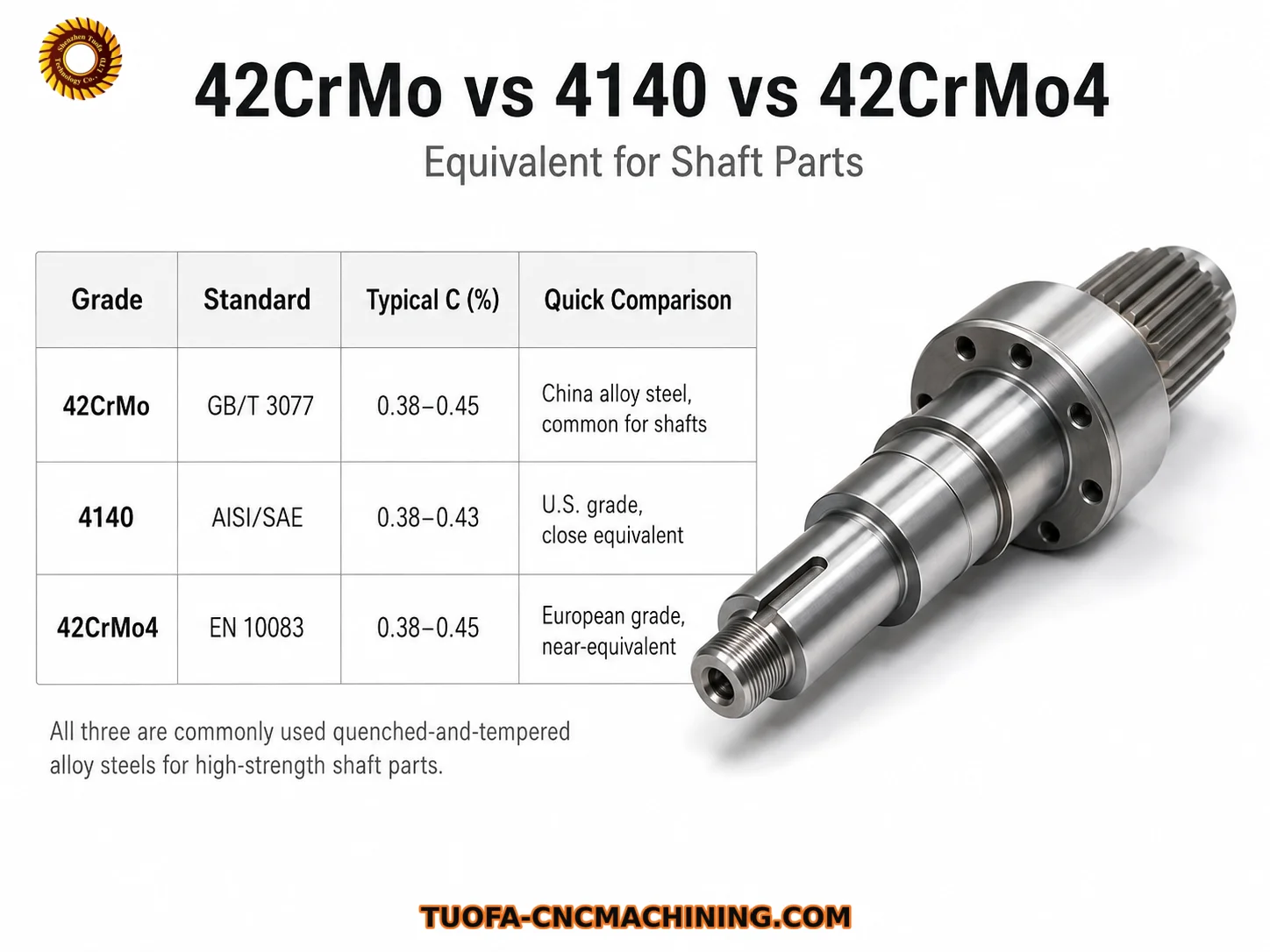
Are 42CrMo, 4140, and 42CrMo4 the Same Material?
They are closely related Cr-Mo alloy steels, but they should not be treated as automatically identical for every shaft project. The safer approach is to compare the standard, chemical range, heat-treatment condition, and required mechanical properties before accepting a substitution.
Regional Grade Names
42CrMo is commonly associated with Chinese GB standards. AISI 4140 is the American designation. 42CrMo4 is the European grade, often connected with EN/DIN 1.7225.
In practical sourcing, a drawing may call for 4140, while a Chinese supplier proposes 42CrMo. A European customer may specify 42CrMo4, while the available stock is 4140. These substitutions can be reasonable, but only when the material certificate, heat treatment, and final performance requirements are checked.
For buyers comparing 42crmo equivalent machining, the key point is not only the grade name. The real question is whether the delivered steel can meet the shaft’s strength, hardness, toughness, and dimensional stability after machining.
Equivalent Does Not Mean Unchecked Substitution
Equivalent grades usually mean the materials are close enough for comparison, sourcing, or engineering discussion. They do not remove the need for verification.
Small differences in chemical limits, sulfur content, cleanliness, heat treatment, or inspection standard can affect machining behavior and final part performance. This matters more when the shaft has tight bearing fits, keyways, splines, cross holes, threads, shoulders, grooves, or long slender geometry.
Why These Steels Are Used for Machined Shafts
Shafts need to transmit power or motion while resisting deformation, wear, as well as fatigue. 42CrMo, 4140, and 42CrMo4 are widely used because they offer a practical balance of strength, toughness, and hardenability after proper heat treatment.
Strength and Toughness Balance
A shaft material should not be only hard. If a shaft is too brittle, it may crack under impact or cyclic loading. Cr-Mo steels are usually selected as they can reach useful strength levels while still retain toughness when heat treated correctly.
This balance is important for drive shafts, motor shafts, pump shafts, actuator shafts, spindle components, pins, axles, as well as other load-bearing cylindrical parts.
Hardenability for Larger Sections
Shafts are often thicker than simple plates or brackets. Hardenability matters because the material must achieve suitable properties not only near the surface but also deeper into the section.
For larger shaft diameters, material condition and heat treatment should be specified clearly. A small shaft and a large shaft made from the same grade may not behave the same after quenching and tempering.
Fatigue Resistance Under Repeated Load
Many shafts fail from fatigue rather than one-time overload. Surface quality, radius design, grinding marks, keyway corners, and machining scratches can all affect fatigue life.
This is why material choice must be connected with machining quality. A correct steel grade can still fail early if the shaft has poor transitions, sharp notches, or rough surfaces in high-stress areas.
What Machining Issues Should Buyers Expect?
Most shafts depend on turning for their main geometry. Bearing diameters, shoulders, grooves, threads, and stepped sections must be controlled carefully because small dimensional errors can affect assembly, rotation, sealing, and service life.
Maintaining this level of repeatability is one reason CNC-based machining is widely used for shaft production. CNC systems allow manufacturers to control cutting paths, speeds, feeds, and tool movements consistently across batches, which is particularly useful for shafts with multiple precision features. The Computer Numerical Control Machine Market is estimated to be valued at USD 96.85 billion in 2026 and is expected to reach USD 187.54 billion in 2033, exhibiting a compound annual growth rate (CAGR) of 9.9% from 2026 to 2033. This growth shows high demand for automated as well as repeatable machining processes, particularly where complex geometries, tight tolerances, as well as consistent production quality are required.
Machining Before or After Heat Treatment
Some shafts are rough machined before heat treatment and then finish machined or ground afterward. This approach aid control distortion as well as achieve accurate final dimensions.
For lower-precision parts, machining from pre-hardened stock may be acceptable. For high-precision shafts, bearing seats, sealing surfaces, threaded sections, and positioning shoulders often need post-heat-treatment finishing.
Tool Wear and Cutting Stability
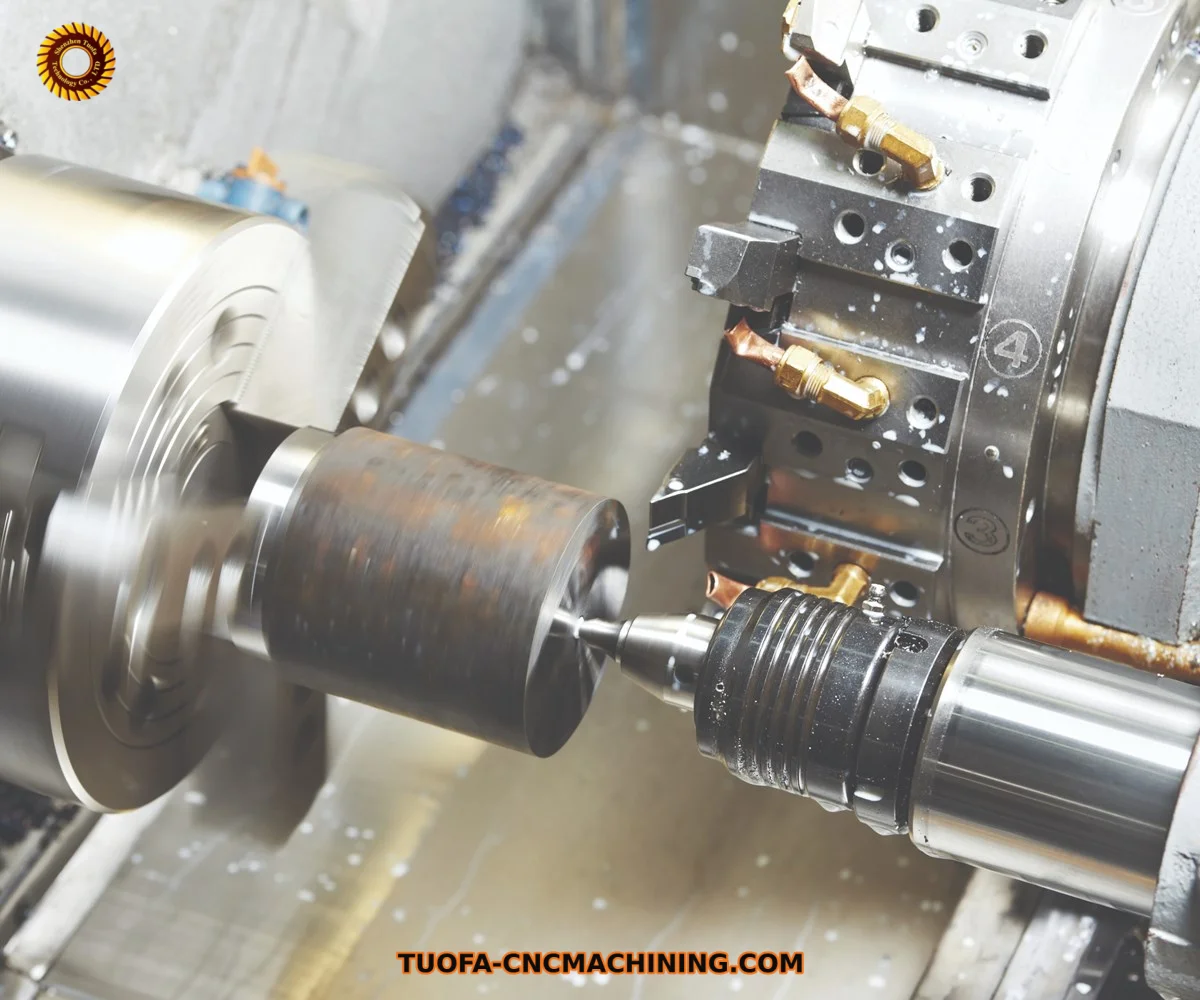
Tool selection with machine stability becomes especially important when machining hardened or heat-treated Cr-Mo steels. Stable cutting parameters, rigid fixturing, appropriate inserts, as well as coolant control can aid manage tool wear and cutting heat. These requirements place high emphasis on the capability as well as precision of the machine tools used in production. The global machine tools market is estimated to be valued at USD 110.50 billion in 2026 and is expected to reach USD 135.92 billion by 2033, exhibiting a compound annual growth rate (CAGR) of 3.0% from 2026 to 2033.
For machined steel, cnc milling for steel structures may be needed for shaft-adjacent features such as flats, keyways, slots, cross holes, mounting faces, as well as structural connection areas. Even when the main shaft body is turned, milling operations are often part of the complete manufacturing route.
Turning Accuracy for Cylindrical Features
Shafts typically rely on turning for their primary geometry. Bearing diameters, shoulders, grooves, threads, as well as stepped sections must be machined accurately as even small dimensional errors can affect assembly, rotation, sealing, and service life. As a result, lathe capability and machining accuracy are important considerations in shaft manufacturing. The Global Lathe Machine Market is estimated to be valued at USD 31.31 billion in 2026 and is expected to reach USD 45.85 billion by 2033, exhibiting a compound annual growth rate (CAGR) of 5.6% from 2026 to 2033. The expansion shows escalating demand for precision turning equipment used to make cylindrical components with controlled diameters, shoulders, grooves, threads, surface finishes etc.
A capable turned parts supplier should be able to manage concentricity, runout, surface finish, tool marks, and repeatability, especially for parts used in motors, actuators, and automation equipment.
What Should Buyers Check Before Accepting Equivalent Grades?
Material substitution can lower cost or lead time, but it should be controlled. Before accepting 42CrMo, 4140, or 42CrMo4 as alternatives, the buyer should confirm whether the substitution still matches the shaft’s function, load, as well as inspection requirements.
Drawing Standard
If the drawing says 4140, check whether it refers to AISI, ASTM, or a customer-specific standard. If it says 42CrMo4, confirm whether EN 10083 or another European standard is expected. If it says 42CrMo, confirm the GB standard and material condition.
The same short grade name can be understood differently by different suppliers. However, experienced machining companies (such as Tuofa CNC Machining) sometimes propose suitable alternatives based on factors like drawing designs and functional requirements to help reduce costs for the customer.
Heat-Treatment Condition
For shaft parts, material grade without heat-treatment condition is incomplete. Buyers should define whether the part is annealed, normalized, quenched and tempered, pre-hardened, induction hardened, or nitrided.
Hardness range, tensile strength, yield strength, and impact toughness may be more important than the grade name itself.
Shaft Function
Not every shaft needs the same material condition. A lightly loaded positioning shaft may not need the same strength as a drive shaft. A shaft with splines, keyways, cross holes, threads, or high torque load may need better toughness and fatigue resistance.
For complex machined shafts, the design should consider material, heat treatment, machining sequence, surface finish, and stress concentration together.
Practical Comparison for Sourcing Decisions
This comparison should be used as a procurement guide, not as final engineering approval. The final decision should follow the drawing, operating load, heat treatment, inspection requirement, and customer approval process.
|
Grade
|
Common Standard Context
|
Typical Use in Shaft Projects
|
Main Caution
|
|
42CrMo
|
Chinese GB material designation
|
Cost-effective sourcing for high-strength machined shaft parts
|
Verify equivalence if the drawing was originally based on AISI or EN standards
|
|
AISI 4140
|
American alloy steel designation
|
Shafts, axles, pins, rods, spindle parts, and high-load cylindrical components
|
Confirm ASTM/AISI condition and heat treatment
|
|
42CrMo4 / 1.7225
|
European EN/DIN context
|
High-strength shafts, axles, rotating parts, and mechanical load-bearing parts
|
Check EN requirements and supplier certificate
|
Conclusion
42CrMo, 4140, and 42CrMo4 are closely related Cr-Mo alloy steels commonly used for machined shaft parts. They are usually acceptable options in international sourcing, but they should not be replaced by name.
For reliable shaft manufacturing, the buyer should confirm the applicable standard, material certificate, heat-treatment condition, machining route, tolerance requirements, as well as final inspection method. The material grade creates the foundation, but the finished shaft depends on controlled machining, correct heat treatment, good surface quality, and suitable design details.

