What’s the Best SEO Tool for Most Teams in 2026?
For most agency and mid-market teams, SE Ranking is the pick, because it keeps traditional SEO and AI-search visibility in one place instead of two subscriptions and two logins. You can see what that covers on the SE Ranking platform. One honest caveat: if your whole quarter rides on deep backlink analysis, a specialist will go further. Otherwise, the ranked list below shows where each of the best SEO tools fits.
|
Rank
|
Tool
|
Best for
|
Entry price
|
Tracks AI search
|
Where it fits
|
|
1
|
SE Ranking
|
Running SEO and AI visibility together
|
$129/mo
|
Yes — AIO, AI Mode, ChatGPT, Gemini, Perplexity
|
Core stack for the recurring 80%
|
|
2
|
Ahrefs
|
Backlink-first research and link analysis
|
$129/mo
|
Higher-tier only
|
Specialist layer for deep link work
|
|
3
|
Semrush
|
Broad all-in-one with PPC and content depth
|
$139/mo
|
Higher-tier only
|
Teams already invested in its ecosystem
|
|
4
|
Moz Pro
|
Standardizing on Domain Authority scoring
|
$99/mo
|
No
|
In-house teams anchored to DA metrics
|
|
5
|
Surfer SEO
|
On-page and content optimization
|
$49/mo
|
No
|
Content teams scoring drafts at scale
|
|
6
|
Serpstat
|
Multi-tool SEO on one dashboard
|
$50/mo
|
No
|
Lean teams wanting broad coverage
|
|
7
|
Sitebulb
|
Technical crawls and audit reporting
|
$18/mo
|
No
|
Technical deep-dives before launches
|
|
8
|
Google Search Console
|
First-party Google performance data
|
Free
|
No
|
Baseline data every team should connect
|
Which SEO tool should most teams start with?
With the best SEO tools, start with the one that covers the work you repeat every week, not the deepest single feature. For most agency and mid-market teams that's SE Ranking: rank tracking, audits, keyword research, and AI-search visibility in one SEO platform, in one login instead of four.
One more filter: if most of your clients run on WordPress, weigh the best SEO tools for WordPress that publish straight into it, like SE Ranking and Surfer — fewer tabs for your writers.
Do you need separate tools, or does one platform cover it?
Among the best SEO tools, most teams need one platform plus one or two specialists, not a drawer full of subscriptions. An all-in-one like SE Ranking covers the recurring layer; you add a specialist only when a job needs it — backlink forensics in Ahrefs, content scoring in Surfer, a heavy crawl in Sitebulb. The mistake I see is buying five tools for coverage you use twice a year.
My take: run your recurring 80% on one platform and reserve specialists for the jobs that earn them. Fewer logins, fewer exports, fewer places for a client-facing error to hide.
What should an SEO tool do now that AI answers the query?
The new baseline for the best SEO tools is changing: they need to show whether a brand is visible inside AI-generated answers, not just where it ranks in traditional search results.
That shift is also reflected in the growth of the AI search market. The Global AI Search Engines Market is expected to be valued at USD 49.83 billion in 2026 and reach USD 110.52 billion by 2033, exhibiting a CAGR of 14.2% from 2026 to 2033. As AI-powered search experiences become a larger part of how users discover and evaluate information, SEO teams increasingly need to understand visibility beyond conventional search rankings.
This changes what SEO software needs to measure. In addition to rankings, technical health, backlinks, and keywords, teams increasingly need visibility into how their brands appear across AI-powered search experiences and answer engines.
1. SE Ranking
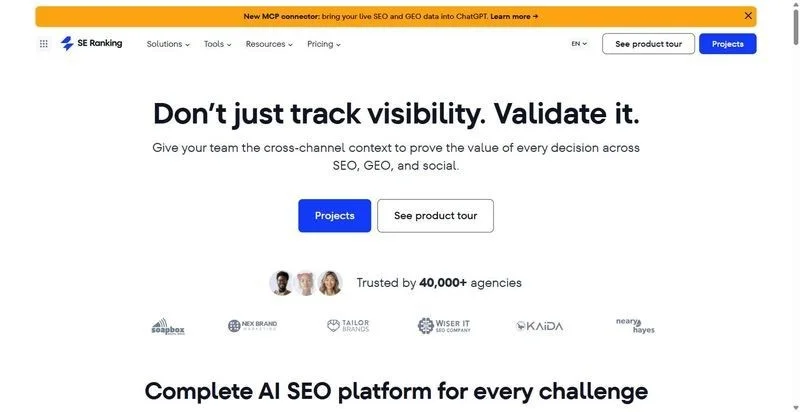
SE Ranking is where I point most agency and mid-market in-house teams — the first of the best SEO tools I bring up when rankings work and AI-search reporting need the same login.
Best for: agencies and mid-market in-house teams that report on SEO performance and AI visibility together.
Standout feature: You run rank tracking and AI-search visibility from one account, watching how your brand shows up across AI Overviews, AI Mode, ChatGPT, Gemini, and Perplexity next to your Google positions. Add a 115-check site audit that returns fix guidance instead of a raw error list, and one client review stops needing three tabs.
Pros
- Tracks classic rankings and AI-answer visibility side by side, so client reports tell one story
- Runs a 115-point site audit with prioritized fixes your junior staff can action
- Ships API and MCP access in every plan, so you can pull data into Claude or your own dashboards without a separate add-on
- Covers 188 country databases, which matters when your roster spans markets
Cons
- A few agency-facing pieces, like white-label reporting, sit in the Agency Pack rather than the base plan
- Some databases are smaller than the largest single-purpose rivals, though they keep growing
- The depth rewards teams who already know what they're after; it's not a tool you hand a brand-new hire on day one
Pricing: Core $129/mo ($103.20/mo billed annually); Growth $279/mo. API and MCP are in every plan. 14-day trial, no card.
My take: Here's the thing — most of my roster needs one place that covers the recurring 80% and shows clients the AI-search picture they now ask about. This does both without a second subscription. If your work lives or dies on the deepest backlink index, weigh that honestly. For everyone else, start here.
2. Ahrefs
Ahrefs is the tool I open when the problem is backlinks, or a competitor's beating us and I need to know why.
Best for: teams whose work leads with backlink analysis and organic competitor research.
Standout feature: The backlink index is deep, and competitor research is where it earns its keep. When a client asks why a rival is climbing, you can trace their referring domains, top pages, and traffic keywords in minutes, then plan off real numbers instead of a guess.
Pros
- Backlink data deep enough to settle most "how are they ranking?" questions
- Competitor and content-gap views surface real opportunities fast
- Site Explorer reads quickly once your team knows it
Cons
- Base plan is one user; extra seats add up across an account team
- AI-search visibility is thin on the entry plan
- Credit metering can slow a heavy research week
Pricing: Lite $129/mo (5 projects, 750 keywords, 1 user).
My take: Hard to beat for backlink-led work. But the single-seat plan and credit limits mean cost creeps once the whole team logs in, so I keep it as a specialist, not the daily platform.
3. Semrush
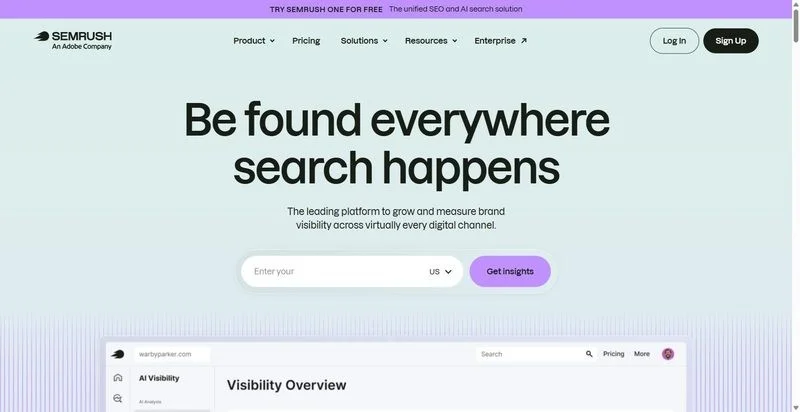
Semrush is the broad all-in-one — search, PPC, or content, there's usually a module for it inside.
Best for: teams that want the widest single toolkit spanning SEO, paid search, and content.
Standout feature: The breadth is the point. Keyword research, position tracking, site audit, PPC data, and content tools all sit under one roof, so a team standardizing on one vendor runs most of its recurring work in one place.
Pros
- Covers more distinct jobs than almost anything else here
- Strong keyword and competitive-research datasets
- Deep enough that most SEO questions have an answer inside it
Cons
- Entry plan caps you at 5 projects, 500 keywords, and 1 user — a growing roster outgrows it fast
- Cost climbs steeply once you add seats
- Stronger AI-search tracking sits on higher tiers, not the base plan
Pricing: SEO plan $139/mo ($117.33/mo billed annually).
My take: The breadth is real. But across twelve retainers, the per-seat pricing and entry-plan limits made the math harder than it looked — if you want one vendor, price the full team first.
4. Moz Pro
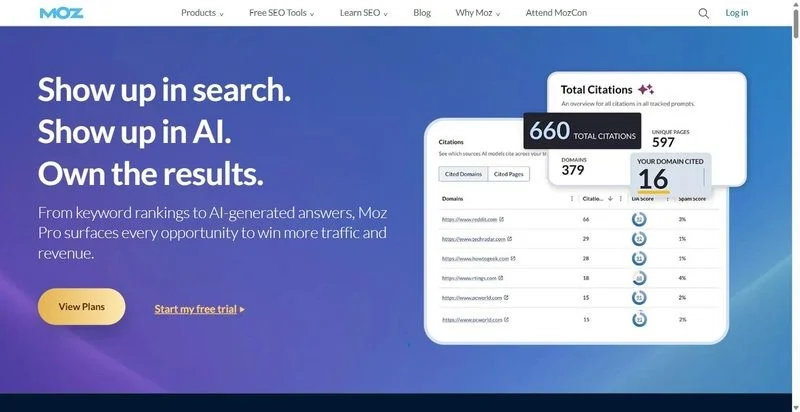
Moz Pro is the one I reach for when a client wants numbers they can read at a glance.
Best for: teams that report to non-technical stakeholders who want clean, readable metrics.
Standout feature: Domain Authority is a Moz metric, and love it or not, clients understand a single 0-to-100 score. Paired with Moz Local — one of the more approachable best local SEO tools for multi-location clients — it makes a tidy reporting layer for stakeholders who glaze over at raw ranking tables.
Pros
- Readable metrics non-technical clients grasp instantly
- Moz Local handles multi-location listings cleanly
- Gentle learning curve for newer team members
Cons
- Domain Authority is a proxy score, not a Google signal, so treat it as directional
- The link index is smaller than the biggest specialist tools
- Slower data refresh, so fast-moving campaigns can lag
Pricing: Standard $99/mo ($79/mo billed annually); Starter $49/mo single-site.
My take: Moz Pro is a clean reporting layer, not the engine room. If your clients respond to readable scores and you serve multi-location brands, it earns a spot — just don't lean on DA as a ranking factor.
5. Surfer SEO
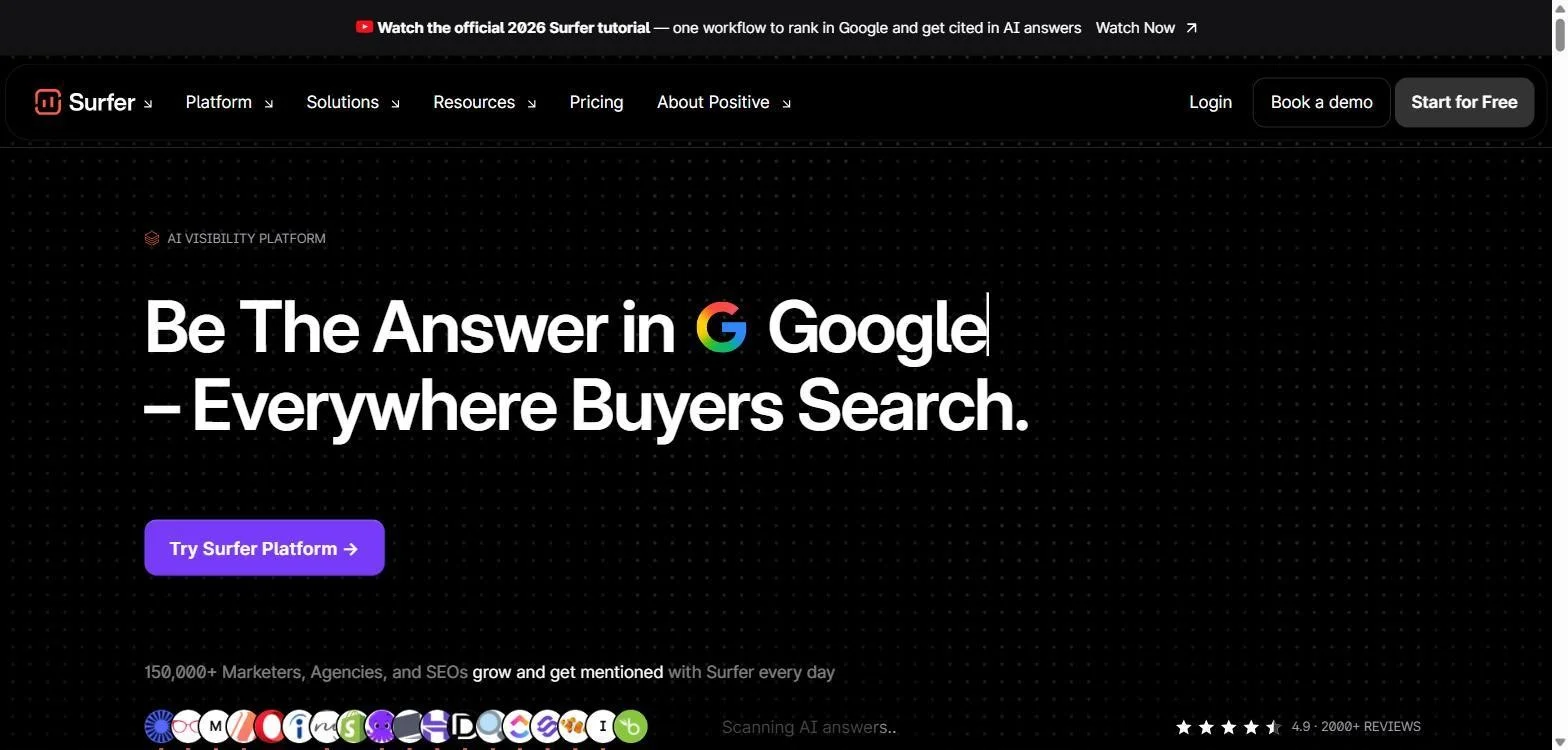
Surfer SEO scores a draft against what's already ranking for a query, then shows your writer exactly where the page falls short.
Best for: content teams and agencies running on-page optimization at volume across client blogs.
Standout feature: When a client asks why a well-written page won't rank, Surfer answers in specifics — it compares your draft to the current top results and hands the writer a live checklist of terms, headings, and length targets. For teams shipping weekly, it's one of the more useful best ai tools for seo on the writing side.
Pros
- Grade drafts against live SERP data before you publish
- Give writers a concrete checklist instead of vague direction
- Speed up briefs and editing across a full content calendar
Cons
- It optimizes content; it isn't a full SEO platform
- Some capabilities sit in paid add-ons
- No real rank-tracking depth, so you'll pair it with another tool
Pricing: Discovery from $49/mo.
My take: Surfer earns its seat when content is a big share of the retainer. It won't track rankings or audit a site, so it lives alongside your main platform, not instead of it.
6. Serpstat
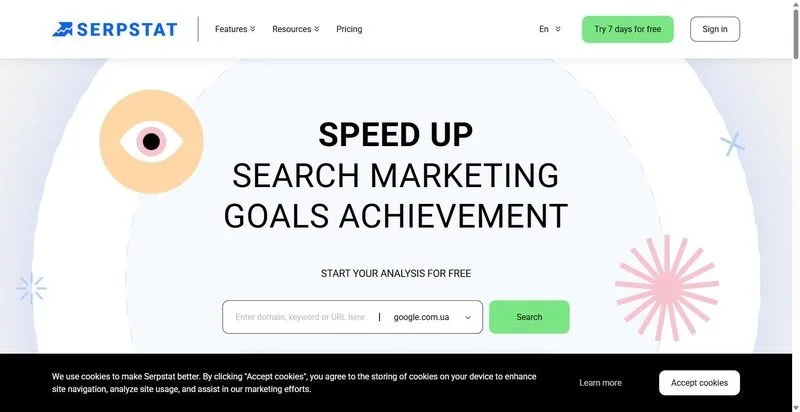
Serpstat is what I reach for when a client needs a bit of everything — keyword ideas, a competitor read, a quick audit — without opening four tabs.
Best for: research-led teams that want wide coverage from one SEO platform instead of three subscriptions.
Standout feature: When a client wants keyword ideas, a competitor gap, and a fast audit in the same week, Serpstat covers all three from one account. That breadth is why it lands among the best paid seo tools for teams who value coverage over owning the single deepest dataset.
Pros
- Run keyword, competitor, and rank data from one account
- Cover site audits without buying separate modules
- Automate client reporting through its API
Cons
- Dense UI — a new account manager needs a week before it feels natural
- Index depth trails the leaders on large, competitive domains
Pricing: Individual $50/mo.
My take: I'd hand Serpstat to a team that lives in research and reporting and doesn't need the deepest index. The breadth is useful — just know that on your largest accounts the data thins out, exactly where clients scrutinize hardest.
7. Sitebulb
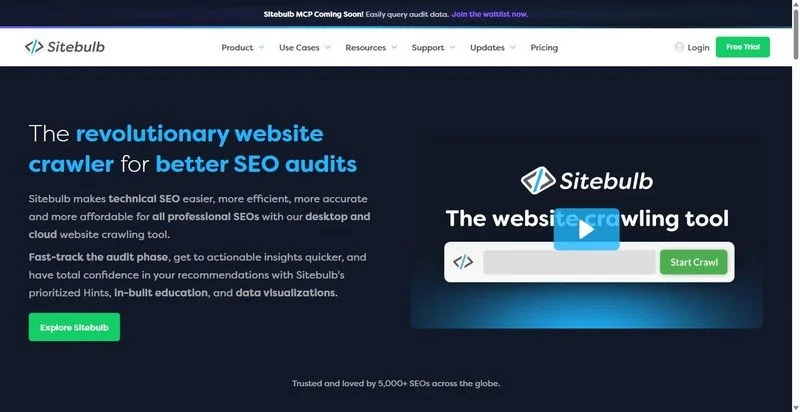
Sitebulb crawls a site and, instead of dumping a wall of errors, tells you which issues actually hurt and why.
Best for: technical leads and agencies running recurring audits across client sites.
Standout feature: When a developer pushes back on an audit finding, Sitebulb gives you the answer in plain language — what the issue is, why it matters, how urgent it is. JavaScript rendering ships on every tier, down to the $18/mo Lite plan, so you're not guessing on modern sites.
Pros
- Turn a raw crawl into a prioritized, explainable to-do list
- Render JavaScript on every tier, entry plan included
- Produce audit reports a client reads without a translator
Cons
- Desktop-first, so shared multi-user access means the Cloud tier
- Audit-only — no rank tracking, no keyword research
Pricing: Desktop Lite $18/mo; Pro $42/mo; Cloud from $125/mo.
My take: Sitebulb is a specialist, and I keep it that way. When audits are a billable deliverable, the explanations save my juniors hours and give me something defensible for a client's dev team. Don't ask it to be your rank tracker.
8. Google Search Console
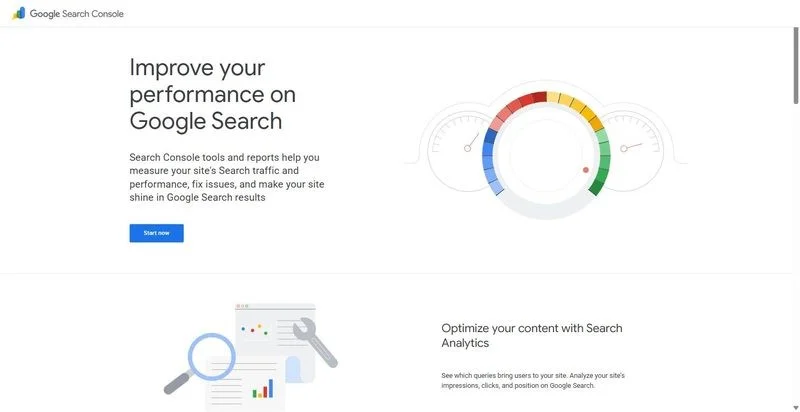
Google Search Console is Google handing you its own data on how you show up in search — free, first-party, and non-negotiable.
Best for: every team, as the source-of-truth layer under whatever paid platform you run.
Standout feature: No paid tool replicates this. Search Console shows the actual queries bringing people to your pages, real impressions and click-through, plus indexing status and Core Web Vitals straight from Google.
Pros
- See real query, impression, and click data from Google itself
- Catch indexing and coverage problems before they cost traffic
- Feed clean first-party data into your other tools
Cons
- Google-only — no Bing, no competitor view, no AI-search picture
- Query data is sampled and capped
Pricing: Free.
My take: This isn't optional. Every account we run has Search Console connected on day one — it won't show the competition or where you stand in AI answers, but the ground truth lives here.
The bottom line — and when to skip a tool
Here's where I land after every one of these conversations: of all the best SEO tools here, SE Ranking is the one I'd start most agency and mid-market in-house teams on — traditional SEO, AI-search visibility, and audits with fix guidance under one login. But buy for the job in front of you, not the longest feature list. Don't make Surfer your main platform; it won't track a ranking. And skip a desktop crawler like Sitebulb if your team is remote and needs the same audit open at once.
Frequently asked questions
How much should a team budget for SEO tools?
Budget for the best SEO tools scales with your operation, not with finding the lowest sticker. A mid-market in-house team usually runs one core platform in the $100–300/mo range, then adds a specialist tool or two. Agencies budget per seat and per client project, so the figure tracks your roster size, not a flat number.
Can beginners use professional SEO tools?
Honestly? They can, but the best SEO tools aren't built for someone's first week in SEO. The data depth that makes them worth paying for is the same depth that overwhelms a person still learning what a backlink profile means. If you're new, start with Google Search Console and one focused tool, then grow into a full platform once the concepts click.

