

Global 800V DC AI Rack Power Equipment Market Size and Forecast – 2026 To 2033
The Global 800V DC AI Rack Power Equipment Market is estimated to be USD 286.2 Mn in 2026 and is projected to grow to USD 2,290.8 Mn by 2033, at a CAGR of 34.60% between 2026 and 2033. The growth of the market is attributed to the shift toward high-density AI computing racks, rising demand for efficient power conversion and development of advanced DC distribution systems.
In March 2026, Texas Instruments launched a full 800V DC power architecture for next-gen AI data centers, offering an 800V-to-6V isolated bus converter with a peak efficiency of 97.6%. This development is a sign of the progress made in high efficiency power conversion technologies aimed at supporting the next generation AI computing infrastructure.
Key Takeaways of the Global 800V DC AI Rack Power Equipment Market
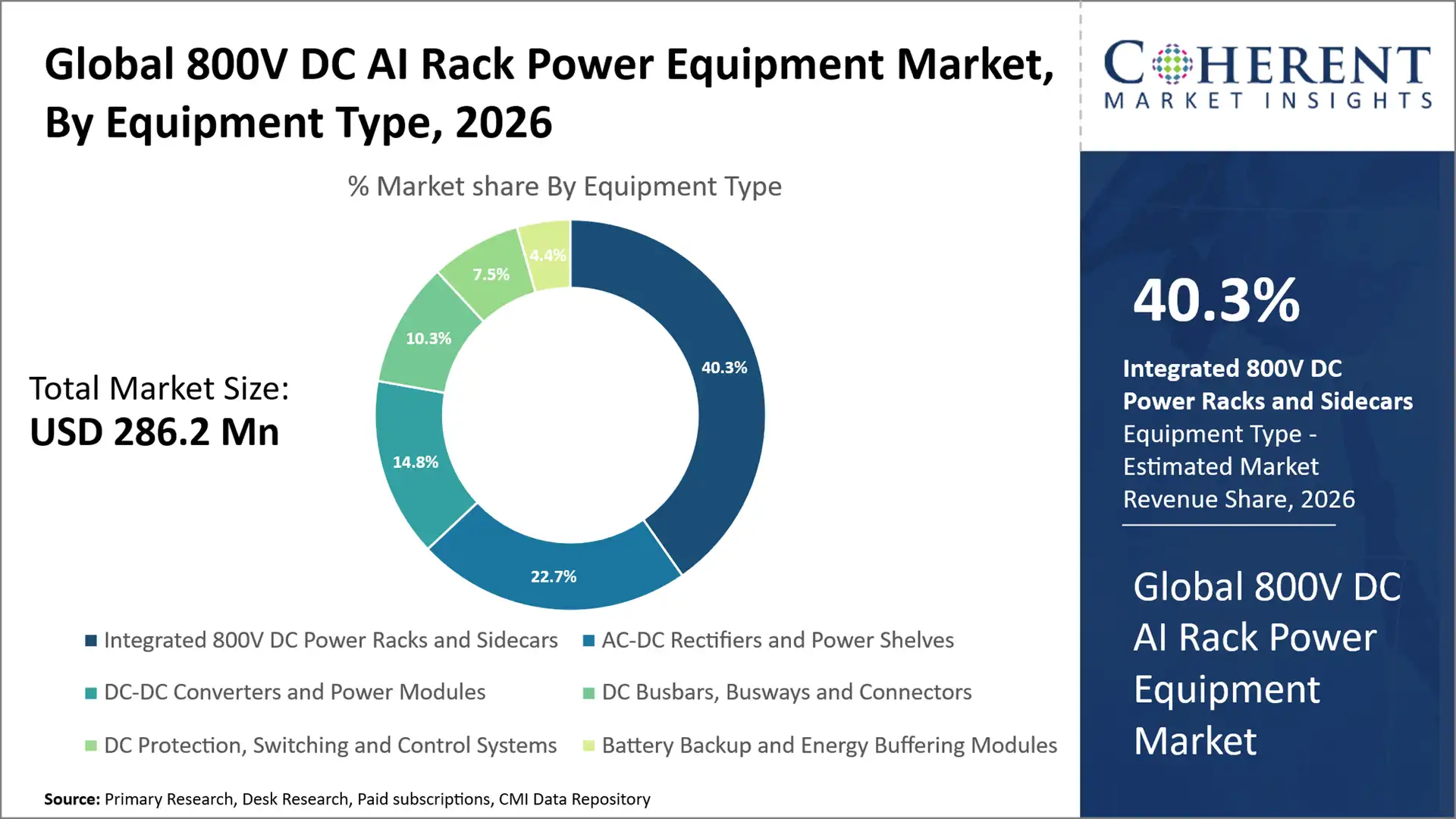
- Integrated 800V DC power racks and sidecars projected to grow at a CAGR of 35.8% through 2033 and to represent 40.3% of the global 800V DC AI rack power equipment market in 2026. Integral rectification, energy buffering and cooling simplify high density rack deployments. In June 2026, LITEON showed a liquid-cooled 800 VDC power rack which integrated power shelves and battery backup units.
- Systems rated above 600 kW–1 MW are expected to grow at a CAGR of 36.7% through 2033, accounting for 50.7% of 2026 global 800V DC AI rack power equipment market revenue. This voltage range supports high density GPU clusters while limiting conductor requirements compared to lower voltage distribution. In July 2026, Vertiv launched its PowerDirect 5000 sidecar, intended to deliver up to 900 kW to compute racks.
- Hybrid AC-Fed 800V DC Rack Systems to grow at 34.1% CAGR through 2033, will account for 94.2% of 2026 global 800V DC AI rack power equipment market revenue. The commercial benefit is they are compatible with existing AC distribution infrastructure so there is no need for costly facility redesign. In August 2026, the Open Compute Project suggested side power racks which convert 480 VAC feeds to 800 VDC near the compute racks.
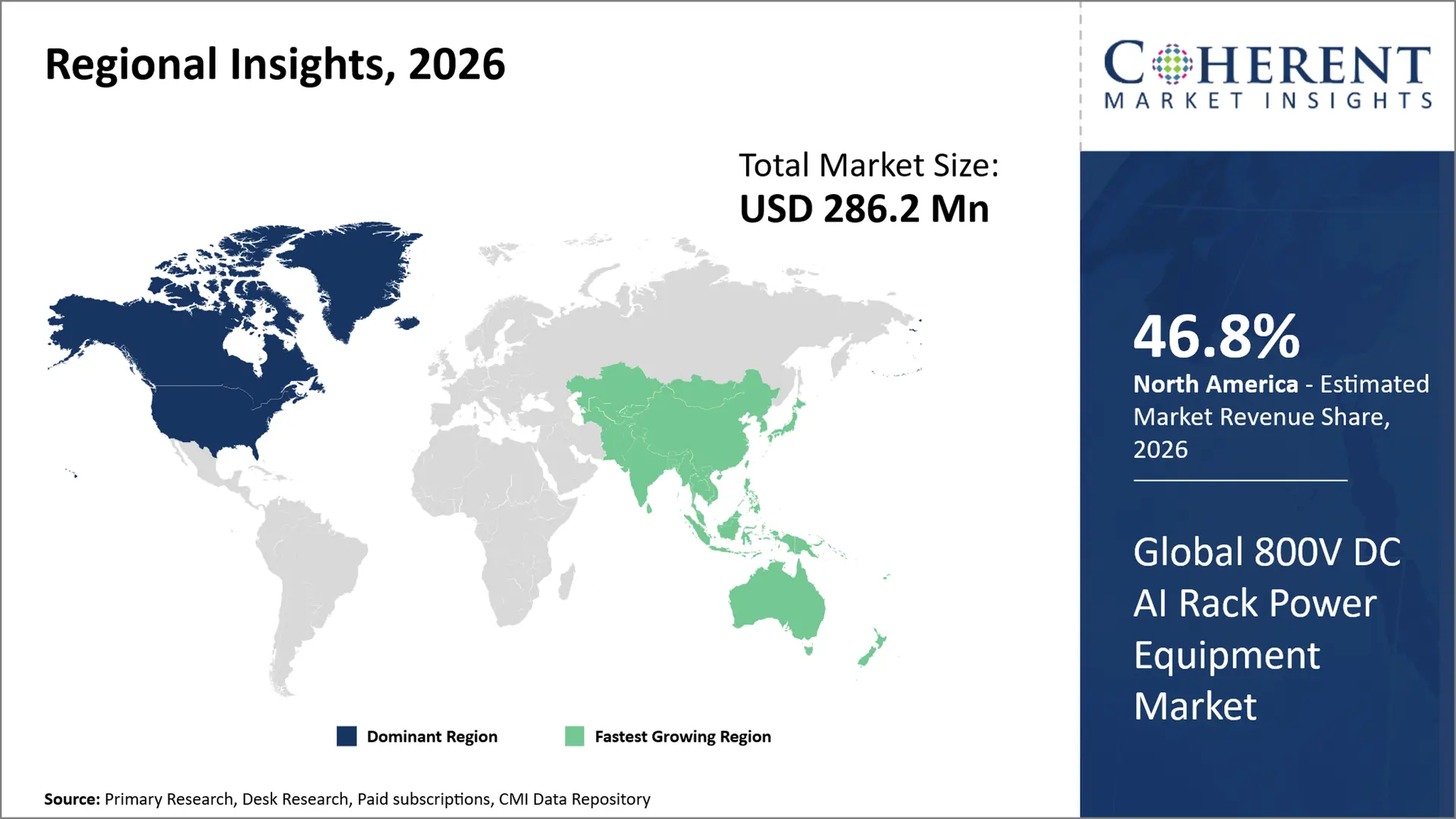
- North America is expected to grow at a CAGR of 32.9% through 2033 and represented 46.8% of global 800V DC AI rack power equipment market revenue in 2026. The region’s leadership is supported by hyperscale procurement and specialist power engineering. In October 2026, US-based Vantage announced that it had secured over 1 GW of manufacturing capacity for the 800 VDC-compatible solid-state transformer platform from Heron Power Electronics.
- Asia Pacific is expected to expand at a CAGR of 38.9% by 2033 and hold a 31.4% market share in 2026. Taiwan’s base in manufacturing AI servers and its regional supply chain for power electronics can speed up the qualification and integration of equipment. Foxconn said its Kaohsiung K-1 AI data center, due to come online in October 2025, will be the first built using its 800 VDC architecture.
Segmental Insights
Why Do Integrated 800V DC Power Racks and Sidecars Dominate the Global 800V DC AI Rack Power Equipment Market?
Integrated 800V DC power racks and sidecars will make up 40.3% of the global 800V DC AI rack power equipment market in 2026. Their leadership suggests procurement will opt for a single, factory-engineered assembly rather than qualifying rectifiers, storage modules, and protection hardware separately. For hyperscale operators this approach is clear on the responsibility for system testing, operating performance and maintenance support. On the supply side, manufacturers can standardize internal module interfaces and customize rack configurations to customer-specific electrical requirements. This makes integrated equipment attractive for use in commercial high density AI deployments where engineering delays can delay server commissioning. October 2025: Schneider Electric said it is developing an 800V DC sidecar that will support racks of up to 1.2 MW, modular conversion shelves and energy storage. The announcement reflects the supplier’s emphasis on complete power assemblies rather than individual components.
- Current Industry Events of 2026
- Market Size Estimation
- Regional Breakdown
- Competitive Landscape
- Customer Intelligence
- Segmental Analysis
- Pricing Analysis
- Key Market Drivers, Challenges & Future Trends
- Customized Insights Section
Why Does the Above 600 kW–1 MW Segment Represent the Largest Power Capacity Category in the Global 800V DC AI Rack Power Equipment Market?
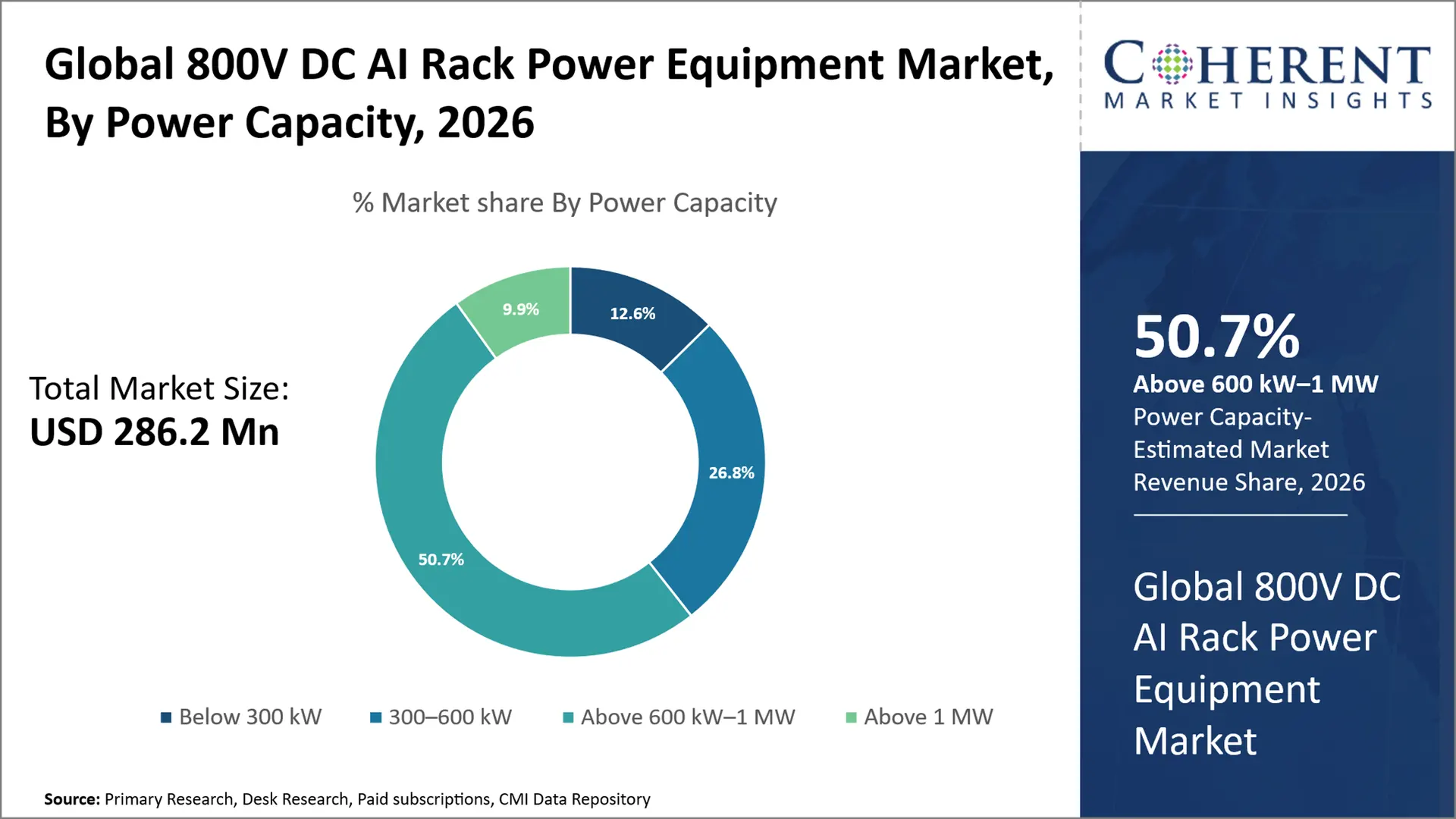
Above 600 kW–1 MW power capacity segment is expected to have 50.7% of the power capacity in 2026. This range suits the electrical planning requirements of emerging accelerator racks without forcing buyers to immediately commit to larger, above-1-MW configurations. For the AI infrastructure builders, choosing equipment in this capacity range can help better align IT deployment timing, power budgets and future server refreshes. Suppliers can address this category by employing standardized high-output shelving that permits phased capacity additions and coordinated load management. This is especially relevant for hyperscale training clusters preparing for more dense generations of computer hardware. In March 2026, Flex Ltd announced an 800V DC power rack to support future GPU configurations delivering up to 880kW per rack. It is a case of the commercial focus on power systems built for this size of capacity.
Why Do Hybrid AC-Fed 800V DC Rack Systems Dominate the Power Architecture Segment of the Global 800V DC AI Rack Power Equipment Market?
Hybrid AC-Fed 800V DC Rack Systems are expected to represent 94.2% of the global 800V DC AI rack power equipment market in 2026. Their leadership demonstrates the operational need of introducing new rack voltages without disturbing established facility procedures. Upstream AC infrastructure maintains known feeder configurations, redundancy practices and power quality monitoring while qualifying DC equipment in selected rows. This staged approach is especially relevant to running colocation facilities where electrical changes need to be scheduled around tenant service agreements. Suppliers who offer clear protection boundaries, documented commissioning procedures and integration support can ease customer concerns about operational disruption. In September 2026, Hitachi announced plans to unveil DC800V Intelligence, a hybrid AC/DC rack-level power distribution platform that can connect existing AC infrastructure to 800V DC systems. The move is indicative of the heightened focus on controlled power architecture migration.
Current Events and their Impact
Current Event | Description and Its Impact |
May 2024 – EU Data Center Sustainability Reporting Regulation |
|
July 2025 – Federal Permitting Reform for AI Data Centers in the U.S. |
|
November 2025 – UK AI Growth Zones Infrastructure Policy |
|
Global 800V DC AI Rack Power Equipment Market Dynamics
Key Market Drivers
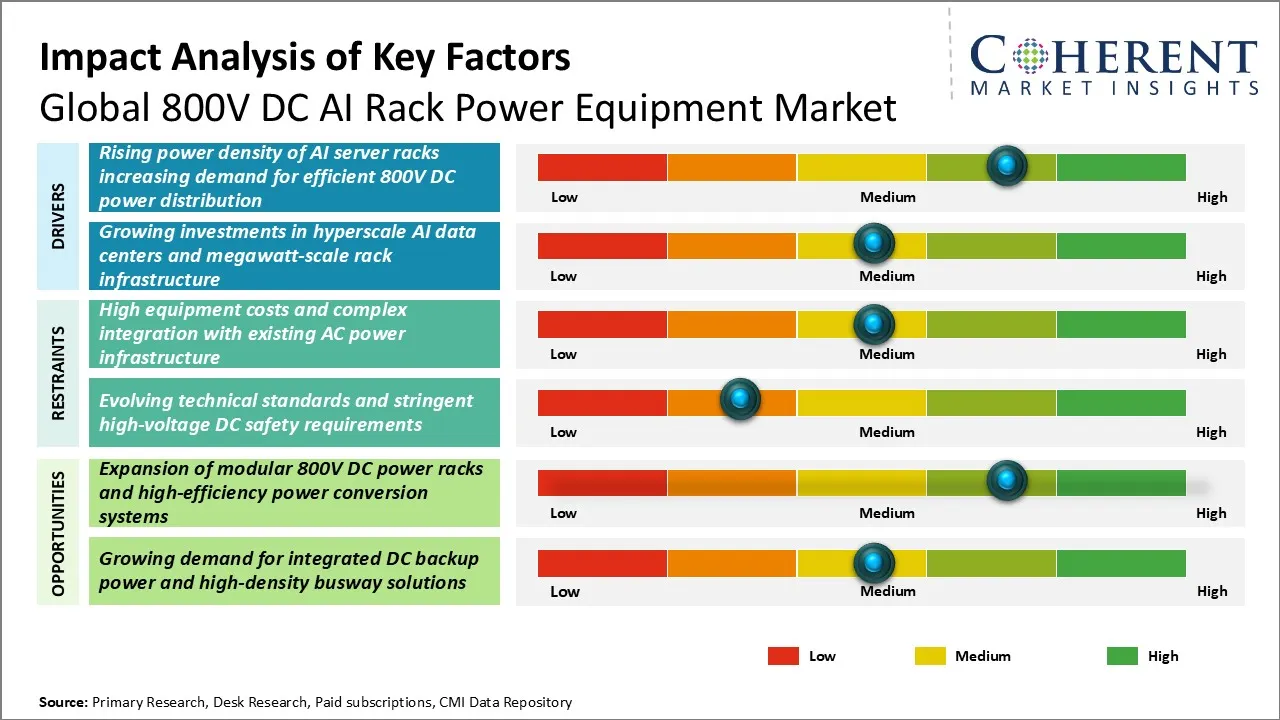
- Rising power density of AI server racks increasing demand for efficient 800V DC power distribution: AI server manufacturers are designing increasingly dense computing racks, creating electrical distribution challenges for traditional low-voltage systems. More copper, more connector losses, more heat, less space for computing equipment. More copper for higher operating currents. So, moving to 800V DC distribution means that manufacturers can get more power without the current increasing proportionally. This is good for power module vendors, busbar makers, and AI rack integrators building compact electrical infrastructure. In May 2025, NVIDIA revealed its 800V DC architecture that will drive megawatt-scale AI computing racks from 2027.
- Growing investments in hyperscale AI data centers and megawatt-scale rack infrastructure: Expanding hyperscale AI campuses are generating opportunities for high-capacity electrical infrastructure capable of supporting large accelerator clusters. Developers are requesting more scalable power distribution, coordinated backup systems and equipment configurations that can accommodate changing server demands. These investments offer potential procurement opportunities for rack power manufacturers, electrical contractors and system integration providers. By September 2025, the drive had generated nearly 7 GW of planned capacity, including the announcement of five more U.S. Stargate data center sites from OpenAI. Such projects expand the potential customer base for next-generation rack power systems, although specific 800V DC procurement was not confirmed.
Emerging Market Trends
- Increasing Emphasis on Coordinated DC Protection and Electrical Safety: AI data center operators are focusing on coordinated protection systems as 800V DC distribution brings new fault interruption and electrical isolation needs. Manufacturers are developing DC-rated circuit breakers, insulation monitoring and intelligent fault detection to improve the safety of the system.
Impact: Greater emphasis on electrical safety will increase demand for validated protection equipment and specialized engineering services, strengthening opportunities for suppliers offering integrated safety solutions.
Relevance to the Market: Safety compliance and reliable fault isolation will become key buying factors for 800V DC rack power gear especially in hyperscale AI facilities.
- Integration of Workload-Aware Power Management and Energy Buffering: The rapid power fluctuations generated by AI computing workloads increase the need for responsive power management within 800V DC rack systems. To ensure the power delivered is stable, manufacturers are combining real-time monitoring, intelligent controllers and energy buffering modules.
Impact: Improved load management will increase operational stability and will provide opportunities for suppliers of advanced power control systems and integrated energy buffering solutions.
Relevance to the Market: As AI rack power densities increase, workload-aware power management will be part of equipment differentiation and buying decisions.
Key Restraining Factors
- Complex DC Fault Protection and Safety Validation Requirements: There are challenges to the adoption of 800V DC rack power systems which are related to the ability to interrupt faults, provide electrical isolation and ensure personnel safety. High voltage DC circuit equipment must be able to interrupt sustained fault currents and handle stored energy in power converters. The manufacturer must validate protection coordination across rectifiers, busways, switching devices and backup modules. Different electrical codes and certification requirements can raise engineering costs, extend product qualification cycles and delay purchasing decisions for data center operators.
- High Initial Integration Costs and Limited Infrastructure Compatibility: The shift to 800V DC distribution requires specialized power conversion equipment, connectors, electrical protection, and operating procedures. Some engineering effort may be required to integrate high voltage DC equipment into existing data center AC infrastructure. Furthermore, uncertainty about the future specifications of GPU racks can make operators hesitant to commit to fixed electrical configurations. These issues may restrict early adoption for smaller enterprise facilities and colocation providers with limited capital budgets.
Regional Insights
Why Does North America Dominate the Global 800V DC AI Rack Power Equipment Market?
North America is expected to have a 46.8% share of the global 800V DC AI rack power equipment market in 2026, due to the concentration of vendors of advanced electrical equipment and hyperscale AI infrastructure players in the region. Large data center operators have the ability to integrate high-voltage DC requirements into their facility planning, opening up opportunities for the development of coordinated energy storage systems, protection systems and power conversion. The region enjoys close cooperation between equipment manufacturers and the developers of computing infrastructure and has existing capacities in electrical engineering. October 2025 Eaton unveiled an 800V DC reference architecture for AI data centers that incorporated power management and protection technologies into its grid-to-chip initiative. This development cements the region’s position in designing next-generation electrical systems and provides manufacturers with a framework to develop high-density AI power infrastructure.
Why Is Asia Pacific Emerging as the Fastest-Growing Region in the Global 800V DC AI Rack Power Equipment Market?
The Asia Pacific region is expected to hold 31.4% of the global 800V DC AI rack power equipment market in 2026 and experience the fastest growth rate through 2033. It benefits from its semiconductor development, production of power electronics and sophisticated supply chains for server components, giving it a competitive edge. Regional manufacturers can commercialize specialized conversion devices and compact power modules for high voltage AI infrastructure, which enables a faster pace of equipment qualification. In September 2026, Japan-based Renesas Electronics Corporation introduced a dual-side-cooled 650V GaN device for power conversion in 800V DC AI data center architectures. The device is intended for power sidecars in the applications of energy backup and intermediate conversion. This development points to the growing component capabilities in the region and opens up opportunities for compact, thermally efficient power electronics suppliers.
Global 800V DC AI Rack Power Equipment Market Outlook for Key Countries
Why Is the U.S. a Key Market for the Global 800V DC AI Rack Power Equipment Market?
The U.S. is a key 800V DC AI rack power equipment market due to the existing relationships between AI infrastructure vendors and component designers and its specialized power semiconductor development capabilities. Domestic suppliers are developing power conversion technologies that address voltage regulation, current density, and thermal limitations in next generation computing systems. These capabilities make it possible to develop integrated power modules and qualified DC-DC converters for AI racks. Monolithic Power Systems said it had sampled an 800V power solution for data center applications in February 2026, according to the full-year 2025 earnings commentary. This is an example of the country’s contribution to high-voltage power electronics advancement, and an opportunity for domestic manufacturers to get future design qualifications from AI equipment vendors.
Why Does China Support Growth in the Global 800V DC AI Rack Power Equipment Market?
China’s ability to combine electrical distribution with AI computing infrastructure and power electronics manufacturing capabilities powers the market development. Domestic equipment suppliers are developing high-voltage DC systems using intelligent busbars, modular power distribution and monitoring technologies. These integrated offerings can enable Chinese manufacturers to expand their specialized equipment portfolios to meet international AI infrastructure needs. In October 2026, ZTE launched the ZXEDC M8000 intelligent computing micro-module with 800V HVDC distribution, intelligent busbars and integration of liquid cooling. The product is designed for high-density AI computing installations that require a flexible power infrastructure. This development strengthens China’s position as a supplier of integrated rack power technologies and provides opportunities for system engineering suppliers and component manufacturers.
Why Is Japan Important in the Global 800V DC AI Rack Power Equipment Market?
Japan's 800V DC AI rack power equipment market potential is closely linked to the development of compact, high-performance AI computing facilities in densely populated urban areas. To optimize computing capacity, data center operators have to pay attention to the availability of electricity, the limitation of the installation area and the cooling requirements. Situations like this create opportunities for modular rack power equipment that can accommodate future high-density GPU configurations. NTT DOCOMO BUSINESS and TEPCO Power Grid will construct a liquid-cooled container data center park in Tokyo’s Ota Ward in August 2026, designed to house advanced GPU servers. While the adoption of 800V DC is yet to be confirmed, the project indicates Japan’s investment in infrastructure suitable for high-density computing, and indicates a possible future customer base for advanced rack power suppliers.
800V DC AI Rack Power Equipment: Procurement and Deployment Landscape
Market Parameter | Customer Requirements | Current Market Landscape | Commercial Significance |
AI Rack Power Capacity Planning | Power systems that meet the specs of GPU racks and future capacity requirements | Buyers are evaluating scalable power configurations to accommodate the deployment of future generations of AI servers. | Opens up opportunities for long term supply contracts and configurable equipment |
Infrastructure Compatibility of Data Centers Today | Smooth integration with existing AC distribution system without major facility modification | At the same time as phased 800V DC deployments, operators are assessing the existing electrical infrastructure. | Increases likelihood of adoption by legacy data centers and reduces retrofit complexity |
Compatibility of system and qualification of suppliers | Verified interoperability of facility electrical systems, AI racks, and power equipment | Procurement increasingly relies on system-level validation and coordinated engineering reviews. | It’s a preference for suppliers with existing relationships with AI infrastructure developers and that provide qualified designs. |
Electrical Safety and Compliance | Documentation for safety procedures, protection coordination, grounding and reliable DC fault isolation | Safety assessments and commissioning validation for high-voltage DC installations must be application-specific. | Provides suppliers specialized engineering and compliance capabilities and opportunities. |
Capital Investment and Operating Economics | Acquisition costs that are competitive, efficiency of conversion, and maintenance costs that are manageable | Customers are looking at total cost of ownership, not just the cost of the equipment. | Increases manufacturers’ ability to deliver efficient systems at lower lifecycle costs. |
Support Through Lifecycle and Equipment Delivery | Predictable delivery schedules, replaceable modules, and dependable technical support | For big AI infrastructure projects, it is necessary to plan the availability, installation and maintenance of equipment. | Deepens long-term relationships with manufacturers and fosters recurring service revenue |
What effect does multi-tenant AI computing facilities have on the growth of the global 800V DC AI rack power equipment market??
Multi-tenant colocation facilities are an emerging commercial opportunity, as AI customers seek high-density computing capacity without the need to build dedicated data centers. Colocation providers, unlike hyperscale operators, must support a variety of server configurations, contractual power allocations, and tenant-specific reliability requirements within a shared infrastructure.
That opens the door to modular 800V DC distribution systems with configurable capacity, selective electrical isolation and independent power metering. Equipment manufacturers can provide pre-engineered power shelves, distribution assemblies and commissioning services to colocation developers, GPU hosting providers and specialized AI infrastructure operators.
Successful entry into the market requires compatibility with a variety of computing racks, transparent operating costs and the ability to expand capacity without disturbing neighboring tenants. Suppliers: Need to invest in interface validation, technical support capabilities and tenant-level power monitoring.
As colocation adoption matures, established vendors can benefit from standardized product configurations and higher volumes of procurement, while specialized system integrators can secure early contracts.
Market Players, Key Development, and Competitive Intelligence
Key Developments
- In October 2026, Delta Electronics announced a 660 kW 800V DC in-row power rack with 480 kW of integrated battery backup capacity at OCP Global Summit in October 2026. The modularity gives system builders a flexible rack power platform to support AI infrastructure with high density.
- In September 2026, ABB launched its Infinitus DC portfolio in September 2026 with solid-state transformers, DC power distribution and protection technologies for AI data centers. Though the implementation of complete source-to-rack architectures is still in its infancy, the portfolio expands the equipment array for future DC-native facilities.
- In September 2026, Infineon Technologies expanded its collaboration with SolarEdge to develop solid-state circuit breaker technology for 800V DC AI data centers. The initiative seeks to remove a key technical barrier and create opportunities for semiconductor-based protection systems by facilitating faster interruption of DC faults.
Competitive Landscape
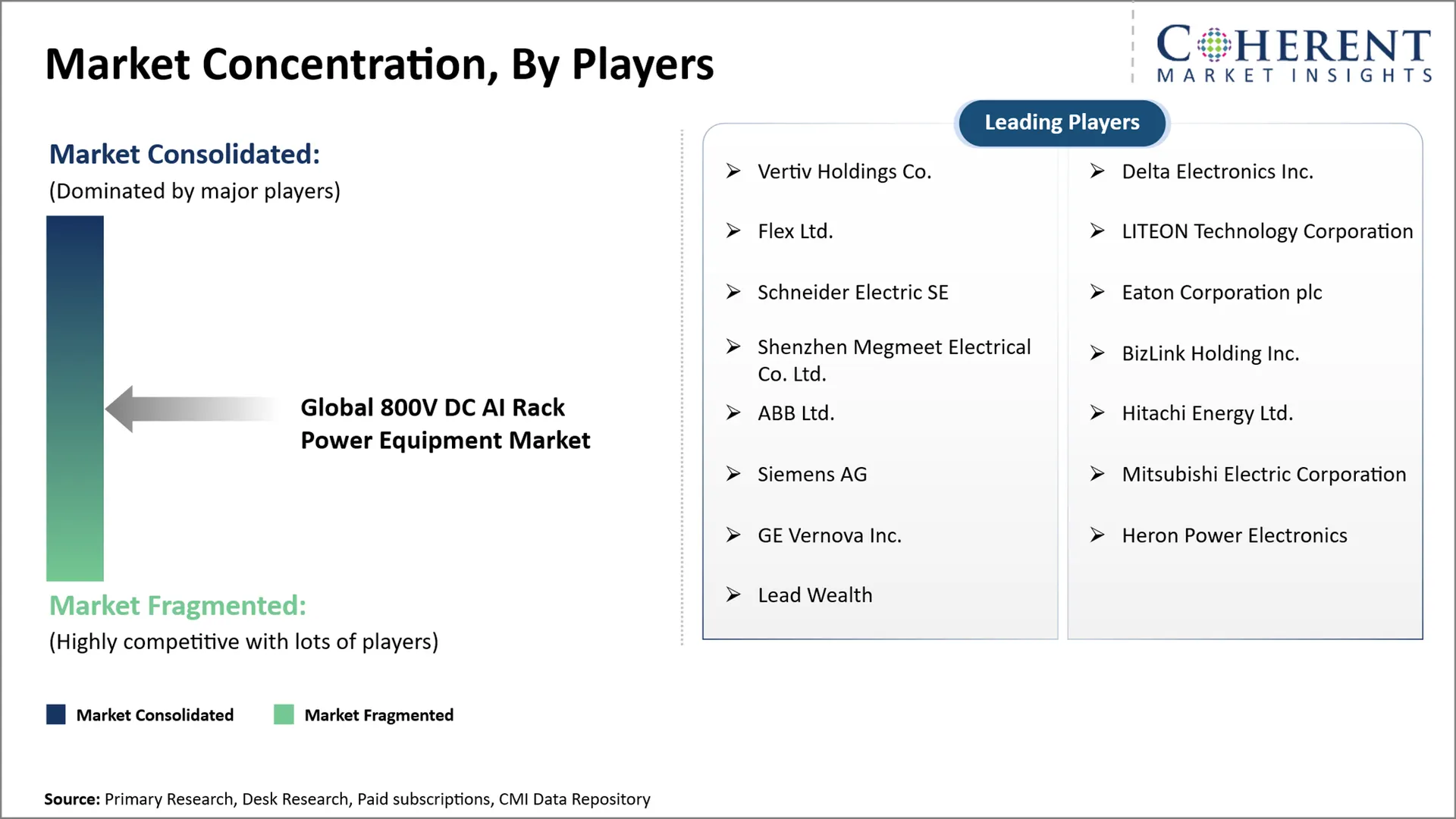
The global 800V DC AI rack power equipment market is emerging as a moderately consolidated industry at the integrated system level, with broader participation across specialized components. Competition involves electrical infrastructure manufacturers, power electronics suppliers, semiconductor companies, and rack integrators. Critical competitive factors are product qualification, conversion efficiency, manufacturing capacity, technical support and long-term supply agreements. Specialist manufacturers can offer advanced component technologies and customized designs.
Key competitive factors include
- Product Performance: Selection of equipment is based on conversion efficiency, power density, reliability and thermal performance.
- Production Scalability: Those suppliers with scalable production capabilities can better accommodate changing customer demand.
- System Compatibility Support for multiple rack configurations and electrical interfaces provides increased supplier qualification opportunities.
- Cost Competitiveness: Component Selection, Manufacturing Efficiency and Installation Requirements Effect on Total Cost of Ownership.
- Supply chain reliability: Delivery commitments are backed by the availability of qualified semiconductors, magnetic components and electrical assemblies.
- Customer Relationships: Early involvement in equipment design and technical qualification improves long-term procurement positioning.
- After-Sales Support: Maintenance accessibility, replacement modules, warranty coverage, and technical assistance strengthen customer retention.
Market Report Scope
Global 800V DC AI Rack Power Equipment Market Report Coverage | |||
Report Coverage | Details | ||
Base Year | 2025 | Market Size in 2026: | USD 286.2 Mn |
Historical Data For: | 2021 To 2024 | Forecast Period: | 2026 To 2033 |
Forecast Period 2026 To 2033 CAGR: | 34.60% | 2033 Value Projection: | USD 2290.8 Mn |
Geographies covered: |
| ||
Segments covered: |
| ||
Companies covered: | Vertiv Holdings Co., Delta Electronics Inc., Flex Ltd., LITEON Technology Corporation, Schneider Electric SE, Eaton Corporation plc, Shenzhen Megmeet Electrical Co. Ltd., BizLink Holding Inc., ABB Ltd., Hitachi Energy Ltd., Siemens AG, Mitsubishi Electric Corporation, GE Vernova Inc., Heron Power Electronics, Lead Wealth | ||
Growth Drivers: |
| ||
Restraints & Challenges: |
| ||
Analyst Opinion (Expert Opinion)
- The global 800V DC AI rack power equipment market leadership is likely to depend increasingly on suppliers' ability to control critical electrical interfaces and reduce customer qualification costs. Manufacturers that establish repeatable engineering specifications, verified interoperability, and consistent installation procedures could gain stronger pricing power. That could give it a structural advantage over suppliers that compete mainly on the specifications of individual equipment.
- Buyers of AI infrastructure could gradually move toward performance-based contracts for power equipment, making suppliers accountable for electrical availability, operating losses and service response. That would put pressure on the traditional sales models that are hardware only. But companies that can monitor installed systems and support measurable performance commitments have the potential to increase service revenue and improve customer retention.
- Manufacturers should focus on modular product designs, qualification testing and reliable sourcing of semiconductors. Investment decisions must balance the uncertainty surrounding future power architectures with the customer requirements of the near term. Rather than investing in unflexible equipment configurations, suppliers need to build technical partnerships, component interchangeability and regional service capabilities to protect margins and reduce project execution risks.
Speak to the analyst
Want personalized insights?
Take the findings above to one of our principal consultants, or have the report rebuilt around the segments, geographies and competitors you actually track.
Market Segmentation
- Equipment Type Insights (Revenue, USD Mn, 2021 - 2033)
- Integrated 800V DC Power Racks and Sidecars
- AC-DC Rectifiers and Power Shelves
- DC-DC Converters and Power Modules
- DC Busbars, Busways and Connectors
- DC Protection, Switching and Control Systems
- Battery Backup and Energy Buffering Modules
- Power Capacity Insights (Revenue, USD Mn, 2021 - 2033)
- Below 300 kW
- 300–600 kW
- Above 600 kW–1 MW
- Above 1 MW
- Power Architecture Insights (Revenue, USD Mn, 2021 - 2033)
- Hybrid AC-Fed 800V DC Rack Systems
- Native 800V DC Facility-Fed Rack Systems
- Application Insights (Revenue, USD Mn, 2021 - 2033)
- Hyperscale AI Data Centers
- Colocation AI Data Centers
- Enterprise AI Data Centers
- High-Performance Computing Facilities
- Sales Channel Insights (Revenue, USD Mn, 2021 - 2033)
- Direct Manufacturer Sales
- System Integrators and EPC Partners
- Distributors and Component Suppliers
- Regional Insights (Revenue, USD Mn, 2021 - 2033)
- North America
- U.S.
- Canada
- Latin America
- Brazil
- Argentina
- Mexico
- Rest of Latin America
- Europe
- Germany
- U.K.
- Spain
- France
- Italy
- Russia
- Rest of Europe
- Asia Pacific
- China
- India
- Japan
- Australia
- South Korea
- ASEAN
- Rest of Asia Pacific
- Middle East
- GCC Countries
- Israel
- Rest of Middle East
- Africa
- South Africa
- North Africa
- Central Africa
- North America
Sources
Primary Research Interviews
- AI data center operators, electrical infrastructure engineers, and rack power system manufacturers
- Power electronics specialists, GPU server integrators, and data center procurement managers
Stakeholders
- 800V DC power equipment manufacturers, component suppliers, and system integrators
- Hyperscale operators, colocation providers, and electrical engineering contractors
End-use Sectors
- Hyperscale AI data centers and GPU cloud infrastructure
- Colocation facilities, enterprise AI data centers, and high-performance computing facilities
Regulatory and Industry Bodies
- International Electrotechnical Commission (IEC)
- National Fire Protection Association (NFPA)
- Underwriters Laboratories (UL Solutions)
- U.S. Department of Energy (DOE)
- European Commission
Databases
- International Energy Agency (IEA) electricity and data center energy datasets
- U.S. Energy Information Administration (EIA) electricity statistics
- Eurostat electricity and energy infrastructure datasets
- UN Comtrade electrical equipment import-export statistics
- Data center capacity, equipment procurement, and power infrastructure databases
Magazines and Journals
- IEEE Spectrum
- IEEE Transactions on Power Electronics
- IEEE Journal of Emerging and Selected Topics in Power Electronics
- IEEE Transactions on Industry Applications
- Data Center Dynamics
Associations
- Open Compute Project Foundation (OCP)
- IEEE Power Electronics Society
- The Green Grid
- SEMI
- AFCOM
Public Domain Sources
- AI data center investments, rack power density, and electrical infrastructure developments
- 800V DC equipment specifications, product announcements, and manufacturing capacity disclosures
- Power conversion efficiency, DC distribution architecture, and equipment deployment information
Key Standards and Regulations
- IEC 61439-1 and IEC 61439-2 – Low-voltage switchgear and controlgear assemblies
- IEC 60947-2 – Low-voltage circuit breakers
- NFPA 70 – National Electrical Code
- UL 62368-1 – Safety requirements for applicable electronic equipment
- EU Regulation 2024/1364 – Data center energy and sustainability reporting requirements
Proprietary Elements
- CMI Data Analytics Tool
- Proprietary research repository, supplemented by manufacturer interviews, AI rack power capacity assessments, equipment pricing analysis, supplier benchmarking, and competitive intelligence.
Get access to 250+ pages report
Every segment, forecast, competitor profile and data table behind the analysis above — available for instant download.
- ESOMAR Member
- ISO 9001:2015 Certified
- D-U-N-S Registered
- GDPR & CCPA Compliant
Frequently Asked Questions
The CAGR of global 800V DC AI rack power equipment market is projected to be 34.60% from 2026 to 2033.
The global 800V DC AI rack power equipment market is estimated to be valued at USD 286.2 Mn in 2026 and is expected to reach USD 2,290.8 Mn by 2033.
800V DC AI rack power equipment means electrical equipment used for the distribution and control of high voltage direct current power to high density AI computing racks.
Key customers are hyperscale data center operators, AI infrastructure developers, GPU cloud providers and data center system integrators.
Key factors in the buying decision are power conversion efficiency, equipment reliability, rack compatibility, electrical safety, scalability and total cost of ownership.
The report covers market forecasts, equipment technologies, competitive positioning, supplier capabilities, procurement considerations, and infrastructure deployment developments.
Rising power density of AI server racks increasing demand for efficient 800V DC power distribution and Growing investments in hyperscale AI data centers and megawatt-scale rack infrastructure are the major factor driving the growth of global 800V DC AI rack power equipment market.