

Global Acifluorfen Market Size and Forecast – 2026 To 2033
The Global Acifluorfen Market is estimated to be valued at USD 292.6 Mn in 2026 and is expected to reach USD 406.3 Mn by 2033, growing at a compound annual growth rate (CAGR) of 4.8% from 2026 to 2033. This steady growth reflects increasing adoption of acifluorfen-based herbicides across agricultural applications aimed at improving weed management efficiency, protecting crop productivity, and supporting higher-quality yields.
The market outlook is further supported by the continued expansion of integrated weed management practices, where growers combine selective herbicides with agronomic planning to manage resistant and difficult-to-control broadleaf weed populations. In January 2025, the U.S. Department of Agriculture’s Agricultural Research Service highlighted ongoing research on herbicide-resistant weed management approaches, emphasizing the need for diversified weed-control strategies to maintain agricultural productivity. Such developments reinforce the importance of selective herbicides like acifluorfen within future crop protection programs.
Key Takeaways of the Global Acifluorfen Market
- Soluble Concentrate is estimated to expand at a 10.1% CAGR during 2026–2033 and is expected to account for 56.8% of the global acifluorfen market in 2026. Its lead reflects easy dilution, uniform spray preparation, tank-mix flexibility, and suitability for post-emergence field programs. In September 2026, UPL’s current U.S. product page identifies Ultra Blazer acifluorfen as a Soluble Liquid (SL) formulation, directly supporting the soluble-formulation category.
- Soybeans are projected to record an estimated 10.7% CAGR during 2026–2033 while representing 58.6% of the global acifluorfen market in 2026. The crop remains central because acifluorfen fits post-emergence programs targeting difficult broadleaf weeds without displacing soybean-specific herbicide rotations. In June 2025, University of Minnesota Extension listed Ultra Blazer, with acifluorfen as its active ingredient, among commonly used post-emergence soybean herbicides.
- Broadleaf Weeds are expected to grow at an estimated 10.8% CAGR during 2026–2033 and capture 62.8% of the global acifluorfen market in 2026. Their dominance reflects acifluorfen’s contact activity against troublesome broadleaf species requiring timely post-emergence treatment. In July 2025, University of Georgia Extension identified Ultra Blazer acifluorfen as a post-emergence option for smaller hophornbeam copperleaf plants in peanut fields.
- North America is expected to post an estimated 9.9% CAGR during 2026–2033 and hold 38.6% of the global acifluorfen market in 2026. Its position is supported by extensive soybean acreage, established post-emergence herbicide programs, and mature label-based tank-mix practices. In August 2025, the U.S. EPA accepted labeling that included Ultra Blazer acifluorfen in soybean tank mixes across defined U.S. regional use groupings.
- Asia Pacific is forecast to achieve an estimated 11.4% CAGR during 2026–2033 while accounting for 34.8% of the global acifluorfen market in 2026. Expansion is linked to soybean cultivation, broader herbicide access, and additions to regional manufacturing and registration capacity. In August 2024, India’s Registration Committee approved an additional Ankleshwar factory address for UPL’s registered sodium acifluorfen plus clodinafop-propargyl formulation, broadening its registered manufacturing footprint.
Segmental Insights
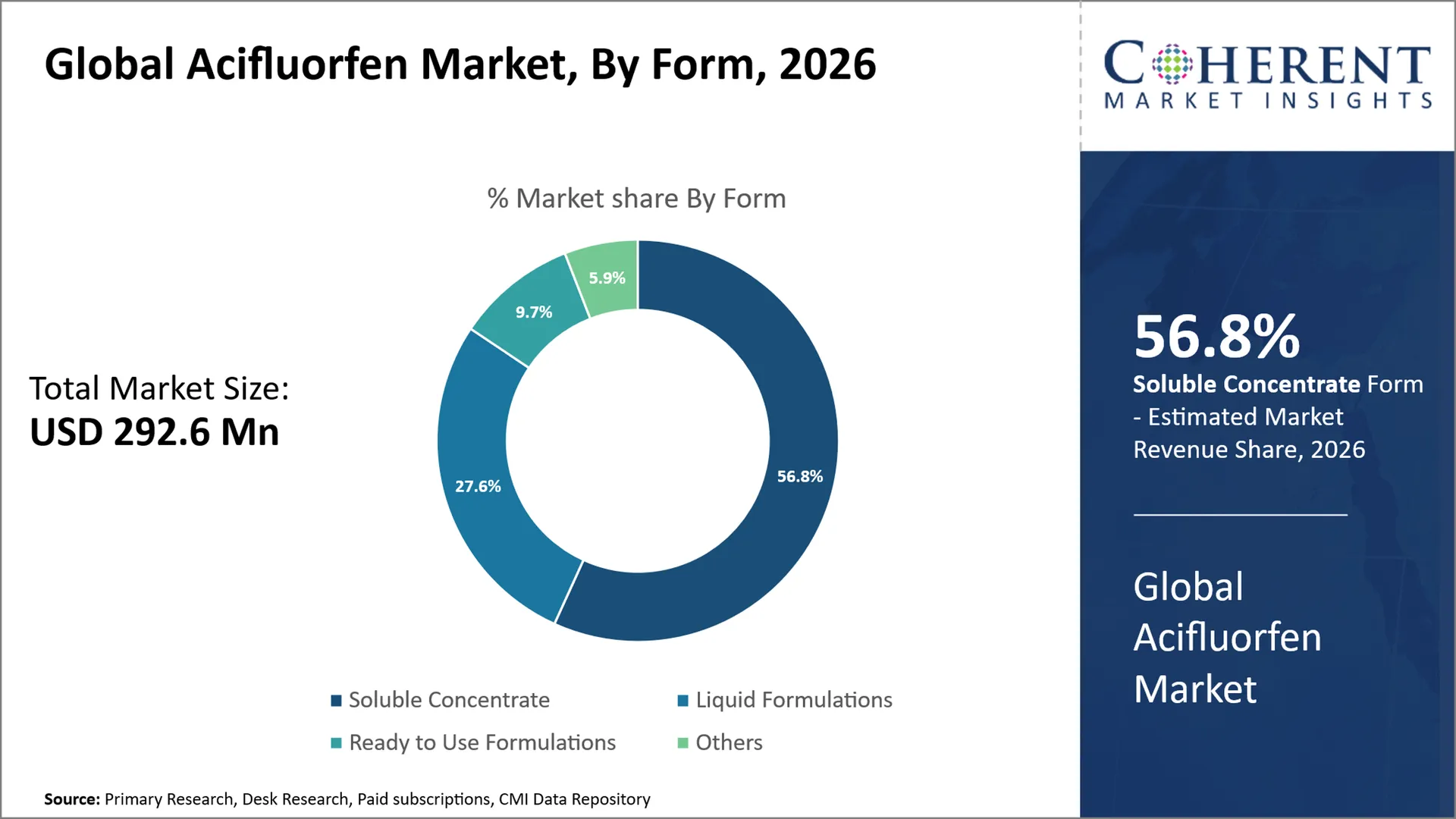
Why Does Soluble Concentrate Dominate the Global Acifluorfen Market?
Soluble Concentrate is expected to hold 56.8% of the global acifluorfen market in 2026, leading the form category because it matches the practical requirements of commercial spray programs. Water-dilutable concentrates simplify measuring, mixing, transport, and storage while allowing applicators to adjust spray volume and rate to crop stage and weed pressure. The format also suits tank-mix programs, an important purchasing consideration where acifluorfen is combined with complementary herbicides for broader control. For manufacturers and distributors, concentrated liquids support standardized packaging and efficient movement through agricultural input channels. In September 2026, Sharda USA’s active product portfolio lists Player, a liquid-concentrate acifluorfen formulation containing 20.1% acifluorfen for post-emergence use in soybeans, peanuts, rice, and strawberries. Its continued commercial listing illustrates why concentrated liquid formats remain central to acifluorfen supply.
- Current Industry Events of 2026
- Market Size Estimation
- Regional Breakdown
- Competitive Landscape
- Customer Intelligence
- Segmental Analysis
- Pricing Analysis
- Key Market Drivers, Challenges & Future Trends
- Customized Insights Section
Why Do Soybeans Represent the Largest Application Segment in the Global Acifluorfen Market?
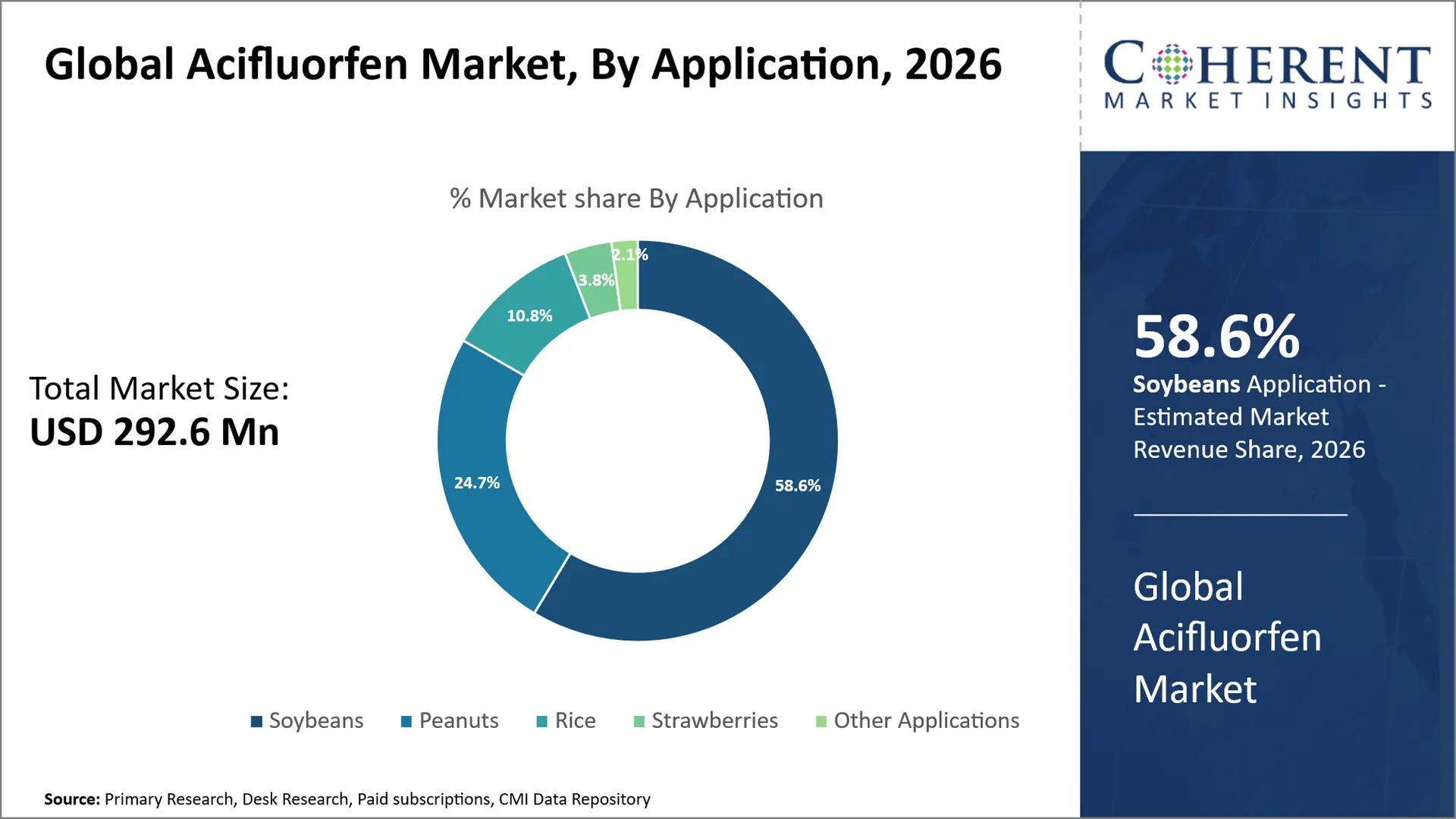
Soybeans are expected to account for 58.6% of the global acifluorfen market in 2026, making the crop the largest application segment because post-emergence weed escapes can directly affect yield protection and harvest efficiency. Acifluorfen fits soybean programs where growers need contact activity against small actively growing broadleaf weeds while retaining flexibility to combine modes of action. The segment also benefits from established custom-application infrastructure and agronomic guidance that supports rate, timing, adjuvant, and tank-mix decisions. In December 2025, Mississippi State University Extension published its 2026 Weed Management Suggestions for Mississippi Row Crops, listing acifluorfen at 0.38–0.50 lb/acre for soybean and identifying targets including hemp sesbania, morningglory, and small pigweeds. That continued agronomic inclusion reinforces soybean as the crop providing the deepest recurring commercial demand for acifluorfen products.
Why Do Broadleaf Weeds Dominate the Weed Type Segment of the Global Acifluorfen Market?
Broadleaf Weeds are expected to represent 62.8% of the global acifluorfen market in 2026, reflecting the herbicide’s strongest commercial role against difficult post-emergence broadleaf populations rather than grasses or sedges. As a Group 14 PPO-inhibiting contact herbicide, acifluorfen is most valuable when weeds are small and spray coverage is strong, making application timing and canopy penetration central to performance. This creates demand for agronomic advice, calibrated sprayers, suitable adjuvants, and timely field scouting. In July 2025, South Dakota State University Extension stated that acifluorfen can effectively control broadleaf weeds such as kochia and water hemp and emphasized that PPO herbicides perform best with adequate coverage and small weeds. The segment therefore offers suppliers the strongest value proposition where growers require rapid foliar control of troublesome broadleaf escapes within diversified resistance-management programs.
Current Events and their Impact
Current Event | Description and Its Impact |
Health Canada Includes Sodium Acifluorfen in Early-Stage Re-evaluation – June 2026 |
|
Australia’s June 2026 Poisons Standard Retains Acifluorfen in Schedule 6 – May 2026 |
|
India Proposes Commodity-Specific Acifluorfen-Sodium MRLs – September 2024 |
|
Global Acifluorfen Market Dynamics
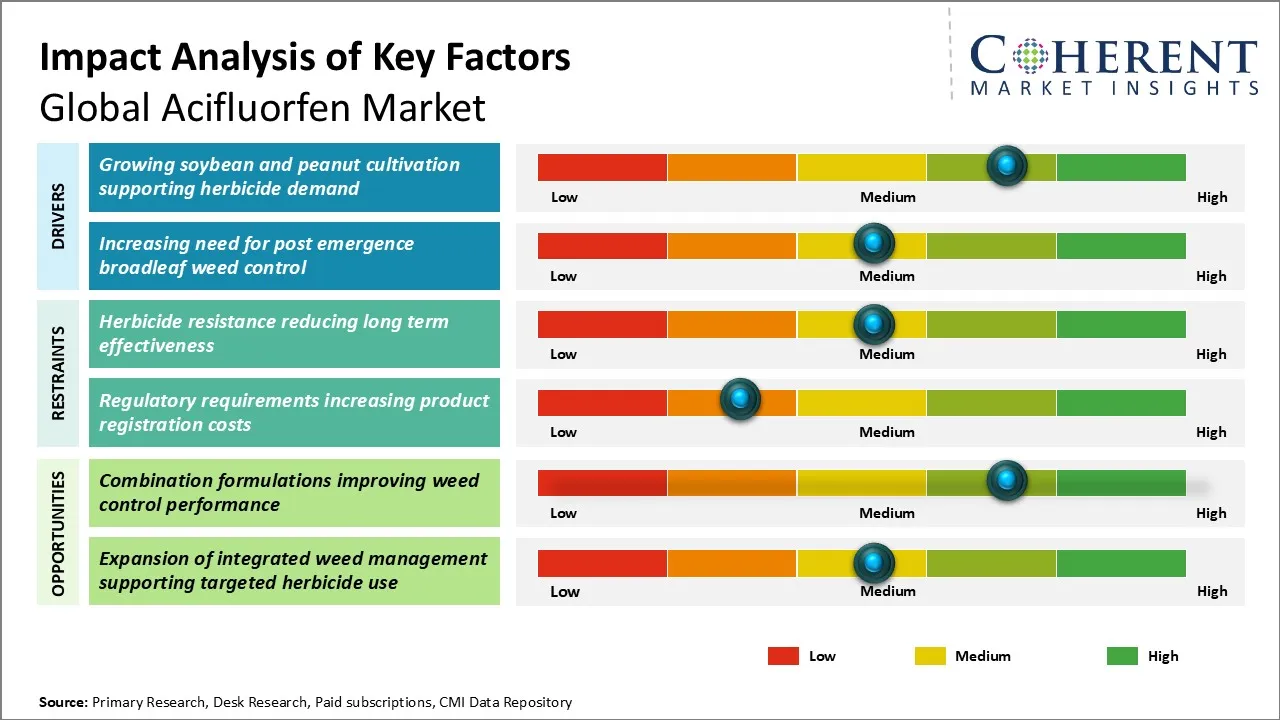
Key Market Drivers
- Growing Soybean and Peanut Cultivation Supporting Herbicide Demand: Growing soybean and peanut cultivation enlarges the treated-area base for selective post-emergence herbicides, supporting seasonal demand for acifluorfen formulations and dealer inventory. Formulators, distributors, crop advisers, and custom applicators benefit when planted area expands because more hectares require broadleaf-weed programs and rotational chemistry options. In June 2026, USDA NASS estimated U.S. soybean planted area at 85.4 million acres, up 5% from 2025. This increases the addressable soybean treatment base and strengthens procurement visibility across crop-protection channels. Peanut-oriented channels can benefit from the same acreage-linked inventory logic where registered use is maintained.
- Increasing Need for Post Emergence Broadleaf Weed Control: Increasing need for post-emergence broadleaf weed control supports acifluorfen where growers must address escapes after crop establishment without relying on a single herbicide mode of action. The opportunity benefits formulators, agricultural distributors, agronomists, and growers that need flexible programs for mixed weed populations. In June 2025, an ICAR soybean advisory included sodium acifluorfen 16.5% + clodinafop-propargyl 8% EC among weed-management options. The recommendation illustrates continued agronomic relevance for broad-spectrum post-emergence combinations in commercial soybean production and differentiated dealer recommendations where grass and broadleaf control are both required.
Emerging Market Trends
- Shift from Stand-Alone Herbicides Toward Program-Based Weed Management: Acifluorfen positioning is gradually shifting from stand-alone molecule selling toward crop-specific program design, where formulation compatibility, weed spectrum, application timing, and rotational fit matter together. This changes how formulators and distributors create value: technical support and program architecture become more important than simply offering another generic active ingredient. Suppliers with agronomy capability, local field knowledge, and clear tank-mix guidance should benefit, while price-only sellers may face margin pressure. Over the forecast period, portfolio differentiation is likely to depend increasingly on how reliably acifluorfen fits complete weed-management sequences.
- Regulatory Lifecycle Management Becoming a Portfolio Selection Discipline: Regulatory lifecycle management is becoming a portfolio-selection discipline rather than a back-office compliance function. Acifluorfen suppliers must increasingly consider residue requirements, toxicological documentation, re-evaluation exposure, labeling obligations, and country-specific stewardship when deciding where to maintain registrations. This can encourage selective investment in markets where data packages and channel economics justify continued support, while weaker registrations may receive less commercial attention. Registrants with strong regulatory teams and traceable quality systems are positioned to benefit. The trend should make market access more differentiated by jurisdiction and raise the strategic value of compliance-ready supply chains.
Regional Insights
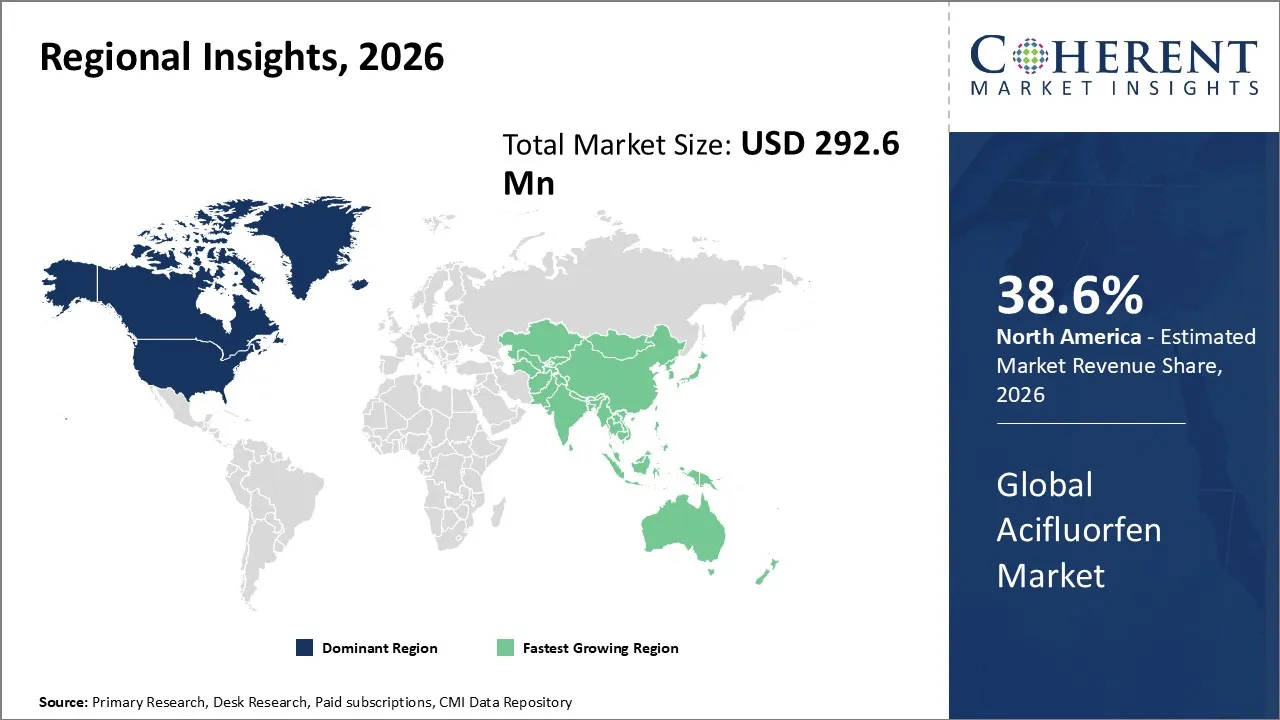
Why Does North America Dominate the Global Acifluorfen Market?
North America is expected to account for 38.6% of the global acifluorfen market in 2026, supported by a large soybean production base, established post-emergence weed-control programs, and a mature crop-protection distribution network. Demand is reinforced by intensive management of broadleaf weeds in soybeans and peanuts, where contact herbicides remain useful within rotational and tank-mix programs. The region also benefits from high mechanization, strong agronomic advisory systems, and disciplined label-based application practices that sustain selective herbicide use. In July 2026, Agriculture and Agri-Food Canada projected Canadian soybean seeded area at 2.412 million hectares for 2026–27, demonstrating that the addressable crop base extends materially beyond the U.S. This combination of acreage, technical farming practices, and established input channels supports North America’s leading commercial position.
Why Is Asia Pacific Emerging as the Fastest-Growing Region in the Global Acifluorfen Market?
Asia Pacific is expected to hold 34.8% of the global acifluorfen market in 2026 and emerge as the fastest-growing region as soybean, pulse, peanut, and other broadleaf-crop systems intensify across major agricultural economies. Expansion is supported by wider adoption of post-emergence herbicide programs, increasing preference for efficient weed-management solutions, reduced availability of manual farm labor, and the region’s strong agrochemical manufacturing ecosystem. Farmers are increasingly integrating selective herbicides into structured crop-protection programs to improve weed control consistency and maintain productivity across diverse farming conditions. In March 2025, the Ministry of Agriculture and Farmers Welfare of India approved the inclusion of additional crop-protection recommendations under its agricultural extension programs, reflecting continued institutional focus on improving access to modern crop-management practices and strengthening productivity across oilseed and pulse cultivation systems. This policy direction supports broader adoption of selective herbicide solutions, including acifluorfen-based formulations, across Asia Pacific agriculture.
Global Acifluorfen Market Outlook for Key Countries
Why Is the U.S. a Key Market for the Global Acifluorfen Market?
The U.S. is estimated to represent 31.0% of the global acifluorfen market in 2026, making it the largest country market within North America. Its importance comes from extensive soybean acreage, commercial peanut production in the Southeast, high adoption of post-emergence weed-control programs, and strong agronomic support for herbicide rotation and rescue treatments. Acifluorfen remains commercially relevant where growers require contact activity against small annual broadleaf weeds and flexibility after pre-emergence programs, particularly in fields facing recurring pigweed and related weed pressure. In September 2026, Kansas State University Extension included Ultra Blazer in its soybean herbicide guidance and highlighted label restrictions for treated forage. This illustrates continued commercial use alongside increasingly precise stewardship requirements, reinforcing the U.S. as a mature, technically managed acifluorfen market.
Why Is China Important in the Global Acifluorfen Market?
China is estimated to hold 15.7% of the global acifluorfen market in 2026, reflecting its substantial soybean cultivation base, intensive crop-management practices, and large domestic agrochemical production ecosystem. Commercial demand is shaped by the need to manage broadleaf weeds after emergence while rotating herbicide modes of action and reducing labor-intensive field operations. Local crop-protection authorities increasingly provide structured guidance covering selective foliar herbicides and integrated weed-control timing. In June 2025, the Tai’an Agriculture and Rural Affairs Bureau issued its soybean pest and weed-control program, identifying acifluorfen among foliar options for broadleaf weeds including amaranth and chenopodium species. Such field-level recommendations increase agronomic familiarity with the active ingredient and strengthen its relevance through regional distributors, crop advisers, and professional application channels.
Why Is India Important in the Global Acifluorfen Market?
India is estimated to account for 10.8% of the global acifluorfen market in 2026, supported by its extensive pulse and oilseed acreage, changing farm-labor economics, and growing requirement for selective post-emergence weed control. The active ingredient has relevance beyond soybean, particularly where mixed grass and broadleaf weed populations create demand for combination products capable of reducing separate spray passes. Domestic formulation capability and extensive agricultural-input dealer networks further support penetration across producing states. In September 2025, NITI Aayog’s strategy for increasing pulse self-sufficiency identified clodinafop-propargyl plus sodium acifluorfen among post-emergence herbicide interventions for pulse crops. This places acifluorfen within a broader national productivity framework and creates commercial relevance beyond conventional soybean-focused demand.
Why Is Brazil an Important Growth Market for the Global Acifluorfen Market?
Brazil is estimated to capture 9.6% of the global acifluorfen market in 2026, supported by its exceptionally large soybean economy, continuing expansion of cultivated area, and sophisticated crop-input distribution structure. Large-scale farming creates recurring demand for post-emergence weed-control tools, while resistance management and mixed weed populations encourage growers to maintain several herbicide modes of action within seasonal programs. Brazil’s commercial farming model also enables rapid deployment of crop-protection products during narrow application windows. In September 2026, Conab reported that soybean cultivation in the 2025–26 season added approximately 1.3 million hectares, representing growth of about 2.7% from the previous cycle. A larger soybean treatment base directly increases the addressable opportunity for selective broadleaf herbicides where registered and agronomically appropriate.
Why Is Australia a Strategic Country in the Global Acifluorfen Market?
Australia is estimated to account for 2.4% of the global acifluorfen market in 2026, representing a smaller but technically significant market shaped by regulated crop protection, commercial broadacre farming, and strong emphasis on safe herbicide application. Acifluorfen is relevant to crop systems including soybeans, peanuts, mung beans, green beans, and selected seed crops, where growers require dependable post-emergence broadleaf control and clear stewardship instructions. Commercial access therefore depends as much on regulatory compliance and formulation quality as on pricing. In September 2025, the Australian Pesticides and Veterinary Medicines Authority’s updated FAISD Handbook continued to specify safety directions for acifluorfen formulations, including preparations at 224 g/L or below. This reinforces Australia’s compliance-intensive but established regulatory pathway for acifluorfen-based agricultural chemicals.
Herbicide Application and Stewardship Technology Landscape
| Technology / Capability | Role in the Acifluorfen Market | Adoption Direction | Commercial Implication |
| Soluble Liquid Formulation Platforms | Enable uniform dilution, spray preparation, and delivery of acifluorfen in field applications. | Established | Formulation stability, storage performance, and mixing characteristics remain important differentiators among generic suppliers. |
| Multi-Active Combination Formulation Technology | Combines acifluorfen with herbicides using complementary modes of action to address broader weed spectra. | Expanding | Creates scope for differentiated formulations and reduces reliance on single-active commodity positioning. |
| High-Coverage Ground Spraying Systems | Improve foliar contact with emerged weeds, which is particularly important for contact-oriented herbicide performance. | Established to advancing | Suppliers providing |
Market Players, Key Development, and Competitive Landscape
Key Developments
- In March 2025, BASF expanded its digital agriculture ecosystem through continued development of xarvio FIELD MANAGER capabilities, supporting more precise crop-management decisions and improved application efficiency. This is important for the global acifluorfen market because precision-based crop management can influence how growers optimize herbicide use, improve field-level decision making, and integrate selective weed-control products into broader farming programs.
- In June 2025, Corteva Agriscience announced the expansion of its biological and crop-protection innovation pipeline through investments in sustainable agriculture solutions. This is important for the global acifluorfen market because evolving crop-protection portfolios encourage herbicide suppliers to improve product positioning, develop integrated weed-management solutions, and strengthen long-term competitiveness beyond single active ingredients.
- In February 2025, FMC Corporation highlighted continued investment in agricultural innovation and digital tools supporting growers with improved crop-protection decisions. This is important for the global acifluorfen market because suppliers increasingly compete through technical support, application guidance, and integrated solutions that enhance the commercial value of herbicide products.
Competitive Landscape
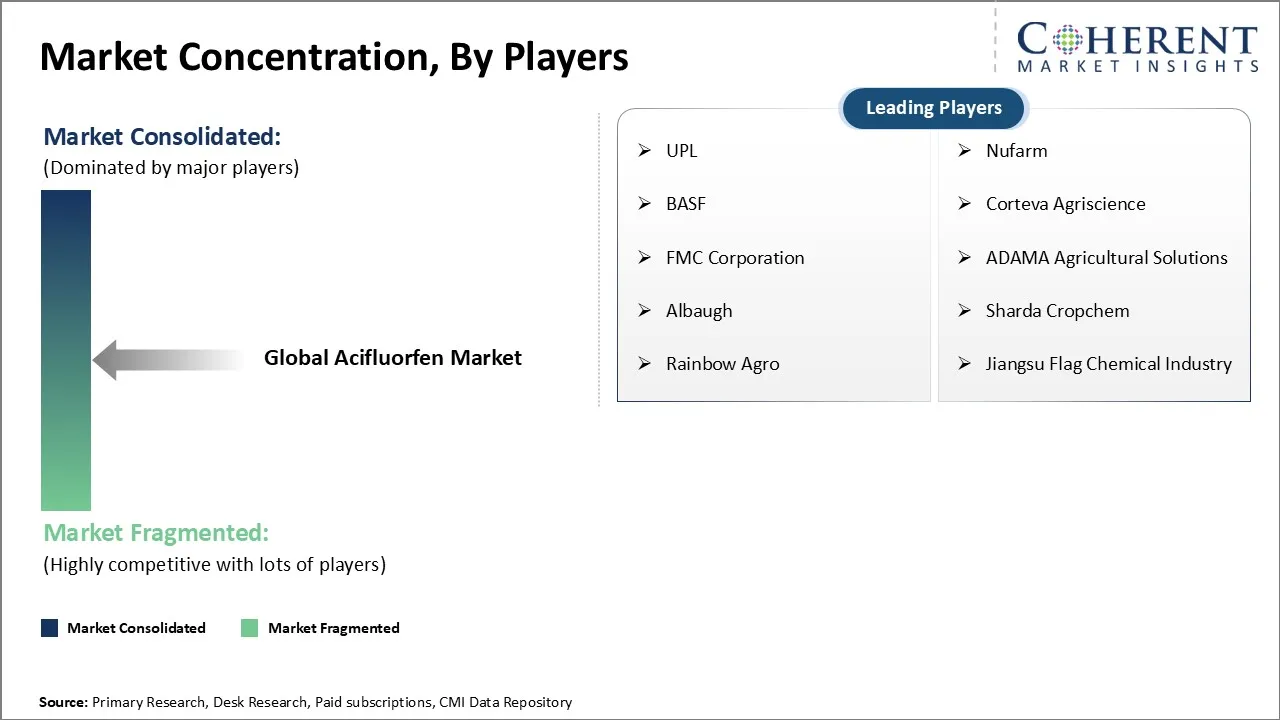
The global acifluorfen market is moderately consolidated, with competition concentrated among multinational agrochemical companies, regional crop-protection manufacturers, and specialized generic herbicide suppliers. Market positioning depends on formulation quality, regulatory registrations, manufacturing reliability, pricing competitiveness, and distribution strength across agricultural regions. While major companies benefit from established farmer relationships and technical support networks, regional suppliers compete through cost-efficient production, localized registrations, and flexible supply capabilities. Compliance expertise, product consistency, and access to crop-specific distribution channels remain critical factors influencing long-term competitiveness.
Key Focus Areas Include
- Product quality and performance differentiation through formulation stability, active ingredient consistency, and reliable field performance.
- Regulatory compliance and quality assurance as registrations, residue requirements, and stewardship standards influence market access.
- Manufacturing capacity and supply reliability to ensure consistent availability during critical agricultural application periods.
- Pricing and total cost of ownership as generic suppliers compete through cost-efficient production and competitive formulations.
- Distribution reach and customer access through agricultural dealers, cooperatives, and crop advisory networks.
- Product format and formulation capabilities including soluble concentrates and combination herbicide formulations suited for specific crop programs.
- Technical support and agronomic expertise helping growers optimize application timing, dosage, and weed-management strategies.
Market Report Scope
Acifluorfen Market Report Coverage | |||
Report Coverage | Details | ||
Base Year | 2025 | Market Size in 2026: | USD 292.6 Mn |
Historical Data For: | 2020 To 2024 | Forecast Period: | 2026 To 2033 |
Forecast Period 2026 To 2033 CAGR: | 4.8% | 2033 Value Projection: | USD 406.3 Mn |
Geographies covered: |
| ||
Segments covered: |
| ||
Companies covered: | UPL, Nufarm, BASF, Corteva Agriscience, FMC Corporation, ADAMA Agricultural Solutions, Albaugh, Sharda Cropchem, Rainbow Agro, Jiangsu Flag Chemical Industry | ||
Growth Drivers: |
| ||
Restraints & Challenges: |
| ||
Analyst Opinion (Expert Opinion)
- The acifluorfen market is likely to gradually shift from molecule-focused competition toward application-focused value creation. Suppliers that combine dependable formulations with agronomic recommendations, stewardship guidance, and regional crop expertise may strengthen their market position. Competitive advantage will increasingly depend on the ability to support growers throughout the weed-management cycle rather than simply supplying an active ingredient.
- The most important transformation could come from the integration of precision agriculture with herbicide decision-making. As farms adopt improved scouting, mapping, and application-control technologies, herbicide selection may become more targeted and data-supported. Companies that connect crop insights with product recommendations could create stronger customer relationships, while suppliers relying mainly on price competition may face increasing pressure.
- Market participants should prioritize regulatory readiness, formulation improvement, reliable manufacturing, and strong agricultural distribution partnerships. Companies should focus on regions with expanding crop-protection needs while maintaining compliance capabilities across different regulatory environments. However, overinvestment in undifferentiated capacity may create margin pressure as generic competition increases. Long-term success will depend on balancing cost efficiency with technical support and product differentiation.
Speak to the analyst
Want personalized insights?
Take the findings above to one of our principal consultants, or have the report rebuilt around the segments, geographies and competitors you actually track.
Market Segmentation
- Form Insights (Revenue, USD Mn, 2021 - 2033)
- Soluble Concentrate
- Liquid Formulations
- Ready to Use Formulations
- Others
- Application Insights (Revenue, USD Mn, 2021 - 2033)
- Soybeans
- Peanuts
- Rice
- Strawberries
- Other Applications
- Weed Type Insights (Revenue, USD Mn, 2021 - 2033)
- Broadleaf Weeds
- Grass Weeds
- Sedges
- Application Method Insights (Revenue, USD Mn, 2021 - 2033)
- Ground Application
- Aerial Application
- Handheld Application
- Distribution Channel Insights (Revenue, USD Mn, 2021 - 2033)
- Agricultural Distributors
- Direct Sales
- Online Agricultural Platforms
- Others
- Regional Insights (Revenue, USD Mn, 2021 - 2033)
- North America
- U.S.
- Canada
- Latin America
- Brazil
- Argentina
- Mexico
- Rest of Latin America
- Europe
- Germany
- U.K.
- Spain
- France
- Italy
- Russia
- Rest of Europe
- Asia Pacific
- China
- India
- Japan
- Australia
- South Korea
- ASEAN
- Rest of Asia Pacific
- Middle East
- GCC Countries
- Israel
- Rest of Middle East
- Africa
- South Africa
- North Africa
- Central Africa
- North America
- Key Players Insights
- UPL
- Nufarm
- BASF
- Corteva Agriscience
- FMC Corporation
- ADAMA Agricultural Solutions
- Albaugh
- Sharda Cropchem
- Rainbow Agro
- Jiangsu Flag Chemical Industry
Sources
Primary Research Interviews
- Herbicide manufacturers, agrochemical formulators, distributors, agricultural retailers, and contract manufacturers
- Agronomists, weed scientists, crop consultants, procurement managers, farmers, and application service providers
Stakeholders
- Acifluorfen and crop protection chemical manufacturers
- Formulators, raw material suppliers, distributors, dealers, and agricultural cooperatives
- Soybean, peanut, rice, pulse, and horticultural crop growers
- Regulatory authorities, agricultural research institutes, and extension agencies
End-use Sectors
- Soybean cultivation
- Peanut cultivation
- Rice and pulse crops
- Commercial agriculture and integrated weed management
Regulatory and Industry Bodies
- U.S. Environmental Protection Agency EPA
- Health Canada Pest Management Regulatory Agency PMRA
- Australian Pesticides and Veterinary Medicines Authority APVMA
- Central Insecticides Board and Registration Committee India
- FAO and national agricultural ministries
Databases
- Company annual reports and regulatory filings
- Pesticide registration and label databases
- Crop production and acreage databases
- Import export and agrochemical trade datasets
- Herbicide product portfolio and formulation databases
Magazines and Journals
- Weed Science
- Weed Technology
- Pest Management Science
- Crop Protection
- Journal of Agricultural and Food Chemistry
Associations
- CropLife International
- Weed Science Society of America WSSA
- Agricultural Retailers Association
- Regional crop protection and agrochemical associations
Public Domain Sources
- Crop acreage and production statistics
- Herbicide registration and re evaluation updates
- Weed resistance and weed management developments
- Agricultural extension recommendations
- Crop protection product and application developments
Key Standards and Regulations
- Pesticide registration and active ingredient approval requirements
- Maximum residue limits MRLs
- Product labeling and application restrictions
- Worker safety and environmental protection requirements
- Storage transport and hazardous chemical compliance
Proprietary Elements
- CMI Data Analytics Tool and proprietary CMI repository containing 10+ years of agrochemical crop protection herbicide and agricultural market intelligence.
Get access to 250+ pages report
Every segment, forecast, competitor profile and data table behind the analysis above — available for instant download.
- ESOMAR Member
- ISO 9001:2015 Certified
- D-U-N-S Registered
- GDPR & CCPA Compliant
Missing comfort of reading report in your local language? Find your preferred language:
Frequently Asked Questions
The CAGR of global acifluorfen market is projected to be 4.8% from 2026 to 2033.
The global acifluorfen market is estimated to be valued at USD 292.6 million in 2026 and is expected to reach USD 406.3 million by 2033.
Acifluorfen is mainly used as a post-emergence herbicide for controlling broadleaf weeds in crops such as soybeans, peanuts, rice, and selected horticultural crops.
The key end users include commercial farmers, large agricultural enterprises, crop protection service providers, and professional applicators using selective weed-control programs.
Acifluorfen is primarily applied through ground-based spraying systems as part of post-emergence weed management programs, with application timing depending on crop stage and weed development.
Important competitive factors include formulation quality, product efficacy, regulatory compliance, pricing, supply reliability, distribution reach, technical support, and the ability to serve crop-specific weed management requirements.
The growth of the global acifluorfen market is primarily supported by increasing soybean and peanut cultivation, which is driving demand for effective herbicide solutions. Additionally, the growing need for post-emergence broadleaf weed control is encouraging the adoption of acifluorfen-based herbicides across major agricultural applications.