

Global Active Packaging Market Size and Forecast – 2026 To 2033
The Global Active Packaging Market is estimated to be valued at USD 17.62 Bn in 2026 and is expected to reach USD 26.32 Bn by 2033, growing at a compound annual growth rate (CAGR) of 5.90% from 2026 to 2033. This growth is supported by increasing demand for sustainable packaging solutions, greater emphasis on food safety, and the development of packaging technologies that extend shelf life and maintain product quality across food, pharmaceuticals, and electronics applications.
The integration of ethylene absorbers and moisture-regulating materials is also creating opportunities for manufacturers to reduce product deterioration during storage and distribution. In September 2026, Symphony Environmental Technologies plc announced the first commercial container-load delivery of its d2p EA ethylene-adsorbing masterbatch to Mexico for incorporation into fresh produce packaging pads. This development highlights the commercial adoption of active packaging technologies designed to control ripening, preserve freshness, and minimize food wastage across agricultural supply chains.
Key Takeaways of the Global Active Packaging Market
- Oxygen Scavengers are projected to grow at an estimated CAGR of 6.4% from 2026 to 2033 and capture 37.5% of the global active packaging market in 2026. Their ability to remove residual oxygen protects oxidation-sensitive beverages and processed foods without altering product formulations. In July 2025, Avient Corporation launched ColorMatrix Amosorb Oxyloop-1, an oxygen-scavenging additive compatible with recycled PET packaging.
- Plastics are expected to register an estimated CAGR of 5.5% during 2026–2033 while retaining 57.2% of the global active packaging market in 2026. Their processing versatility allows manufacturers to integrate active substances into lightweight films suitable for automated packaging operations. In March 2025, ProAmpac introduced its Moisture Protect MP-3000 mono-polyolefin film, combining active moisture adsorption with a structure designed for recyclability.
- Active Bags and Pouches are forecast to expand at an estimated CAGR of 6.7% through 2033, accounting for 38.6% of global active packaging market in 2026. Their adaptable designs enable produce packers to combine freshness management with convenient retail presentation. In September 2026, StePacPPC introduced Xgo PAZ resealable pouches integrating modified atmosphere, humidity management, and condensation control for moisture-sensitive fresh produce.
- North America is projected to advance at an estimated CAGR of 5.2% during 2026–2033 and account for 36.8% of the global active packaging market in 2026. Established food-processing infrastructure and demanding retail quality standards support investment in specialized preservation technologies. In March 2025, Canada's Atlantic Canada Opportunities Agency announced funding for Freshr Technologies to expand manufacturing capabilities for antibacterial food packaging coatings.
- Asia Pacific is anticipated to achieve the fastest estimated CAGR of 7.6% during 2026–2033, capturing 28.6% of the global active packaging market in 2026. Expanding packaged-food distribution and increasingly specialized preservation requirements create opportunities for regional suppliers. In April 2025, Japan's Mitsubishi Gas Chemical established its LivingTech and Hygiene Solutions Division, encompassing AGELESS oxygen absorbers and oxygen-absorbing packaging films.
Segmental Insights
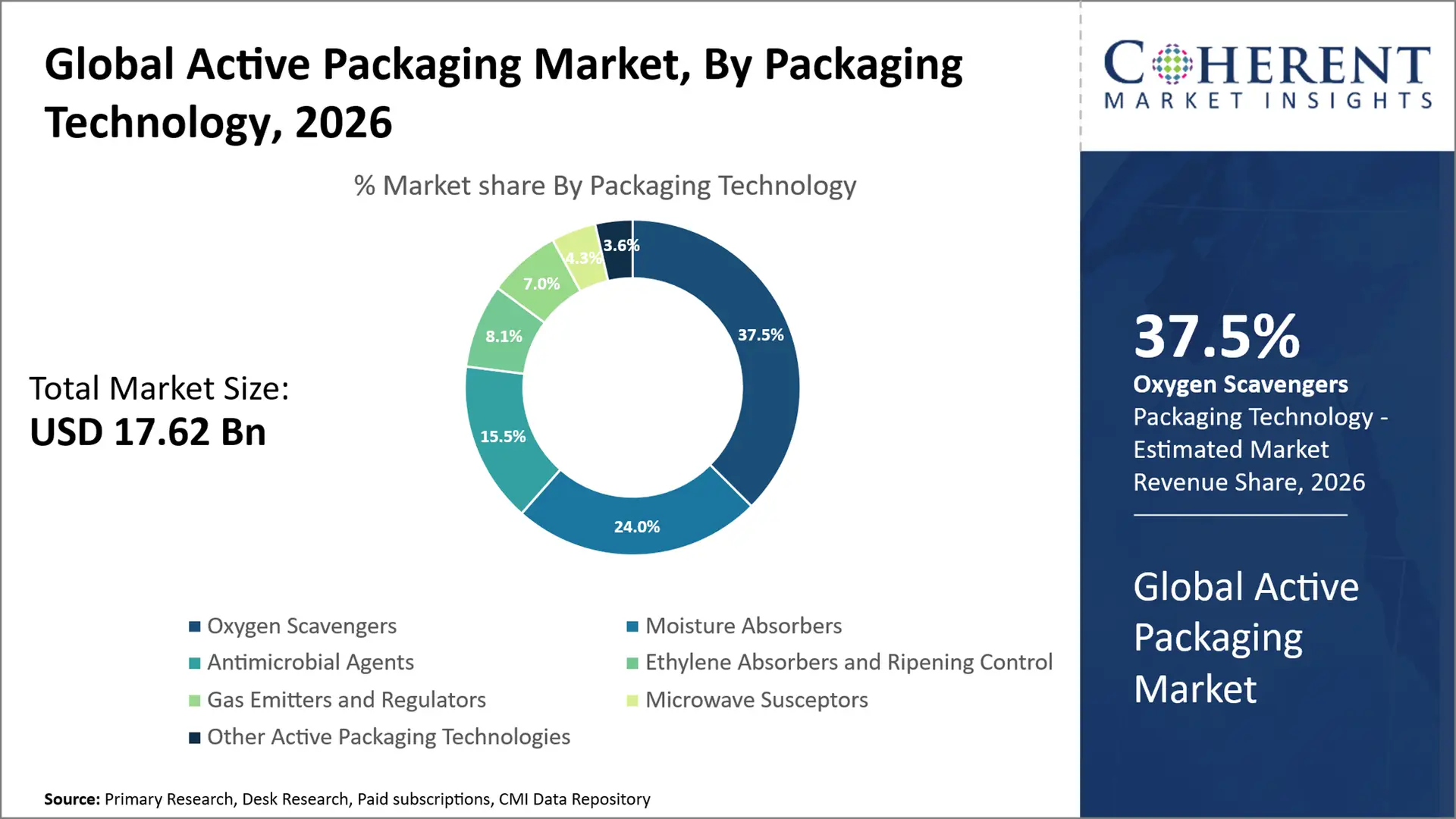
Why Do Oxygen Scavengers Dominate the Global Active Packaging Market?
Oxygen Scavengers are expected to account for 37.5% of the global active packaging market by packaging technology in 2026. Their leading position reflects their suitability for protecting oxygen-sensitive pharmaceutical formulations, nutraceutical powders, and softgel capsules. Manufacturers can select absorber capacities according to package headspace, oxygen permeability, and product stability requirements. This flexibility supports application-specific packaging development and recurring procurement by pharmaceutical companies and contract packagers. In November 2025, Multisorb announced plans to showcase its StabilOx oxygen-absorbing technology at CPHI PMEC India, emphasizing protection against oxidative degradation in tablets, powders, and botanical formulations. Such developments highlight the commercial importance of precisely engineered oxygen-control systems. Suppliers offering validated absorption performance, formulation compatibility, and technical support are expected to secure stronger positions in specialized active packaging applications.
- Current Industry Events of 2026
- Market Size Estimation
- Regional Breakdown
- Competitive Landscape
- Customer Intelligence
- Segmental Analysis
- Pricing Analysis
- Key Market Drivers, Challenges & Future Trends
- Customized Insights Section
Why Do Plastics Represent the Largest Material Type in the Global Active Packaging Market?
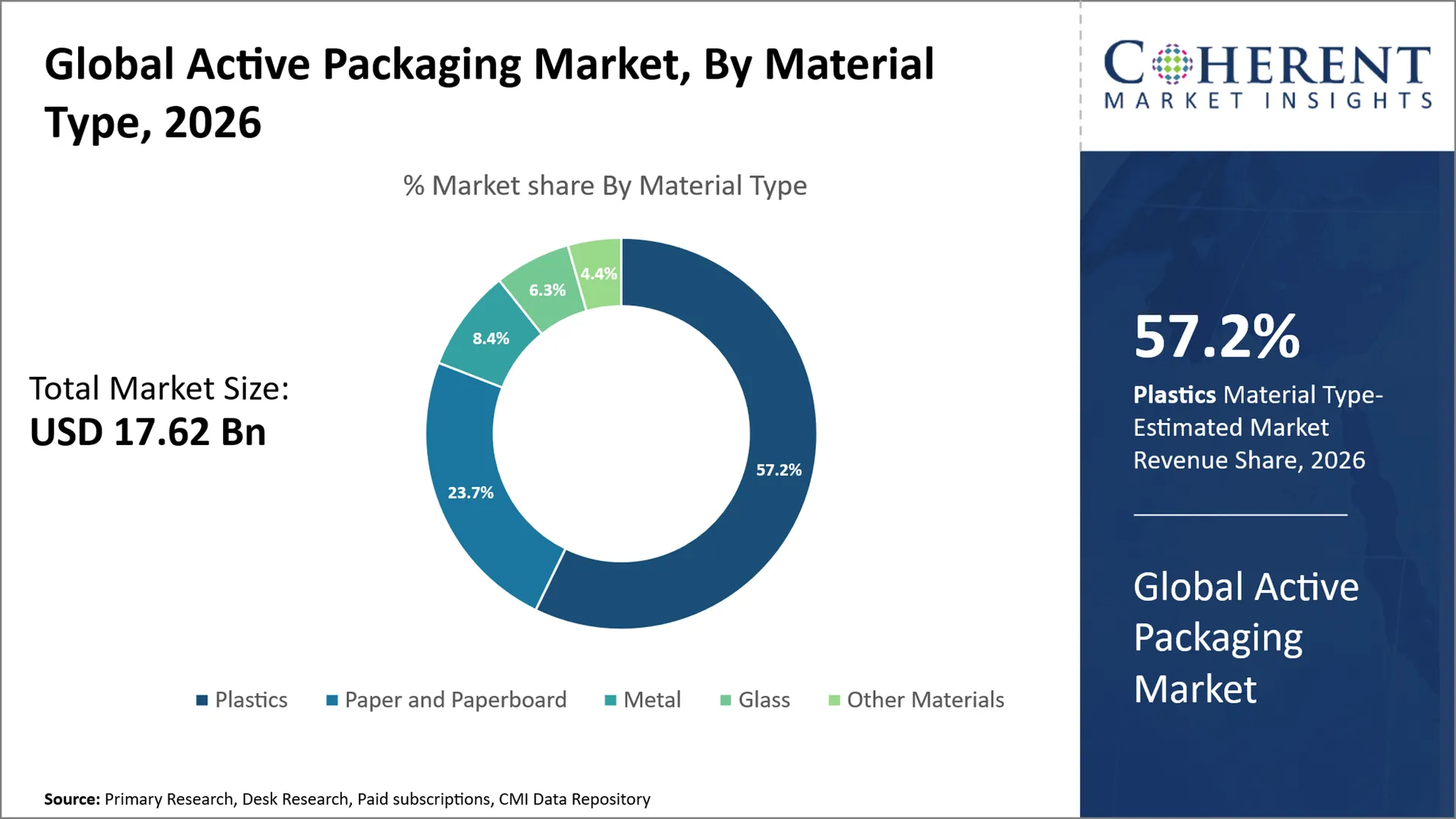
Plastics are projected to capture 57.2% of the global active packaging market by material type in 2026. Their competitive position is supported by the ability to engineer multiple functional layers while maintaining heat-sealing performance and mechanical durability. This characteristic is particularly important for fresh-produce packaging, where gas regulation and microbial protection must operate under refrigerated distribution conditions. Manufacturers can combine active coatings with established polyethylene film structures, although migration safety and production consistency require careful validation. In January 2026, researchers published a study in Food Packaging and Shelf Life demonstrating a low-density polyethylene film incorporating ethylene-scavenging materials and an antibacterial coating for blueberry preservation. The findings demonstrate technical feasibility rather than commercial deployment. Such multifunctional structures could create premium opportunities for polymer suppliers and packaging converters serving quality-sensitive produce exporters.
Why Do Active Bags and Pouches Dominate the Packaging Format Segment of the Global Active Packaging Market?
Active Bags and Pouches are expected to hold 38.6% of the global active packaging market by packaging format in 2026. Their commercial appeal includes lower tooling requirements than rigid packaging and flexibility in accommodating specialized protective films. These advantages are relevant to edible oils, condiments, and specialty food products requiring tailored packaging configurations. Manufacturers can incorporate antioxidant compounds into pouch materials while adjusting sealing characteristics and package dimensions to accommodate different product requirements. In June 2024, research published in Food Hydrocolloids demonstrated chitosan-and-gelatin antioxidant pouches containing gallic acid for olive oil storage. The experimental pouches reduced certain oxidation-related volatile compounds compared with glass-container controls. Although commercial scalability requires further validation, the findings indicate opportunities for differentiated active pouches offering product-specific protection and alternative material formulations.
Current Events and their Impact
Current Event | Description and Its Impact |
January 2025 – U.S. FDA Withdraws Effectiveness of PFAS Food-Contact Authorizations |
|
February 2025 – European Commission Strengthens Plastic Food-Contact Material Requirements |
|
August 2026 – EU Packaging and Packaging Waste Regulation Begins Applying |
|
Global Active Packaging Market Dynamics
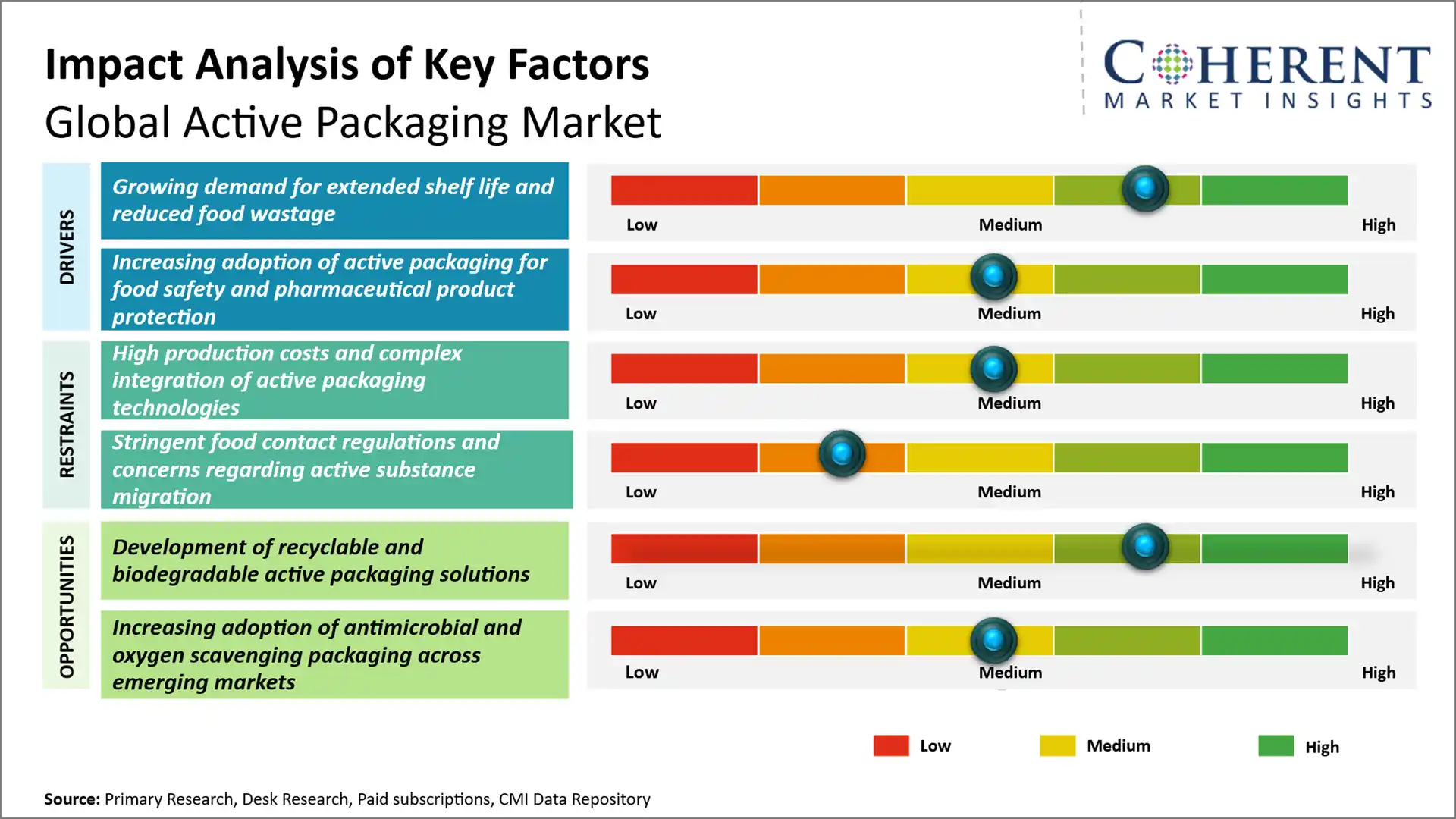
Key Market Drivers
- Growing demand for extended shelf life and reduced food wastage: Food manufacturers increasingly assess packaging against the cost of products discarded before purchase rather than packaging expenditure alone. Active oxygen removal can protect product quality during distribution, reducing rejected inventory and helping processors serve longer retail routes. Bakery manufacturers, snack brands, and dried-food exporters benefit from these preservation capabilities. In July 2026, Flair Packaging launched its ACTIV8 oxygen-absorber sachets, designed to remove residual oxygen and manage subsequent oxygen ingress within sealed packaging. The development demonstrates how manufacturers can strengthen preservation without modifying existing food formulations.
- Increasing adoption of active packaging for food safety and pharmaceutical product protection: Active packaging is becoming an important tool for managing product-quality risks that conventional packaging barriers cannot always address. Pharmaceutical manufacturers and contract packaging organizations increasingly need solutions that protect sensitive formulations without requiring changes to established drug compositions. In June 2026, Aptar Active Material Science announced that its N-Sorb technology had secured U.S. patent-application allowance for packaging-integrated nitrosamine mitigation. The development illustrates how specialized packaging materials could help manufacturers manage chemical impurities, strengthen product stability strategies, and differentiate pharmaceutical protection systems, subject to appropriate validation.
Emerging Market Trends
- Integration of Active Functions into Recycling-Compatible Packaging Structures: Active packaging development is shifting toward materials that combine preservation performance with simpler recycling pathways. Packaging converters are reconsidering multilayer construction, additive selection, and functional coatings to avoid compromising recovery processes. This transition is encouraging closer coordination between polymer developers, active-ingredient suppliers, and recycling specialists. Manufacturers capable of retaining oxygen or moisture-control functionality within recycling-compatible structures could gain stronger positions in procurement decisions. During the forecast period, material recovery considerations are likely to become an integral part of active packaging design rather than a separate sustainability assessment.
- Transition Toward Precisely Controlled Release of Active Packaging Ingredients: Active packaging technologies are moving beyond continuous, uniform substance release toward systems engineered for specific product conditions and exposure periods. Controlled-release antimicrobial agents, antioxidants, and gas-regulating components can be tailored to respond to temperature, humidity, or product characteristics. This approach could improve protection while limiting unnecessary active-ingredient consumption. Specialty chemical suppliers and packaging developers with formulation expertise may benefit from higher-value applications. However, validation complexity and manufacturing consistency will remain significant commercialization barriers, particularly when performance must remain predictable throughout extended storage and transportation.
Regional Insights
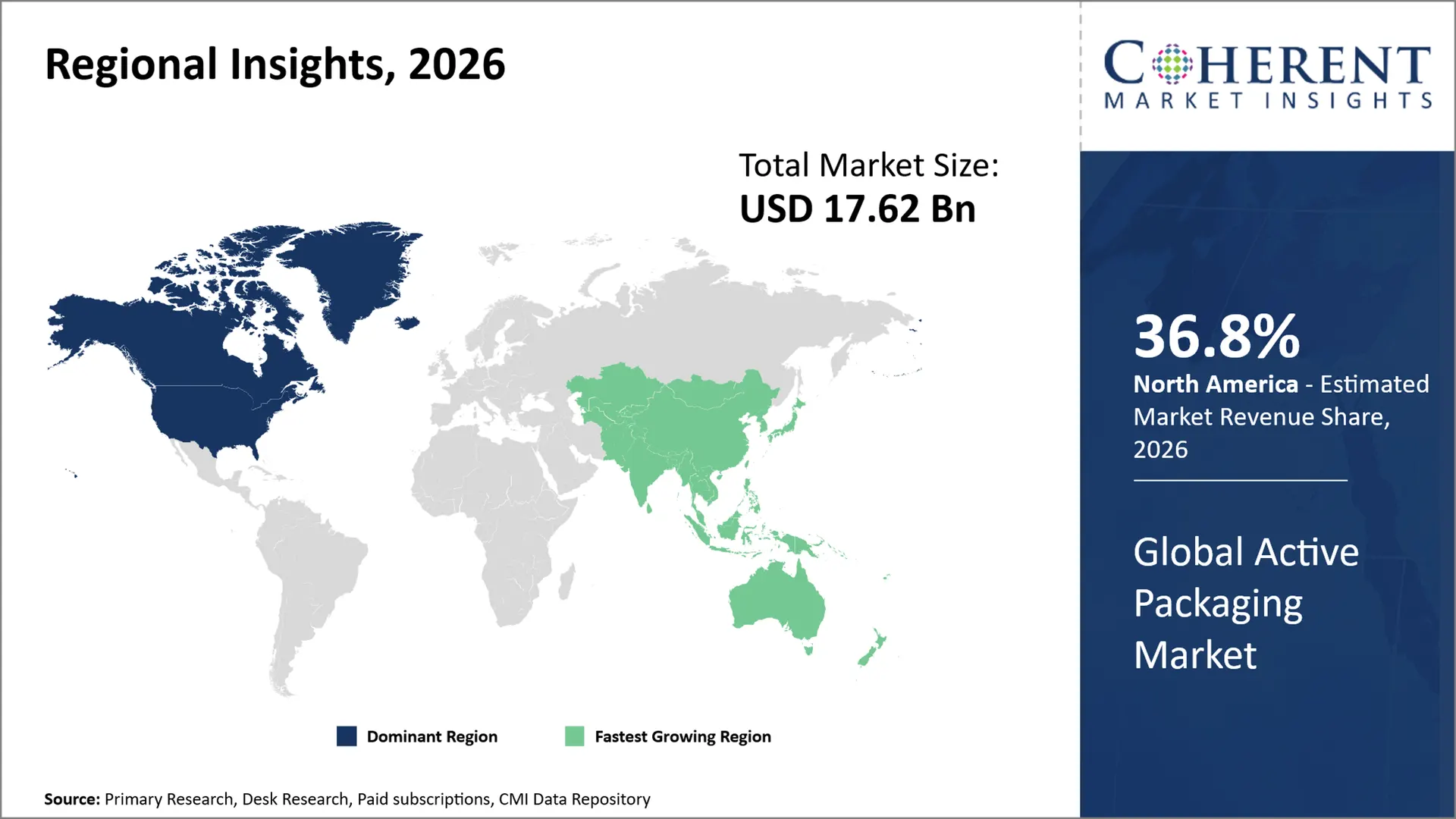
Why Does North America Dominate the Global Active Packaging Market?
North America is expected to dominate the global active packaging market, accounting for 36.8% of total revenue in 2026. Its leadership reflects an established ecosystem of specialty material developers, packaging converters, and technically demanding industrial customers. Food manufacturers across the region increasingly evaluate packaging functionality through product stability, material traceability, and compatibility with automated filling operations. The presence of research institutions specializing in functional polymers also supports the development of commercially differentiated packaging materials. In August 2025, according to National Library of Medicine, researchers affiliated with the University of British Columbia published findings on cellulose nanofibril films incorporating lignin nanoparticles, demonstrating improved antioxidant functionality and preservation performance in raspberry packaging trials. Such research strengthens regional capabilities in developing renewable active packaging materials. Manufacturers capable of translating these formulations into industrial production could gain access to higher-value food preservation applications.
Why Is Asia Pacific Emerging as the Fastest-Growing Region in the Global Active Packaging Market?
Asia Pacific is anticipated to become the fastest-growing region in the global active packaging market, holding 28.6% of revenue in 2026. Regional expansion will benefit from greater integration of specialty packaging technologies into food-processing operations and the development of locally manufactured functional materials. Research institutions are exploring antimicrobial compounds, bio-based films, and antioxidant systems suitable for temperature-sensitive food applications. This activity could reduce dependence on imported specialty formulations and support regional packaging innovation. In December 2025, researchers at South Korea's Dongguk University published a study demonstrating antimicrobial and antioxidant performance in agar-based packaging films incorporating zinc oxide and carbon quantum dots. The findings establish technical potential rather than confirmed commercial adoption. Continued cooperation between material developers and packaging converters could accelerate product qualification and strengthen Asia Pacific's competitive position in specialized food packaging.
Global Active Packaging Market Outlook for Key Countries
Why Is the U.S. a Key Market for the Global Active Packaging Market?
The U.S. represents a major commercial center for active packaging market, supported by its established food manufacturing sector, specialized packaging equipment suppliers, and extensive material testing infrastructure. Domestic food processors increasingly require packaging solutions that balance microbial protection with ingredient-label requirements and production efficiency. Research into controlled-release systems is particularly relevant for manufacturers seeking alternatives to adding preservatives directly to food formulations. In its 2025 annual research report, the U.S. Department of Agriculture's Agricultural Research Service documented progress in encapsulating essential oils and antioxidants using agricultural starches for incorporation into food packaging. The research demonstrates opportunities to transform domestic agricultural materials into functional preservation components. Commercial suppliers that can achieve reliable ingredient release, regulatory compliance, and scalable manufacturing will be positioned to serve food producers seeking differentiated packaging solutions.
Why Is India Important in the Global Active Packaging Market?
India's active packaging market is positioned to benefit from the expansion of packaged snacks, bakery products, spices, and nutraceutical manufacturing. These industries require packaging that withstands variations in humidity and storage conditions while remaining economically suitable for high-volume production. Domestic availability of plant-derived active ingredients and packaging research capabilities could support affordable oxygen-control alternatives. In June 2025, researchers associated with the Indian Institute of Technology Roorkee published findings on oxygen-scavenging labels incorporating catechu, sodium carbonate, and guar gum. The study demonstrated moisture-activated oxygen absorption, indicating potential for packaging systems that become functional under defined environmental conditions. Such developments could help Indian packaging converters introduce locally developed protective components for specialty food applications. Successful commercialization will depend on material stability, industrial processing compatibility, and cost-effective integration into existing packaging lines.
Why Does China Support Growth in the Global Active Packaging Market?
China's importance in the global active packaging market comes from its extensive polymer processing capabilities, established packaging supply chains, and large domestic food manufacturing industry. Fresh meat processors, in particular, require solutions that manage lipid oxidation and maintain acceptable product appearance during refrigerated distribution. China's manufacturing ecosystem provides opportunities to integrate functional compounds into packaging films while leveraging domestic raw-material and converting capabilities. In September 2025, the Chinese Academy of Agricultural Sciences announced the development of a chitosan and polyvinyl alcohol packaging film reinforced with quercetin nanocrystals. The researchers reported improved antioxidant performance and preservation results for chilled pork. This development illustrates China's progress in specialized active-material formulation. Packaging suppliers translating such research into commercially validated production processes could strengthen their positions among meat processors and refrigerated food distributors.
Why Is Germany a Strategic Country in the Global Active Packaging Market?
Germany holds a strategic position in the global active packaging market through its expertise in packaging machinery, materials engineering, and industrial product validation. German packaging manufacturers face the challenge of delivering functional preservation capabilities while meeting demanding European food-contact and recyclability requirements. This encourages research into renewable antimicrobial substances and packaging materials that can be evaluated under realistic production conditions. Fraunhofer IVV's MATE4MEAT research project, operating during 2024–2027, is developing antimicrobial packaging concepts for meat using materials derived from industrial and agricultural residues. The institute is responsible for evaluating packaging performance, application suitability, and compliance with food legislation. These capabilities support Germany's importance as a technology development center. Packaging manufacturers could benefit from transferring validated research into specialized commercial products for European meat processors and premium food manufacturers.
Why Is Japan an Important Growth Market for the Global Active Packaging Market?
Japan's active packaging market benefits from established oxygen-absorber manufacturing expertise, advanced packaging machinery, and strict product-quality expectations among food producers. Packaged rice, traditional confectionery, and processed food manufacturers require precise oxygen management to maintain product quality during storage. Automation is particularly important because incorrect absorber insertion can compromise package protection and production efficiency. In June 2026, Nomura Sangyo showcased its SIP-110RII automated weighing and packaging machine at FOOMA JAPAN 2026. The equipment supports both modified-atmosphere packaging and packaging incorporating oxygen absorbers for rice preservation. This development demonstrates the importance of integrating active packaging components directly into production equipment. Suppliers offering reliable absorber dispensing, equipment compatibility, and technical maintenance support could strengthen relationships with Japanese food manufacturers seeking consistent preservation performance and efficient packaging operations.
Active Packaging Technology Adoption Landscape
Technology | Primary Function | Adoption Landscape | Commercial Implications |
Oxygen Scavenging Systems | Chemically absorb residual oxygen and oxygen entering sealed packages. | Commercially established in sachets, inserts, and oxygen-absorbing polymer structures for oxidation-sensitive products. | Suppliers can differentiate through absorption capacity, reaction speed, and compatibility with high-barrier packaging. |
Moisture Absorption and Humidity Regulation | Control internal moisture using silica gel, molecular sieves, clay, or engineered adsorption materials. | Established in desiccant inserts, with increasing integration into films and automated dispensing systems. | Manufacturers can improve process efficiency through appropriately sized sorbents and accurate insertion technologies. |
Antimicrobial Active Packaging | Release or incorporate antimicrobial substances to control microbial growth under specified conditions. | Specialized commercial applications exist, while broader adoption depends on safety validation and regulatory requirements. | Creates opportunities for high-value applications but requires strong evidence of efficacy, migration safety, and formulation compatibility. |
Ethylene Absorption and Ripening Control | Reduce or regulate ethylene exposure to influence ripening and senescence in susceptible produce. | Applied in selected produce packaging systems and post-harvest handling applications. | Offers differentiation for horticultural exporters and produce packers through commodity-specific preservation solutions. |
Carbon Dioxide Emitters and Gas-Regulating Systems | Regulate carbon dioxide concentrations within sealed packaging environments. | Used selectively in preservation applications that require controlled internal gas conditions. | Packaging developers can offer specialized gas-management configurations matched to product respiration, microbial stability, and package permeability. |
Microwave Susceptor Technology | Convert microwave energy into localized surface heat to improve browning and crispness. | Established in selected microwaveable food packaging formats and convenience-food applications. | Enables food brands to improve cooking performance and product differentiation, provided heating uniformity and food-contact safety are validated. |
How Are Active Protective Closures for Refillable Personal-Care Products Creating New Growth Opportunities in the Global Active Packaging Market?
Refillable personal-care packaging presents an underdeveloped opportunity for active packaging suppliers seeking applications beyond conventional sealed products. Premium skincare formulations, concentrated cosmetics, and moisture-sensitive personal-care products can experience repeated exposure to environmental conditions during consumer use. Specialized oxygen-absorbing closures and replaceable humidity-control inserts could help brands maintain formulation stability across refill cycles. This creates opportunities for packaging manufacturers to supply modular protective components compatible with standardized refill containers.
Commercial adoption will require material compatibility testing, migration assessment, reliable closure performance, and validation under repeated opening conditions. Suppliers must also develop economical component replacement and recovery systems.
Specialist active-material developers may initially benefit from their formulation expertise, while established closure manufacturers could provide manufacturing scale and access to international cosmetic brands. Companies entering this opportunity should prioritize measurable formulation protection, consumer convenience, and total packaging-system economics rather than relying exclusively on sustainability positioning.
Market Players, Key Development, and Competitive Intelligence
Key Developments
- In September 2026, DuPont launched Tyvek with Renewable Attribution for consumer and industrial applications, explicitly including active packaging. The certified bio-circular material sourcing approach provides manufacturers of protective sachets and inserts with an alternative substrate option, supporting sustainability objectives without requiring fundamental changes to existing converting processes.
- In April 2026, Clariant expanded its continuous-strip desiccant portfolio in the Americas, introducing reel-based formats for automated packaging operations. The development supports more efficient moisture protection for nutraceutical, diagnostic, and healthcare products while reducing manual handling requirements and simplifying integration with high-speed production equipment.
- In March 2026, Cortec Corporation announced the availability of standard-stock VpCI-125 HP Permanent ESD bags for electronics packaging. Combining static-control properties with vapor-phase corrosion protection, these packages help safeguard sensitive electronic components during storage and transportation, expanding commercially accessible active packaging solutions for industrial supply chains.
Competitive Landscape
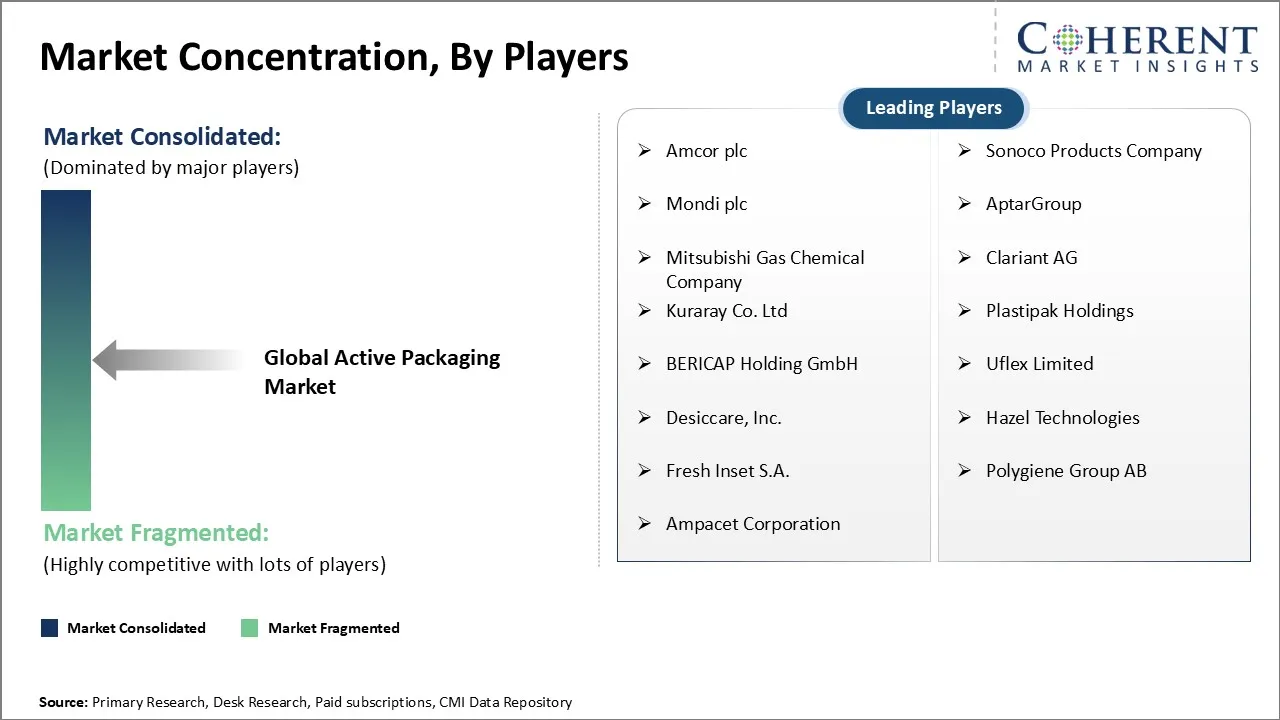
The global active packaging market remains moderately fragmented, comprising multinational packaging manufacturers, specialty chemical suppliers, sorbent producers, functional coating developers, and regional packaging converters. Competition centers on functional performance, regulatory compliance, manufacturing consistency, and cost efficiency. Specialized manufacturers maintain competitive positions through proprietary material formulations, while larger organizations benefit from production scale, established distribution networks, and relationships with industrial and healthcare customers.
Key competitive focus areas include
- Product Performance Differentiation: Developing active materials with consistent absorption capacities, controlled-release characteristics, and reliable performance throughout product storage.
- Manufacturing Efficiency: Improving coating uniformity, material processing, and production reliability to reduce operational costs and product rejection rates.
- Pricing Competitiveness: Balancing the additional cost of active ingredients against measurable reductions in product deterioration and handling expenses.
- Regulatory Compliance: Maintaining appropriate food-contact documentation, material traceability, migration testing, and pharmaceutical packaging quality standards.
- Customization Capabilities: Offering application-specific active chemistry, packaging formats, and integration options tailored to customer manufacturing requirements.
- Supply Chain Reliability: Establishing dependable sourcing arrangements for specialty chemicals, absorbent materials, polymer substrates, and packaging components.
- Intellectual Property Protection: Securing differentiated formulations, proprietary delivery mechanisms, and manufacturing processes that strengthen long-term commercial positioning.
- Regional Manufacturing Strategies: Expanding local converting and technical support capabilities to improve delivery responsiveness and accommodate customer-specific product requirements.
Market Report Scope
Global Active Packaging Market Report Coverage | |||
Report Coverage | Details | ||
Base Year | 2025 | Market Size in 2026: | USD 17.62 Bn |
Historical Data For: | 2020 To 2024 | Forecast Period: | 2026 To 2033 |
Forecast Period 2026 To 2033 CAGR: | 5.90% | 2033 Value Projection: | USD 26.32 Bn |
Geographies covered: |
| ||
Segments covered: |
| ||
Companies covered: | Amcor plc, Sonoco Products Company, Mondi plc, AptarGroup, Mitsubishi Gas Chemical Company, Clariant AG, Kuraray Co. Ltd, Plastipak Holdings, BERICAP Holding GmbH, Uflex Limited, Desiccare, Inc., Hazel Technologies, Fresh Inset S.A., Polygiene Group AB, Ampacet Corporation | ||
Growth Drivers: |
| ||
Restraints & Challenges: |
| ||
Analyst Opinion (Expert Opinion)
- The global active packaging market leadership will increasingly depend on commercializing proprietary active-material technologies through scalable manufacturing partnerships. Suppliers licensing formulations and standardized production processes to regional converters could expand their market presence without major capital investments. This approach may create opportunities for specialized technology developers and encourage larger manufacturers to establish technology-sharing agreements.
- Inline verification of active packaging functionality could transform traditional quality assurance practices. Instead of relying solely on batch-level certifications and laboratory testing, manufacturers may adopt real-time performance monitoring during production. This shift could challenge suppliers offering poorly documented materials while benefiting companies integrating analytical testing, process monitoring, and traceable quality records into packaging operations.
- Manufacturers should prioritize stable active formulations, reliable performance testing, and diversified sourcing of critical ingredients. Investment should focus on applications where enhanced protection justifies higher packaging costs. Companies must address regulatory uncertainty, material compatibility, and fluctuating input prices. Pilot-scale validation and customer qualification should take priority over major capacity expansion, particularly for technologies without proven commercial acceptance.
Speak to the analyst
Want personalized insights?
Take the findings above to one of our principal consultants, or have the report rebuilt around the segments, geographies and competitors you actually track.
Market Segmentation
- Packaging Technology Insights (Revenue, USD Bn, 2021 - 2033)
- Oxygen Scavengers
- Moisture Absorbers
- Antimicrobial Agents
- Ethylene Absorbers and Ripening Control
- Gas Emitters and Regulators
- Microwave Susceptors
- Other Active Packaging Technologies
- Material Type Insights (Revenue, USD Bn, 2021 - 2033)
- Plastics
- Paper and Paperboard
- Metal
- Glass
- Other Materials
- Packaging Format Insights (Revenue, USD Bn, 2021 - 2033)
- Active Bags and Pouches
- Active Rigid Containers and Trays
- Active Sachets and Inserts
- Active Labels and Closures
- End User Insights (Revenue, USD Bn, 2021 - 2033)
- Food and Beverages
- Pharmaceuticals and Healthcare
- Agriculture and Fresh Produce Handling
- Personal Care and Cosmetics
- Electronics and Electrical
- Industrial Goods and Logistics
- Other End Users
- Distribution Channel Insights (Revenue, USD Bn, 2021 - 2033)
- Direct Manufacturer Sales
- Distributors and Specialty Suppliers
- Regional Insights (Revenue, USD Bn, 2021 - 2033)
- North America
- U.S.
- Canada
- Latin America
- Brazil
- Argentina
- Mexico
- Rest of Latin America
- Europe
- Germany
- U.K.
- Spain
- France
- Italy
- Russia
- Rest of Europe
- Asia Pacific
- China
- India
- Japan
- Australia
- South Korea
- ASEAN
- Rest of Asia Pacific
- Middle East
- GCC Countries
- Israel
- Rest of Middle East
- Africa
- South Africa
- North Africa
- Central Africa
- North America
Sources
Primary Research Interviews
- Active packaging manufacturers, packaging converters, and specialty chemical suppliers
- Oxygen scavenger, moisture absorber, and antimicrobial packaging technology developers
- Food processors, pharmaceutical packaging companies, distributors, and industry experts
Stakeholders
- Active packaging manufacturers and material suppliers
- Polymer, functional coating, sorbent, and additive manufacturers
- Food and beverage, pharmaceutical, healthcare, and industrial packaging companies
- Packaging converters, distributors, retailers, and end users
End-use Sectors
- Food and beverage packaging
- Pharmaceutical and healthcare packaging
- Agriculture and fresh produce handling
- Personal care, electronics, and industrial packaging
Regulatory and Industry Bodies
- U.S. Food and Drug Administration (FDA)
- European Commission
- European Food Safety Authority (EFSA)
- U.S. Environmental Protection Agency (EPA)
- International Organization for Standardization (ISO)
- ASTM International
- Food Safety and Standards Authority of India (FSSAI)
Databases
- Company annual reports and investor presentations
- UN Comtrade packaging materials and international trade datasets
- Eurostat and national packaging manufacturing databases
- Active packaging production, pricing, capacity, and patent databases
- Food-contact material and packaging compliance databases
Magazines and Journals
- Food Packaging and Shelf Life
- Packaging Technology and Science
- Journal of Food Engineering
- Food Control
- Innovative Food Science & Emerging Technologies
- Packaging Europe
Associations
- Flexible Packaging Association (FPA)
- Active & Intelligent Packaging Industry Association (AIPIA)
- Institute of Packaging Professionals (IoPP)
- European Organisation for Packaging and the Environment (EUROPEN)
- World Packaging Organisation (WPO)
Public Domain Sources
- Active packaging production, consumption, and trade statistics
- Food wastage, shelf-life extension, and packaging performance data
- Oxygen scavenging, moisture control, and antimicrobial technology developments
- Packaging material innovation, recycling, and sustainability initiatives
- Product launches, regulatory updates, and manufacturing investments
Key Standards and Regulations
- Regulation (EC) No. 1935/2004 – Food-contact materials
- Commission Regulation (EC) No. 450/2009 – Active and intelligent food-contact materials
- Commission Regulation (EU) No. 10/2011 – Plastic food-contact materials
- U.S. FDA 21 CFR Parts 174–178 – Food-contact substances and materials
- Regulation (EU) 2025/40 – Packaging and Packaging Waste Regulation
- ASTM F1927 – Oxygen transmission rate testing
- ASTM F1249 – Water vapor transmission rate testing
Proprietary Elements
- CMI Data Analytics Tool
- Proprietary CMI repository containing 10+ years of packaging industry intelligence covering active packaging technologies, market demand, material pricing, production capacity, food safety, shelf-life extension, sustainability, regulatory developments, and competitive intelligence.
Get access to 250+ pages report
Every segment, forecast, competitor profile and data table behind the analysis above — available for instant download.
- ESOMAR Member
- ISO 9001:2015 Certified
- D-U-N-S Registered
- GDPR & CCPA Compliant
Frequently Asked Questions
The CAGR of global active packaging market is projected to be 5.90% from 2026 to 2033.
The global active packaging market is estimated to be valued at USD 17.62 Bn in 2026 and is expected to reach USD 26.32 Bn by 2033.
The report provides insights into market performance, competitive dynamics, technology adoption, regulatory developments, and regional business opportunities.
Yes, the report examines major manufacturers, their competitive positioning, product innovations, strategic initiatives, and market expansion strategies.
The report provides country-level insights into key markets, including the U.S., China, Germany, India, and Japan.
The report helps manufacturers, investors, and packaging suppliers evaluate investment opportunities, identify potential customers, assess competitive positioning, and develop market entry strategies.
The major factors driving the growth of the global active packaging market are the growing need to extend product shelf life, reduce food wastage, improve food safety, and protect pharmaceutical products..