

Global Adaptive Learning Market Size and Forecast – 2026 To 2033
The global adaptive learning market is expected to grow from USD 5.25 Bn in 2026 to USD 24.00 Bn by 2033, registering a compound annual growth rate (CAGR) of 14.3% from 2026 to 2033. The global adaptive learning market is driven by rising emphasis on measurable learning outcomes. On November 12, 2025, Schoox announced the launch of its Learning Impact Suite, the first AI-engineered learning solution that starts with desired business outcomes and creates learning programs to achieve them.
Key Takeaways of the Global Adaptive Learning Market
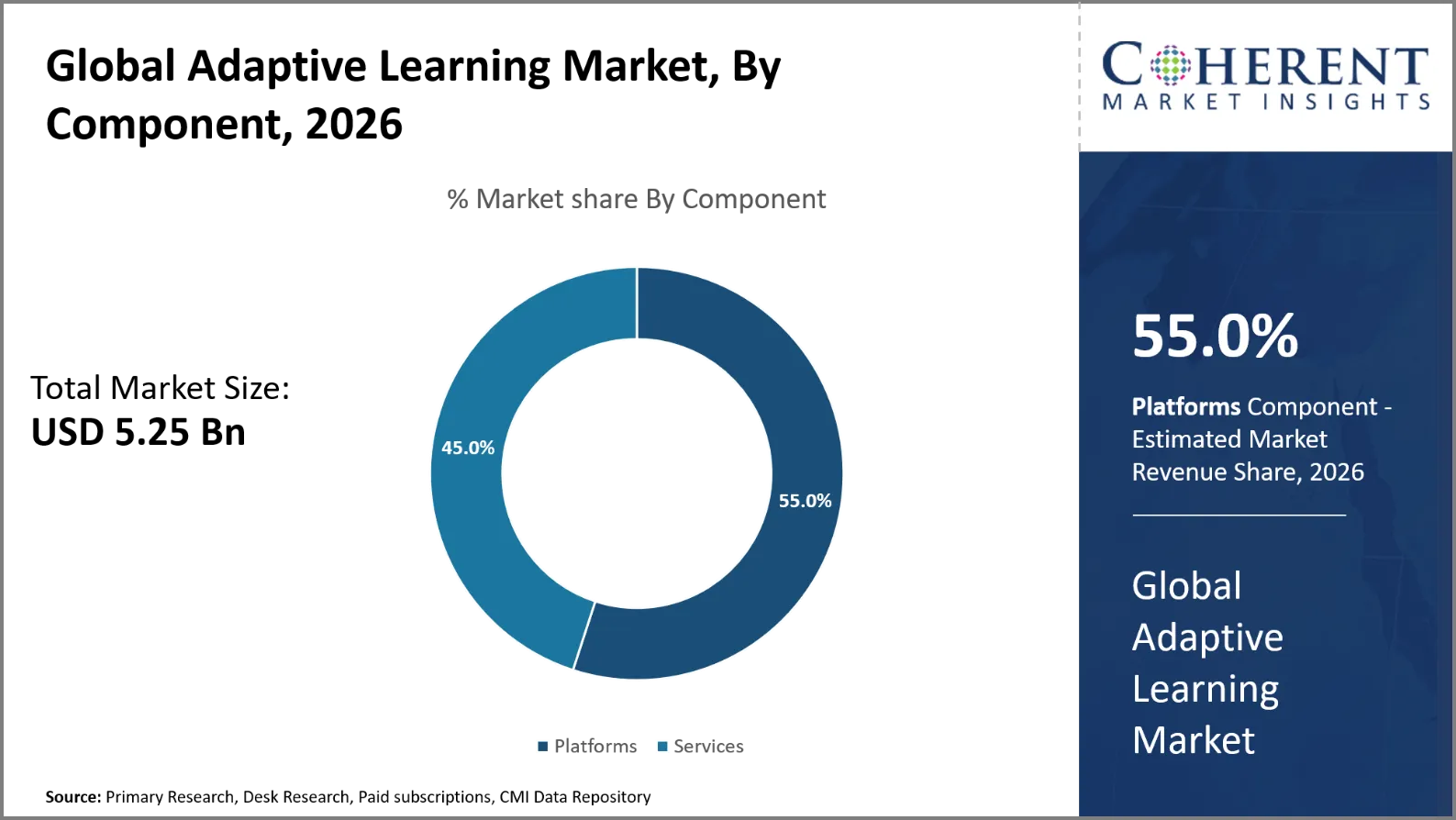
- The Platforms segment is expected to account for 55.0% of the global adaptive learning market share in 2026. Expansion of enterprise learning and employee development is driving the growth of the segment. On October 29, 2025, HCLTech partnered with Talents of Endearment. The companies announced an artificial intelligence-powered learning and development framework combining HCLTech's Career Shaper platform with Talents of Endearment's education and recruitment expertise.
- The Cloud-Based segment is estimated to capture 51.0% of the market share in 2026. Development of multilingual learning platforms is majorly driving the growth of the segment. On November 24, 2025, Mimir opened its personalized language learning platform to global consumers. The company expanded beyond institutional customers to offer subscriptions directly to individual learners and families worldwide.
- The Algorithm-Based Learning segment is estimated to capture 43.0% of the market share in 2026. Growth in digital education is majorly driving the growth of the segment. On April 8, 2026, Penda Learning launched Cosmos. The company introduced an artificial intelligence instructional assistant within its K-12 science platform.
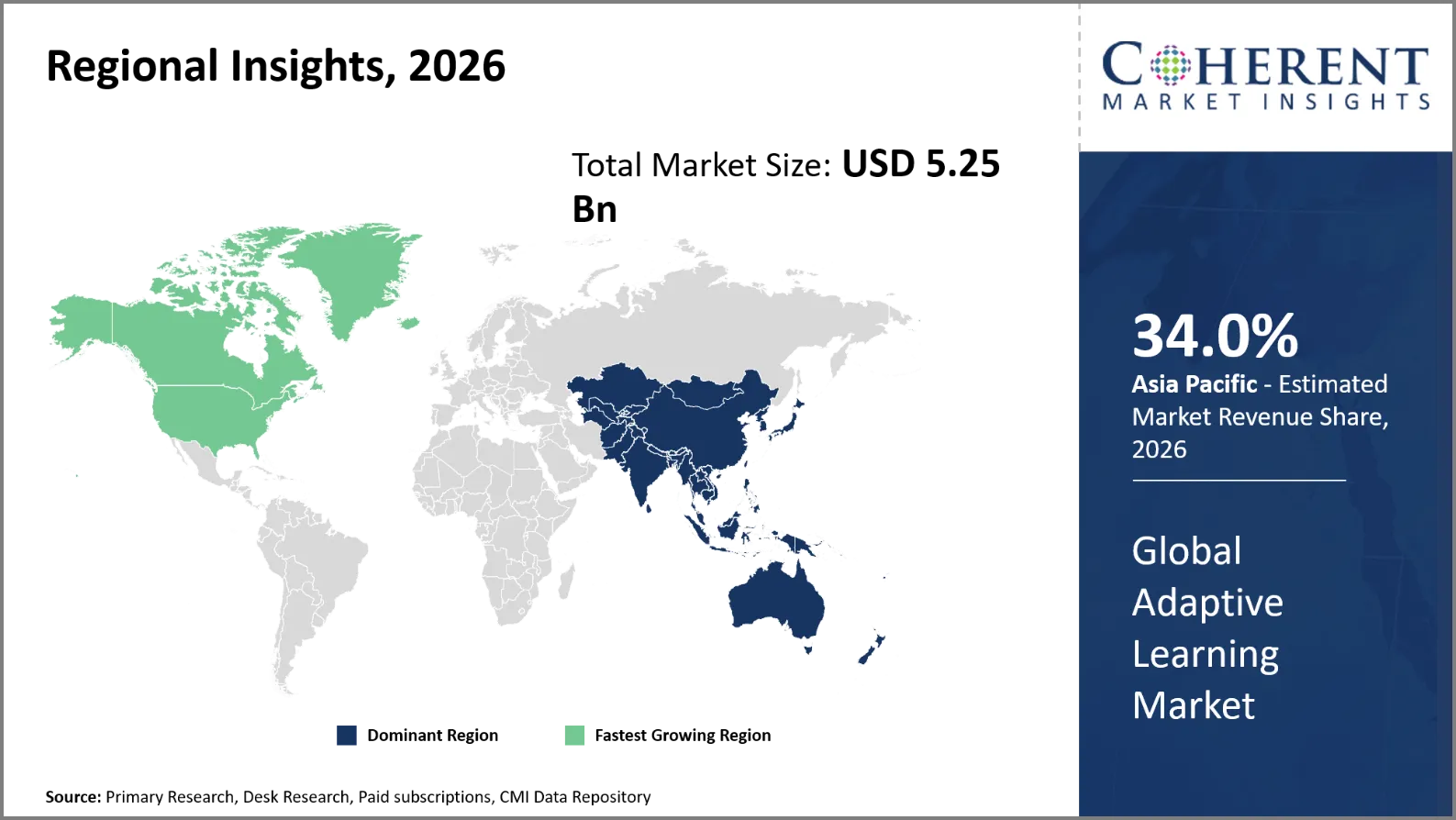
- Asia Pacific is expected to dominate the adaptive learning market in 2026 with a market share of 34.0%. Adoption of adaptive learning for professional certification in Asia Pacific is driving the growth of the regional market. On February 5, 2026, SAP announced an expansion of its global learning ecosystem, including broader access to instructor-led training through authorized training partners
- North America is expected to account for 23.0% share in 2026 and is projected to record the fastest growth over the forecast period. Integration with educational content and assessment systems in North America is driving the growth of the regional market. On June 4, 2025, McGraw Hill and Pearson announced an agreement to integrate Pearson's Review of Progress and Learning assessment solution into McGraw Hill's K-12 curriculum.
Segmental Insights
Why Does Platforms Dominate the Global Adaptive Learning Market?
The platforms segment is expected to account for 55.0% of the global adaptive learning market share in 2026. The reason platforms are prevalent is that they provide customized training, learner analytics, assessment and content management in an integrated digital environment. Schools and organizations utilize these platforms to find gaps in knowledge and personalize learning experiences to an individual’s performance. Centralized dashboards can help teachers monitor student progress, pinpoint students who are falling behind, and adjust teaching strategies. Integration with learning management systems to facilitate smooth course delivery and administrative activities. Platforms employ artificial intelligence to provide rapid feedback and suggest relevant material to the user. These features enable large populations of learners and avoid repetitive educational duties.
On January 15, 2026, Explore, a one-stop digital portal that includes curricular information, instructional resources, assessments and real-time data, was released by Cengage School. Teachers can utilize adjustable dashboards to track learner’s progress and adapt teaching activities. Explore also connects with Canvas, Schoology and Google Classroom, enabling schools to connect content delivery with their existing learning management systems.
- Current Industry Events of 2026
- Market Size Estimation
- Regional Breakdown
- Competitive Landscape
- Customer Intelligence
- Segmental Analysis
- Pricing Analysis
- Key Market Drivers, Challenges & Future Trends
- Customized Insights Section
Why is Cloud-Based the Most Preferred Deployment Type?
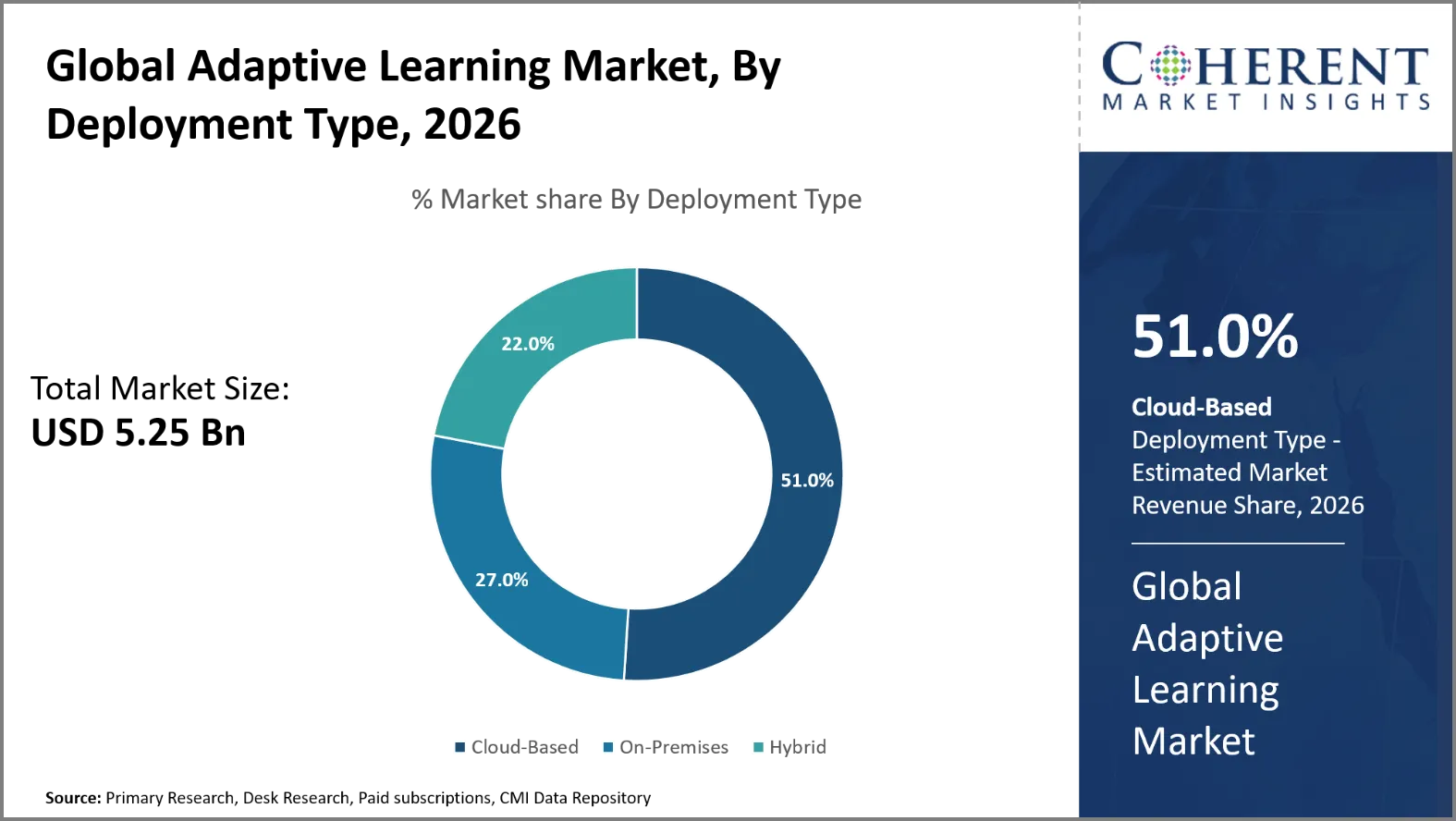
The cloud-based segment is expected to account for 51.0% of the global adaptive learning market share in 2026. The cloud deployment is popular due to the flexible access, centralized update and scalable computer resources. Learners can access educational content on suitable devices without dependence on institution-specific infrastructure. Cloud environments also help providers in processing learning data and providing personalized suggestions to geographically distributed users. Schools and colleges can profit from subscription-based distribution as it removes the upfront expense of hardware and simplifies software maintenance. Cloud infrastructure also makes it easy to interface with digital classrooms, content libraries and student information systems.
On February 28, 2025, Pearson and Amazon Web Services, Inc. announced the expansion of their long-standing collaboration to accelerate the delivery of AI-powered learning for millions of people around the world and enhance the learner experience for Pearson’s products and services. Building on their 13-year collaboration, AWS will continue to serve as a Pearson strategic AI and cloud provider, advancing infrastructure and AI capabilities designed to enable Pearson to enhance and scale its products and services, especially in its higher education footprint.
Algorithm-Based Learning Dominates the Global Adaptive Learning Market
The algorithm-based learning segment is expected to account for 43.0% of the global adaptive learning market share in 2026. Algorithm-based learning dominates because it enables educational systems to personalize instruction using measurable learner performance and behavioral data. Algorithms examine assessment results and response patterns, learning speed and demonstrated competency to discover specific knowledge gaps. This knowledge enables systems to adapt question difficulty, offer relevant resources, and select suitable learning sequences. As students interact with educational materials, knowledge tracing and machine learning can be used to improve customization. Algorithmic techniques also provide for automatic feedback and mastery-based development for huge populations of students. The efficiency of these systems depends on the availability of reliable data, the suitability of the instructional design and the ongoing assessment of learning results. In May 2026, Pearson surveyed more than 62,000 higher education students using Pearson Study Prep. Students who worked with artificial intelligence-powered adaptive questions were 90% more likely to acquire initial topic mastery than students working with static questions.
Current Events and their Impact
Current Events | Description and its Impact |
European Union Artificial Intelligence Act Regulation (EU) 2024/1689 |
|
India Digital Personal Data Protection Act, 2023, and Rules, 2025 (Act No. 22 of 2023. Rules notified through G.S.R. 846(E), November 13, 2025) |
|
Adaptive Learning Market Dynamics
Market Drivers
Increasing demand for individualized learning experiences
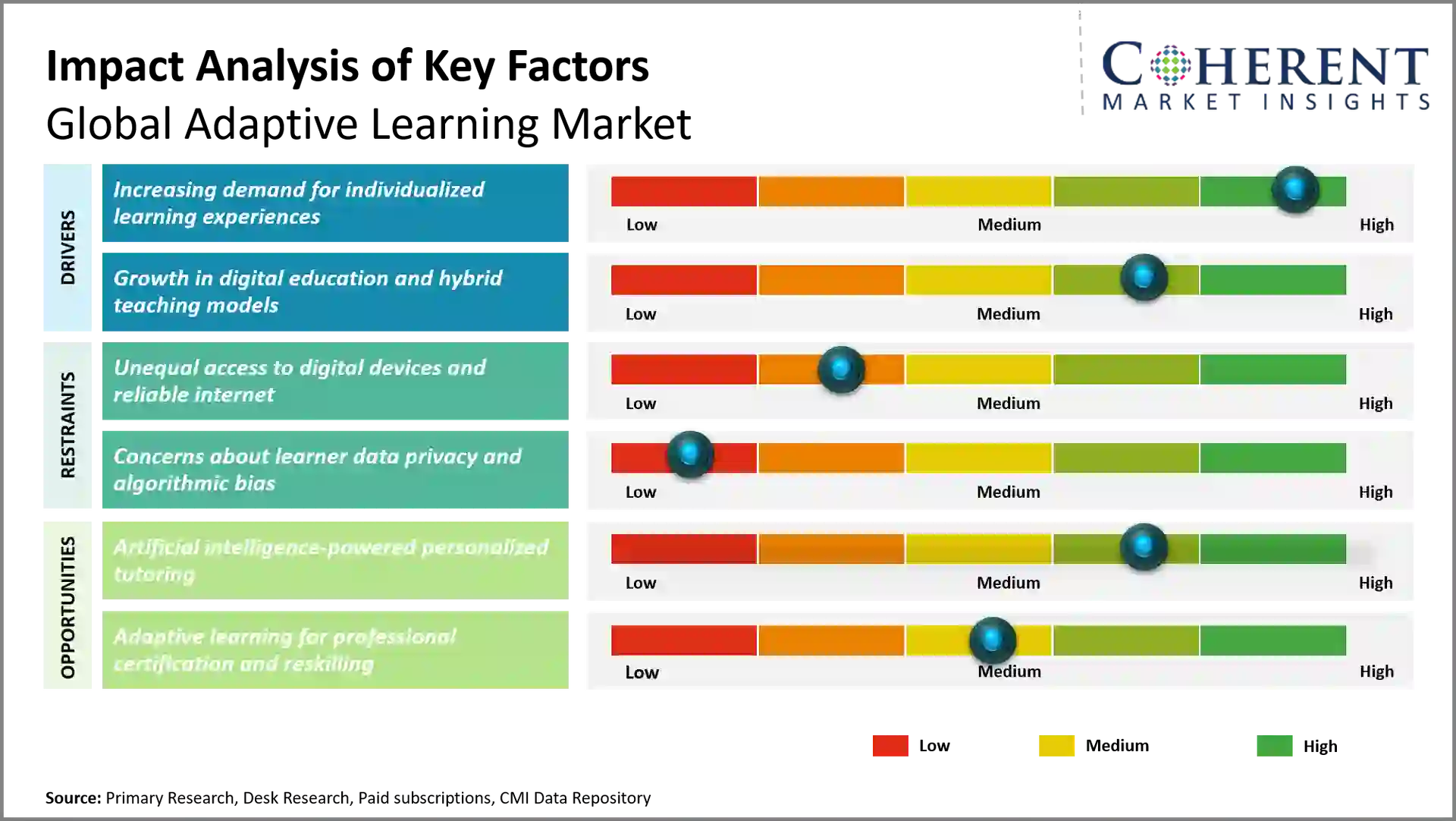
The growth of the global adaptive learning market is attributed to the increasing demand for individualized learning experiences as learners want education that is tailored to their talents, goals, and learning speeds. Adaptive learning platforms use assessment data, patterns in responses and knowledge gaps to provide individualized educational content. AI helps teachers to build personalized activities, provide instant feedback and suggest appropriate learning paths. Schools and universities can apply these skills to help address a range of learning needs in the same classroom. Companies also tailor training to build employee skills and job-related performance. As demand for student engagement, knowledge retention and measurable outcomes increases, the rationale for investing in adaptive learning systems is clear.
On September 16, 2025, Google introduced Learn Your Way. Google Research released this experimental tool that converts textbook content into custom-tailored educational experiences. With the help of LearnLM and Gemini 2.5 Pro, it can customize the explanations to the students’ grade level and interests.
Growth in digital education and hybrid teaching models
The increasing adoption of digital education and hybrid teaching models is driving the demand for adaptive learning solutions in educational institutions and corporate training settings. Benefits of tailored assessments and automatic feedback are enabled by online courses, virtual classrooms and hybrid training. Digital curriculum can be tailored to individual progress through the use of adaptive platforms that allow teachers to spot learning gaps. Cloud distribution also allows access through various devices and from geographically separated learning environments. Schools and universities are increasingly combining on-line resources with traditional classroom instruction to achieve greater flexibility and continuity of learning. As digital education continues to grow, adaptive learning technology can serve as a tool for organizations to handle different groups of learners, but also to make training more responsive and data-informed.
On March 31, 2026, Discovery Education announced the launch Discovery Education Connected Ecosystem, a single K-12 system that brings together AI, instructional materials, adaptive learning and professional preparedness into the everyday routine of teaching. Built on more than 20 years of teaching and learning excellence and trusted by 45% of U.S. K-12 schools, the Discovery Education Connected Ecosystem delivers trusted curriculum, intelligent tools, and responsive partnership as a single coherent approach.
Emerging Trends
- Generative artificial intelligence in personalized education: Adaptive learning systems are increasingly leveraging generative artificial intelligence to create personalized explanations, practice problems, and learning materials. These characteristics allow learners to fill up knowledge gaps and instructors to offer customized training for a variety of subjects and competency levels.
- Integration of learning analytics and predictive algorithms: Learning analytics are increasingly adopted by educational institutions to identify performance trends, predict learning challenges, and make specific changes. Adaptive platforms combine assessment data and predictive algorithms to deliver timely feedback and better-informed teaching decisions.
- Expansion of microlearning and competency-based education: Adaptive learning firms are increasingly providing brief, focused learning modules that correspond to particular skill levels and competencies. It provides flexibility in learning schedules, continuous improvement of skills and measurable success in academic education and corporate training programs.
- Growing adoption of mobile and cloud-based adaptive learning: Cloud infrastructure and mobile learning applications are extending access to tailored education across places and devices. They allow schools, universities and organizations serving distant learners to do synchronized learning activities, update centrally managed content, and deploy at scale.
Regional Insights
Why is Asia Pacific a Strong Market for Adaptive Learning?
Asia Pacific is expected to account for a market share of 34.0% in 2026. Asia Pacific adaptive learning market is driven by huge student populations, national digital education efforts, and need for tailored instructional technologies. The Smart Education platform of China is supporting digital educational resources and DIKSHA platform of India provides curriculum linked materials and teacher training. The Singaporean government is driving technology-enabled learning through the Ministry of Education’s digital learning programs. Japan’s Society 5.0 agenda promote digital change in education and beyond. South Korea’s digital education regulations promote the use of technology in the classroom. Regional providers are developing more bilingual content and artificial intelligence tutoring solutions. Mobile-first delivery remains important for reaching learners across geographically dispersed communities and diverse education systems.
Why Does North America Adaptive Learning Market Exhibit High Growth?
North America is expected to register the fastest growth with a CAGR of 14.9% over the forecast period. It is projected to account for 23.0% of the global adaptive learning market in 2026. North America’s adaptive learning market is supported by established educational software vendors, extensive university networks, and demand for measurable learning outcomes. The U.S. 2024 National Educational Technology Plan takes on digital resource access and design disparities, personalized education, and learner engagement. In July 2025, the Department of Education released recommendations for artificial intelligence, mentioning high-quality instructional resources and artificial intelligence-enhanced tutoring as possible applications. DreamBox Learning is one platform that helps with math practice through distinct learning routes. Through Contact North, Canada is developing digital learning services for post-secondary institutions. These programs assist differentiated instruction, accessibility and technology-enabled delivery of education.
Global Adaptive Learning Market Outlook for Key Countries
Why is China Emerging as a Major Hub in the Adaptive Learning Market?
The government-backed smart education infrastructure and national programs to embed artificial intelligence into the teaching process are driving the adaptive learning market in China. Smart Education of China, the Ministry of Education’s platform for digital educational resources and technology-enabled training, provides a basis. The Digital-Based Educational Innovation Plan in China encourages personalized education suited to the particular ability, learning objectives and progress of each student. The China Smart Education Development Report 2025-2026 highlights the convergence of AI with national smart education plans. These programs aim to deliver intelligent coaching possibilities, automated assessments and individual digital content. Chinese language demands and curriculum-specific learning needs can also be addressed by domestic technology developers.
Is U.S. the Next Growth Engine for the Adaptive Learning Market?
The U.S. adaptive learning market is benefiting from the increased interest in artificial intelligence-assisted tutoring and focused academic intervention. In July 2025, the U.S. Department of Education clarified that eligible federal education funds could support responsible artificial intelligence applications. The guideline pointed to artificial intelligence-powered high-impact tutoring, educational materials and college and career assistance as potential applications. The 2024 National Educational Technology Plan also promotes individualized instruction and technology availability. Khan Academy offers Khanmigo, an artificially intelligent learning assistant, whereas DreamBox Learning is an example of adaptive mathematics training. These programs provide chances for individualized practice, timely feedback, and differentiated training.
Germany Adaptive Learning Market Analysis and Trends
Germany’s adaptive learning industry is driven by vocational education, technical workforce development, and state investment in school digitalization. On December 18, 2025, federal and state governments agreed on DigitalPakt 2.0 with a commitment of USD 5 billion till 2030. The program offers funding for school development, instructional approaches and teacher training and equipment. These priorities open up possibilities for adaptable systems for math and science, digital competencies, and vocational qualifications. Germany’s industrial base also supports customized training for engineers, manufacturing and technical workers. Providers must take into account German language requirements, institutional procurement processes and European data protection standards.
U.K. Adaptive Learning Market Analysis and Trends
The U.K. adaptive learning market benefits from expanding teacher use of artificial intelligence and increasing attention to safe educational technology implementation. England’s Department for Education reported that 44% of surveyed teachers used generative artificial intelligence for at least one teaching-related activity in the 2024-2025 survey. Typical uses included class planning, administration and giving written feedback. The Office for Standards in Education, Children’s Services and Skills reported in June 2025 on 21 schools and further education colleges already utilizing artificial intelligence. The government also released safety requirements for instructional AI products, updated in January 2026. These developments encourage demand for secure tools supporting personalized resources and differentiated instruction.
India Adaptive Learning Market Analysis and Trends
India’s adaptive learning market is driven by examination preparation, multilingual education, and the need to address substantial differences in learner proficiency. The Digital Infrastructure for Knowledge Sharing platform promotes curriculum-linked resources and teacher development throughout Indian states and UTs. The platform is available in 36 Indian languages for tailored digital learning delivery. SATHEE is a joint initiative of Ministry of Education and Indian Institute of Technology Kanpur. It gives video lectures, practice questions, artificial intelligence support and mentorship for competitive exams. In its progress report for 2024, it recorded 7,47,451 enrollments for Joint Entrance Examination and 2,33,293 for National Eligibility cum Entrance Test preparation. These instances demonstrate the need for customized practice and cheap exam help.
Global Adaptive Learning Market - Corporate Training And Workforce Reskilling
Region/Country | Quantitative Data Point | Market Opportunity |
Asia Pacific | 39 annual training hours per employee in 2024 | Personalized technical training, digital skills development, and employee reskilling |
China | 55 annual training hours per employee in 2024 | Artificial intelligence training, manufacturing skills, and digital transformation |
North America | 32% of Canadian businesses trained existing employees due to AI adoption in Q2 2026 | Artificial intelligence literacy, automation training, and workforce redeployment |
Europe | United Kingdom employer training investment statistics cover 2024 | Skills-based learning, regulatory training, and digital workforce development |
Global | 35 annual training hours per employee globally in 2024 | Enterprise learning platforms, competency assessments, and continuous professional development |
How is Artificial Intelligence-Powered Personalized Tutoring Creating New Growth Opportunities in the Adaptive Learning Market?
Based on AI, tailored coaching is opening up new avenues of growth in the adaptive learning market by targeting unique misconceptions and not only providing uniform lessons. Tools such as Khan Academy’s Khanmigo guide learners through questions that help them solve problems, rather than giving them the solutions right away. It’s a way to remediate arithmetic, ready for tests, and get some one-on-one criticism on writing. SATHEE is a unique combination of Artificial Intelligence aid, practice questions and educational resources for preparing for competitive examinations in India. Adaptive tutoring can also tell teachers what mistakes are most common and can suggest particular activities. These capabilities allow platform providers to offer subject-specific tutoring, institutional subscriptions and measurable intervention programs.
One particularly promising economic possibility is the enhancement of tutoring effectiveness by quantitative learning results. Adding structured learner history to Khanmigo for Khan Academy resulted in 6.1% more correct responses to the next question in product testing from October 2025 to April 2026. Similarly, IIT Kanpur launched a revamped SATHEE program in February 2026, featuring conversational teaching, adaptive learning routes, customized study plans and success indicators.
Market Players, Key Development, and Competitive Landscape
Key Developments
- On July 22, 2026, Workday announced the general availability of Workday Learning, powered by Sana. The new solution combines Workday's trusted people and skills data with Sana's AI-native learning experience. Now, organizations can deliver personalized training grounded in the workforce data they already rely on.
- On July 14, 2026, LearnUpon announced the launch of its Agentic Learning Platform, completely reimagining how organizations unlock human capability and potential. This announcement sets a bold new vision for the industry by advancing learning technology from a passive administrative system into an intelligent, strategic partner.
- On March 16, 2026, Cornerstone OnDemand Inc. revealed the next evolution of Cornerstone Galaxy as part of its Spring 2026 Innovation release. Designed to build and expand the value AI can bring as a multiplier within organizations, the new features add assistive and agentic capabilities allowing organizations to drive faster skilling and talent development.
Competitive Landscape
The global adaptive learning market features education publishers, specialist software developers, and learning management platform providers competing through personalization, analytics, and artificial intelligence. McGraw Hill differentiates itself through ALEKS, which identifies knowledge gaps and generates individualized mathematics and chemistry learning pathways. D2L Brightspace, for schools, universities, and business training, includes adaptive learning, analytics and artificial intelligence. Smart Sparrow is all about interactive courseware, adaptive feedback and customized learning paths. Khan Academy is designing Khanmigo to aid with customized instruction and guided tutoring. Adaptemy supplies adaptive learning technology that educational publishers can integrate into existing products. Competition increasingly centers on subject-specific intelligence, integration with existing educational systems, teacher oversight, and demonstrable learner progress.
Top Manufacturers and Notable Products/Solutions in the Adaptive Learning Market
Manufacturer | Notable Product/Solution | Key features |
Cornerstone OnDemand | Cornerstone Galaxy | Artificial intelligence-driven learning recommendations, skills intelligence, personalized learning paths, compliance management, and workforce development analytics |
Docebo | Docebo Learning Platform | Artificial intelligence-powered content recommendations, automated course creation, personalized learning journeys, learning analytics, and integration capabilities |
Workday | Workday Learning | Skills-based learning recommendations, personalized artificial intelligence tutoring, employee development tracking, and integration with human capital management |
SAP | SAP SuccessFactors Learning | Skills-based recommendations, compliance training, learning assignments, certification management, and integration with employee development processes |
LinkedIn Learning | Personalized course recommendations, professional skills development, role-based learning content, skills insights, and integration with workplace development tools |
Market Report Scope
Report Coverage | Details | ||
Base Year | 2025 | Market Size in 2026: | USD 5.25 Bn |
Historical Data For: | 2020 To 2024 | Forecast Period: | 2026 To 2033 |
Forecast Period 2026 To 2033 CAGR: | 14.3% | 2033 Value Projection: | USD 24.00 Bn |
Geographies covered: |
| ||
Segments covered: |
| ||
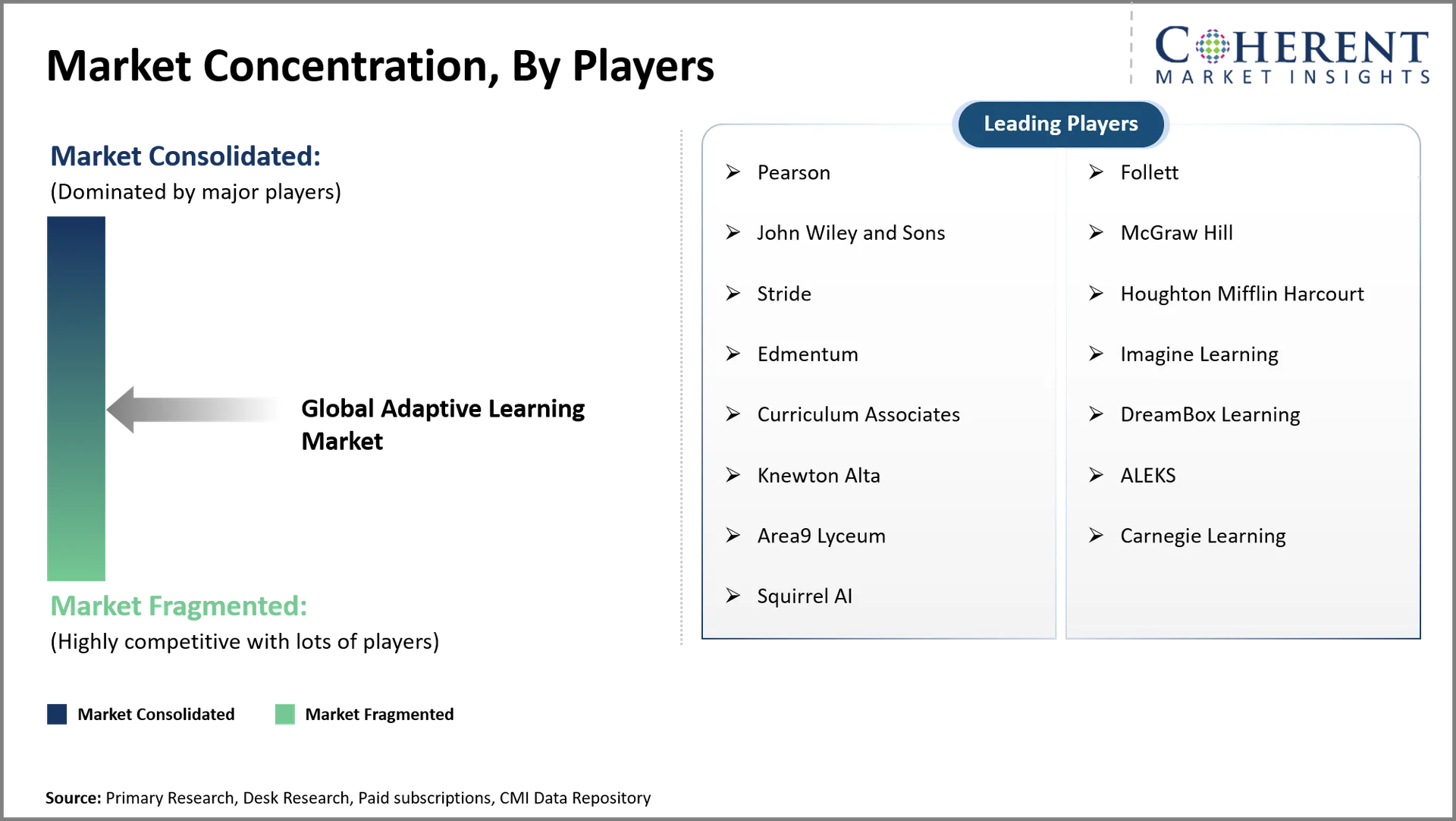
Companies covered: | Pearson, Follett, John Wiley and Sons, McGraw Hill, Stride, Houghton Mifflin Harcourt, Edmentum, Imagine Learning, Curriculum Associates, DreamBox Learning, Knewton Alta, ALEKS, Area9 Lyceum, Carnegie Learning, Squirrel AI | ||
Growth Drivers: |
| ||
Restraints & Challenges: |
| ||
Analyst Opinion (Expert Opinion)
- The future of the adaptive learning industry will depend on systems that diagnose misconceptions and change instruction immediately. Generic chatbots will face differentiation challenges as educational buyers demand curriculum alignment, reliable assessments, and teacher controls. It is expected that adaptive engines will become increasingly embedded within learning management systems, digital textbooks, and examination preparation applications. Platforms that provide recommendations alone will be less valuable than vendors that connect learner diagnosis with specific remediation exercises. Trust will still depend upon explainable feedback and successful human educator escalation.
- The biggest prospects are in artificial intelligence-powered tutoring, math remedial, language learning and test prep. In the U.S., vendors should target school district purchases, community colleges and lower-level mathematics courses. Attractive chances for application are in India through competitive examination preparation and bilingual fundamental learning. Germany offers chances for adaptable vocational training in manufacturing, engineering and technical certification. Providers should focus on building subject-specific products, rather than launching broad platforms that lack differentiated teaching skills. Pricing should be based on institutional budgets, availability to learners, and verifiable increases in demonstrated competency.
- To be competitive, firms should create their own learner models that can tell the difference between conceptual misconceptions and thoughtless blunders. Platforms should link each knowledge gap they identify to an explanatory explanation, an appropriate exercise, and a follow-up mastery check. Vendors need to integrate with current learning management systems and institutional assessment workflows to reduce implementation friction. They should also give teachers the ability to control recommendations, intervention thresholds and student progression. Regional expansion involves localized curriculum, relevant languages and adherence to applicable student data protection requirements. Clear evidence of educational achievement and transparent pricing for execution can enhance purchasing decisions and long-term consumer loyalty.
Speak to the analyst
Want personalized insights?
Take the findings above to one of our principal consultants, or have the report rebuilt around the segments, geographies and competitors you actually track.
Market Segmentation
- Component Insights (Revenue, USD Billion, 2021 - 2033)
- Platforms
- Services
- Deployment Type Insights (Revenue, USD Billion, 2021 - 2033)
- Cloud-Based
- On-Premises
- Hybrid
- Learning Model Insights (Revenue, USD Billion, 2021 - 2033)
- Algorithm-Based Learning
- AI-Driven Learning
- Competency-Based Learning
- Personalized Learning Paths
- Application Insights (Revenue, USD Billion, 2021 - 2033)
- Personalized Instruction
- Adaptive Testing
- Corporate Skills Development
- Academic Assessment
- Language Learning
- End User Insights (Revenue, USD Billion, 2021 - 2033)
- K-12 Education
- Higher Education
- Corporate Training
- Professional Education
- Regional Insights (Revenue, USD Billion, 2021 - 2033)
- North America
- U.S.
- Canada
- Latin America
- Brazil
- Argentina
- Mexico
- Rest of Latin America
- Europe
- Germany
- U.K.
- Spain
- France
- Italy
- Russia
- Rest of Europe
- Asia Pacific
- China
- India
- Japan
- Australia
- South Korea
- ASEAN
- Rest of Asia Pacific
- Middle East
- GCC Countries
- Israel
- Rest of Middle East
- Africa
- South Africa
- North Africa
- Central Africa
- North America
- Key Players Insights
- Pearson
- Follett
- John Wiley and Sons
- McGraw Hill
- Stride
- Houghton Mifflin Harcourt
- Edmentum
- Imagine Learning
- Curriculum Associates
- DreamBox Learning
- Knewton Alta
- ALEKS
- Area9 Lyceum
- Carnegie Learning
- Squirrel AI
Sources
Primary Research Interviews
- E-Learning Content Developers & Instructional Designers
- Adaptive Learning Platform Providers & EdTech Solution Vendors
- Corporate Learning & Development (L&D) Managers
- Academic Institution Representatives & School Administrators
Magazines
- eLearning Industry Magazine
- EdTech Magazine
- T.H.E. Journal (Technological Horizons in Education)
- Training Industry Magazine
Journals
- Journal of Learning Analytics
- Computers & Education (Elsevier)
- British Journal of Educational Technology (BJET)
Associations
- International Society for Technology in Education (ISTE)
- Association for Educational Communications and Technology (AECT)
- eLearning Guild
- United States Distance Learning Association (USDLA)
Public Domain Sources
- U.S. Department of Education – National Center for Education Statistics (NCES)
- European Commission – Education & Training Monitor
- World Bank Open Data – Education Statistics
- IMS Global Learning Consortium (Public Resources)
Proprietary Elements
- CMI Data Analytics Tool
- Proprietary CMI Existing Repository of Information for Last 10 Years
Get access to 250+ pages report
Every segment, forecast, competitor profile and data table behind the analysis above — available for instant download.
- ESOMAR Member
- ISO 9001:2015 Certified
- D-U-N-S Registered
- GDPR & CCPA Compliant
Frequently Asked Questions
The global adaptive learning market is expected to stand at USD 5.25 Bn in 2026 and is expected to reach USD 24.00 Bn by 2033.
The CAGR of the global adaptive learning market is projected to be 14.3% from 2026 to 2033.
Increasing demand for individualized learning experiences and growth in digital education and hybrid teaching models are the major factors driving the growth of the global adaptive learning market.
Unequal access to digital devices and reliable internet and Concerns about learner data privacy and algorithmic bias are the major factors hampering the growth of the global adaptive learning market.
In terms of component, platforms segment is estimated to dominate the market revenue share in 2026.
The global adaptive learning market comprises digital platforms that personalize educational content, assessments, and learning pathways according to individual learner performance.
Artificial intelligence analyzes learner responses, identifies knowledge gaps, and recommends targeted explanations, exercises, and learning sequences.