

Global Cloud Infrastructure Market Size and Forecast – 2026 To 2033
The Global Cloud Infrastructure Market is estimated to be valued at USD 214.63 Bn in 2026 and is expected to reach USD 454.11 Bn by 2033, growing at a compound annual growth rate (CAGR) of 11.3% from 2026 to 2033. Growth is supported by enterprise cloud migration, digital transformation, distributed workforce requirements, and increasing consumption of scalable compute, storage, and networking resources.
AI-intensive workloads are also requiring higher-bandwidth, low-latency, and increasingly specialized cloud infrastructure. In June 2025, Cisco reported that AI infrastructure orders from hyperscale customers had already exceeded its US$1 billion annual target one quarter ahead of schedule, highlighting accelerating investment in infrastructure capable of supporting large-scale AI workloads.
Key Takeaways of the Global Cloud Infrastructure Market
- Compute is expected to register a CAGR of 12.6% during 2026–2033 and account for 44.7 % of the global cloud infrastructure market in 2026. Its lead reflects AI training, inference, analytics, and cloud-native workloads that require elastic CPU and accelerator capacity. In March 2025, Google Cloud made A4 VMs with NVIDIA B200 GPUs generally available for large-scale machine learning workloads.
- Public Cloud is expected to register a CAGR of 11.8% during 2026–2033 and account for 67.8 % of the market in 2026. Its scale advantage comes from rapid provisioning, global availability, consumption-based economics, and broad managed-service integration. In November 2025, Oracle opened its second public cloud region in Italy, expanding access to OCI AI and cloud services for enterprises and public-sector organizations.
- Large Enterprises are expected to register a CAGR of 10.8% during 2026–2033 and account for 65.4 % of the market in 2026. Their dominance reflects large application estates, high compliance requirements, multi-region operations, and sustained modernization budgets. In January 2025, IBM and SAP announced RISE with SAP on IBM Power Virtual Server, targeting faster migration of mission-critical SAP workloads to cloud infrastructure.
- North America is expected to register a CAGR of 10.7% during 2026–2033 and account for 39.4 % of the global cloud infrastructure market in 2026. The region benefits from hyperscale concentration, mature enterprise cloud adoption, deep capital availability, and expanding AI data-center capacity. In June 2025, Pennsylvania announced Amazon’s planned US$20 billion investment in cloud computing and AI infrastructure campuses across the state.
- Asia Pacific is expected to register a CAGR of 13.4% during 2026–2033 and account for 29.6 % of the market in 2026. Expansion is supported by new data-center capacity, national AI programs, digital-service growth, local data-residency priorities, and enterprise modernization across major economies. In April 2026, Microsoft announced a US$10 billion investment in Japan through 2029 covering AI infrastructure, cybersecurity, and workforce development.
Segmental Insights
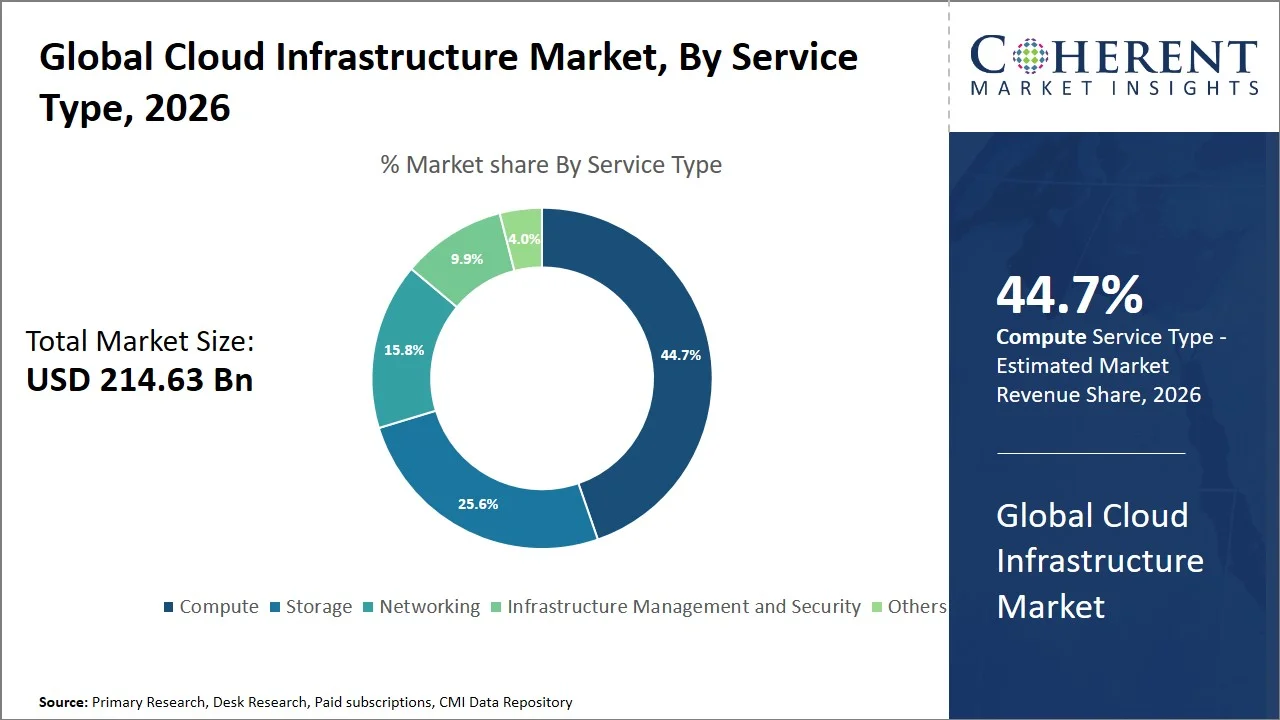
Why Does Compute Dominate the Global Cloud Infrastructure Market?
Compute is expected to hold 44.7% of the global cloud infrastructure market in 2026 because it is the infrastructure layer most directly tied to application execution, AI inference, model training, databases, analytics, and high-performance workloads. Buyers can expand or contract virtual CPU, GPU, and accelerator resources without purchasing dedicated hardware, making compute the primary consumption point when workload intensity changes. On the supply side, providers are differentiating through accelerator availability, cluster architecture, scheduling efficiency, and high-bandwidth interconnects rather than basic virtual-machine capacity alone. This particularly benefits AI developers, IT departments, research organizations, and digital platforms requiring elastic processing power. In June 2025, Nebius announced general availability of GB200 Grace Blackwell capacity in Europe through its AI cloud, expanding on-demand access to high-performance compute for enterprise and AI workloads. This reinforces compute’s role as the central monetizable resource within modern cloud infrastructure.
- Current Industry Events of 2026
- Market Size Estimation
- Regional Breakdown
- Competitive Landscape
- Customer Intelligence
- Segmental Analysis
- Pricing Analysis
- Key Market Drivers, Challenges & Future Trends
- Customized Insights Section
Why Does Public Cloud Represent the Largest Deployment Model in the Global Cloud Infrastructure Market?
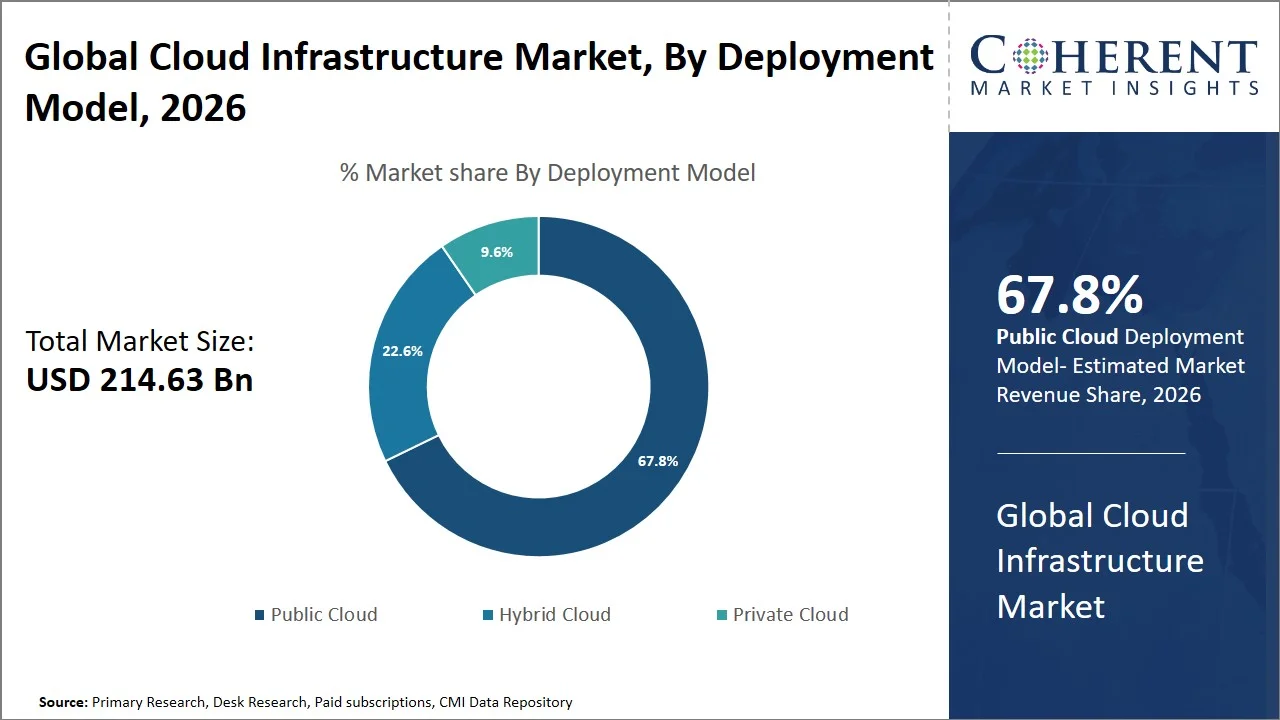
Public Cloud is expected to represent 67.8% of the global cloud infrastructure market in 2026 because it gives organizations immediate access to standardized infrastructure across multiple geographic locations without requiring them to own or operate the underlying facilities. Its advantage is strongest where workloads need rapid provisioning, regional replication, developer self-service, and variable capacity. Cloud suppliers can spread hardware, network, operations, and platform costs across a broad customer base, while customers gain access to new regions and services through a common operating environment. The model is particularly relevant for web applications, SaaS platforms, development environments, digital commerce, and distributed enterprise workloads. In May 2026, Vultr opened Milan as its 33rd cloud data center region, offering cloud compute, GPU, bare-metal, Kubernetes, and storage capabilities to regional users. The expansion illustrates how geographic availability strengthens the commercial reach of public-cloud infrastructure.
Why Do Large Enterprises Dominate the Organization Size Segment of the Global Cloud Infrastructure Market?
Large Enterprises are expected to account for 65.4% of the global cloud infrastructure market in 2026 because their infrastructure requirements extend across large application portfolios, multiple business units, geographically distributed operations, and demanding continuity requirements. Their cloud spending is therefore broader than simple server replacement, encompassing migration, network redesign, storage modernization, disaster recovery, governance, and ongoing workload optimization. Large organizations also possess the budgets and technical teams required to execute multi-year transformation programs while maintaining legacy systems during transition. This creates substantial opportunities for cloud providers, migration specialists, systems integrators, and managed-service firms that can coordinate complex infrastructure estates. In March 2025, Accenture announced that it was supporting Air France-KLM in migrating applications away from three proprietary data centers to the cloud, with 350 applications already deployed through an industrialized migration approach. The project demonstrates the scale and operational complexity behind large-enterprise cloud infrastructure demand.
Current Events and their Impact
Current Event | Description and Its Impact |
EU Data Act Becomes Applicable – September 2025 |
|
U.S. Revises Advanced AI Technology Export-Control Direction – May 2025 |
|
Japan Updates ISMAP Cloud Services List – June 2025 |
|
Global Cloud Infrastructure Market Dynamics
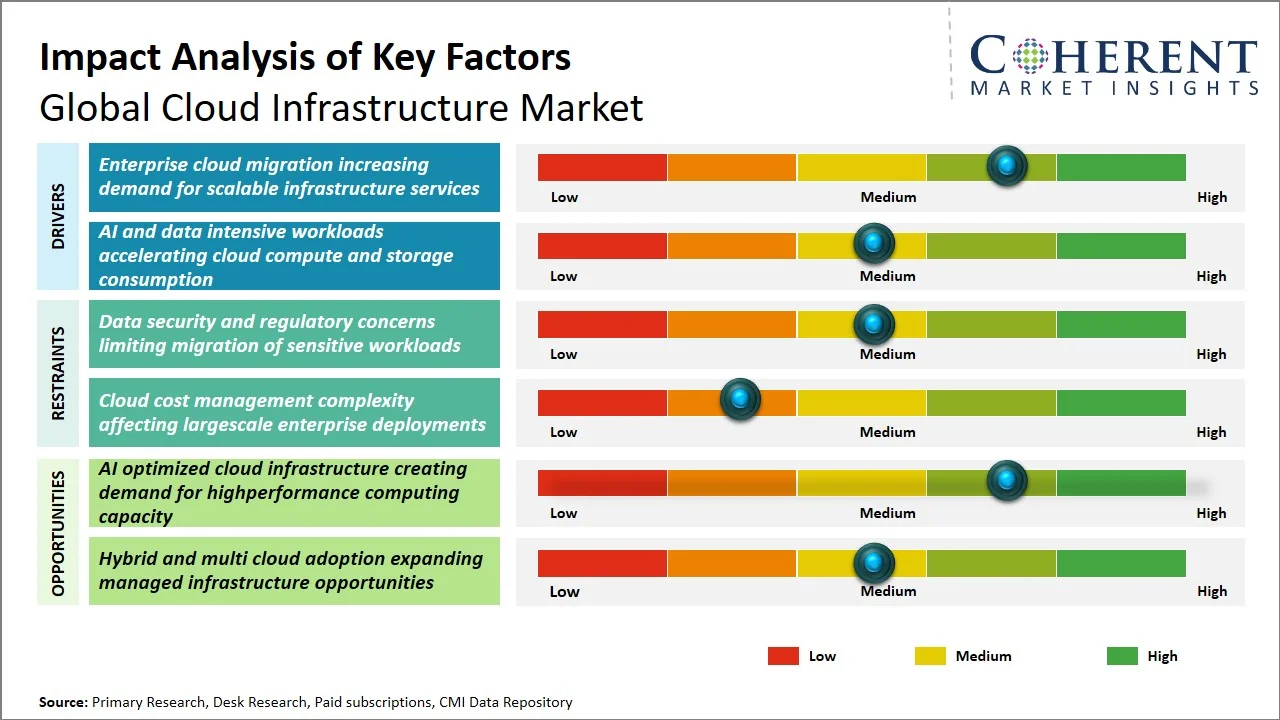
Key Market Drivers
- Enterprise cloud migration increasing demand for scalable infrastructure services: Enterprise cloud migration is shifting infrastructure purchasing from periodic hardware refreshes toward elastic, service-based capacity that can be expanded, reconfigured, and governed across changing workloads. The commercial effect extends beyond moving applications off premises: migration creates recurring demand for compute, storage, networking, backup, orchestration, migration tooling, and operational support. Large enterprises with complex virtual-machine estates and legacy applications particularly need infrastructure that can preserve resilience while reducing migration disruption. Cloud providers, infrastructure vendors, systems integrators, and managed-service operators benefit as customers standardize operating models and retire isolated environments. In May 2026, HPE introduced new private-cloud, storage, and data-protection capabilities designed to unify virtualized and cloud-native workloads, support hybrid and multicloud management, and enable live workload migration from VMware environments. This illustrates how enterprise modernization translates into infrastructure-service demand.
- AI and data intensive workloads accelerating cloud compute and storage consumption: AI and data-intensive workloads are changing the capacity profile of cloud infrastructure by increasing the need for high-density compute, parallel storage, fast interconnects, and infrastructure that can scale without long provisioning cycles. Training, inference, model serving, scientific computing, and large data pipelines create synchronized demand across computer, networking, and storage rather than isolated consumption of one service. This favors cloud operators with accelerator capacity, optimized clusters, high-throughput fabrics, and expertise in scheduling expensive resources efficiently. AI developers, research organizations, digital-native enterprises, and infrastructure specialists gain from faster access to production-grade capacity, while providers unable to support intensive workloads risk losing higher-value demand. In March 2025, CoreWeave agreed to provide dedicated AI infrastructure capacity to OpenAI for model training and services, demonstrating how advanced AI workloads are translating directly into large-scale cloud infrastructure commitments.
Emerging Market Trends
- Event-Driven Infrastructure Is Reducing Dependence on Persistently Provisioned Capacity: Serverless and event-driven architectures are reducing the need for continuously provisioned infrastructure by enabling automated, workload-based scaling. This shifts competition toward rapid provisioning, granular billing, observability, and orchestration. Digital-native businesses benefit from lower operational overhead, while traditional hosting providers face pressure to offer more programmable and flexible infrastructure models.
- Workload-Level Unit Economics Are Reshaping Cloud Procurement: Cloud buyers are increasingly evaluating total workload cost rather than individual compute or storage prices. Network transfer, idle capacity, support, resilience, and engineering effort now influence provider selection. This favors providers offering transparent pricing, cost-allocation tools, and optimization capabilities while encouraging closer collaboration between procurement and engineering teams.
Regional Insights
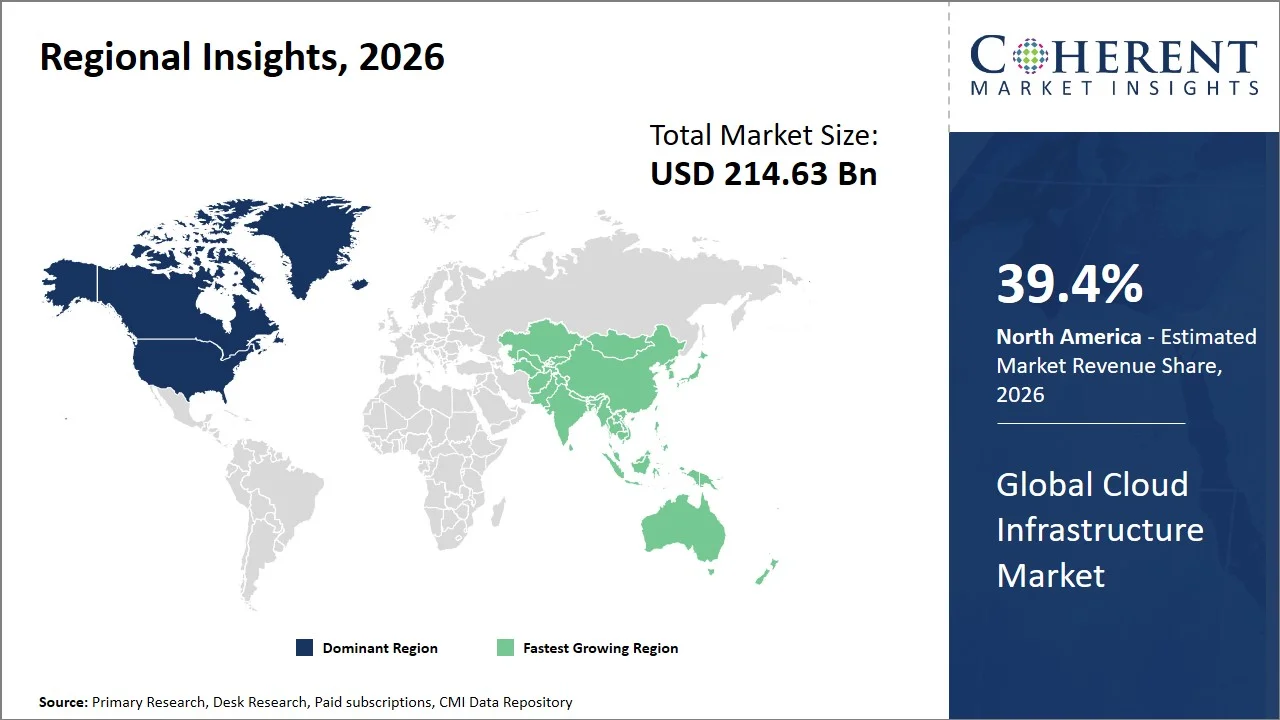
Why Does North America Dominate the Global Cloud Infrastructure Market?
North America is expected to account for 39.4% of the global cloud infrastructure market in 2026, supported by its concentration of hyperscale data centers, mature enterprise cloud adoption, high AI-compute intensity, and strong demand from technology, BFSI, retail, healthcare, and public-sector users. The region also benefits from deep fiber connectivity, established colocation ecosystems, access to capital, and a large base of enterprises shifting mission-critical workloads toward scalable cloud architectures. Power availability and permitting are becoming more important as AI workloads increase infrastructure requirements, making energy-linked site development a strategic advantage. In July 2025, the U.S. Department of Energy selected four federal sites to advance potential AI data center and associated energy infrastructure development, demonstrating public-sector support for expanding domestic compute capacity.
Why Is Asia Pacific Emerging as the Fastest-Growing Region in the Global Cloud Infrastructure Market?
Asia Pacific is expected to hold 29.6% of the global cloud infrastructure market in 2026 and emerge as the fastest-growing region as cloud adoption broadens across digitally intensive economies. Expansion is supported by new hyperscale and colocation capacity, rapid enterprise digitization, AI deployment, e-commerce growth, financial-services modernization, and stronger data-residency requirements. Regional demand is also spreading beyond established hubs into Southeast Asia and India, where providers are building infrastructure closer to users to reduce latency and improve resilience. The availability of submarine cables, renewable-power projects, and large technology talent pools further improves deployment economics. In May 2026, Equinix announced a purpose-built International Business Exchange data center in Kuala Lumpur to support Malaysia’s AI and cloud growth, extending its Asia Pacific digital infrastructure footprint.
Global Cloud Infrastructure Market Outlook for Key Countries
Why Is the U.S. a Key Market for the Global Cloud Infrastructure Market?
The U.S. is estimated to represent 35.1% of the global cloud infrastructure market in 2026, making it the largest individual country market. Demand is concentrated among hyperscale’s, large enterprises, AI developers, digital-native firms, federal agencies, financial institutions, healthcare organizations, and media platforms that require scalable compute, storage, networking, and security services. The country’s advantage also comes from dense fiber networks, a mature data-center supply chain, broad enterprise software adoption, and strong access to investment capital. AI training and inference are raising requirements for high-density infrastructure, advanced cooling, and new power arrangements, accelerating the next wave of cloud capacity additions. In July 2026, Meta announced that its Richland Parish, Louisiana data center would expand to 5 GW of compute capacity, illustrating the scale of infrastructure being built to support AI-intensive workloads.
Why Is India Important in the Global Cloud Infrastructure Market?
India is estimated to account for 5.1% of the global cloud infrastructure market in 2026, supported by rapid digitization across banking, telecom, e-commerce, government services, software, and consumer platforms. Growth is reinforced by increasing domestic data generation, demand for low-latency services, wider AI adoption, and enterprise preference for locally hosted infrastructure that supports compliance and business continuity. India also offers a large technology workforce and expanding data-center clusters across major commercial centers, improving access to cloud capacity. The market is increasingly attractive for long-term infrastructure capital as operators prepare for higher-density AI workloads. In March 2026, Bharti Airtel announced a US$1 billion investment in Nxtra aimed at accelerating AI-data-center expansion, strengthening India’s domestic digital infrastructure base.
Why Does China Support Growth in the Global Cloud Infrastructure Market?
China is estimated to hold 11.8% of the global cloud infrastructure market in 2026, supported by its large digital economy, extensive internet-user base, strong e-commerce and fintech ecosystems, and expanding use of cloud resources for AI, industrial digitalization, and smart services. Domestic providers benefit from large-scale demand for computing, storage, databases, networking, and AI infrastructure from technology companies, manufacturers, financial institutions, and public-sector organizations. National emphasis on computing capacity and localized technology ecosystems also encourages investment in domestic cloud platforms and data-center networks. China’s scale allows providers to deploy infrastructure across multiple economic clusters while serving high-volume enterprise and consumer workloads. In February 2025, Alibaba Group announced plans to invest at least USD 56.34 billion in AI and cloud infrastructure over three years, indicating substantial domestic capacity expansion.
Why Is Germany a Strategic Country in the Global Cloud Infrastructure Market?
Germany is estimated to account for 5.9% of the global cloud infrastructure market in 2026, reflecting strong demand from manufacturing, automotive, financial services, government, healthcare, and other compliance-sensitive industries. Its market position is shaped by enterprise requirements for secure infrastructure, operational resilience, data sovereignty, and integration between cloud environments and established industrial IT systems. Germany’s advanced manufacturing base also creates demand for cloud platforms supporting industrial AI, engineering workloads, connected factories, and data-intensive automation. European data-protection requirements make locally controlled and sovereign cloud options particularly relevant for public institutions and regulated businesses. In May 2026, Deutsche Telekom introduced T Cloud Public for German public administration, combining high-performance cloud infrastructure with sovereign data storage in German data centers and strengthening locally controlled cloud deployment.
Why Is Brazil an Important Growth Market for the Global Cloud Infrastructure Market?
Brazil is estimated to represent 1.5% of the global cloud infrastructure market in 2026 and remains an important cloud infrastructure growth center within Latin America. Demand is supported by banking and fintech ecosystems, e-commerce activity, telecom modernization, digital government services, and enterprises seeking lower-latency access to compute and storage resources within the country. Brazil’s established data-center and connectivity ecosystem supports domestic and regional workloads, while data-governance requirements increase the commercial relevance of locally controlled infrastructure. Public-sector modernization is creating an additional demand layer for secure, scalable cloud environments. In February 2025, Serpro announced an expansion of Brazil’s Government Cloud infrastructure through new servers, storage, networking equipment, and GPU capacity, strengthening sovereign processing capabilities for sensitive public-sector workloads.
Technology Adoption Landscape in the Global Cloud Infrastructure Market
Technology | Adoption Level | Key Application Area | Business Impact |
Kubernetes Container Orchestration | High | Deployment and management of containerized cloud workloads | Improves workload portability, automated scaling, resource utilization, and deployment consistency across infrastructure environments. |
Infrastructure as Code and Policy as Code | High | Automated provisioning, configuration, and governance | Reduces manual configuration, accelerates deployment, improves repeatability, and embeds infrastructure controls into development workflows. |
Confidential Computing with Trusted Execution Environments | Medium | Protection of sensitive workloads while data is being processed | Strengthens workload isolation and enables security-sensitive organizations to place more regulated processing on shared cloud infrastructure. |
Software-Defined Networking and Virtual Private Cloud Networking | High | Network segmentation, traffic routing, private connectivity, and workload isolation | Makes cloud networks programmable, accelerates provisioning, and supports scalable security and connectivity across distributed applications. |
Distributed Object Storage with Erasure Coding | High | Large-scale unstructured data, backup, archives, analytics, and application datasets | Improves storage scalability and durability while reducing dependence on expensive full-data replication for large distributed datasets. |
Direct-to-Chip Liquid Cooling | Medium | High-density cloud infrastructure and thermally intensive compute environments | Supports higher rack densities, improves thermal management, and can increase usable compute capacity where conventional air cooling becomes restrictive. |
How Are Managed, Security-Integrated Infrastructure Services Creating New Growth Opportunities Among SMEs in the Global Cloud Infrastructure Market?
Managed, security-integrated cloud infrastructure for small and medium enterprises represents an underdeveloped opportunity because many smaller organizations need cloud scalability but lack dedicated teams for architecture, cybersecurity, resilience, cost management, and continuous optimization. The opportunity is therefore not simply lower-priced infrastructure; it is packaging compute, storage, networking, backup, security controls, monitoring, and support into an operationally manageable service. Regional cloud providers, managed-service specialists, distributors, and telecom-linked providers can capture this demand through standardized bundles, industry-specific configurations, predictable billing, migration assistance, and local technical support. Buyers in retail, professional services, healthcare, manufacturing, and digital commerce are particularly relevant where uptime and data protection matter but internal cloud skills remain limited. Participation requires automation, remote management, security operations, partner ecosystems, and disciplined service-level delivery. The opportunity is likely to favor specialists and channel-oriented providers capable of simplifying adoption throughout deployment, operation, optimization, and renewal without requiring SMEs to assemble multiple infrastructure products independently.
Market Players, Key Development, and Competitive Landscape
Key Developments
- In March 2026, Akamai disclosed a multi-year cloud infrastructure service agreement involving a dedicated high-performance compute cluster integrated with its distributed cloud platform. The development is important because it shows specialist infrastructure providers moving beyond generalized cloud capacity toward dedicated architectures for demanding workloads, combining dense computing resources, high-performance networking, distributed infrastructure, and large-scale service commitments as a differentiated commercial model.
- In October 2025, DigitalOcean announced expanded capabilities across storage, databases, networking, compute, and its broader cloud portfolio, including infrastructure intended to support more complex workloads. This is important for the global cloud infrastructure market because it demonstrates how alternative cloud providers are broadening infrastructure depth to compete for customers whose requirements extend beyond basic virtual machines into scalable storage, networking, databases, and production application environments.
- In May 2025, OVHcloud opened its first data center in Italy in the Milan region and positioned the site as part of its planned three-availability-zone architecture. This is important for the global cloud infrastructure market because multi-zone regional infrastructure gives organizations additional options for resilient, low-latency, locally hosted cloud workloads, particularly where service continuity and data-location requirements influence procurement.
Competitive Landscape
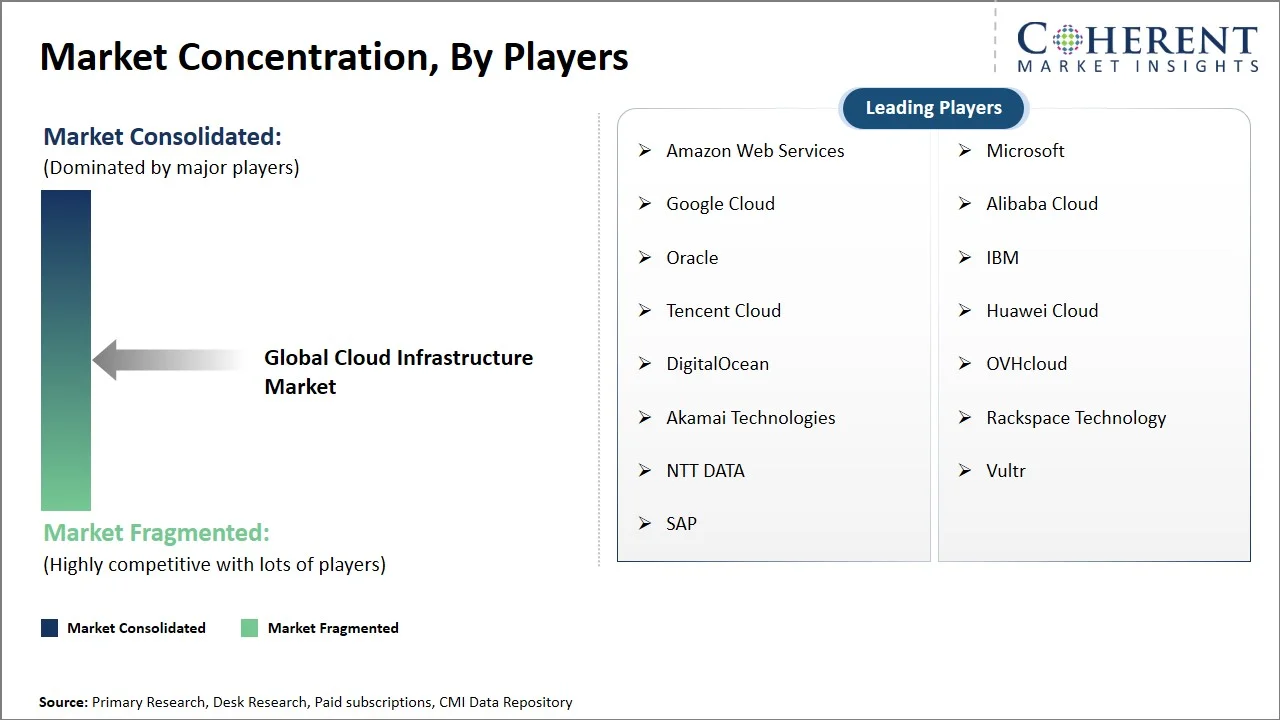
The global cloud infrastructure market is moderately consolidated, led by hyperscale providers alongside regional cloud operators, managed infrastructure firms, private-cloud suppliers, and specialist platforms. Competition centers on performance, pricing, resilience, geographic reach, security, migration support, and operational simplicity. While scale provides an advantage, regional presence and workload specialization enable smaller providers to compete effectively. Key focus areas include:
- Workload price-performance: Providers must optimize infrastructure economics for specific workload profiles rather than compete solely on headline resource pricing.
- Availability and resilience: multi-zone architecture, recovery design, and service continuity influence mission-critical infrastructure procurement.
- Network economics: Private connectivity, bandwidth performance, latency, and data-transfer pricing increasingly affect total infrastructure cost.
- Security and compliance: Certifications, workload isolation, access controls, auditability, and local compliance capabilities support regulated customer acquisition.
- Infrastructure specialization: Purpose-built storage, networking, dedicated compute, and high-performance configurations create differentiation beyond commodity virtual machines.
- Migration and technical support: Simplified onboarding, workload conversion, architecture assistance, and operational support reduce customer switching friction.
- Regional service depth: Local infrastructure, data-location choices, support teams, and channel partnerships improve competitiveness in markets requiring localized delivery.
- Capacity reliability: Hardware availability, data-center access, energy planning, network redundancy, and disciplined capacity expansion determine providers’ ability to meet contracted demand consistently.
Market Report Scope
Cloud Infrastructure Market Report Coverage
| Report Coverage | Details | ||
|---|---|---|---|
| Base Year: | 2025 | Market Size in 2026: | USD 214.63 Bn |
| Historical Data for: | 2020 To 2024 | Forecast Period: | 2026 To 2033 |
| Forecast Period 2026 to 2033 CAGR: | 11.3% | 2033 Value Projection: | USD 454.11 Bn |
| Geographies covered: |
| ||
| Segments covered: |
| ||
| Companies covered: | Amazon Web Services, Microsoft, Google Cloud, Alibaba Cloud, Oracle, IBM, Tencent Cloud, Huawei Cloud, DigitalOcean, OVHcloud, Akamai Technologies, Rackspace Technology, NTT DATA, Vultr, SAP | ||
| Growth Drivers: |
| ||
| Restraints & Challenges: |
| ||
Analyst Opinion (Expert Opinion)
- The global cloud infrastructure market leadership will increasingly depend on simplifying how infrastructure is consumed rather than offering the broadest resource portfolio. Providers integrating provisioning, observability, resilience, policy control, and developer workflows will be better positioned to reduce operational complexity and create stronger platform-level differentiation.
- Cloud capacity procurement may become more forward-contracted for high-performance infrastructure with limited availability. Buyers could increasingly reserve capacity before deployment, favoring providers with strong forecasting, capacity planning, supply agreements, and flexible contracting models over purely transactional cloud operators.
- Providers should prioritize infrastructure reliability, transparent workload economics, automation, efficient networking, migration support, and supply resilience. Capacity expansion should remain closely aligned with proven workload demand, as overinvestment in standardized infrastructure could pressure utilization and margins amid increasingly selective customer procurement.
Speak to the analyst
Want personalized insights?
Take the findings above to one of our principal consultants, or have the report rebuilt around the segments, geographies and competitors you actually track.
Market Segmentation
- Service Type Insights (Revenue, USD Bn, 2021 - 2033)
- Compute
- Storage
- Networking
- Infrastructure Management and Security
- Others
- Deployment Model Insights (Revenue, USD Bn, 2021 - 2033)
- Public Cloud
- Hybrid Cloud
- Private Cloud
- Organization Size Insights (Revenue, USD Bn, 2021 - 2033)
- Large Enterprises
- Small and Medium Enterprises
- End User Insights (Revenue, USD Bn, 2021 - 2033)
- IT and Telecommunications
- BFSI
- Retail and Ecommerce
- Manufacturing
- Government and Public Sector
- Healthcare
- Media and Entertainment
- Others
- Distribution Channel Insights (Revenue, USD Bn, 2021 - 2033)
- Direct Sales
- Indirect Sales
- Regional Insights (Revenue, USD Bn, 2021 - 2033)
- North America
- U.S.
- Canada
- Latin America
- Brazil
- Argentina
- Mexico
- Rest of Latin America
- Europe
- Germany
- U.K.
- Spain
- France
- Italy
- Russia
- Rest of Europe
- Asia Pacific
- China
- India
- Japan
- Australia
- South Korea
- ASEAN
- Rest of Asia Pacific
- Middle East
- GCC Countries
- Israel
- Rest of Middle East
- Africa
- South Africa
- North Africa
- Central Africa
- North America
- Key Players Insights
- Amazon Web Services
- Microsoft
- Google Cloud
- Alibaba Cloud
- Oracle
- IBM
- Tencent Cloud
- Huawei Cloud
- DigitalOcean
- OVHcloud
- Akamai Technologies
- Rackspace Technology
- NTT DATA
- Vultr
- SAP
Sources
Primary Research Interviews
- Cloud infrastructure service providers, hyperscale cloud operators, data center companies, and managed cloud service providers
- Compute, storage, networking, virtualization, containerization, cybersecurity, and infrastructure-management solution providers
- CIOs, CTOs, cloud architects, infrastructure managers, DevOps teams, FinOps professionals, and enterprise IT decision-makers
- System integrators, cloud consultants, distributors, telecom operators, colocation providers, and industry experts
Stakeholders
- Public, private, and hybrid cloud infrastructure providers
- Compute, server, storage, networking, accelerator, and data-center equipment suppliers
- Cloud security, infrastructure management, orchestration, monitoring, and automation vendors
- System integrators, managed service providers, telecom companies, data-center operators, and connectivity providers
- Enterprises, SMEs, government agencies, financial institutions, healthcare organizations, manufacturers, and digital-native companies
End-use Sectors
- IT and telecommunications
- Banking, financial services, and insurance
- Retail and e-commerce
- Manufacturing and industrial enterprises
- Government and public sector
- Healthcare and life sciences
- Media, entertainment, gaming, and digital services
- Professional services and other enterprise applications
Regulatory and Government Bodies
- U.S. National Institute of Standards and Technology, Cybersecurity and Infrastructure Security Agency, Federal Trade Commission, and General Services Administration
- European Commission, European Union Agency for Cybersecurity, European Data Protection Board, and national data-protection authorities
- China Cyberspace Administration of China, Ministry of Industry and Information Technology, and State Administration for Market Regulation
- India Ministry of Electronics and Information Technology, CERT-In, and Digital India authorities
- Japan Ministry of Economy, Trade and Industry, Digital Agency, and Ministry of Internal Affairs and Communications
- Singapore Infocom Media Development Authority and Cyber Security Agency of Singapore
- Australian Cyber Security Centre and Australian Communications and Media Authority
Databases
- World Bank, OECD, Eurostat, UNCTAD, and International Telecommunication Union databases
- U.S. Census Bureau, Bureau of Economic Analysis, and government digital-economy databases
- European Commission Digital Economy and Society databases
- ITU ICT indicators and broadband infrastructure databases
- National data-center, broadband, digitalization, and ICT investment statistics
- WIPO PATENTSCOPE, Espacenet, and USPTO patent databases
- Company annual reports, investor presentations, infrastructure-capacity disclosures, pricing records, and service portfolios
Magazines and Journals
- IEEE Cloud Computing, IEEE Transactions on Cloud Computing
- Journal of Cloud Computing
- Future Generation Computer Systems
- Computer Networks
- ACM Computing Surveys
- Data Center Dynamics
- Network World, CIO
- InfoWorld
Associations
- Cloud Native Computing Foundation
- Cloud Security Alliance
- Uptime Institute
- Open Compute Project Foundation
- Internet Infrastructure Coalition
- Storage Networking Industry Association
- FinOps Foundation
- Telecommunications Industry Association
- AFCOM
- National and regional cloud, data-center, cybersecurity, and digital-infrastructure associations
Public Domain Sources
- Cloud service portfolios covering compute, storage, networking, security, infrastructure management, and managed services
- Virtual-machine, GPU, storage, bandwidth, data-transfer, and reserved-capacity pricing information
- Data-center locations, availability zones, cloud regions, network connectivity, and infrastructure-capacity announcements
- Product documentation covering virtualization, Kubernetes, serverless infrastructure, software-defined networking, and infrastructure automation
- Service-level agreements, uptime commitments, security certifications, data-residency policies, and compliance documentation
- Annual reports, government digital-infrastructure programs, cloud-region launches, data-center expansions, partnerships, investments, and technology introductions
Key Standards and Regulations
- ISO/IEC 27001 Information Security Management Systems
- ISO/IEC 27017 Cloud Security Controls
- ISO/IEC 27018 Protection of Personally Identifiable Information in Public Clouds
- ISO/IEC 27701 Privacy Information Management
- SOC 1, SOC 2, and SOC 3 assurance frameworks
- U.S. FedRAMP cloud security requirements for federal workloads
- EU General Data Protection Regulation, Data Act, NIS2 Directive
- EU Digital Operational Resilience Act for financial-sector ICT environments
- PCI DSS for cloud infrastructure supporting payment-card workloads
- HIPAA-related security and privacy requirements for U.S. healthcare cloud environments
- Data-residency, cybersecurity, cross-border data-transfer, cloud-security, business-continuity, and infrastructure-resilience requirements
Proprietary Elements
- CMI Data Analytics Tool, Proprietary CMI Existing Repository of Information for the Last 10 Years
Get access to 250+ pages report
Every segment, forecast, competitor profile and data table behind the analysis above — available for instant download.
- ESOMAR Member
- ISO 9001:2015 Certified
- D-U-N-S Registered
- GDPR & CCPA Compliant
Missing comfort of reading report in your local language? Find your preferred language:
Transform your Strategy with Exclusive Trending Reports
Frequently Asked Questions
The CAGR of global cloud infrastructure market is projected to be 11.3% from 2026 to 2033.
The global cloud infrastructure market is estimated to be valued at USD 214.63 billion in 2026 and is expected to reach USD 454.11 billion by 2033.
Cloud infrastructure includes compute, storage, networking, security, and infrastructure management resources delivered through public, private, or hybrid cloud environments.
Public cloud is the most widely adopted deployment model due to its scalability, flexible resource provisioning, broad service availability, and lower infrastructure management requirements.
AI is increasing demand for high-performance computing, GPU-enabled infrastructure, scalable storage, high-speed networking, and specialized cloud architectures supporting model training and inference workloads.
Key opportunities include AI-optimized cloud infrastructure, hybrid and sovereign cloud solutions, managed cloud services, edge infrastructure, cloud security, and infrastructure offerings designed for regulated and data-intensive industries.
Enterprise cloud migration increasing demand for scalable infrastructure services and AI and data intensive workloads accelerating cloud compute and storage consumption are the major factor driving the growth of global cloud infrastructure market.