

Global Adaptive Learning Software Market Size and Forecast – 2026 To 2033
The global adaptive learning software market is expected to grow from USD 5.70 Bn in 2026 to USD 17.00 Bn by 2033, registering a compound annual growth rate (CAGR) of 12% from 2026 to 2033. The global adaptive learning software market is driven by growing adoption of educational platforms. On September 30, 2025, McGraw Hill announced the launch of Sharpen Advantage, a new AI-powered enterprise offering that expands the company’s popular Sharpen study app into a custom solution built for higher education institutions.
Key Takeaways of the Global Adaptive Learning Software Market
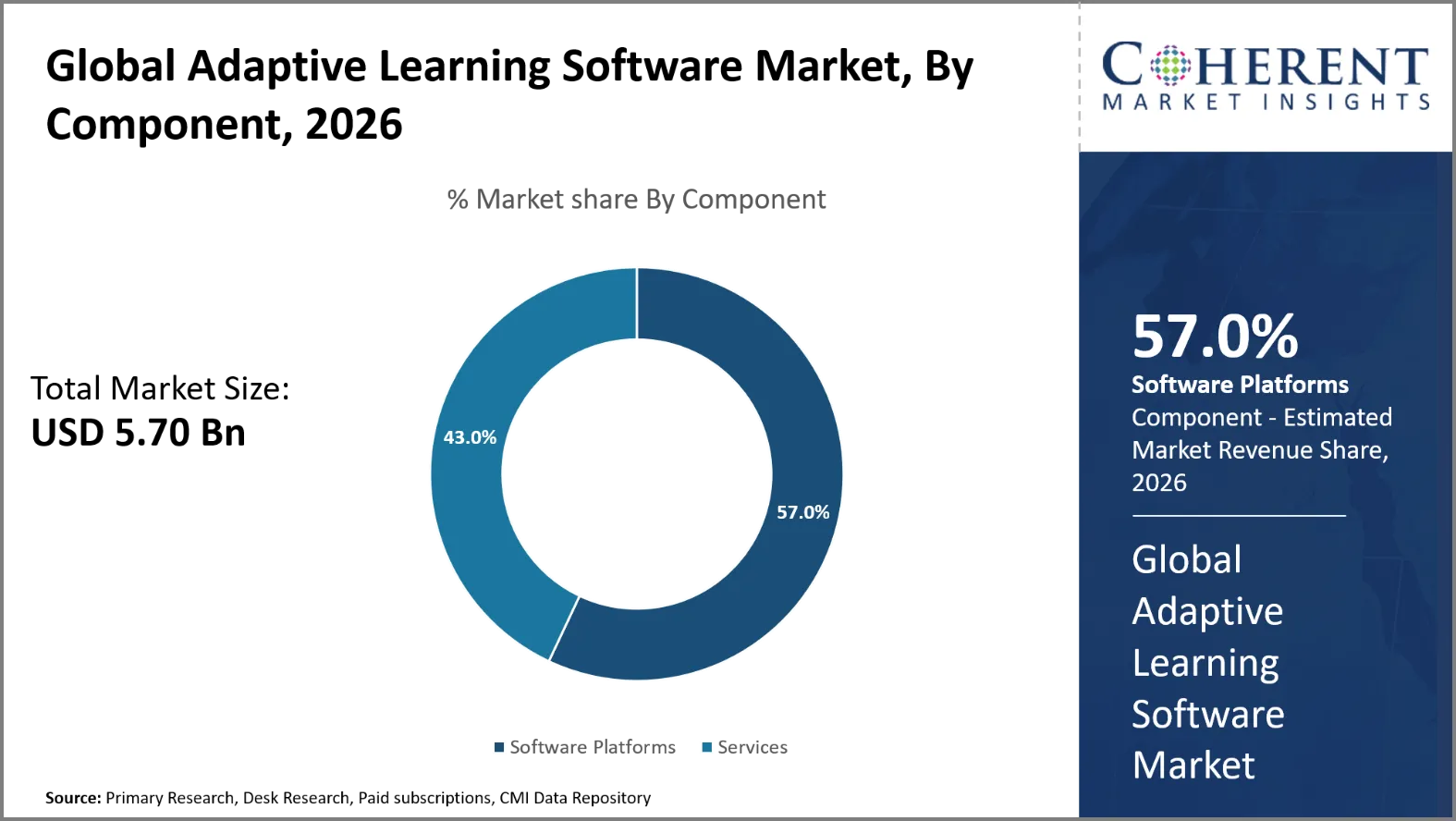
- The Software Platforms segment is expected to account for 57.0% of the global adaptive learning software market share in 2026. Rising use of learning analytics to measure student performance is driving the growth of the segment. On October 29, 2025, HCLTech and Talents of Endearment jointly announced an AI-powered learning and development framework combining HCLTech's Career Shaper platform with Talents of Endearment's education and recruitment expertise.
- The Cloud-Based segment is estimated to capture 48.0% of the market share in 2026. Expansion of online education and corporate training is majorly driving the growth of the segment. On October 6, 2025, Coursera launched an app in ChatGPT that allows users to discover educational videos and learning resources within conversations.
- The Artificial Intelligence segment is estimated to capture 44.0% of the market share in 2026. Integration with learning management systems is majorly driving the growth of the segment. On July 23, 2025, Instructure and OpenAI announced an integration that embeds artificial intelligence workflows into Canvas. The partnership enables educators to develop learning experiences within an existing learning management environment.
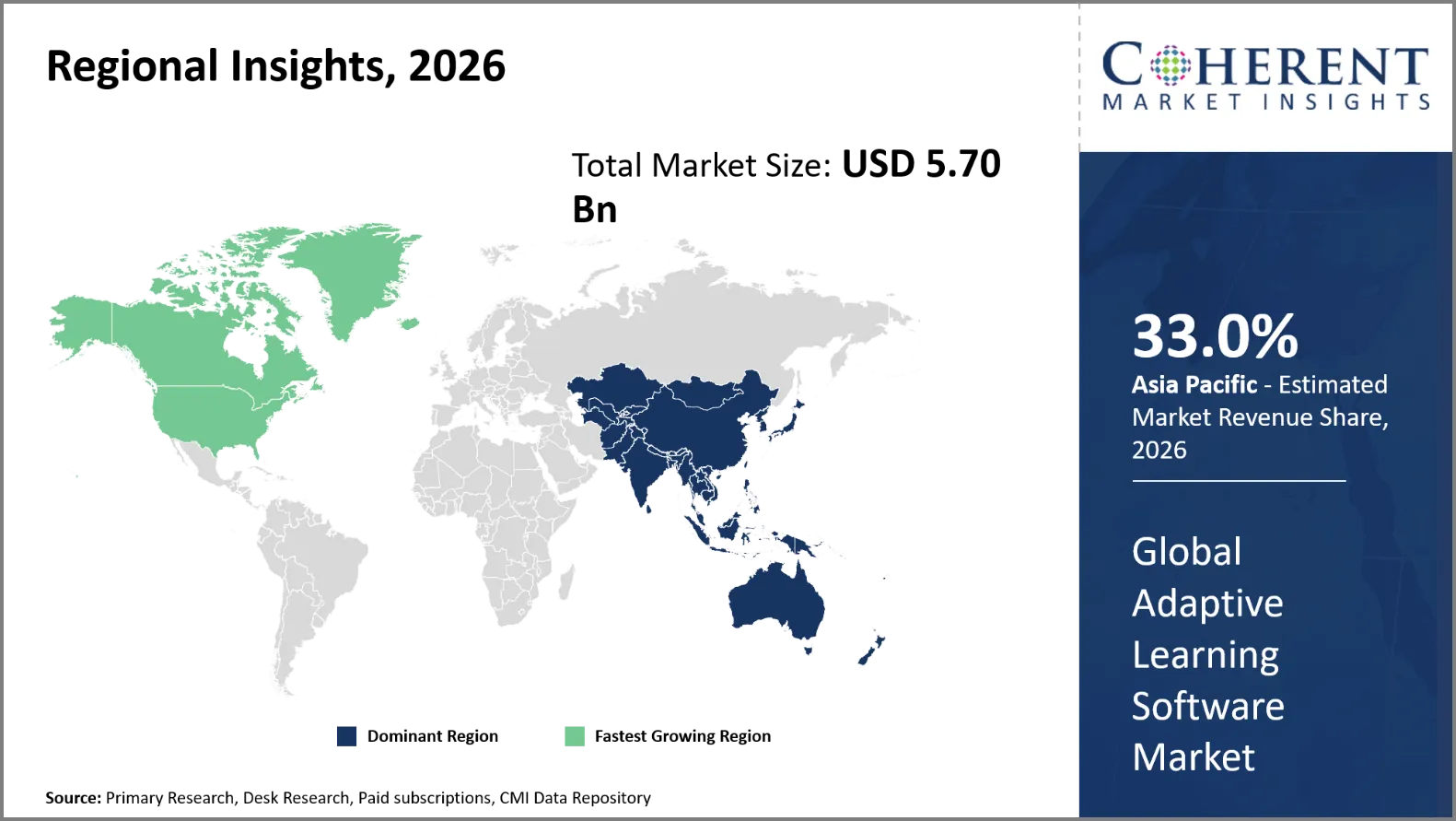
- Asia Pacific is expected to dominate the adaptive learning software market in 2026 with a market share of 33.0%. Growing development of adaptive learning applications in Asia Pacific is driving the growth of the regional market. On February 4, 2026, LingoAce launched ACE Academy, expanding beyond Mandarin instruction into mathematics and English language arts. The platform combines teacher-led lessons with artificial intelligence-powered learning plans that adapt to students’ academic levels and progress.
- North America is expected to account for 21.0% share in 2026 and is projected to record the fastest growth over the forecast period. Expansion of Personalized workforce training and reskilling in North America is driving the growth of the regional market. On October 1, 2025, Deloitte launched Scout, an artificial intelligence-powered learning assistant for its U.S. professionals. The platform personalizes development according to employees’ roles, previous learning activity, content preferences, and career goals.
Segmental Insights
Why Does Software Platforms Dominate the Global Adaptive Learning Software Market?
The software platforms segment is expected to account for 57.0% of the global adaptive learning software market share in 2026. Software platforms dominate because they provide the core infrastructure for personalized learning experiences. These platforms evaluate the performance of the learners, find the knowledge gaps and alter the training content as per the individual progress. Their unified dashboards also let educators track engagement, measure outcomes and provide targeted solutions. The usefulness is even greater due to the interaction with learning management systems, student information systems and digital material libraries. Organizations also benefit from automated assessments, tracking of progress and scalable course management. These features are meant to assist schools, universities, and corporate training departments. The increasing desire for verifiable learning outcomes is driving platform adoption in digital education contexts.
On April 21, 2026, Cognizant announced the launch of Skillspring, a multimodal, AI-native, conversational learning platform that reinvents learning for the AI era and enables enterprises to build AI-ready talent at scale. The platform moves beyond static courses and compliance-driven training to enable organizations to respond to rapidly changing roles, technologies and skills demands, and help learning investments translate to business outcomes.
- Current Industry Events of 2026
- Market Size Estimation
- Regional Breakdown
- Competitive Landscape
- Customer Intelligence
- Segmental Analysis
- Pricing Analysis
- Key Market Drivers, Challenges & Future Trends
- Customized Insights Section
Why is Cloud-Based the Most Preferred Deployment Type?
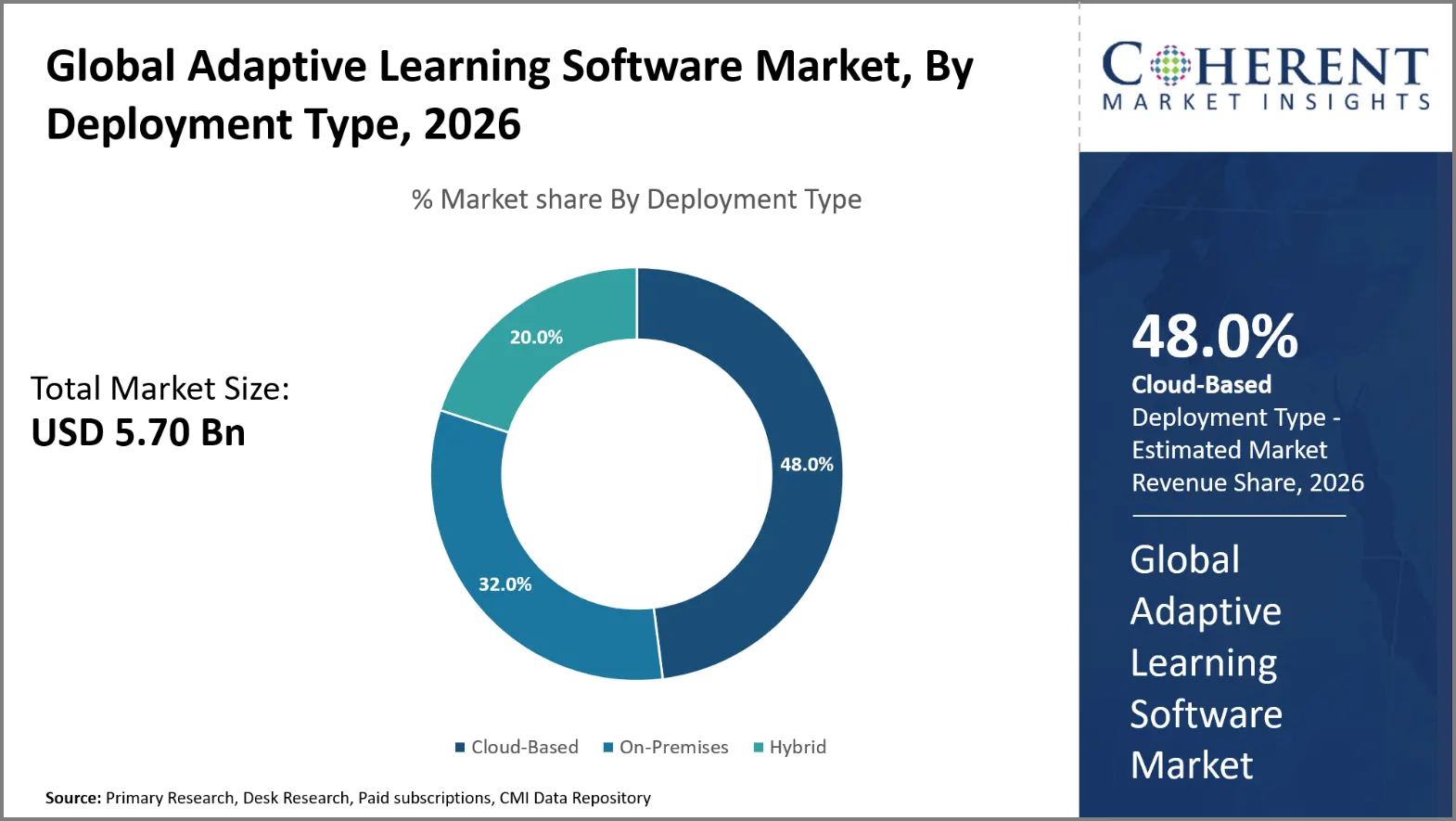
The cloud-based segment is expected to account for 48.0% of the global adaptive learning software market share in 2026. The most preferred deployment type is cloud-based deployment as it offers flexible access across devices and places. Educational institutions and enterprises can deliver learning resources without the need for large on-premise infrastructure. Cloud platforms enable software updates, centralized content management, user administration and connection with current digital learning systems. They also support remote learning, scattered workforces and consistent access across many campuses. The subscription pricing can minimize the initial cost of infrastructure and allow smaller enterprises access to sophisticated learning tools. Also, the cloud architecture can handle data at scale for tailored recommendations and learner analytics.
On February 28, 2025, Pearson and Amazon Web Services, Inc. announced the expansion of their long-standing collaboration to accelerate the delivery of AI-powered learning for millions of people around the world and enhance the learner experience for Pearson’s products and services.
Artificial Intelligence Dominates the Global Adaptive Learning Software Market
The artificial intelligence segment is expected to account for 44.0% of the global adaptive learning software market share in 2026. Artificial Intelligence is a key technology because it enables software to respond dynamically to individual learner needs. Machine learning algorithms analyze assessment results, response patterns, learning progress, and recurring mistakes to identify knowledge gaps. Systems can then adjust the level of the content, along with related activities and quick feedback. Conversational explanations and guided problem solutions can be provided using natural language processing and intelligent tutoring skills. Learning analytics can help educators to identify students who are falling behind and devise interventions to help them. These capabilities add value to Artificial Intelligence for customized education, competency development and workforce training.
On September 4, 2025, Pearson rolled out artificial intelligence literacy modules for pupils through its MyLab and Mastering digital learning offerings. The modules address responsible use of artificial intelligence, verification of created material, and proper citation standards.
Current Events and their Impact
Current Events | Description and its Impact |
European Union Artificial Intelligence Act Regulation (EU) 2024/1689 |
|
India Digital Personal Data Protection Act, 2023, and Rules, 2025 (Act No. 22 of 2023. Rules notified through G.S.R. 846(E)) |
|
Adaptive Learning Software Market Dynamics
Market Drivers
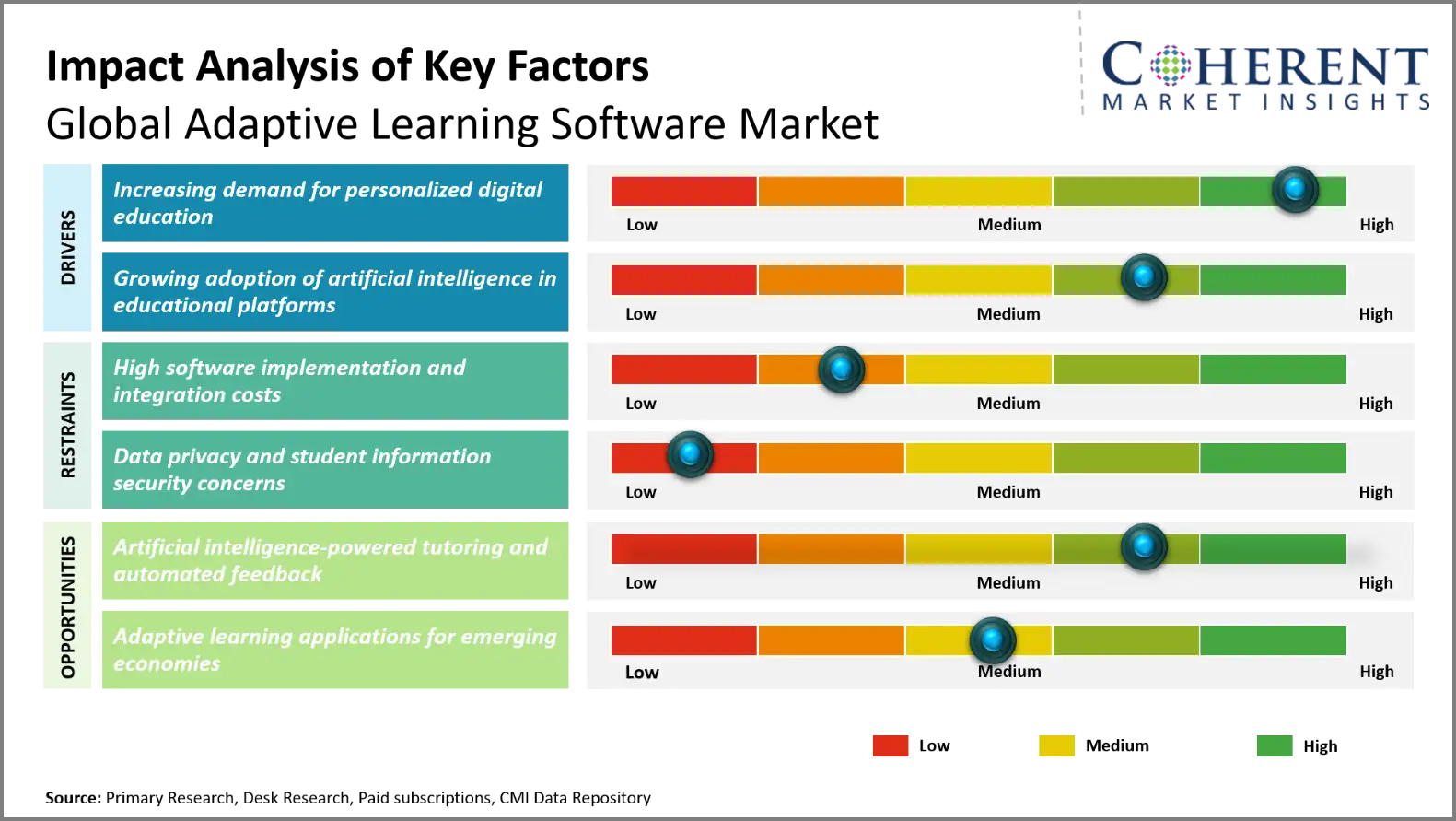
Increasing demand for personalized digital education
Increasing demand for personalized digital education is driving the global adaptive learning software market by encouraging institutions to address individual learning needs. Adaptive platforms adapt the educational content, the level of difficulty of the assessment, and the pace of learning to the way students perform. This technique enables the learners to fill the gaps of information as well as satisfy the diverse skills and preferences of learning. Schools, universities and corporate training providers are increasingly using individualized digital resources to boost participation and improve outcomes. The availability of digital gadgets and online instructional tools also makes adoption easier. The demand for adaptive learning software is growing, driven by the need for flexible, learner-centered education.
On June 26, 2025, Google Cloud and Pearson announced a multi-year strategic agreement to accelerate the development of new AI-powered products and services to customize learning for pupils, empower teachers with insights and help enhance educational results.
Growing adoption of artificial intelligence in educational platforms
The global adaptive learning software market is expanding with rising adoption of Artificial Intelligence in education platforms, improving personalization and instructional effectiveness. The artificial intelligence algorithms analyze the learner’s responses, assessment scores and progress patterns to identify areas of knowledge that require attention. Based on these results, platforms can deliver appropriate lessons, adapt material difficulty and provide personalized feedback. Intelligent tutoring assistants and automated evaluations can also help eliminate repetitious educational work. Educational institutions and business training departments are increasingly valuing these competencies in helping diverse learners. New breakthroughs in machine learning and natural language processing are opening up new potential for more responsive, data-driven digital education.
On January 15, 2026, Cengage School debuted Explore, a comprehensive K-12 digital learning platform to increase student engagement and customized classroom. The site delivers curriculum related materials, interactive exercises, customized evaluations and real-time feedback.
Emerging Trends
- Generative Artificial Intelligence in Personalized Learning: Generative AI-based adaptive learning systems provide personalized explanations, practice problems, and interactive learning resources. These features help learners to complete the knowledge gaps and give educators the chance to individualize teaching according to talents and learning objectives.
- Integration with Learning Management Systems: Adaptive learning software is rapidly being integrated with learning management systems, student information systems and digital assessment tools. These interfaces provide a unified administration of student data, faster delivery of courses and improved visibility of individual progress, bridging the gap between educational institutions and corporate training settings.
- Expansion of Skills-Based Corporate Training: Companies are implementing adaptive learning systems to reskill their current employees, onboard new hires, and foster ongoing professional development. Learning paths are targeted to help workers acquire the skills they need for their career. Performance analytics let us measure the impact of training and identify skills gaps.
- Growth of Learning Analytics and Predictive Insights: Suppliers of adaptive learning are strengthening their analytics skills to diagnose learning issues and to predict potential disengagement. These insights help educators to intervene earlier, change teaching tactics and provide support more effectively, which in turn boosts student retention and improves educational decision making.
Regional Insights
Why is Asia Pacific a Strong Market for Adaptive Learning Software?
Asia Pacific is expected to account for a market share of 33.0% in 2026. Growth in Asia Pacific is driven by big student populations, national digital education programs and a demand for multi-lingual learning tools. India’s DIKSHA platform supports digital teaching resources while China’s smart education programs promote technology-enabled instruction. Singapore’s Student Learning Space offers curriculum-aligned digital content for schools. Access to digital devices was made possible by Japan’s GIGA School Program and opened the door to adaptive programs that individualize practice and feedback. The push for digital textbooks in South Korea also encourages technology-led change of the classroom. Organizations that have localized curricula, language assistance, and teacher analytics are better positioned to meet the needs of different education systems. Integration with existing school platforms remains an important purchasing consideration.
Why Does North America Adaptive Learning Software Market Exhibit High Growth?
North America is expected to register the fastest growth with a CAGR of 12.4% over the forecast period. It is projected to account for 21.0% of the global adaptive learning software market in 2026. The region has well-established educational technology companies, university-led digital learning programs, and a significant desire for quantitative academic performance. Carnegie Learning’s MATHia uses student responses to drive math instruction and give targeted feedback. ALEKS from McGraw Hill uses adaptive questioning to determine what users know and don't know in math and other subjects. Khan Academy’s Khanmigo offers AI-powered tutor and teacher help. Canadian institutions also offer options through on-line universities and distance learning programs. Ontario’s Contact North delivers digital learning resources to students in rural and remote regions. These applications increase demand for adaptive assessment, tailored teaching and precise learning analytics.
Global Adaptive Learning Software Market Outlook for Key Countries
Why is China Emerging as a Major Hub in the Adaptive Learning Software Market?
China’s adaptive learning software market is supported by massive digital education infrastructure, AI integration and widespread online learning ecosystems. As of May 2025, the Smart Education of China platform has over 61.3 billion visits and over 164 million registered users. Its resources are basic education, vocational education, higher education, and lifelong learning. Beijing has teamed up to share educational materials and expand the scope of online classes, while Zhejiang has made use of virtual simulations to provide immersive learning and industrial training. Beijing Normal University has also sponsored student evaluation programs based on artificial intelligence in 44 locations and over 8,000 primary and secondary schools. These programs emphasize the value of tailored training and data-driven instructional tools.
Is U.S. the Next Growth Engine for the Adaptive Learning Software Market?
The U.S. adaptive learning software industry is being benefitted by the demand for customized education, evidence-based therapies, and technology-enabled academic recovery. Carnegie Learning’s MATHia offers mathematics training that reacts to students’ problem-solving steps. McGraw Hill’s ALEKS uses adaptive testing to find holes in knowledge and direct students to the right learning materials. Khan Academy’s Khanmigo offers tutoring and teacher-support solutions powered by artificial intelligence. Many universities use digital learning tools extensively to cope with big groups of students with different levels of preparedness. In August 2026, the U.S. Department of Education emphasized value of instruction, transparency, teacher judgment, and student outcomes. These criteria push providers to show clear learning advantages and to participate in acceptable data practices.
Germany Adaptive Learning Software Market Analysis and Trends
The German market for adaptive learning software is influenced by the federal-state education framework, requirements for learning in the German language, and the need to integrate digital means with classroom teaching. The Standing Conference of the Ministers of Education and Cultural Affairs of the Länder has outlined an Adaptive Intelligent System with assisted learning pathways and tailored feedback with artificial intelligence. It has plans to include adaptive activities, dashboards for teachers and integration of commercial and noncommercial educational resources. Germany’s VIDIS project also aims to provide standardized access to digital education services in member states. These advancements present potential for software that can fit state-specific curricula, protect student data and facilitate customized education. German-as-a-second-language learning tools provide another specialized application.
U.K. Adaptive Learning Software Market Analysis and Trends
The U.K. adaptive learning software market benefits from curriculum-aligned digital resources, teacher workload reduction, and initiatives addressing educational inequality. Aila is an artificial intelligence lesson assistant developed by Oak National Academy to help teachers tailor lesson plans and classroom supplies. Nearly two-thirds of those surveyed who used the Aila said their burden or time recovered has been decreased by an average of three hours, the ministry said. The government unveiled plans in January 2026 for individualized AI tutoring tools that could support as many as 450,000 disadvantaged kids every year. The suggested tools focus on English, mathematics, science and modern foreign languages. Such programs provide potential for adaptive platforms that provide curriculum alignment, instructor monitoring, personalized feedback, and targeted academic support.
India Adaptive Learning Software Market Analysis and Trends
Multilingual digital education, competency-based assessments and a desire for cost-effective remedial learning are driving the Indian adaptive learning software industry. The DIKSHA site of the Ministry of Education includes curriculum-linked resources, interactive assessments and individualized practice. According to official data released in June 2026, the platform supports 135 languages including 128 Indian languages. Their textbooks use QR codes to link printed lectures to videos, exercises and further explanations. Mindspark, developed by Educational Initiatives, assesses students’ learning levels and provides customized learning paths. These features may help to explain disparities in classroom achievement, regional curricula and language preferences. Affordable mobile access and analytics focused on teachers give further prospects for adaptive software in public schools and private education providers.
Global Adaptive Learning Software Market - AI Tutoring Capabilities by Application
Application | Key AI Tutoring Capabilities | Automated Feedback Capabilities | Primary Users |
K-12 Education | Curriculum-aligned tutoring, adaptive exercises, guided explanations, personalized learning paths | Instant quiz feedback, reading assessments, error identification, targeted remediation | School students and teachers |
Higher Education | Subject-specific tutoring, step-by-step problem solving, course-material-based explanations, exam preparation | Assignment feedback, quiz analysis, misconception detection, practice recommendations | College students, faculty, and universities |
Corporate Training | Role-based tutoring, skill-gap identification, personalized learning paths, scenario-based practice | Competency scoring, knowledge checks, targeted retraining, progress feedback | Employees, managers, and learning teams |
Professional Certification | Exam-focused tutoring, adaptive question banks, concept explanations, personalized revision plans | Practice-test scoring, incorrect-answer explanations, weak-topic identification, readiness tracking | Certification candidates and working professionals |
Language Learning | Conversational practice, vocabulary adaptation, pronunciation guidance, personalized grammar instruction | Grammar correction, pronunciation feedback, vocabulary assessments, fluency tracking | Students, migrants, and language learners |
How is Artificial Intelligence-Powered Tutoring and Automated Feedback Creating New Growth Opportunities in the Adaptive Learning Software Market?
The emergence of artificial intelligence-based tutoring and automated feedback has provided new opportunities for growth in the market of adaptive learning software that provides ongoing and tailored instruction without the regular engagement of teachers. For example, McGraw Hill’s Learning assist uses discussion to explain ideas and assist students through issues on its Connect platform, and Instructure’s Project Athena hopes to produce tailored quizzes and study aids from course content. These apps allow learners to plug knowledge gaps and get fast feedback on incorrect answers. Workday Learning by Sana provides customized learning recommendations for business training based on employee roles and skill needs. These capabilities create opportunities for software providers to develop subject-specific tutoring agents, automated competency assessments, and targeted remediation tools that improve learning efficiency and reduce educators’ repetitive workloads.
On April 7, 2026, McGraw Hill, Inc., a leading global provider of education solutions for preK-12, higher education and professional learning, today announced new artificial intelligence (AI) capabilities within McGraw Hill Connect, its digital learning and course management solution for higher education.
Market Players, Key Development, and Competitive Landscape
Key Developments
- On July 22, 2026, Workday announced the general availability of Workday Learning, powered by Sana. The new solution combines Workday's trusted people and skills data with Sana's AI-native learning experience. Now, organizations can deliver personalized training grounded in the workforce data they already rely on.
- On July 14, 2026, LearnUpon announced the launch of its Agentic Learning Platform, completely reimagining how organizations unlock human capability and potential. This announcement sets a bold new vision for the industry by advancing learning technology from a passive administrative system into an intelligent, strategic partner.
- On March 16, 2026, Cornerstone OnDemand Inc. revealed the next evolution of Cornerstone Galaxy as part of its Spring 2026 Innovation release. Designed to build and expand the value AI can bring as a multiplier within organizations, the new features add assistive and agentic capabilities allowing organizations to drive faster skilling and talent development.
Competitive Landscape
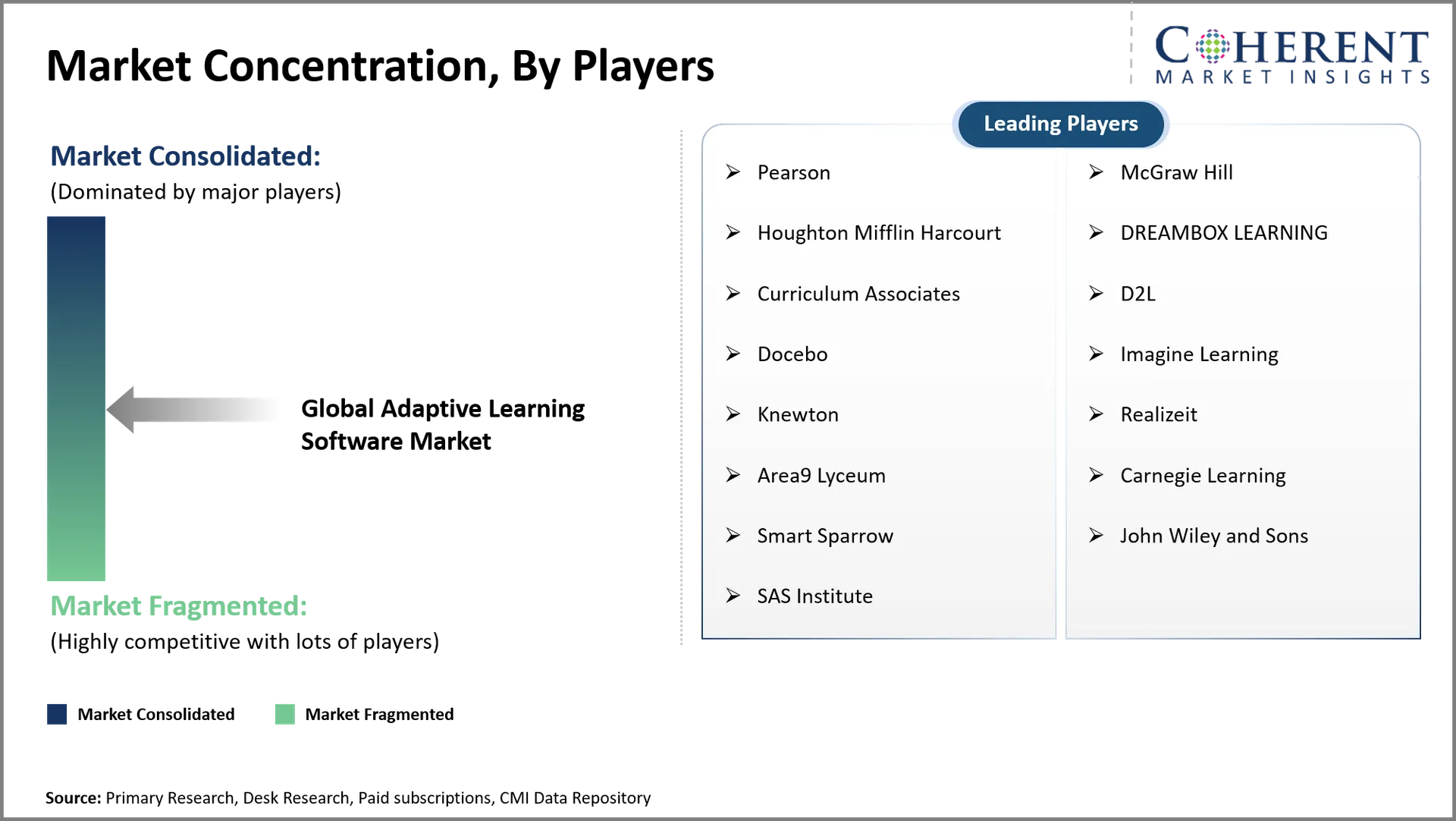
The global adaptive learning software market features established education publishers and specialist technology providers competing through artificial intelligence, adaptive assessments, and curriculum-specific content. ALEKS pinpoints areas of weakness and customizes the mathematics and chemistry learning paths, strengthening McGraw Hill’s position. In June 2026, McGraw Hill included Calculus II and elementary mathematics to ALEKS. One standout is Carnegie Learning’s MATHia, which personalizes math training based on student behavior when solving problems. Pearson is dedicated to digital courseware and customized learning experiences for higher education. Curriculum Associates competes with i-Ready, which integrates diagnostic evaluation with personalized educational recommendations Wiley serves higher education through Knewton Alta. Competitive advantage increasingly depends on subject-specific accuracy, curriculum alignment, actionable teacher dashboards, and demonstrable learning progress.
Top Manufacturers and Notable Products/Solutions in the Adaptive Learning Software Market
Manufacturer | Notable Product/Solution | Key features |
McGraw Hill | ALEKS | Artificial intelligence-powered knowledge assessment, adaptive learning paths, personalized mathematics and chemistry instruction, real-time progress reports |
Pearson | MyLab and Mastering | Adaptive practice, personalized learning activities, assessment tools, performance tracking, targeted support for higher education courses |
Curriculum Associates | i-Ready Personalized Instruction | Adaptive diagnostic assessment, individualized mathematics and reading lessons, progress monitoring, skill-gap identification |
D2L | Brightspace with Lumi | AI-generated study support, personalized practice questions, formative feedback, learning summaries, performance insights |
Carnegie Learning | MATHia | Individualized mathematics tutoring, step-by-step problem solving, misconception detection, real-time feedback, teacher progress reports |
Adaptive Learning Software Market Report Coverage | |||
Report Coverage | Details | ||
Base Year | 2025 | Market Size in 2026: | USD 5.70 Bn |
Historical Data For: | 2020 To 2024 | Forecast Period: | 2026 To 2033 |
Forecast Period 2026 To 2033 CAGR: | 12% | 2033 Value Projection: | USD 17.00 Bn |
Geographies covered: |
| ||
Segments covered: |
| ||
Companies covered: | Pearson, McGraw Hill, Houghton Mifflin Harcourt, DREAMBOX LEARNING, Curriculum Associates, D2L, Docebo, Imagine Learning, Knewton, Realizeit, Area9 Lyceum, Carnegie Learning, Smart Sparrow, John Wiley and Sons, SAS Institute | ||
Growth Drivers: |
| ||
Restraints & Challenges: |
| ||
Analyst Opinion (Expert Opinion)
- The future of the adaptive learning software industry will center on systems that combine learner diagnostics, artificial intelligence tutoring, and teacher-controlled personalization. Platforms will increasingly need to explain why they recommend specific lessons rather than merely generate exercises. McGraw Hill’s ALEKS demonstrates the value of knowledge-gap identification, while Pearson’s MyLab combines personalized study tools with real-time performance insights. Vendors that connect instructional recommendations with clearly defined learning objectives will have stronger opportunities. Human oversight, reliable subject content, and transparent feedback should remain essential product differentiators.
- There is expected to be substantial opportunities in cloud-based adaptive software for mathematics, language learning, and foundational skills development. In the U.S., there are options for school intervention programs and higher education courses that require personalized attention. India provides a distinctive opportunity for low-cost, multilingual, state-aligned and national digital learning resources. China offers opportunity for localized systems supporting large scale digital education. Germany offers opportunities for curriculum tailored solutions with robust privacy protections. Providers should choose programs that provide individualized feedback to a measurable instructional difficulty.
- Market players should compete on specific learning outcomes, not on introducing AI features that have no evident instructional benefit. They should create curriculum-mapped content, diagnostic tests, teacher dashboards, and link to existing learning management systems. Pearson’s MyLab and D2L’s Brightspace exemplify how customized learning may be integrated into broader teaching and course-management workflows. Vendors eyeing India will have to focus on mobile usability, multi-lingual content and flexible institutional pricing. Enterprise customer providers should have competency mapping and role-based learning paths. Strong data protection, inclusive design, instructor controls and open pricing can build confidence and help enhance long-term client retention.
Speak to the analyst
Want personalized insights?
Take the findings above to one of our principal consultants, or have the report rebuilt around the segments, geographies and competitors you actually track.
Market Segmentation
- Component Insights (Revenue, USD Billion, 2021 - 2033)
- Software Platforms
- Services
- Deployment Type Insights (Revenue, USD Billion, 2021 - 2033)
- Cloud-Based
- On-Premises
- Hybrid
- Technology Type Insights (Revenue, USD Billion, 2021 - 2033)
- Artificial Intelligence
- Machine Learning
- Natural Language Processing
- Learning Analytics
- Application Insights (Revenue, USD Billion, 2021 - 2033)
- Personalized Learning
- Adaptive Assessments
- Learning Management
- Skills Development
- End User Insights (Revenue, USD Billion, 2021 - 2033)
- K-12 Education
- Higher Education
- Corporate Training
- Professional Education
- Regional Insights (Revenue, USD Billion, 2021 - 2033)
- North America
- U.S.
- Canada
- Latin America
- Brazil
- Argentina
- Mexico
- Rest of Latin America
- Europe
- Germany
- U.K.
- Spain
- France
- Italy
- Russia
- Rest of Europe
- Asia Pacific
- China
- India
- Japan
- Australia
- South Korea
- ASEAN
- Rest of Asia Pacific
- Middle East
- GCC Countries
- Israel
- Rest of Middle East
- Africa
- South Africa
- North Africa
- Central Africa
- North America
- Key Players Insights
- Pearson
- McGraw Hill
- Houghton Mifflin Harcourt
- DREAMBOX LEARNING
- Curriculum Associates
- D2L
- Docebo
- Imagine Learning
- Knewton
- Realizeit
- Area9 Lyceum
- Carnegie Learning
- Smart Sparrow
- John Wiley and Sons
- SAS Institute
Sources
Primary Research Interviews
- E-Learning Content Developers & Instructional Designers
- Adaptive Learning Platform Providers & EdTech Solution Vendors
- Corporate Learning & Development (L&D) Managers
- Academic Institution Representatives & School Administratorsa
Magazines
- eLearning Industry Magazine
- EdTech Magazine
- T.H.E. Journal (Technological Horizons in Education)
- Training Industry Magazine
Journals
- Journal of Learning Analytics
- Computers & Education (Elsevier)
- British Journal of Educational Technology (BJET)
Associations
- International Society for Technology in Education (ISTE)
- Association for Educational Communications and Technology (AECT)
- eLearning Guild
- United States Distance Learning Association (USDLA)
Public Domain Sources
- U.S. Department of Education – National Center for Education Statistics (NCES)
- European Commission – Education & Training Monitor
- World Bank Open Data – Education Statistics
- IMS Global Learning Consortium (Public Resources)
Proprietary Elements
- CMI Data Analytics Tool
- Proprietary CMI Existing Repository of Information for Last 10 Years
Get access to 250+ pages report
Every segment, forecast, competitor profile and data table behind the analysis above — available for instant download.
- ESOMAR Member
- ISO 9001:2015 Certified
- D-U-N-S Registered
- GDPR & CCPA Compliant
Frequently Asked Questions
The global adaptive learning software market is expected to stand at USD 5.70 Bn in 2026 and is expected to reach USD 17.00 Bn by 2033.
The CAGR of the global adaptive learning software market is projected to be 12% from 2026 to 2033.
Increasing demand for personalized digital education and Growing adoption of artificial intelligence in educational platforms are the major factors driving the growth of the global adaptive learning software market.
High software implementation and integration costs and data privacy and student information security concerns are the major factors hampering the growth of the global adaptive learning software market.
In terms of component, software platforms segment is estimated to dominate the market revenue share in 2026.
Adaptive learning software personalizes educational content, assessments, and learning pathways according to individual learner performance and needs.
Artificial intelligence analyzes learner responses and recommends appropriate content, difficulty levels, exercises, and personalized feedback.