

Global Advanced Bipolar Direct Energy Devices Market Size and Forecast – 2026 To 2033
The global advanced bipolar direct energy devices market is expected to grow from USD 3.84 Bn in 2026 to USD 5.28 Bn by 2033, registering a compound annual growth rate (CAGR) of 4.7% from 2026 to 2033. The market for global advanced bipolar direct energy devices is poised for significant expansion, fueled by the growing investment in medical-device manufacturing and surgical technologies.
In FY2024–25, India recorded USD 595 million (INR 5,253 crore) in foreign direct investment (FDI) inflows into the medical-device sector, supporting expansion of domestic medical-device capacity and technology adoption.
Key Takeaways of the Global Advanced Bipolar Direct Energy Devices Market
- Electrosurgical generator systems are projected to hold 61.4% of the global advanced bipolar direct energy devices market share in 2026, making it dominant product segment, across North America due to the established regulatory framework for bipolar energy systems. The U.S. FDA classifies electrosurgical vessel/tissue sealers with built-in generators under 21 CFR 878.4400 as Class II devices subject to the 510(k) pathway, supporting continued commercialization of integrated bipolar energy platforms.
- General surgery is projected to hold 27.6% of the global advanced bipolar direct energy devices market share in 2026, making it dominant application segment, across Europe, where advanced bipolar vessel-sealing technologies are being evaluated for routine surgical use. For instance, in March 2025, Health Technology Wales assessed advanced bipolar vessel-sealing systems for hysterectomy and found evidence supporting their adoption, highlighting the role of advanced bipolar technology in major general and gynecological surgical procedures.
- Hospitals are projected to hold 68.7% of the global advanced bipolar direct energy devices market share in 2026, making it dominant end user segment, across Asia Pacific, where regulatory authorities are strengthening oversight of electrosurgical technologies used in healthcare institutions. For instance, Japan's PMDA maintains dedicated safety and medical-device information for electrosurgical units with bipolar electrodes, including guidance addressing their use for hemostasis and coagulation, supporting the continued integration of bipolar energy technologies into clinical settings.
- North America market maintains dominance with an expected share of 42.8% in 2026, bolstered by the region’s established use of advanced electrosurgical technologies across surgical care. The U.S. FDA’s 2026 device classification framework specifically identifies electrosurgical vessel/tissue sealers with integrated RF generators for vessel ligation, tissue grasping, and dissection, reinforcing the region’s mature regulatory and clinical ecosystem for advanced bipolar energy devices.
- Asia Pacific is expected to exhibit the fastest growth in the global advanced bipolar direct energy devices market, registering an estimated CAGR of 6.7% during 2026–2033, driven by expanding medical-device infrastructure and regulatory modernization. For instance, in June 2026, India’s CDSCO published updates to its Medical Device framework, including a workshop on strengthening medical-device regulation and testing capabilities, reflecting continued efforts to build the regulatory infrastructure supporting advanced medical-device adoption in the country.
Segmental Insights
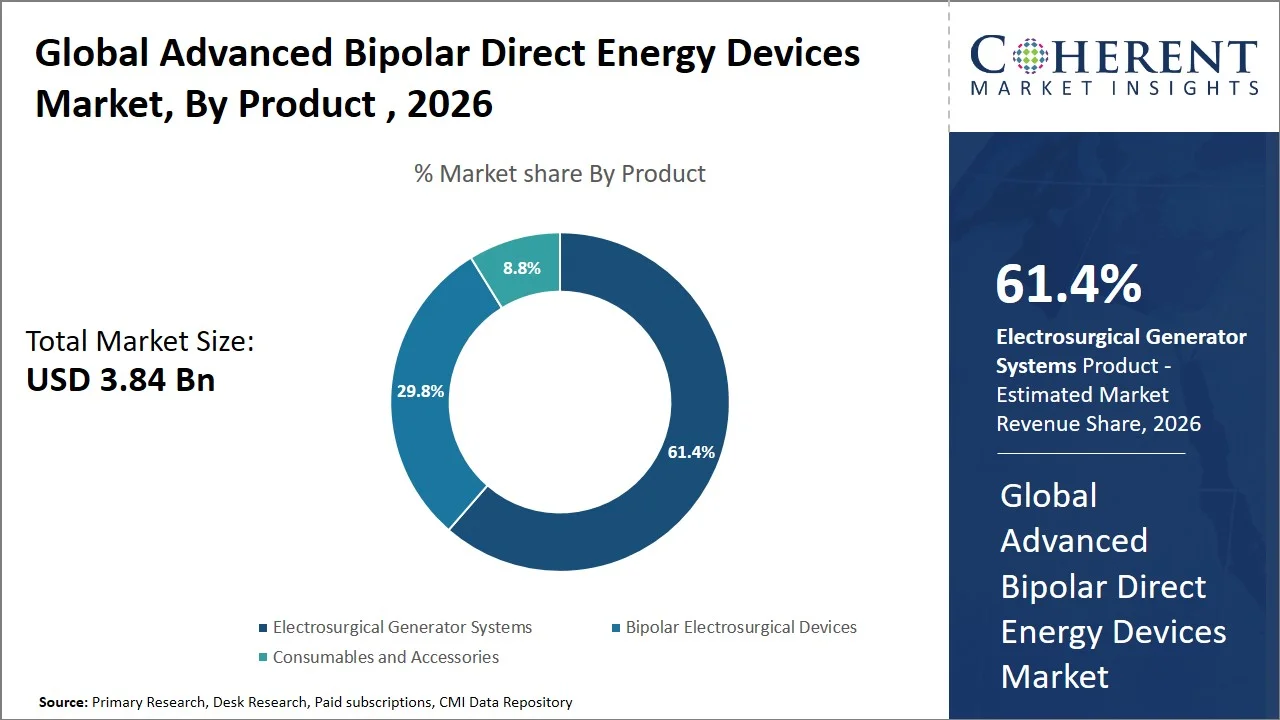
Why Do Electrosurgical Generator Systems Dominate the Global Advanced Bipolar Direct Energy Devices Market?
Electrosurgical generator systems are projected to hold the market share of 61.4% in 2026, attributed to its function of operating as a control platform delivering bipolar energy through the combination of various surgical instruments and surgical procedures. The inclusion of tissue sensing, selectable output energy, and numerous coagulation and sealing functions has helped them gain more importance in operating rooms. For instance, in September 2025, AIIMS Rishikesh tendered a requirement of advanced bipolar and ultrasonic energy generator, suggesting a requirement of integrated energy platforms for better RF energy delivery and tissue dissection, and vessel sealing.
- Current Industry Events of 2026
- Market Size Estimation
- Regional Breakdown
- Competitive Landscape
- Customer Intelligence
- Segmental Analysis
- Pricing Analysis
- Key Market Drivers, Challenges & Future Trends
- Customized Insights Section
Why Does General Surgery Represent the Largest Application Segment in the Advanced Bipolar Direct Energy Devices Market?
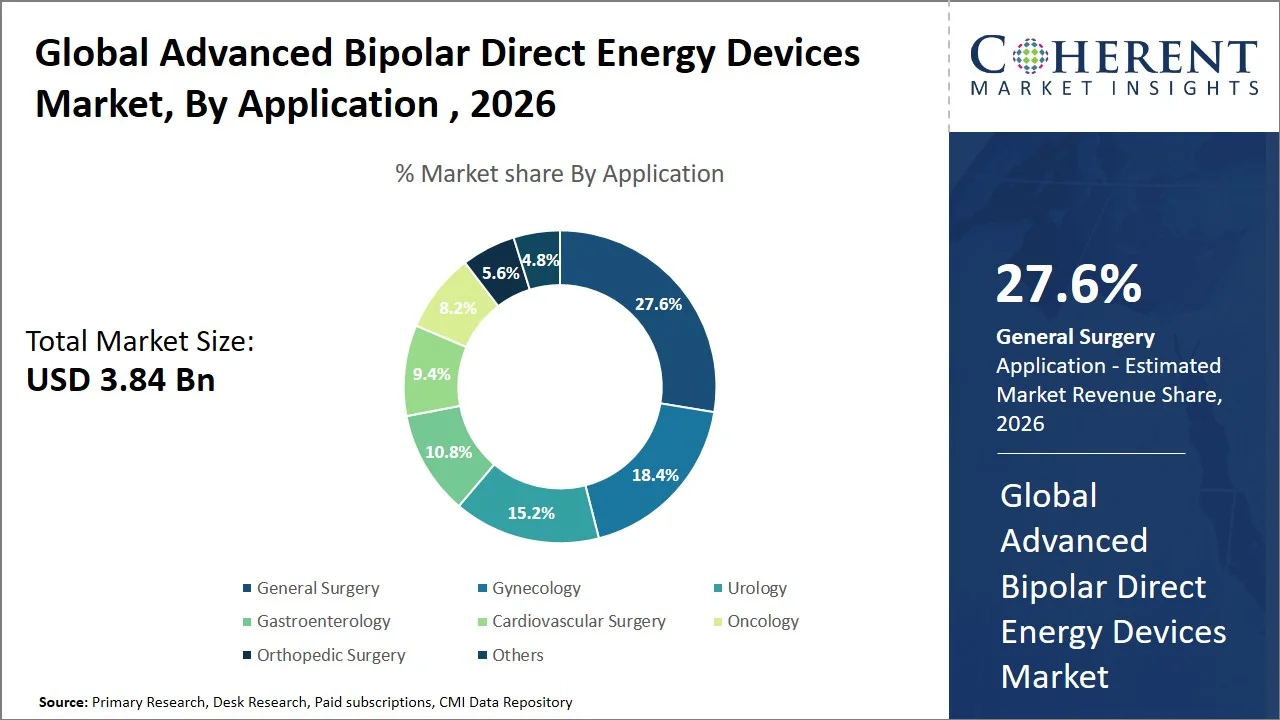
General surgery is projected to hold a market share of 27.6% in 2026, owing to the widespread use of advanced bipolar system for vessel sealing, coagulation and tissue dissection during abdominal surgeries. These can serve the dual function of sealing and cutting through a single system thus enhancing procedure and decrease requirement of additional hemostatic devices. In January 2026, randomized controlled trial of 180 patients published by National Library of Medicine, showed standard bipolar Maryland electrosurgery to be safe and feasible in closing off the appendicular base without the need for clips, ligatures, or knot-tying.
Hospitals Segment Dominates the Global Advanced Bipolar Direct Energy Devices Market
The hospitals segment is projected to hold a market share of 68.7% in 2026, owing to the presence of operating rooms, skilled surgeons grouped in multidisciplinary surgery team, along with a huge number of surgical procedures needing the use of electrosurgical tools. Besides these, hospitals can install the necessary generator system along with open surgery laparoscopic and robotic surgery instrument. For instance, as per the India Economic Review 2026, more than 80,000 major surgeries were performed in government hospitals in Kerala between April 2024-March 2025, which exhibits the extent of surgical practices in institutions and thus necessitates high-performance surgical energy technology. (Source: Data Portal Kerala)
Currents Events and their Impact
Current Events | Description and its Impact |
Australia Registered Bipolar Electrosurgical Device (May 2026) |
|
Canada Specified Bipolar and Vessel-Sealing Requirements for Electrosurgical Units (April 2026) |
|
China Revised Medical Device GMP Requirements (November 2025) |
|
Advanced Bipolar Direct Energy Devices Market Dynamics
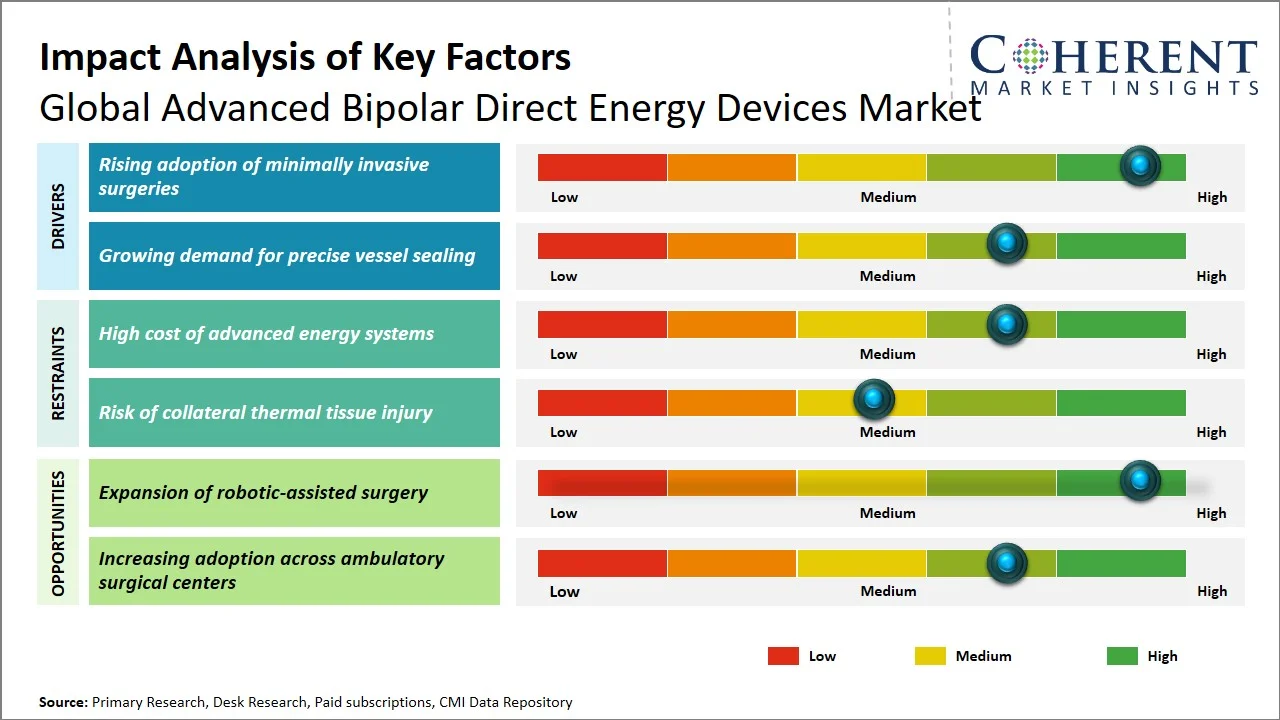
Market Drivers
Rising adoption of minimally invasive surgeries
The increasing shift toward laparoscopic and other minimally invasive procedures is driving demand for advanced bipolar devices that enable precise tissue dissection, coagulation, and vessel sealing through smaller surgical access points. For instance, in 2024–25, 98% of pelvic endometriosis lesion excision and ablation procedures in Australian hospitals were performed laparoscopically, demonstrating continued reliance on minimally invasive surgical approaches.
Growing demand for precise vessel sealing
The increasing shift toward minimally invasive procedures is supporting demand for advanced bipolar devices used for tissue dissection, coagulation, and vessel sealing during laparoscopic and robotic surgeries. For instance, in January 2026, AIIMS New Delhi reported that it had performed more than 1,000 robotic-assisted surgeries within 13 months, including complex gastrointestinal, hepatobiliary, endocrine, and abdominal procedures, demonstrating the expanding adoption of advanced minimally invasive surgical techniques and the growing need for compatible surgical energy technologies.
Growing adoption of robotic-assisted surgery
The expansion of robotic-assisted procedures is creating demand for advanced bipolar instruments that provide controlled vessel sealing, coagulation, and tissue dissection with greater maneuverability. For instance, in August 2026, AIIMS New Delhi issued a procurement tender for a radiofrequency cutting, coagulation, and vessel-sealing system with bipolar devices for open and laparoscopic surgery, reflecting institutional demand for integrated advanced energy platforms.
Emerging Trends
Growing adoption of tissue-sensing energy technology
Advanced bipolar devices are increasingly incorporating tissue-sensing capabilities to adjust energy delivery according to tissue characteristics. This supports more consistent vessel sealing and helps control unnecessary thermal spread during surgery.
Integration with robotic-assisted surgery
Bipolar energy is increasingly being incorporated into robotic assisted surgical systems, enabling precise vessel sealing and tissue coagulation during minimally invasive procedures. This trend is expanding the role of advanced bipolar devices in complex laparoscopic and robotic surgeries.
Convergence of multiple energy modalities
The market is shifting toward multimodal energy platforms that combine bipolar, monopolar, and other energy technologies within a single generator. This allows surgeons to switch between energy functions while reducing equipment and instrument changes during procedures.
Regional Insights
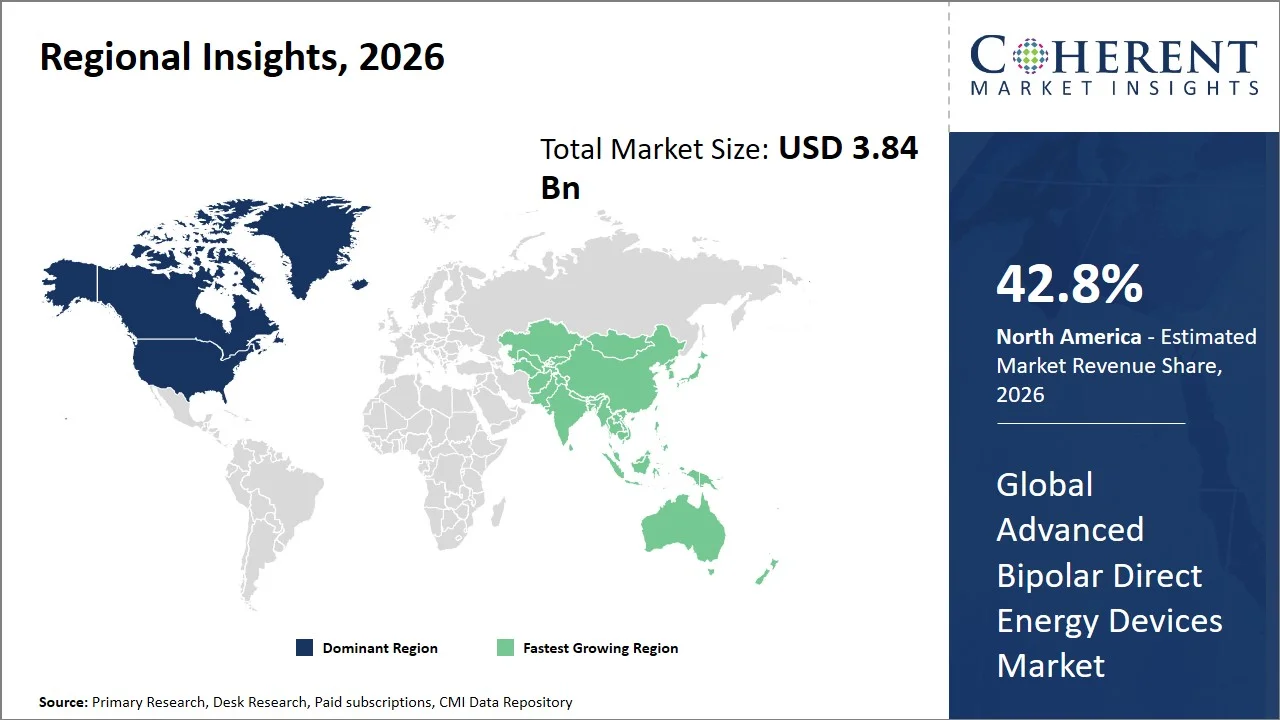
Why is North America a Strong Market for Advanced Bipolar Direct Energy Devices?
North America leads the global advanced bipolar direct energy devices market, accounting for an estimated 42.8% share in 2026, due to its robust innovation framework, comprehensive infrastructure and effective clinical settings for surgeries. Its substantial investments in future-generation technologies for surgical procedures, the rise of defense transformation initiatives by government, and close collaborations between commercial organizations and governmental agencies is fueling innovations.
For instance, in February 2025, the U.S. National Institutes of Health (NIH) awarded Vanderbilt University about USD 497,464 for creation of a minimally-invasive surgical robot with the help of a bipolar electrosurgery technique, which improves precision for tissue manipulation and resection. Furthermore, region’s well-established healthcare framework coupled with growing demand for these highly advanced bipolar energy platforms helps to sustain North American technological dominance.
Why Does Asia Pacific Advanced Bipolar Direct Energy Devices Market Exhibit High Growth?
Asia-Pacific is expected to exhibit the fastest growth in the global advanced bipolar direct energy devices market, registering an estimated CAGR of 6.7% during 2026–2033. The region is projected to account for approximately 20.9% of the global market in 2026, due to increased spending on healthcare infrastructure along with growing number of surgical procedures in the region. The region's drive toward self-sufficiency, supported by a favorable government policy and considerable investments in next-generation healthcare technologies expedites the development of home-grown technologies and market dynamics.
For instance, in January 2026, the Shanghai Municipal Government put forth an action plan to promote an all-industry chain development of the high-end medical device manufacturing industry, with focus on R&D and renovation of advanced surgery system. The plan emphasizes surgical robots (including endoscopic robots) and next-generation surgical robots. Furthermore, the rise in the region's own capabilities in medical device and the growing use of minimally invasive techniques, and robotic surgery are fostering further demand for advanced bipolar energy devices.
Global Advanced Bipolar Direct Energy Devices Market Outlook for Key Countries
Why is the U.S. Leading Innovation and Adoption in the Advanced Bipolar Direct Energy Devices Market?
The U.S. Leads in innovation and adoption since a well-established regulatory pathway exists for the use of electrosurgery devices, and more notably, bipolar vessel sealers and electrosurgical cutting/coagulation units are subject to U.S. FDA guidance and under the scope of Class II. Electrosurgery units' compatibility with robotically assisted surgery platforms is helping fuel the electrosurgery market as a tool necessary for a variety of surgical interventions including general, cardiac, gynecologic, urologic, and more to which the U.S. FDA understands that electrosurgery units can function as supporting devices for robotically assisted surgery devices.
Is Japan a Favorable Market for Advanced Bipolar Direct Energy Devices Market?
Japan is a lucrative market for advanced bipolar direct energy devices, as the country has the requisite medical-device regulatory framework through PMDA. Japan has a specific listing and separate classification for bipolars and electrosurgery instruments for both cutting and coagulation. The country is also a growing opportunity for robot-assisted and minimally invasive surgery with over 570 robotic surgical systems operating in the country by 2023 driving demand for compatible advanced energy instruments.
Is China Emerging as a Key Growth Hub for the Advanced Bipolar Direct Energy Devices Market?
China presents a significant avenue for future growth in the global advanced bipolar direct energy devices Market, driven by a growing domestic medical-device innovation environment and regulatory mechanisms more geared toward speedy new and enhanced gadget approvals. The NMPA has set aside policies in its 2025 program to boost approval of modern and excessive-end medical systems such as surgical activities machines and superior therapeutic cutting expertise. As China focuses on building domestic merchandise and providing life-cycle regulated assistance for the gadgets, advanced bipolar power gadgets will have the tendency of to flourish.
Why Does Germany Top the European Advanced Bipolar Direct Energy Devices Market?
Germany leads the European advanced bipolar direct energy devices market because it has a large hospital base and a rich segment of medical-tech innovation. The availability of a mature surgical infrastructure coupled with cooperation among hospitals, manufacturers, universities, and research institutions is facilitating a quicker adoption rate among surgical technologies in the country. Furthermore, its mature medtech system offers a well-supported foundation that is enabling the growth and commercialization of latest electrosurgical systems.
Is Advanced Bipolar Direct Energy Devices Market Developing in India?
India evolves as a promising market for state-of-the art bipolar direct energy devices due to growth in hospital infrastructure and the use of advanced surgical techniques. The country’s medical-device segment trends toward high-value domestic manufacturing, presenting opportunities for the next generation of advanced surgical equipment. Continued investment in medical-device park, manufacturing incentives and regulatory infrastructure will boost domestic utilization and manufacturing capacity.
Advanced Bipolar Direct Energy Devices by Surgical Function
Surgical Function | Role of Advanced Bipolar Devices | Key Clinical Value |
Vessel Sealing | Seals blood vessels and lymphatics using controlled RF energy | Reliable hemostasis |
Tissue Dissection | Dissects tissue following energy-based sealing | Precise tissue handling |
Coagulation | Controls bleeding through bipolar energy delivery | Reduced intraoperative blood loss |
Tissue Grasping | Allows grasping and manipulation alongside energy delivery | Fewer instrument exchanges |
Cutting / Transection | Divides sealed vessels and tissue bundles | Improved procedural efficiency |
How is the expansion of robotic-assisted surgery creating new growth opportunities in the advanced bipolar direct energy devices market?
As robotic-assisted surgery continues to proliferate, demand is emerging for advanced bipolar devices for vessel sealing, coagulation, and dissection within robotic operations. Through robotic articulation and visualization of instruments, a widening range of operative settings can benefit from application of advanced energy solutions. For instance, in January 2025, an analysis of 408 U.S. hospitals published by National Library of Medicine, found that hospitals that minimally invasive surgery rates increased from 60.5% to 65.8% at hospitals that introduced robotic-assisted surgery, compared with 56.1% to 57.0% at hospitals without robotic adoption.
Market Players, Key Development, and Competitive Intelligence
Key Developments
- In February 2026, a U.S. federal jury awarded Applied Medical approximately USD 381.7 million in damages after finding Medtronic liable for anticompetitive conduct in the advanced bipolar devices market. The case involved alleged bundling and exclusive-dealing practices related to advanced bipolar vessel-sealing devices, highlighting the competitive and procurement dynamics shaping the market.
- In October 2025, Olympus launched THUNDERBEAT II, a next-generation hybrid energy device featuring an advanced bipolar mode for vessel pre-sealing and spot hemostasis. The device combined bipolar, hybrid, and ultrasonic energy modes for laparoscopic and open surgery, highlighting the growing shift toward multifunctional surgical energy platforms.
- In September 2025, Medtronic launched the Valleylab FT10 Electrosurgical Generator and FT10 Vessel Sealing Generator in India, expanding access to advanced surgical energy technology. The platform incorporated bipolar, monopolar, and LigaSure technologies with tissue-sensing capabilities that adjust energy delivery according to tissue characteristics.
Competitive Landscape
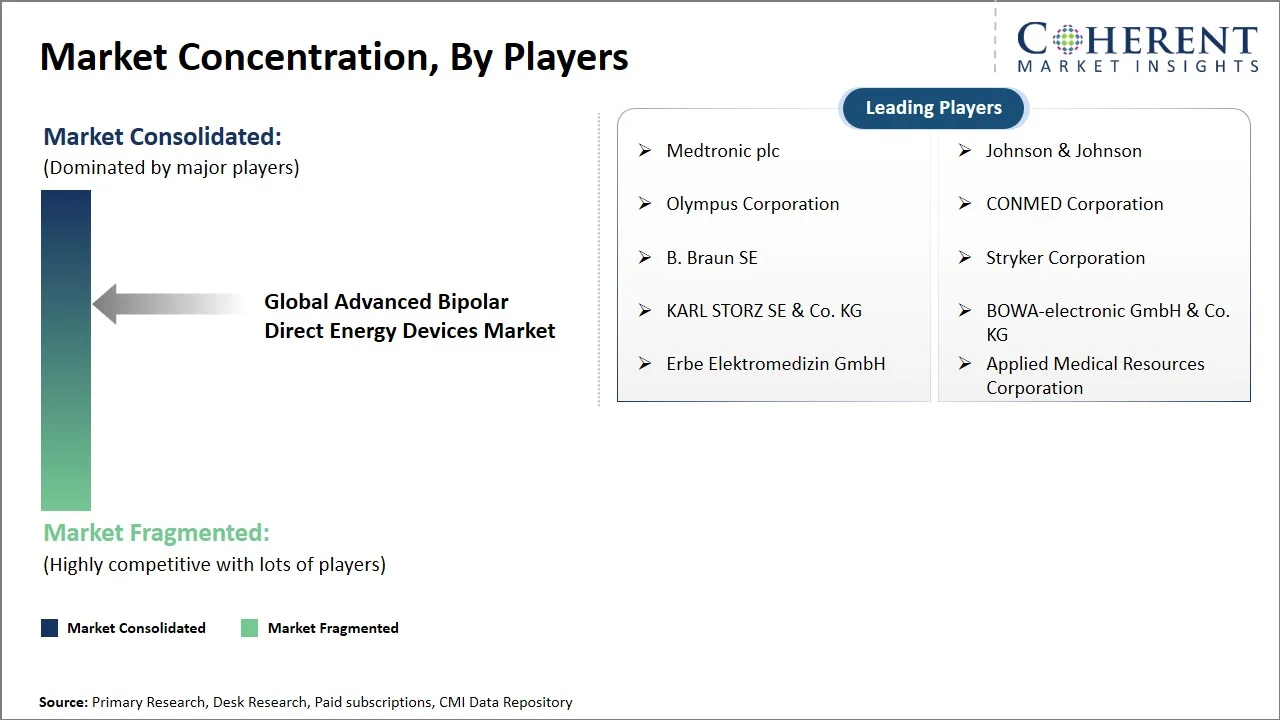
The global advanced bipolar direct energy devices market is moderately competitive, with competition centered on vessel-sealing performance, energy-delivery precision, thermal control, device ergonomics, and compatibility with minimally invasive and robotic surgical platforms. Market participants are increasingly focusing on multifunctional energy systems that combine sealing, cutting, coagulation, and tissue dissection while improving procedural efficiency and surgeon control. Key focus areas include:
- Development of advanced vessel-sealing systems offering consistent sealing strength across different vessel sizes
- Integration of real-time tissue sensing and energy modulation to optimize power delivery and minimize unnecessary thermal spread
- Expansion of multifunctional energy platforms combining bipolar, advanced bipolar, ultrasonic, and other energy modalities within a single generator
- Development of ergonomic and lightweight bipolar instruments designed to reduce surgeon fatigue and improve control during lengthy procedures
- Integration of advanced bipolar instruments with robotic-assisted surgical platforms to support precise sealing, coagulation, and tissue dissection
- Expansion of laparoscopic and minimally invasive bipolar instruments with different shaft lengths, jaw configurations, and articulation capabilities
Market Report Scope
Advanced Bipolar Direct Energy Devices Market Report Coverage
| Report Coverage | Details | ||
|---|---|---|---|
| Base Year: | 2025 | Market Size in 2026: | USD 3.84 Bn |
| Historical Data for: | 2020 To 2024 | Forecast Period: | 2026 To 2033 |
| Forecast Period 2026 to 2033 CAGR: | 4.7% | 2033 Value Projection: | USD 5.28 Bn |
| Geographies covered: |
| ||
| Segments covered: |
| ||
| Companies covered: | Medtronic plc, Johnson & Johnson, Olympus Corporation, CONMED Corporation, B. Braun SE, Stryker Corporation, KARL STORZ SE & Co. KG, BOWA-electronic GmbH & Co. KG, Erbe Elektromedizin GmbH, Applied Medical Resources Corporation | ||
| Growth Drivers: |
| ||
| Restraints & Challenges: |
| ||
Analyst Opinion (Expert Opinion)
- In the coming years, the global advanced bipolar direct energy devices market will be shaped by smarter, multifunctional energy platforms that combine vessel sealing, cutting, coagulation, and tissue sensing in a single system. The integration with robotic and digitally connected operating rooms to become increasingly important, while improved thermal control and energy modulation will remain key differentiators.
- The maximum opportunities will probably exist within advanced bipolar vessel-sealing systems for robotic-assisted general surgery in China. The manufacturers that develop compact, highly precise bipolar instruments compatible with robotic and laparoscopic platforms can capture demand as surgical infrastructure expands and hospitals increasingly prioritize procedural efficiency.
- In order to obtain a competitive advantage, market participants should move beyond competing primarily on generator or instrument specifications and build integrated energy ecosystems around surgeons' procedural needs. Priorities should include improving tissue-sensing capabilities, developing multifunctional instruments, ensuring compatibility across robotic and laparoscopic platforms, and strengthening surgeon training and post-sale support to accelerate adoption.
Speak to the analyst
Want personalized insights?
Take the findings above to one of our principal consultants, or have the report rebuilt around the segments, geographies and competitors you actually track.
Market Segmentation
- Product Insights (Revenue, USD Bn, 2021 - 2033)
- Electrosurgical Generator Systems
- Bipolar Electrosurgical Devices
- Consumables and Accessories
- Application Insights (Revenue, USD Bn, 2021 - 2033)
- General Surgery
- Gynecology
- Urology
- Gastroenterology
- Cardiovascular Surgery
- Oncology
- Orthopedic Surgery
- Others
- End User Insights (Revenue, USD Bn, 2021 - 2033)
- Hospitals
- Ambulatory Surgical Centers
- Specialty Clinics
- Others
- Regional Insights (Revenue, USD Bn, 2021 - 2033)
- North America
- U.S.
- Canada
- Latin America
- Brazil
- Argentina
- Mexico
- Rest of Latin America
- Europe
- Germany
- U.K.
- Spain
- France
- Italy
- Russia
- Rest of Europe
- Asia Pacific
- China
- India
- Japan
- Australia
- South Korea
- ASEAN
- Rest of Asia Pacific
- Middle East
- GCC Countries
- Israel
- Rest of Middle East
- Africa
- South Africa
- North Africa
- Central Africa
- North America
Sources
Primary Research Interviews
- Electrosurgical technology specialists
- General and minimally invasive surgeons
- Operating-room procurement specialists
- Medical-device R&D professionals
- Hospital surgical-equipment managers
Stakeholders
- Electrosurgical device manufacturers
- Surgical equipment distributors
- Hospitals and ambulatory surgical centers
- Contract manufacturers
- Robotic-surgery technology providers
- End-use Sectors
- Hospitals
- Ambulatory surgical centers
- Specialty surgical clinics
- Academic medical centers
- Government healthcare facilities
- Regulatory & Health Bodies
- U.S. Food and Drug Administration (FDA)
- European Medicines Agency (EMA)
- Medicines and Healthcare products Regulatory Agency (MHRA)
- Pharmaceuticals and Medical Devices Agency (PMDA)
- National Medical Products Administration (NMPA)
- Therapeutic Goods Administration (TGA)
- Health Canada
Databases
- FDA 510(k) Database
- FDA Device Classification Database
- Access GUDID
- ClinicalTrials.gov
- Australian Register of Therapeutic Goods (ARTG)
- EU EUDAMED
Journals
- Journal of Surgical Research
- International Journal of Surgery
- Annals of Surgery
- BMC Surgery
Associations
- Association of periOperative Registered Nurses (AORN)
- Society of American Gastrointestinal and Endoscopic Surgeons (SAGES)
- American College of Surgeons (ACS)
- European Association for Endoscopic Surgery (EAES)
- Society of Robotic Surgery (SRS)
Public Domain Sources
- U.S. Food and Drug Administration (FDA) – Medical-device classification, 510(k) databases, electrosurgical device information, and post-market surveillance data. FDA – Medical Devices
- National Library of Medicine (NLM)– Peer-reviewed literature covering electrosurgery, bipolar energy technologies, surgical applications, safety, and clinical outcomes.
- ClinicalTrials.gov – Clinical-trial records evaluating bipolar electrosurgical systems and their applications across surgical procedures. ClinicalTrials.gov – Electrosurgical Bipolar Systems
- FDA MAUDE Database – Public post-market reports on adverse events, device problems, and safety issues associated with medical devices. FDA MAUDE Database
Proprietary Elements
- CMI Data Analytics Tool
- Proprietary CMI Existing Repository of information for last 10 years.
Get access to 250+ pages report
Every segment, forecast, competitor profile and data table behind the analysis above — available for instant download.
- ESOMAR Member
- ISO 9001:2015 Certified
- D-U-N-S Registered
- GDPR & CCPA Compliant
Missing comfort of reading report in your local language? Find your preferred language:
Frequently Asked Questions
The global advanced bipolar direct energy devices market is estimated to be valued at USD 3.84 Bn in 2026 and is expected to reach USD 5.28 Bn by 2033.
Electrosurgical generator systems dominate due to their central role in controlling energy delivery, tissue sensing, and vessel-sealing performance across compatible bipolar instruments.
Advanced bipolar direct energy devices are electrosurgical systems that use controlled bipolar RF energy and feedback mechanisms to seal, coagulate, and dissect tissue while limiting unnecessary thermal spread.
The CAGR of global Advanced Bipolar Direct Energy Devices market is projected to be 4.7% from 2026 to 2033.
Rising adoption of minimally invasive surgeries, and growing demand for precise vessel sealing are the major factors driving the growth of the global advanced bipolar direct energy devices market.
High cost of advanced energy systems, and risk of collateral thermal tissue injury are the major factors hampering the growth of the global advanced bipolar direct energy devices market.
Medtronic plc, Johnson & Johnson, Olympus Corporation, CONMED Corporation, B. Braun SE, Stryker Corporation, KARL STORZ SE & Co. KG, BOWA-electronic GmbH & Co. KG, Erbe Elektromedizin GmbH, and Applied Medical Resources Corporation are the major players.