

Global Agentic Manufacturing Platform Market Size and Forecast – 2026 To 2033
The global agentic manufacturing platform market is expected to grow from USD 9.20 Bn in 2026 to USD 56.19 Bn by 2033, at a compound annual growth rate (CAGR) of 29.5% over 2026–2033. An agentic manufacturing platform is software that lets AI agents plan, decide and act on factory and enterprise systems with limited human input, instead of only flagging issues on a dashboard. These agents read data from machines, manufacturing execution systems (MES) and enterprise resource planning (ERP) tools, work out the next step, and then carry it out or hand it to a person for approval. The platforms form a fast-growing part of the wider Smart Manufacturing Platform Market and build on the software and connected systems covered by the Digital Manufacturing Market.
Vendors are moving from pilots to products that factory teams can use day to day. In April 2026, QAD | Redzone announced at Hannover Messe that its ChampionAI agents run on Amazon Bedrock AgentCore and Amazon SageMaker, helping mid-market manufacturers move AI from pilot projects into live production. In the same month, Accenture and Avanade reported they are co-developing an agentic factory intelligence system with Microsoft, with manufacturers Kruger and Nissha Metallizing Solutions validating it ahead of general availability later in 2026.
Key Takeaways of the Global Agentic Manufacturing Platform Market
- The platform (software) segment is expected to account for 52.8% of the global agentic manufacturing platform market share in 2026. Manufacturers license the agent builder, orchestration layer and data connectors first, before buying integration work. In September 2026, Cognite announced its Q3 release, adding Industrial MCP in public preview so third-party agents, including Claude and Microsoft Copilot, can connect to Cognite Data Fusion under the same governed knowledge graph and user permissions as Cognite Atlas AI.
- The cloud segment is expected to hold 42.1% of the deployment mode segment in 2026. Cloud delivery lets manufacturers add agents to existing cloud ERP and planning systems without new plant hardware. In May 2026, SAP introduced Autonomous Supply Chain Management at SAP Sapphire, including agents such as the Production Excellence Agent that monitor production, quality and machine signals to detect issues early.
- The predictive maintenance segment is expected to account for 36.4% of the application segment in 2026 (CMI estimate). Maintenance is the most common entry point, because machine data already exists and avoided downtime is easy to measure. In April 2026, Treon launched its AI-native Maintenance Orchestration Layer, in which AI agents automate ticket creation, scheduling and technician dispatch while managers supervise.
- North America is expected to dominate the agentic manufacturing platform market in 2026, with a share of 41.8%. The region is home to most hyperscale cloud and enterprise AI vendors, and its manufacturers committed AI budgets early. In April 2026, Microsoft demonstrated agentic AI that evaluates disruptions, simulates scenarios and recommends adjustments across procurement, logistics and production planning.
- Asia Pacific is expected to account for 23.5% share in 2026 and to be the fastest-growing region. Dense automation in Japan, South Korea and China gives agents rich machine data to act on. In September 2026, Hitachi entered a strategic co-creation partnership with Agile Robots to develop physical AI that lets robots carry out complex manufacturing tasks and production processes autonomously.
Segmental Insights
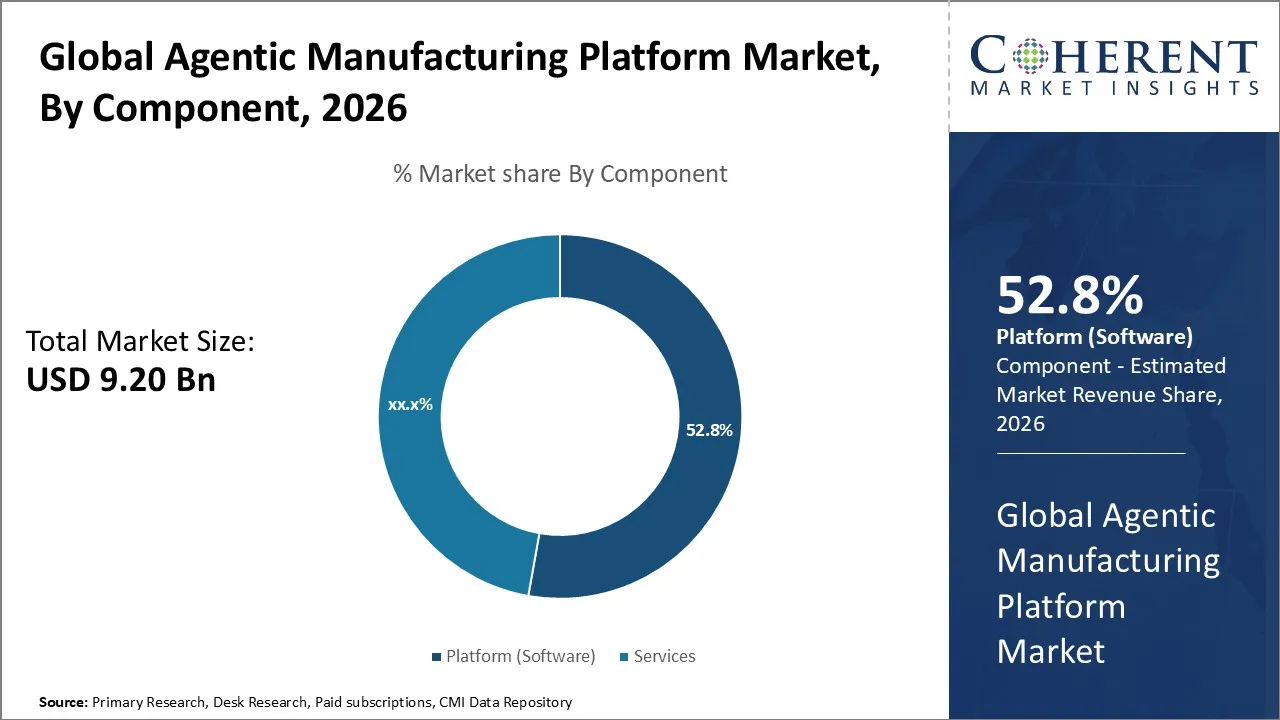
Why Does the Platform (Software) Segment Dominate the Global Agentic Manufacturing Platform Market?
In terms of component, the platform (software) segment is expected to account for 52.8% of the global agentic manufacturing platform market share in 2026. A working agentic platform needs an agent builder, an orchestration layer that assigns tasks across several agents, connectors to MES, ERP and plant historians, and governance tools that log every action an agent takes. Each of these is licensed as software, usually on an annual subscription, so spending grows as manufacturers add agents, plants and users.
Platforms are also taking over more of the engineering cycle. Vendors are building agents that design, test and deploy automation logic, so a change on the line no longer passes through several separate tools.
On April 16, 2026, Schneider Electric announced agentic manufacturing capabilities built on EcoStruxure Automation Expert and Microsoft Azure AI, where specialized agents coordinated by an orchestrator validate automation logic before it reaches the plant. The company reported engineering time savings of up to 50% on control configuration and documentation. In a pilot at a 10 MW green hydrogen plant, it reported a cut in the levelised cost of hydrogen worth about EUR 500,000 a year, or roughly USD 545,000.
- Current Industry Events of 2026
- Market Size Estimation
- Regional Breakdown
- Competitive Landscape
- Customer Intelligence
- Segmental Analysis
- Pricing Analysis
- Key Market Drivers, Challenges & Future Trends
- Customized Insights Section
Why Do Cloud Platforms Lead the Deployment Mode Segment?
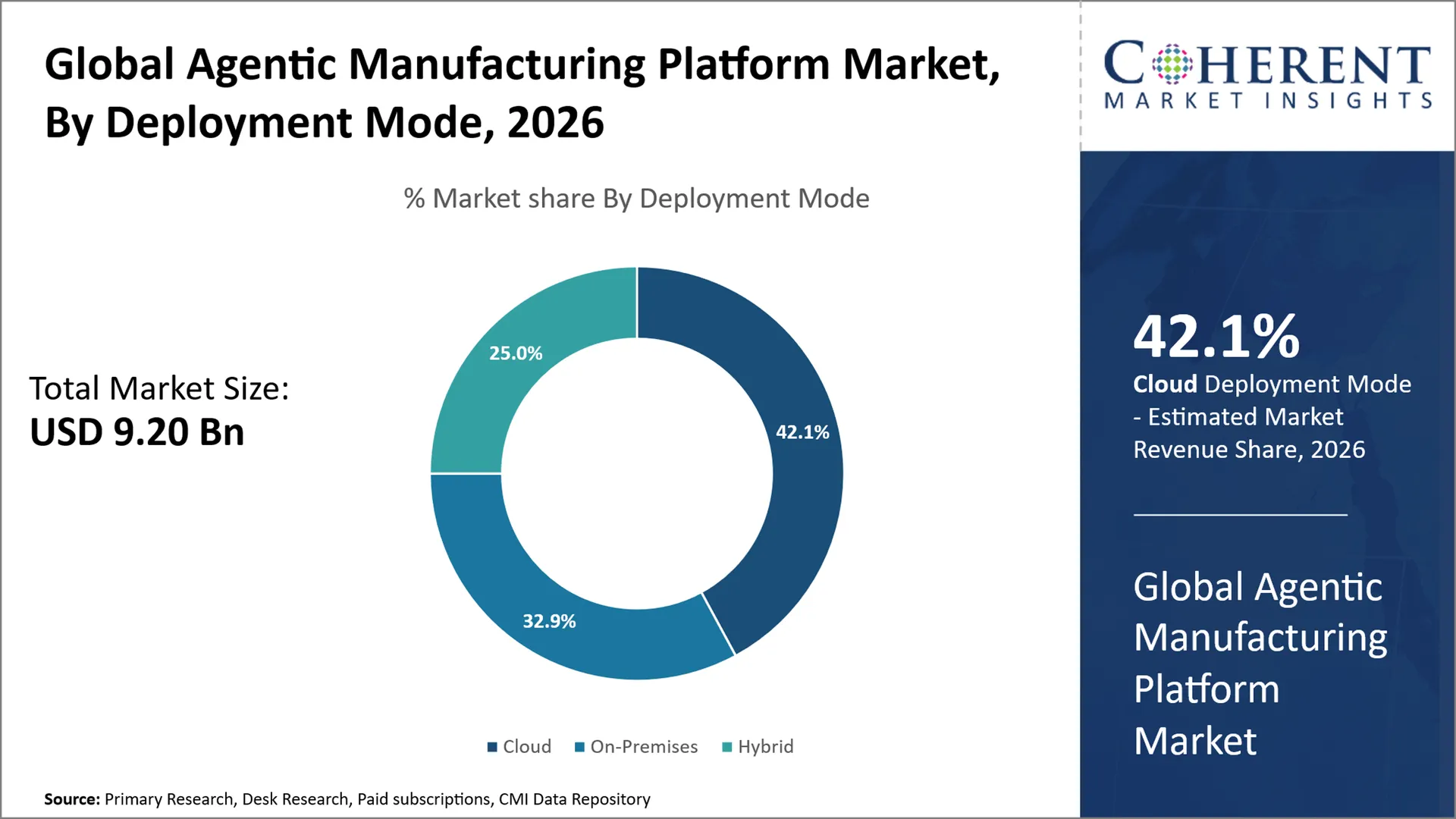
In terms of deployment mode, the cloud segment is expected to account for 42.1% of the global agentic manufacturing platform market share in 2026. Most agents work on business data held in cloud ERP, planning and procurement systems, so running them in the cloud avoids moving that data into the plant. Cloud delivery also lets vendors update agent models and add new skills without on-site upgrades, and lets a manufacturer roll the same agent out to many sites at once.
On November 9, 2026, Hitachi launched the TWX-21 Procurement AI Service under HMAX Industry, which uses multiple AI agents to handle quotation comparisons, ordering and delivery management. Hitachi reported that internal use cut work time on selected delivery-management tasks by up to 65%, with final decisions left to procurement staff.
Why Does Predictive Maintenance Lead the Application Segment?
In terms of application, predictive maintenance is expected to account for 36.4% of the global agentic manufacturing platform market share in 2026 (CMI estimate, based on third-party 2024 share data of about 38% adjusted for faster growth in planning and supply chain applications). Factories already collect vibration, temperature and current data from critical machines, so maintenance agents have data to work with from the start. The payback is also easy to show, because each avoided breakdown has a known cost in lost output. Agents now go beyond flagging a fault: they diagnose the likely cause, raise the work order and suggest the repair.
On March 24, 2025, Siemens expanded its Industrial Copilot offering with new generative AI capabilities for Senseye Predictive Maintenance, covering every stage of the maintenance cycle from repair and prevention to prediction and optimization.
Current Events and their Impact
Current Events | Description and its Impact |
EU Digital Omnibus on AI, Regulation (EU) 2026/1744 (July 2026) |
|
EU Machinery Regulation (EU) 2023/1230 (applies from January 20, 2027) |
|
Agentic Manufacturing Platform Market Dynamics
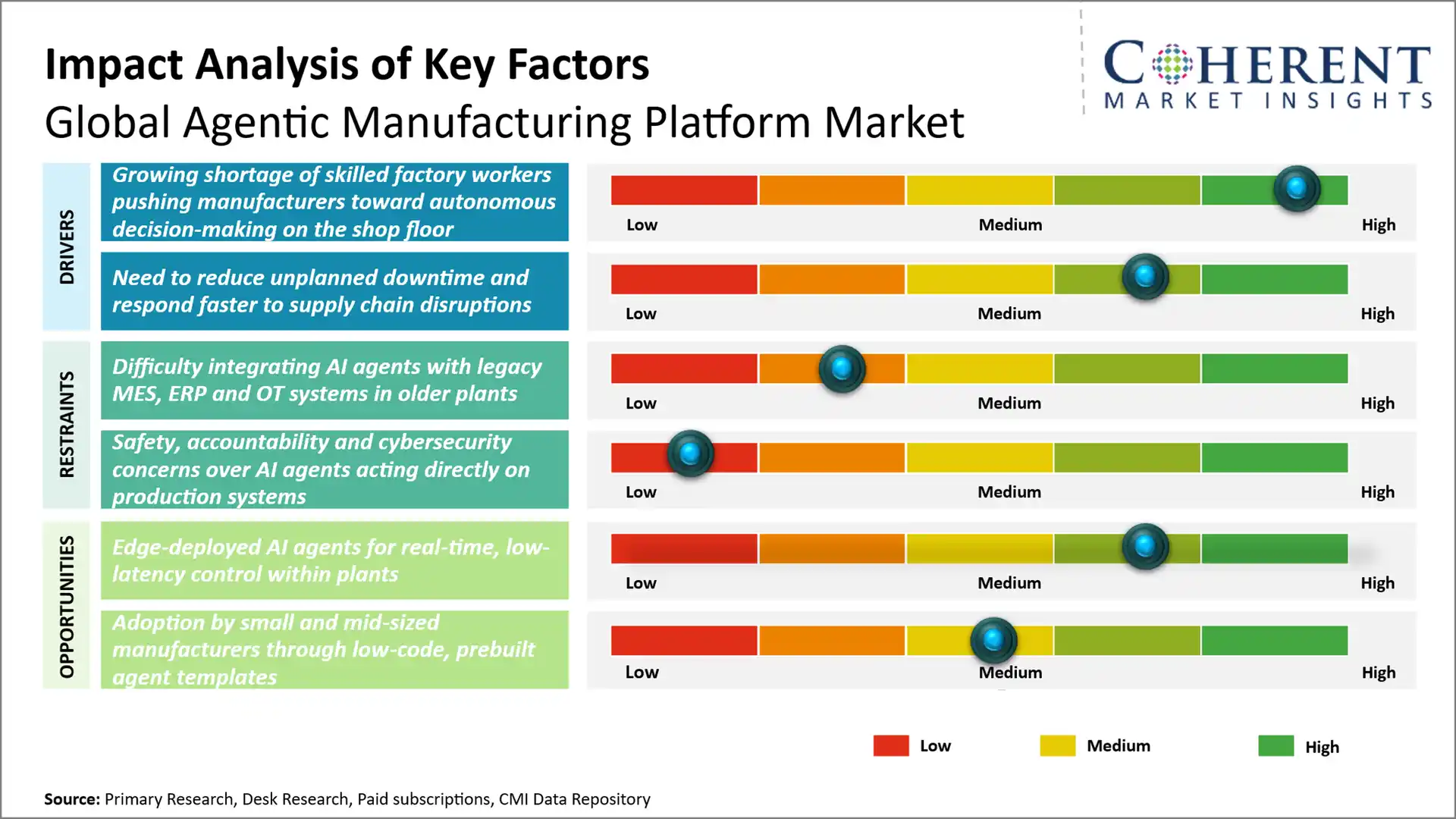
Market Drivers
- Growing shortage of skilled factory workers pushing manufacturers toward autonomous decision-making on the shop floor: Experienced operators, planners and maintenance technicians are retiring faster than plants can replace them. Much of their know-how was never written down, so new staff take years to reach the same level. Agents can capture that knowledge from manuals, work orders and machine history, then apply it around the clock. This lets a smaller team run the same lines and keeps decisions consistent across shifts.
- On August 31, 2026, Mitsubishi Electric announced it would present an internally validated model at CEATEC 2026 aimed at AI-supported factory equipment that performs assembly at the level of skilled operators, in processes long considered hard to automate.
- Need to reduce unplanned downtime and respond faster to supply chain disruptions: Tariffs, shortages and logistics delays now hit production plans every week, not once a year. Planners working through spreadsheets and email cannot replan fast enough, and each delay ripples into missed orders and idle lines. Agents watch supplier, inventory and production signals together, flag the conflict and propose a fix within minutes.
- On March 11, 2026, Blue Yonder announced an expanded set of AI agents and role-specific mobile applications across its planning and execution solutions, and reported extending AI functions for manufacturing planning to cover issue detection and resolution support.
Emerging Trends
- Agents are moving from software into robots and machines: Early agents worked on data and documents. Vendors are now linking agents to robot controllers and machine tools, so an agent can change how a machine acts, not only report on it. In May 2026, FANUC announced a strategic collaboration with Google to advance physical AI in its robot systems, and reported shipping more than 1,000 robots for physical AI applications after launching its physical AI system in December 2025.
Impact: Agent decisions reach the physical process faster, with fewer manual hand-offs.
Relevance to the market: This widens the market from IT software buyers to automation and robotics budgets
- Agents from different vendors are starting to work with each other: Manufacturers use dozens of systems and do not want a separate agent silo for each. Vendors are building agent-to-agent links so a sales or service agent can pull engineering answers from another vendor’s platform. In September 2026, Salesforce and Siemens announced they are combining Agentforce with Siemens’ Teamcenter Service Lifecycle Management to bring engineering-grade answers into sales, service and customer workflows.
Impact: Agents can complete tasks that span several systems without custom integration work.
Relevance to the market: This favours open platforms and raises the value of shared standards for agent communication.
Regional Insights
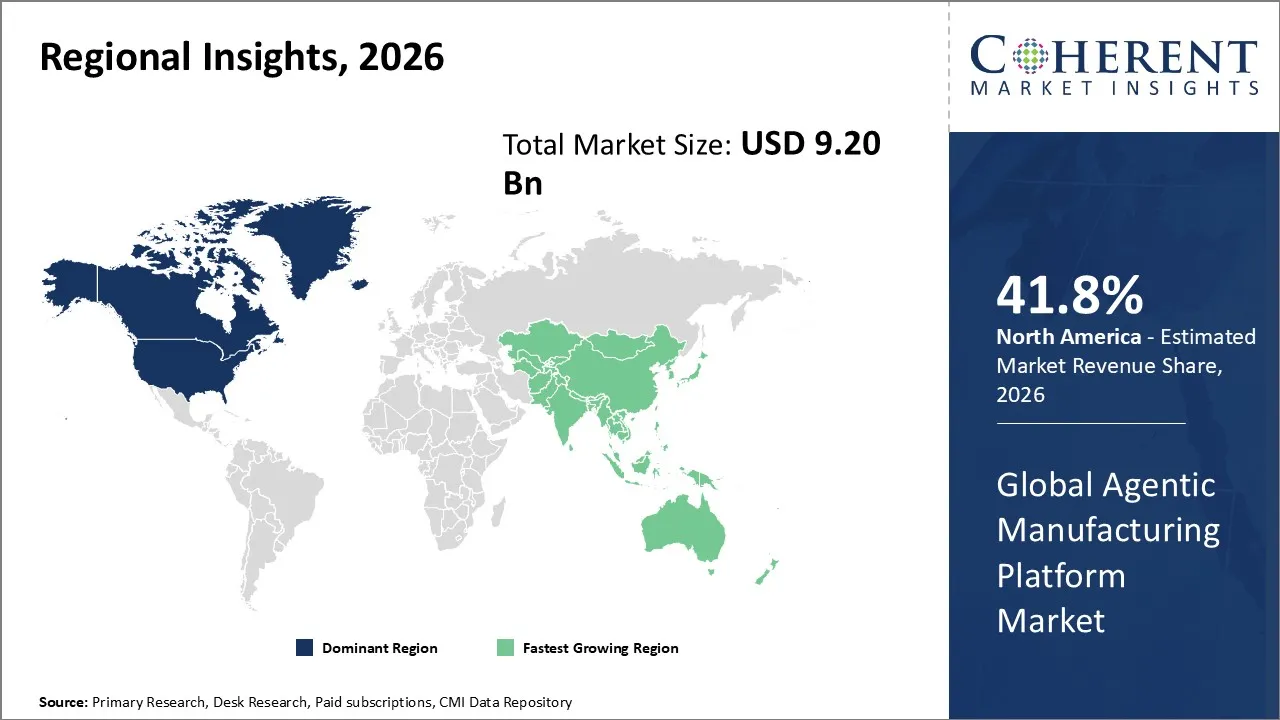
Why Does North America Lead the Global Agentic Manufacturing Platform Market?
North America is expected to account for a market share of 41.8% in 2026. Most hyperscale cloud providers, enterprise software vendors and agent platform developers are based in the U.S., and they sell first to manufacturers close to home. Large automotive, aerospace, semiconductor and process manufacturers in the region were early buyers of cloud ERP and plant data platforms, so they have the data foundations agents need. Reshoring and tariff-driven sourcing changes also push planners to replan more often, which raises demand for agents that work on supply and production data together.
Why Is Asia Pacific the Fastest-Growing Region in the Agentic Manufacturing Platform Market?
Asia Pacific is expected to account for 23.5% of the global market in 2026 and to register the fastest growth over the forecast period, at an estimated 33.6% CAGR (CMI estimate, based on the region’s robot installed base and announced factory automation programs relative to its current share). China, Japan and South Korea run the densest factory automation in the world, giving agents a large base of connected machines to act on. Ageing workforces in Japan and South Korea, and rising wages in China, make autonomous decisions on the shop floor more valuable. Large electronics and appliance makers in the region are also building agentic factories in-house and then selling the approach to suppliers.
Global Agentic Manufacturing Platform Market Outlook for Key Countries
Is the U.S. Driving Agentic Manufacturing Platform Adoption in North America?
The U.S. agentic manufacturing platform market is projected to reach USD 3.39 Bn in 2026, the largest of any country. U.S. manufacturers have the deepest pool of platform vendors and systems integrators to draw on, and many are moving agents from engineering pilots into daily use. On April 21, 2026, Rockwell Automation demonstrated an AI-native engineering workflow with Microsoft at Hannover Messe, in which intelligent agents link digital factory design, automation logic generation and performance validation, with commercial availability expected in May 2026.
Is China Following Its Own Path in Asia Pacific?
China’s agentic manufacturing platform market is projected to reach USD 0.78 Bn in 2026, the largest in Asia Pacific. Large Chinese manufacturers tend to build agent systems on domestic models and in-house platforms rather than buying from Western vendors, which keeps much of the activity outside licensed platform revenue. On June 9, 2026, Midea Group launched its Agentic Factory Overseas Expansion Solution, including a cross-border supply chain AI agent that monitors 35 core nodes in real time and cuts exception-handling response time from 48 hours to within 12 hours.
Germany Agentic Manufacturing Platform Market Analysis and Trends
Germany’s agentic manufacturing platform market is projected to reach USD 0.62 Bn in 2026. The country combines a large machinery and automotive base with leading industrial software vendors, and its engineering firms are heavy users of simulation and automation tools. On January 6, 2026, Siemens announced at CES 2026 that it will deploy nine new AI-powered copilots across its software offerings, spanning simulation, product lifecycle management, manufacturing and operations.
Japan Agentic Manufacturing Platform Market Analysis and Trends
Japan’s agentic manufacturing platform market is projected to reach USD 0.56 Bn in 2026. A shrinking workforce makes skill retention a priority, and Japanese robot and automation makers are building agents directly into their equipment. Japanese buyers tend to test new tools in their own plants first, so growth is steady rather than fast. On September 30, 2026, Hitachi and FANUC entered a strategic partnership to commercialize physical AI, validating it first in Hitachi Group factories in Japan before joint deployment to customers from fiscal 2027.
South Korea Agentic Manufacturing Platform Market Analysis and Trends
South Korea’s agentic manufacturing platform market is projected to reach USD 0.28 Bn in 2026. The country has the highest robot density in the world and large electronics, battery and automotive makers that are setting long-term autonomy targets. On March 1, 2026, Samsung Electronics announced plans to shift to AI-driven autonomous factories by 2030 and to apply the agentic AI introduced with the Galaxy S26 to manufacturing.
Global Agentic Manufacturing Platform Market – Key Agentic Platforms Used in Manufacturing Operations
Platform | Producer | Main Features and Uses |
Cognite Atlas AI | Cognite | Low-code industrial agent workbench with preconfigured agents, an agent builder and LLM benchmarking, grounded in an industrial knowledge graph |
Production Planning and Operations Agent | SAP | Checks material, capacity and scheduling before releasing production orders in SAP Cloud ERP, and can propose workarounds or release orders when conditions are met |
Factory Operations Agent | Microsoft | Lets production, maintenance and quality teams query unified IT-OT data in natural language for root cause analysis; runs in Azure AI Foundry and Copilot Studio |
Reliability Agent | Augury | Analyzes machine condition data, detects emerging equipment issues and recommends corrective maintenance actions |
How Are Edge-Deployed AI Agents Creating New Growth Opportunities in the Agentic Manufacturing Platform Market?
Many plant decisions must be made in milliseconds, and some sites cannot send production data to the cloud for security or latency reasons. Agents that run on controllers, industrial PCs or edge servers inside the plant can close the loop locally, adjusting machine settings or stopping a line without waiting for a cloud round-trip. This opens a new product category: compact, verified agent runtimes sold together with automation hardware. Suppliers that pair edge agents with the safety certifications plants already trust are best placed, because buyers in regulated and safety-critical sectors will not hand control to an untested system.
Market Players, Key Development, and Competitive Intelligence
Key Developments
- On June 30, 2026, Schneider Electric announced a definitive agreement to acquire 100% of Cognite in an all-cash transaction valued at USD 3.1 billion, with Cognite to be integrated into AVEVA after closing.
- On October 9, 2025, SAP announced new Joule Agents at SAP Connect, including a Production Planning and Operations Agent for production managers.
- On September 25, 2025, Hitachi announced an NVIDIA AI Factory built on NVIDIA’s reference architecture to accelerate development of physical AI solutions.
Competitive Intelligence
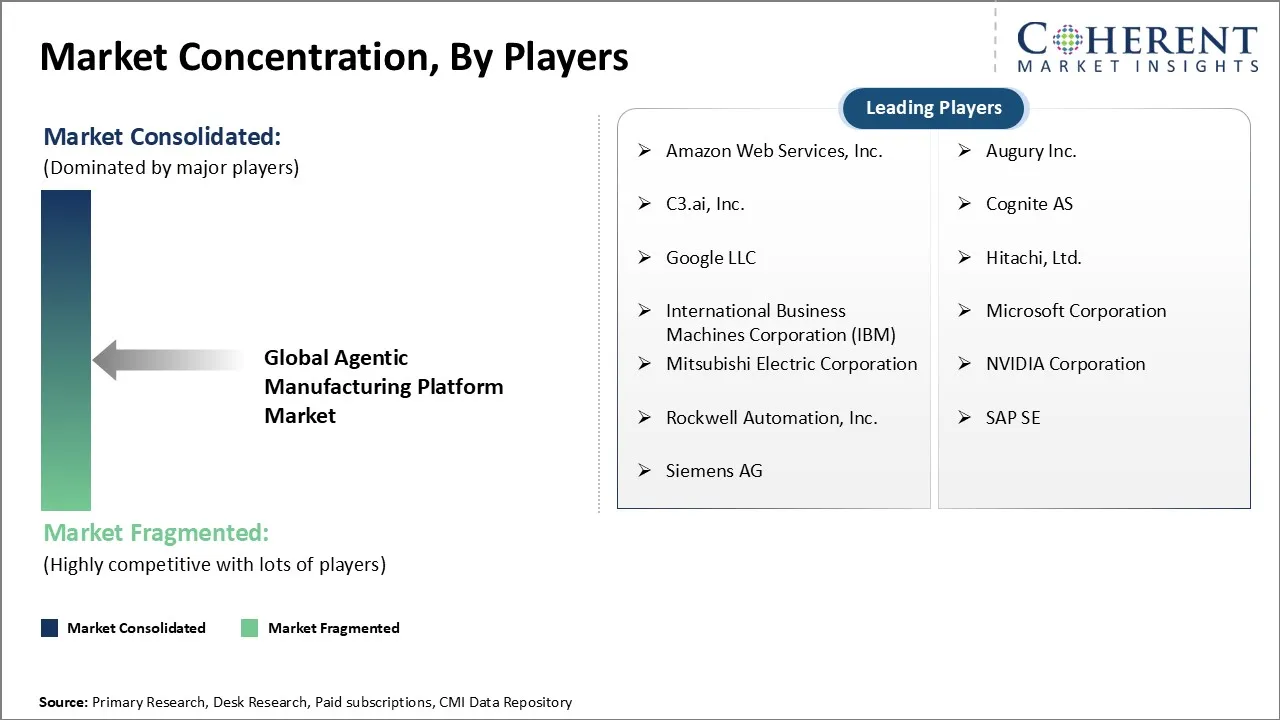
The market is moderately fragmented and shared between three groups that increasingly partner with each other. Cloud and enterprise AI providers such as Microsoft, Amazon Web Services, Google, IBM and NVIDIA supply the models, agent runtimes and orchestration tools. Industrial automation and software companies such as Siemens, Rockwell Automation, Hitachi, Mitsubishi Electric and SAP embed agents into the MES, ERP, PLC programming and asset tools manufacturers already run. Industrial AI specialists such as Cognite, C3.ai and Augury build domain agents on top of contextualized plant data. Competition centers on access to clean, contextual plant data, depth of manufacturing domain knowledge, safety and governance controls, and the ability to move customers from pilots to plant-wide use. Consolidation is under way, as automation majors buy industrial AI specialists to secure data platforms and agent tooling.
Top Companies and Notable Products in the Agentic Manufacturing Platform Market
Company | Notable Product | Key Features |
C3.ai, Inc. | C3 AI Agentic Platform | Platform for building and deploying enterprise AI agents and applications, including reliability and supply chain use cases |
International Business Machines Corporation (IBM) | IBM watsonx Orchestrate | Builds, deploys and manages AI agents that automate business workflows across enterprise systems |
Amazon Web Services, Inc. | Amazon Bedrock AgentCore | Managed services to run, secure and monitor AI agents at scale on AWS |
Google LLC | Gemini Enterprise | Platform for building and running AI agents connected to enterprise data and applications |
Market Report Scope
Global Agentic Manufacturing Platform Market Report Coverage | |||
Report Coverage | Details | ||
Base Year | 2025 | Market Size in 2026: | USD 9.20 Bn |
Historical Data For: | 2020 To 2024 | Forecast Period: | 2026 To 2033 |
Forecast Period 2026 To 2033 CAGR: | 29.50% | 2033 Value Projection: | USD 56.19 Bn |
Geographies covered: |
| ||
Segments covered: |
| ||
Companies covered: | Amazon Web Services, Inc., Augury Inc., C3.ai, Inc., Cognite AS, Google LLC, Hitachi, Ltd., International Business Machines Corporation (IBM), Microsoft Corporation, Mitsubishi Electric Corporation, NVIDIA Corporation, Rockwell Automation, Inc., SAP SE, Siemens AG | ||
Growth Drivers: |
| ||
Restraints & Challenges: |
| ||
Analyst Opinion (Expert Opinion)
- Platforms lead, but services are catching up as deployments scale. Platform (software) makes up 52.8% of spending in 2026, against 47.2% for services, and predictive maintenance holds 36.4% of application spending because it is the easiest place to prove value. That balance will shift as manufacturers move from single-use agents to agents that plan and coordinate across the plant. Production planning and scheduling is the fastest-growing application, at an estimated 32.8% CAGR (CMI estimate, based on the pace of agent launches inside cloud ERP and planning suites). Services will stay large because every plant needs data cleanup and integration before agents can act, so vendors offering the platform, plant connectors and deployment support together tend to win larger contracts.
- Growth follows data readiness, with two main risks. North America holds 41.8% of the market in 2026, while Asia Pacific, at 23.5%, grows fastest as large manufacturers there build agentic factories at scale. The first risk is integration: many plants run decades-old MES, ERP and control systems that agents cannot easily read or write to, which slows rollout beyond pilot lines. The second risk is trust: an agent that changes a machine setting or releases an order must be safe, traceable and secure, and EU rules on AI and machinery raise the bar from 2027. Vendors that log every agent action and keep a human approval step for high-impact decisions are the least exposed
Speak to the analyst
Want personalized insights?
Take the findings above to one of our principal consultants, or have the report rebuilt around the segments, geographies and competitors you actually track.
Market Segmentation
- Component Insights (Revenue, USD Billion, 2021 - 2033)
- Platform (Software)
- Services
- Deployment Mode Insights (Revenue, USD Billion, 2021 - 2033)
- Cloud
- On-Premises
- Hybrid
- Application Insights (Revenue, USD Billion, 2021 - 2033)
- Production Planning and Scheduling
- Predictive Maintenance
- Quality Inspection and Control
- Supply Chain and Procurement Management
- Energy Management
- Others
- Organization Size Insights (Revenue, USD Billion, 2021 - 2033)
- Large Enterprises
- Small and Medium-sized Enterprises (SMEs)
- End User Insights (Revenue, USD Billion, 2021 - 2033)
- Automotive
- Electronics and Semiconductors
- Aerospace and Defense
- Pharmaceuticals and Life Sciences
- Food and Beverages
- Chemicals
- Industrial Machinery and Equipment
- Others
- Regional Insights (Revenue, USD Billion, 2021 - 2033)
- North America
- U.S.
- Canada
- Latin America
- Brazil
- Argentina
- Mexico
- Rest of Latin America
- Europe
- Germany
- U.K.
- Spain
- France
- Italy
- Russia
- Rest of Europe
- Asia Pacific
- China
- India
- Japan
- Australia
- South Korea
- ASEAN
- Rest of Asia Pacific
- Middle East
- GCC Countries
- Israel
- Rest of Middle East
- Africa
- South Africa
- North Africa
- Central Africa
- North America
- Key Players Insights
- Amazon Web Services, Inc.
- Augury Inc.
- C3.ai, Inc.
- Cognite AS
- Google LLC
- Hitachi, Ltd.
- International Business Machines Corporation (IBM)
- Microsoft Corporation
- Mitsubishi Electric Corporation
- NVIDIA Corporation
- Rockwell Automation, Inc.
- SAP SE
- Siemens AG
Sources
Primary Research Interviews
- Manufacturing operations and plant heads
- Production planning and supply chain managers
- Maintenance and reliability engineers
- Industrial software and automation vendors
- Systems integrators and AI consultants
Magazines
- Automation World
- Control Engineering
- IndustryWeek
- Manufacturing Today
- IEEE Spectrum
Journals
- Journal of Manufacturing Systems
- IEEE Transactions on Industrial Informatics
- Robotics and Computer-Integrated Manufacturing
- International Journal of Production Research
Associations
- International Society of Automation (ISA)
- VDMA (German Mechanical Engineering Industry Association)
- Industrial Internet Consortium / Industry IoT Consortium
- International Federation of Robotics (IFR)
- MESA International
Public Domain Sources
- European Union: Regulation (EU) 2024/1689 (AI Act) and Regulation (EU) 2026/1744 (Digital Omnibus on AI)
- European Union: Regulation (EU) 2023/1230 on machinery
- ISO/IEC 42001:2023: Artificial intelligence management system
- IEC 62443: Industrial communication networks – security
- U.S. Securities and Exchange Commission (SEC): Company annual filings
- Company press releases
Proprietary Elements
- CMI Data Analytics Tool
- Proprietary CMI Existing Repository of information for last 10 years
Get access to 250+ pages report
Every segment, forecast, competitor profile and data table behind the analysis above — available for instant download.
- ESOMAR Member
- ISO 9001:2015 Certified
- D-U-N-S Registered
- GDPR & CCPA Compliant
Frequently Asked Questions
The global agentic manufacturing platform market is estimated to be valued at USD 9.20 Bn in 2026 and is expected to reach USD 56.19 Bn by 2033.
The CAGR of the global agentic manufacturing platform market is projected to be 29.5% from 2026 to 2033.
Growing shortage of skilled factory workers pushing manufacturers toward autonomous decision-making on the shop floor, and need to reduce unplanned downtime and respond faster to supply chain disruptions, are the major factors driving market growth.
Difficulty integrating AI agents with legacy MES, ERP and OT systems in older plants, and safety, accountability and cybersecurity concerns over AI agents acting directly on production systems, are the major factors hampering market growth.
In terms of component, the platform (software) segment is estimated to dominate the market, with a revenue share of 52.8% in 2026.
It is software that lets AI agents plan, decide and act on manufacturing systems, such as MES, ERP, maintenance and planning tools, toward a set goal. Unlike a dashboard or chatbot, an agent can carry out the next step itself or hand it to a person for approval.
RPA follows fixed, pre-scripted steps. A copilot answers questions or drafts content when a user asks. An agent works toward a goal, chooses its own steps, calls tools and other agents, and can act without a prompt for each step, usually within set limits and with human sign-off for high-impact actions.