

Global AI Agent Governance and Control Plane Market Size and Forecast – 2026 To 2033
The global AI agent governance and control plane market is expected to grow from USD 0.79 Bn in 2026 to USD 10.09 Bn by 2033, at a compound annual growth rate (CAGR) of 43.9% over 2026–2033. An AI agent control plane is the software layer that sits above an organization's AI agents and keeps track of what each agent is, what it is allowed to reach, and what it actually did. It keeps an inventory of agents, gives each one its own identity, checks policy at the moment an agent calls a tool, an application or another agent, and stores an audit trail of those actions. Demand for these controls rises with adoption across the broader agentic AI market. The market also shares buyers and regulatory drivers with the AI governance market, although its focus is on autonomous agents that take actions rather than on individual models.
Vendors spent 2026 turning agent oversight into licensed products. On 15 June 2026, Omada announced Omada Agent Governance, which brings identity governance practices such as accountability and access reviews to AI agents across cloud environments. On 1 May 2026, Microsoft made Agent 365 generally available as a control plane for observing, governing and securing agents, priced at USD 15 per user per month as a standalone license. On 16 March 2026, Okta announced its blueprint for the secure agentic enterprise, citing research in which 88% of organizations reported suspected or confirmed AI agent security incidents while only 22% treated agents as independent, identity-bearing entities.
Key Takeaways of the Global AI Agent Governance and Control Plane Market
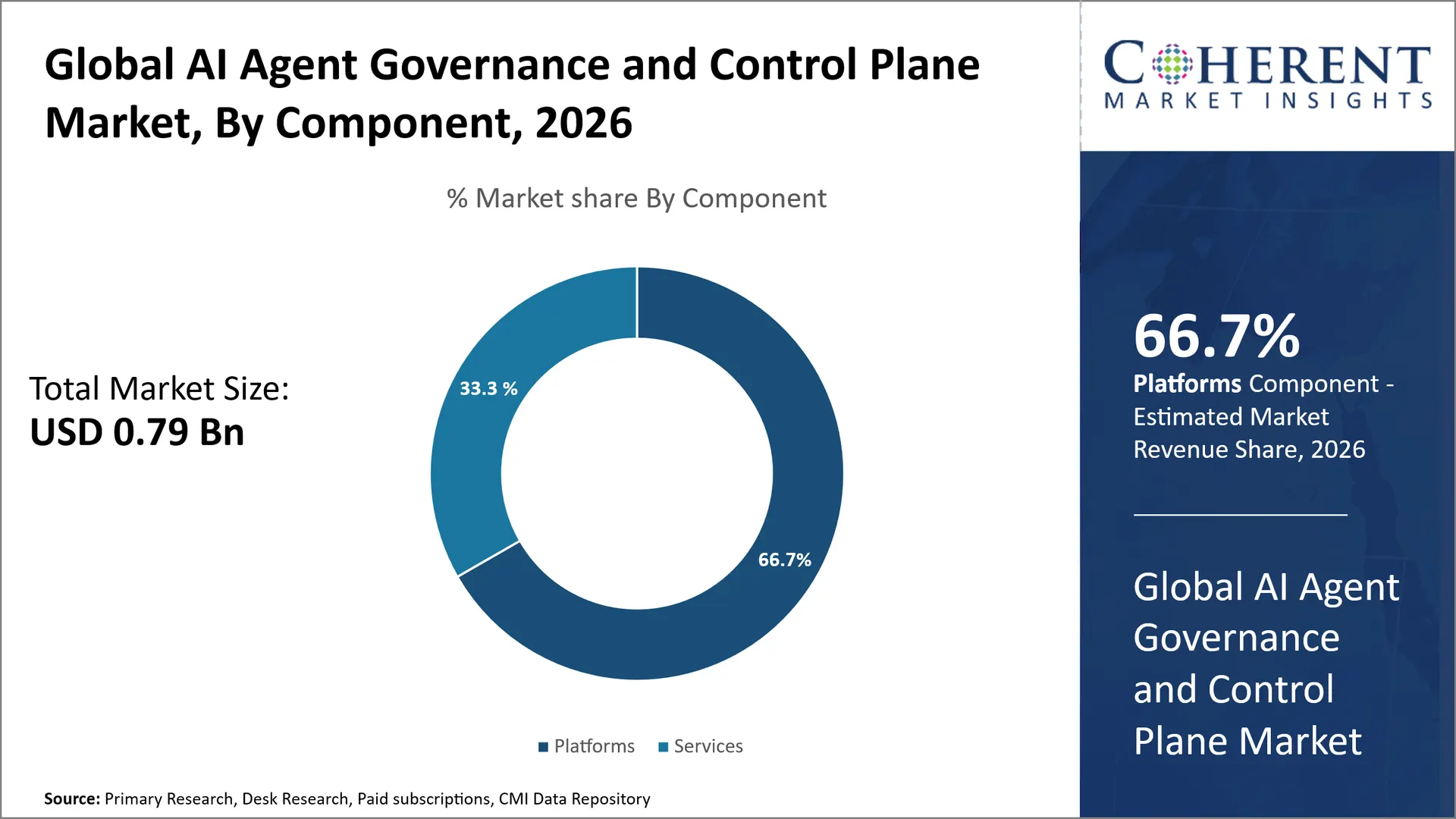
- The platforms segment is expected to account for 66.7% of the global AI agent governance and control plane market share in 2026. Platforms hold the agent inventory, policy engine and audit records, so most first-year budgets go to them. On 22 April 2026, Google Cloud announced the Gemini Enterprise Agent Platform with Agent Identity, Agent Registry and Agent Gateway built in, so that every agent on the platform or from partners carries a trackable identity.
- The policy management and compliance segment is expected to hold 27.7% of the function segment in 2026. Companies need written, versioned rules for agents before they can show regulators or auditors that the agents behave as intended. On 2 September 2026, Genesys announced its AI Control Plane, describing it as the operating layer for enterprise AI that keeps agent decisions and actions within defined business boundaries.
- The cloud segment is expected to account for 66.9% of the deployment segment in 2026. Agents mostly call SaaS applications and hosted models, so cloud-delivered controls can sit directly in that traffic. On 22 September 2026, Okta announced Agent Gateway for Okta for AI Agents, which sits between an agent and its tool calls to apply policy and log each interaction at runtime.
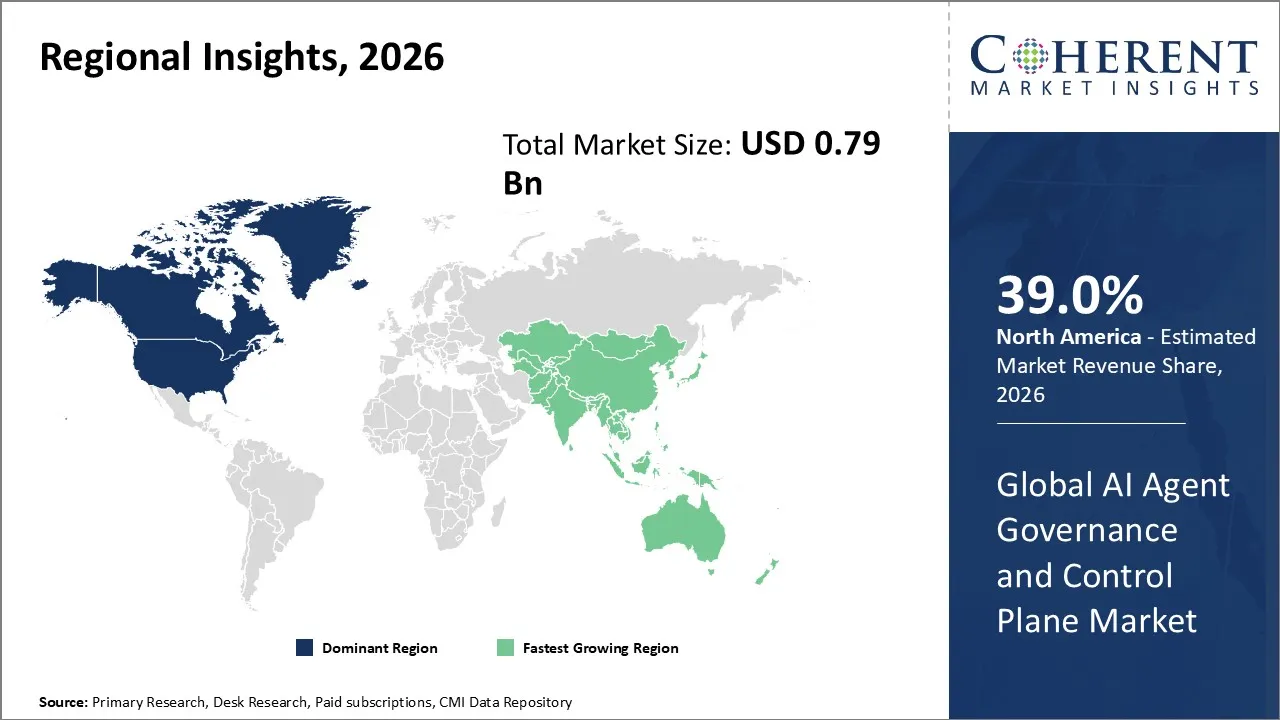
- North America is expected to dominate the global AI agent governance and control plane market in 2026, with a share of 39.0%. The region is home to most platform, identity and gateway vendors, as well as the largest early adopters of production agents. On 27 October 2026, IBM announced that IBM Agent Identity and HashiCorp Vault work alongside watsonx Orchestrate to help enterprises set up governed agent identities and manage agent access to business systems.
- Asia Pacific is expected to account for 21.5% share in 2026 and to be the fastest-growing region. Governments in the region are publishing agent-specific guidance early, which gives buyers a clear checklist to purchase against. On 22 January 2026, Singapore's Infocomm Media Development Authority (IMDA) launched the Model AI Governance Framework for Agentic AI at the World Economic Forum in Davos, describing it as the first governance framework written specifically for AI agents
Segmental Insights
Why Do Platforms Dominate the Global AI Agent Governance and Control Plane Market?
In terms of component, the platforms segment is expected to account for 66.7% of the global AI agent governance and control plane market share in 2026. A governance platform brings together an agent registry, a policy engine, identity brokering and an audit store in one product that runs all the time. Each new agent that reaches production has to be registered, assigned permissions and monitored, so platform spending rises in step with the number of agents a company runs. Vendors are also moving to per-user and per-agent subscriptions, which turns agent oversight into a recurring budget line rather than a project cost.
Platform vendors are now borrowing hardware-backed security to make their controls harder to bypass. On 22 June 2026, Anjuna announced the availability of a trusted control plane built on confidential computing, designed to manage risk, control usage and secure autonomous AI software.
- Current Industry Events of 2026
- Market Size Estimation
- Regional Breakdown
- Competitive Landscape
- Customer Intelligence
- Segmental Analysis
- Pricing Analysis
- Key Market Drivers, Challenges & Future Trends
- Customized Insights Section
Why Does Policy Management and Compliance Lead the Function Segment?
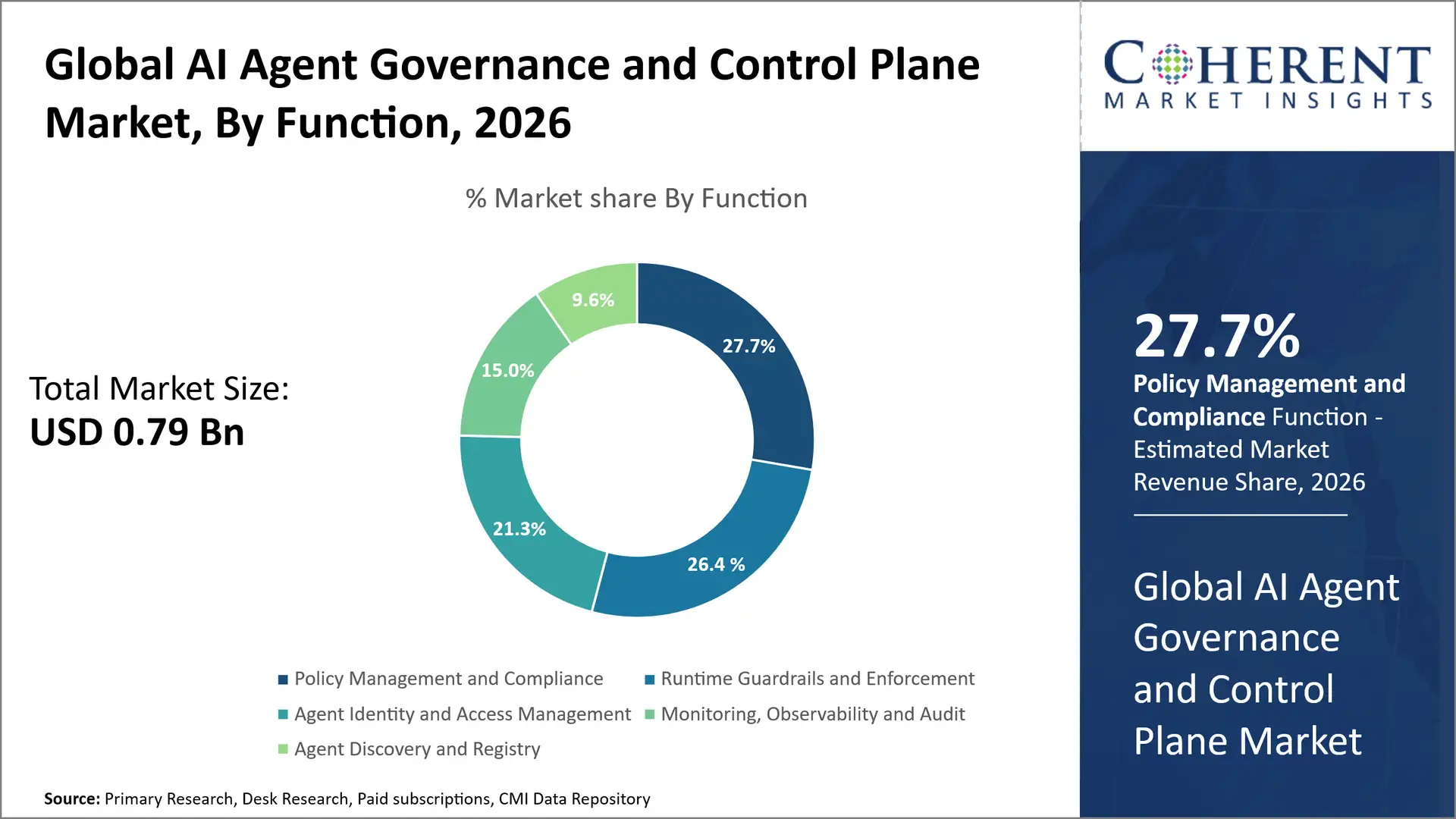
In terms of function, the policy management and compliance segment is expected to account for 27.7% of the global AI agent governance and control plane market share in 2026. This function covers writing the rules that set what each agent may do, mapping those rules to laws and internal standards, and producing the evidence that auditors and regulators ask for. It is usually the first purchase in an agent governance program, since a company cannot prove compliance without a documented and versioned rule set. Demand is strongest in regulated industries, where every automated decision may later need to be explained.
Vendors are making these tools easier to buy through existing cloud contracts. On 8 June 2026, Ares Networks announced that its Agent Governance Platform, which governs what AI agents are permitted to do, is available in the Microsoft Marketplace for Azure customers.
Why Does Cloud Lead the Deployment Segment?
In terms of deployment mode, the cloud segment is expected to account for 66.9% of the global AI agent governance and control plane market share in 2026. Most enterprise agents run on hosted models and call SaaS applications, so a cloud-delivered control plane can sit directly in the path of that traffic. Cloud delivery also lets vendors add support for new models, agent frameworks and communication protocols within days, without customers installing new software. Buyers can start with a small group of agents and expand coverage without new hardware.
Cloud-native infrastructure vendors are building agent controls into the platforms that already run containers. On 17 June 2026, Tigera announced the general availability of Tigera Lynx, a unified control plane for Kubernetes-native AI agents.
Current Events and their Impact
Current Events | Description and its Impact |
EU Digital Omnibus on AI, Regulation (EU) 2026/1744 (in force from 27 July 2026) |
|
Five Eyes joint guidance, Careful Adoption of Agentic AI Services (1 May 2026) |
|
AI Agent Governance and Control Plane Market Dynamics
Market Drivers
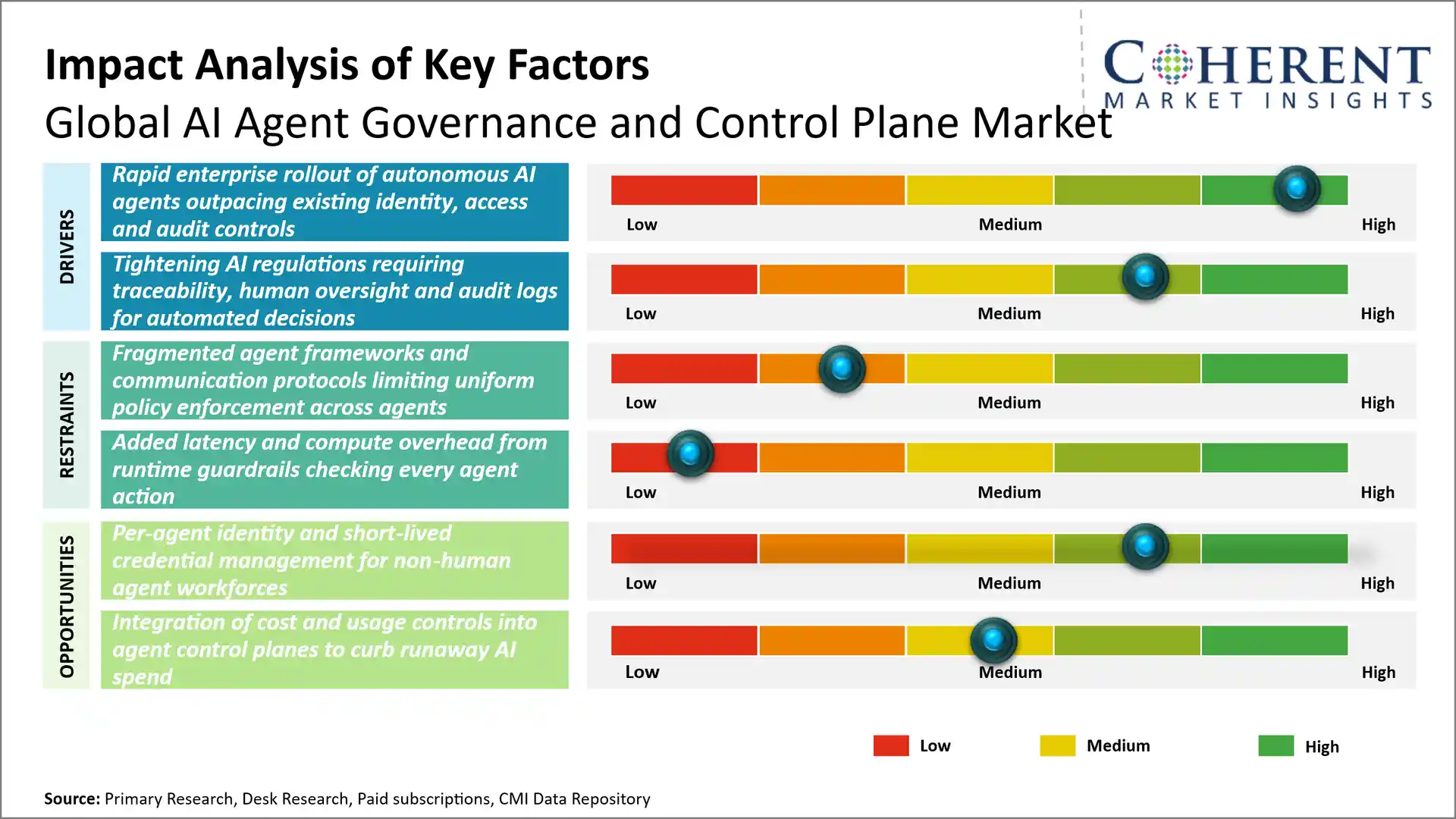
- Rapid enterprise rollout of autonomous AI agents outpacing existing identity, access and audit controls: Enterprises are moving agents from pilots into daily work, where they read data, call APIs and act for employees. Identity and access systems were designed around people and fixed applications, so many agents end up running on shared service accounts with broad permissions and little logging. Each new agent widens this gap and pushes security teams to buy controls built for agents.
- On 14 April 2026, Kong announced Agent Gateway as part of its AI Gateway 3.14 release, extending governance to agent-to-agent (A2A) traffic alongside LLM and MCP traffic. The company reported that enterprises no longer send prompts to a single model but run systems in which agents call tools through MCP and hand tasks to other agents, creating traffic that existing gateways and access controls were not built to govern.
- Tightening AI regulations requiring traceability, human oversight and audit logs for automated decisions: Regulators are making it clear that existing laws apply to the actions agents take, and that the deploying business stays accountable. This turns agent logs, approval checkpoints and policy records from good practice into evidence that companies must be able to produce.
- On 9 March 2026, the UK Competition and Markets Authority (CMA) published guidance on complying with consumer law when using AI agents, stating that businesses remain responsible for their AI agents even when a third party designed or supplied them.
Emerging Trends
- Identity security vendors are extending real-time access enforcement to AI agents: Identity and access management providers are treating agents as a new class of identity and adding controls that act while an agent is working, not only at login. On 9 June 2026, Linx Security announced the general availability of Linx Agentic Access Control, a real-time enforcement layer that gives security and identity teams control over what AI agents can access.
Impact: Agent access decisions are expected to move into the same tools that already govern employee and service accounts, which shortens deployment for existing identity customers.
Relevance to the market: Identity vendors are likely to win a growing share of agent governance budgets, raising competition for standalone governance specialists.
- Deterministic enforcement engines are replacing prompt-based guardrails: Instructions written into prompts can be ignored or overridden by a model, so vendors are adding rule engines that approve or block each agent action before it runs. On 10 June 2026, LangGuard announced the general availability of LangGuard Arbiter at the Databricks Data and AI Summit, an engine for deterministic enforcement of agent actions.
Impact: Runtime controls are expected to become more predictable and easier to audit, since the same input always produces the same allow-or-block decision.
Relevance to the market: Buyers in regulated sectors are likely to favor platforms that can prove consistent enforcement, which raises the bar for products that rely only on model-based filtering
Regional Insights
Why Does North America Lead the Global AI Agent Governance and Control Plane Market?
North America is expected to account for a market share of 39.0% in 2026, worth about USD 0.31 Bn. Supply is heavily concentrated in the region: 13 of the 14 key players profiled in this report are headquartered in the U.S. The region also has the largest base of enterprises running agents in production, together with active federal work on agent security standards. Large financial institutions and healthcare groups are among the earliest buyers, since they face audit demands for every automated decision.
Why Is Asia Pacific the Fastest-Growing Region in the AI Agent Governance and Control Plane Market?
Asia Pacific is expected to account for 21.5% of the global market in 2026, worth about USD 0.17 Bn, and to register the fastest growth over the forecast period. Governments across the region are writing agent-specific guidance early and are deploying agents in public services, which creates both rules and demand at the same time. On 4 June 2026, Australia's Digital Transformation Agency published an agentic AI addendum to its AI technical standard, setting expectations for how government agencies manage and operate AI agents while keeping human oversight and control.
Global AI Agent Governance and Control Plane Market Outlook for Key Countries
Is the U.S. Setting the Standards for Agent Governance in North America?
The U.S. is the largest single market for agent governance and control plane tools. Federal standards work is giving buyers a common reference for agent identity and security. On 17 February 2026, the Center for AI Standards and Innovation (CAISI) at the National Institute of Standards and Technology (NIST) announced the AI Agent Standards Initiative, focused on standards for the security, interoperability and identity of AI agents.
U.K. AI Agent Governance and Control Plane Market Analysis and Trends
U.K. regulators are coordinating their approach to agents across consumer, competition, data and communications rules. On 30 October 2026, members of the Digital Regulation Cooperation Forum (DRCF) published a joint statement on protecting people and businesses in an agentic AI economy, giving companies a single view of how existing U.K. rules apply to AI agents.
Germany AI Agent Governance and Control Plane Market Analysis and Trends
Germany is building formal audit methods for AI systems, which supports demand for controls that produce verifiable evidence. On 6 July 2026, the Federal Office for Information Security (BSI) published the community draft of its AI Audit and Assurance Assessment Architecture (A5), a framework for assessing trustworthy AI systems, with public comments open until 31 August 2026. The BSI also ran a tender in June 2026 for test requirements for LLM-based agentic AI.
Japan AI Agent Governance and Control Plane Market Analysis and Trends
Japan relies on soft-law guidance, and that guidance now names AI agents directly. On 31 March 2026, the Ministry of Economy, Trade and Industry (METI) and the Ministry of Internal Affairs and Communications (MIC) published version 1.2 of the AI Guidelines for Business, which for the first time brought AI agents explicitly into scope and set human-in-the-loop expectations for agents that take external actions.
India AI Agent Governance and Control Plane Market Analysis and Trends
India's large IT services sector builds and runs agents for clients worldwide, which makes governance capability a selling point for service providers. On 5 November 2025, the Ministry of Electronics and Information Technology (MeitY) released the India AI Governance Guidelines under the IndiaAI Mission, which noted the need for targeted changes to existing laws to address agentic AI and autonomous systems.
Global AI Agent Governance and Control Plane Market – Open Protocols and Where Control Planes Apply Governance
Protocol / Standard | Introduced by | What It Connects | Governance Control Point |
Model Context Protocol (MCP) | Anthropic | Agents to tools, data sources and applications | Registering approved MCP servers and limiting which tools each agent can call |
Agent2Agent (A2A) Protocol | Agents to other agents, including agents from other vendors | Verifying the calling agent and checking which tasks it may hand off | |
OAuth 2.0 | IETF | Agents to APIs on behalf of users or services | Issuing scoped, expiring tokens and revoking access |
OpenTelemetry | Cloud Native Computing Foundation (CNCF) | Agent actions to monitoring and logging tools | Recording traces of each agent step for audit and troubleshooting |
Global AI Agent Governance and Control Plane Market – Comparison of Credential Types Used by AI Agents
Credential Type | Typical Lifetime | How Access Is Removed | Governance Risk |
Static API key | Months, or no expiry | Manual rotation or deletion | High: a leaked key keeps working until someone finds and deletes it |
Shared service account | Long-lived password or secret | Password change, which affects every agent using the account | High: actions cannot be traced to a single agent |
OAuth access token | Minutes to hours | Expires on its own, or the token is revoked | Medium: limited by scope and expiry, but depends on how the token is issued |
Workload identity certificate | Short-lived and rotated automatically | Certificate is not renewed | Low: each agent proves its own identity, and access ends quickly if the agent is removed |
How Is Per-agent Identity and Short-lived Credential Management for Non-human Agent Workforces Creating New Growth Opportunities in the AI Agent Governance and Control Plane Market?
Many agents still run on shared service accounts or long-lived API keys, which makes it hard to tell which agent took an action and easy for a stolen key to be misused. Giving each agent its own identity, with credentials that expire within minutes or hours, closes both gaps and creates a new product category: identity issuance, credential rotation and attestation built for software that acts on its own. Vendors that can issue and verify agent identities across clouds, agent frameworks and partner systems are best placed, since agents increasingly hand work to agents run by other companies.
On 23 June 2026, OPAQUE announced OPAQUE 3.0 at the Confidential Computing Summit and released Agent Manifest, an open standard for verifiable AI agents, with general availability of the platform planned for July 2026.
Market Players, Key Development, and Competitive Landscape
Key Developments
- On 2 July 2026, IBM introduced the Agentic Control Plane in watsonx Orchestrate on AWS and IBM Cloud, a central place to operate, govern and scale AI agents across an enterprise.
- On 17 June 2026, Securden announced its AI Agent Security and Governance Platform, which combines AI agent governance with identity governance, privileged access management and credential security in a single platform.
- On 2 February 2026, Kong introduced MCP Registry in Kong Konnect, which lets enterprises centrally register and govern the MCP servers that AI agents use to find approved tools.
Competitive Landscape
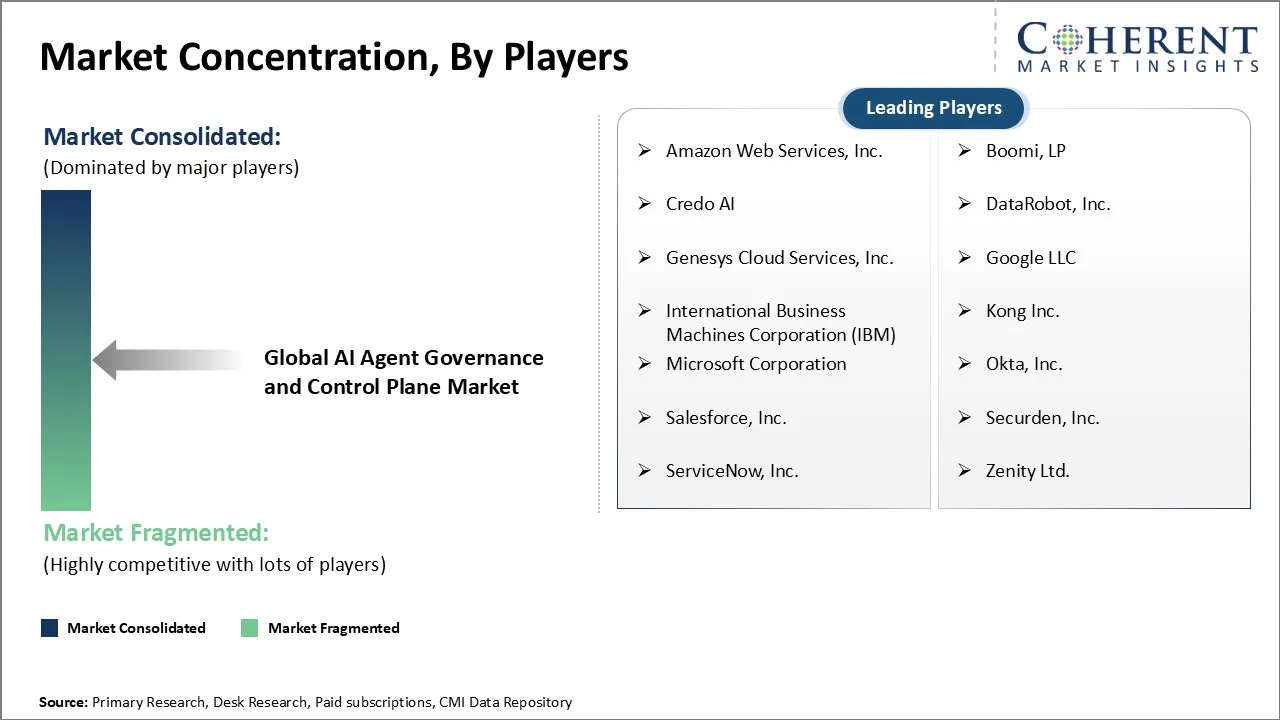
The market is moderately concentrated, with large platform vendors setting the pace and specialists competing on depth. Hyperscalers and enterprise software vendors such as Microsoft, Google, Amazon Web Services, Salesforce, ServiceNow and IBM build governance into the platforms where agents are created and run. Identity vendors such as Okta and Securden treat agents as a new type of identity, while API and integration vendors such as Kong and Boomi place controls in the traffic between agents, tools and data. Specialists such as Credo AI, Zenity and DataRobot focus on policy, risk and security for agents, and Genesys applies the same controls to customer service agents. Competition centers on how many agent platforms a product can govern beyond its own, the speed of runtime enforcement, support for open protocols such as MCP and A2A, and pricing that scales with agent counts. Partnerships between platform and identity vendors are common, since few buyers want a separate control layer for each agent platform.
Market Report Scope
Global AI Agent Governance and Control Plane Market Report Coverage | |||
Report Coverage | Details | ||
Base Year | 2025 | Market Size in 2026: | USD 0.79 Bn |
Historical Data For: | 2020 To 2024 | Forecast Period: | 2026 To 2033 |
Forecast Period 2026 To 2033 CAGR: | 43.90% | 2033 Value Projection: | USD 10.09 Bn |
Geographies covered: |
| ||
Segments covered: |
| ||
Companies covered: | Amazon Web Services, Inc., Boomi, LP, Credo AI, DataRobot, Inc., Genesys Cloud Services, Inc., Google LLC, International Business Machines Corporation (IBM), Kong Inc., Microsoft Corporation, Okta, Inc., Salesforce, Inc., Securden, Inc., ServiceNow, Inc., Zenity Ltd. | ||
Growth Drivers: |
| ||
Restraints & Challenges: |
| ||
Analyst Opinion (Expert Opinion)
- Platforms lead, but services and hybrid deployments are where buyers struggle most. Platforms account for 66.7% of spending in 2026, against 33.3% for services, as many enterprises need outside help to inventory their agents and write policies for them. Cloud holds 66.9% of deployments, while hybrid deployments are expected to grow fastest as banks, insurers and public agencies keep sensitive agent traffic inside their own networks. Policy management and compliance leads functions at 27.7%, but the sharpest competition is in runtime enforcement, where identity, gateway and platform vendors now overlap.
- Adoption depends on interoperability and performance. North America holds 39.0% of the market in 2026, while Asia Pacific, at 21.5%, grows fastest on the back of early, agent-specific government guidance. The first risk is fragmentation: agents built on different frameworks and protocols are hard to govern with a single policy set, which slows enterprise-wide rollouts. The second is performance: checks on every agent action add latency and compute cost. Vendors that govern agents across several platforms and keep enforcement fast are best placed to win large contracts.
Speak to the analyst
Want personalized insights?
Take the findings above to one of our principal consultants, or have the report rebuilt around the segments, geographies and competitors you actually track.
Market Segmentation
- Component Insights (Revenue, USD Billion, 2021 - 2033)
- Platforms
- Services
- Function Insights (Revenue, USD Billion, 2021 - 2033)
- Agent Discovery and Registry
- Agent Identity and Access Management
- Policy Management and Compliance
- Runtime Guardrails and Enforcement
- Monitoring, Observability and Audit
- Deployment Mode Insights (Revenue, USD Billion, 2021 - 2033)
- Cloud
- On-premises
- Hybrid
- Organization Size Insights (Revenue, USD Billion, 2021 - 2033)
- Large Enterprises
- Small and Medium-sized Enterprises (SMEs)
- End User Insights (Revenue, USD Billion, 2021 - 2033)
- Banking, Financial Services and Insurance (BFSI)
- Healthcare and Life Sciences
- IT and Telecommunications
- Retail and E-commerce
- Government and Public Sector
- Manufacturing
- Others (Energy and Utilities, Media and Entertainment, Education)
- Regional Insights (Revenue, USD Billion, 2021 - 2033)
- North America
- U.S.
- Canada
- Latin America
- Brazil
- Argentina
- Mexico
- Rest of Latin America
- Europe
- Germany
- U.K.
- Spain
- France
- Italy
- Russia
- Rest of Europe
- Asia Pacific
- China
- India
- Japan
- Australia
- South Korea
- ASEAN
- Rest of Asia Pacific
- Middle East
- GCC Countries
- Israel
- Rest of Middle East
- Africa
- South Africa
- North Africa
- Central Africa
- North America
Key Players Insights
- Amazon Web Services, Inc.
- Boomi, LP
- Credo AI
- DataRobot, Inc.
- Genesys Cloud Services, Inc.
- Google LLC
- International Business Machines Corporation (IBM)
- Kong Inc.
- Microsoft Corporation
- Okta, Inc.
- Salesforce, Inc.
- Securden, Inc.
- ServiceNow, Inc.
- Zenity Ltd.
Sources
Primary Research Interviews
- Chief information security officers and identity and access management heads
- Enterprise AI platform and MLOps leads
- Risk, compliance and internal audit managers
- Product managers at agent governance, identity and API gateway vendors
- AI governance consultants and system integrators
Magazines
- CSO Online
- Dark Reading
- InformationWeek
- Computer Weekly
- IEEE Spectrum
Journals
- IEEE Transactions on Dependable and Secure Computing
- ACM Computing Surveys
- Journal of Artificial Intelligence Research
- AI and Ethics
Associations
- Cloud Security Alliance (CSA)
- OWASP Foundation
- Linux Foundation
- IEEE Computer Society
- International Association of Privacy Professionals (IAPP)
Public Domain Sources
- Regulation (EU) 2026/1744 (Digital Omnibus on AI), Official Journal of the European Union
- CISA, NSA, ASD's ACSC, CCCS, NCSC-NZ and NCSC-UK: Careful Adoption of Agentic AI Services (May 2026)
- NIST CAISI: AI Agent Standards Initiative (February 2026)
- IMDA Singapore: Model AI Governance Framework for Agentic AI (January 2026)
- METI and MIC Japan: AI Guidelines for Business, Version 1.2 (March 2026)
- BSI Germany: AI Audit and Assurance Assessment Architecture (A5), community draft (July 2026)
- MeitY India: India AI Governance Guidelines (November 2025)
- UK CMA: Complying with consumer law when using AI agents (March 2026)
- Gartner press releases on securing-AI and AI spending forecasts (August and September 2026)
- Company press releases
Proprietary Elements
- CMI Data Analytics Tool
- Proprietary CMI Existing Repository of information for last 10 years
Get access to 250+ pages report
Every segment, forecast, competitor profile and data table behind the analysis above — available for instant download.
- ESOMAR Member
- ISO 9001:2015 Certified
- D-U-N-S Registered
- GDPR & CCPA Compliant
Frequently Asked Questions
The global AI agent governance and control plane market is estimated to be valued at USD 0.79 Bn in 2026 and is expected to reach USD 10.09 Bn by 2033.
The CAGR of the global AI agent governance and control plane market is projected to be 43.9% from 2026 to 2033.
Rapid enterprise rollout of autonomous AI agents outpacing existing identity, access and audit controls, and tightening AI regulations requiring traceability, human oversight and audit logs for automated decisions, are the major factors driving market growth.
Fragmented agent frameworks and communication protocols limiting uniform policy enforcement across agents, and added latency and compute overhead from runtime guardrails checking every agent action, are the major factors hampering market growth.
In terms of component, the platforms segment is estimated to dominate the market, with a revenue share of 66.7% in 2026.
An AI agent control plane is a central software layer that registers an organization's AI agents, gives each agent an identity, sets and enforces what each agent may access or do, and records the actions agents take.
Model governance checks how a model is built, tested and documented. Agent governance controls what a running agent does: which tools, data and other agents it can reach, which actions need human approval, and how each action is logged.