

Global AI Agent Identity & Runtime Authorization Platforms Market Size and Forecast – 2026 To 2033
The Global AI Agent Identity & Runtime Authorization Platforms Market is estimated to be valued at USD 385.4 Mn in 2026 and is expected to reach USD 3,544.9 Mn by 2033, registering a CAGR of 37.30% during 2026–2033. The market growth is driven by the increasing adoption of autonomous AI agents in enterprise workflows, driving demands for secure agent authentication, delegated access management and real-time authorization.
Organizations are increasingly adopting security solutions to prevent unauthorized system access, enforce agent permissions, and maintain accountability for automated operations. In October 2026, IBM announced the general availability of IBM Agent Identity, integrating agent registration, delegated authorization, runtime policy enforcement, and identity governance. This development highlights the growing commercialization of purpose-built identity security infrastructure for enterprise AI agents.
Key Takeaways of the Global AI Agent Identity & Runtime Authorization Platforms Market
- Software and Platforms will grow at a CAGR of 38.5% till 2033 and will be 76.8% of the market by 2026. Enterprises want integrated agent registries, lifecycle controls and permission management instead of fragmented security services because reusable software scales across applications. Entra Agent ID (Public Preview) Launched by Microsoft in May 2025 to secure and manage AI-agent identities.
- Runtime authorization and policy enforcement is expected to witness a CAGR of 40.2% through 2033 and hold 31.6% share of the market in 2026. Agents execute tools. Not only is the agent authenticated, but permissions are checked. This prevents unauthorized actions. AWS introduced the AgentCore Policy in preview in December 2025, enabling real-time interception and evaluation of agent tool calls.
- Attribution & Policy-Based Access Control is anticipated to grow at an estimated CAGR of 39.6% up to 2033 and will account for 38.4% of the market in 2026. Static user roles don’t provide enough insight into data sensitivity, operating context or delegated authority. In February 2026, Cerbos announced an integration with Tailscale Aperture to allow fine-grained authorization of AI-agent tool calls with contextual policies.
- North America is expected to record an estimated CAGR of 35.0% through 2033, accounting for 42.5% share of global revenue in 2026. Its leadership is a reflection of a mature enterprise identity security ecosystem and commercially available agent governance solutions. Okta for AI Agents, providing agent registration, scoped access, and centralized identity governance, was announced as generally available in April 2026 by US-based Okta.
- Europe is projected to register the fastest regional CAGR of 41.5% during 2026-2033, accounting for 26.3% share of the market in 2026. European companies’ focus on auditable identity controls creates opportunities for home-grown authorization platforms. In October 2026, a Berlin-based company called Cygrid launched an identity-enforcement platform to govern human, machine and AI-agent actions in enterprise environments.
Segmental Insights
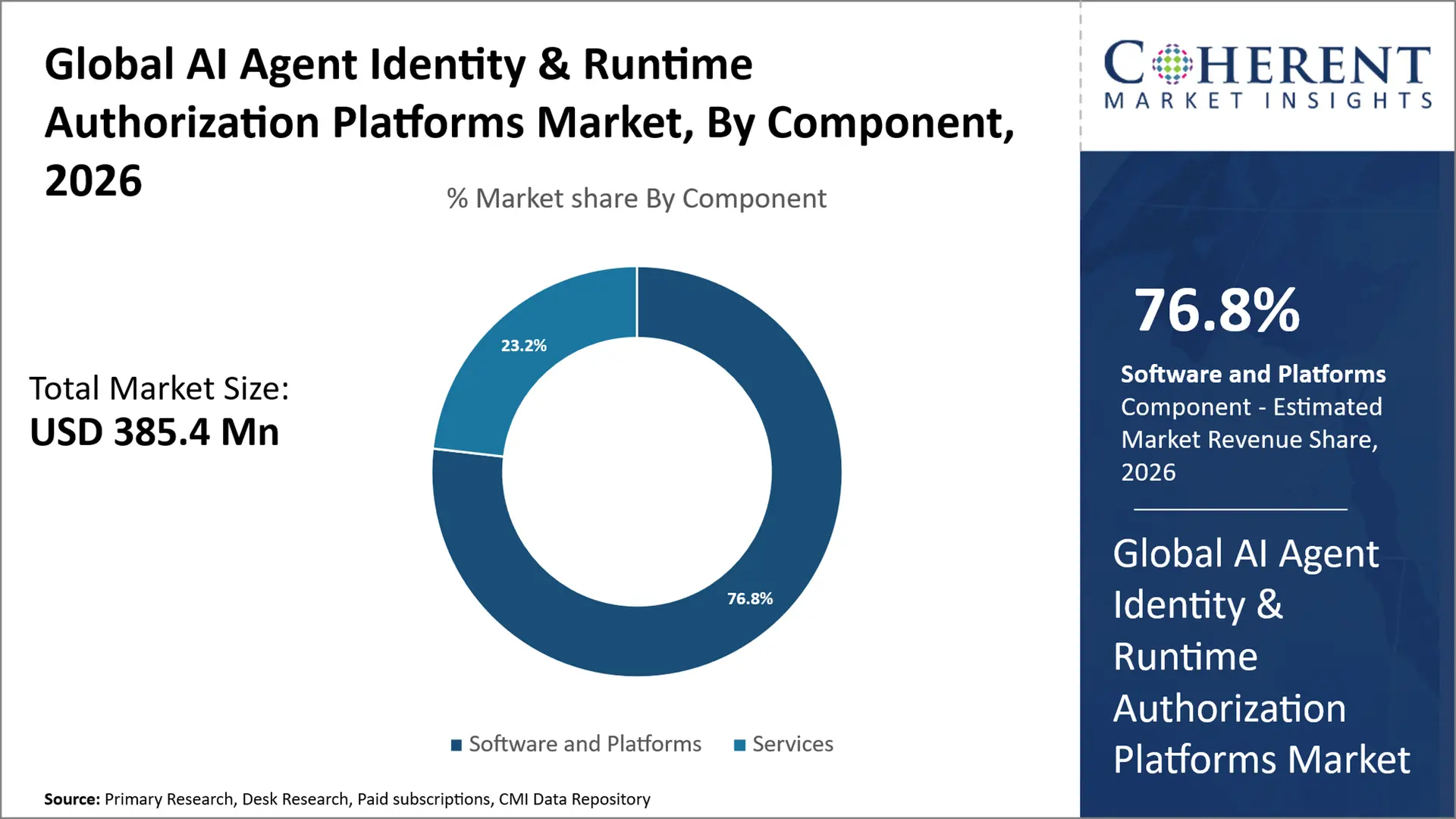
Why Do Software and Platforms Dominate the Global AI Agent Identity & Runtime Authorization Platforms Market?
Software and Platforms is expected to account for 76.8% of the market in 2026, leading the component category because enterprises increasingly purchase a persistent security control layer rather than commission separate implementations for each agent. The commercial benefits are shared management, out-of-the-box integration connectors, and repeatable onboarding for both in-house and third-party agents. These capabilities are especially useful to large financial institutions and IT service providers managing agents across heterogeneous operating environments. For vendors, platform licensing offers a way to expand from identity discovery to lifecycle oversight and enterprise governance, while reducing the integration burden for buyers. In March 2026, Saviynt launched Identity Security for AI, which introduced agent discovery, ownership management, identity posture monitoring and authorization capabilities into its enterprise platform. The development shows how bundled functionality is becoming a defined software offering.
- Current Industry Events of 2026
- Market Size Estimation
- Regional Breakdown
- Competitive Landscape
- Customer Intelligence
- Segmental Analysis
- Pricing Analysis
- Key Market Drivers, Challenges & Future Trends
- Customized Insights Section
Why Do Runtime Authorization and Policy Enforcement Lead the Function Segment in the Global AI Agent Identity & Runtime Authorization Platforms Market?
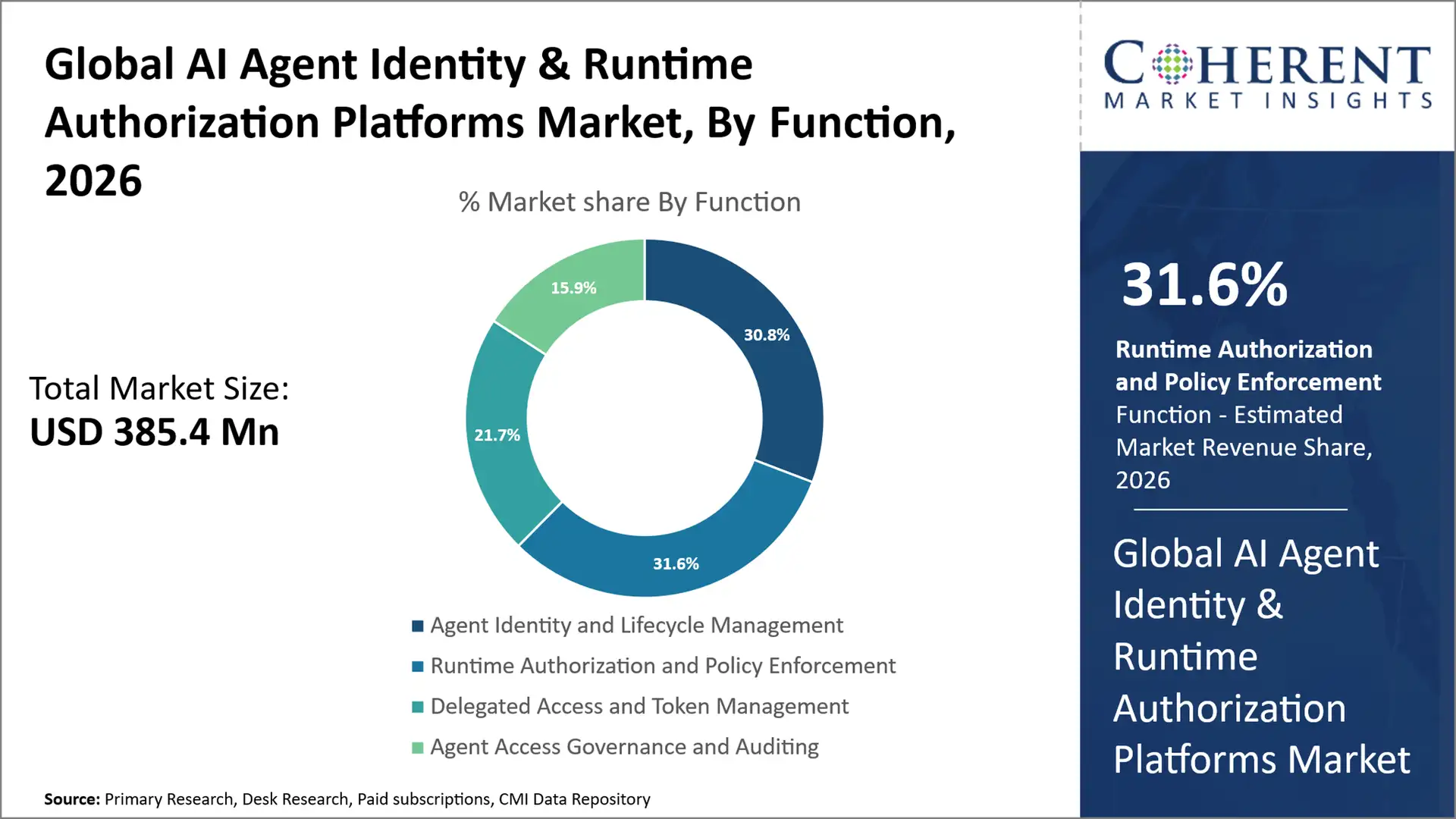
Runtime Authorization and Policy Enforcement is expected to secure 31.6% of the market's function category in 2026 as enterprises seek control over the exact operations an agent performs after authentication. A valid sign-in does not suffice to determine the acceptability of a proposed database query, payment instruction or tool parameter. Runtime enforcement does this by checking each action against the allowed operations before it is actually performed. It is particularly useful in processing financial transactions and in autonomous management of IT systems. An instruction with wrong authorization can immediately affect assets or systems. Gateway compatibility, parameter level restrictions and enforcement allow suppliers to differentiate without modifying the existing application code. PlainID announces AI-Ready Gateway Enforcement to be available in October 2026, extending its authorization controls to API, AI and Model Context Protocol gateways for data exposure, allowed parameters and tool operations.
Why Does Attribute and Policy-Based Access Control Dominate the Authorization Model Segment in the Global AI Agent Identity & Runtime Authorization Platforms Market?
Attribute and Policy-Based Access Control will take 38.4% of the authorization model category in 2026, highlighting the need to define permissions based on business conditions rather than strict job titles. Policies can check the requesting agent, the sensitivity of the resource, the value of the transaction, and the approved purpose before granting access. This matters for multitenant enterprise software and regulated information workflows where the same agent may serve customers with different data entitlements. Vendors benefit from the ability to update common rules centrally in the security team, without having to rebuild each application. This supports faster policy maintenance as workflows change. March 2026, Permit.io releases MCP Gateway, a product that combines granular authorization, delegated identity, consent, and reusable policy controls for AI-agent tool access. The announcement shows a way to propagate policy decisions to agent interfaces and underlying business services.
Current Events and their Impact
Current Event | Description and Its Impact |
January 2025 – EU Digital Operational Resilience Act (DORA) Becomes Applicable |
|
NIST AI Agent Identity and Authorization Initiative, February 2026 |
|
Global AI Agent Identity & Runtime Authorization Platforms Market Dynamics
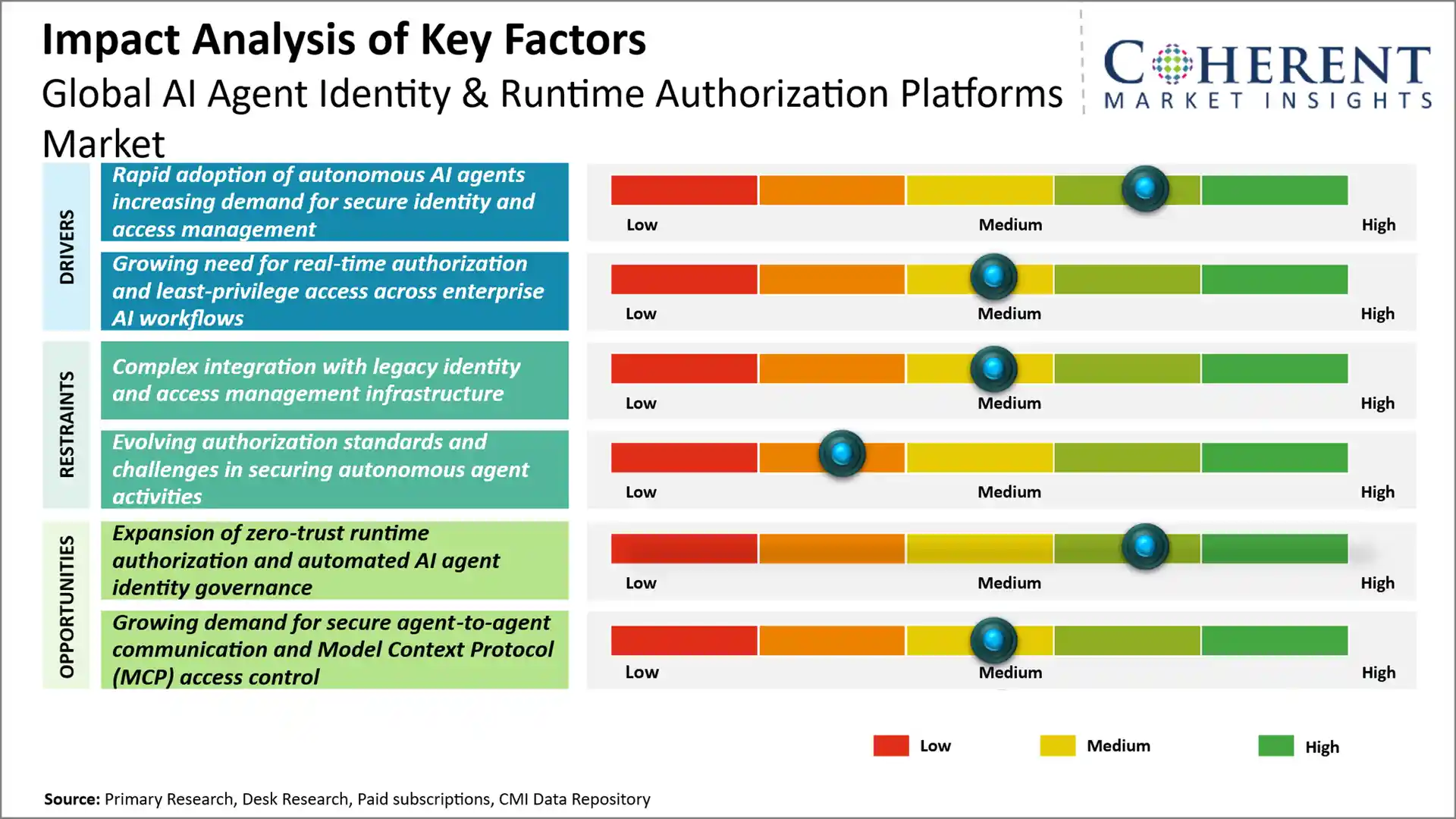
Key Market Drivers
- Rapid adoption of autonomous AI agents increasing demand for secure identity and access management: The proliferation of autonomous AI agents in enterprise applications is generating new identity management needs that traditional human-centric authentication systems are not built to fully meet. Organizations need dedicated agent identities, ownership attribution, credential lifecycle management and controlled access to business systems. The change gives identity platform providers the chance to add agent discovery, authentication and governance to existing enterprise security environments. In May 2026, Google Cloud announced general availability of Agent Identity for Agent Runtime, allowing AI agents to run with dedicated, cryptographically protected identities and agent-specific control over access.
- Growing need for real-time authorization and least-privilege access across enterprise AI workflows: AI agents are increasingly executing transactions, invoking external tools and exchanging sensitive information without the need for constant human involvement. These operations result in security exposure if permissions remain after a task is complete or operating conditions change. This is why enterprises are focusing on continuous authorization, risk-sensitive access decisions and immediate privilege revocation. Such requirements strengthen the commercial position of vendors offering enforcement capabilities across interconnected applications. In June 2026, CrowdStrike announced Continuous Identity for AI Agents, allowing for risk-aware authorization based on agent ownership, asking for identity and real-time security context.
Emerging Market Trends
- Interoperable Delegation Across Multi-Agent Workflows: As AI agents start delegating tasks to specialized assistants, the problem of permission transfer is becoming a product design problem, not a backend credential operation. Buyers are increasingly demanding delegation records that retain initiating user, permitted purpose, downstream agent and expiration conditions across every handoff. This will favor vendors who support interoperable authorization assertions and verifiable task provenance. Security reviews and integration costs could be longer for software teams using reusable bearer tokens or undocumented agent chains. During the forecast period, delegation transparency may become a criterion in enterprise platform procurement.
- Authorization Testing Becomes Part of Agent Development: Enterprise buyers are building authorization testing into agent development pipelines, rather than relying solely on production security reviews. Policy simulation, adversarial test cases and approval workflows can identify privilege escalation paths before an agent accesses operational systems. This opens up new opportunities for developer-security tooling vendors to package up authorization controls as reusable components in continuous integration workflows. Technical buyers will shun identity vendors without easy-to-use testing interfaces, hurting their clout. Procurement decisions over the forecast period will be a balancing act between policy portability, developer effort and measurable enforcement coverage versus the cost of platform licensing.
Regional Insights
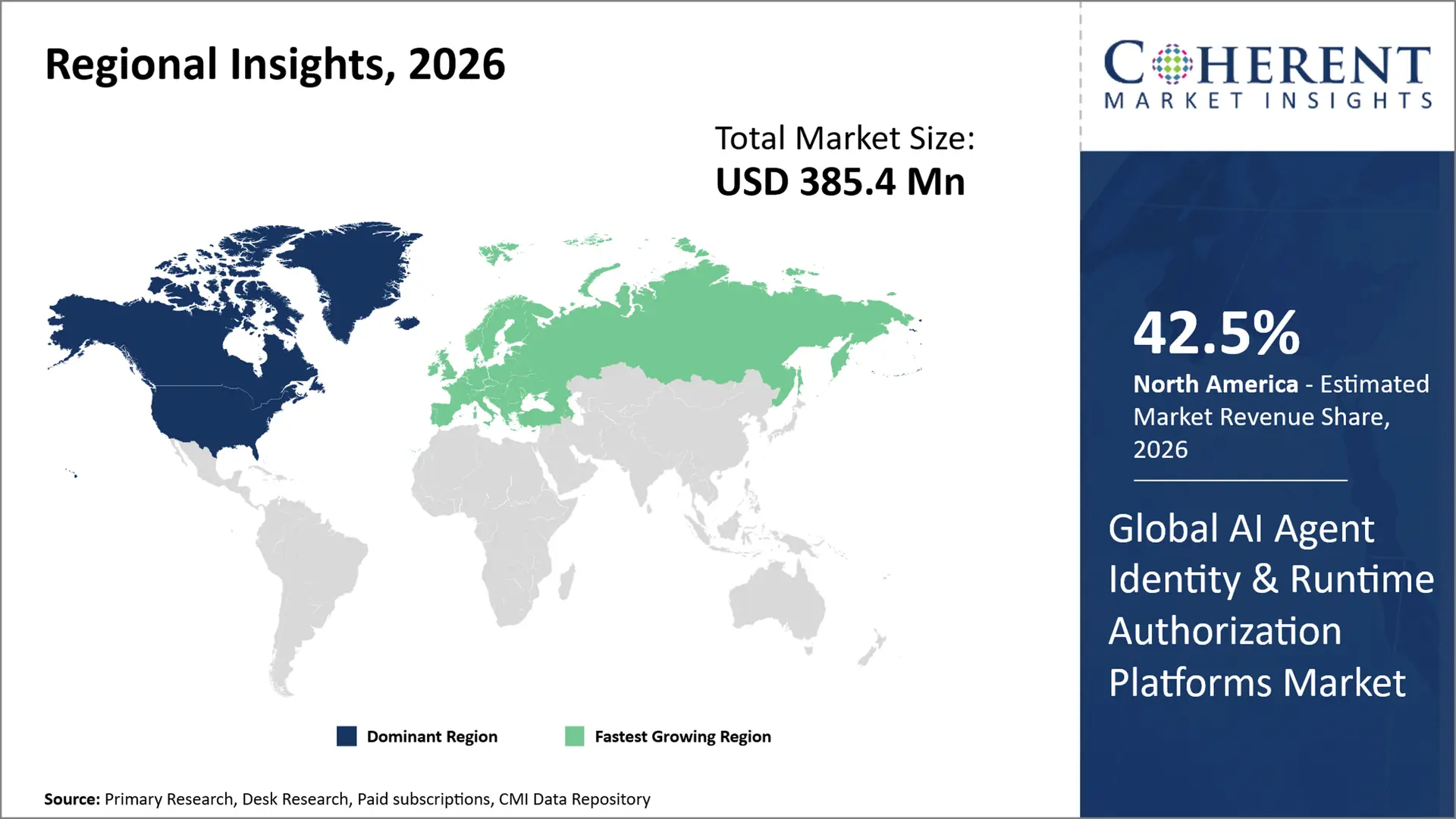
Why Does North America Dominate the Global AI Agent Identity & Runtime Authorization Platforms Market?
North America is expected to account for 42.5% of the global market in 2026, supported by its concentration of enterprise cybersecurity vendors, established identity management infrastructure, and early commercialization of AI-agent security solutions. Large organizations want visibility into autonomous agents running across business applications and privileged IT environments. The mature enterprise software ecosystem in the region also enables security providers to integrate agent governance into existing identity platforms, reducing procurement and implementation complexity. This creates additional opportunities for vendors that provide agent discovery, privilege management and centralized security oversight. In September 2025, Atlanta-based BeyondTrust launched AI-agent security controls in Identity Security Insights, including agent discovery, risk assessment and just-in-time privileged access. The development demonstrates North America’s ability to commercialize AI-specific identity protection through existing enterprise security products.
Why Is Europe Emerging as the Fastest-Growing Region in the Global AI Agent Identity & Runtime Authorization Platforms Market?
Europe is projected to register the fastest regional CAGR of 41.5% during 2026–2033, accounting for 26.3% of global market revenue in 2026, driven by enterprise requirements for verifiable AI governance, data protection and operational accountability. European financial institutions, industrial enterprises and public-sector organizations have complex security obligations when autonomous agents interact with sensitive information or critical systems. This creates a growing demand for authorization solutions that maintain enforceable access boundaries and offer transparent audit trails of automated actions. In July 2026, the European Commission issued its Action Plan on Cybersecurity and Artificial Intelligence, which outlined coordinated actions to address cybersecurity threats posed by advanced AI. The plan doesn’t mention agent identity platforms by name, but it highlights the strategic value of securely deploying AI and creates a fertile field for specialized security providers.
Global AI Agent Identity & Runtime Authorization Platforms Market Outlook for Key Countries
Why Is the U.S. a Key Market for the Global AI Agent Identity & Runtime Authorization Platforms Market?
The U.S. is a key player in this market, with its cybersecurity startup ecosystem, enterprise software makers and early adoption of autonomous workflows in financial services and cloud operations. American tech companies are building dedicated security infrastructure that decouples agent identities from human accounts while preserving delegated permissions. This opens the door for specialized providers to offer workload authentication, secure credential exchange, and integration with enterprise APIs. In October 2025, Maryland-based Aembit announced Identity and Access Management for Agentic AI, which featured Blended Identity and an MCP Identity Gateway. The platform enables organizations to authenticate agents, enforce contextual access policies and ensure accountability for actions taken on behalf of users. This is evidence of the commercialization of purpose-built agent authorization infrastructure in the U.S.
Why Does China Support Growth in the Global AI Agent Identity & Runtime Authorization Platforms Market?
The importance of China is driven by its domestic cloud computing ecosystem, large digital commerce platforms and enterprise adoption of AI-enabled business automation. Chinese cloud providers are embedding agent-specific identity controls into existing application and infrastructure services, opening up opportunities for integrated security deployment. In particular, enterprise developers need ways to restrict access between autonomous agents, customer applications, and backend services without exposing privileged credentials. In May 2026, Alibaba Cloud documented the permission management features of Agent ID Guard, which include inbound authentication controls, outbound resource authorization, and identity-chain tracking. The functions help satisfy security requirements from multistage AI-agent interactions. The development demonstrates China’s growing ability to provide enterprise agent authorization with domestic cloud infrastructure and identity management technologies.
Why Is India Important in the Global AI Agent Identity & Runtime Authorization Platforms Market?
India presents growth opportunities supported by its established IT services industry, enterprise software development capabilities, and increasing adoption of AI-driven business automation. Technology providers developing and deploying autonomous agents for domestic and international clients require secure identity management, delegated access controls, and integration with enterprise security infrastructure. In August 2026, India's Technology Development Board announced support for One2X Tech's indigenous Fixit agentic AI platform, which incorporates secure tool execution, observability, and human oversight. Although Fixit is not a dedicated agent identity platform, the initiative highlights the growing importance of controlled AI-agent execution and may support demand for specialized identity and runtime authorization technologies in India.
Why Is Japan an Important Growth Market for the Global AI Agent Identity & Runtime Authorization Platforms Market?
The potential of Japan’s market is tightly connected to secure intercompany data exchange, trusted digital identities and automation across interconnected industrial and service organizations. As Japanese enterprises develop agents that can interact with external business partners, verifying the identity and authority of participating agents is commercially important. This unlocks the potential for verifiable credentials, agent registries and trusted authentication infrastructure. In May 2026, NTT Docomo Business showed a prototype AI-agent attribute registry that authenticates agent operator and execution authority information using verifiable credentials. Instead of announcing commercial availability, the company has begun technical verification of the system. This initiative is reflective of Japan’s focus on developing trusted agent identities before progressing to more complex autonomous transactions between organizations.
Why Is Germany a Strategic Country in the Global AI Agent Identity & Runtime Authorization Platforms Market?
Germany is perfectly placed with a pre-existing enterprise software sector and industrial organizations that rely on tightly controlled business applications. Manufacturers and multinational corporations want AI agents to respect transaction permissions, segregation-of-duties rules and financial approval structures that have been established. This opens up opportunities for embedded authorization technologies in enterprise resource planning and governance systems. SAP, based in Germany, announced its Access Governance and Security Assistant in October 2026, designed to extend control of access and security monitoring to human and AI identities. General availability is planned for the first quarter 2027.
Agent Identity, Authorization, and Runtime Control Landscape
Technology | Primary Function | Adoption Position | Commercial Implication |
SPIFFE/SPIRE-Based Agent Identity | Establishes cryptographically verifiable workload identities and supports automated identity attestation | Established in workload security; expanding into AI-agent architectures | Reduces dependence on shared service credentials and supports consistent identification across distributed environments |
OAuth 2.0 Token Exchange and Delegated Identity | Issues restricted access tokens that preserve the relationship between an agent and its authorizing principal | Scaling in agent-enabled enterprise integrations | Supports controlled delegation across SaaS applications, enterprise APIs, and multi-stage workflows |
Policy-as-Code Authorization Engines | Evaluates access requests against centrally maintained rules using attributes, context, and defined permissions | Established in application security; adapting to agent execution | Enables reusable authorization logic, automated policy testing, and reduced application-level customization |
Relationship-Based Authorization Graphs | Evaluates permissions using relationships among agents, users, organizations, and protected resources | Selective enterprise adoption | Supports complex organizational permissions and creates differentiation for vendors serving multi-tenant applications |
MCP-Aware Authorization Gateways | Intercepts Model Context Protocol tool requests to validate identity, token scopes, and approved operations | Emerging commercial adoption | Creates an independent enforcement layer that can secure tool access without extensive changes to underlying applications |
Agent Execution Tracing and Tamper-Evident Audit Records | Correlates tool invocations, authorization decisions, and agent activity into traceable execution records | Developing agent-specific implementations | Improves incident investigation, accountability, and security assurance for workflows involving multiple autonomous components |
How Are Consent-Aware Healthcare Coordination Agents Creating New Growth Opportunities in the Global AI Agent Identity & Runtime Authorization Platforms Market?
Healthcare coordination agents represent an underdeveloped opportunity for platforms that can mediate permissions across hospitals, laboratories, insurers, and patient-facing applications. These agents may organize appointments, retrieve clinical records, or prepare coverage requests, but each action carries different consent, purpose, and data-minimization requirements.
A commercially viable solution would translate patient permissions and institutional policies into narrowly scoped, time-limited authorization decisions while preserving an auditable chain of responsibility. Vendors could enter through electronic health record integrations, payer technology partners, and specialist clinical workflow providers rather than selling standalone security consoles.
Differentiation will depend on consent-aware policy engines, interoperability with established healthcare identity systems, strong revocation controls, and safeguards against unauthorized onward data sharing. Successful entrants must invest in healthcare-specific implementation expertise, rigorous security testing, and locally appropriate healthcare data governance.
This opportunity may favor specialized authorization providers partnering with established healthcare software vendors, especially where cross-organization workflows remain difficult to automate safely.
Market Players, Key Development, and Competitive Intelligence
Key Developments
- In October 2026, SailPoint announced expanded Agentic Fabric capabilities, including shadow AI discovery, runtime authorization, and instant access shutdown controls. These developments extend identity governance beyond periodic access reviews toward continuous security oversight of AI agents. The expansion strengthens SailPoint's positioning in enterprise identity security modernization and highlights growing demand for runtime access enforcement.
- In March 2026, Ping Identity announced the general availability of Identity for AI, which includes dedicated agent registration, delegated OAuth token exchange and scoped access to enterprise systems. The launch makes agent identity controls a commercial offering for organizations that want to ensure human accountability across automated application interactions.
- In June 2026, 1Password acquired Apono to combine credential protection with just-in-time access governance for human, machine, and AI identities. The acquisition supports a broader product strategy encompassing access duration and task-specific privileges, increasing competitive pressure on standalone secrets management and authorization vendors.
Competitive Landscape
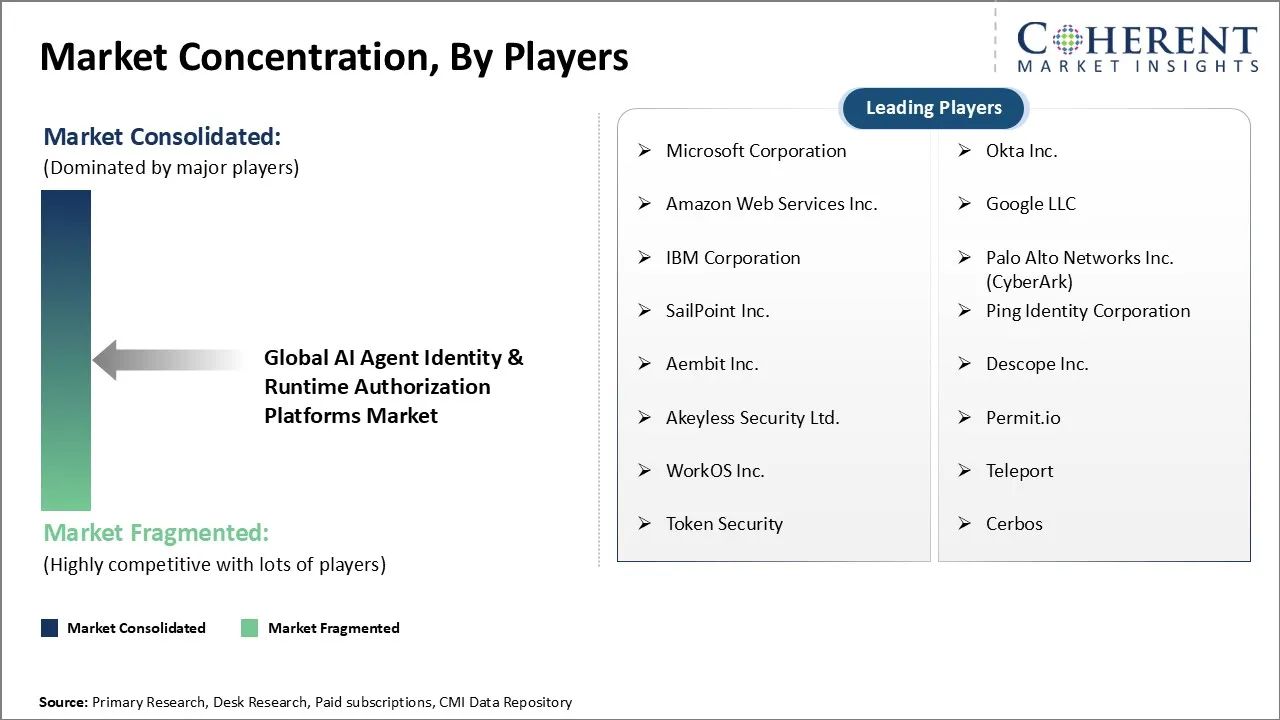
The global AI agent identity & runtime authorization platforms market is fragmented. Hyperscale cloud providers, established identity-security vendors, cyber security platforms and specialist authorization developers are all competing for the same enterprise dollars. The process of differentiation is increasingly important for integration depth, reliability of policy evaluation, flexibility of deployment and operating cost. Specialists are able to compete with narrowly focused application programming interfaces and implementation expertise, while larger suppliers use procurement access and existing identity infrastructure relationships.
Key focus areas include
- Authorization Performance: Consistent enforcement and low-latency policy decisions during high volume agent interactions.
- Enterprise Integration: Integration with enterprise security apps, API infrastructure and established identity providers.
- Policy Reliability: Use of automated validation, versioning and rollback capabilities for authorization rules deployment.
- Flexible Deployment: Deploy on-premises, in a hybrid environment, or in the cloud with appropriate data isolation.
- Pricing Models: Predictable costs and subscription models that are competitive for agent identities and authorization requests.
- Security Assurance: Independently assessed security controls, strong credential protection and incident response capabilities.
- Customer Relationships: Implementation support, technical expertise, and partnerships with enterprise software providers.
Market Report Scope
Global AI Agent Identity & Runtime Authorization Platforms Market Report Coverage | |||
Report Coverage | Details | ||
Base Year | 2025 | Market Size in 2026: | USD 385.4 Mn |
Historical Data For: | 2020 To 2024 | Forecast Period: | 2026 To 2033 |
Forecast Period 2026 To 2033 CAGR: | 37.30% | 2033 Value Projection: | USD 3,544.9 Mn |
Geographies covered: |
| ||
Segments covered: |
| ||
Companies covered: | Microsoft Corporation, Okta Inc., Amazon Web Services Inc., Google LLC, IBM Corporation, Palo Alto Networks Inc. (CyberArk), SailPoint Inc., Ping Identity Corporation, Aembit Inc., Descope Inc., Akeyless Security Ltd., Permit.io, WorkOS Inc., Teleport, Token Security, Cerbos | ||
Growth Drivers: |
| ||
Restraints & Challenges: |
| ||
Analyst Opinion (Expert Opinion)
- Leadership in the global AI agent identity and runtime authorization platforms market will increasingly be driven by business assurance rather than the breadth of individual security features. Providers that develop validated implementation frameworks, clear accountability models, and measurable operational outcomes could develop stronger enterprise relationships. Vendors competing on the basis of software alone may be at a disadvantage in this transition while integrated security solution providers that can support complex deployments may win out.
- As autonomous agents create more variable workloads, authorization infrastructure may evolve to consumption-based commercial models. Actual security processing requirements may vary greatly, so charging for named identities or fixed software licenses may be less appealing. Providers that tie pricing to authorization volumes, performance commitments and risk profiles may disrupt traditional subscription models and influence corporate buying behavior.
- Vendors should focus on authorization robustness, predictable processing costs and safe failure behaviors for business critical agent operations. “Manufacturing automation, enterprise procurement and sensitive infrastructure workflows all deserve focused product development. Investment should focus on proven integration capabilities, explainable access decisions and disciplined implementation partnerships. Providers should avoid over-customisation that adds complexity to deployments, increases maintenance costs and creates more customer lock-in over the long term.
Speak to the analyst
Want personalized insights?
Take the findings above to one of our principal consultants, or have the report rebuilt around the segments, geographies and competitors you actually track.
Market Segmentation
- Component Insights (Revenue, USD Mn, 2021 - 2033)
- Software and Platforms
- Services
- Function Insights (Revenue, USD Mn, 2021 - 2033)
- Agent Identity and Lifecycle Management
- Runtime Authorization and Policy Enforcement
- Delegated Access and Token Management
- Agent Access Governance and Auditing
- Authorization Model Insights (Revenue, USD Mn, 2021 - 2033)
- Role-Based Access Control (RBAC)
- Attribute and Policy-Based Access Control
- Relationship-Based Access Control (ReBAC)
- Context-Aware and Risk-Adaptive Authorization
- Deployment Insights (Revenue, USD Mn, 2021 - 2033)
- Cloud-Based
- Hybrid
- On-Premises
- Organization Size Insights (Revenue, USD Mn, 2021 - 2033)
- Large Enterprises
- Small and Medium Enterprises
- End User Insights (Revenue, USD Mn, 2021 - 2033)
- BFSI
- IT and Telecommunications
- Healthcare and Life Sciences
- Manufacturing
- Retail and E-Commerce
- Government and Defense
- Other Industries
- Regional Insights (Revenue, USD Mn, 2021 - 2033)
- North America
- U.S.
- Canada
- Latin America
- Brazil
- Argentina
- Mexico
- Rest of Latin America
- Europe
- Germany
- U.K.
- Spain
- France
- Italy
- Russia
- Rest of Europe
- Asia Pacific
- China
- India
- Japan
- Australia
- South Korea
- ASEAN
- Rest of Asia Pacific
- Middle East
- GCC Countries
- Israel
- Rest of Middle East
- Africa
- South Africa
- North Africa
- Central Africa
- North America
Sources
Primary Research Interviews
- Identity and access management (IAM) vendors, AI security platform providers, and runtime authorization specialists
- Enterprise CISOs, AI security architects, cloud security consultants, and agentic AI developers
Stakeholders
- AI agent identity platform providers, authorization software vendors, and cloud service providers
- Enterprise IT security teams, identity governance specialists, cybersecurity integrators, and AI application developers
End-use Sectors
- Banking, financial services, insurance, IT, telecommunications, and healthcare
- Manufacturing, retail, e-commerce, government, defense, and life sciences
Regulatory and Industry Bodies
- National Institute of Standards and Technology (NIST)
- European Union Agency for Cybersecurity (ENISA)
- Cybersecurity and Infrastructure Security Agency (CISA)
- European Commission and UK National Cyber Security Centre (NCSC)
Databases
- NIST National Vulnerability Database (NVD) and MITRE ATT&CK/ATLAS
- Common Vulnerabilities and Exposures (CVE) and Common Weakness Enumeration (CWE)
- Public cybersecurity spending, enterprise AI adoption, and identity security investment datasets
- Vendor financial disclosures, enterprise software pricing, and cybersecurity procurement databases
Magazines and Journals
- IEEE Security & Privacy
- Computers & Security
- Journal of Cybersecurity
- ACM Transactions on Privacy and Security
Associations
- Identity Defined Security Alliance (IDSA)
- Cloud Security Alliance (CSA)
- OpenID Foundation
- Open Worldwide Application Security Project (OWASP)
Public Domain Sources
- AI agent identity management, runtime authorization, and delegated access technology documentation
- Enterprise AI agent deployments, cybersecurity incidents, and identity governance adoption information
- Authorization platform product launches, strategic partnerships, funding, and enterprise security investments
Key Standards and Regulations
- NIST AI Risk Management Framework (AI RMF 1.0) and NIST SP 800-53 Security Controls
- OAuth 2.0 Token Exchange (RFC 8693), OAuth 2.0 Security Best Current Practice (RFC 9700), and OpenID AuthZEN Authorization API 1.0
- ISO/IEC 27001 – Information Security Management Systems
- EU General Data Protection Regulation (GDPR), EU AI Act, and Digital Operational Resilience Act (DORA), where applicable
Proprietary Elements
- CMI Data Analytics Tool
- Proprietary research repository, supplemented by primary research interviews, enterprise AI agent deployment analysis, vendor product benchmarking, authorization technology mapping, software pricing assessments, and competitive intelligence.
Get access to 250+ pages report
Every segment, forecast, competitor profile and data table behind the analysis above — available for instant download.
- ESOMAR Member
- ISO 9001:2015 Certified
- D-U-N-S Registered
- GDPR & CCPA Compliant
Frequently Asked Questions
The CAGR of global ai agent identity & runtime authorization platforms market is projected to be 37.30% from 2026 to 2033.
The global ai agent identity & runtime authorization platforms market is estimated to be valued at USD 385.4 Mn in 2026 and is expected to reach USD 3,544.9 Mn by 2033.
Companies should evaluate platforms for how well they integrate with existing identity systems, are scalable, have audit features, secure credentials, perform authorization and total cost of ownership before choosing one.
Traditional identity management systems are built to protect human users. These platforms protect autonomous AI agents using dedicated identities and delegated permissions, continuously verifying access and controlling the execution of automated actions.
When evaluating AI agent identity and authorization solutions, enterprises seek data protection, identity governance, traceability of access, audit readiness and compliance with applicable cybersecurity regulations.
The report helps in strategic investment planning, competitive intelligence, technology assessment, partnership evaluation and vendor benchmarking by analyzing market participants, product capabilities, regulatory developments and changing enterprise procurement requirements.
The major factors driving the global AI agent identity and runtime authorization platforms market are the rapid adoption of autonomous AI agents, the growing need for secure identity and access management, and the increasing importance of real-time authorization and least-privilege access across enterprise AI workflows.